
Canadian Government Douglas Wilhelm Harder M Math LEL
- Slides: 65
Canadian Government Douglas Wilhelm Harder, M. Math. LEL Department of Electrical and Computer Engineering University of Waterloo, Ontario, Canada ece. uwaterloo. ca dwharder@alumni. uwaterloo. ca © 2013 by Douglas Wilhelm Harder. Some rights reserved.
Canadian Government Outline An introduction to the engineering profession, including: – Standards and safety – Law: Charter of Rights and Freedoms, contracts, torts, negligent malpractice, forms of carrying on business – Intellectual property (patents, trade marks, copyrights and industrial designs) – Professional practice • Professional Engineers Act • Professional misconduct and sexual harassment – Alternative dispute resolution – Labour Relations and Employment Law – Environmental Law 2
Canadian Government Topic Outline We will look at: – – – Governance Sovereign states, countries and nations Unitary, federal and confederal states Heads of State Sources of law • Legislative assemblies, parliament • Unicameral and bicameral legislatures – Administration of law • Responsible government • Parliamentary, presidential and semi-presidential systems – Interpretation and application of law • The judiciary • Judicial independence and review 3
Canadian Government Governance How are people governed? – Law gives the policies that must be followed – These policies must be enacted, administered, interpreted, applied, policed and enforced The government is the collection of all institutions that are involved in these actions In 350 BCE, Aristotle said that “the rule of law is better than the rule of any individual. ” 4
Canadian Government States and State Organization We will begin by looking at states and the relationships between states and subdivisions of that state – What is a sovereign state? – State organization • Unitary states • Federal states • Confederations 5
Canadian Government States and State Organization Sovereign States A sovereign state is a political organization that has independent authority to determine policy within its domain – There is no role for any external agencies for the domain A country is the geographic territory controlled by a sovereign state – Not all sovereign states are countries: Sovereign Military Order of Malta 6
Canadian Government States and State Organization Note that the term nation tends to refer to a group of people who share common language, culture or ethnicity – Sovereign states, as they are defined today, only came into existence with the Peace of Westphalia of 1648 – Stateless nations comprise ethnic groups without sovereign territory • • In the Indian subcontinent, the Tamils, Naga and Boda people In Great Britain, the Scots and Welsh In sub-Saharan Africa, the. Yoruba and Igbo people In the Iberian peninsula, the Basque and Catalan people In the Middle East, the Kurds and Assyrians In the Far East, the Uyghur, Hmong, Acehnese and Tibetan peoples In Mali and Niger, the Tuareg people – The Romani people are a stateless nation with no aspirations toward statehood 7
Canadian Government States and State Organization State Subdivisions In governance, is the power to govern held by a single government, or is at least some power shared with subdivisions of the state? There are three models in use today: – Unitary – Federal – Confederal Others include rule of a state from an external agency: – Imperial (direct rule) and hegemony (indirect rule) 8
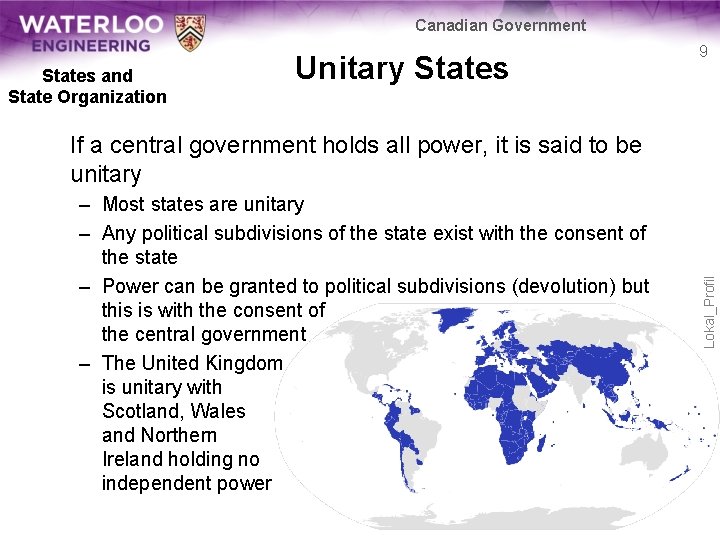
Canadian Government States and State Organization Unitary States 9 – Most states are unitary – Any political subdivisions of the state exist with the consent of the state – Power can be granted to political subdivisions (devolution) but this is with the consent of the central government – The United Kingdom is unitary with Scotland, Wales and Northern Ireland holding no independent power Lokal_Profil If a central government holds all power, it is said to be unitary
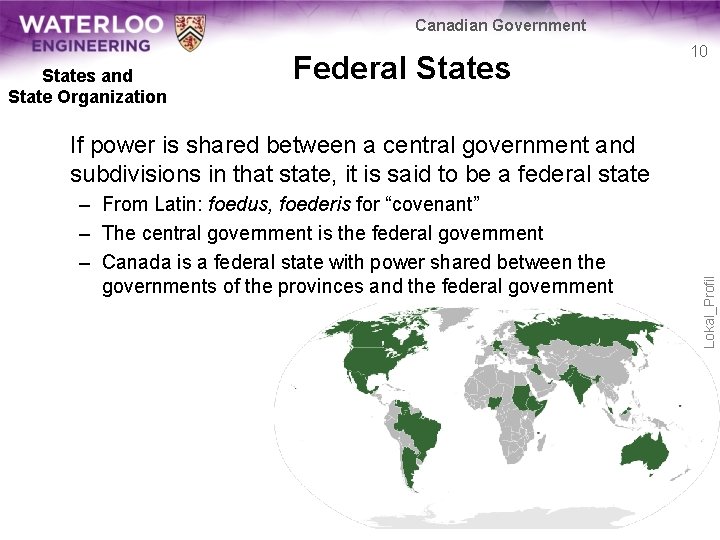
Canadian Government States and State Organization Federal States 10 – From Latin: foedus, foederis for “covenant” – The central government is the federal government – Canada is a federal state with power shared between the governments of the provinces and the federal government Lokal_Profil If power is shared between a central government and subdivisions in that state, it is said to be a federal state
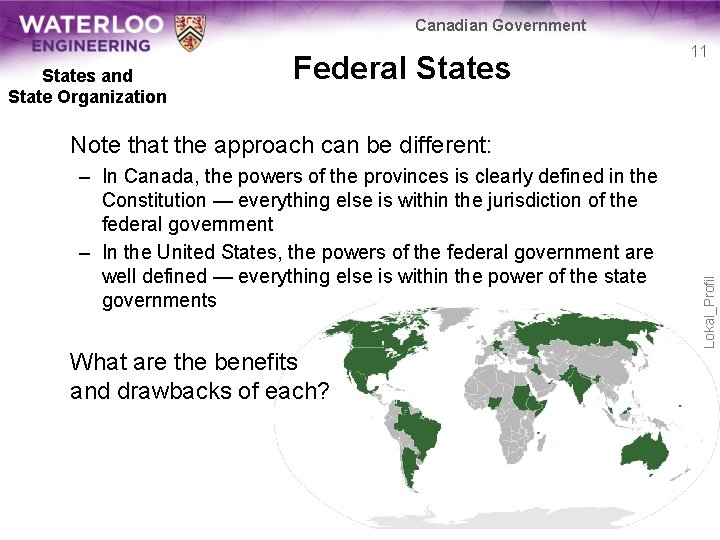
Canadian Government States and State Organization Federal States 11 – In Canada, the powers of the provinces is clearly defined in the Constitution — everything else is within the jurisdiction of the federal government – In the United States, the powers of the federal government are well defined — everything else is within the power of the state governments What are the benefits and drawbacks of each? Lokal_Profil Note that the approach can be different:
Canadian Government States and State Organization Confederations A confederation is a union of sovereign states – The only recent example was the political union of Serbia and Montenegro (2003– 2006) – Canada is not and never was a confederation – The Swiss Confederation is also not a confederation: • In 1291, it was originally created as a confederation of cantons • When Catholic cantons attempted to separate in 1845, the state took on a federal character 12
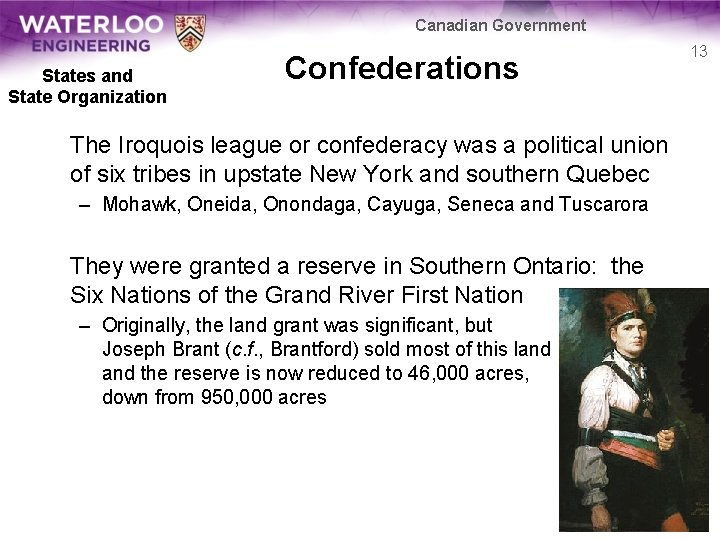
Canadian Government States and State Organization Confederations The Iroquois league or confederacy was a political union of six tribes in upstate New York and southern Quebec – Mohawk, Oneida, Onondaga, Cayuga, Seneca and Tuscarora They were granted a reserve in Southern Ontario: the Six Nations of the Grand River First Nation – Originally, the land grant was significant, but Joseph Brant (c. f. , Brantford) sold most of this land the reserve is now reduced to 46, 000 acres, down from 950, 000 acres 13
Canadian Government Municipalities and Cities All cities and municipalities in Canada are under the control of the provincial governments – The provincial government imposed the structure of regional municipalities and cities – When the province amalgamated the Municipality of Metropolitan Toronto to the City of Toronto, the individual cities attempted to prevent it • See Toronto’s Legal Challenge to Amalgamation by Dr. Beth Milroy – Cities in Canada are corporations that have certain rights, in Ontario, under the Municipalities Act • This act specifies what a municipality can regulate 14
Canadian Government Heads of State Next, we will look at the overall authority for a state: the Head of State – An individual versus a group – Range of powers: • • Ceremonial Supervisory Executive Absolute – Forms: • Monarchy • Republics 15
Canadian Government Heads of State The highest officer and chief representative of a sovereign state is termed the Head of State – This is the individual responsible for all aspects of governance in a sovereign state – This is the position originally held by a monarch or ruler In most countries, the Head of State is an individual – Four countries have a body of individuals: • • Federal Council of Switzerland (7 individuals) Bosnia (one Bosniak, one Croat and one Serb) Captains Regent of San Marino (2) Co-princes of Andorra (2) 16
Canadian Government Heads of State In some countries, the Head of State is largely ceremonial and supervisory – In Canada, the Queen is the Head of State and her representative is the Governor General – In Germany and Israel, the President is also ceremonial – The Emperor of Japan and King of Sweden are the respective Heads of State, but they do not have even supervisory authority In the Presidential System, the Head of State wields significant political power — the ability to influence policy – The President holds significant power and is independent of other institutions of governance – Named after the United States and adopted by many South and Central American countries 17
Canadian Government Heads of State Monarchies and Republics A monarchy is any country where the Head of State is a usually hereditary position monarch – An absolute monarchy is where the monarch has few restraints Saudi Arabia, Vatican City, Qatar, Oman, Brunei, Swaziland – A constitutional monarchy has constraints on the power weilded Morocco, Jordan, Kuwait, Bahrain, UAE, Bhutan, Monaco, Lichtenstein – Often only supervisory and even only ceremonial United Kingdom et al. , Norway, Sweden, Denmark, Netherlands, Belgium, Spain, Thailand, Cambodia, Japan, Malaysia A republic is any country where the Head of State is not a hereditary position — that is, either elected or appointed – That individual can be a dictator resulting from a military coup 18
Canadian Government Heads of State In practice, no policy gains force of law until it is approved by the Head of State or a representative thereof – Usually in the form of a signature – The Governor General represents the Head of State for all federal matters – As Canada is a federation, the Head of State is represented by the Lieutenant Governors for all provincial matters Treaties, agreements, protocols, etc. between sovereign states are also usually signed by the respective Heads of State 19
Canadian Government Source of Law In antiquity, the ruler was the source of law – Absolute monarchies and dictatorships We will look at this history: – The source of laws in most countries today comes from a legislative branch of government – Forms of legislatures • Unicameral • Bicameral 20
Canadian Government Source of Law Where do laws actually come from? – In an absolute monarchy and military dictatorships, the ruling power is the source of law – In constitutional monarchies, usually the monarchs is restricted to either supervisory or ceremonial roles – In most countries, a significant source of law is a legislative assembly • Usually, this assembly is elected – Countries without legislative assemblies: Saudi Arabia, Vatican City, Mali, Guinea, Yemen, Madagascar Legislative, adj. That legislates or makes laws; having the function of legislating. www. oed. com 21
Canadian Government Source of Law In the Roman Republic and Empire, the Senate was a legislative assembly that issued senatus consulta, which, while not legally binding, were followed There were two legislative assemblies: – Assembly of the Centuries – Assembly of the Tribes – Plebeian Council The assemblies could pass laws that would be enforced by elected magistrates 22
Canadian Government Source of Law When William the Conqueror invaded England, he imposed feudalism – The exchange of land for service or labour William retained 20 % of the land (crown lands) – 55 % of the land was divided between 180 barons – The king and his barons would further grant land to knights who provided military services – Any of these could grant farmland to freemen (in return for rent) or villeins (in return for services) In this hierarchy, the individual immediately above you was your “lord” 23
Canadian Government Source of Law Now, in England, William was King; however, in France, William was also Duke of Normandy King Henry II and others obtained other titles: – Count of Anjou – Duke of Aquitaine – Count of Poitiers The Duke of Brittany was made a vassal of the Duke of Normandy All these were inherited by John who, nominally, owed allegiance to the King of France 24
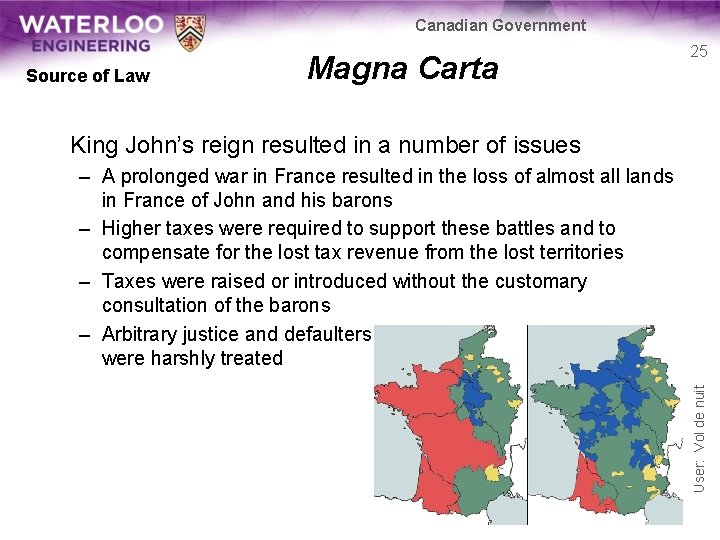
Canadian Government Source of Law Magna Carta 25 King John’s reign resulted in a number of issues User: Vol de nuit – A prolonged war in France resulted in the loss of almost all lands in France of John and his barons – Higher taxes were required to support these battles and to compensate for the lost tax revenue from the lost territories – Taxes were raised or introduced without the customary consultation of the barons – Arbitrary justice and defaulters were harshly treated
Canadian Government Source of Law Magna Carta One of the articles in the Magna Carta required that the King could not raise or introduce taxes without the consent of his Great Council, or Magnum Concilium – This was comprised of the King’s officers and the immediate vassals of the king, including his barons and ecclesiastics – This council existed prior to the Magna Carta, but it was not necessarily consulted 26
Canadian Government Source of Law Parliament 27 King John’s successor, King Henry III, was crowned at nine years old – When his infancy ended, he began to be influenced by his foreign relatives – The 1236 council was the first to be termed a parliament from concilium regis in parliamento – In 1254, Henry III also called two knights from each county to parliament Middle French parlement, n. Discussion, conversation, meeting, negotiation www. oed. com c. f. parler, v. To talk.
Canadian Government Source of Law Parliament After the Oxford Parliament of 1258, Henry III was forced to sign the Provisions of Oxford which abolished the absolutist monarchy and established a privy (private) council for the King – The privy council was composed of those who ministered to the king’s administrative needs – These parliaments were led by Simon de Montford, whose example lead to the establishment of the Speaker of Parliament – The Baron’s Revolt started in 1264 – In 1265, de Montford called a parliament without royal approval • Each shire sent two knights • Each borough (semi-autonomous settlements) sent two elected representatives, or burgesses 28
Canadian Government Source of Law Parliament In 1275, under King Edward I, the Statute of Westminster was a codification of many of the laws that had evolved under common law over the past century – One act of this statute is still in force today in England Wales: the Freedom of Election Act – It says: There shall be no Disturbance of Free Elections. AND because Elections ought to be free, the King commandeth upon great Forfeiture, that no Man by force of Arms, nor by Malice, or Menacing, shall disturb any to make free Election. 29
Canadian Government Source of Law Parliament In 1295, King Edward I required new taxes and called what is to be termed the Model Parliament – 49 lords, aristocratic and ecclesiastic representatives – 292 representatives of the community of the realm: • Two knights per shire • Two burgesses per borough • Two citizens per city (new) – This second group was termed “the Commons” 30
Canadian Government Source of Law Parliament Prior to 1341, the king would call on the lords if he required advice, but would call both the lords and the Commons if he needed to raise taxes In 1341, the Commons met separately from the Lords – This established a lower chamber and an upper chamber 31
Canadian Government Source of Law Parliament In 1376, the Good Parliament met during which time the Commons attempted to address growing corruption – Peter de la Mare, the elected to be the speaker of the House of Commons to the House of Lords – They attempted to impeach corrupt councillors within the King’s privy council – He was imprisoned after and the 1377 Bad Parliament undid the acts of the Good Parliament 32
Canadian Government Source of Law Parliament Under the next king, Richard II, the House of Commons began to impeach corrupt councillors within the privy council and began to insist that they could control public expenditures as well as taxation The authority of parliament waxed and waned in inverse relation to the ability of the monarchy to impose its authority – Never-the-less, the monarch could never bypass parliament—its only means was to control parliament 33
Canadian Government Source of Law Parliament The War of the Roses weakened the aristocracy and thus the House of Lords and parliament as a whole – Parliament was significantly weaker during the Tutor reign • This included Queen Elizabeth I as the last Tutor monarch – This was changed during the subsequent rule of the House of Stuart and then again during the reign of the House of Hanover 34
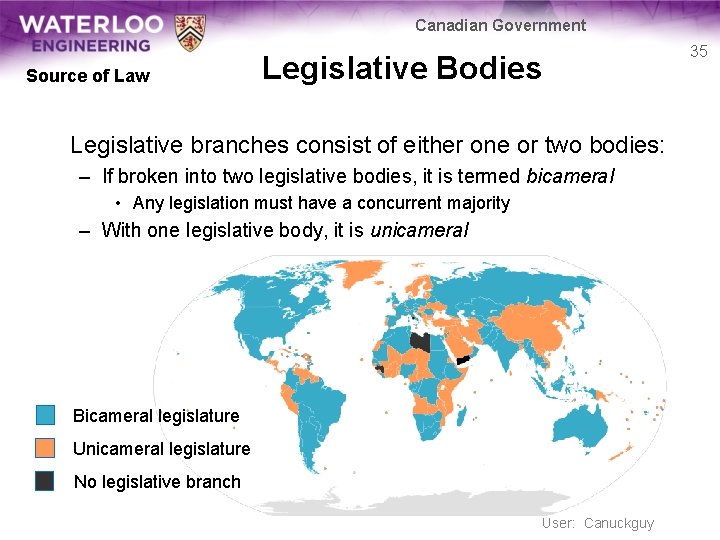
Canadian Government Source of Law Legislative Bodies Legislative branches consist of either one or two bodies: – If broken into two legislative bodies, it is termed bicameral • Any legislation must have a concurrent majority – With one legislative body, it is unicameral Bicameral legislature Unicameral legislature No legislative branch User: Canuckguy 35
Canadian Government Source of Law Legislative Bodies In Canada: – The federal legislature is bicameral: • The House of Commons and the Senate – The provincial legislatures are unicameral • • Provincial Legislative Assemblies Ontario stylizes its legislature as the Provincial Parliament Quebec stylizes its legislature as the National Assembly Newfoundland Labrador, and Nova Scotia stylize their legislatures as Houses of Assembly – In the Constitution, they are all referred to as Legislative Assemblies and their members are Members of the Legislative Assembly or MLAs 36
Canadian Government Source of Law Legislative Bodies 37 The United States is a federal state: – The federal legislature and almost all state legislatures are bicameral – Only the State of Nebraska has a unicameral legislature, the Nebraska Legislature Australia is a federal state: – The federal legislature is bicameral as are most states and territories – Queensland, Northern Territory and the Australian Capital Territory are unicameral New Zealand is a unitary state with a unicameral legislature
Canadian Government Administration of Law The largest branch of government is the executive branch—it is the branch that administers the law – The function of all ministries, departments, agencies, crown corporations, etc. We will look at: – The control of the administration – The evolution of responsible government – The presidential system 38
Canadian Government Administration of Law In a dictatorship or absolute monarchy, the administration of the law is under the control of either – A single individual: an absolute monarchy or dictatorship – A small group or oligarchy An alternative is to have the control of the administration under a group that is answerable to either: – The legislative branch: – The public directly: responsible government the presidential model 39
Canadian Government Administration of Law Responsible Government With Charles I, the second Stuart king, he took as his council a group within the larger privy council – He stylized this group his cabinet council With the reign of King George I (1714 – 27), the first Hanoverian king, control of the government passed to the Cabinet – These were members of the Houses of Commons and Lords and ministers to the king – The speaker for the Cabinet was stylized as the Prime Minister 40
Canadian Government Administration of Law Responsible Government With the defeat of Britain at Yorktown during the American Revolution, the Parliament voted that they “can no longer repose confidence in the present ministers” The Prime Minister requested to King George III that he be allowed to resign and a new Cabinet was formed The finer details were developed in the early 1900 s 41
Canadian Government Administration of Law Responsible Government This is the defining feature of the Parliamentary System – The executive branch of government controls the administration of government and law – The controlling body of the executive branch is the Cabinet – The Cabinet derives its legitimacy from the legislative branch of government • In England, the Houses of Commons and Lords • In Canada, the House of Commons and the Senate – If the legislative branch loses confidence in the executive branch, the executive branch must resign and either a new Cabinet is formed or an election is held 42
Canadian Government Administration of Law Parliamentary System In Commonwealth countries, the head of the executive branch is known as the Head of Government Any government where the head of the executive branch is responsible to the legislative branch is said to be under the Parliamentary System – The executive branch gains its legitimacy from the legislative branch 43
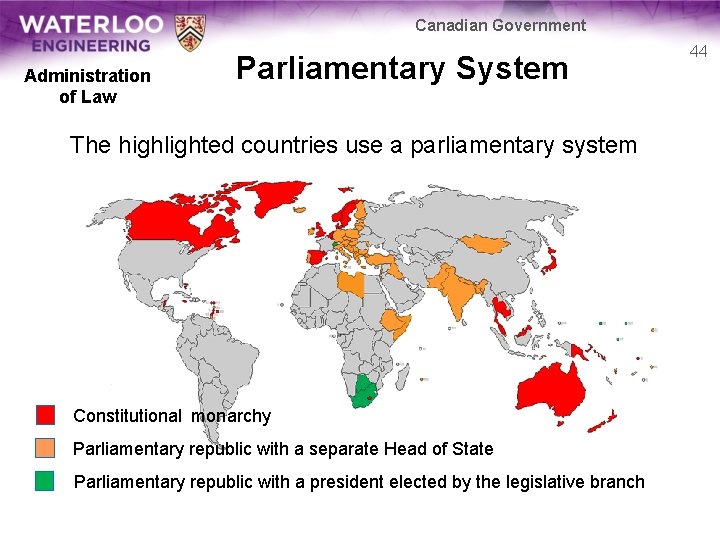
Canadian Government Administration of Law Parliamentary System The highlighted countries use a parliamentary system Constitutional monarchy Parliamentary republic with a separate Head of State Parliamentary republic with a president elected by the legislative branch 44
Canadian Government Administration of Law Presidential System When the Americans wrote their constitution, they wanted to eliminate many of the ambiguities that were present in the British parliamentary system – Recall that responsible government was the consequence of the American Revolution – Prior to this, it was the Cabinet who called elections at their convenience, provided it was within approximately a five-year period – England, at this point, had 56 rotten boroughs—settlements with almost no population where those living there could be bought – Prior to 1832, only approximately 10 % of men had the right to vote 45
Canadian Government Administration of Law Presidential System Without a monarch as a Head of State, they devised a system where – The Head of State is the Head of Government – Originally, the President was the individual who presided over the Continental Congress – With the Constitution, the executive branch was split from the legislative branch, but the title remained – The President can veto a bill passed by the legislative branch – The Presidents decide who sits in their Cabinets, but these choices may require legislative approval 46
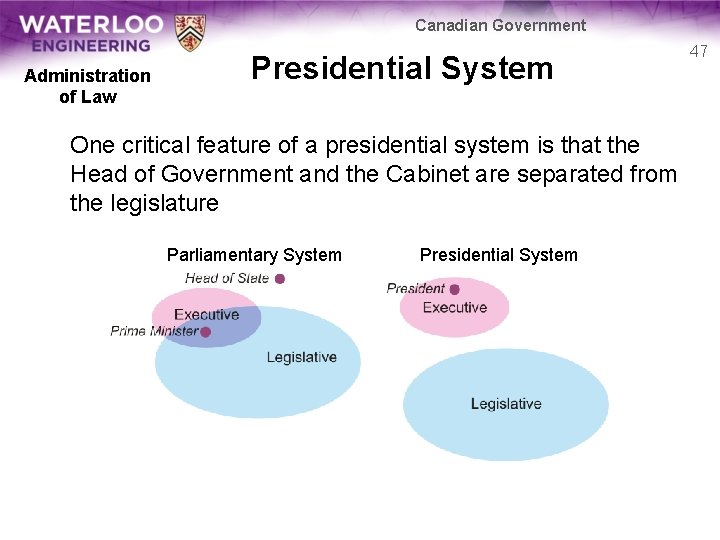
Canadian Government Administration of Law Presidential System One critical feature of a presidential system is that the Head of Government and the Cabinet are separated from the legislature Parliamentary System Presidential System 47
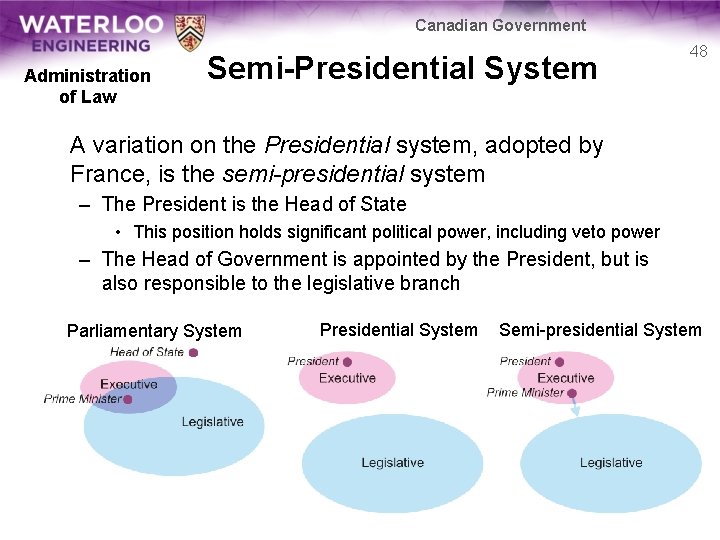
Canadian Government Administration of Law Semi-Presidential System 48 A variation on the Presidential system, adopted by France, is the semi-presidential system – The President is the Head of State • This position holds significant political power, including veto power – The Head of Government is appointed by the President, but is also responsible to the legislative branch Parliamentary System Presidential System Semi-presidential System
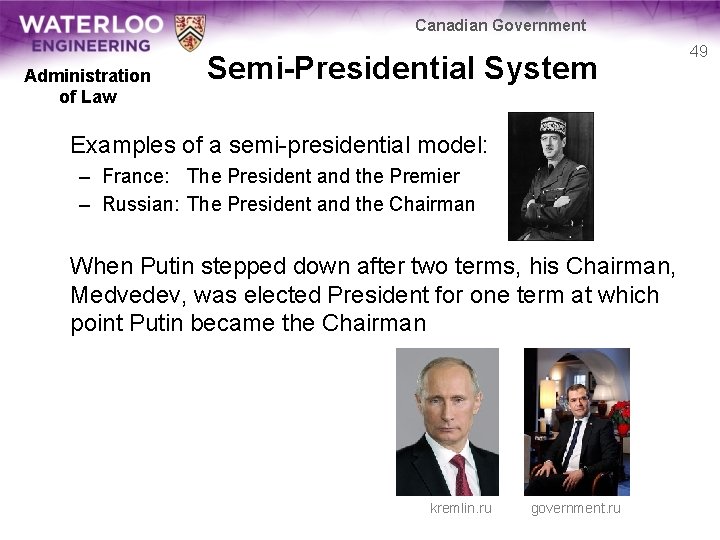
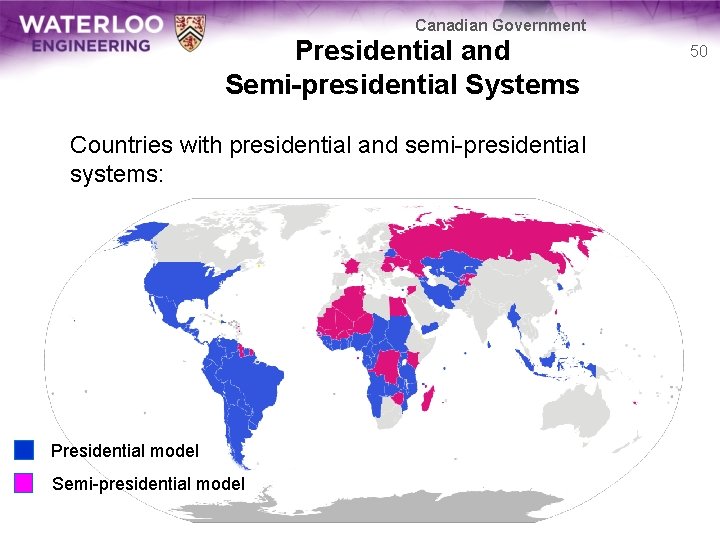
Canadian Government Administration of Law Semi-Presidential System Examples of a semi-presidential model: – France: The President and the Premier – Russian: The President and the Chairman When Putin stepped down after two terms, his Chairman, Medvedev, was elected President for one term at which point Putin became the Chairman kremlin. ru government. ru 49
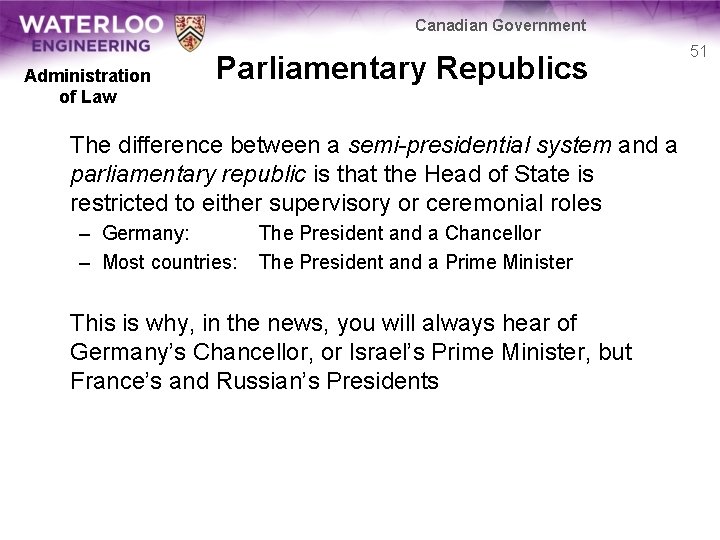
Canadian Government Presidential and Semi-presidential Systems Countries with presidential and semi-presidential systems: Presidential model Semi-presidential model 50
Canadian Government Administration of Law Parliamentary Republics The difference between a semi-presidential system and a parliamentary republic is that the Head of State is restricted to either supervisory or ceremonial roles – Germany: – Most countries: The President and a Chancellor The President and a Prime Minister This is why, in the news, you will always hear of Germany’s Chancellor, or Israel’s Prime Minister, but France’s and Russian’s Presidents 51
Canadian Government Interpretation and Application of Law The next question is one on the interpretation of law – A body has passed a law—who now interprets and applies the law? 52
Canadian Government Interpretation and Application of Law History of the Legal Profession First, a quick history of the legal profession: – In the 1 st century CE, Emperor Claudius allowed advocates, iuris consulti, to charge for advocating for clients – By 460 CE, the Byzantine Emperor Leo I required proof of competence in the form of testimonials from their teachers – Within a century, a four-year course of study was required – The collapse of the Western Roman Empire ended the profession west of Greece 53
Canadian Government Interpretation and Application of Law History of the Legal Profession The re-emergence of the profession in England: – In 1268, the City of London granted the right to its citizens to have access to pleaders (sergeants) and attorneys – By 1275, the Statute of Westminster included the Fraud Act against deceitful lawyers – The London Ordnance of 1280 regulated admission and conduct of lawyers, and required the swearing of an oath – The London Ordnance of 1296 again regulated admission but also limited the number of those practicing – By Queen Elizabeth I, attorney-client privilege was well established 54
Canadian Government Interpretation and Application of Law Lawyers, while practicing law, did not judge it – Under William the Conqueror, the king and his Curia Regis interpreted and applied the law – The judges sent out by King Henry II were appointed by him – Initially, the Lord Chancellor was chosen from the ecclesiastics, but with the appointment of Thomas More in 1529, Lord Chancellors were selected from the legal professional – The kings who followed Queen Elizabeth I, however, attempted to control Parliament by controlling the appointment of judges – The Act of Settlement of 1701 finally gave judges tenure upon appointment and they could only be removed by an act of both houses of Parliament 55
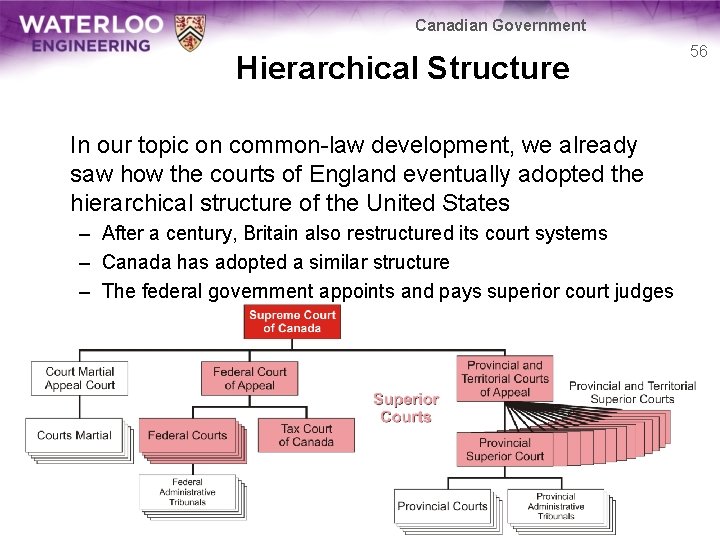
Canadian Government Hierarchical Structure In our topic on common-law development, we already saw how the courts of England eventually adopted the hierarchical structure of the United States – After a century, Britain also restructured its court systems – Canada has adopted a similar structure – The federal government appoints and pays superior court judges 56
Canadian Government Administration of Justice In Canada, the following are held by the same individual: – The Attorney General is the chief legal advisor to the administration and is a member of the Cabinet – The Minister of Justice is the member of the Cabinet responsible for the Department of Justice The Minister for Justice, however, does not interfere with the judicial system 57
Canadian Government Interpretation and Application of Law Judicial Independence 58 Today, judges are chosen from those lawyers who are members of the Bar: those qualified to practice law – Judges must be members of the Bar for at least five years, though usually ten There are restrictions on judges; they may not – Engage in public debate about any of their decisions – Express personal opinions on major social issues that could lead to a perception of bias – Engage in any outside business http: //www. cbc. ca/news/canada/story/2010/08/31/f-judges-how-they-are-chosen. html
Canadian Government Judicial Review What is the relationship between the judiciary and the other branches of government? – In Britain, there evolved the concept of parliamentary sovereignty – Under this doctrine, Parliament is absolute—it may pass and repeal laws, its legislation may not be reviewed by the judiciary nor is it bound by precedence, and it may even override a constitution • Examples: United Kingdom, Finland, Israel, New Zealand, Jamaica – The European Court of Justice has the nominal right to review the laws of European Union nations • The review of British laws has lead to significant issues 59
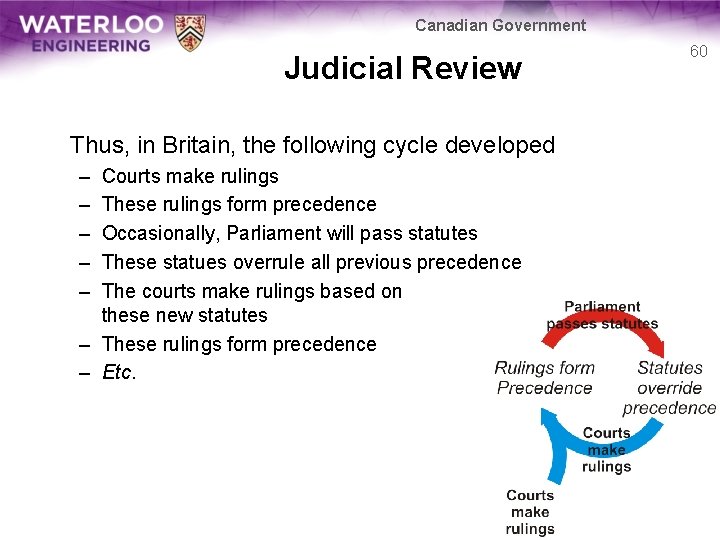
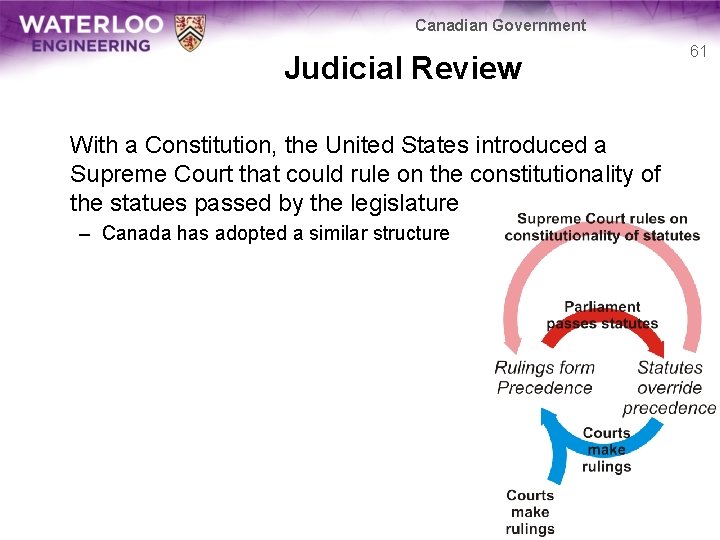
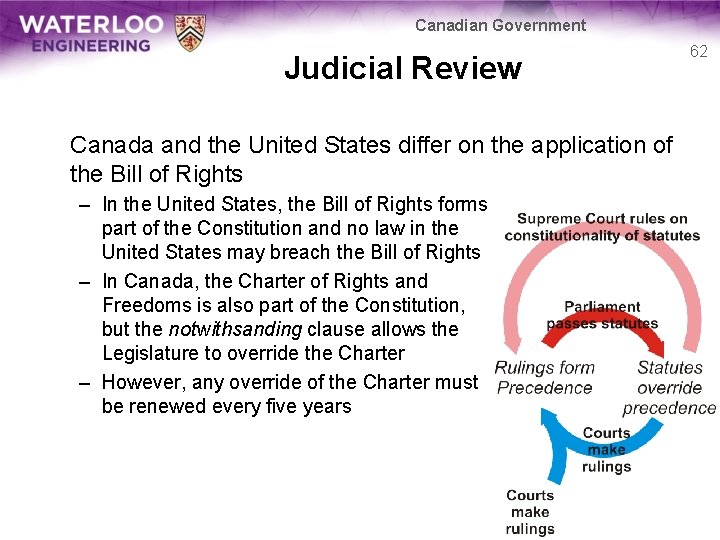
Canadian Government Judicial Review Thus, in Britain, the following cycle developed – – – Courts make rulings These rulings form precedence Occasionally, Parliament will pass statutes These statues overrule all previous precedence The courts make rulings based on these new statutes – These rulings form precedence – Etc. 60
Canadian Government Judicial Review With a Constitution, the United States introduced a Supreme Court that could rule on the constitutionality of the statues passed by the legislature – Canada has adopted a similar structure 61
Canadian Government Judicial Review Canada and the United States differ on the application of the Bill of Rights – In the United States, the Bill of Rights forms part of the Constitution and no law in the United States may breach the Bill of Rights – In Canada, the Charter of Rights and Freedoms is also part of the Constitution, but the notwithsanding clause allows the Legislature to override the Charter – However, any override of the Charter must be renewed every five years 62
Canadian Government The Canadian Government is therefore – A federal system with power divided between the federal government and the provincial governments by the Constitution Act, 1867 – Her Majesty Queen Elizabeth II is the Head of State – She is represented by the Governor General at the federal level and by the Lieutenant Governors at the provincial levels – Both federal and provincial legislative branches follow the parliamentary system – The legislative branch is bicameral at the federal level and unicameral at the provincial levels – The judiciary is independent of the executive and legislative branches but may only review laws with respect to their constitutionality 63
Canadian Government Summary In this topic, we have seen that: – – The world is divided into sovereign states These are either unitary or federal The Head of State is the chief representative Even going back to Roman time, legislative assemblies were sources of law • There are unicameral and bicameral legislatures – Administration of law is by the executive branch • The Cabinet is responsible to the legislature in the parliamentary and semi-presidential systems, but not in presidential systems – The judiciary interprets and applies the law • Judicial independence and review 64
Canadian Government References [1] Wikipedia, http: //www. wikipedia. org/ These course slides are provided for the ECE 290 class. The material in it reflects Douglas Harder’s best judgment in light of the information available to him at the time of preparation. Any reliance on these course slides by any party for any other purpose are the responsibility of such parties. Douglas W. Harder accepts no responsibility for damages, if any, suffered by any party as a result of decisions made or actions based on these course slides for any other purpose than that for which it was intended. 65