
Canadas Recognition and Implementation of Indigenous Rights Framework
- Slides: 11
Canada’s Recognition and Implementation of Indigenous Rights Framework
General Information • On February 14, 2018 Trudeau announced the Recognition and Implementation of Indigenous Rights Framework • The engagement process is currently underway and is expected to be completed in June – this timeframe is inadequate to properly address the issue • A draft bill is supposed to completed in fall 2018 and legislation is expected to be passed before the next federal election in 2019 • If passed this legislation will be the basis for all negotiations and recognition of rights for all First Nations – the Indian Act will be abolished and replaced with rights derived from s. 35 of the Canadian Constitution • The Comprehensive Land Claims Policy and Inherent Right to Self-Government Policy will be replaced with this legislation
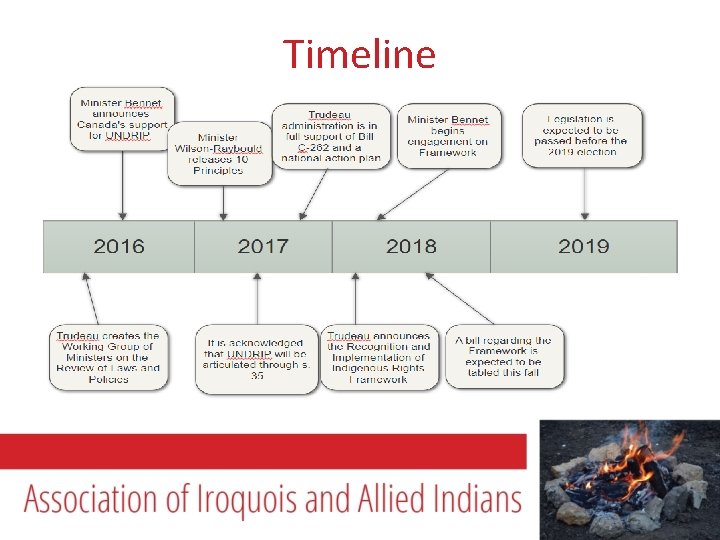
Timeline
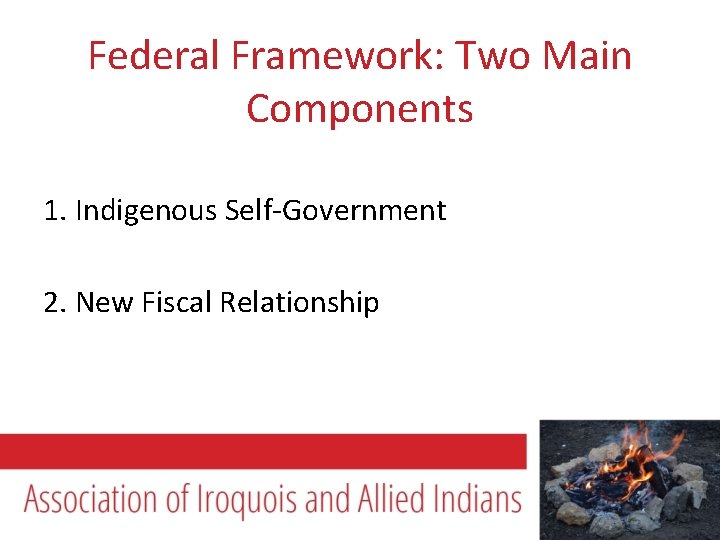
Federal Framework: Two Main Components 1. Indigenous Self-Government 2. New Fiscal Relationship
1. Indigenous Self-Government • The core of the planned Framework is to merge bands currently under the Indian Act into federally recognized “Indigenous Governments” • The aim is to create 40 -50 Indigenous self-governing bodies across Canada along ethno-linguistic lines (Cree, Ojibway, Algonquin, Mohawk, etc. ), essentially creating a 3 rd order of government • Trudeau’s government will not consider opening the Constitution so all rights will be derived from s. 35 of the Constitution Act, 1982 • Budget 2018 set aside $101. 5 million to achieve these ends
2. A New Fiscal Relationship • A new fiscal relationship between the Federal Government and the new federally recognized “Indigenous Governments” will be developed • Budget 2018 has set aside $377. 8 million to develop and begin implementation of the new fiscal policy • The Carrot and Stick Approach – Carrot: Jurisdiction over programs and services and a significant amount of funding to run them. Concern: adequate funding is not guaranteed, especially in the long-term. – Stick: First Nations that remain under the Indian Act may find it harder to access service dollars as more First Nations opt-in to the new fiscal relationship • The Department of Indigenous Services, which continues to provide funding for services to bands, will cease to exist once all First Nations become part of the new system.
What’s on the Table • As the Indian Act is replaced, Indigenous Self-Governments will take over certain jurisdictions currently under federal and provincial control • The Federal Government has stated they see “. . . the scope of Aboriginal jurisdiction as likely extending to matters that are internal to the group, integral to its distinct Aboriginal culture, and essential to its operation as a government or institution. ” • Jurisdictions up for negotiation include: – – – Establishment of governing structures, elections, and leadership selection processes Membership, marriage, adoption, and child welfare Education, health, and social service provision Administration and enforcement of laws which may include certain criminal laws Policing, penitentiary and parole Environmental protection and assessment, fisheries co-management, and gaming
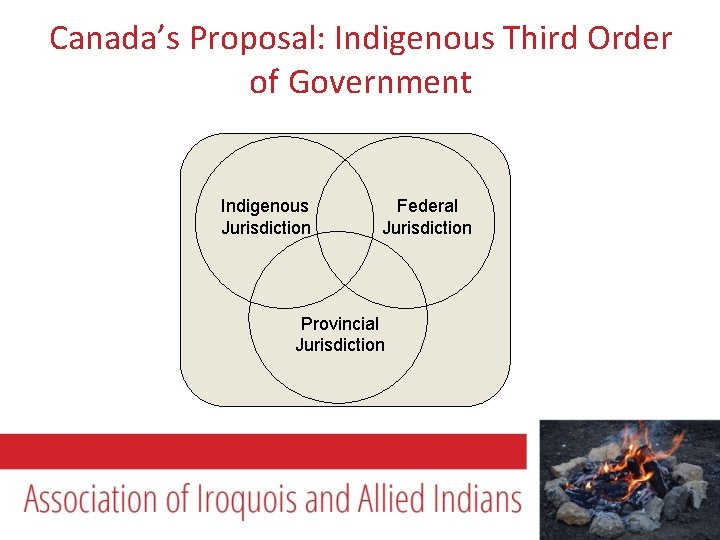
Canada’s Proposal: Indigenous Third Order of Government Indigenous Jurisdiction Federal Jurisdiction Provincial Jurisdiction
What’s Not on the Table • First Nations who agree to enter an Indigenous Self-Government arrangement would have authority delegated to them by the central government and would be subject to the Canadian Constitution (3 rd order of government) • This is not full sovereignty and it would therefore be impossible to have a true nation-to-nation relationship with other governments or fully exercise: – The right to self-determination – Free, prior, and informed consent on First Nations traditional territory – The right to have treaties recognized as international instruments – Pre-existing jurisdiction and inherent rights • The Framework, as guided by the 10 Principles, is the Federal Government’s attempt to harmonize a watered-down version of UNDRIP with Canadian law. Full implementation of UNDRIP is also off the table.
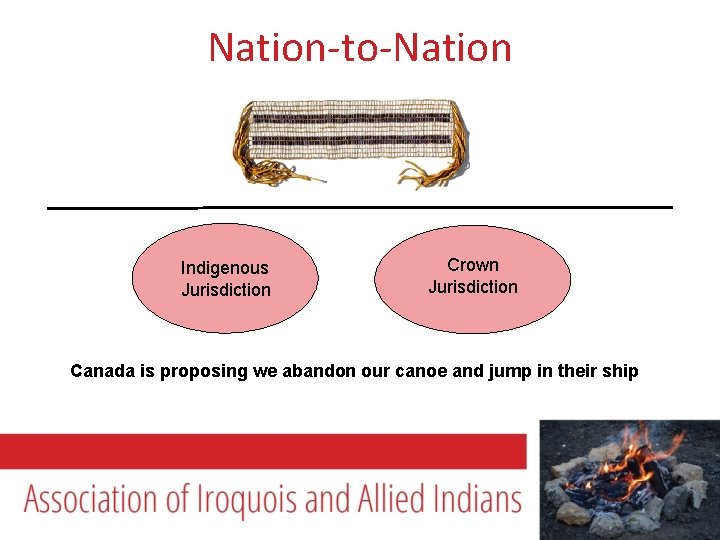
Nation-to-Nation Indigenous Jurisdiction Crown Jurisdiction Canada is proposing we abandon our canoe and jump in their ship
Unknowns • What will happen to Reserve Lands? • What will happen with Indian Status? • What will the composition of the “Indigenous Governments” look like? • What would the new funding arrangements look like? • Will the situation be similar to the Inuit Land Claim Agreement that created the Territory of Nunavut in 1999?