
Canadas national laboratory for particle and nuclear physics
Canada’s national laboratory for particle and nuclear physics Laboratoire national canadien pour la recherche en physique nucléaire et en physique des particules Detector Physics Radiation Interacting with Matter D. Lascar | Postdoctoral Fellow | TRIUMF Accelerating Science for Canada Un accélérateur de la démarche scientifique canadienne Owned and operated as a joint venture by a consortium of Canadian universities via a contribution through the National Research Council Canada Propriété d’un consortium d’universités canadiennes, géré en co-entreprise à partir d’une contribution administrée par le Conseil national de recherches Canada
Outline • Radiation Interacting with Matter • Cross Section (σ) • Mean Free Path (λ) • Energy Loss • • • Sept XX, 2015 Electrons Cherenkov Radiation Bremsstrahlung Phontons Neutrons Detector Physics - Lecture 1 2
Charged particles going through matter • Two things happen most of the time: • Inelastic collisions with the target’s electrons • Elastic scattering of the target’s nuclei • More interesting things happen less often • Cherenkov radiation emission • Nuclear reactions • Bremsstrahlung The reason we’re in business 1 barn = 10 -24 cm 2 Sept XX, 2015 Detector Physics - Lecture 1 3
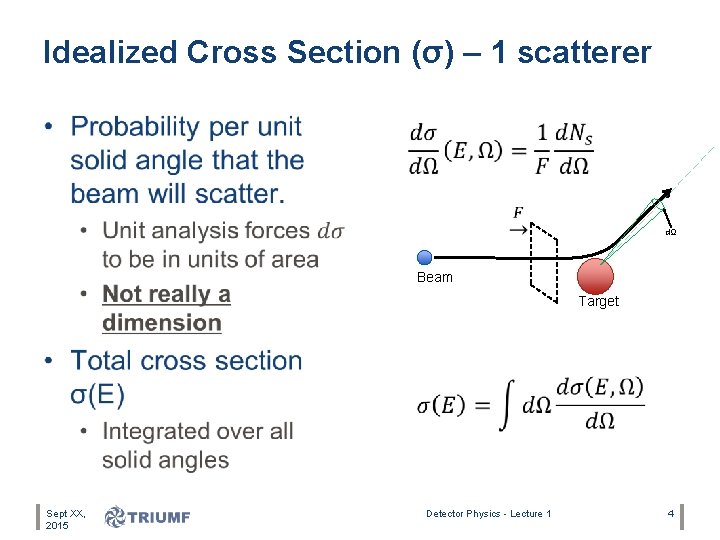
Idealized Cross Section (σ) – 1 scatterer • dΩ Beam Target Sept XX, 2015 Detector Physics - Lecture 1 4
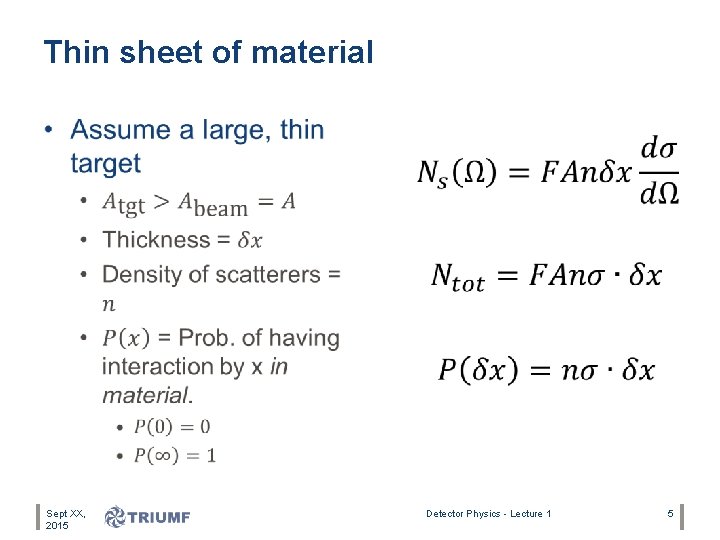
Thin sheet of material • Sept XX, 2015 Detector Physics - Lecture 1 5
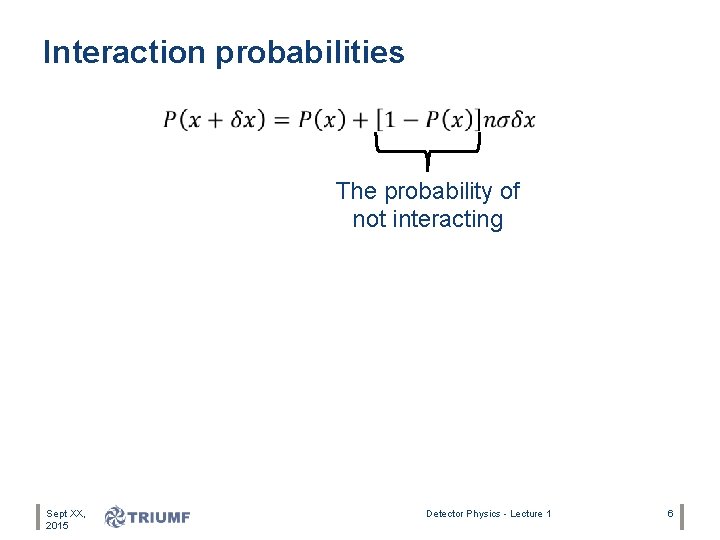
Interaction probabilities The probability of not interacting Sept XX, 2015 Detector Physics - Lecture 1 6
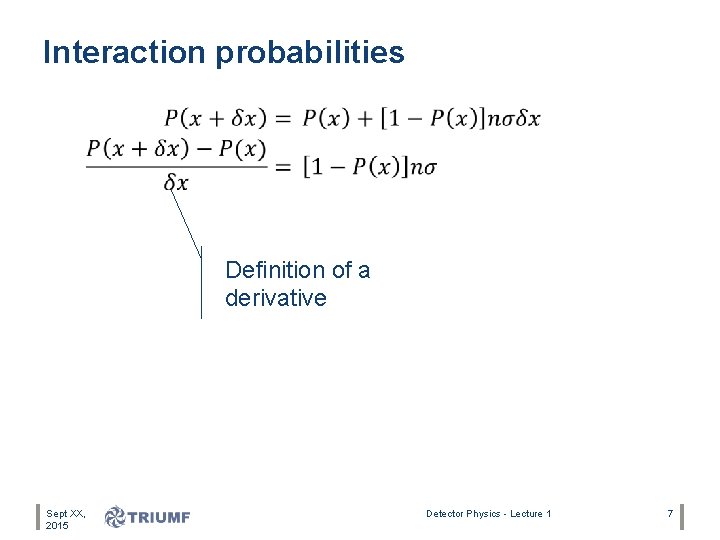
Interaction probabilities Definition of a derivative Sept XX, 2015 Detector Physics - Lecture 1 7
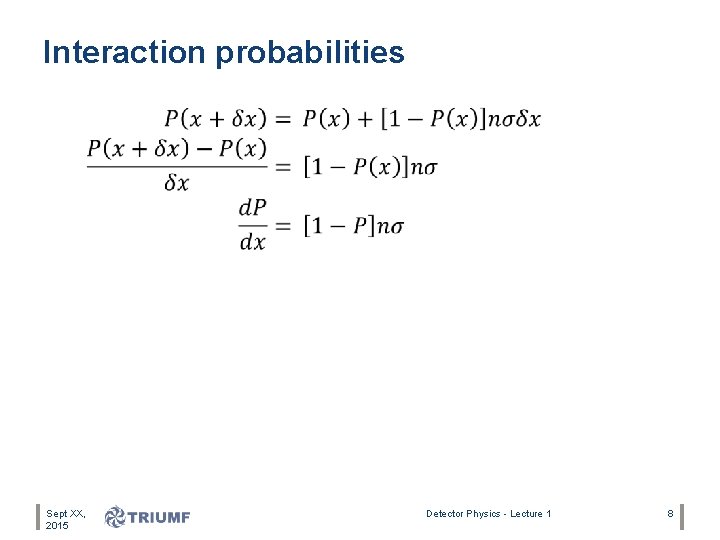
Interaction probabilities Sept XX, 2015 Detector Physics - Lecture 1 8
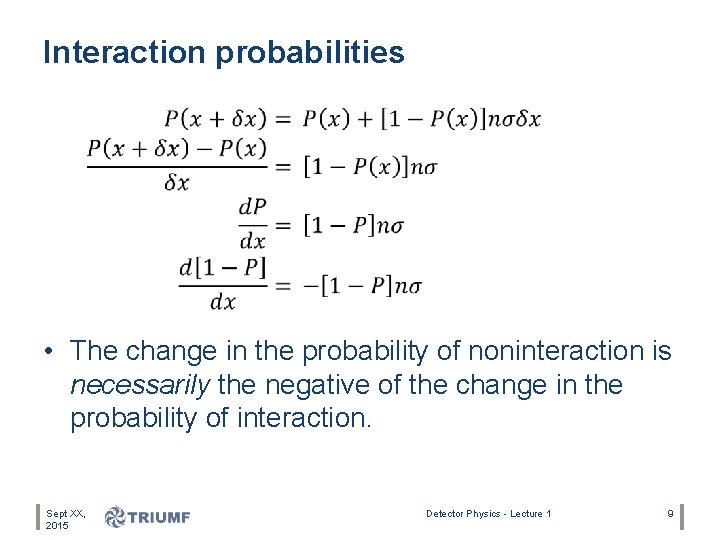
Interaction probabilities • The change in the probability of noninteraction is necessarily the negative of the change in the probability of interaction. Sept XX, 2015 Detector Physics - Lecture 1 9
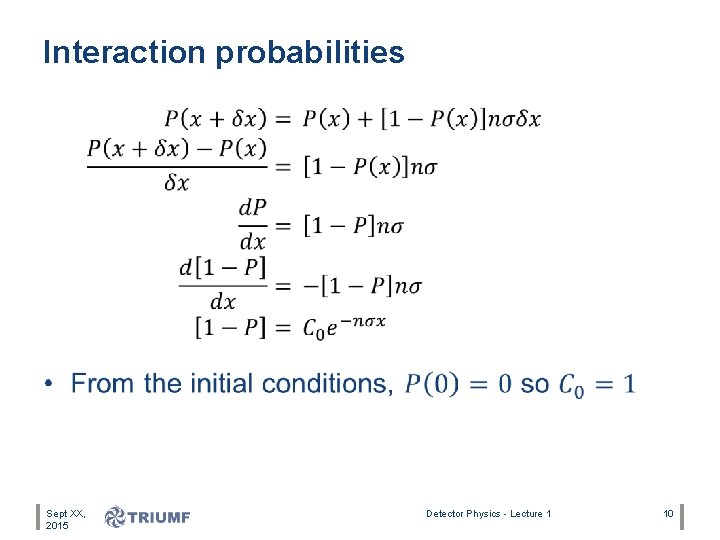
Interaction probabilities • Sept XX, 2015 Detector Physics - Lecture 1 10
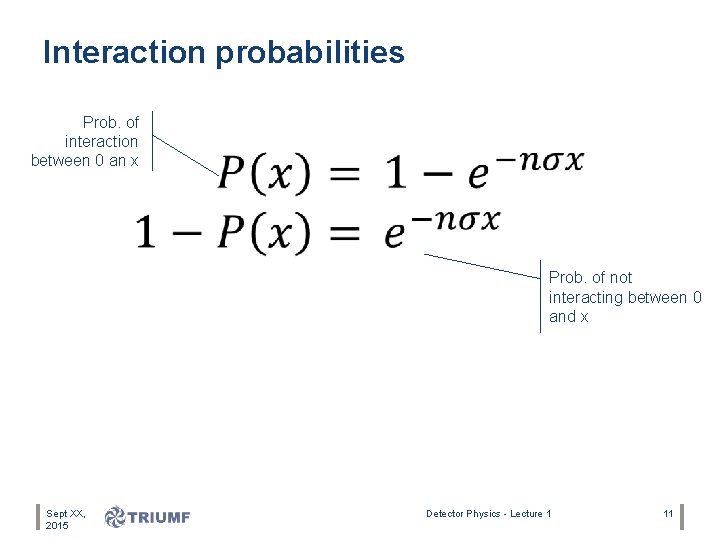
Interaction probabilities Prob. of interaction between 0 an x Prob. of not interacting between 0 and x Sept XX, 2015 Detector Physics - Lecture 1 11
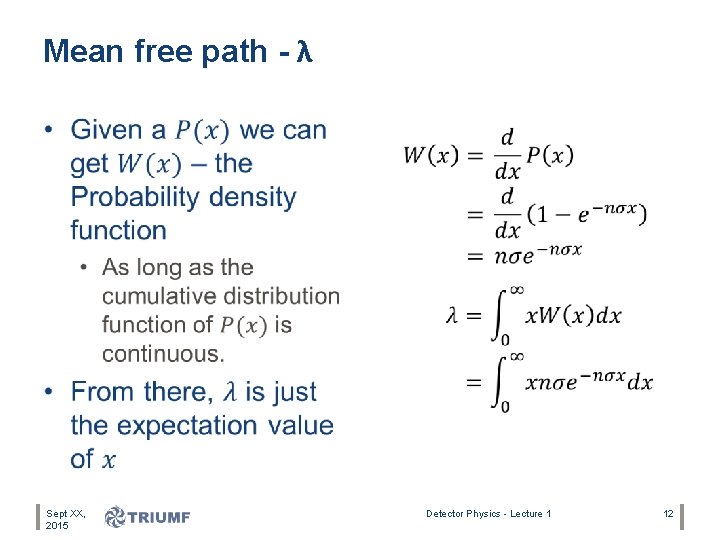
Mean free path - λ • Sept XX, 2015 Detector Physics - Lecture 1 12
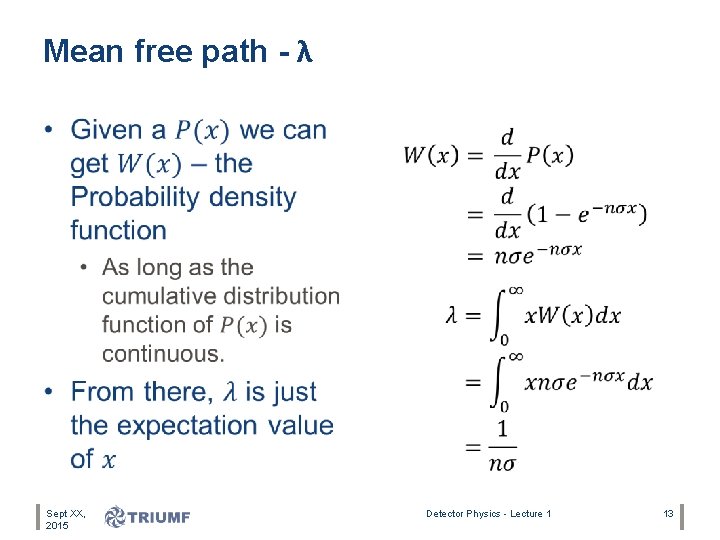
Mean free path - λ • Sept XX, 2015 Detector Physics - Lecture 1 13
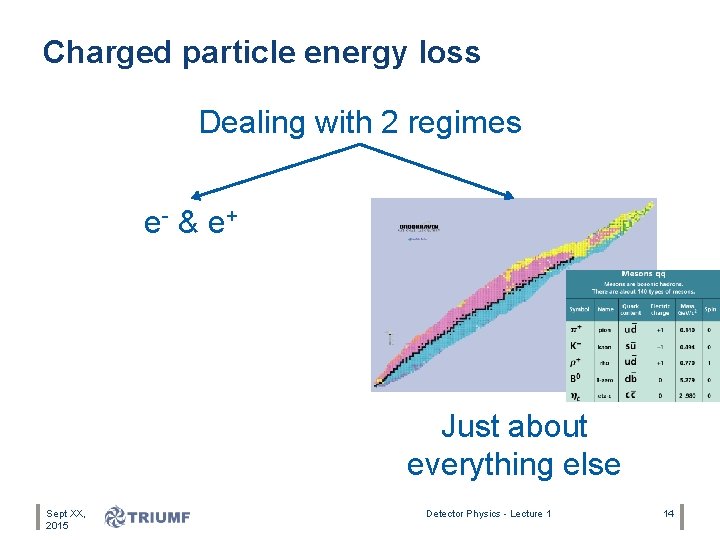
Charged particle energy loss Dealing with 2 regimes e- & e+ Just about everything else Sept XX, 2015 Detector Physics - Lecture 1 14
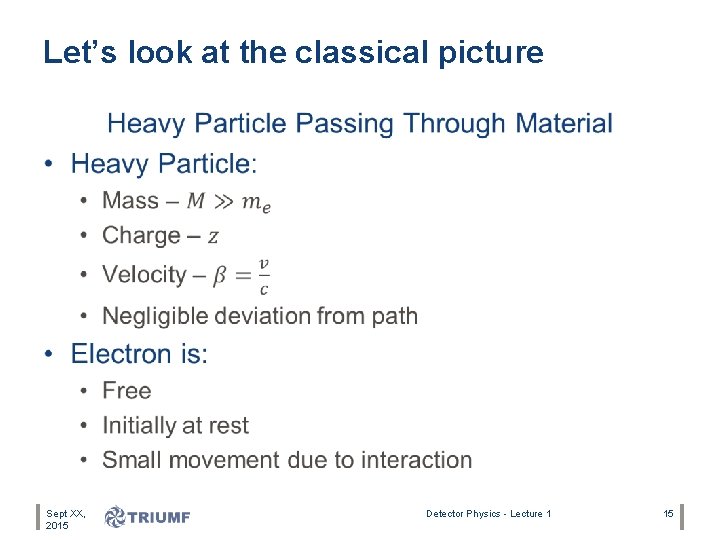
Let’s look at the classical picture • Sept XX, 2015 Detector Physics - Lecture 1 15
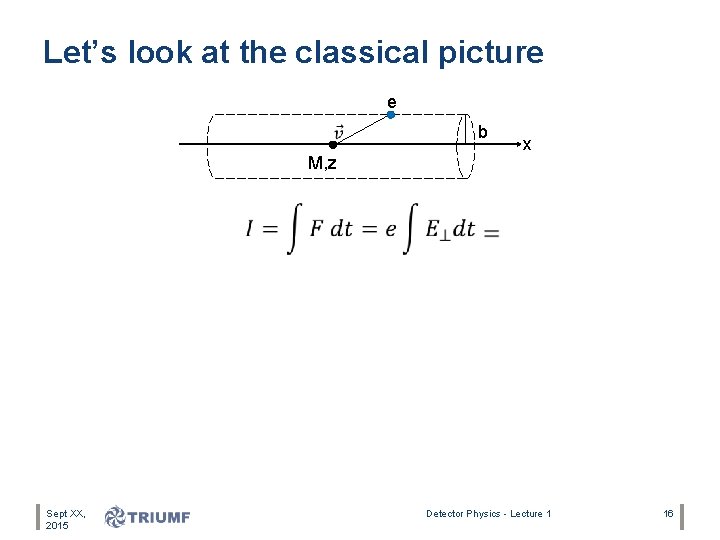
Let’s look at the classical picture e ` M, z ` b x Sept XX, 2015 Detector Physics - Lecture 1 16
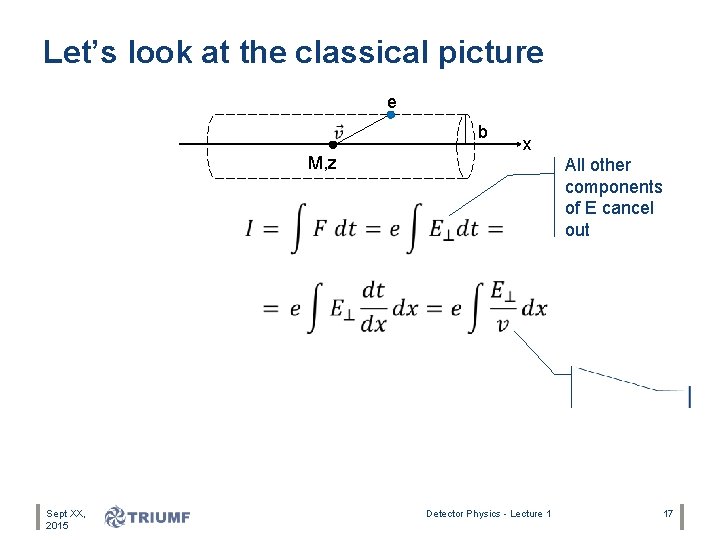
Let’s look at the classical picture e ` M, z ` b x All other components of E cancel out Sept XX, 2015 Detector Physics - Lecture 1 17
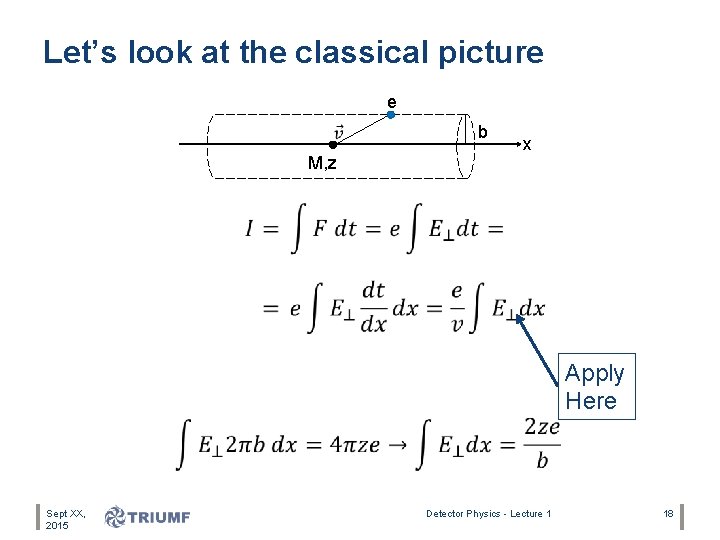
Let’s look at the classical picture e ` M, z ` b x Apply Here Sept XX, 2015 Detector Physics - Lecture 1 18
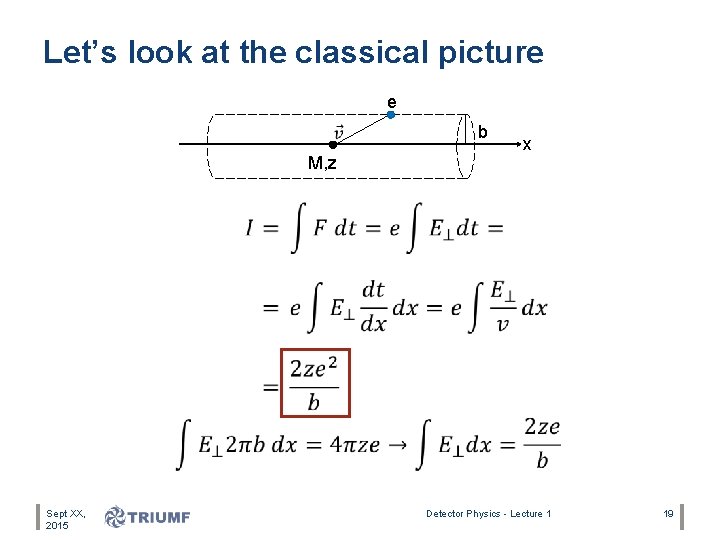
Let’s look at the classical picture e ` M, z ` b x Sept XX, 2015 Detector Physics - Lecture 1 19
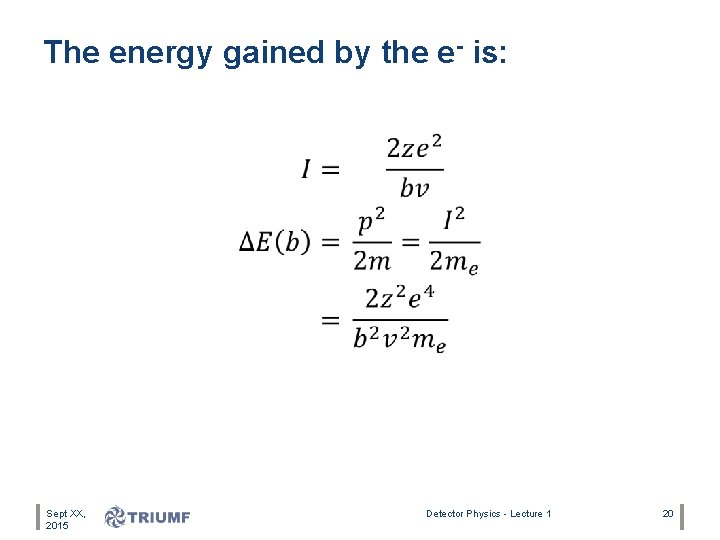
The energy gained by the e- is: Sept XX, 2015 Detector Physics - Lecture 1 20
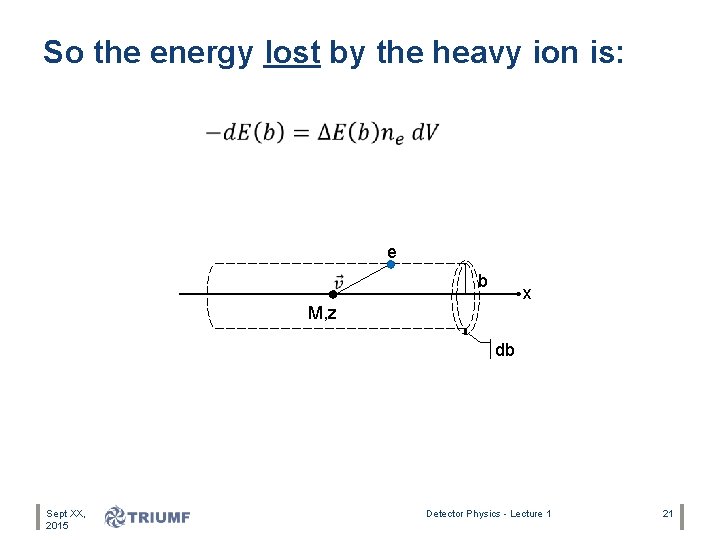
So the energy lost by the heavy ion is: e ` ` b x M, z db Sept XX, 2015 Detector Physics - Lecture 1 21
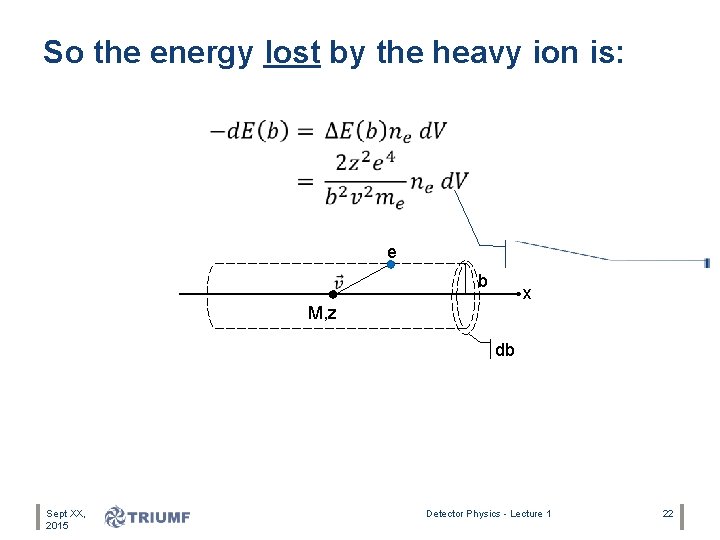
So the energy lost by the heavy ion is: e ` ` b x M, z db Sept XX, 2015 Detector Physics - Lecture 1 22
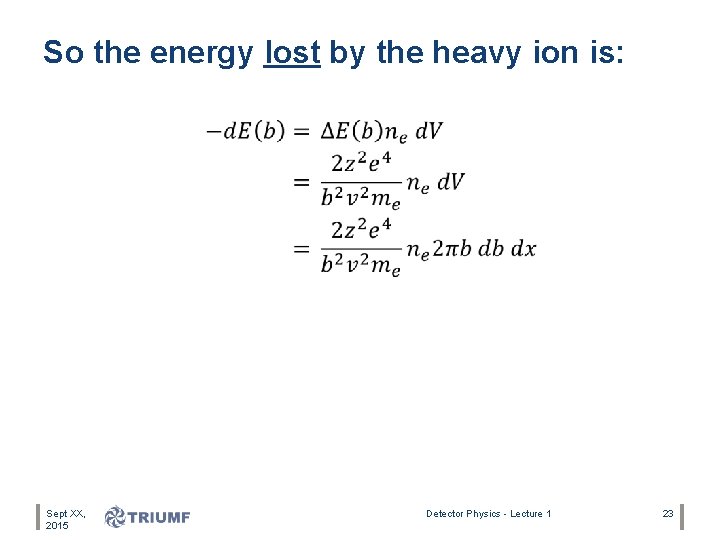
So the energy lost by the heavy ion is: Sept XX, 2015 Detector Physics - Lecture 1 23
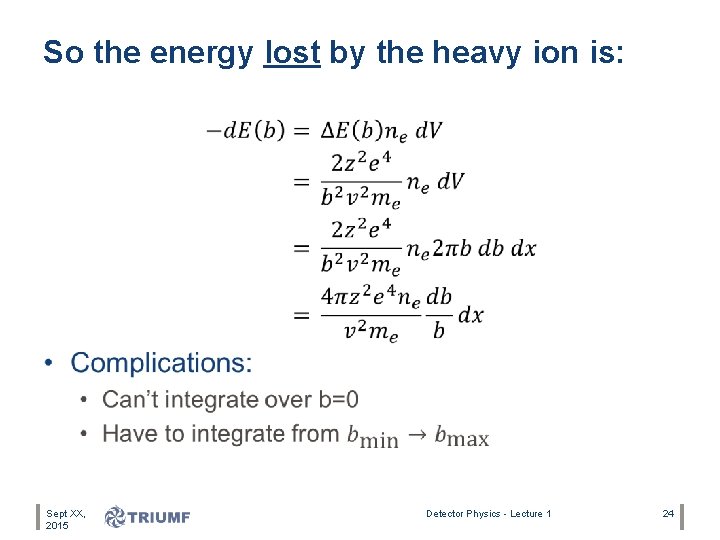
So the energy lost by the heavy ion is: • Sept XX, 2015 Detector Physics - Lecture 1 24
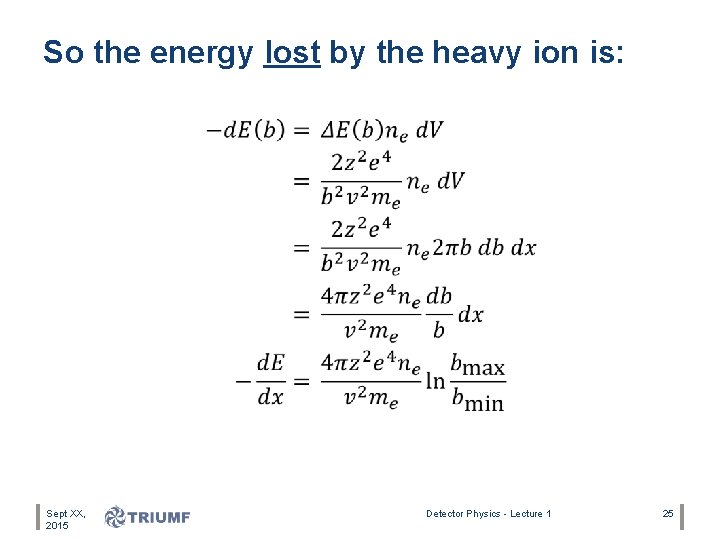
So the energy lost by the heavy ion is: Sept XX, 2015 Detector Physics - Lecture 1 25
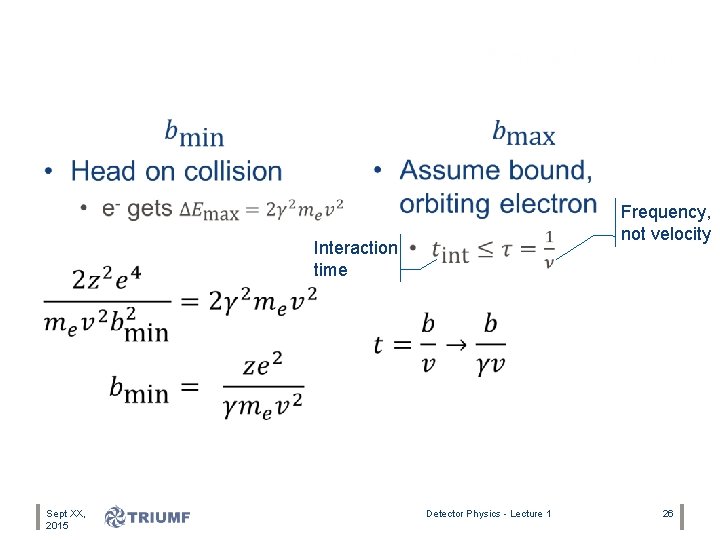
• • Frequency, not velocity Interaction time Sept XX, 2015 Detector Physics - Lecture 1 26
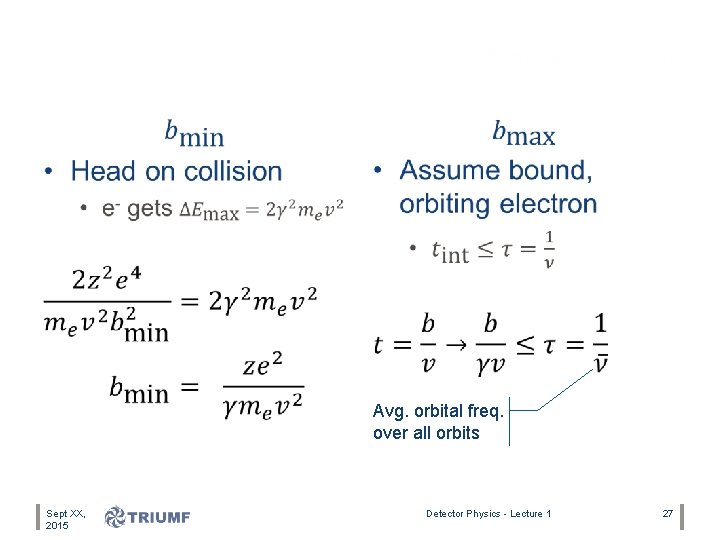
• • Avg. orbital freq. over all orbits Sept XX, 2015 Detector Physics - Lecture 1 27
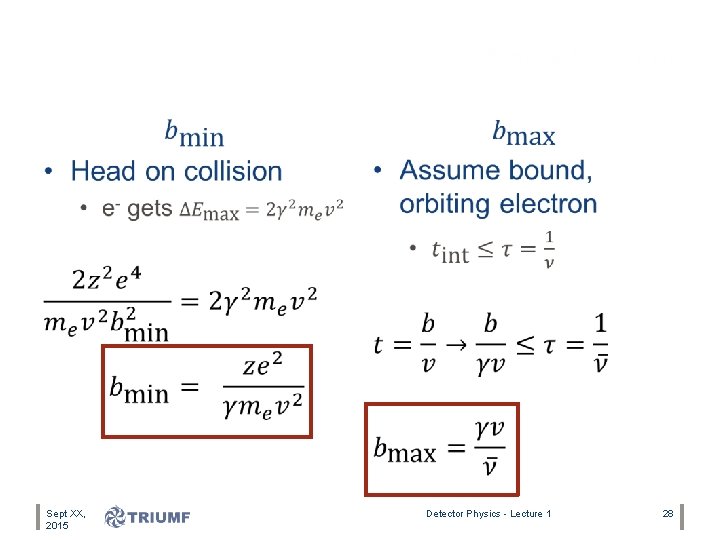
• Sept XX, 2015 • Detector Physics - Lecture 1 28
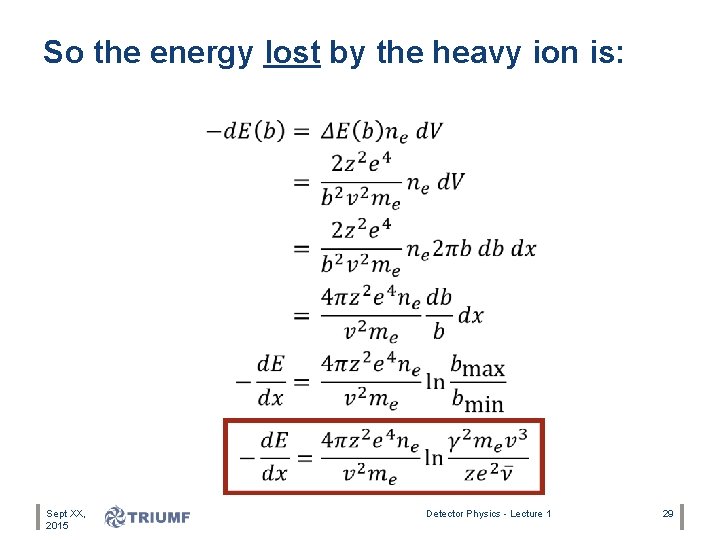
So the energy lost by the heavy ion is: Sept XX, 2015 Detector Physics - Lecture 1 29
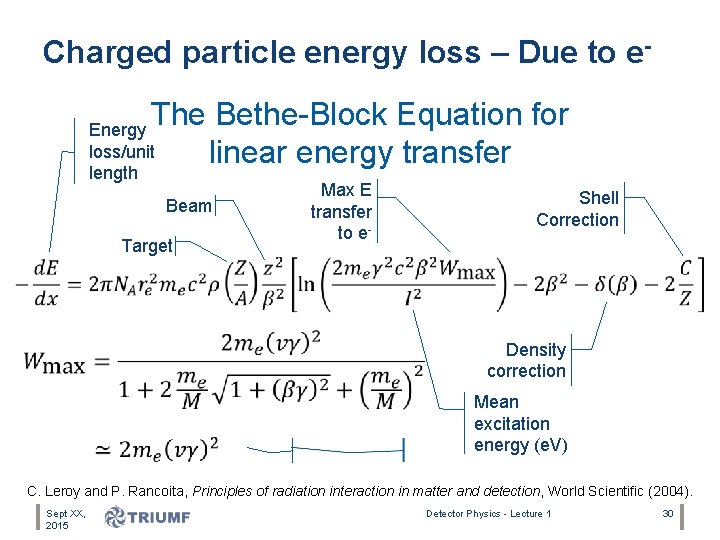
Charged particle energy loss – Due to e. The Bethe-Block Equation for linear energy transfer Energy loss/unit length Max E transfer to e- Beam Target Shell Correction Density correction Mean excitation energy (e. V) C. Leroy and P. Rancoita, Principles of radiation interaction in matter and detection, World Scientific (2004). Sept XX, 2015 Detector Physics - Lecture 1 30
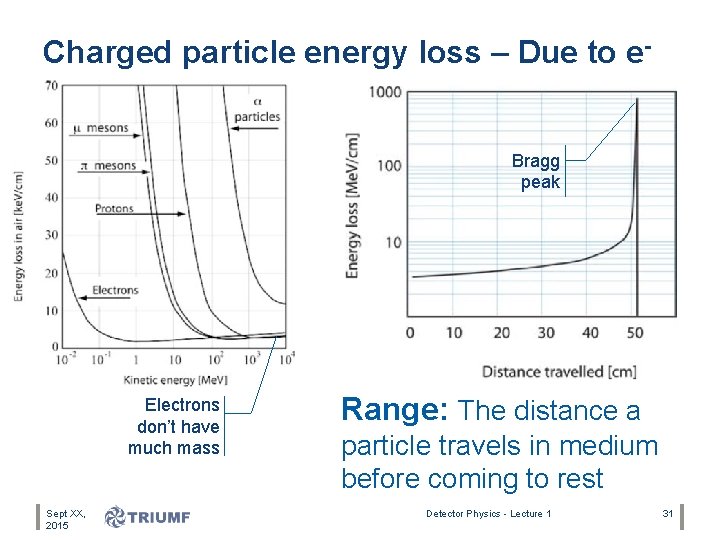
Charged particle energy loss – Due to e- Bragg peak Electrons don’t have much mass Sept XX, 2015 Range: The distance a particle travels in medium before coming to rest Detector Physics - Lecture 1 31
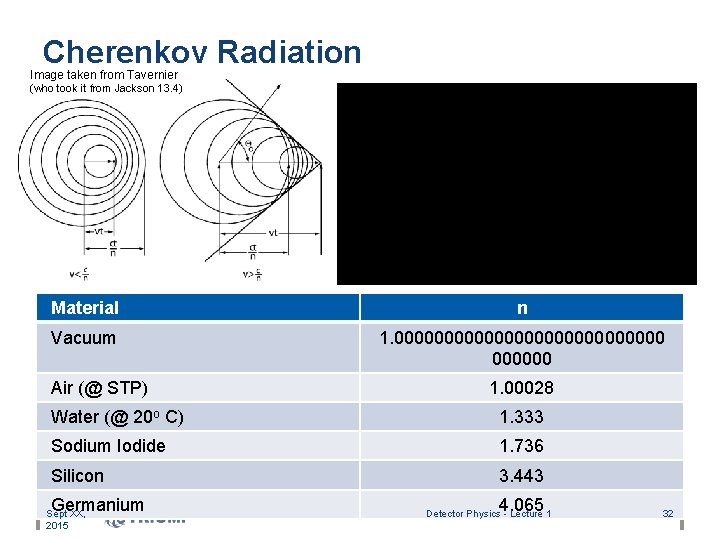
Cherenkov Radiation Image taken from Tavernier (who took it from Jackson 13. 4) Material n Vacuum 1. 00000000000000 Air (@ STP) 1. 00028 Water (@ 20 o C) 1. 333 Sodium Iodide 1. 736 Silicon 3. 443 Germanium Sept XX, 2015 4. 065 Detector Physics - Lecture 1 32
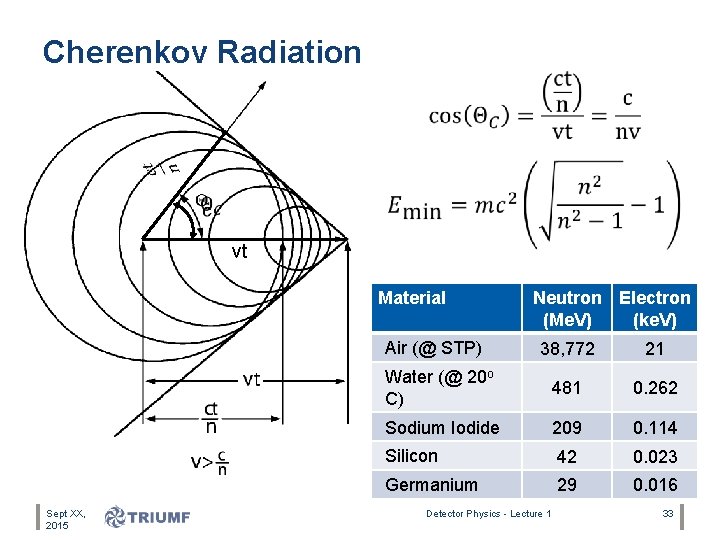
Cherenkov Radiation vt Material Air (@ STP) Sept XX, 2015 Neutron Electron (Me. V) (ke. V) 38, 772 21 Water (@ 20 o C) 481 0. 262 Sodium Iodide 209 0. 114 Silicon 42 0. 023 Germanium 29 0. 016 Detector Physics - Lecture 1 33
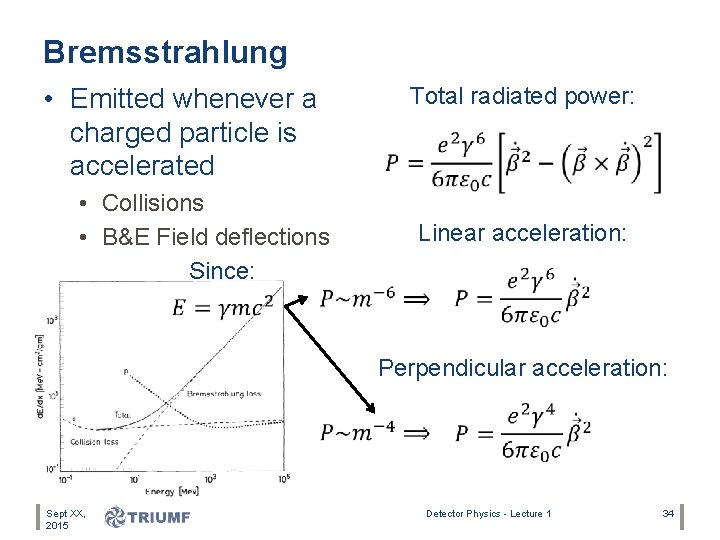
Bremsstrahlung • Emitted whenever a charged particle is accelerated • Collisions • B&E Field deflections Since: Total radiated power: Linear acceleration: Perpendicular acceleration: Sept XX, 2015 Detector Physics - Lecture 1 34
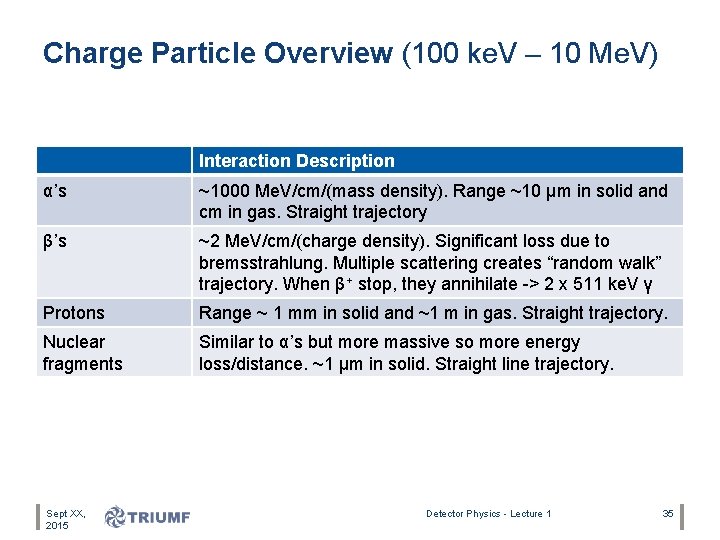
Charge Particle Overview (100 ke. V – 10 Me. V) Interaction Description α’s ~1000 Me. V/cm/(mass density). Range ~10 µm in solid and cm in gas. Straight trajectory β’s ~2 Me. V/cm/(charge density). Significant loss due to bremsstrahlung. Multiple scattering creates “random walk” trajectory. When β+ stop, they annihilate -> 2 x 511 ke. V γ Protons Range ~ 1 mm in solid and ~1 m in gas. Straight trajectory. Nuclear fragments Similar to α’s but more massive so more energy loss/distance. ~1 µm in solid. Straight line trajectory. Sept XX, 2015 Detector Physics - Lecture 1 35
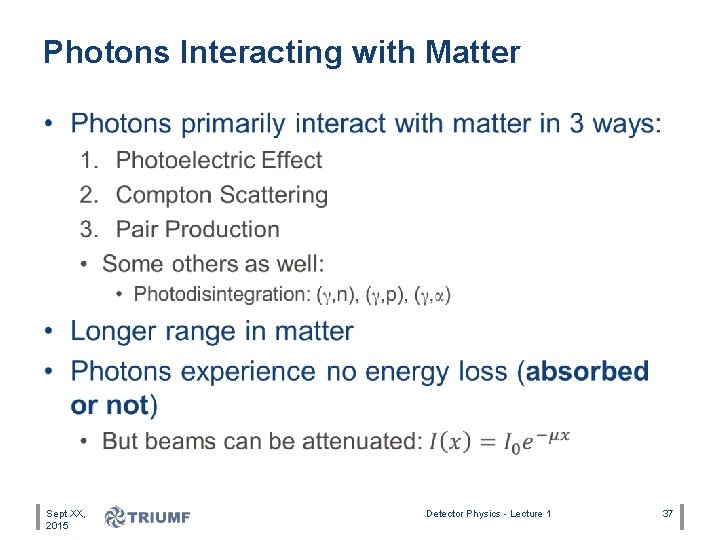
Photons Interacting with Matter • Sept XX, 2015 Detector Physics - Lecture 1 37
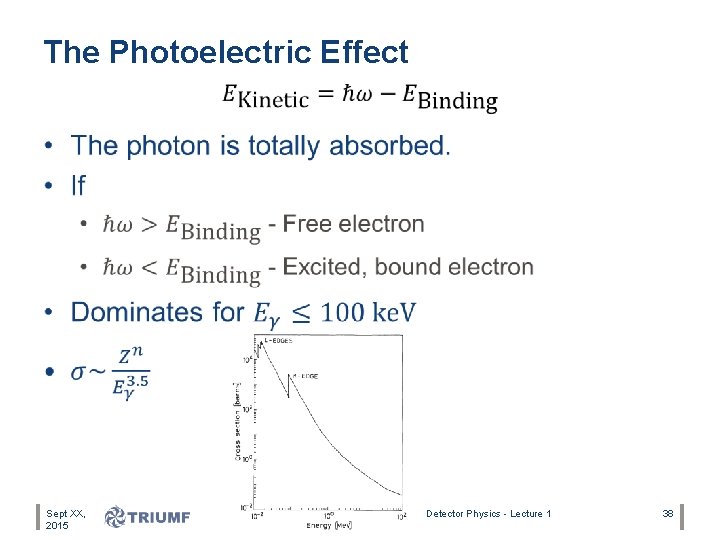
The Photoelectric Effect • Sept XX, 2015 Detector Physics - Lecture 1 38
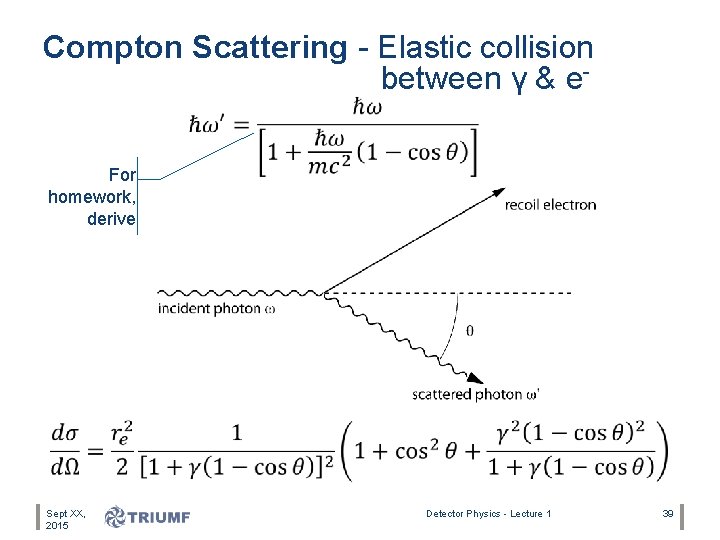
Compton Scattering - Elastic collision between γ & e For homework, derive Sept XX, 2015 Detector Physics - Lecture 1 39
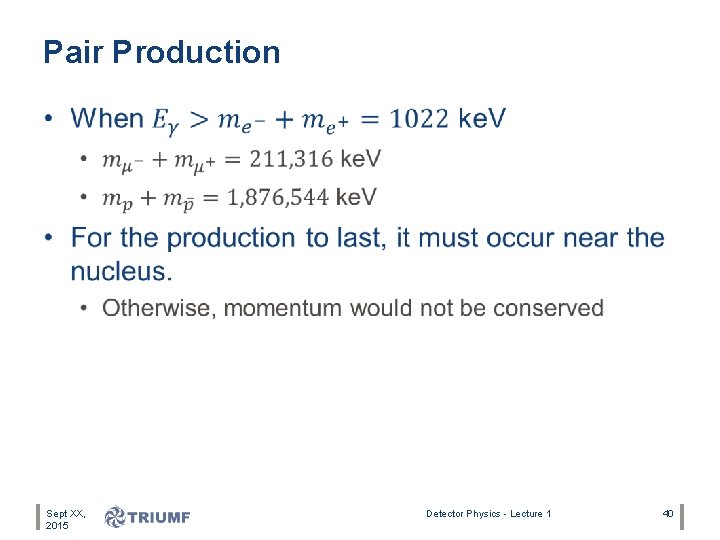
Pair Production • Sept XX, 2015 Detector Physics - Lecture 1 40
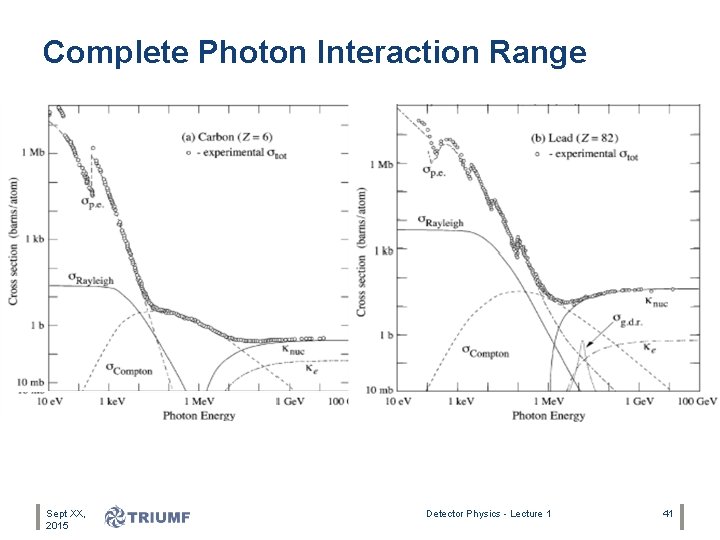
Complete Photon Interaction Range Sept XX, 2015 Detector Physics - Lecture 1 41
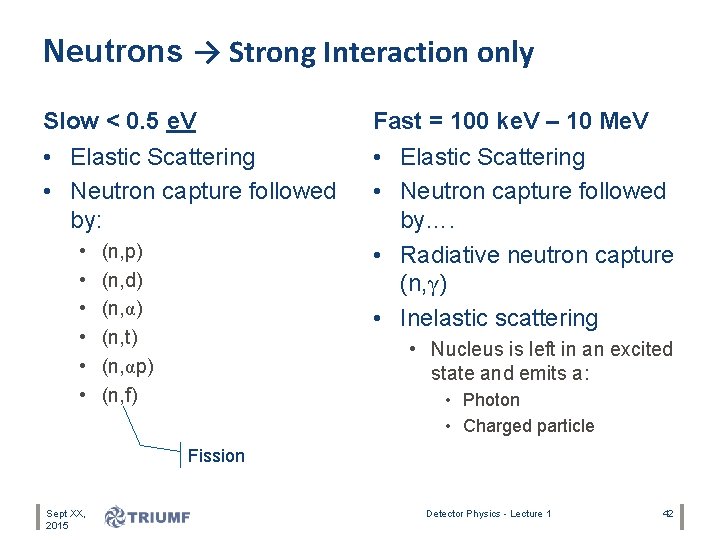
Neutrons → Strong Interaction only Slow < 0. 5 e. V Fast = 100 ke. V – 10 Me. V • Elastic Scattering • Neutron capture followed by: • Elastic Scattering • Neutron capture followed by…. • Radiative neutron capture (n, γ) • Inelastic scattering • • • (n, p) (n, d) (n, α) (n, t) (n, αp) (n, f) • Nucleus is left in an excited state and emits a: • Photon • Charged particle Fission Sept XX, 2015 Detector Physics - Lecture 1 42
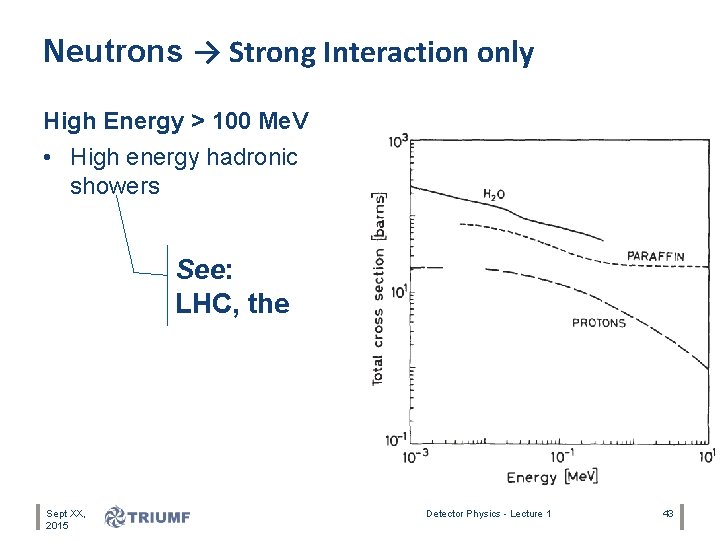
Neutrons → Strong Interaction only High Energy > 100 Me. V • High energy hadronic showers See: LHC, the Sept XX, 2015 Detector Physics - Lecture 1 43
Canada’s national laboratory for particle and nuclear physics Laboratoire national canadien pour la recherche en physique nucléaire et en physique des particules Thank you! Merci Owned and operated as a joint venture by a consortium of Canadian universities via a contribution through the National Research Council Canada Propriété d’un consortium d’universités canadiennes, géré en co-entreprise à partir d’une contribution administrée par le Conseil national de recherches Canada TRIUMF: Alberta | British Columbia | Calgary | Carleton | Guelph | Manitoba | Mc. Gill | Mc. Master | Montréal | Northern British Columbia | Queen’s | Regina | Saint Mary’s | Simon Fraser | Toronto | Victoria | Western | Winnipeg | York
- Slides: 43