
Canadas Flu Watch Surveillance Program Outbreak Surveillance Dr
Canada’s Flu. Watch Surveillance Program Outbreak Surveillance Dr. Christina Bancej & Dr. Yan Li, Public Health Agency of Canada on behalf of the 2015 -16 Flu. Watch Team: Liza Lee, Joy Pulickal, Myriam Saboui, Claire Sevenhuysen and provincial/territorial /regional Flu. Watch partners
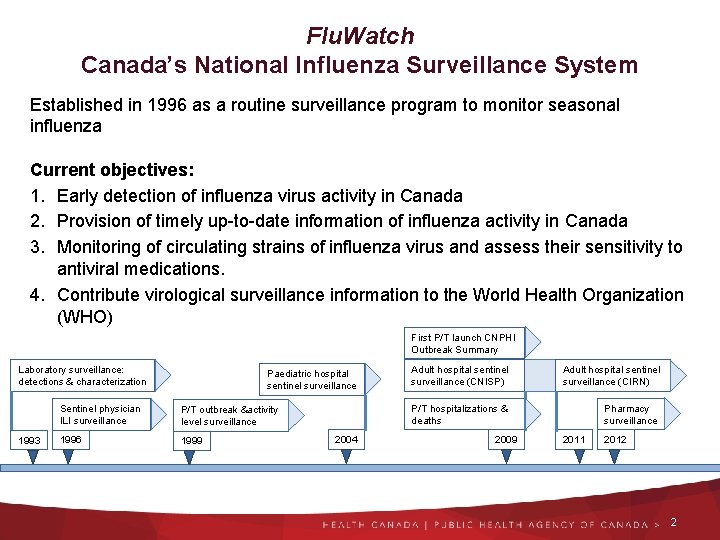
Flu. Watch Canada’s National Influenza Surveillance System Established in 1996 as a routine surveillance program to monitor seasonal influenza Current objectives: 1. Early detection of influenza virus activity in Canada 2. Provision of timely up-to-date information of influenza activity in Canada 3. Monitoring of circulating strains of influenza virus and assess their sensitivity to antiviral medications. 4. Contribute virological surveillance information to the World Health Organization (WHO) First P/T launch CNPHI Outbreak Summary Laboratory surveillance: detections & characterization 1993 Paediatric hospital sentinel surveillance Sentinel physician ILI surveillance P/T outbreak &activity level surveillance 1996 1999 2004 Adult hospital sentinel surveillance (CNISP) Adult hospital sentinel surveillance (CIRN) P/T hospitalizations & deaths Pharmacy surveillance 2009 2011 2012 2
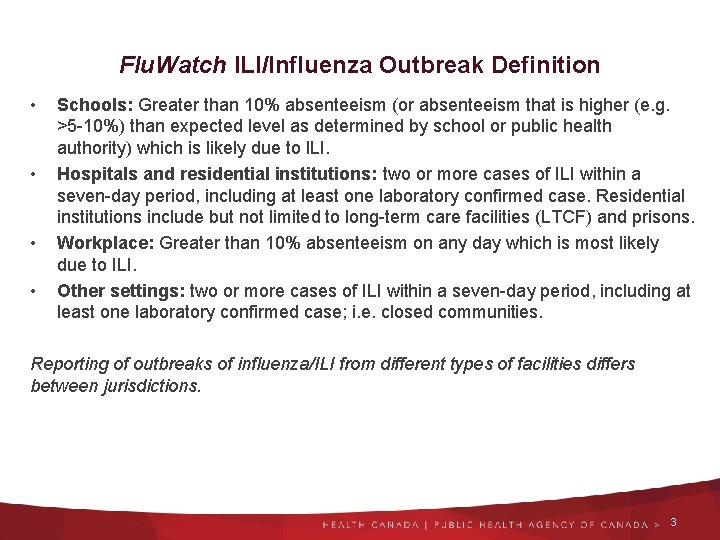
Flu. Watch ILI/Influenza Outbreak Definition • • Schools: Greater than 10% absenteeism (or absenteeism that is higher (e. g. >5 -10%) than expected level as determined by school or public health authority) which is likely due to ILI. Hospitals and residential institutions: two or more cases of ILI within a seven-day period, including at least one laboratory confirmed case. Residential institutions include but not limited to long-term care facilities (LTCF) and prisons. Workplace: Greater than 10% absenteeism on any day which is most likely due to ILI. Other settings: two or more cases of ILI within a seven-day period, including at least one laboratory confirmed case; i. e. closed communities. Reporting of outbreaks of influenza/ILI from different types of facilities differs between jurisdictions. 3
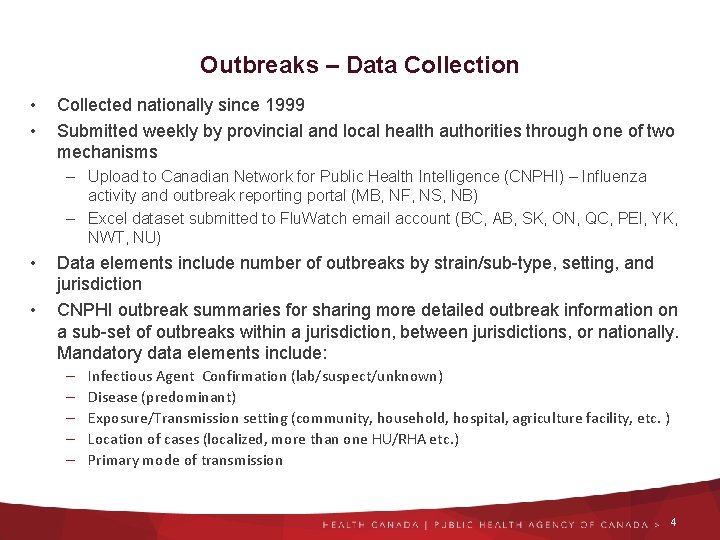
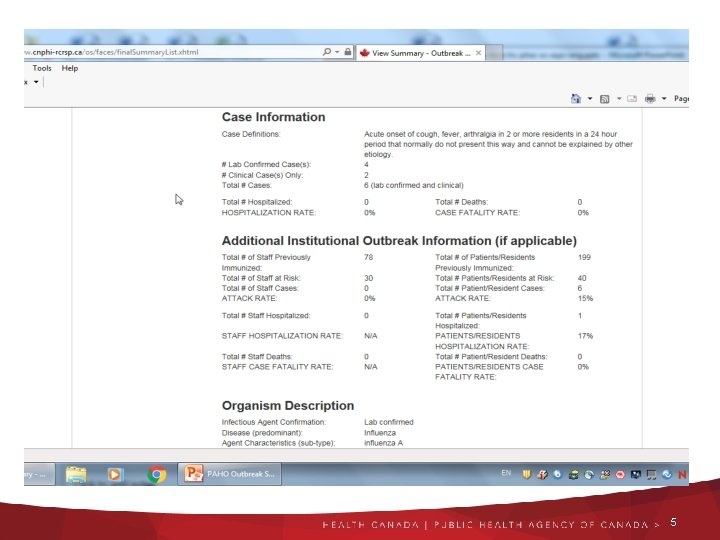
Outbreaks – Data Collection • • Collected nationally since 1999 Submitted weekly by provincial and local health authorities through one of two mechanisms – Upload to Canadian Network for Public Health Intelligence (CNPHI) – Influenza activity and outbreak reporting portal (MB, NF, NS, NB) – Excel dataset submitted to Flu. Watch email account (BC, AB, SK, ON, QC, PEI, YK, NWT, NU) • • Data elements include number of outbreaks by strain/sub-type, setting, and jurisdiction CNPHI outbreak summaries for sharing more detailed outbreak information on a sub-set of outbreaks within a jurisdiction, between jurisdictions, or nationally. Mandatory data elements include: – – – Infectious Agent Confirmation (lab/suspect/unknown) Disease (predominant) Exposure/Transmission setting (community, household, hospital, agriculture facility, etc. ) Location of cases (localized, more than one HU/RHA etc. ) Primary mode of transmission 4
5
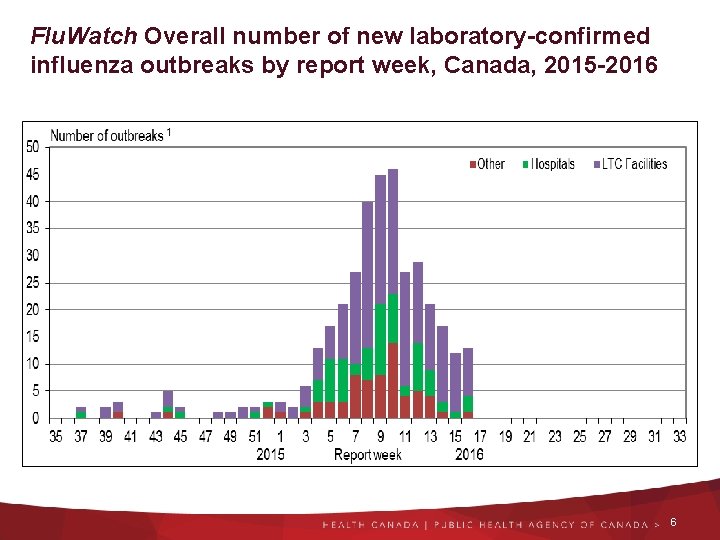
Flu. Watch Overall number of new laboratory-confirmed influenza outbreaks by report week, Canada, 2015 -2016 6
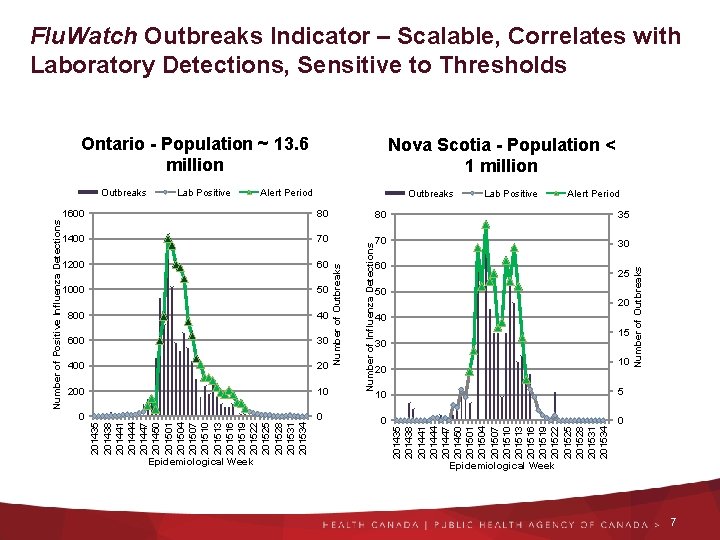
Flu. Watch Outbreaks Indicator – Scalable, Correlates with Laboratory Detections, Sensitive to Thresholds Ontario - Population ~ 13. 6 million Alert Period Outbreaks Lab Positive Alert Period 80 35 1400 70 70 30 1200 60 1000 50 800 40 600 30 400 20 200 10 Epidemiological Week 0 60 25 50 20 40 15 30 10 20 10 5 0 0 201435 201438 201441 201444 201447 201450 201501 201504 201507 201510 201513 201516 201519 201522 201525 201528 201531 201534 0 Number of Influenza Detections 80 Number of Outbreaks 1600 Number of Outbreaks Lab Positive 201435 201438 201441 201444 201447 201450 201501 201504 201507 201510 201513 201516 201519 201522 201525 201528 201531 201534 Number of Positive Influenza Detections Outbreaks Nova Scotia - Population < 1 million Epidemiological Week 7
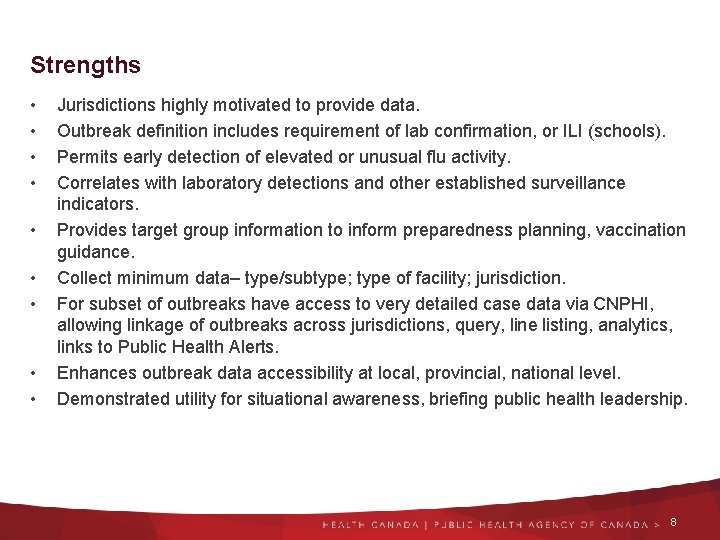
Strengths • • • Jurisdictions highly motivated to provide data. Outbreak definition includes requirement of lab confirmation, or ILI (schools). Permits early detection of elevated or unusual flu activity. Correlates with laboratory detections and other established surveillance indicators. Provides target group information to inform preparedness planning, vaccination guidance. Collect minimum data– type/subtype; type of facility; jurisdiction. For subset of outbreaks have access to very detailed case data via CNPHI, allowing linkage of outbreaks across jurisdictions, query, line listing, analytics, links to Public Health Alerts. Enhances outbreak data accessibility at local, provincial, national level. Demonstrated utility for situational awareness, briefing public health leadership. 8
Limitations • • Definitions not uniformly applied/implemented. Multiple systems for data collection and they are not interoperable. – Detailed outbreak summaries are not linkable to aggregate outbreak reporting. – Data providers dislike duplicate entry requirements. • • • Timeliness (in some cases rely on retrospective updating). With aggregate data, obtain initial signal, but not followed for duration of outbreak. Much unharnessed potential 9
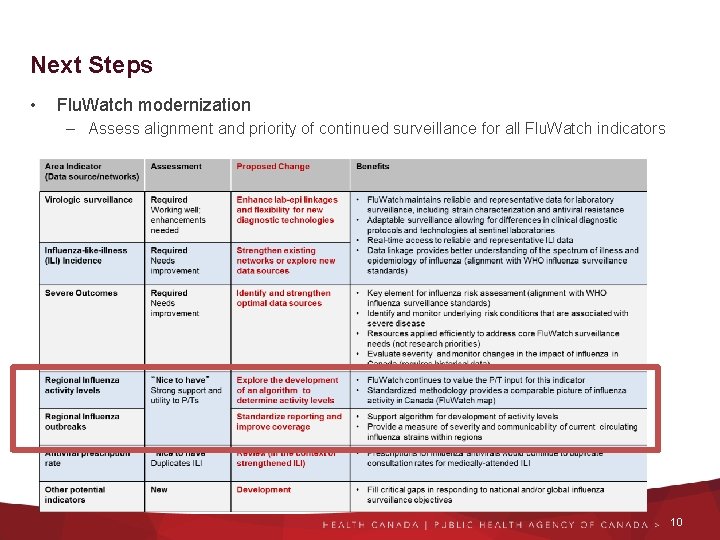
Next Steps • Flu. Watch modernization – Assess alignment and priority of continued surveillance for all Flu. Watch indicators 10
- Slides: 10