
Canadas Deep Geological Repository for Used Nuclear Fuel
- Slides: 34
Canada’s Deep Geological Repository for Used Nuclear Fuel: Modelling Economic Effects Presented to: Ignace Nuclear Waste Community Advisory Committee Presented by: M. Stemeroff, AECOM M. Krizanc, NWMO February, 2016
Introduction • • • 2 Context Background for economic modelling work Purpose of Update Methods Used Preliminary Findings Next steps
Focus of Discussion during Phase 2 • • Can we identify a safe site? Is the project a good “fit” for the area? Is the project compatible with the area’s vision? How might the project foster well-being? The Project will only proceed with the interested community, First Nation and Métis Communities in the area, and surrounding communities working together with the NWMO to implement it 3
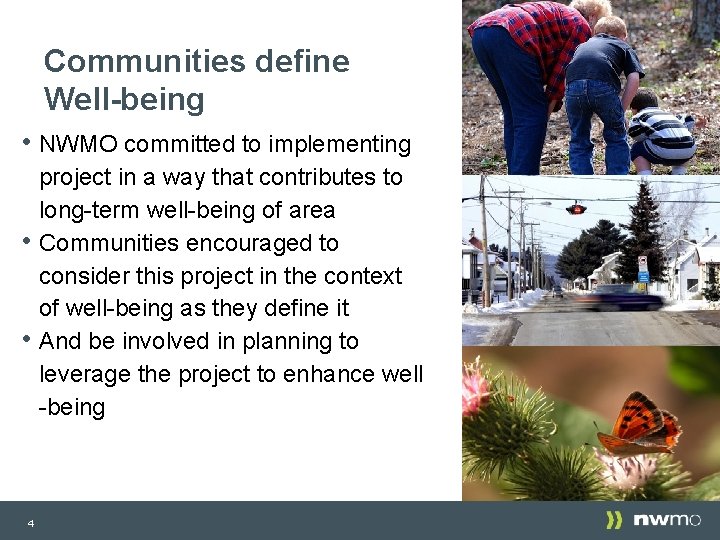
Communities define Well-being • NWMO committed to implementing • • 4 project in a way that contributes to long-term well-being of area Communities encouraged to consider this project in the context of well-being as they define it And be involved in planning to leverage the project to enhance well -being
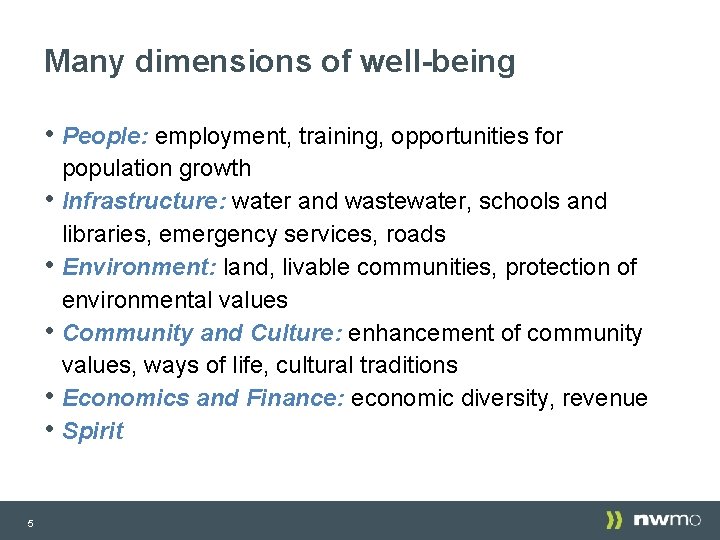
Many dimensions of well-being • People: employment, training, opportunities for • • • 5 population growth Infrastructure: water and wastewater, schools and libraries, emergency services, roads Environment: land, livable communities, protection of environmental values Community and Culture: enhancement of community values, ways of life, cultural traditions Economics and Finance: economic diversity, revenue Spirit
Preliminary Economic Analysis 6
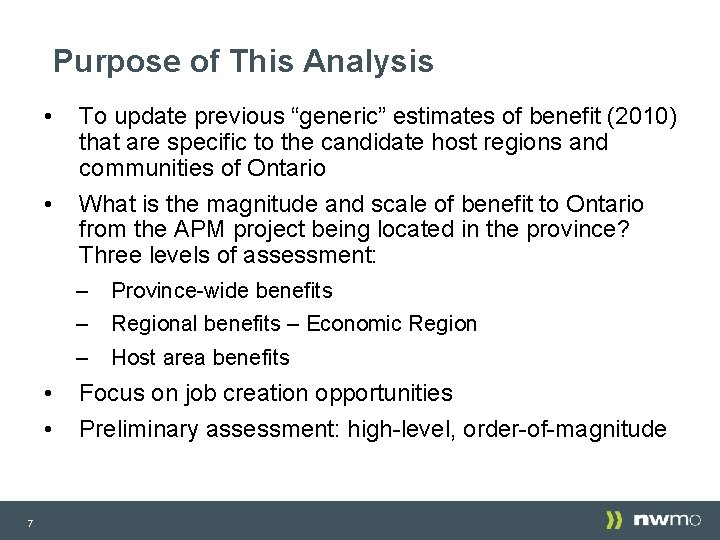
Purpose of This Analysis • • 7 To update previous “generic” estimates of benefit (2010) that are specific to the candidate host regions and communities of Ontario What is the magnitude and scale of benefit to Ontario from the APM project being located in the province? Three levels of assessment: – Province-wide benefits – Regional benefits – Economic Region – Host area benefits Focus on job creation opportunities Preliminary assessment: high-level, order-of-magnitude
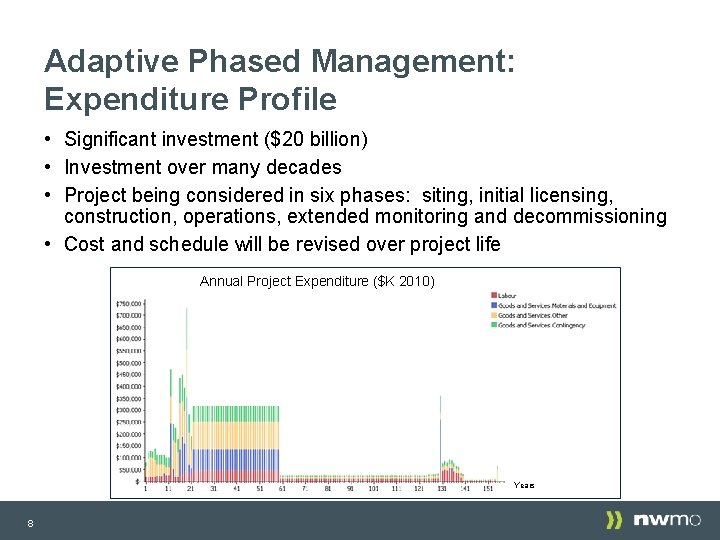
Adaptive Phased Management: Expenditure Profile • Significant investment ($20 billion) • Investment over many decades • Project being considered in six phases: siting, initial licensing, construction, operations, extended monitoring and decommissioning • Cost and schedule will be revised over project life Annual Project Expenditure ($K 2010) Years 8
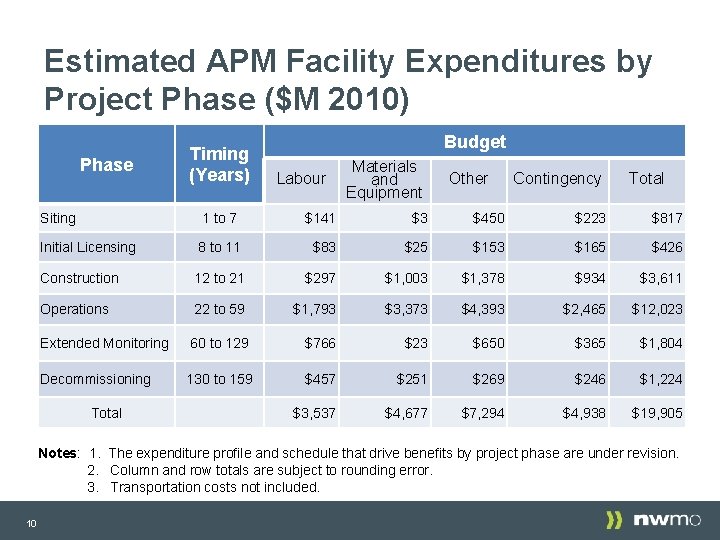
Estimated APM Facility Expenditures by Project Phase ($M 2010) Phase Timing (Years) Budget Labour Materials and Equipment Other Contingency Total Siting 1 to 7 $141 $3 $450 $223 $817 Initial Licensing 8 to 11 $83 $25 $153 $165 $426 Construction 12 to 21 $297 $1, 003 $1, 378 $934 $3, 611 Operations 22 to 59 $1, 793 $3, 373 $4, 393 $2, 465 $12, 023 Extended Monitoring 60 to 129 $766 $23 $650 $365 $1, 804 Decommissioning 130 to 159 $457 $251 $269 $246 $1, 224 $3, 537 $4, 677 $7, 294 $4, 938 $19, 905 Total Notes: 1. The expenditure profile and schedule that drive benefits by project phase are under revision. 2. Column and row totals are subject to rounding error. 3. Transportation costs not included. 10
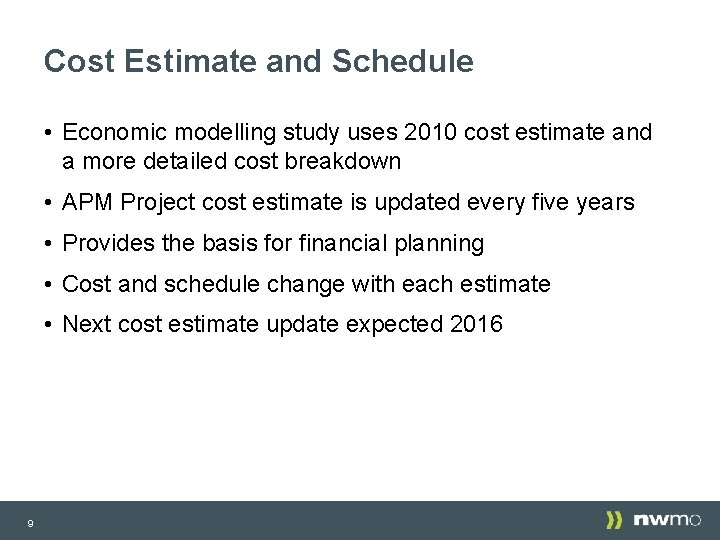
Cost Estimate and Schedule • Economic modelling study uses 2010 cost estimate and a more detailed cost breakdown • APM Project cost estimate is updated every five years • Provides the basis for financial planning • Cost and schedule change with each estimate • Next cost estimate update expected 2016 9
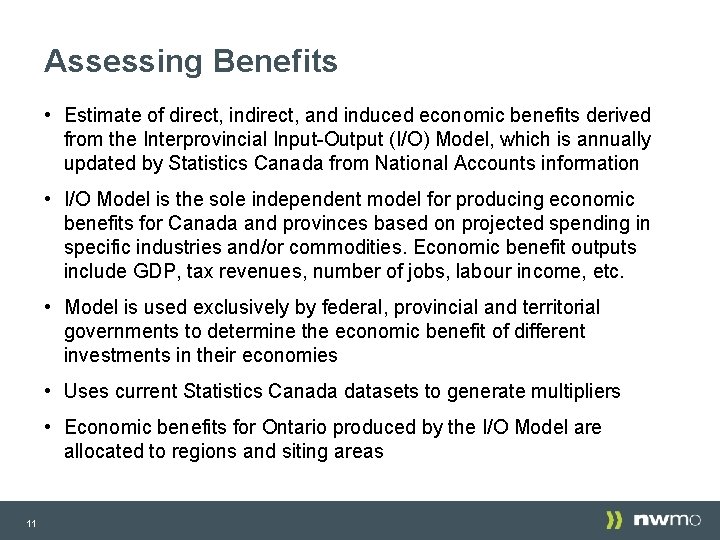
Assessing Benefits • Estimate of direct, indirect, and induced economic benefits derived from the Interprovincial Input-Output (I/O) Model, which is annually updated by Statistics Canada from National Accounts information • I/O Model is the sole independent model for producing economic benefits for Canada and provinces based on projected spending in specific industries and/or commodities. Economic benefit outputs include GDP, tax revenues, number of jobs, labour income, etc. • Model is used exclusively by federal, provincial and territorial governments to determine the economic benefit of different investments in their economies • Uses current Statistics Canada datasets to generate multipliers • Economic benefits for Ontario produced by the I/O Model are allocated to regions and siting areas 11
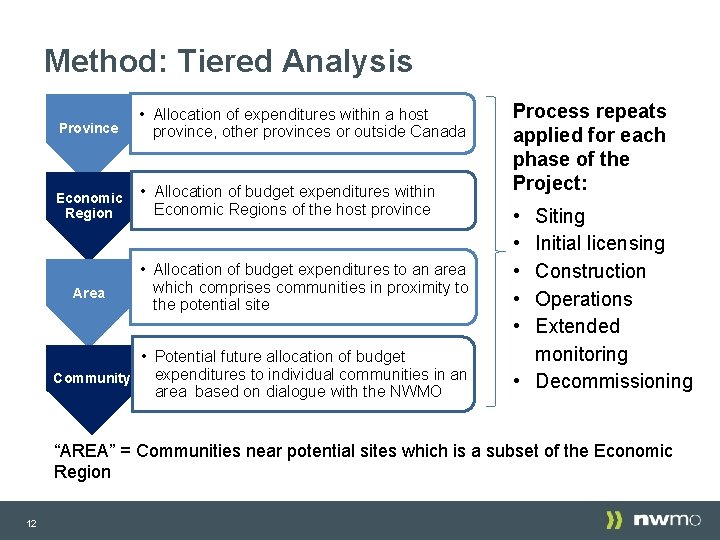
Method: Tiered Analysis Province • Allocation of expenditures within a host province, other provinces or outside Canada Economic Region • Allocation of budget expenditures within Economic Regions of the host province Area • Allocation of budget expenditures to an area which comprises communities in proximity to the potential site • Potential future allocation of budget expenditures to individual communities in an Community area based on dialogue with the NWMO Process repeats applied for each phase of the Project: • • • Siting Initial licensing Construction Operations Extended monitoring • Decommissioning “AREA” = Communities near potential sites which is a subset of the Economic Region 12
Preliminary Initial Findings - Ontario 13
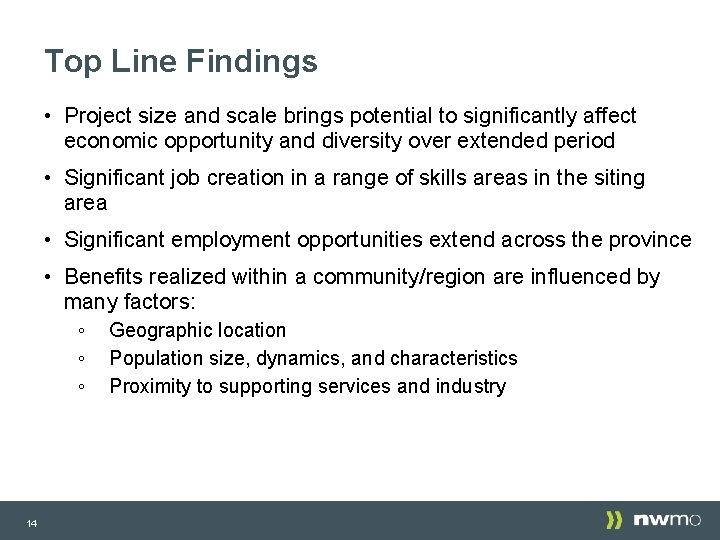
Top Line Findings • Project size and scale brings potential to significantly affect economic opportunity and diversity over extended period • Significant job creation in a range of skills areas in the siting area • Significant employment opportunities extend across the province • Benefits realized within a community/region are influenced by many factors: ◦ ◦ ◦ 14 Geographic location Population size, dynamics, and characteristics Proximity to supporting services and industry
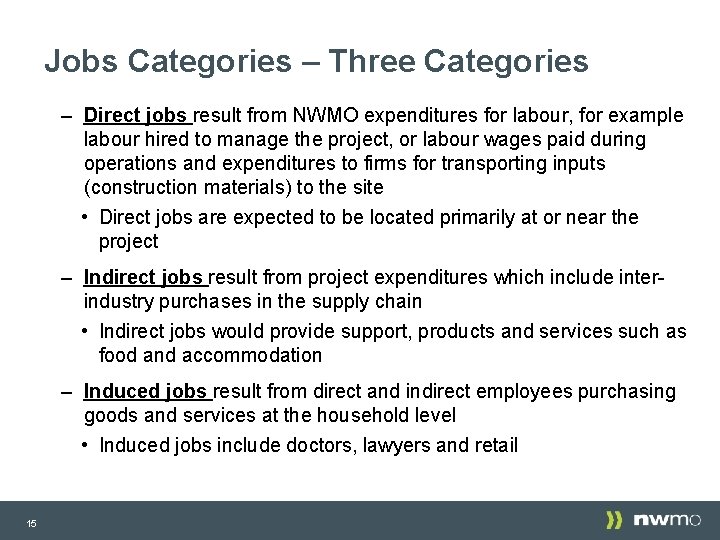
Jobs Categories – Three Categories – Direct jobs result from NWMO expenditures for labour, for example labour hired to manage the project, or labour wages paid during operations and expenditures to firms for transporting inputs (construction materials) to the site • Direct jobs are expected to be located primarily at or near the project – Indirect jobs result from project expenditures which include interindustry purchases in the supply chain • Indirect jobs would provide support, products and services such as food and accommodation – Induced jobs result from direct and indirect employees purchasing goods and services at the household level • Induced jobs include doctors, lawyers and retail 15
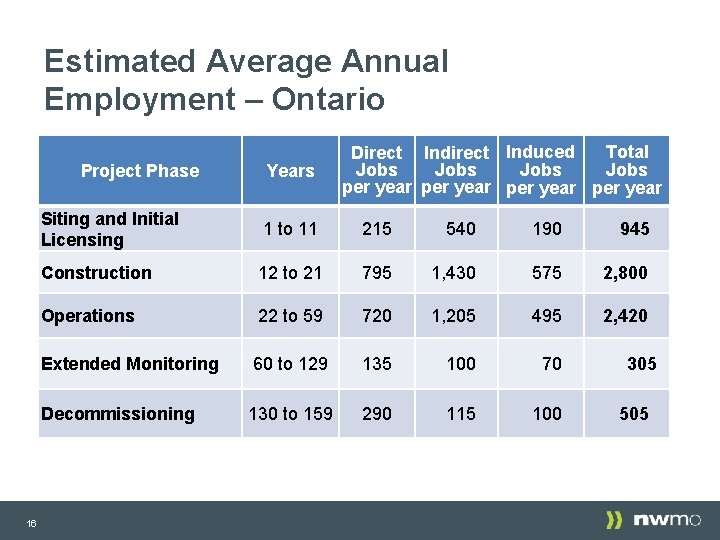
Estimated Average Annual Employment – Ontario Project Phase 16 Years Total Direct Induced Jobs per year Siting and Initial Licensing 1 to 11 215 540 190 945 Construction 12 to 21 795 1, 430 575 2, 800 Operations 22 to 59 720 1, 205 495 2, 420 Extended Monitoring 60 to 129 135 100 70 Decommissioning 130 to 159 290 115 100 305 505
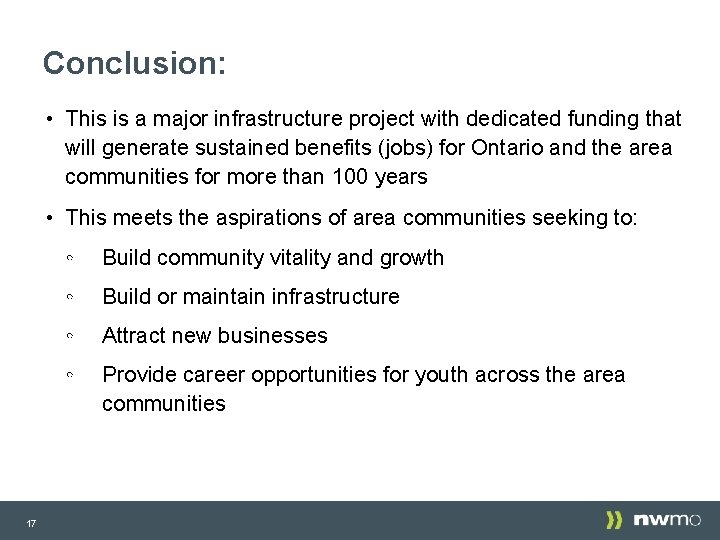
Conclusion: • This is a major infrastructure project with dedicated funding that will generate sustained benefits (jobs) for Ontario and the area communities for more than 100 years • This meets the aspirations of area communities seeking to: 17 ◦ Build community vitality and growth ◦ Build or maintain infrastructure ◦ Attract new businesses ◦ Provide career opportunities for youth across the area communities
Initial Estimates for Ignace and Area 18
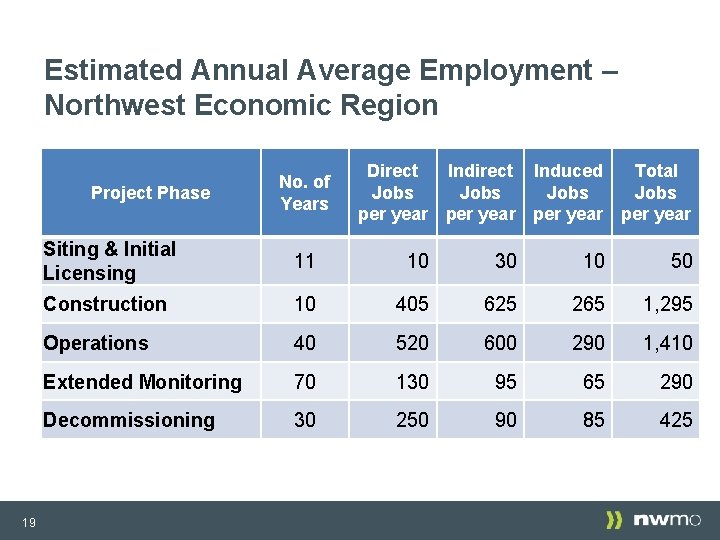
Estimated Annual Average Employment – Northwest Economic Region Project Phase 19 No. of Years Direct Induced Total Jobs per year Siting & Initial Licensing 11 10 30 10 50 Construction 10 405 625 265 1, 295 Operations 40 520 600 290 1, 410 Extended Monitoring 70 130 95 65 290 Decommissioning 30 250 90 85 425
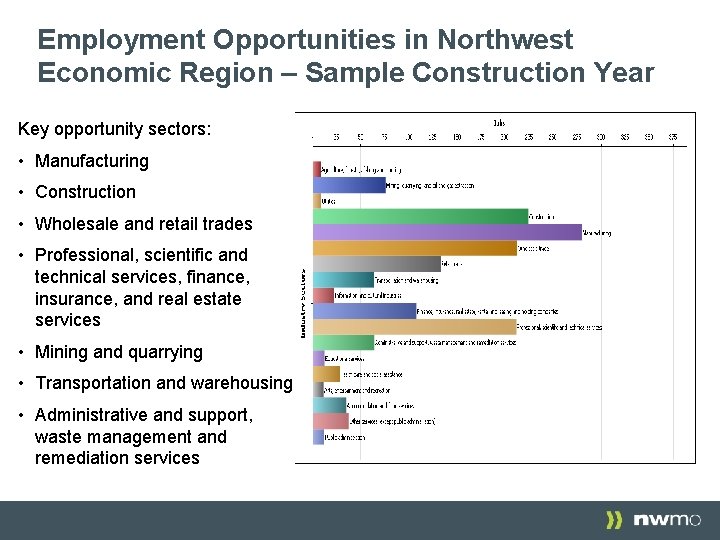
Employment Opportunities in Northwest Economic Region – Sample Construction Year Key opportunity sectors: • Manufacturing • Construction • Wholesale and retail trades • Professional, scientific and technical services, finance, insurance, and real estate services • Mining and quarrying • Transportation and warehousing • Administrative and support, waste management and remediation services
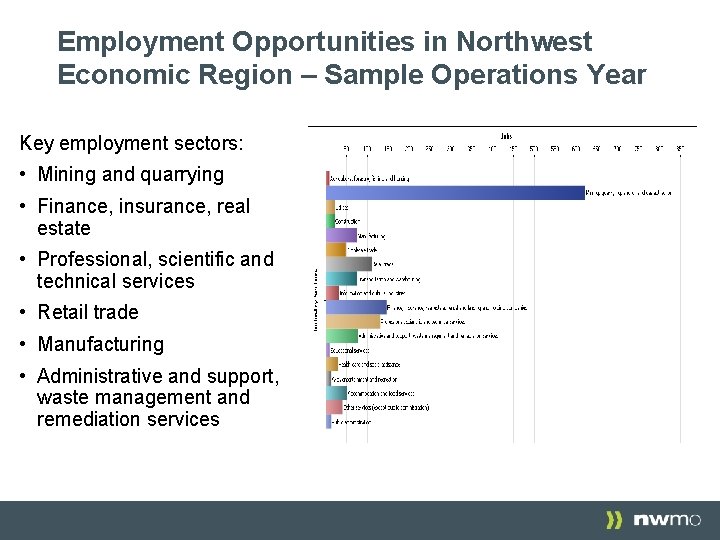
Employment Opportunities in Northwest Economic Region – Sample Operations Year Key employment sectors: • Mining and quarrying • Finance, insurance, real estate • Professional, scientific and technical services • Retail trade • Manufacturing • Administrative and support, waste management and remediation services
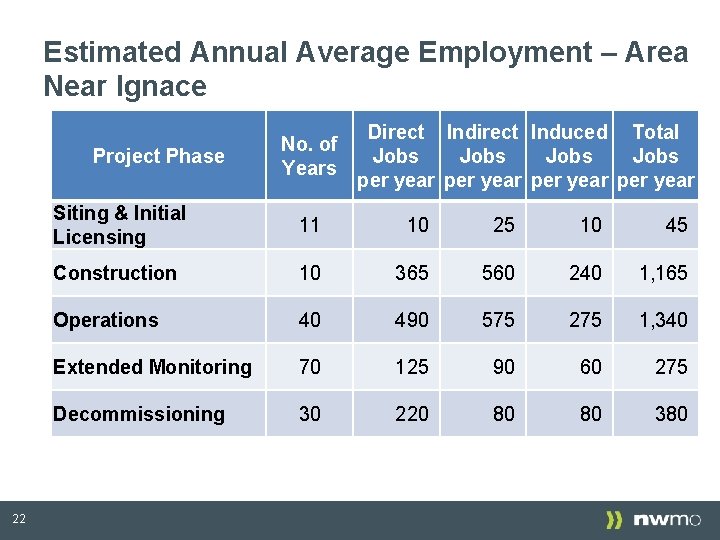
Estimated Annual Average Employment – Area Near Ignace Project Phase 22 No. of Years Direct Induced Total Jobs per year Siting & Initial Licensing 11 10 25 10 45 Construction 10 365 560 240 1, 165 Operations 40 490 575 275 1, 340 Extended Monitoring 70 125 90 60 275 Decommissioning 30 220 80 80 380
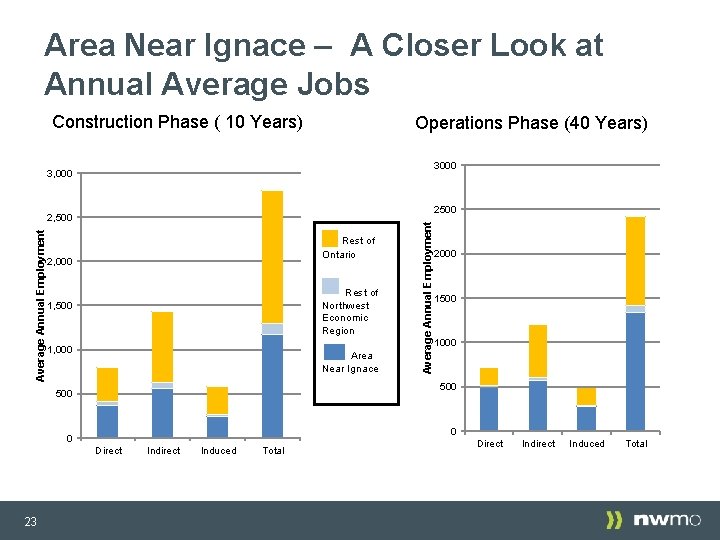
Area Near Ignace – A Closer Look at Annual Average Jobs Construction Phase ( 10 Years) Operations Phase (40 Years) 3000 3, 000 Average Annual Employment Rest of Ontario 2, 000 Rest of Northwest Economic Region 1, 500 1, 000 Area Near Ignace 2000 1500 1000 500 0 0 Direct 23 Average Annual Employment 2500 2, 500 Indirect Induced Total Direct Induced Total
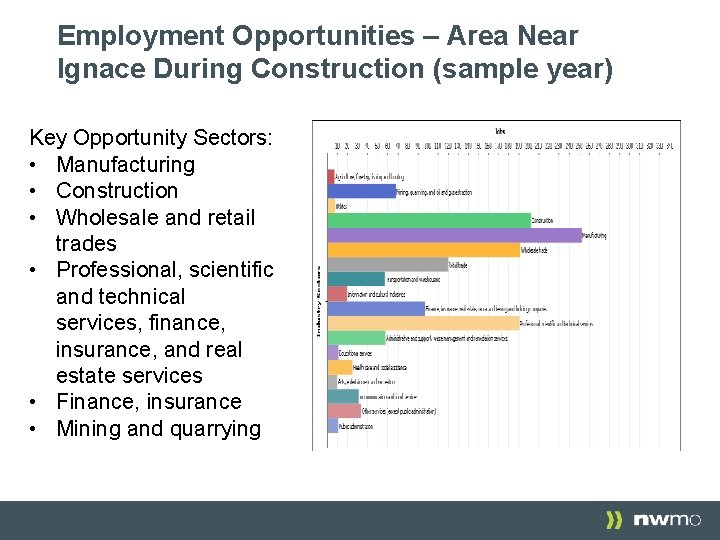
Employment Opportunities – Area Near Ignace During Construction (sample year) Key Opportunity Sectors: • Manufacturing • Construction • Wholesale and retail trades • Professional, scientific and technical services, finance, insurance, and real estate services • Finance, insurance • Mining and quarrying
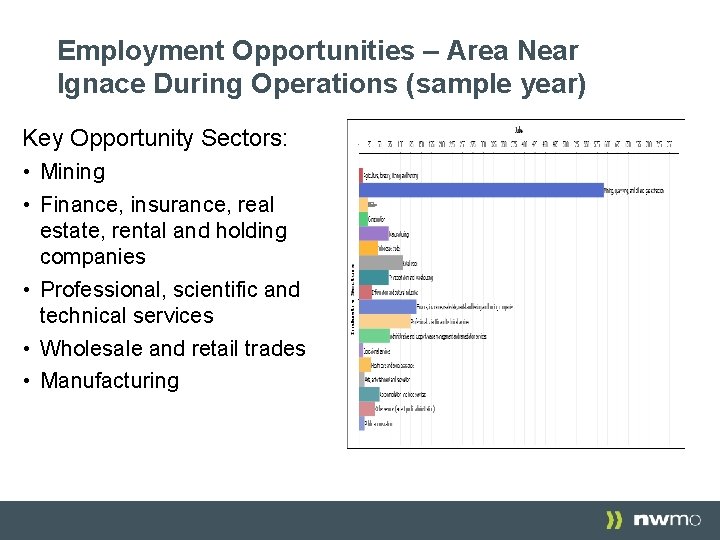
Employment Opportunities – Area Near Ignace During Operations (sample year) Key Opportunity Sectors: • Mining • Finance, insurance, real estate, rental and holding companies • Professional, scientific and technical services • Wholesale and retail trades • Manufacturing
Influencing Benefits • NWMO committed to work with communities to plan implementation of the project • Work to create a common economic development strategy, which may include: • Training • Local hiring and procurement programs • Fostering business development and infrastructure 26
Next Steps 27
Focus of Discussion during Phase 2 • Is the project a good “fit” for the area? • Is the project compatible with the area’s vision: • considering the many aspects of well-being, including people, environment, infrastructure, community and culture, Spirit, and economics and finance? • from the perspective of interested community, First Nation and Métis Communities in the area, and surrounding communities? 28
Next steps 1. Explore economic benefits at regional level and how this might advance other important aspects of well-being 2. Explore the different components of the project and implementation scenarios 3. Envision the Centre of Expertise 4. Begin to prepare for implementation through training and capacity building 29
Regional picture • Explore priorities, objectives and vision at the area level • Explore potential to advance the vision for the area, and address the priorities and objectives of communities • The model will help explore economic impact of various implementation plans 30
Project Components and Scenarios • Updated Project Description describes key components of the project • There are options for how project components would be implemented that would effect economic benefits • This includes where different project components could be located • Project components include surface facilities such as: o o 31 Used Fuel Container Factory Used Fuel Packaging Plant Sealing Material Compaction Plant/ Concrete Batch Plant Centre of Expertise
Designing and Developing Centre of Expertise How might the Centre be designed and developed • Where might we wish to locate the Centre of Expertise if our area hosts the APM Project? • What would we like the Centre to look like? What architectural style? • What kinds of facilities and meeting venues would the community find useful if available for general purpose? • What other opportunities are there for the Centre of Expertise to contribute to community priorities? • How might we like to see local history and culture reflected in the design? • How might we like to see indigenous knowledge and local First Nation and Métis cultures reflected? • How will we involve local people in the day-to-day operation of the Centre and how can we plan for this? • What other decision points would the community like to be part of? 32
Preparing for the project: Building Local Capacity and Employment Opportunities • Development of jobs and skill inventory • Implement hiring plan to build locally based staff • Discuss priority steps for developing skills and job opportunities • Discuss plan for investments in training, hiring, business development and begin implementation focussed on transferable skills 33
Beginning the Discussion • Review initial findings and report from economic modelling with CLC, community members, others in the area in 2016 • Share initial findings with community in an open house as part of an update on the project • Continue discussion about fostering well-being including new project description, Centre of Expertise and training 34