
Canadas Constitution The Constitution Defines the political structure
- Slides: 14
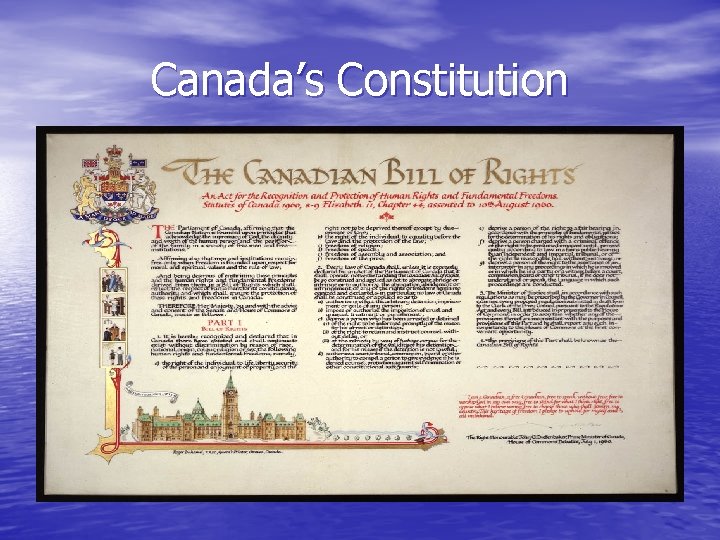
Canada’s Constitution
The Constitution… • Defines the political structure of the country. • Outlines the relationship between government and the people. • Established two levels and three branches of government. • Canada is still a monarchy.
What Is It Based On? • Rule of Law - Guarantees all Canadians both justice and equality before the law • No one, or government, is above the laws of the land
History of Constitution • Royal Proclamation of 1763 • Quebec Act of 1774 • Constitutional Act of 1791 • Act of Union 1840 • British North America Act 1867 • Constitution Act 1982
Amendments To Our Constitution • Amending Formula is the way in which we can make changes to our constitution. • Amendments require the support of 7 of 10 provinces and 50% popular vote. • Generally amendments are suggested from the federal government. • Constitution was last amended in 1982.
Royal Proclamation 1763 • Confirmed British control of Great Lakes area and St Lawrence. • Declared that English Laws and institutions as well as English language would prevail in politics of Quebec • French language and Catholicism tolerated
Quebec Act of 1774 • Emphasize that English criminal law would be emphasized in colony • Restored the use of Civil Code which is still in use in Quebec • French speakers could hold positions in public office
Constitutional Act 1791 • Divided Quebec into two parts, Upper and Lower Canada • Lower Canada = English Criminal Law and French Civil code • Upper Canada = English Criminal Law and English Common Law
Constitutional Act cont’d… • All colonies of North America granted representative government • Only male property owners could vote • Frustration grew over the lack of power the elected officials had • One of major causes of rebellions of 1837 and 1838
Act of Union 1840 • Was recommended that two Canada’s be • • • reunited Under reunification both would be represented equally in the an elected assembly French was widely used in proceedings Late 1840’s responsible government came into being. Executive branch is responsible to the legislative branch.
British North America Act 1867 • By 1860’s colonies becoming dissatisfied with political structure • In 1867, confederation occurred between the Canada’s, New Brunswick, and Nova Scotia. • Known as the BNA Act of 1867 • Divided Canada into Ontario and Quebec • Four provinces in confederation
BNA Act continued…. Made up of 147 sections divided into eight categories: 1. ) Terms of Union 2. ) Executive Power 3. ) Legislative Power 4. ) Judicial Power 5. ) Revenue and Taxation 6. ) Provincial Institutions 7. ) Distribution of Legislative Power 8. ) Admission of other colonies into Confederation
Changes to Constitution • Many federal-provincial arguments during the • • • 1960’s and 1970’s The Quiet Revolution in Quebec marked the beginning of a period of Change for the Canadian constitution. Quebec began to consider separation To persuade Quebec, Prime Minister Trudeau and his government offered a new constitutional arrangement
Change to Constitution • Constitution Act 1982 included: 1. ) Charter of Rights and Freedoms to protect Quebec’s interests 2. ) Amending formula = 7 of 10 provinces representing 50% of population of Canada