
Canada Between The Wars 1919 1939 Post War
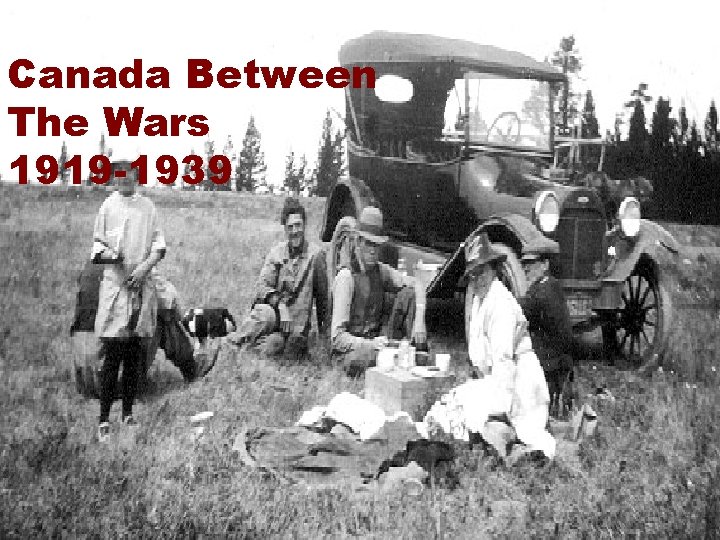
Canada Between The Wars 1919 -1939
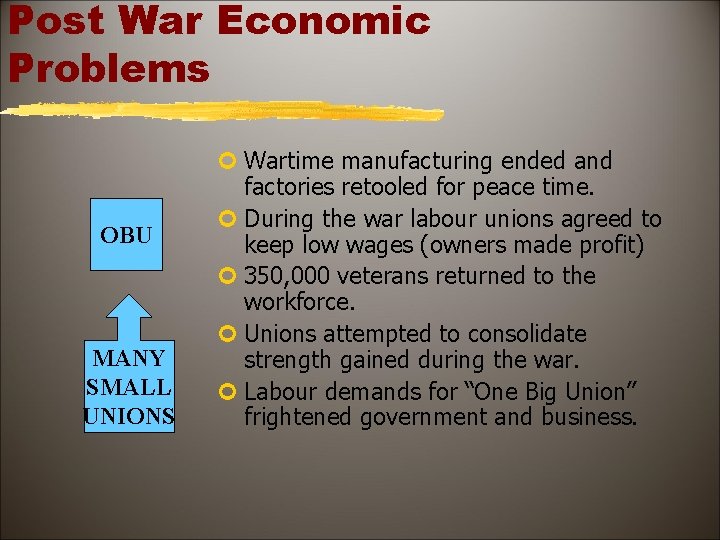
Post War Economic Problems OBU MANY SMALL UNIONS ¢ Wartime manufacturing ended and factories retooled for peace time. ¢ During the war labour unions agreed to keep low wages (owners made profit) ¢ 350, 000 veterans returned to the workforce. ¢ Unions attempted to consolidate strength gained during the war. ¢ Labour demands for “One Big Union” frightened government and business.
Post War Economic Problems II ¢ The government refused a veteran demand for a $2000 bonus. ¢ No military pensions, no services for the wounded ¢ Farmers were upset by government prices for wheat. ¢ Inflation, after 1917, resulted in rising interest rates.
Winnipeg General Strike ¢ Workers demanded the right to bargain with employers. ¢ 30, 000 workers set up picket lines on May 15, 1919. ¢ The strike showed signs of spreading beyond Winnipeg. ¢ A frightened government brought a violent end to the strike.
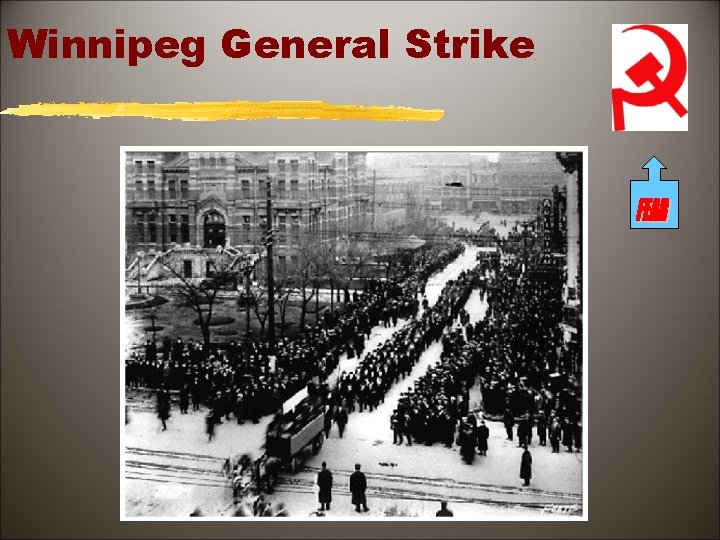
Winnipeg General Strike
Railways ¢ Bankrupt railway lines established during the Laurier era were consolidated by the government as the Canadian National Railway system. ¢ To meet costs the CNR raised freight rates on the Maritime section of the line imposing severe hardship on industry in this region.
Maritime Provinces ¢ In the 1920’s the Maritime Provinces found that their influence in national politics was declining. ¢ Since the population of the Maritimes was small they had fewer seats in Parliament, and some of the bigger businesses were moving to Ontario or Quebec. ¢ Oil was replacing coal as fuel, and the Maritimes had a lot of coal, but no oil.
Prairie Provinces ¢ The people in the Prairies and Ontario had their own problems as well. ¢ They were upset by the National Policy that imposed tariffs on foreign products, because it meant that they had to buy Canadian-made machinery, but their products were traded on the open-world market.
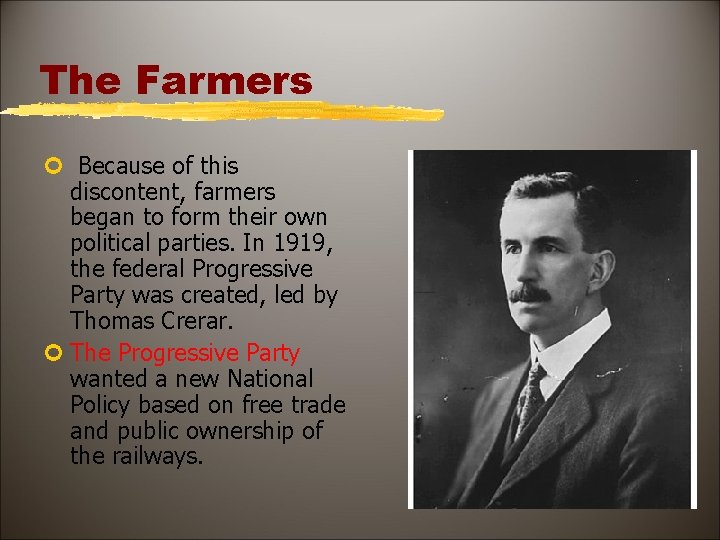
The Farmers ¢ Because of this discontent, farmers began to form their own political parties. In 1919, the federal Progressive Party was created, led by Thomas Crerar. ¢ The Progressive Party wanted a new National Policy based on free trade and public ownership of the railways.
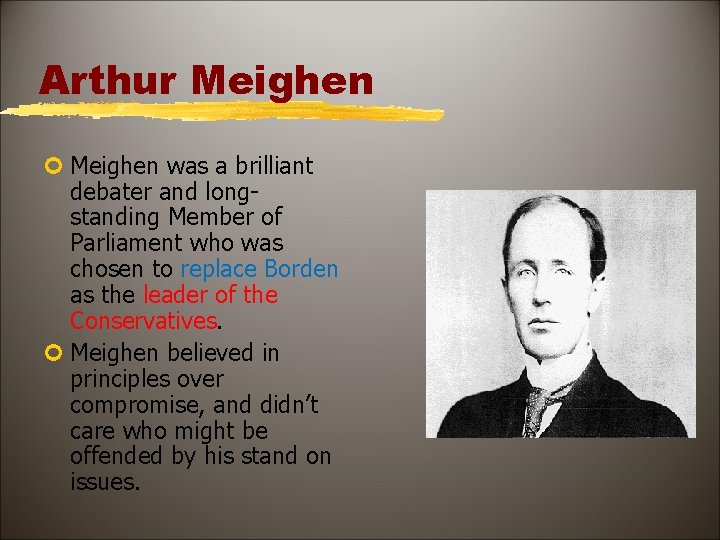
Arthur Meighen ¢ Meighen was a brilliant debater and longstanding Member of Parliament who was chosen to replace Borden as the leader of the Conservatives. ¢ Meighen believed in principles over compromise, and didn’t care who might be offended by his stand on issues.
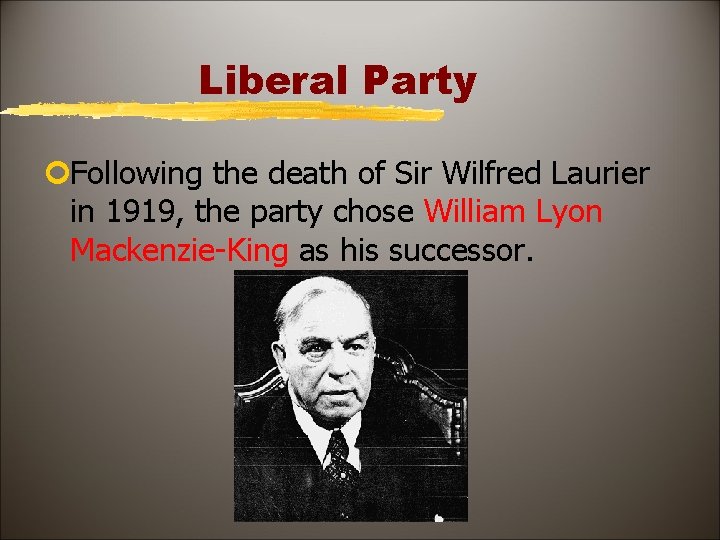
Liberal Party ¢Following the death of Sir Wilfred Laurier in 1919, the party chose William Lyon Mackenzie-King as his successor.
Election Time ¢In the 1921 Federal Election the Liberals became a minority government, which meant that they needed the support of some opposition members to pass legislation.
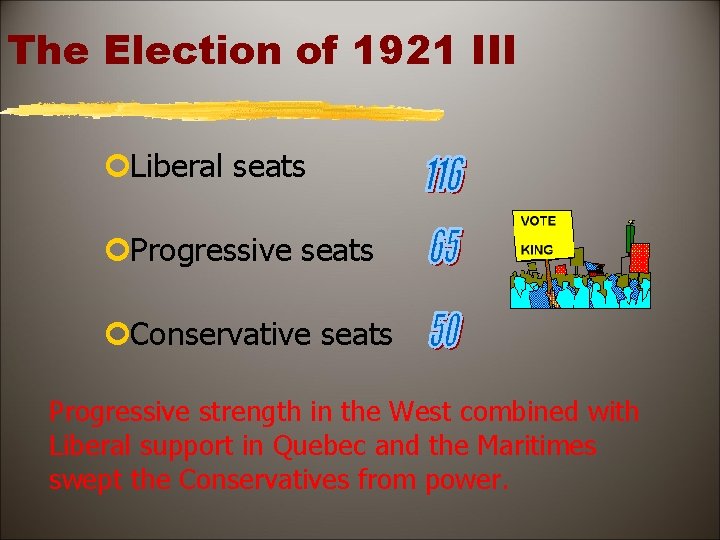
The Election of 1921 III ¢Liberal seats ¢Progressive seats ¢Conservative seats Progressive strength in the West combined with Liberal support in Quebec and the Maritimes swept the Conservatives from power.
Canada’s Growing Independence ¢ After WW 1 Prime Minister Borden had taken a number of important steps that raised Canada’s profile internationally. When King became prime minister, he did the same. ¢ In 1922 he refused to support Britain’s plans to invade Turkey (Chanak Crisis) ¢ The next year he insisted that Canada be allowed to sign an international treaty without the signature of a British representative. (Halibut Treaty) ¢ In 1926 King publicly challenged Britain over it’s influence on Canada’s international policies in what became known as the King-Byng crisis ¢ He participated in the Imperial Conference that led to the Balfour Report.

King-Byng Crisis
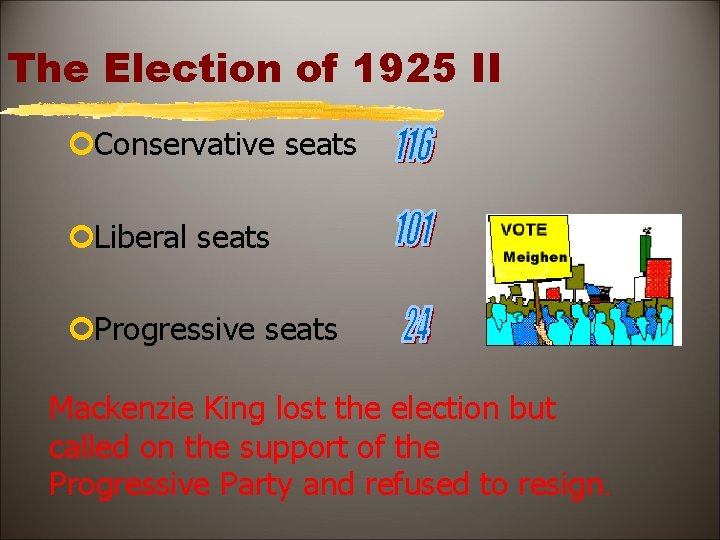
The Election of 1925 II ¢Conservative seats ¢Liberal seats ¢Progressive seats Mackenzie King lost the election but called on the support of the Progressive Party and refused to resign.
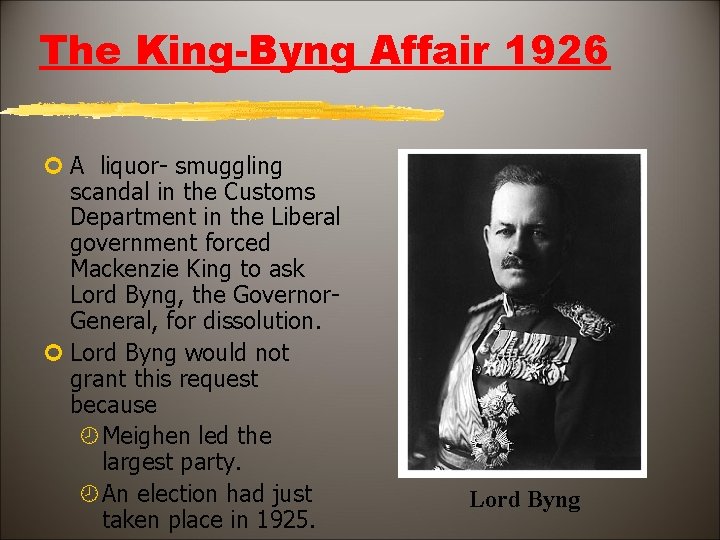
The King-Byng Affair 1926 ¢ A liquor- smuggling scandal in the Customs Department in the Liberal government forced Mackenzie King to ask Lord Byng, the Governor. General, for dissolution. ¢ Lord Byng would not grant this request because ¾Meighen led the largest party. ¾An election had just taken place in 1925. Lord Byng
The King-Byng Affair 1926 II ¢ A reluctant Arthur Meighen now formed government. ¢ King accused Lord Byng and the Conservatives of “twisting the Constitution. ” ¢ The Progressives continued to support the Liberals and Meighen was quickly defeated. ¢ An election called for September 14, 1926 returned King and the Liberals to power.
The Balfour Report (From Empire to Commonwealth) ¢ At the 1926 Imperial Conference the British Dominions (Including Canada) requested formal recognition of their autonomy, the freedom to govern themselves. ¢ A special committee, under the leadership of Lord Balfour agreed, and the recommendations of the Balfour Report became law in 1931, making the former British Empire into the British Commonwealth. ¢ Canada was now a country equal in status with Britain and entitled to make its own laws.
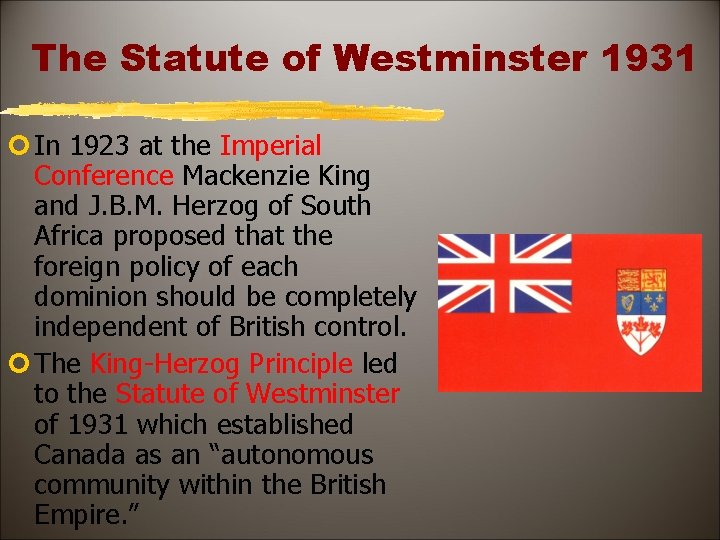
The Statute of Westminster 1931 ¢ In 1923 at the Imperial Conference Mackenzie King and J. B. M. Herzog of South Africa proposed that the foreign policy of each dominion should be completely independent of British control. ¢ The King-Herzog Principle led to the Statute of Westminster of 1931 which established Canada as an “autonomous community within the British Empire. ”
- Slides: 20