
Can You Taste That Predicting PTC Tasting Ability

Can You Taste That? Predicting PTC Tasting Ability Among Non-Human Primates
What is “Bioinformatics”? Bioinformatics is the application of computer science and information technology to biology and medicine. National Institutes of Health Definition: Research, development, or application of computational tools and approaches for expanding the use of biological, medical, behavioral or health data, including those to acquire, store, organize, archive, analyze or visualize such data.
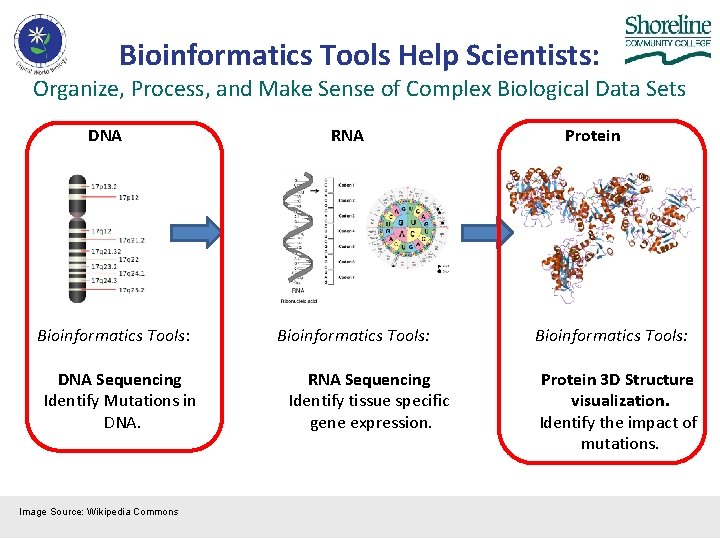
Bioinformatics Tools Help Scientists: Organize, Process, and Make Sense of Complex Biological Data Sets DNA Bioinformatics Tools: DNA Sequencing Identify Mutations in DNA. Image Source: Wikipedia Commons RNA Bioinformatics Tools: RNA Sequencing Identify tissue specific gene expression. Protein Bioinformatics Tools: Protein 3 D Structure visualization. Identify the impact of mutations.
![TAS 2 R 38 Bitter Taste Receptor [“PTC”] Gene Left Primer Chromosome 7 1002](http://slidetodoc.com/presentation_image_h2/b936edfafaedcca448d4593f07e38960/image-4.jpg "TAS 2 R 38 Bitter Taste Receptor [“PTC”] Gene Left Primer Chromosome 7 1002")
TAS 2 R 38 Bitter Taste Receptor [“PTC”] Gene Left Primer Chromosome 7 1002 bp Right Primer Amplify by PCR NONTASTER (tt) TASTER (TT) GGCGGGCACT GGCGGCCACT PCR PRODUCT (221 bp) GGCGGGCACT 221 bp FRAGMENT Digest with Hae. III Restriction Enzyme (Recognition Sequence GGCC ) Gel Electrophoresis 221 bp FRAGMENT PCR PRODUCT (221 bp) GGCGG 44 bp FRAGMENT CCACT 177 bp FRAGMENT 44 bp FRAGMENT Source: Using a Single-Nucleotide Polymorphism to Predict Bitter-Tasting Ability. Dolan DNA Learning Center and Carolina Biologicals.

Can you taste that? PTC Tasting & Polymerase Chain Reaction (PCR) U = Undigested PCR Product D = Digested PCR Product • Day 1: Isolating DNA • Day 2: Performing PCR • Day 3: Restriction Digest of PCR Product TT MW U D Tt U D tt U D • Day 4: Agarose Gel Electrophoresis & PTC Tasting Paper • Day 5: Bioinformatics Activity TT = 221 bp FRAGMENT Tt = 221 bp, 177 bp & 44 bp* FRAGMENTS tt = 177 bp & 44 bp* FRAGMENTS *44 bp FRAGMENT difficult to visualize

Can you taste that? PTC Tasting Ability Among Primates http: //v 3. digitalworldbiology. com/ptc-tasting-ability-among-
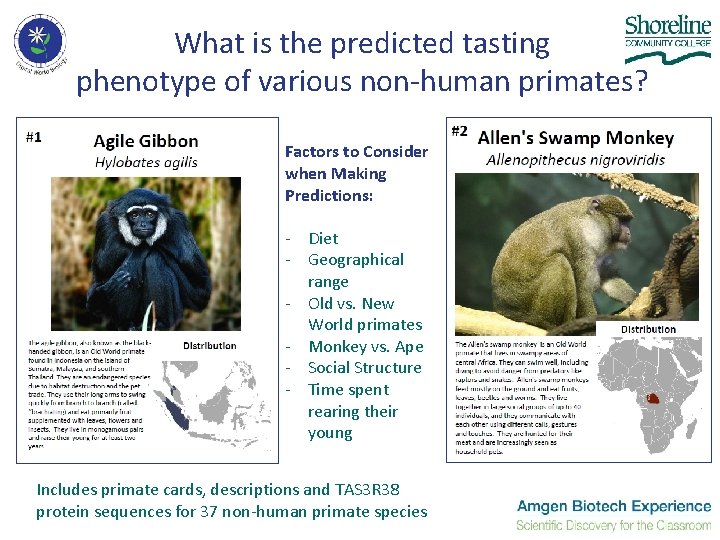
What is the predicted tasting phenotype of various non-human primates? Factors to Consider when Making Predictions: - Diet - Geographical range - Old vs. New World primates - Monkey vs. Ape - Social Structure - Time spent rearing their young Includes primate cards, descriptions and TAS 3 R 38 protein sequences for 37 non-human primate species
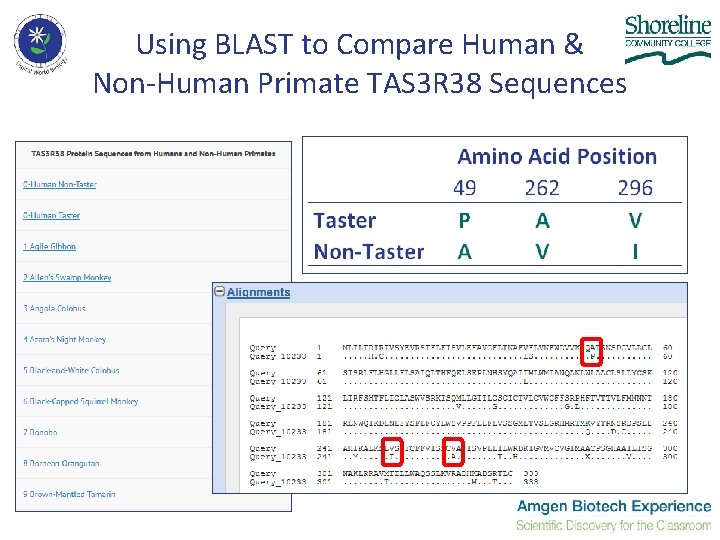
Using BLAST to Compare Human & Non-Human Primate TAS 3 R 38 Sequences
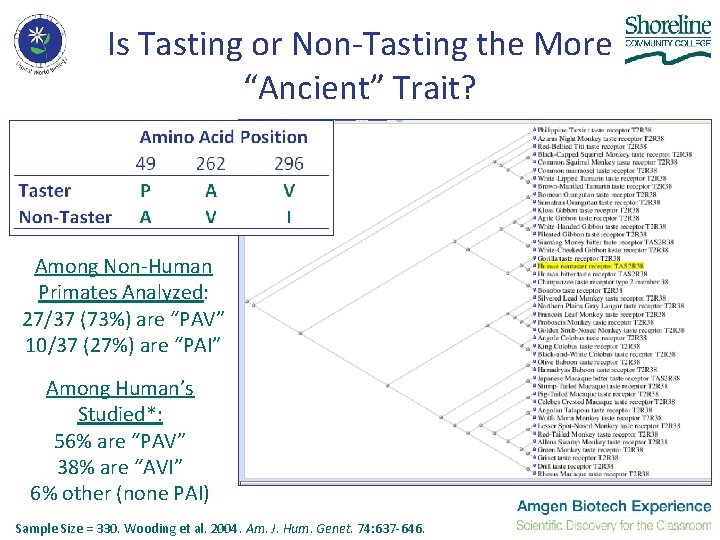
Is Tasting or Non-Tasting the More “Ancient” Trait? Among Non-Human Primates Analyzed: 27/37 (73%) are “PAV” 10/37 (27%) are “PAI” Among Human’s Studied*: 56% are “PAV” 38% are “AVI” 6% other (none PAI) Sample Size = 330. Wooding et al. 2004. Am. J. Hum. Genet. 74: 637 -646.
- Slides: 9