
Can we improve MRI detection sensitivity by 2
Can we improve MRI detection sensitivity by 2 to 3 orders? Jiani Hu, Ph. D Wayne State University Detroit, Michigan (313) 993 -7947 jianihu@yahoo. com jhu@med. wayne. edu
MRI is a favorable imaging modality: • non-invasiveness • excellent soft-tissue contrast • morphological imaging • functional imaging
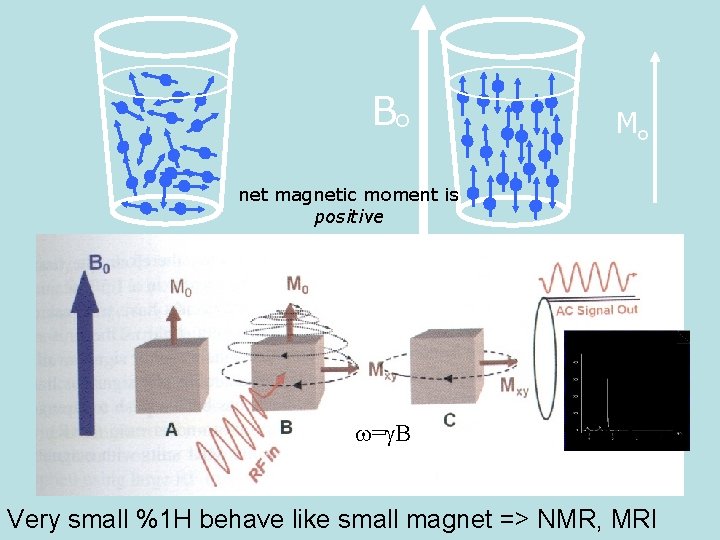
Bo Mo net magnetic moment is positive w=g. B Very small %1 H behave like small magnet => NMR, MRI
MRI is fundamentally a low-sensitivity technique: • Information from a few ppm of water. Disadvantage of low sensitivity: • long scan times • low resolution imaging • expensive equipment
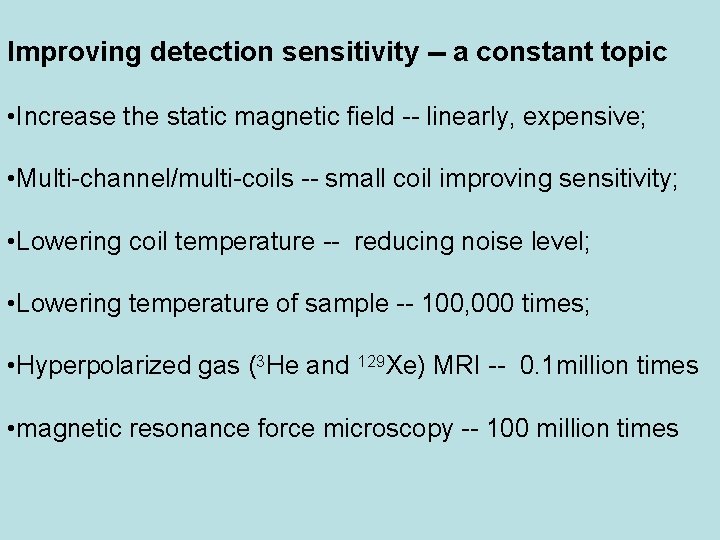
Improving detection sensitivity -- a constant topic • Increase the static magnetic field -- linearly, expensive; • Multi-channel/multi-coils -- small coil improving sensitivity; • Lowering coil temperature -- reducing noise level; • Lowering temperature of sample -- 100, 000 times; • Hyperpolarized gas (3 He and 129 Xe) MRI -- 0. 1 million times • magnetic resonance force microscopy -- 100 million times
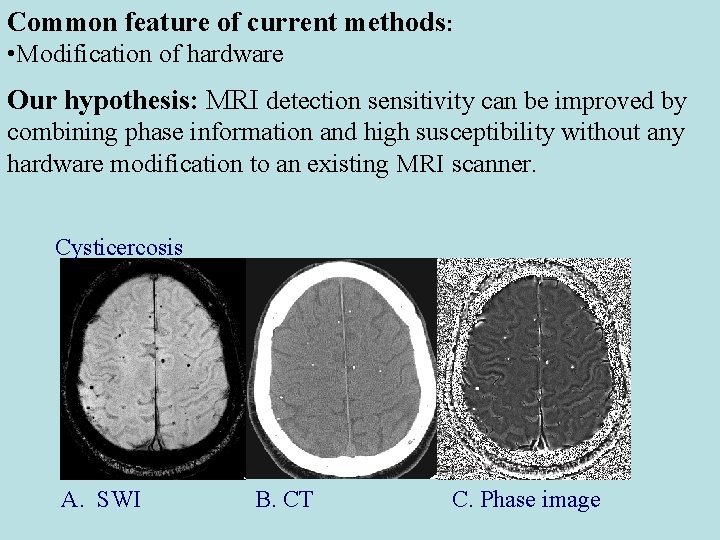
Common feature of current methods: • Modification of hardware Our hypothesis: MRI detection sensitivity can be improved by combining phase information and high susceptibility without any hardware modification to an existing MRI scanner. Cysticercosis A. SWI B. CT C. Phase image
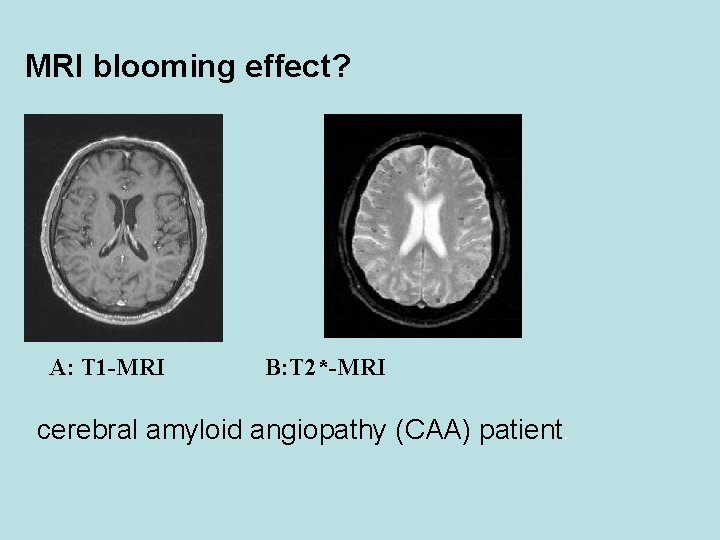
MRI blooming effect? A: T 1 -MRI B: T 2*-MRI cerebral amyloid angiopathy (CAA) patient.
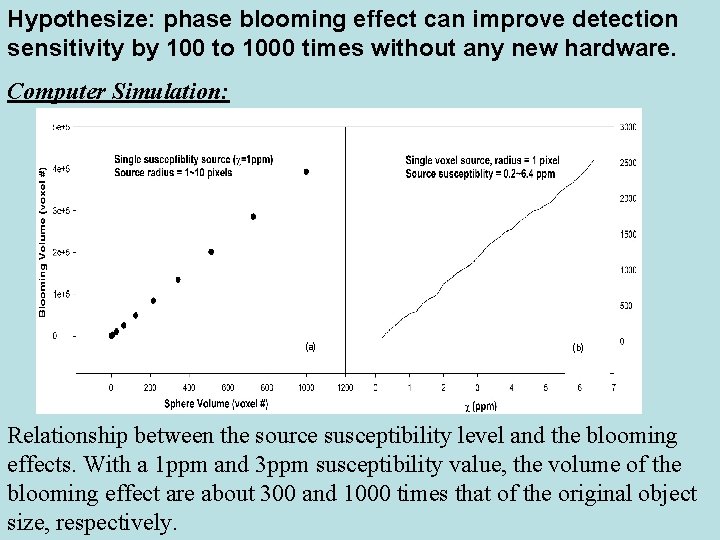
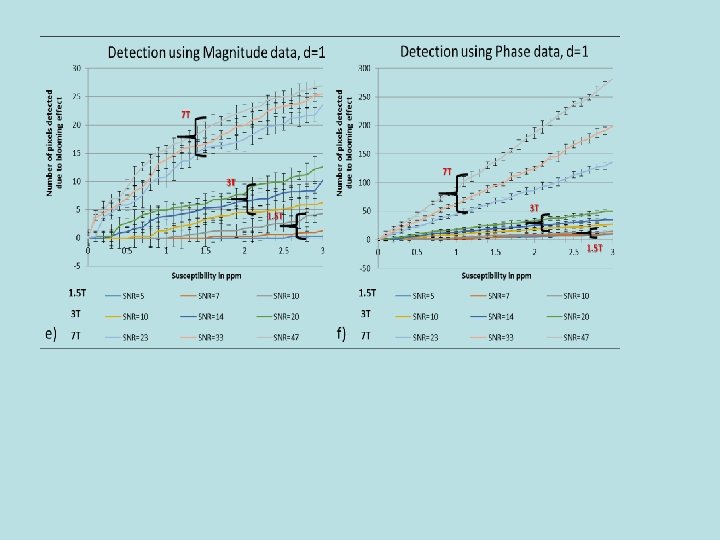
Hypothesize: phase blooming effect can improve detection sensitivity by 100 to 1000 times without any new hardware. Computer Simulation: (a) (b) Relationship between the source susceptibility level and the blooming effects. With a 1 ppm and 3 ppm susceptibility value, the volume of the blooming effect are about 300 and 1000 times that of the original object size, respectively.
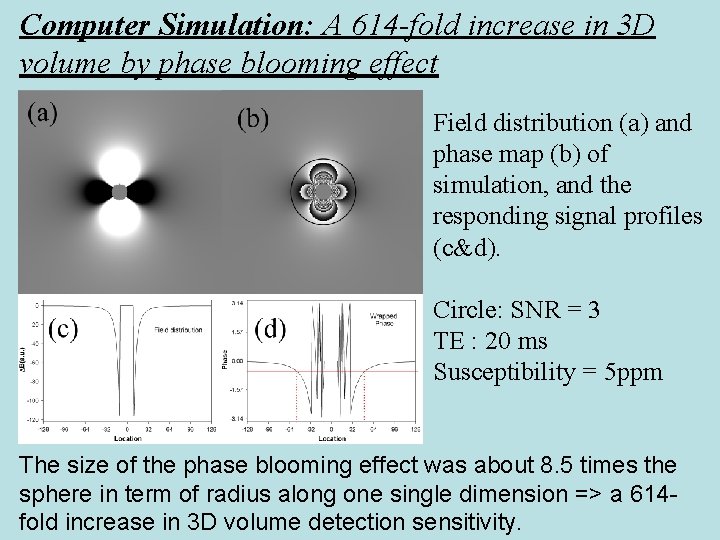
Computer Simulation: A 614 -fold increase in 3 D volume by phase blooming effect Field distribution (a) and phase map (b) of simulation, and the responding signal profiles (c&d). Circle: SNR = 3 TE : 20 ms Susceptibility = 5 ppm The size of the phase blooming effect was about 8. 5 times the sphere in term of radius along one single dimension => a 614 fold increase in 3 D volume detection sensitivity.
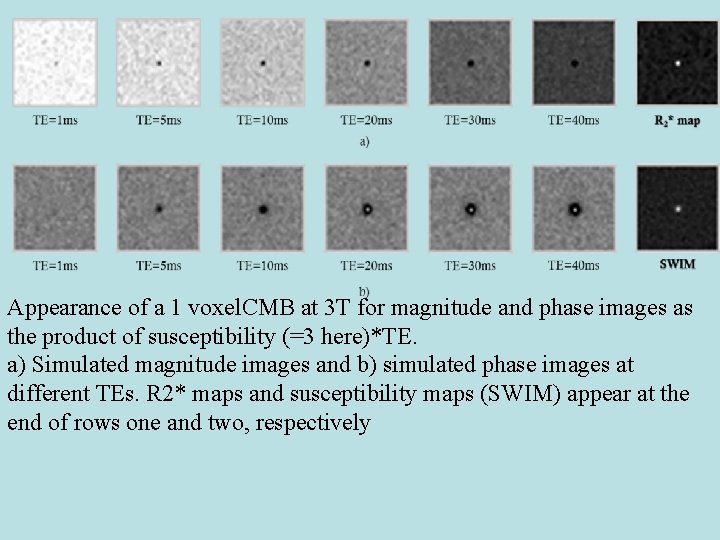
Appearance of a 1 voxel. CMB at 3 T for magnitude and phase images as the product of susceptibility (=3 here)*TE. a) Simulated magnitude images and b) simulated phase images at different TEs. R 2* maps and susceptibility maps (SWIM) appear at the end of rows one and two, respectively
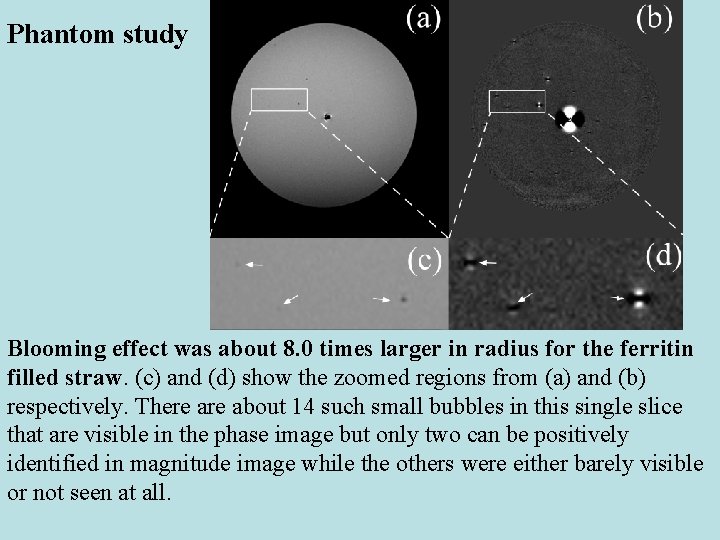
Phantom study Blooming effect was about 8. 0 times larger in radius for the ferritin filled straw. (c) and (d) show the zoomed regions from (a) and (b) respectively. There about 14 such small bubbles in this single slice that are visible in the phase image but only two can be positively identified in magnitude image while the others were either barely visible or not seen at all.
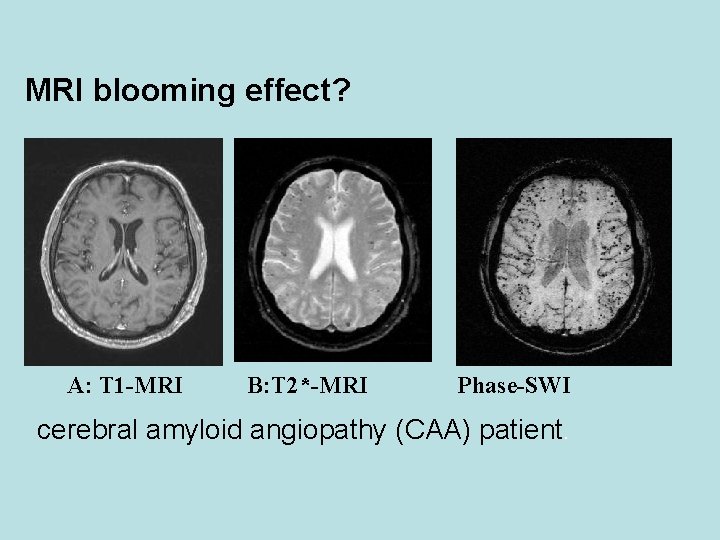
MRI blooming effect? A: T 1 -MRI B: T 2*-MRI Phase-SWI cerebral amyloid angiopathy (CAA) patient.
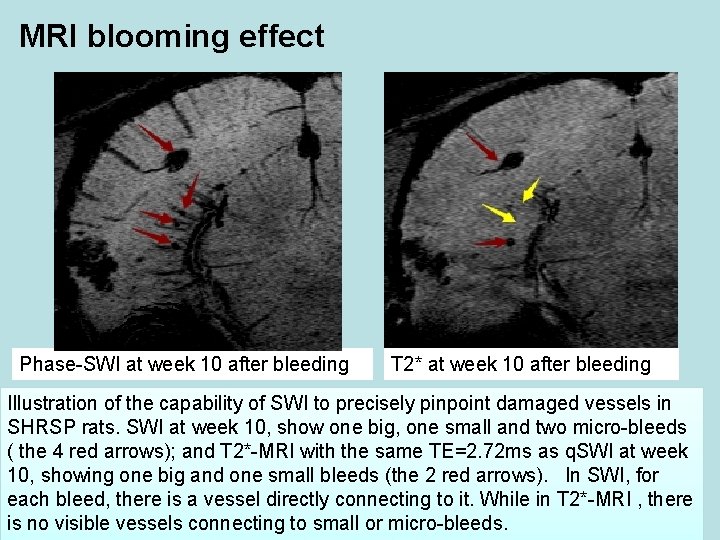
MRI blooming effect Phase-SWI at week 10 after bleeding T 2* at week 10 after bleeding Illustration of the capability of SWI to precisely pinpoint damaged vessels in SHRSP rats. SWI at week 10, show one big, one small and two micro-bleeds ( the 4 red arrows); and T 2*-MRI with the same TE=2. 72 ms as q. SWI at week 10, showing one big and one small bleeds (the 2 red arrows). In SWI, for each bleed, there is a vessel directly connecting to it. While in T 2*-MRI , there is no visible vessels connecting to small or micro-bleeds.
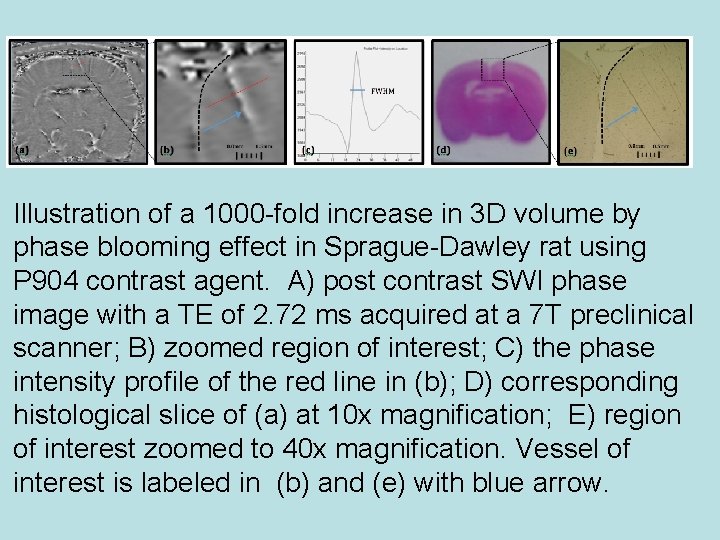
Illustration of a 1000 -fold increase in 3 D volume by phase blooming effect in Sprague-Dawley rat using P 904 contrast agent. A) post contrast SWI phase image with a TE of 2. 72 ms acquired at a 7 T preclinical scanner; B) zoomed region of interest; C) the phase intensity profile of the red line in (b); D) corresponding histological slice of (a) at 10 x magnification; E) region of interest zoomed to 40 x magnification. Vessel of interest is labeled in (b) and (e) with blue arrow.
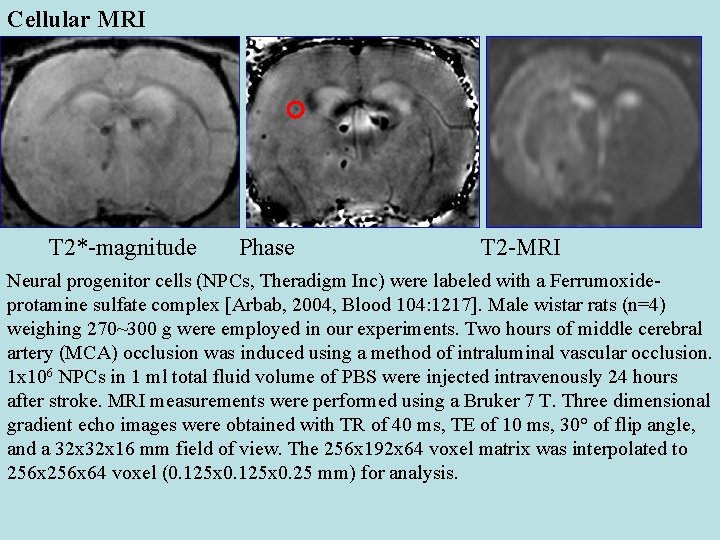
Cellular MRI T 2*-magnitude Phase T 2 -MRI Neural progenitor cells (NPCs, Theradigm Inc) were labeled with a Ferrumoxideprotamine sulfate complex [Arbab, 2004, Blood 104: 1217]. Male wistar rats (n=4) weighing 270~300 g were employed in our experiments. Two hours of middle cerebral artery (MCA) occlusion was induced using a method of intraluminal vascular occlusion. 1 x 10⁶ NPCs in 1 ml total fluid volume of PBS were injected intravenously 24 hours after stroke. MRI measurements were performed using a Bruker 7 T. Three dimensional gradient echo images were obtained with TR of 40 ms, TE of 10 ms, 30° of flip angle, and a 32 x 16 mm field of view. The 256 x 192 x 64 voxel matrix was interpolated to 256 x 64 voxel (0. 125 x 0. 25 mm) for analysis.
The potential: cellular, molecular imaging If current MRI detection threshold is 100, 000 cells, the "new" detection sensitivity could be improved to 100 cells. Such capability could change the paradigm of how we acquire cellular/ molecular MRI today. Early cancer detection using targeted delivery of iron-based contrast agent: 1. Stem cells 2. Nanoparticle based delivery system. The clinical significance

Acknowledgments Horea Calimente E. Mark Haacke Quan Jiang Zhengang Zhang Zach Dell Tianwu Chen Qing Lu Haoyu Wang Mattew Amans Wenzheng Feng Zahid Latif Yimin Shen Yang Xuan Kui Luo Jiajun Wang Guojun Wu Yongquan Ye Zhifeng Kou Chuanming Li Hong Li Lianmin Wu Wanlong Pan Xinghui Li Yanwei Miao Bisher Tarabishy Yanming Yu
- Slides: 18