
Can this be generalized NPhard for Potts model
![Can this be generalized? § § NP-hard for Potts model [K/BVZ 01] Two main](https://slidetodoc.com/presentation_image_h2/95b6b54ae08e71308c83a0d8e93d1245/image-1.jpg "Can this be generalized? § § NP-hard for Potts model [K/BVZ 01] Two main")
Can this be generalized? § § NP-hard for Potts model [K/BVZ 01] Two main approaches 1. Exact solution [Ishikawa 03] • Large graph, convex V (arbitrary D) • Not the considered the right prior for vision 2. Approximate solutions [BVZ 01] • Solve a binary labeling problem, repeatedly • Expansion move algorithm 1
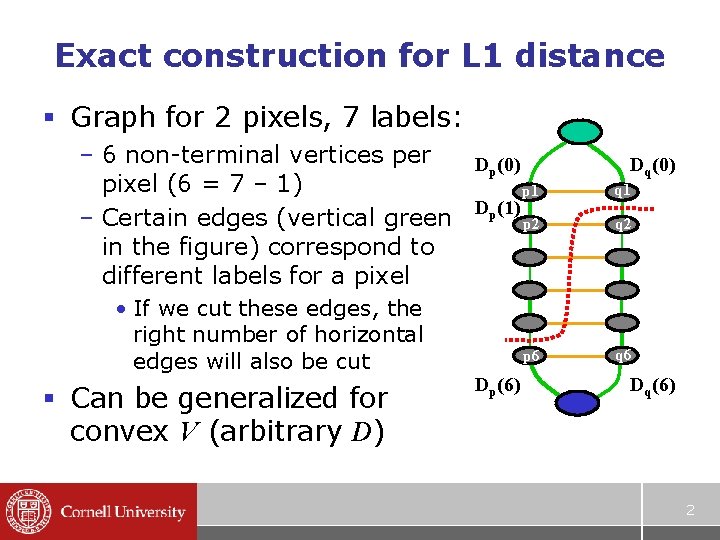
Exact construction for L 1 distance § Graph for 2 pixels, 7 labels: – 6 non-terminal vertices per Dp(0) pixel (6 = 7 – 1) p 1 – Certain edges (vertical green Dp(1) p 2 in the figure) correspond to different labels for a pixel • If we cut these edges, the right number of horizontal edges will also be cut § Can be generalized for convex V (arbitrary D) p 6 Dp(6) Dq(0) q 1 q 2 q 6 Dq(6) 2

Convex over-smoothing § Convex priors are widely viewed in vision as inappropriate (“non-robust”) – These priors prefer globally smooth images • Which is almost never suitable § This is not just a theoretical argument – It’s observed in practice, even at global min 3
Appropriate prior? § We need to avoid over-penalizing large jumps in the solution § This is related to outliers, and the whole area of robust statistics § We tend to get structured outliers in images, which are particularly challenging! 4
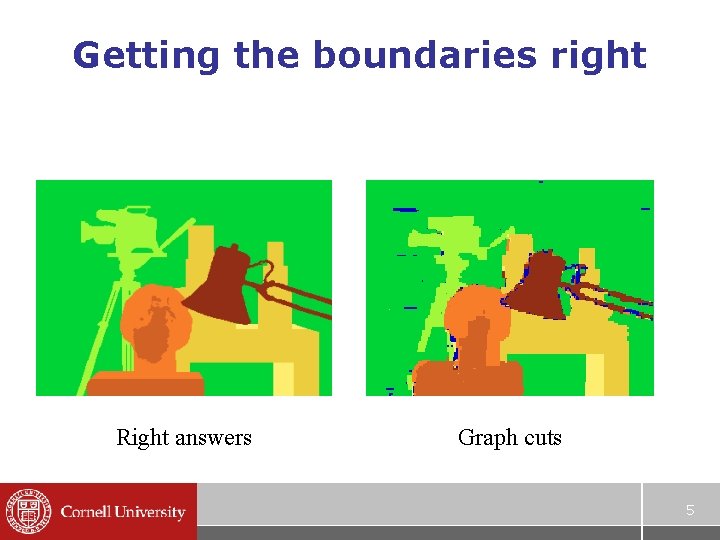
Getting the boundaries right Right answers Graph cuts Correlation 5

Expansion move algorithm Input labeling f Green expansion move from f § Make green expansion move that most decreases E – Then make the best blue expansion move, etc – Done when no -expansion move decreases the energy, for any label – See [BVZ 01] for details 6
Local improvement vs. Graph cuts § Continuous vs. discrete – No floating point with graph cuts § Local min in line search vs. global min § Minimize over a line vs. hypersurface – Containing O(2 n) candidates § Local minimum: weak vs. strong – Within 1% of global min on benchmarks! – Theoretical guarantees concerning distance from global minimum • 2 -approximation for a common choice of E 7
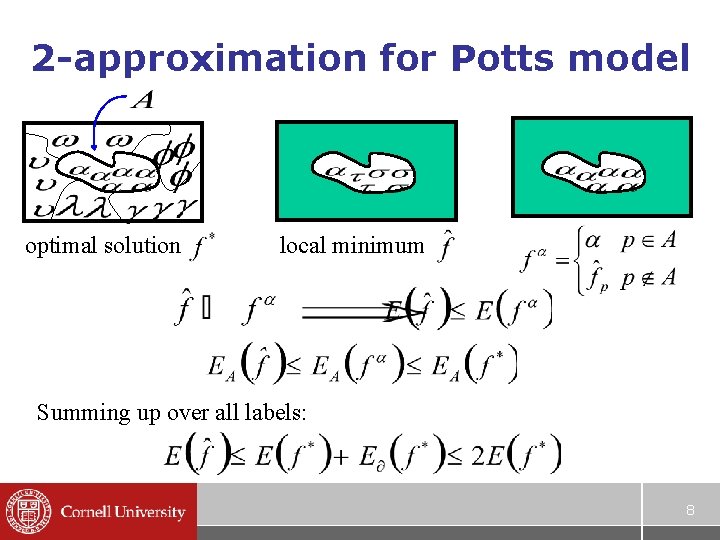
2 -approximation for Potts model optimal solution local minimum Summing up over all labels: 8
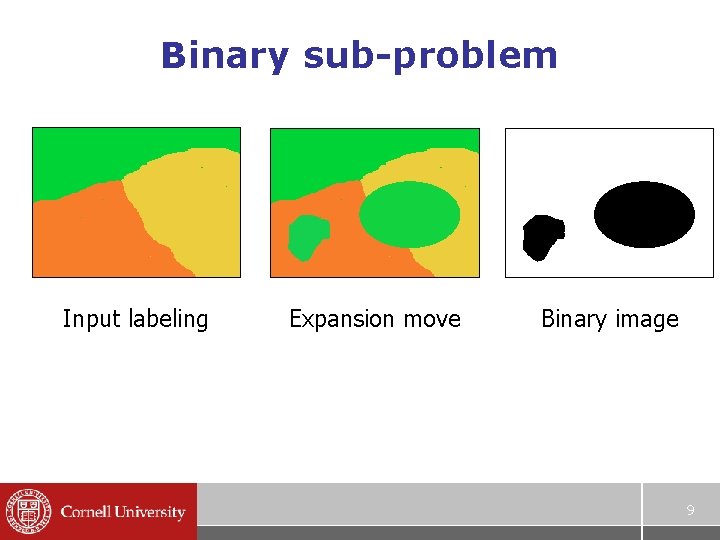
Binary sub-problem Input labeling Expansion move Binary image 9
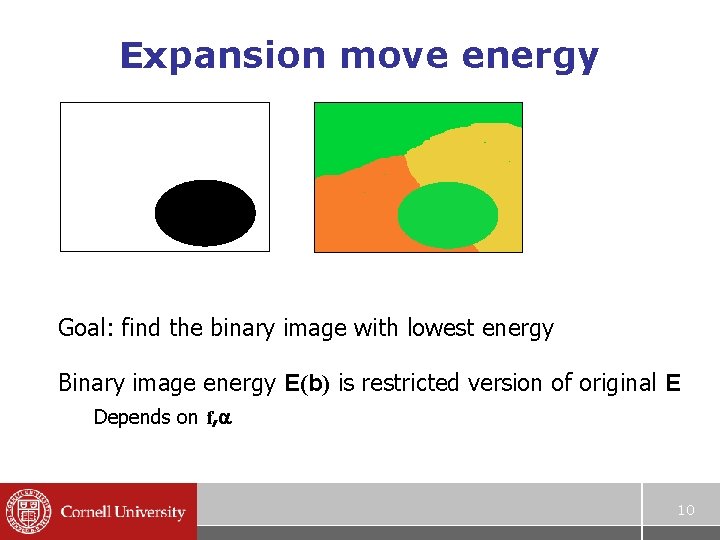
Expansion move energy Goal: find the binary image with lowest energy Binary image energy E(b) is restricted version of original E Depends on f, 10
![Regularity § The binary energy function is regular [KZ 04] if § This is](http://slidetodoc.com/presentation_image_h2/95b6b54ae08e71308c83a0d8e93d1245/image-11.jpg "Regularity § The binary energy function is regular [KZ 04] if § This is")
Regularity § The binary energy function is regular [KZ 04] if § This is a special case of submodularity 11
- Slides: 11