
CAN PLASMA MODELING BE A PREDICTIVE TOOL IN
CAN PLASMA MODELING BE A PREDICTIVE TOOL IN PROCESS DEVELOPMENT? ETCHING OF VERY HIGH ASPECT RATIO FEATURES AND GATE STACKS Mingmei Wang, Juline Shoeb, Yang and Mark J. Kushner University of Michigan Ann Arbor, MI 48109 USA mjkush@umich. edu http: //uigelz. eecs. umich. edu October 2008 AVS 08_MJK
CONGRATULATIONS · Congratulations to Prof. Herb Sawin on his retirement. · With apologies to www. despair. com AVS 08_MJK University of Michigan Institute for Plasma Science and Engineering
AGENDA · Past, present and future expectations for process modeling. · How do we get from here to there? · We model equipment well, why not processes? · Extremely high aspect ratio features · Hf. O 2 gate-stack etching · Concluding Remarks · Work supported by Semiconductor Research Corp. , Applied Materials Inc. , Tokyo Electron Ltd. and Intevac. AVS 08_MJK University of Michigan Institute for Plasma Science and Engineering
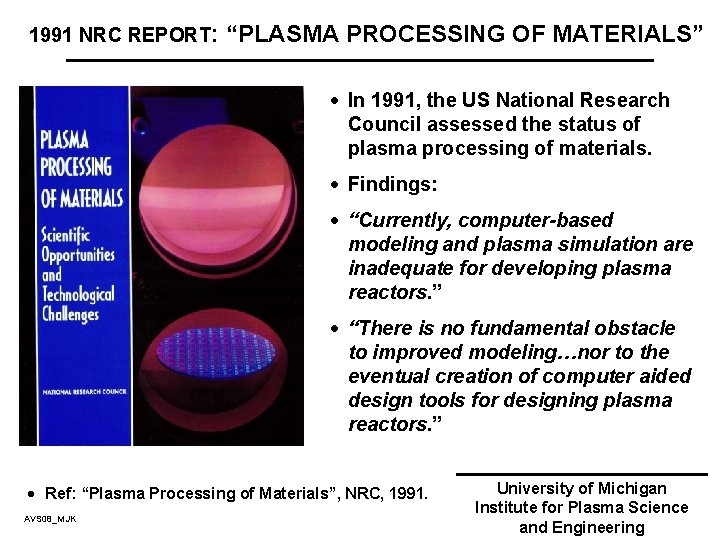
1991 NRC REPORT: “PLASMA PROCESSING OF MATERIALS” · In 1991, the US National Research Council assessed the status of plasma processing of materials. · Findings: · “Currently, computer-based modeling and plasma simulation are inadequate for developing plasma reactors. ” · “There is no fundamental obstacle to improved modeling…nor to the eventual creation of computer aided design tools for designing plasma reactors. ” · Ref: “Plasma Processing of Materials”, NRC, 1991. AVS 08_MJK University of Michigan Institute for Plasma Science and Engineering
1991 NRC REPORT: WHAT IS NECESSARY TO ACHIEVE GOALS · To achieve the modeling goals set out in the 1991 NRC Report: · A reliable and extensive plasma data base against which the accuracy of simulations of plasmas can be compared. · A reliable and extensive input data base for calculating plasma generation, transport and surface interaction. · Efficient algorithms and supercomputers for simulating magnetized plasmas in 3 dimensions. · Ref: “Plasma Processing of Materials”, NRC, 1991. AVS 08_MJK University of Michigan Institute for Plasma Science and Engineering
2007 NRC REPORT: PLASMA SCIENCE: ADVANCING KNOWLEDGE IN THE NATIONAL INTEREST · NRC Decadal Study on Plasma Science (http: //www. nap. edu/catalog. php? record_id=11960) · Low Temperature Plasmas: Extreme challenges face modeling and the allied sciences to develop comprehensive and validated theories, computer models and databases that place predictive capabilities in the hands of technologists. “This represents the highest level of challenge and the highest potential return…to both quantify and advance our understanding of low temperature plasmas, and to leverage that understanding by speeding the develop of society benefiting technologies. ” Ref: Adapted from “Plasma Science: Advancing Knowledge in the National Interest”, NRC, 2007. AVS 08_MJK University of Michigan Institute for Plasma Science and Engineering
DOE/OFFICE OF SCIENCE WORKSHOP · Low Temperature Plasma Science: Not only the Fourth State of Matter but All of Them (September 2008) · Priorities in Modeling and simulation · 1 - Expand plasma capabilities to combine theory, simulation, and reacting flow equations to model closely-coupled, stochastic processes. · 4 - Develop multi-scale methods describing interactions of plasmas with nanoscale features such as nano-particles and nano-textured surfaces. AVS 08_MJK University of Michigan Institute for Plasma Science and Engineering
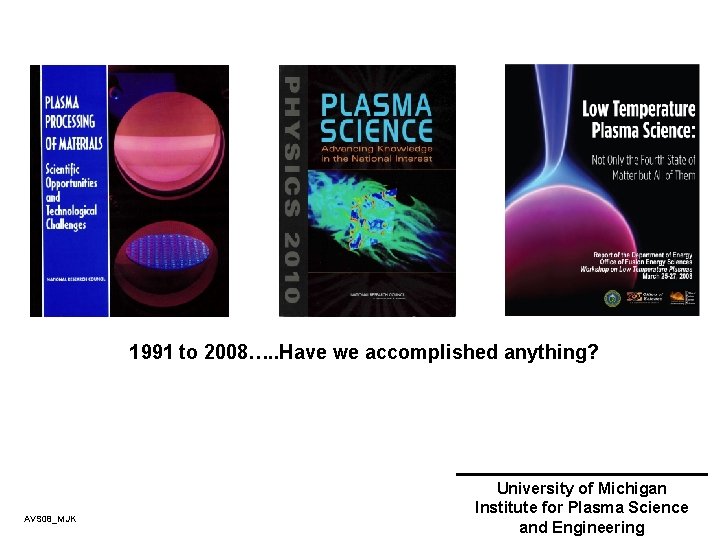
1991 to 2008…. . Have we accomplished anything? AVS 08_MJK University of Michigan Institute for Plasma Science and Engineering
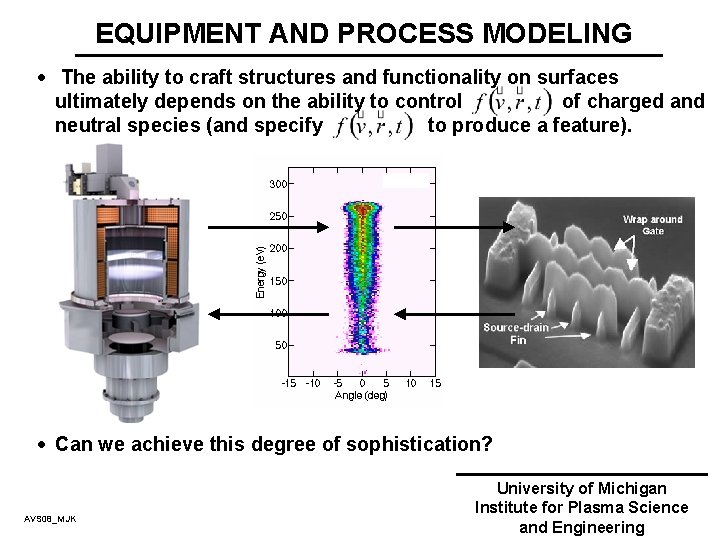
EQUIPMENT AND PROCESS MODELING · The ability to craft structures and functionality on surfaces ultimately depends on the ability to control of charged and neutral species (and specify to produce a feature). · Can we achieve this degree of sophistication? AVS 08_MJK University of Michigan Institute for Plasma Science and Engineering

MODELS FOR DESIGNING PLASMA EQUIPMENT · We do well in modeling plasma equipment · Vary power, pressure, geometry, gas mixture in the model…We can predict the change in fluxes. · Parametric variations better represented than absolute values. · Subtleties of equipment (e. g. , materials, gaps) can be captured. · Instabilities and long term transients are problematic. · High frequency and non-standard excitation are challenging but doable. · In principle there is a path forward for most of these issues. AVS 08_MJK · 3 D CCP simulation showing plasma penetration through confinement rings (Ref: Kenney, Rauf, Collins, 2008) University of Michigan Institute for Plasma Science and Engineering
MODELS FOR DESIGNING PROCESSES · We do less well in modeling processes. · Vary power, pressure, geometry, gas mixture in the model… Quantitative, first principles predictions of profiles (or better yet, specify the reactor conditions to produce a profile) are lacking. · In principle, this is a “chemistry issue”. If we knew the reaction mechanism, we could represent the process well. · Subtleties abound (e. g. , mixed layers, reflection from non-planar local topology) that are not known or that are not captured. · Subtleties may not be resolvable from first principles (e. g. , MD) on large enough scale lengths for process design without massively parallel computing approaching weapons design. · Even then fundamentals parameters are not known…. . · Is there a path forward? Less clear…. AVS 08_MJK University of Michigan Institute for Plasma Science and Engineering
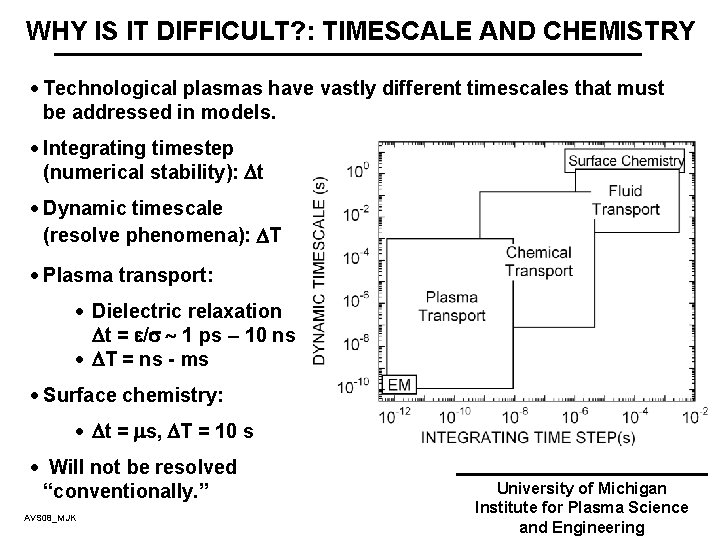
WHY IS IT DIFFICULT? : TIMESCALE AND CHEMISTRY · Technological plasmas have vastly different timescales that must be addressed in models. · Integrating timestep (numerical stability): t · Dynamic timescale (resolve phenomena): T · Plasma transport: · Dielectric relaxation t = / 1 ps – 10 ns · T = ns - ms · Surface chemistry: · t = s, T = 10 s · Will not be resolved “conventionally. ” AVS 08_MJK University of Michigan Institute for Plasma Science and Engineering
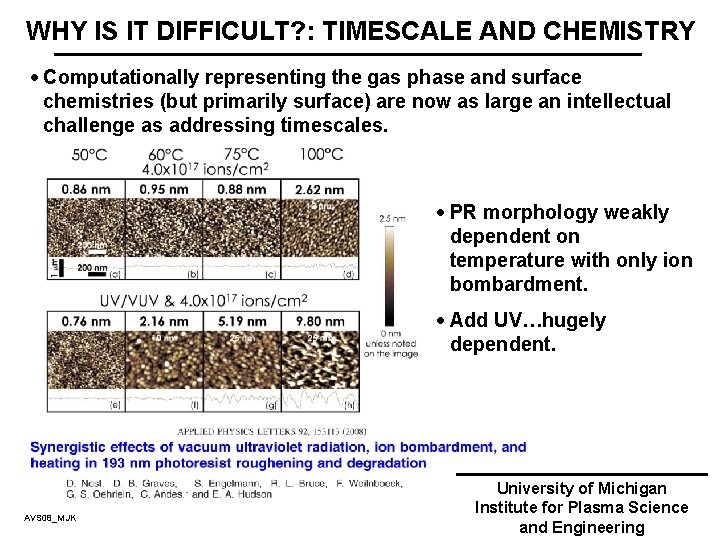
WHY IS IT DIFFICULT? : TIMESCALE AND CHEMISTRY · Computationally representing the gas phase and surface chemistries (but primarily surface) are now as large an intellectual challenge as addressing timescales. · PR morphology weakly dependent on temperature with only ion bombardment. · Add UV…hugely dependent. AVS 08_MJK University of Michigan Institute for Plasma Science and Engineering
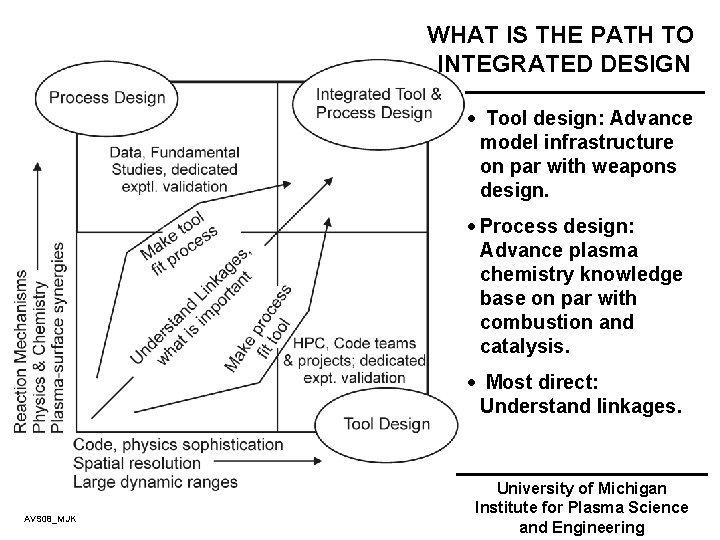
WHAT IS THE PATH TO INTEGRATED DESIGN · Tool design: Advance model infrastructure on par with weapons design. · Process design: Advance plasma chemistry knowledge base on par with combustion and catalysis. · Most direct: Understand linkages. AVS 08_MJK University of Michigan Institute for Plasma Science and Engineering
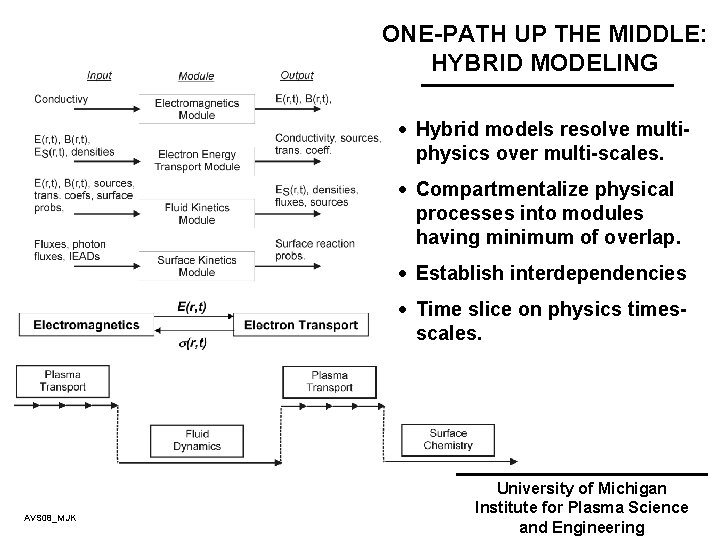
ONE-PATH UP THE MIDDLE: HYBRID MODELING · Hybrid models resolve multiphysics over multi-scales. · Compartmentalize physical processes into modules having minimum of overlap. · Establish interdependencies · Time slice on physics timesscales. AVS 08_MJK University of Michigan Institute for Plasma Science and Engineering
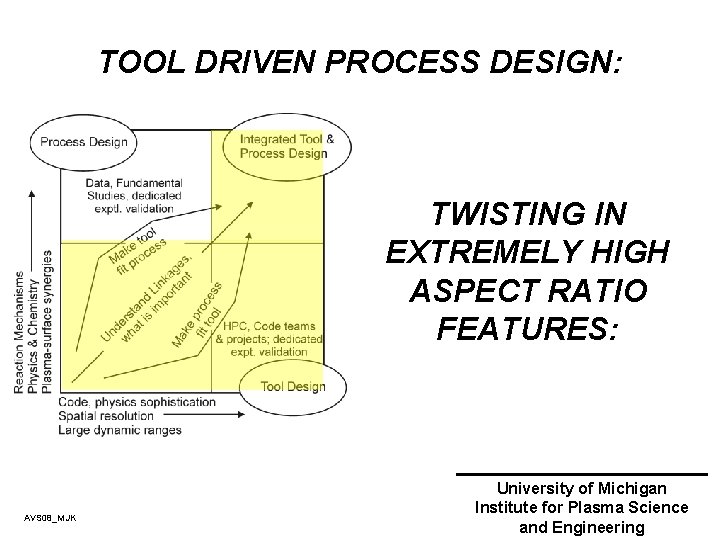
TOOL DRIVEN PROCESS DESIGN: TWISTING IN EXTREMELY HIGH ASPECT RATIO FEATURES: AVS 08_MJK University of Michigan Institute for Plasma Science and Engineering
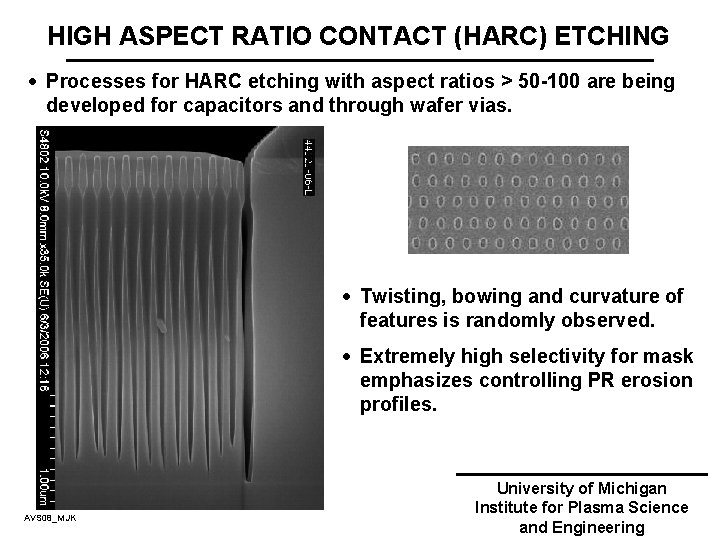
HIGH ASPECT RATIO CONTACT (HARC) ETCHING · Processes for HARC etching with aspect ratios > 50 -100 are being developed for capacitors and through wafer vias. · Twisting, bowing and curvature of features is randomly observed. · Extremely high selectivity for mask emphasizes controlling PR erosion profiles. AVS 08_MJK University of Michigan Institute for Plasma Science and Engineering
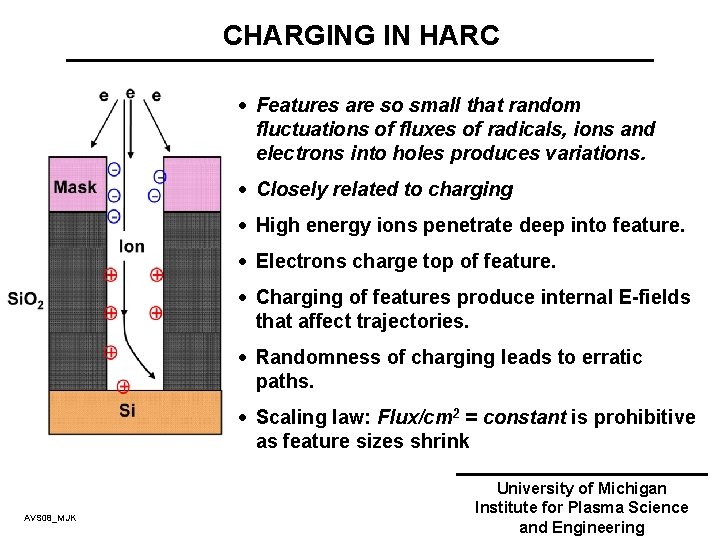
CHARGING IN HARC · Features are so small that random fluctuations of fluxes of radicals, ions and electrons into holes produces variations. · Closely related to charging · High energy ions penetrate deep into feature. · Electrons charge top of feature. · Charging of features produce internal E-fields that affect trajectories. · Randomness of charging leads to erratic paths. · Scaling law: Flux/cm 2 = constant is prohibitive as feature sizes shrink AVS 08_MJK University of Michigan Institute for Plasma Science and Engineering
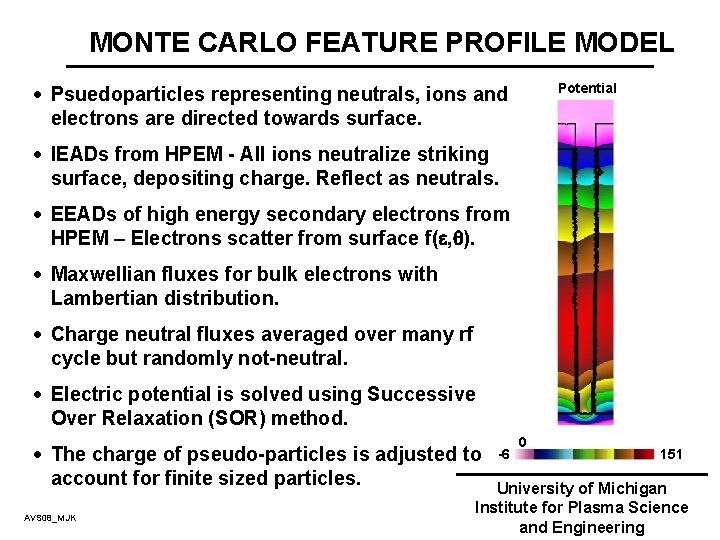
MONTE CARLO FEATURE PROFILE MODEL Potential · Psuedoparticles representing neutrals, ions and electrons are directed towards surface. · IEADs from HPEM - All ions neutralize striking surface, depositing charge. Reflect as neutrals. · EEADs of high energy secondary electrons from HPEM – Electrons scatter from surface f( , ). · Maxwellian fluxes for bulk electrons with Lambertian distribution. · Charge neutral fluxes averaged over many rf cycle but randomly not-neutral. · Electric potential is solved using Successive Over Relaxation (SOR) method. · The charge of pseudo-particles is adjusted to account for finite sized particles. AVS 08_MJK -6 0 151 University of Michigan Institute for Plasma Science and Engineering
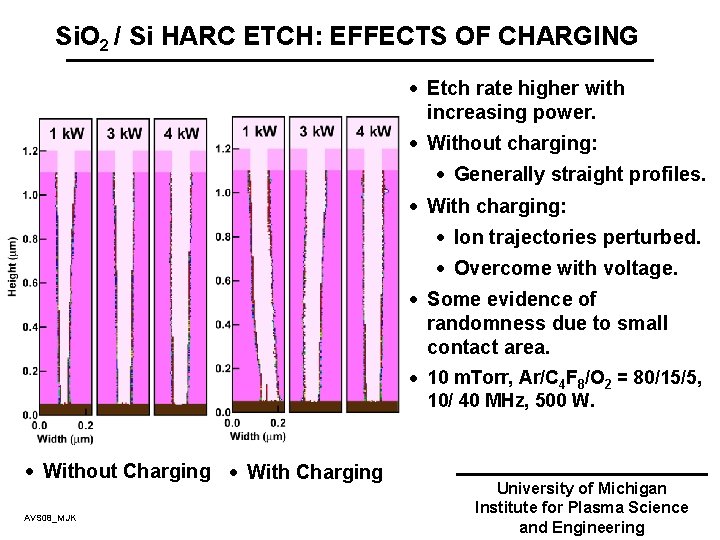
Si. O 2 / Si HARC ETCH: EFFECTS OF CHARGING · Etch rate higher with increasing power. · Without charging: · Generally straight profiles. · With charging: · Ion trajectories perturbed. · Overcome with voltage. · Some evidence of randomness due to small contact area. · 10 m. Torr, Ar/C 4 F 8/O 2 = 80/15/5, 10/ 40 MHz, 500 W. · Without Charging · With Charging AVS 08_MJK University of Michigan Institute for Plasma Science and Engineering
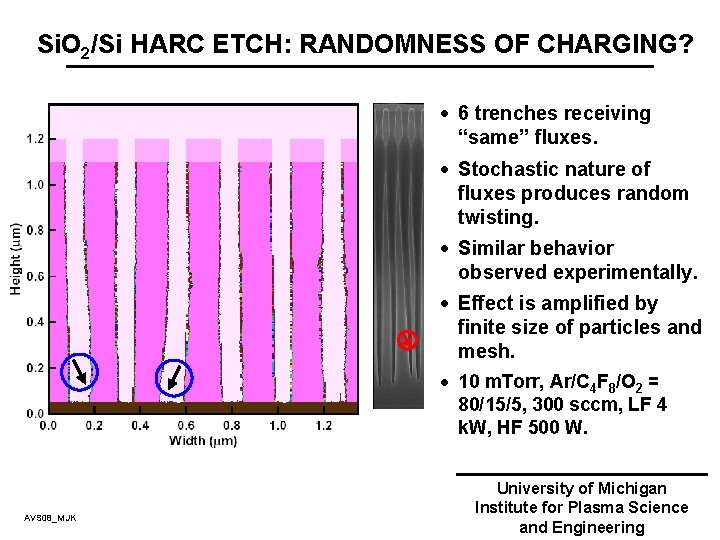
Si. O 2/Si HARC ETCH: RANDOMNESS OF CHARGING? · 6 trenches receiving “same” fluxes. · Stochastic nature of fluxes produces random twisting. · Similar behavior observed experimentally. · Effect is amplified by finite size of particles and mesh. · 10 m. Torr, Ar/C 4 F 8/O 2 = 80/15/5, 300 sccm, LF 4 k. W, HF 500 W. AVS 08_MJK University of Michigan Institute for Plasma Science and Engineering
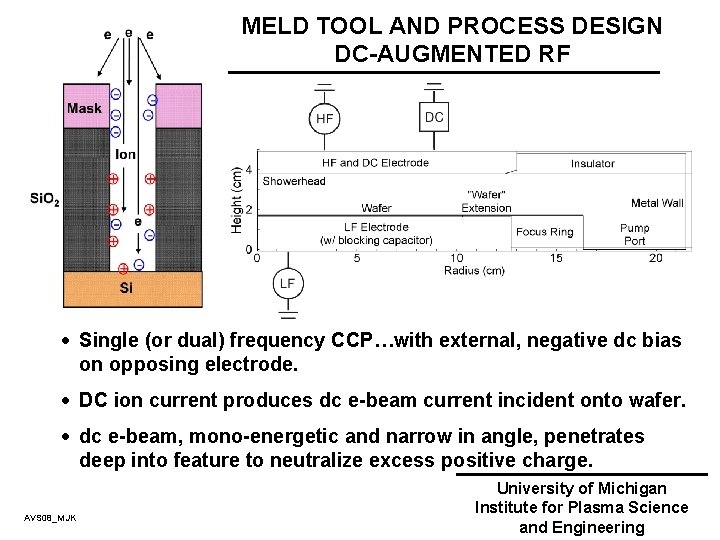
MELD TOOL AND PROCESS DESIGN DC-AUGMENTED RF · Single (or dual) frequency CCP…with external, negative dc bias on opposing electrode. · DC ion current produces dc e-beam current incident onto wafer. · dc e-beam, mono-energetic and narrow in angle, penetrates deep into feature to neutralize excess positive charge. AVS 08_MJK University of Michigan Institute for Plasma Science and Engineering
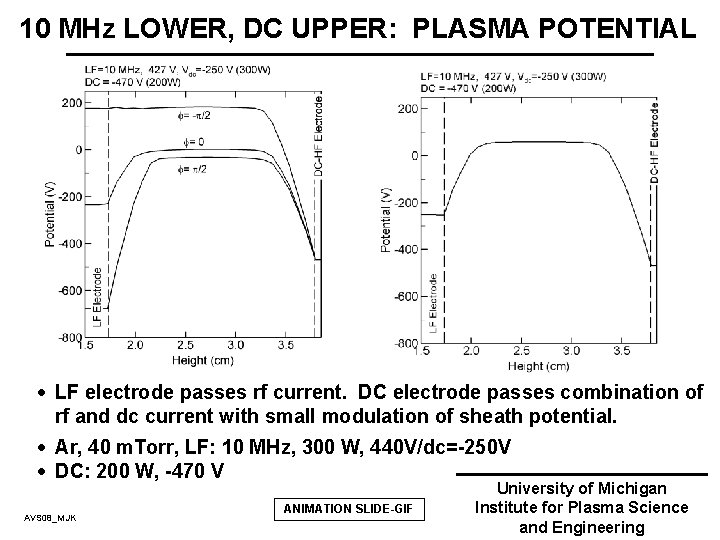
10 MHz LOWER, DC UPPER: PLASMA POTENTIAL · LF electrode passes rf current. DC electrode passes combination of rf and dc current with small modulation of sheath potential. · Ar, 40 m. Torr, LF: 10 MHz, 300 W, 440 V/dc=-250 V · DC: 200 W, -470 V AVS 08_MJK ANIMATION SLIDE-GIF University of Michigan Institute for Plasma Science and Engineering
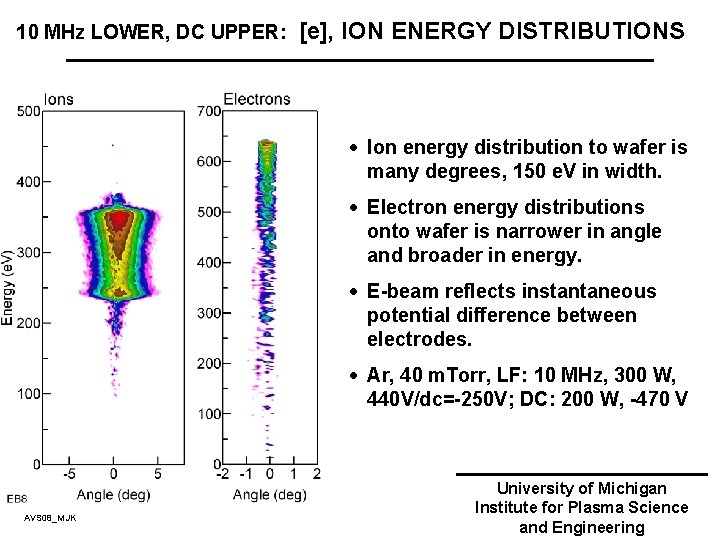
10 MHz LOWER, DC UPPER: [e], ION ENERGY DISTRIBUTIONS · Ion energy distribution to wafer is many degrees, 150 e. V in width. · Electron energy distributions onto wafer is narrower in angle and broader in energy. · E-beam reflects instantaneous potential difference between electrodes. · Ar, 40 m. Torr, LF: 10 MHz, 300 W, 440 V/dc=-250 V; DC: 200 W, -470 V AVS 08_MJK University of Michigan Institute for Plasma Science and Engineering
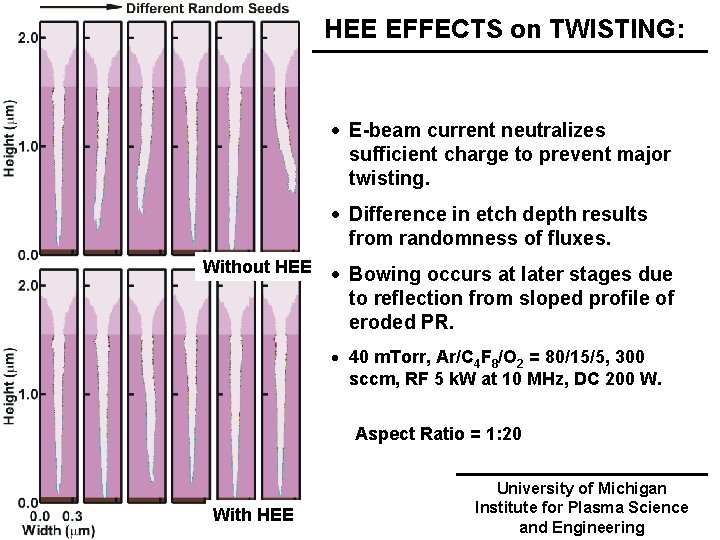
HEE EFFECTS on TWISTING: · E-beam current neutralizes sufficient charge to prevent major twisting. · Difference in etch depth results from randomness of fluxes. Without HEE · Bowing occurs at later stages due to reflection from sloped profile of eroded PR. · 40 m. Torr, Ar/C 4 F 8/O 2 = 80/15/5, 300 sccm, RF 5 k. W at 10 MHz, DC 200 W. Aspect Ratio = 1: 20 With HEE University of Michigan Institute for Plasma Science and Engineering
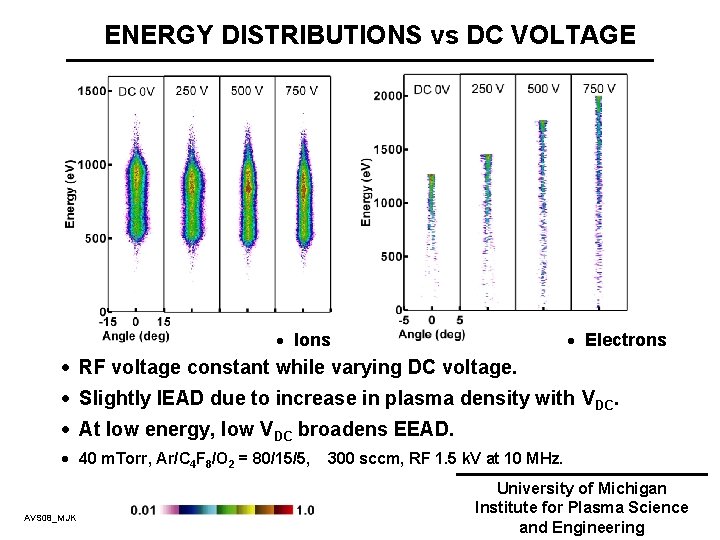
ENERGY DISTRIBUTIONS vs DC VOLTAGE · Electrons · Ions · RF voltage constant while varying DC voltage. · Slightly IEAD due to increase in plasma density with VDC. · At low energy, low VDC broadens EEAD. · 40 m. Torr, Ar/C 4 F 8/O 2 = 80/15/5, AVS 08_MJK 300 sccm, RF 1. 5 k. V at 10 MHz. University of Michigan Institute for Plasma Science and Engineering
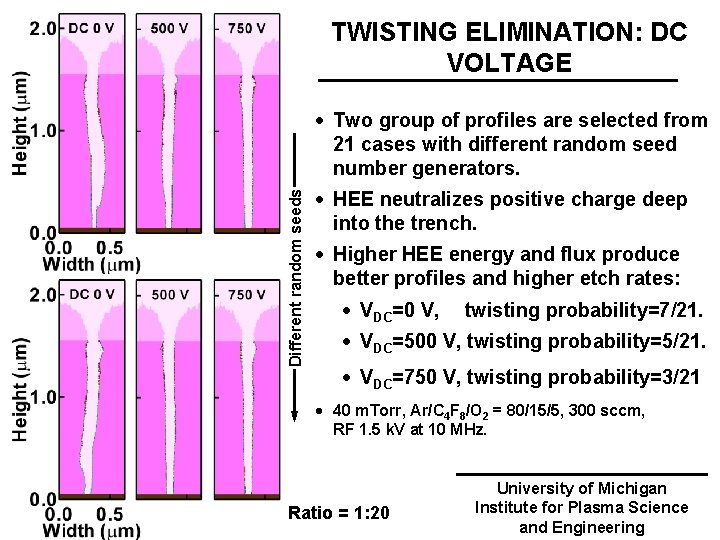
TWISTING ELIMINATION: DC VOLTAGE Different random seeds · Two group of profiles are selected from 21 cases with different random seed number generators. · HEE neutralizes positive charge deep into the trench. · Higher HEE energy and flux produce better profiles and higher etch rates: · VDC=0 V, twisting probability=7/21. · VDC=500 V, twisting probability=5/21. · VDC=750 V, twisting probability=3/21 · 40 m. Torr, Ar/C 4 F 8/O 2 = 80/15/5, 300 sccm, RF 1. 5 k. V at 10 MHz. MINGMEI_AVS 08_12 Aspect Ratio = 1: 20 University of Michigan Institute for Plasma Science and Engineering
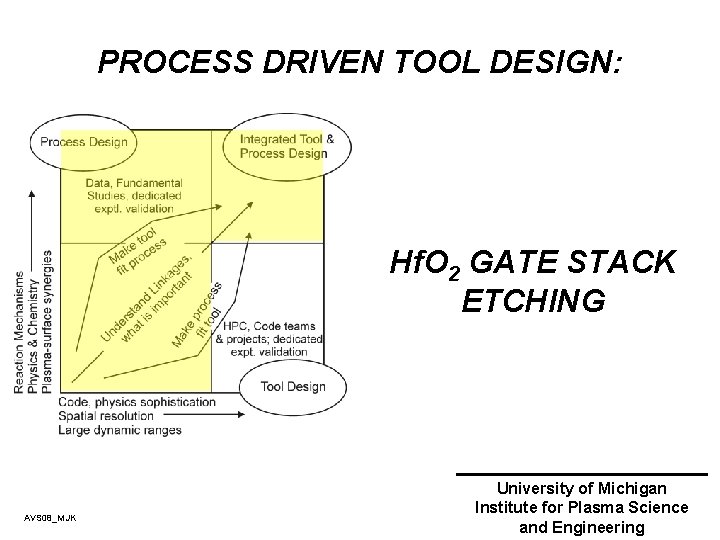
PROCESS DRIVEN TOOL DESIGN: Hf. O 2 GATE STACK ETCHING AVS 08_MJK University of Michigan Institute for Plasma Science and Engineering
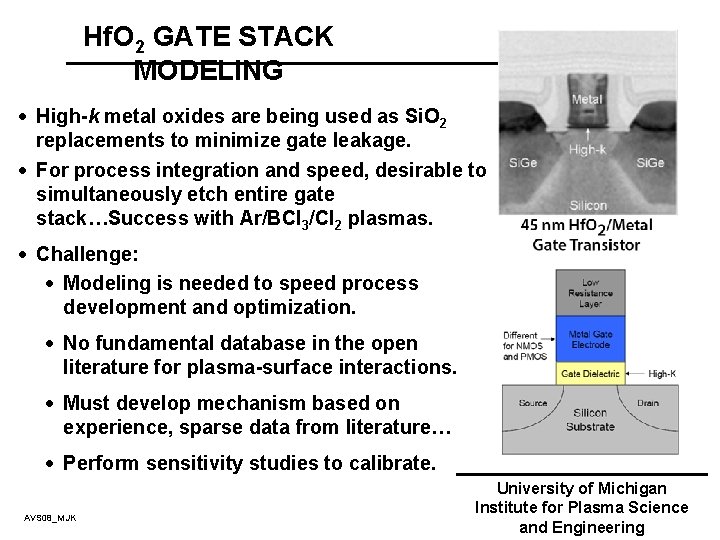
Hf. O 2 GATE STACK MODELING · High-k metal oxides are being used as Si. O 2 replacements to minimize gate leakage. · For process integration and speed, desirable to simultaneously etch entire gate stack…Success with Ar/BCl 3/Cl 2 plasmas. · Challenge: · Modeling is needed to speed process development and optimization. · No fundamental database in the open literature for plasma-surface interactions. · Must develop mechanism based on experience, sparse data from literature… · Perform sensitivity studies to calibrate. AVS 08_MJK University of Michigan Institute for Plasma Science and Engineering
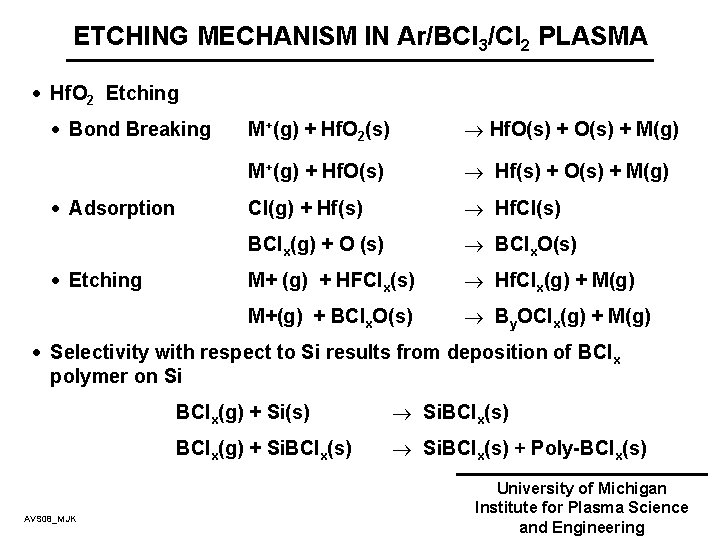
ETCHING MECHANISM IN Ar/BCl 3/Cl 2 PLASMA · Hf. O 2 Etching · Bond Breaking · Adsorption · Etching M+(g) + Hf. O 2(s) Hf. O(s) + M(g) M+(g) + Hf. O(s) Hf(s) + O(s) + M(g) Cl(g) + Hf(s) Hf. Cl(s) BClx(g) + O (s) BClx. O(s) M+ (g) + HFClx(s) Hf. Clx(g) + M(g) M+(g) + BClx. O(s) By. OClx(g) + M(g) · Selectivity with respect to Si results from deposition of BClx polymer on Si AVS 08_MJK BClx(g) + Si(s) Si. BClx(s) BClx(g) + Si. BClx(s) + Poly-BClx(s) University of Michigan Institute for Plasma Science and Engineering
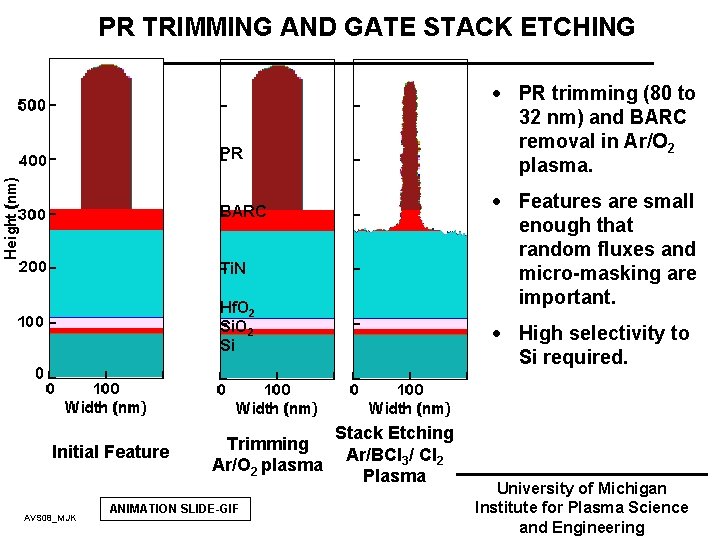
PR TRIMMING AND GATE STACK ETCHING · PR trimming (80 to 32 nm) and BARC removal in Ar/O 2 plasma. PR · Features are small enough that random fluxes and micro-masking are important. BARC Ti. N Hf. O 2 Si Initial Feature AVS 08_MJK Trimming Ar/O 2 plasma ANIMATION SLIDE-GIF · High selectivity to Si required. Stack Etching Ar/BCl 3/ Cl 2 Plasma University of Michigan Institute for Plasma Science and Engineering
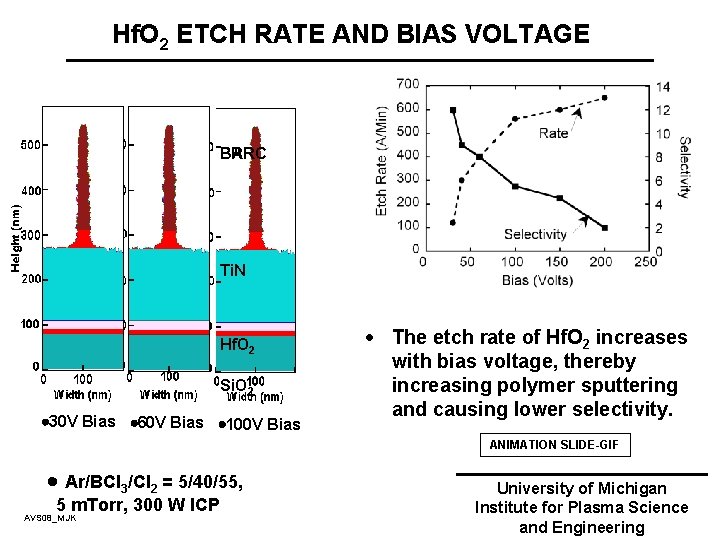
Hf. O 2 ETCH RATE AND BIAS VOLTAGE PR BARC Ti. N Hf. O 2 Si. O 30 V Bias 60 V Bias 100 V Bias · The etch rate of Hf. O 2 increases with bias voltage, thereby increasing polymer sputtering and causing lower selectivity. ANIMATION SLIDE-GIF · Ar/BCl 3/Cl 2 = 5/40/55, 5 m. Torr, 300 W ICP AVS 08_MJK University of Michigan Institute for Plasma Science and Engineering
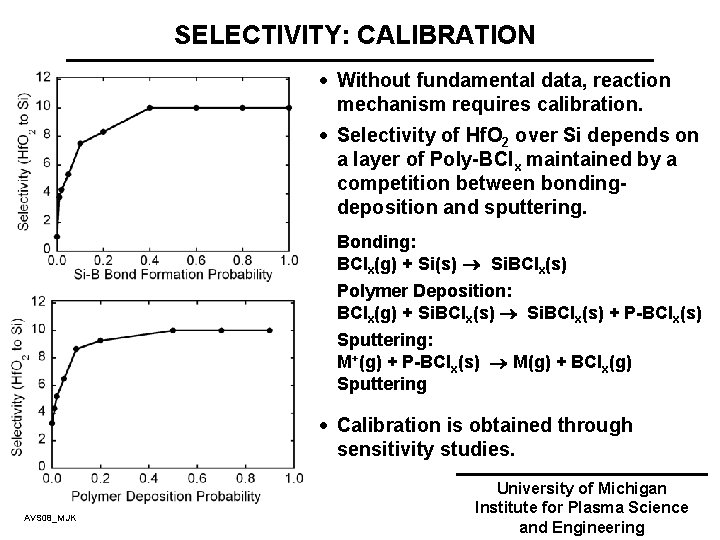
SELECTIVITY: CALIBRATION · Without fundamental data, reaction mechanism requires calibration. · Selectivity of Hf. O 2 over Si depends on a layer of Poly-BClx maintained by a competition between bondingdeposition and sputtering. Bonding: BClx(g) + Si(s) Si. BClx(s) Polymer Deposition: BClx(g) + Si. BClx(s) + P-BClx(s) Sputtering: M+(g) + P-BClx(s) M(g) + BClx(g) Sputtering · Calibration is obtained through sensitivity studies. AVS 08_MJK University of Michigan Institute for Plasma Science and Engineering
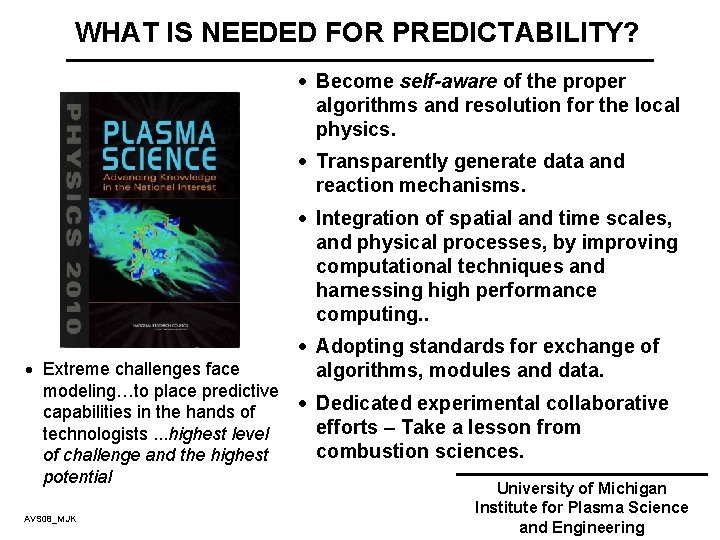
WHAT IS NEEDED FOR PREDICTABILITY? · Become self-aware of the proper algorithms and resolution for the local physics. · Transparently generate data and reaction mechanisms. · Integration of spatial and time scales, and physical processes, by improving computational techniques and harnessing high performance computing. . · Extreme challenges face modeling…to place predictive capabilities in the hands of technologists. . . highest level of challenge and the highest potential AVS 08_MJK · Adopting standards for exchange of algorithms, modules and data. · Dedicated experimental collaborative efforts – Take a lesson from combustion sciences. University of Michigan Institute for Plasma Science and Engineering
- Slides: 34