
CAN DO DESCRIPTORS A FREE TOOL FOR ESL
- Slides: 25
CAN DO DESCRIPTORS: A FREE TOOL FOR ESL DIFFERENTIATION By: Haydee Mas ELL / Spanish Teacher Kokomo High School
OVERVIEW OF THE PRESENTATION • Briefly describe the myths and language acquisition theories. • Discuss how educators can use the Can Do Descriptors to interpret and analyze scores. • Discuss how educators can use the Can Do Descriptors to develop lesson plans for their classrooms.
OBJECTIVES Content Objectives: Participants will: Describe what students with different ELP levels can be expected to do with R/W/L/S in English. Identify factors beyond ELP level that influence an ELL’s participation and achievement in class. Identify appropriate instructional and assessment strategies for different ELLs that we find in our classrooms. Note: Content objectives are about the big ideas and should be more or less the same for all students.
OBJECTIVES Language Objectives: Participants will: • Use content-obligatory and content-compatible vocabulary orally and in writing: q WIDA standards q q Student can-do descriptors ELP levels: Entering, beginning, developing, expanding, bridging. Conversational fluency / BICS Academic language proficiency / CALP • Use oral and written language to identify, describe, and explain. Note: Language objectives should be differentiated to address the language and literacy needs of students in the classroom.
Common Myths about Language Acquisition • Myth: Children learn second languages more quickly and easily than adults. • • Children do appear to acquire social language more easily perhaps because children have more occasions to interact socially in less-threatening ways. Additionally, their requirements for communication are much lower. They have much less to learn in order to interact in the school setting with their peers. • • Teenagers and adults have acquired language learning strategies that they can transfer from their first language to their new language. They have more prior knowledge and life experiences to help them make the relevant connections necessary for language acquisition.
Common Myths about Language Acquisition • Myth: A person’s accent indicates his/her level of English language proficiency. • • Research shows that children do outperform adults in the area of pronunciation. An accent is the cumulative auditory effect of those features of pronunciation that identify where a person is from, regionally or socially. Though a heavy accent may impede communication to others, it will not necessarily impact the individual’s understanding of language. Likewise, because a person sounds fluent, it does not mean that he or she is proficient.
Common Myths about Language Acquisition • Myth: Code switching is an example of a language disorder and poor grammatical ability. • Code switching is a term to describe when a person uses more than one language in a conversation. • It is only an example of how bilinguals use whatever words may be necessary to communicate their thoughts as precisely as possible, irrespective of the language.
Common Myths about Language Acquisition • Myth: When children use their first language, it slows down the process of learning English. • Proficiency in the first language can transfer to the second. • Cognitive and academic development in native language has an important and positive effect on second language acquisition. • Studies have demonstrated, when both languages are supported, the acquisition of English is not delayed, nor is academic achievement impeded.
Common Myths about Language Acquisition • Myth: People have acquired a second language once they can speak it. • • • Children can speak and socialize long before they can use language for academic purposes. BICS (Basic Interpersonal Communication Skills) are acquired first. This is the language needed to interact socially. It may take students 1 -3 years to completely develop this social language. However, academic success requires development of CALP (Cognitive Academic Language Proficiency) skills. This is the language needed to undertake academic tasks in the mainstream classroom. It includes contentspecific vocabulary and complex grammar and syntax. It may take students up to 10 years to fully achieve CALP.
Language Acquisition Theory How do we learn language? • James Cummins is one researcher who has provided instructional professionals with models that allow educational communities to empower our multilingual students, rather than allowing a language difference to become a disabling characteristic. • Cummins characterized language as falling into one of two categories: • Basic Interpersonal Communication Skills (BICS) • Cognitive Academic Language Proficiency (CALP)
Language Acquisition Theory BICS CALP • • • Basic language fluency used in social, face-to-face, everyday situations. Contextualized language with many clues to comprehension. Acquired quickly, may take up to three years. Individuals who have mastered BICS may appear to be proficient English speakers but cannot succeed in an instructional setting without also advancing their CALP. • • • Content-specific vocabulary and complex grammar and syntax. The language of instruction. Language needed to accomplish academic tasks, with fewer context clues; students must draw meaning from the language itself. Language of advanced interpersonal conversations. May take up to ten years to acquire. Individuals who might be able to talk at length on social topics (BICS) may still struggle to learn academic content (CALP).
WIDA What does WIDA stand What IS WIDA? for? • WIDA is the acronym for • WIDA is a consortium of states dedicated to the design “World-class and implementation of high Instructional Design and standards and equitable Assessment. ” educational opportunities for English language learners.
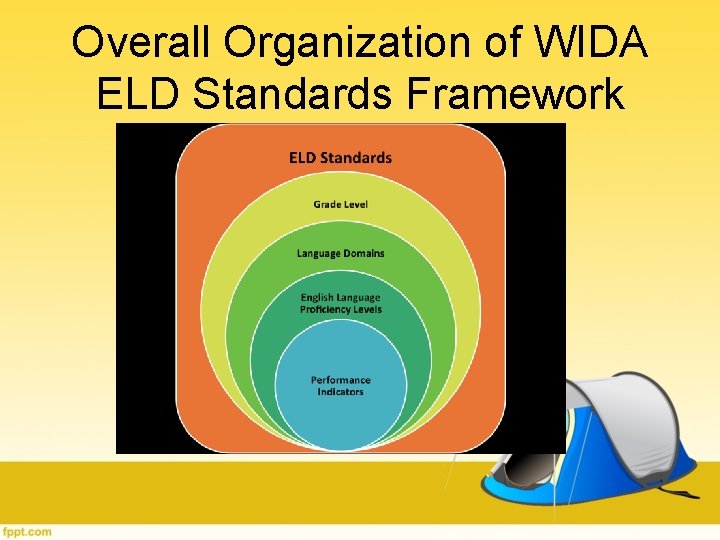
Overall Organization of WIDA ELD Standards Framework
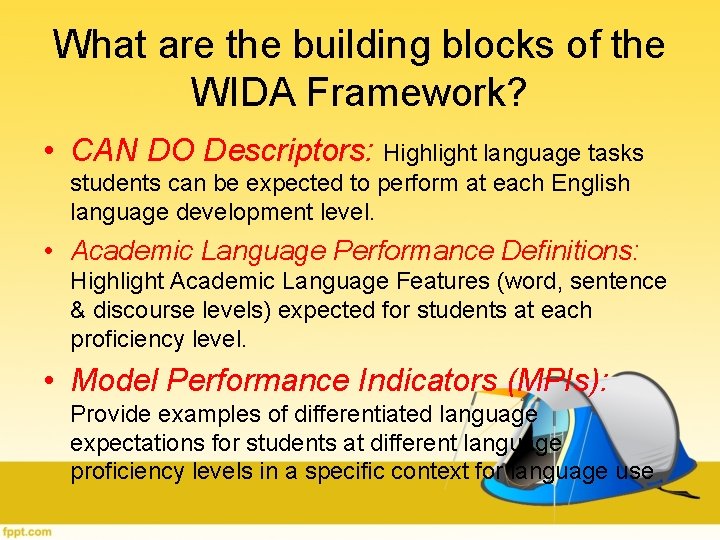
What are the building blocks of the WIDA Framework? • CAN DO Descriptors: Highlight language tasks students can be expected to perform at each English language development level. • Academic Language Performance Definitions: Highlight Academic Language Features (word, sentence & discourse levels) expected for students at each proficiency level. • Model Performance Indicators (MPIs): Provide examples of differentiated language expectations for students at different language proficiency levels in a specific context for language use
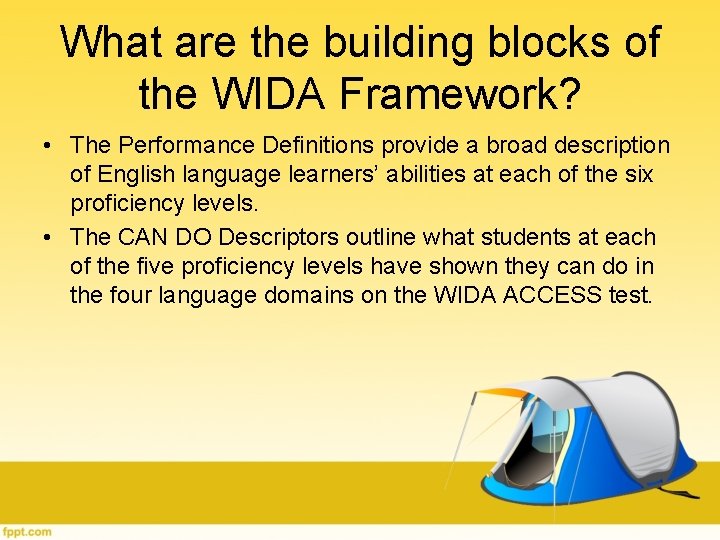
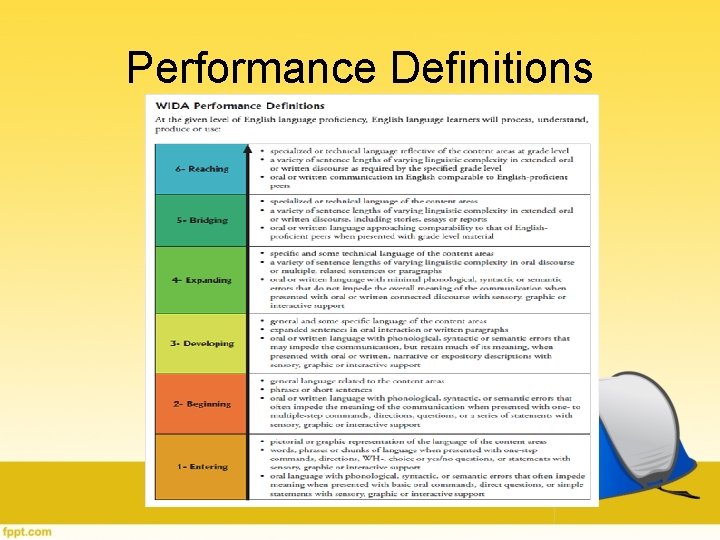
What are the building blocks of the WIDA Framework? • The Performance Definitions provide a broad description of English language learners’ abilities at each of the six proficiency levels. • The CAN DO Descriptors outline what students at each of the five proficiency levels have shown they can do in the four language domains on the WIDA ACCESS test.
Performance Definitions
What are CAN DO Descriptors? • • The five grade level cluster CAN DO Descriptors- Pre. K-K, 1 -2, 3 -5, 6 -8, and 9 -12 - are examples of expectations of English language learners for each of the four language domains—listening, speaking, reading, and writing—and five levels of English language proficiency—Entering, Beginning, Developing, Expanding, and Bridging. The CAN DO Descriptors are a collective representation of WIDA’s five English language proficiency standards—social and instructional language, the language of language arts, the language of mathematics, the language of science, and the language of social studies. The Descriptors are a standards-based resource tool—an extension of, not a substitute for, the English language proficiency standards. Examples in the folder provided
What CAN They Do? • These descriptors are designed to help classroom teachers understand what students at different levels of English proficiency should be able to do in a regular content area classroom. • The descriptors can help you look at an activity you plan to do with your English-speaking students, then scale it back for ELL students so that they are still interacting with the academic content, just at a simplified level.
What CAN They Do? LANGUAGE DOMAINS FIVE LEVELS OF ENGLISH PROFICIENCY
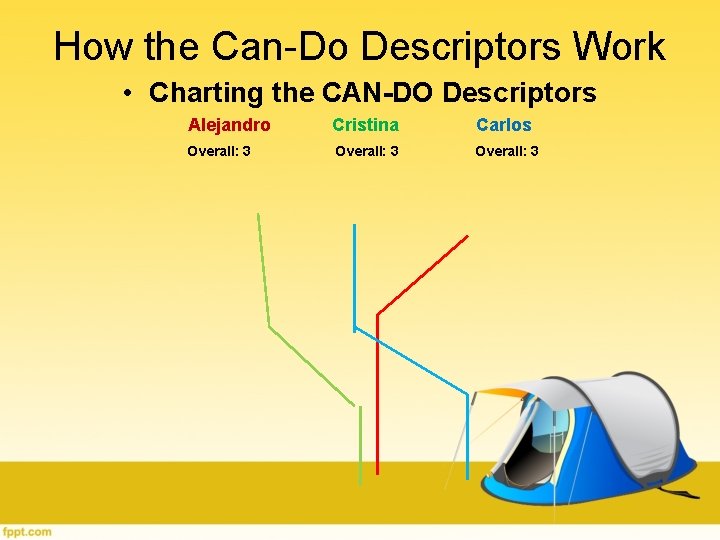
How the Can-Do Descriptors Work • The levels in these charts are based on student scores on the ACCESS test, which is given in many states to measure English language proficiency. • Keep in mind that each student will have a separate score for each domain. Generally, Speaking and Listening proficiency develop more rapidly than Reading and Writing, although there always exceptions. • Let’s walk through an example so you can see the Can-Do charts in action. Here’s an example from 3 rd-grade teacher Kelsey Davis, using the grades 3 -5 descriptors: • https: //www. youtube. com/watch? v=F 4 mwkotn. NI 8
How the Can-Do Descriptors Work • Charting the CAN-DO Descriptors Alejandro Cristina Carlos Overall: 3
Charting the CAN-DO Descriptors
Charting the CAN-DO Descriptors
ESSENTIAL QUESTIONS • 1. Who are my ELLs? • 2. What are my goals? • 3. What is challenging about those goals / objectives for all students / my ELLs? • 4. What instructional strategies can I use to enable my ELLs to participate and achieve in this activity/lesson/unit/class/program? • 5. What assessment / strategies can I use to collect evidence of my ELLs’ / all student’s learning? • 6. How can we use evidence of student learning?
CONCLUSION • The point of using the descriptors is to challenge each student as much as possible within their current language abilities, so make your best guess about what the student might be able to do, try it, and adjust as necessary. • Please, if you have questions, ask either Johnnie or myself. • Thanks for your attention.