
Can biomass supply meet the demands of BECCS

Can biomass supply meet the demands of BECCS? Michael B Jones Botany Department, School of Natural Sciences, Trinity College Dublin, University of Dublin, Ireland. (mike. jones@tcd. ie)

Key policy and governance challenges associated with BECCS How does BECCS fit with carbon budgets? How negative is BECCS? Can BECCS be delivered at sufficient scale? Can sufficient biomass be provided sustainably? How does BECCS fit into the policy context? How does BECCS fit with the climate agreement? (Gough et al. , 2018)
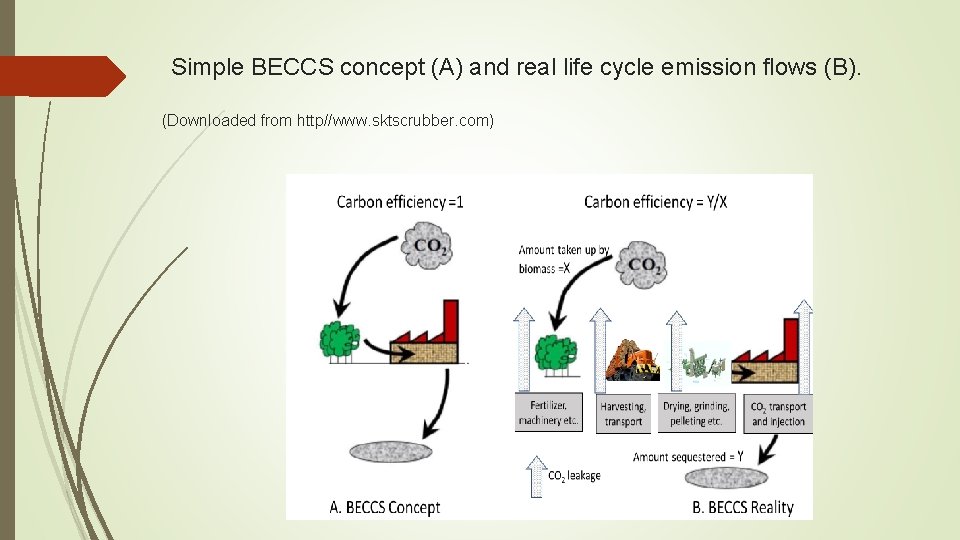
Simple BECCS concept (A) and real life cycle emission flows (B). (Downloaded from http//www. sktscrubber. com)

. Published estimates of global bioenergy technical production potential: amount of biomass energy that can be supplied globally given current expectations on technology, food demand environmental constraints. Reference Estimate of Technical Potential Comments Haberl et al. (2010) 160 -270 EJ/yr in 2050 ‘Scientific studies required in order to be more precise’ Dornburg et al. (2010) 200 -500 EJ/yr in 2050 Berndes et al. (2003) 100 ->400 EJ/yr in 2050 Review of 17 studies Beringer et al. (2011) 130 -270 EJ/yr in 2050 Used LPJm. L DGVM model Rogier et al. (2012) 793 EJ/yr currently Kemper et al. (2015) 50 ->1000 EJ/yr currently ‘most likely range’ Fuss et al. (2018) 60 -1548 EJ/yr in 2050

Conclusions All available evidence points to a high variability in the possible outcomes of a BECCS project in terms of cumulative net carbon removal over the facility’s lifetime. Significant risks exist of perverse outcomes where the net effect is to increase emissions. Determining the suitability of a BECCS project as a contribution to NET thus needs to be assessed on a case by case basis. Key factors which favour improved carbon efficiencies are: limiting the impacts of direct and indirect land use changes, increasing biomass yields while reducing inputs, reducing transport costs, and exploiting alternative biomass processing options; e. g. natural drying. Prospects of achieving the anticipated negative emissions by BECCS are very uncertain and support the view that BECCS are not fit for purpose.
- Slides: 5