
Can Beauty Point Us to God A Posteriori
Can Beauty Point Us to God? A Posteriori Argument: Reasoning from beauty back to God www. prshockley. org
Consider this quote from Plato who was the father & fiercest critic of aesthetics, that is, the philosophy of beauty: Now if a man believes in the existence of beautiful things, but not of Beauty itself, and cannot follow a guide who would lead him to a knowledge of it, is he not living in a dream? " Plato's Republic, 476 c.

An Introduction: Is it reasonable to believe that beauty points us to God? Or is beauty merely in the eye of the beholder? While not discounting the possibility of a subjective aspect to beauty, subjectivity does not automatically mean the non-existence of objective beauty or that objectivity is necessarily oppositional to subjectivity. Could it be that both objective beauty and subjective beauty are co-extensive (i. e. , two sides of a coin)?
The Standard of Validity How had I got this idea of beauty and ugliness? A man does not call a line crooked unless he has some idea of a straight line. What was I comparing object X with when I called it ugly? Straight Line = Standard
Argument from Aesthetic Normativity for God’s Existence: 1. It appears to human beings that aesthetic normativity exists. 2. The best explanation of aesthetic normativity is that it is grounded in God. 3. Therefore God exists.

Argument from Universal Signatures of Beauty for God’s Existence: 1. Universal signatures of beauty exists. 2. Universal signatures have the properties of being objective. 3. The best explanation of there being universal signatures of beauty is provided by theism. 4. Therefore the existence of universal signatures of beauty provides good grounds for thinking theism is true.
Evidences of Aesthetic Normativity: Universal Signatures of Art: In his article, “Aesthetic Universals, ” Denis Hutton brilliantly contends that there are universal features of art that everyone shares. These features transcend our cultural boundaries because they are “rooted in our common humanity. ”
Universal Signatures Include: 1. Expertise or virtuosity, namely, specialized and technical skills, are noticed in societies and are generally admired; certain individuals stand out by virtue of their talents and are honored for it.
Universal Signatures Include: 2. Non-utilitarian pleasure. Whether story, object, visual, music, or fine art performances, object X is viewed as a source of pleasure in itself, rather than as a practical tool or source of knowledge.
Universal Signatures Include: 3. Style. Art objects and performances including fictional or poetic narratives, are made in recognizable styles, according to rules of form and composition.
Universal Signatures Include: 4. Criticism. There exists some kind of indigenous critical language of judgment and appreciation, simple or elaborate, that is applied to arts. The development of a critical vocabulary and discourse, including criteria for excellence, mediocrity, competence/incompetence, and for failure, is intrinsic to almost all human activities outside of art.
Universal Signatures Include: 5. Imitation. In widely varying degrees of naturalism, art objects, including sculptures, paintings, and oral narratives, represent or imitate real and imaginary experience of the world. The differences between naturalistic representation, highly stylized representation, and non-imitative symbolism is generally understood by artists and their audiences. (Blueprints, newspaper stories pictures, passport photographs, and road maps are equally imitations or representations. While imitation is important to much art — notable exceptions being abstract painting and music — its significance extends into all areas human intellectual life. )
Universal Signatures Include: 6. “Special” focus. Works of art and artistic performances are frequently bracketed off from ordinary life, made a special and dramatic focus of experience. These objects or performance occasions are often imbued with intense emotion and sense of community. They frequently involve the combining of many different art forms, such as chanting, dancing, body decoration, and dramatic lighting in the case of New Guinea sing-sings. (Outside of art, or at its fringes, political rallies, sporting events, public ceremonies such as coronations and weddings, and religious meetings of all sorts also invoke a sense of specialness).
Universal Signatures Include: (7) Imaginative Experience: The experience of art is an imaginative experience for both producers and audiences. The carving may realistically represent an animal, but as a sculpture it becomes an imaginative object. The same can be said of any story well told, whether ancient mythology or personal anecdote. A passionate dance performance has an imaginative element not to be found in the group exercise of factory workers. Art of all kinds happens in theatre of the imagination: it is raised from the mundane practical world to become an imaginative experience. (At the mundane level, imagination in problemsolving, planning, hypothesising, inferring the mental states of others, or merely in day-dreaming is practically co-extensive with normal human conscious life. )
Argument from Normative Aesthetic Experience for God’s Existence: 1. It appears to human beings that normative (transcultural) aesthetic experiences occur. 2. The best explanation for aesthetic normative experiences (transcultural) is that it is grounded in God. 3. Therefore God exists.
Argument from Aesthetic Order for God’s Existence: 1. Beauty is a rational enterprise. 2. Beauty would not be a rational enterprise if there were no aesthetic order in the world. 3. Only the existence of God traditionally conceived could support the hypothesis that there is an aesthetic order in the world. Therefore, there is a God.
An argument from Beauty to God: 1. There must be objective beauty; otherwise: (a) There would not be such great agreement on its meaning. (b) No real disagreements of beauty would ever have occurred, each person being right from his own perspective. (c) No value judgment of beauty would ever have been wrong, each being subjectively right. (d) No question of beauty could ever be discussed, there being no objective understanding of beauty (e) Contradictory views would both be right, since opposites could be equally correct.
An Argument from Beauty to God: 2. Objective beauty is beyond individual persons and beyond humanity as a whole: (a) It is beyond individual persons, since they often sense a conflict with beauty/ugliness; (b) It is beyond humanity as a whole, for they collectively fall short of beauty and measure the progress of civilization by its art-forms in terms of beauty.
An Argument from Beauty to God: 3. Objective beauty must come from an objective Mind of beauty because: (a) Beauty has no meaning unless it comes from a mind; only minds emit meaning. (b) Beauty is meaningless unless it is a meeting of mind with mind, yet people inherently desire to experience beauty. (c) Hence, discovery of and desire for beauty make sense only if there is a Mind or Person behind it. 4. Therefore, there must be a beautiful, personal Mind behind objective beauty.
Idealist Argument from Beauty to God’s Existence: 1. There is objective beauty that is independent of human consciousness of it and that exists in spite of human lack of conformity to it: (a) Persons are conscious of beauty beyond themselves; (b) Persons admit its validity is prior to their recognition of it; (c) Persons acknowledge its claim on them, even while not yielding to it; (d) no finite mind completely grasps its significance; (e) all finite minds together have not reached complete agreement on its meaning, nor conformity with its ideal.
An Idealist Argument from Beauty to God’s Existence: “ 2. But ideas exist only in minds. 3. Therefore, there must be a supreme Mind (beyond all finite minds) in which this objective beauty exists.
Argument from Objective Beauty to an Absolute Mind: Beginning with the objectivity of beauty, one may reason to an absolutely perfect Mind: 1. An absolutely perfect ideal of beauty exists (at least psychologically in our minds). 2. An absolutely perfect idea of beauty can exist only if there is an absolutely perfect Mind of beauty: (a) Ideas can exist only if there are minds (thoughts depend on thinkers). (b) And absolute ideas depend on an absolute Mind (not on individual [finite] minds like ours). 3. Hence, it is rationally necessary to postulate an absolute Mind as the basis for the absolutely perfect idea of beauty.
An Argument from Value Judgments: This argument is rooted in the idea that a naturalistic worldview entails skepticism. 1. Value judgments of aesthetics is a rational enterprise. 2. Value judgments would not be a rational if skepticism were true. 3. There is too much unresolved disagreement for us to suppose that skepticism can be avoided if human sources of aesthetic value judgments are all that we have. 4. Therefore we must assume that there is an extra-human, divine source of aesthetic value judgments.
A Practical Argument from Objective Beauty for God’s Existence: 1. 2. 3. 4. 5. It would be demoralizing not to believe there is objective beauty. Demoralization is morally undesirable. There is a moral advantage in believing that there is objective beauty. Theism provides the best theory of the source of beauty. Therefore there is a moral advantage in accepting theism.
Argument from human design of beauty by Blaise Pascal: "Man does not like to remain alone; and as he loves, he must look elsewhere for an object for his love. He can find it only in beauty. Since, however, he is himself the most beautiful creature that God has created, he must find within himself a model for the beauty he seeks beyond himself. " ~ Blaise Pascal, Discours sur les passions d'armour, Oeuvres completes (ed. de la Pleiade, 1954, 539 -40).
Existential Hunger for the Extraordinary? Why aren’t we satisfied with the mundane? Why aren’t we satisfied with monotomy? Why do we anticipate an encounter with the sublime? Why are we in “awe” when we encounter something that is truly beautiful? Why do we hunger for the extraordinary? Could the sublime be anticipatory to Him who is the Ultimate Sublime, the Sum-total of His Infinite Perfections?
Cultural Apologetic Argument # 1: What happens when humanity is oppressed by humanistic doctrines such as Marxism? Why do some artists strive to construct "shock art“? Consider an acute observation made by John Dewey in his classic work Art as Experience:
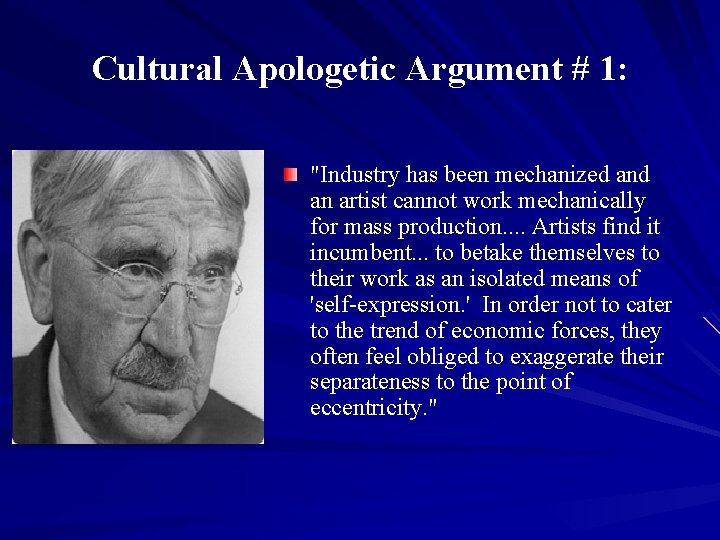
Cultural Apologetic Argument # 1: "Industry has been mechanized an artist cannot work mechanically for mass production. . Artists find it incumbent. . . to betake themselves to their work as an isolated means of 'self-expression. ' In order not to cater to the trend of economic forces, they often feel obliged to exaggerate their separateness to the point of eccentricity. "
Positively, when art is generated from a Christian worldview we personally and sociologically illustrate what it means to truly be human: "Art is communication, the announcement of observed beauties, the calling of attention to human values, the bestowing upon one's fellow human beings of beauty, singing and testifying, rejoicing and praising, opening eyes and building an outlook truly worth of human being. " Hans Rookmaaker in "Norms for Art and Entertainment, " The Complete Works of Hans Rookmaaker, 6 vols, 3: 77.
Cultural Apologetic Argument # 2: In his Gifford Lecture series, William Temple makes an interesting statement: "It takes a considerable time for a secure aesthetic judgment to be formed, and with regard to contemporary art there is much debate. But when a common judgment is reached after long periods of discussion, it is secure as scientific theories never are. Many may be uncertain in this second quarter of the twentieth century about the aesthetic rank of Epstein as a sculptor or T. S. Eliot as a poet. But there is no serious dispute about Pheidias or Aeschylus, about Giotto, or Piero, or Botticelli, about Velasquez or Rembrandt, about Dante or Shakespeare. No doubt I 'date' myself by the precise list which I select; Beethoven to Bach; but every name thus mentioned is securely established in the list of Masters; and the actual works of the earliest touch us now they touched the hearts of those who knew them first. . It takes longer for the aesthetic judgment to become stable than for the scientific, but when it reaches stability it also achieves finality as the other does not. " ~ Nature, Man, and God (Macmillan, 1956), 158 -9.
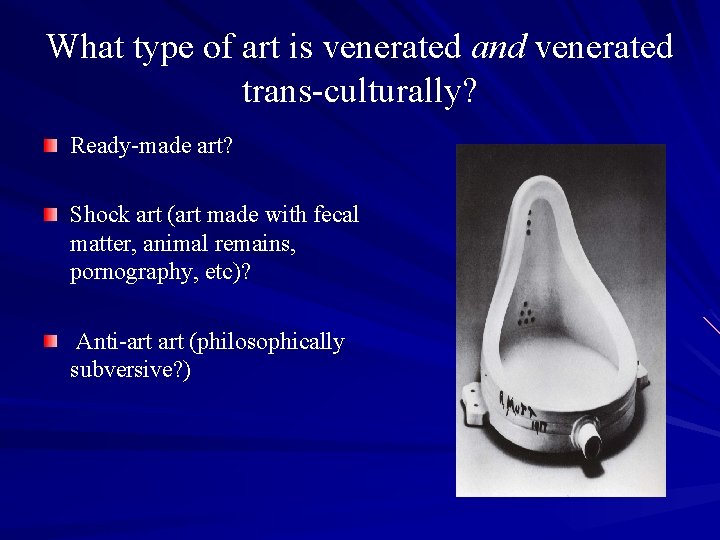
What type of art is venerated and venerated trans-culturally? Ready-made art? Shock art (art made with fecal matter, animal remains, pornography, etc)? Anti-art (philosophically subversive? )
What type of art ennobles and enriches society? Art serves a moral aim. Even ancient Greeks realized this: Consider the following quotes from Aristophanes: “Answer me, for what reasons ought one to admire a poet? For ability and advice, because we make the inhabitants of the various cities better men [Ranae, 1008]. “But a poet at any rate ought to conceal what is base and not bring it forward and put it on stage. For mere boys have a schoolmaster to instruct them, grown men have poets. From every point of view it is our duty to speak of good things [Ranae, 1053 -1056].
What type of art ennobles and enriches society? Art reflects a moral aim. Consider this observation by Sextus Empiricus: “In sum, music is not only a sound of rejoicing, but is heard also in sacred hymns and feasts and sacrifices to the gods; and because of this it incites the mind to emulate the Good. ” ~ Adv. Mathem. VI. 18 In contrast, “degenerative arts” incites the mind to emulate what is corrupt. How does this impact us personally and collectively as a community?
Argument from Aesthetic Norms of Beauty for God’s Existence: 1. Aesthetic moral norms of beauty have authority. 2. If they have authority, there must be a reliable motive for human beings to be moral. 3. No such motive could exist, unless there was an omniscient, omnipresent, wholly just agent to attach sanctions to behavior under aesthetic moral norms of beauty. 4. There is a God.
Bibliography: Dennis Hutton, “Aesthetic Universals” in The Routledge Companion to Aesthetics, edited by Dominic Mc. Iver Lopes, Dominic Lopes, & Berys Gaut.
- Slides: 35