
CAMPYLOBACTER and HELICOBACTER Dr Wasan Abdulilah Bakir CAMPYLOBACTER

CAMPYLOBACTER and HELICOBACTER • Dr. Wasan Abdul-ilah Bakir

CAMPYLOBACTER

C. jejuni CAMPYLOBACTER Campylobacters cause both diarrheal and systemic diseases, and are among the most widespread causes of infection in the world. C jejuni is the prototype organism in the group and is a very common cause of diarrhea in humans. CAMPYLOBACTER JEJUNI C jejuni has emerged as common human pathogen, causing mainly enteritis and occasionally systemic infection. These bacteria are at least as common as salmonellae and shigellae as a cause of diarrhea.

C. jejuni Morphology and Identification • C jejuni are Gram-negative rods with comma, S, or “gull wing” Shapes. • They are motile, with a single polar flagellum. • Microaerophilic Toxins 1. Lipopolysaccharides activity. with 2. Cytopathic extracellular toxins 3. Enterotoxins have been found. endotoxic

C. jejuni Transmission is usually fecal–oral. Food and water contaminated with animal feces are the major sources of human infection. Foods, such as poultry, meat, and unpasteurized milk, are commonly involved. Human-to-human transmission occurs but is less frequent than animal-to-human transmission. The infection is acquired by the oral route from food, drink, or contact with infected animals or animal products, especially poultry.

C. jejuni Pathogenesis and Pathology C. jejuni is susceptible to gastric acid. The organisms multiply in the small intestine epithelium produce inflammation that invade the results in the appearance of red and white blood cells in the stools. Occasionally, the bloodstream is invaded, and enteric fever develops. Localized tissue invasion coupled with the toxic activity appears to be responsible for the enteritis.

C. jejuni Clinical Findings Clinical manifestations are • Crampy abdominal pain • Profuse diarrhea that may be grossly bloody • Headache • Malaise • Fever. • Usually the illness is self-limited to a period of 5– 8 days, but occasionally it continues longer. Most cases resolve without antimicrobial therapy.

C. jejuni • Certain serotypes of C jejuni have been associated with postdiarrheal Guillain-Barre syndrome, a form of ascending paralytic disease (is an autoimmune disease attributed to the formation of antibodies against C. jejuni that cross-react with antigens on neurons). • Reactive arthritis and Reiter’s syndrome may also follow acute Campylobacter diarrhea.

C. jejuni Diagnostic Laboratory Tests A. Specimens Diarrheal stool is the usual specimen. B. Smears Gram-stained smears of stool may show the typical “gull wing”–shaped rods. Dark-field or phase contrast microscopy may show the typical darting motility of the organisms.

C. jejuni C. Culture If the patient has diarrhea, a stool specimen is cultured the selective media containing antibiotics that inhibit most other fecal flora, is the definitive test to diagnose C jejuni enteritis. The plate is incubated at 42°C in a microaerophilic atmosphere containing 5% oxygen and 10% carbon dioxide, which favors the growth of C. jejuni. Although C jejuni grows well at 36– 37°C, incubation at 42°C prevents growth of most of the other bacteria present in feces, thus simplifying the identification of C jejuni.

C. jejuni Skirrow’s medium contains vancomycin, polymyxin trimethoprim to inhibit growth of other bacteria. B, and The colonies tend to be colorless or gray. They may be watery and spreading or round and convex, and both colony types may appear on one agar plate. Oxidase +ve, catalase +ve and H 2 S

C. jejuni D. Serology ELISA and Complement fixation test that can detect recent infection with C. jejuni Treatment Fluid and electrolyte replacement is the mainstay of treatment Erythromycin or ciprofloxacin is used successfully in C. jejuni. Control There is no vaccine or other specific preventive measure. Proper sewage disposal and personal hygiene (hand washing) are important.

HELICOBACTER PYLORI
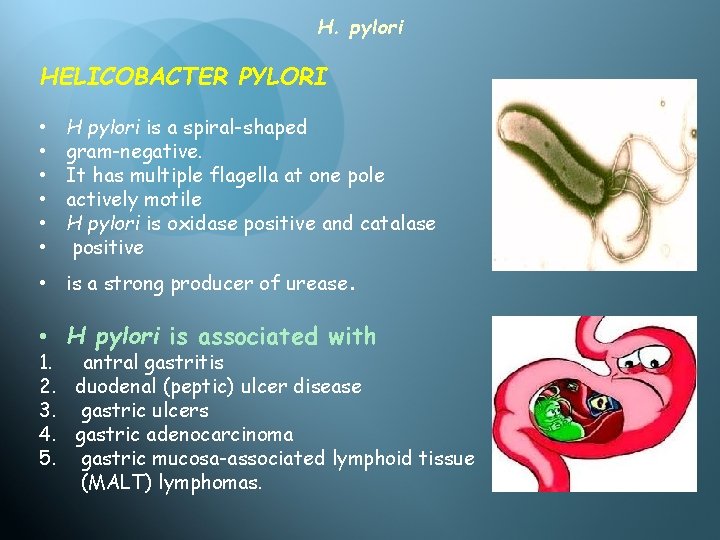
H. pylori HELICOBACTER PYLORI • • • H pylori is a spiral-shaped gram-negative. It has multiple flagella at one pole actively motile H pylori is oxidase positive and catalase positive • is a strong producer of urease. • H pylori is associated with 1. antral gastritis 2. duodenal (peptic) ulcer disease 3. gastric ulcers 4. gastric adenocarcinoma 5. gastric mucosa-associated lymphoid tissue (MALT) lymphomas.

H. pylori verulence factors 1. Outer membrane proteins: a. The adhesions: adhesion to host cell b. Porin proteins, iron transport and flagella proteins 2. The lipopolysuccharide (LPS) 3. The exotoxins: The vaculating (Vac A) toxin (gastric mucosal enjury) 4. The secretory enzymes: a. The urease : Neutralize gastric acid b. The mucinase, lipase and protease (mucosal injury) 5. The flagella ( motility) 6. The effector cytotoxin: The cytotoxin associated gene A (Cag A).

H. pylori Pathogenesis H pylori grows optimally at a p. H of 6. 0– 7. 0 and would be killed or not grow at the p. H within the gastric lumen. Gastric mucus is impermeable to acid and has a strong buffering capacity. On the lumen side of the mucus, the p. H is low (1. 0– 2. 0); on the epithelial side, the p. H is about 7. 4. H pylori is found deep in the mucous layer near the epithelial surface where physiologic p. H is present. H pylori produces a protease that modifies the gastric mucus and reduces the ability of acid to diffuse through the mucus. H pylori produces potent urease activity, which yields production of ammonia and further buffering of acid.
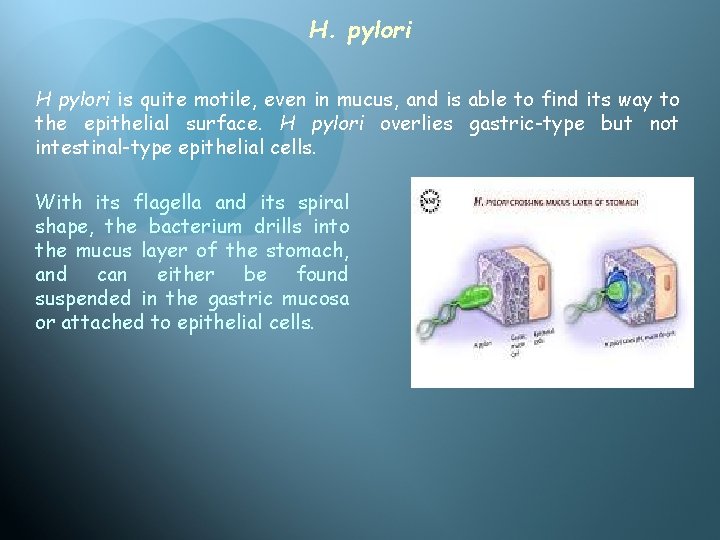
H. pylori H pylori is quite motile, even in mucus, and is able to find its way to the epithelial surface. H pylori overlies gastric-type but not intestinal-type epithelial cells. With its flagella and its spiral shape, the bacterium drills into the mucus layer of the stomach, and can either be found suspended in the gastric mucosa or attached to epithelial cells.
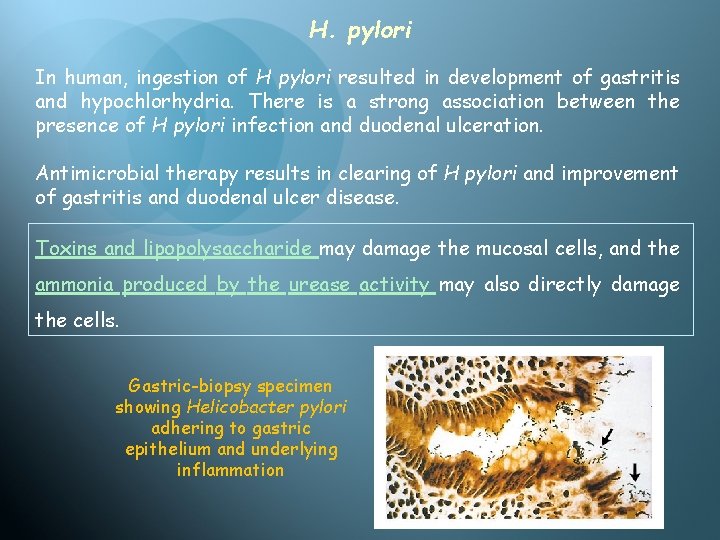
H. pylori In human, ingestion of H pylori resulted in development of gastritis and hypochlorhydria. There is a strong association between the presence of H pylori infection and duodenal ulceration. Antimicrobial therapy results in clearing of H pylori and improvement of gastritis and duodenal ulcer disease. Toxins and lipopolysaccharide may damage the mucosal cells, and the ammonia produced by the urease activity may also directly damage the cells. Gastric-biopsy specimen showing Helicobacter pylori adhering to gastric epithelium and underlying inflammation
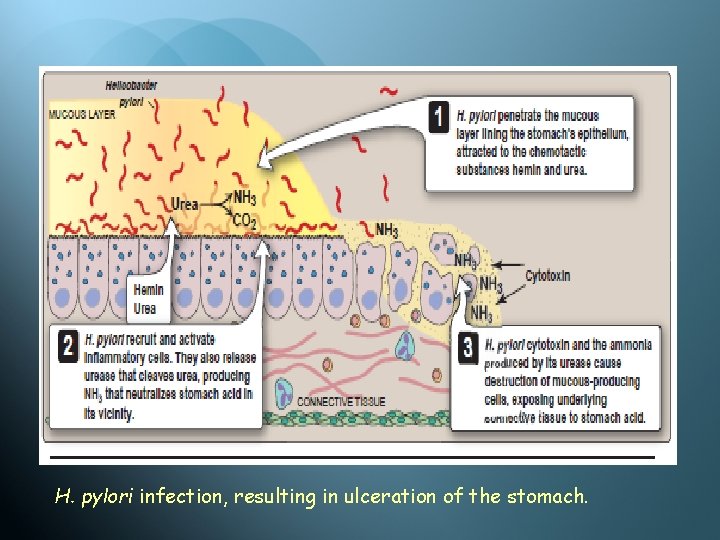
H. pylori infection, resulting in ulceration of the stomach.

H. pylori Histologically, gastritis is characterized by acute and chronic inflammation. Polymorphonuclear and mononuclear epithelium and lamina propria. cell infiltrates within the Destruction of the epithelium is common, and glandular atrophy may occur. H pylori thus is a major risk factor for gastric cancer.
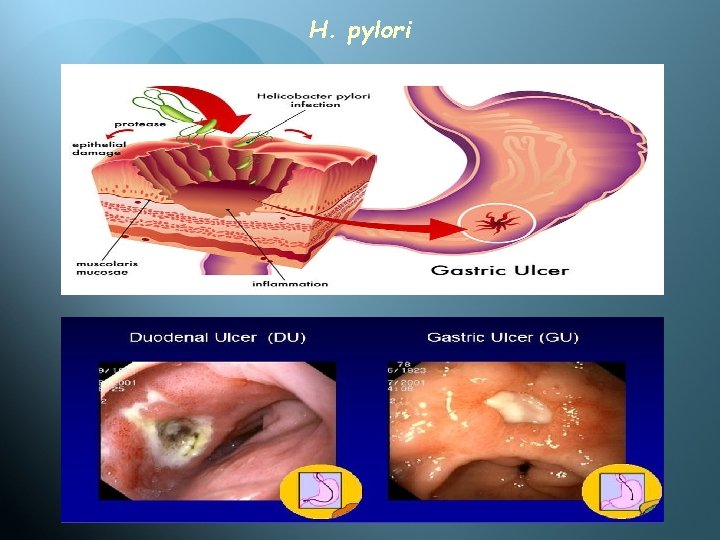
H. pylori
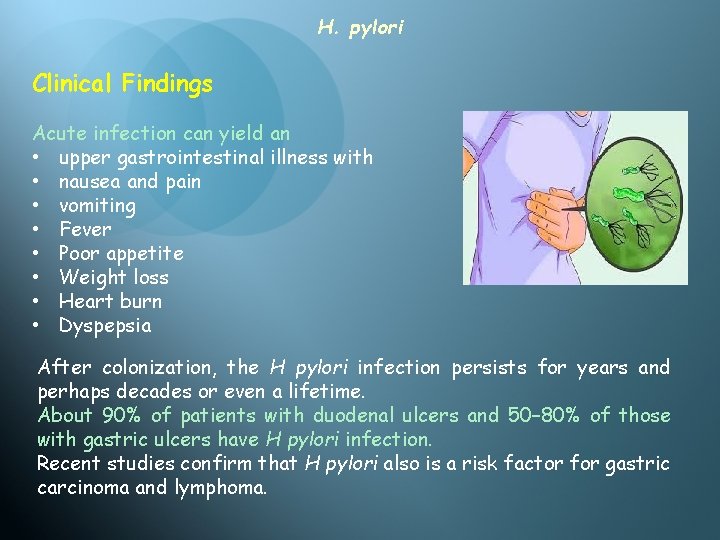
H. pylori Clinical Findings Acute infection can yield an • upper gastrointestinal illness with • nausea and pain • vomiting • Fever • Poor appetite • Weight loss • Heart burn • Dyspepsia After colonization, the H pylori infection persists for years and perhaps decades or even a lifetime. About 90% of patients with duodenal ulcers and 50– 80% of those with gastric ulcers have H pylori infection. Recent studies confirm that H pylori also is a risk factor for gastric carcinoma and lymphoma.
H. pylori Diagnostic Laboratory Tests • Diagnostic test are of two kinds: A. Invasive test Endoscopy guided multiple biopsies can be taken from gastric mucosa and are subjected to: a. Histopathology b. Microbiological methods. Gram staining. Culture media. Biochemical tests B. Biopsy urease test (Rapid urease test) B. Noninvasive test a. Urea breath test b. Stool antigen assay c. Antibody detection d. Polymerase chain reaction (PCR)
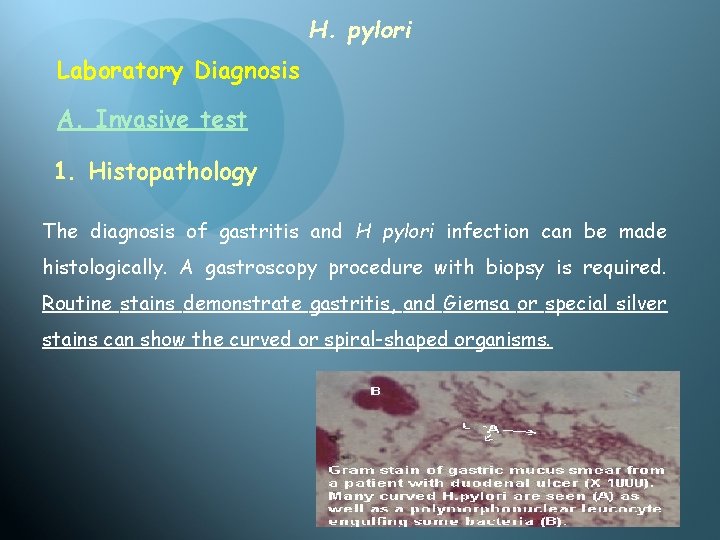
H. pylori Laboratory Diagnosis A. Invasive test 1. Histopathology The diagnosis of gastritis and H pylori infection can be made histologically. A gastroscopy procedure with biopsy is required. Routine stains demonstrate gastritis, and Giemsa or special silver stains can show the curved or spiral-shaped organisms.
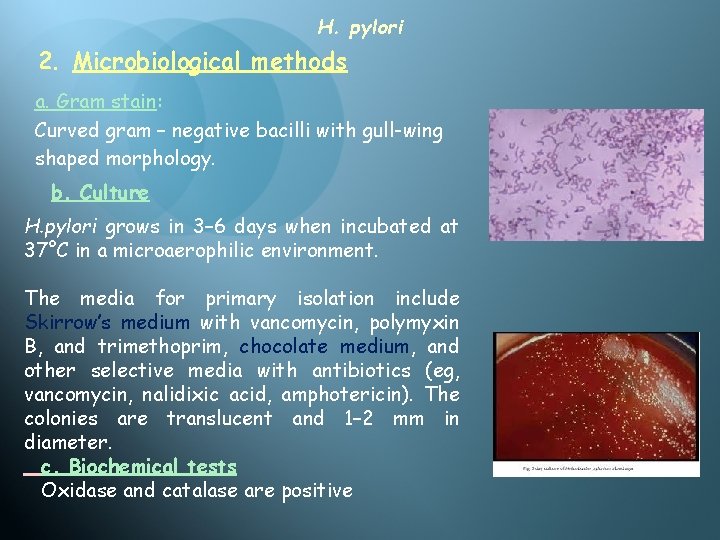
H. pylori 2. Microbiological methods a. Gram stain: Curved gram – negative bacilli with gull-wing shaped morphology. b. Culture H. pylori grows in 3– 6 days when incubated at 37°C in a microaerophilic environment. The media for primary isolation include Skirrow’s medium with vancomycin, polymyxin B, and trimethoprim, chocolate medium, and other selective media with antibiotics (eg, vancomycin, nalidixic acid, amphotericin). The colonies are translucent and 1– 2 mm in diameter. c. Biochemical tests Oxidase and catalase are positive
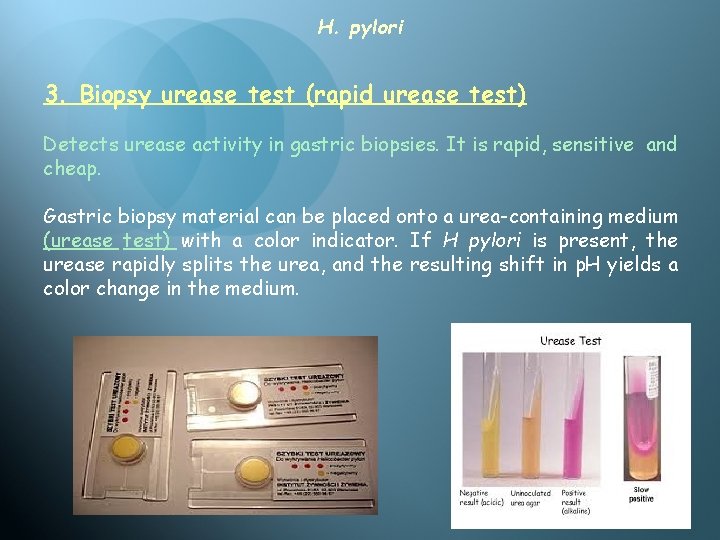
H. pylori 3. Biopsy urease test (rapid urease test) Detects urease activity in gastric biopsies. It is rapid, sensitive and cheap. Gastric biopsy material can be placed onto a urea-containing medium (urease test) with a color indicator. If H pylori is present, the urease rapidly splits the urea, and the resulting shift in p. H yields a color change in the medium.
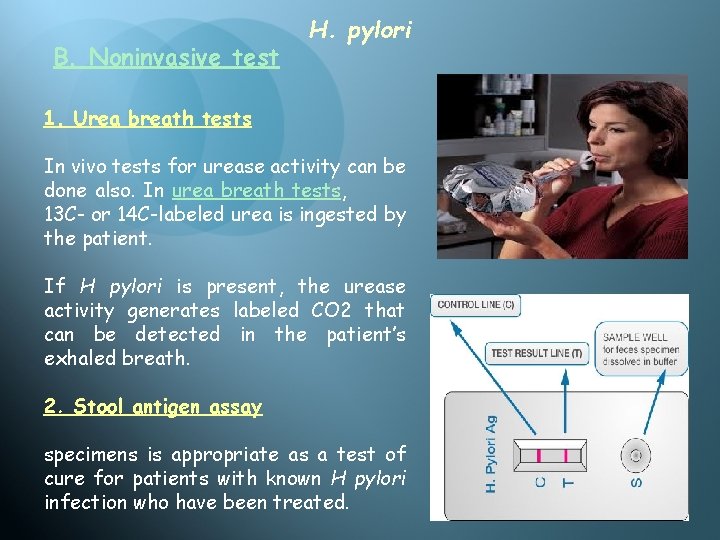
B. Noninvasive test H. pylori 1. Urea breath tests In vivo tests for urease activity can be done also. In urea breath tests, 13 C- or 14 C-labeled urea is ingested by the patient. If H pylori is present, the urease activity generates labeled CO 2 that can be detected in the patient’s exhaled breath. 2. Stool antigen assay specimens is appropriate as a test of cure for patients with known H pylori infection who have been treated.
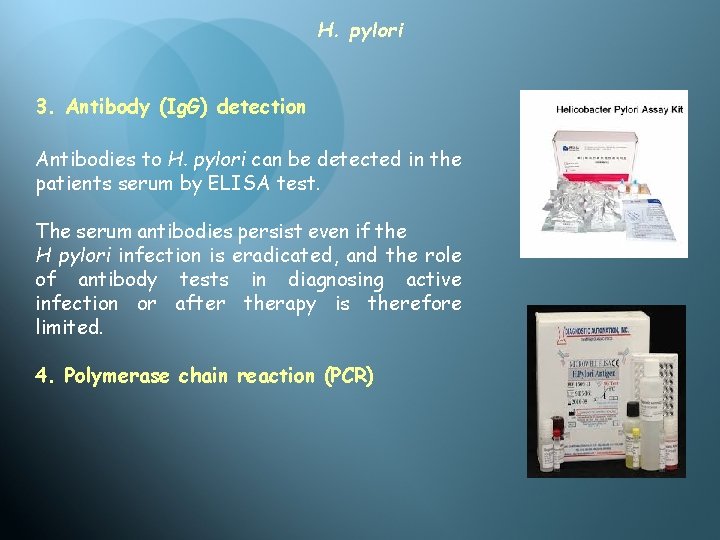
H. pylori 3. Antibody (Ig. G) detection Antibodies to H. pylori can be detected in the patients serum by ELISA test. The serum antibodies persist even if the H pylori infection is eradicated, and the role of antibody tests in diagnosing active infection or after therapy is therefore limited. 4. Polymerase chain reaction (PCR)
H. pylori Treatment 1 st line triple drug therapy Omeprazole + Clarithromycin + Metronidazole or Amoxicillin given for 7 -14 dayes Urea breath test is done If the 1 st line regimen fails (Urea breath test +ve) 2 nd line quadruple drug therapy Omeprazole + Bismuth subsalicylate + Metronidazole + Tetracycline Given for 14 dayes If 2 nd line quadruple drug therapy fails then – Culture of endoscopic guided biopsy is done and treatment is Given based on antimicrobial susceptibility test
H. pylori Control H pylori is present on the gastric mucosa of fewer than 20% of persons younger than years 30 but increases in prevalence to 40– 60% of persons age 60 years, including persons who are asymptomatic. In developing countries, the prevalence of infection may be 80% or higher in adults. Person-to-person transmission of H pylori is likely because intrafamilial clustering of infection occurs. Acute epidemics of gastritis suggest a common source for H pylori. There is no vaccine or other specific preventive measure.

Thank you

Thank you
- Slides: 33