
CAMPBELL BIOLOGY TENTH EDITION Reece Urry Cain Wasserman
CAMPBELL BIOLOGY TENTH EDITION Reece • Urry • Cain • Wasserman • Minorsky • Jackson 32 An Overview of Animal Diversity Clicker Questions by Roberta Batorsky © 2014 Pearson Education, Inc.

What should animals with radial symmetry be better able to do than those with bilateral symmetry? a) move quickly in one direction b) detect threats from above or below equally well c) deal effectively with food distributed homogeneously in 360 d) focus attention in a single direction © 2014 Pearson Education, Inc.

What should animals with radial symmetry be better able to do than those with bilateral symmetry? a) move quickly in one direction b) detect threats from above or below equally well c) deal effectively with food distributed homogeneously in 360 d) focus attention in a single direction © 2014 Pearson Education, Inc.
What is true of modern animal phylogenies? a) They take no account of an animal’s “body plan. ” b) They portray an animal’s place on the scale of nature (scala naturae). c) They rely solely on molecular (genetic) data. d) They are hypothetical. e) They are immune from error due to homoplasy. © 2014 Pearson Education, Inc.
What is true of modern animal phylogenies? a) They take no account of an animal’s “body plan. ” b) They portray an animal’s place on the scale of nature (scala naturae). c) They rely solely on molecular (genetic) data. d) They are hypothetical. e) They are immune from error due to homoplasy. © 2014 Pearson Education, Inc.
Which of these genetic changes is thought to have led to the increasing complexity of the arthropod body plan? a) increased number of Hox genes for body segmentation b) changes in regulation of Hox genes for body segmentation c) increased number of Hox genes for appendages d) changes in regulation of Hox genes for appendages e) increased complexity in genes for exoskeleton arrangements © 2014 Pearson Education, Inc.
Which of these genetic changes is thought to have led to the increasing complexity of the arthropod body plan? a) increased number of Hox genes for body segmentation b) changes in regulation of Hox genes for body segmentation c) increased number of Hox genes for appendages d) changes in regulation of Hox genes for appendages e) increased complexity in genes for exoskeleton arrangements © 2014 Pearson Education, Inc.
Which of the following statements about Hox genes is incorrect? a) The Hox gene family underwent a series of duplications. b) Most animals share a unique homeobox-containing family of genes. c) Hox genes regulate the formation of the anteriorposterior axis. d) Simple animals such as sponges possess Hox genes. © 2014 Pearson Education, Inc.
Which of the following statements about Hox genes is incorrect? a) The Hox gene family underwent a series of duplications. b) Most animals share a unique homeobox-containing family of genes. c) Hox genes regulate the formation of the anteriorposterior axis. d) Simple animals such as sponges possess Hox genes. © 2014 Pearson Education, Inc.
Scientists researching the origins of multicellularity compared protein domains of ______ proteins of unicellular organisms with those of certain animals. a) fibrillin b) collagen c) elastin d) cadherin e) keratin © 2014 Pearson Education, Inc.
Scientists researching the origins of multicellularity compared protein domains of ______ proteins of unicellular organisms with those of certain animals. a) fibrillin b) collagen c) elastin d) cadherin e) keratin © 2014 Pearson Education, Inc.
Reasons for the rise in the diversity of animal phyla during the Cambrian include all of the following except a) predators acquired novel adaptations b) prey species acquired new defenses c) an increase in atmospheric oxygen permitted larger bodied animals to thrive d) hox genes facilitated the evolution of new forms e) global cooling triggered shifts in animal lineages © 2014 Pearson Education, Inc.
Reasons for the rise in the diversity of animal phyla during the Cambrian include all of the following except a) predators acquired novel adaptations b) prey species acquired new defenses c) an increase in atmospheric oxygen permitted larger bodied animals to thrive d) hox genes facilitated the evolution of new forms e) global cooling triggered shifts in animal lineages © 2014 Pearson Education, Inc.
Which of the following triploblastic organisms is incorrectly matched with the type of body cavity it possesses? a) pseudocoelomate—flatworm b) coelomate—earthworm c) acoelomate—planarian © 2014 Pearson Education, Inc.
Which of the following triploblastic organisms is incorrectly matched with the type of body cavity it possesses? a) pseudocoelomate—flatworm b) coelomate—earthworm c) acoelomate—planarian © 2014 Pearson Education, Inc.
In which of the following types of cleavage patterns does each cell have the capacity to develop into a complete embryo? a) determinate cleavage b) indeterminate cleavage c) spiral cleavage © 2014 Pearson Education, Inc.
In which of the following types of cleavage patterns does each cell have the capacity to develop into a complete embryo? a) determinate cleavage b) indeterminate cleavage c) spiral cleavage © 2014 Pearson Education, Inc.
Which of the following is not a major clade of bilaterian animals? a) Deuterostomia b) Lophotrochozoa c) Ecdysozoa d) Eumetazoa © 2014 Pearson Education, Inc.
Which of the following is not a major clade of bilaterian animals? a) Deuterostomia b) Lophotrochozoa c) Ecdysozoa d) Eumetazoa © 2014 Pearson Education, Inc.
During the Neoproterozoic era, all except which of the following would have been true? a) Soft-bodied, multicellular eukaryotes could be found. b) Molluscs, sponges and cnidarians could be found. c) Predation existed. d) Animal diversity decreased. © 2014 Pearson Education, Inc.
During the Neoproterozoic era, all except which of the following would have been true? a) Soft-bodied, multicellular eukaryotes could be found. b) Molluscs, sponges and cnidarians could be found. c) Predation existed. d) Animal diversity decreased. © 2014 Pearson Education, Inc.
Scientific Skills Exercises Animal phyla vary greatly in morphology, from simple sponges that lack tissues and symmetry to complex vertebrates. Members of different animal phyla have similar developmental genes, but the number of mi. RNAs (micro. RNAs) varies considerably. These small RNAs are involved in the regulation of gene expression. In this exercise, you will explore whether mi. RNA diversity is correlated to morphological complexity. In the analysis, mi. RNA diversity is represented by the average number of mi. RNAs in a phylum (x), while morphological complexity is represented by the average number of cell types in that phylum (y). Researchers examined the relationship between these two variables by calculating the correlation coefficient (r). © 2014 Pearson Education, Inc.
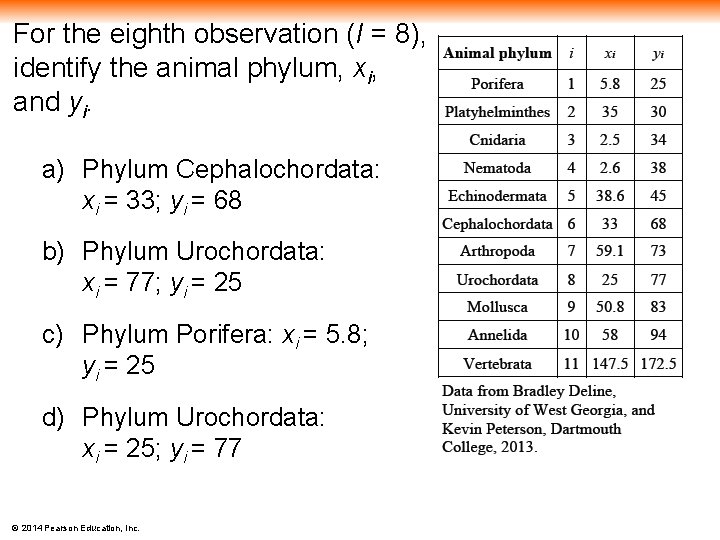
For the eighth observation (I = 8), identify the animal phylum, xi, and yi. a) Phylum Cephalochordata: xi = 33; yi = 68 b) Phylum Urochordata: xi = 77; yi = 25 c) Phylum Porifera: xi = 5. 8; yi = 25 d) Phylum Urochordata: xi = 25; yi = 77 © 2014 Pearson Education, Inc.
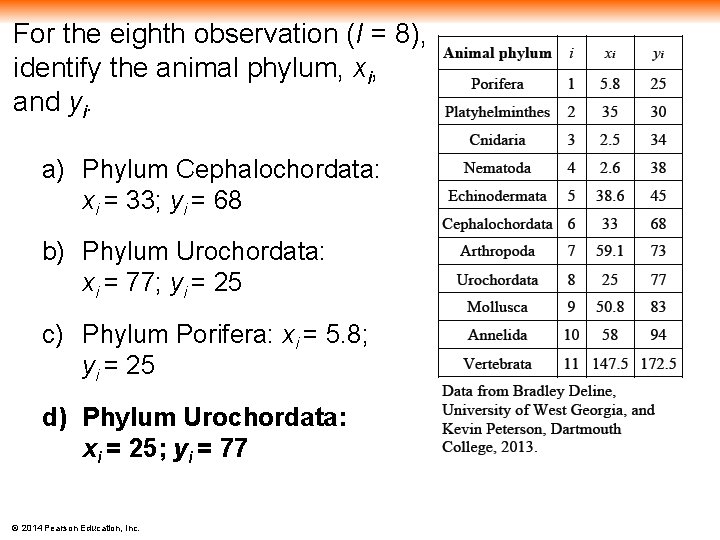
For the eighth observation (I = 8), identify the animal phylum, xi, and yi. a) Phylum Cephalochordata: xi = 33; yi = 68 b) Phylum Urochordata: xi = 77; yi = 25 c) Phylum Porifera: xi = 5. 8; yi = 25 d) Phylum Urochordata: xi = 25; yi = 77 © 2014 Pearson Education, Inc.
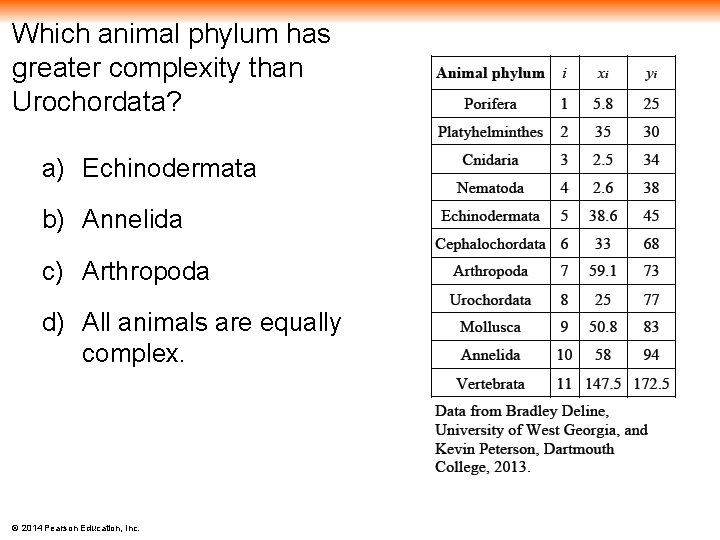
Which animal phylum has greater complexity than Urochordata? a) Echinodermata b) Annelida c) Arthropoda d) All animals are equally complex. © 2014 Pearson Education, Inc.
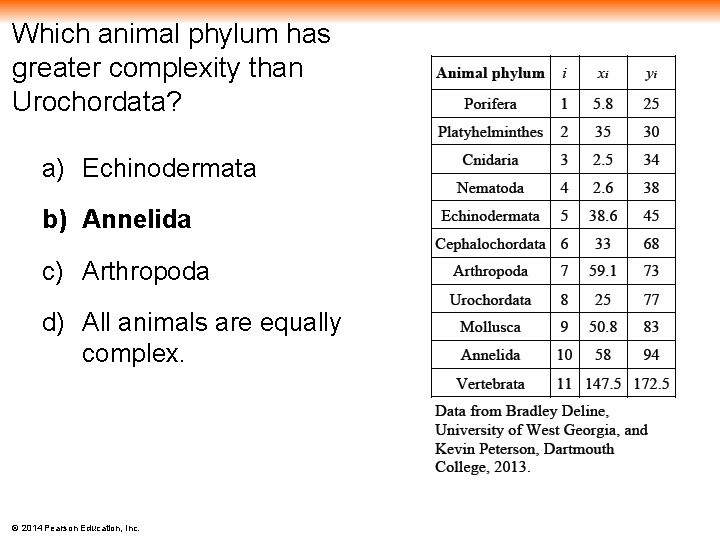
Which animal phylum has greater complexity than Urochordata? a) Echinodermata b) Annelida c) Arthropoda d) All animals are equally complex. © 2014 Pearson Education, Inc.
- Slides: 26