
CAMPBELL BIOLOGY IN FOCUS URRY CAIN WASSERMAN MINORSKY
CAMPBELL BIOLOGY IN FOCUS URRY • CAIN • WASSERMAN • MINORSKY • REECE 32 The Internal Environment of Animals: Tissues, Endocrine and Renal Systems Lecture Presentations by Kathleen Fitzpatrick and Nicole Tunbridge, Simon Fraser University © 2016 Pearson Education, Inc. SECOND EDITION
ORGANIZATION OF ANIMAL BODIES Anatomy: the study of the biological form of an organism Physiology: the study of the biological functions an organism performs Form fits function • Cell: lowest level that can live as an organism • Tissues: groups of cells with common structure and function • Cells may be held together by: • Sticky coating of collagen and elastin • Desmosomes • Tight junctions • 4 main categories of tissues: • Epithelial • Connective • Muscle • Nervous
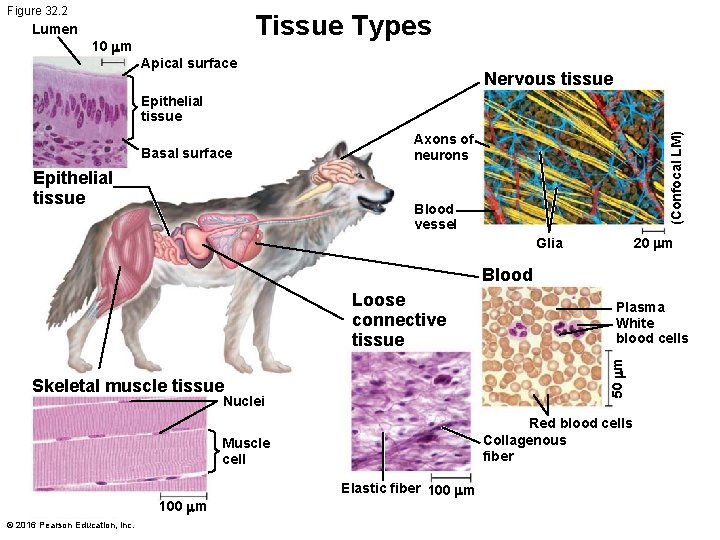
Figure 32. 2 Tissue Types Lumen 10 mm Apical surface Nervous tissue Epithelial tissue Axons of neurons (Confocal LM) Basal surface Blood vessel 20 mm Glia Blood Skeletal muscle tissue Nuclei Red blood cells Collagenous fiber Muscle cell 100 mm © 2016 Pearson Education, Inc. Plasma White blood cells 50 mm Loose connective tissue Elastic fiber 100 mm
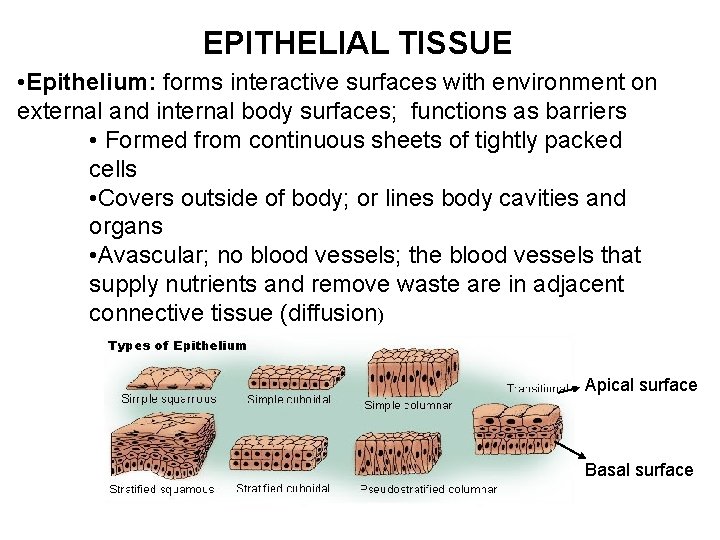
EPITHELIAL TISSUE • Epithelium: forms interactive surfaces with environment on external and internal body surfaces; functions as barriers • Formed from continuous sheets of tightly packed cells • Covers outside of body; or lines body cavities and organs • Avascular; no blood vessels; the blood vessels that supply nutrients and remove waste are in adjacent connective tissue (diffusion) Apical surface Basal surface

Figure 32. 2 -1 Lumen 10 mm Apical surface Epithelial tissue Basal surface Epithelial tissue © 2016 Pearson Education, Inc.
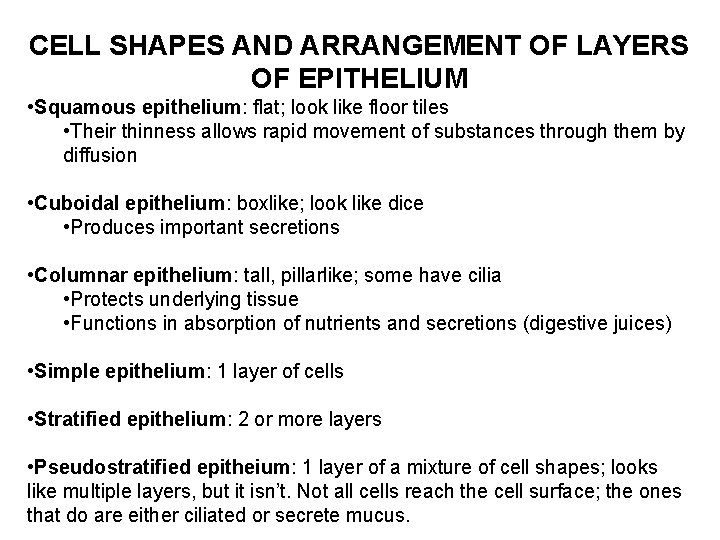
CELL SHAPES AND ARRANGEMENT OF LAYERS OF EPITHELIUM • Squamous epithelium: flat; look like floor tiles • Their thinness allows rapid movement of substances through them by diffusion • Cuboidal epithelium: boxlike; look like dice • Produces important secretions • Columnar epithelium: tall, pillarlike; some have cilia • Protects underlying tissue • Functions in absorption of nutrients and secretions (digestive juices) • Simple epithelium: 1 layer of cells • Stratified epithelium: 2 or more layers • Pseudostratified epitheium: 1 layer of a mixture of cell shapes; looks like multiple layers, but it isn’t. Not all cells reach the cell surface; the ones that do are either ciliated or secrete mucus.
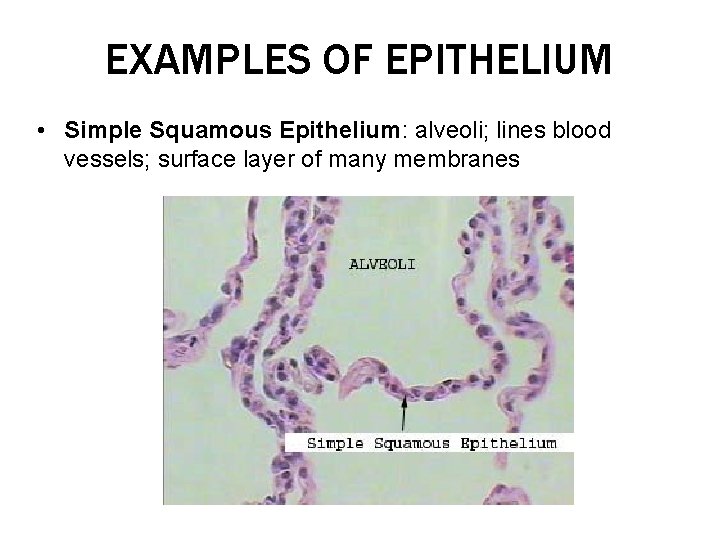
EXAMPLES OF EPITHELIUM • Simple Squamous Epithelium: alveoli; lines blood vessels; surface layer of many membranes
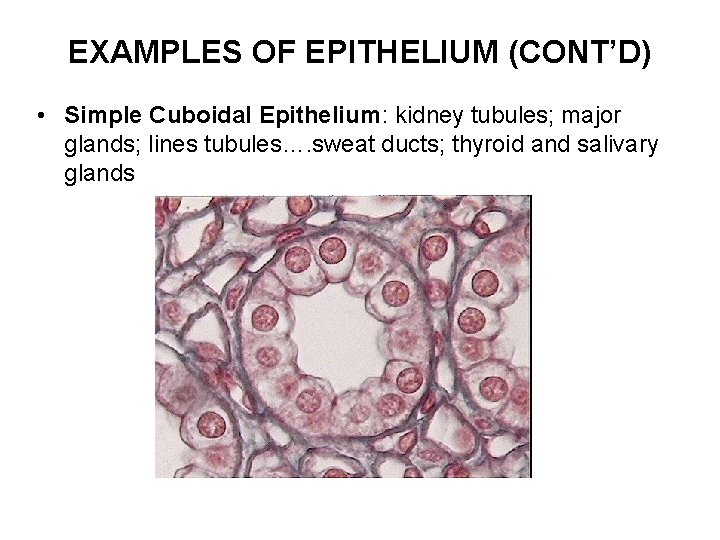
EXAMPLES OF EPITHELIUM (CONT’D) • Simple Cuboidal Epithelium: kidney tubules; major glands; lines tubules…. sweat ducts; thyroid and salivary glands
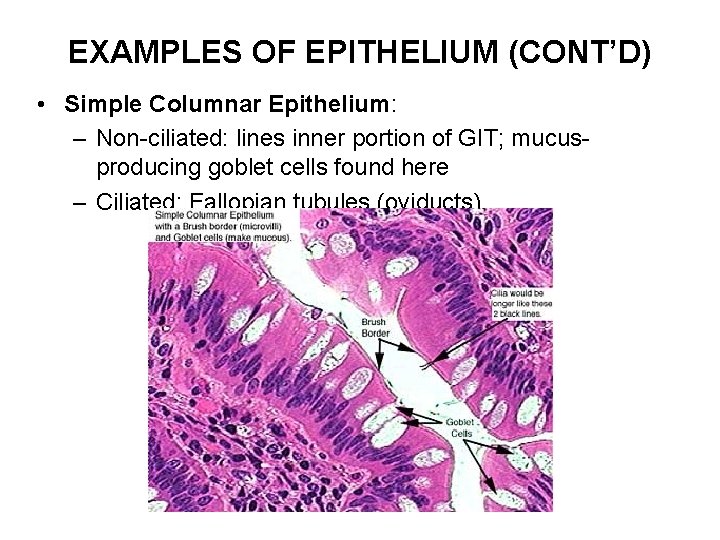
EXAMPLES OF EPITHELIUM (CONT’D) • Simple Columnar Epithelium: – Non-ciliated: lines inner portion of GIT; mucusproducing goblet cells found here – Ciliated: Fallopian tubules (oviducts)
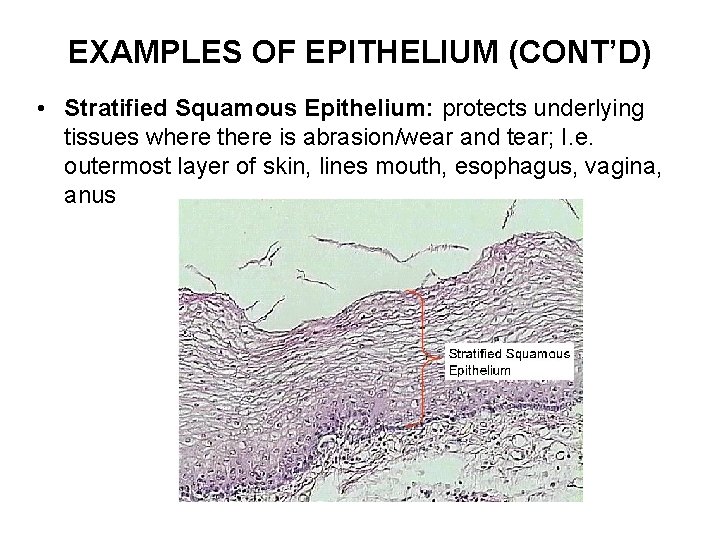
EXAMPLES OF EPITHELIUM (CONT’D) • Stratified Squamous Epithelium: protects underlying tissues where there is abrasion/wear and tear; I. e. outermost layer of skin, lines mouth, esophagus, vagina, anus
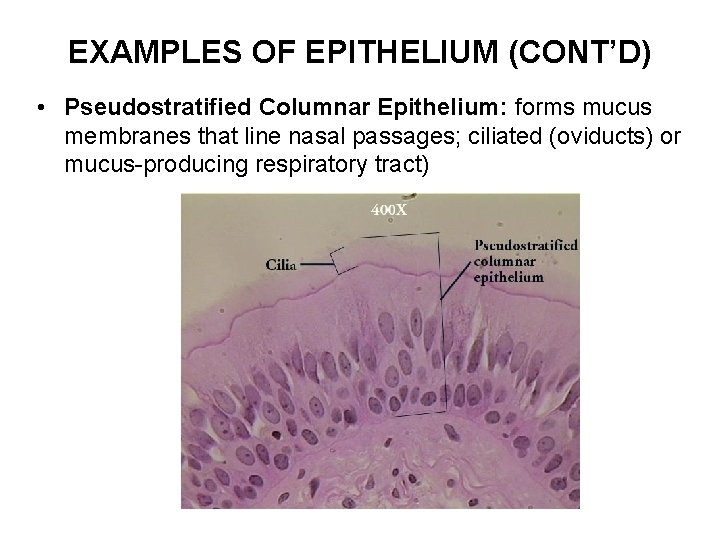
EXAMPLES OF EPITHELIUM (CONT’D) • Pseudostratified Columnar Epithelium: forms mucus membranes that line nasal passages; ciliated (oviducts) or mucus-producing respiratory tract)
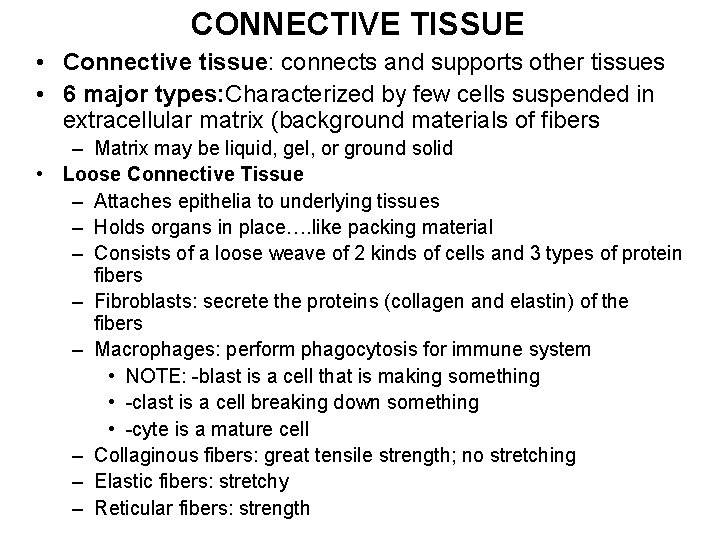
CONNECTIVE TISSUE • Connective tissue: connects and supports other tissues • 6 major types: Characterized by few cells suspended in extracellular matrix (background materials of fibers – Matrix may be liquid, gel, or ground solid • Loose Connective Tissue – Attaches epithelia to underlying tissues – Holds organs in place…. like packing material – Consists of a loose weave of 2 kinds of cells and 3 types of protein fibers – Fibroblasts: secrete the proteins (collagen and elastin) of the fibers – Macrophages: perform phagocytosis for immune system • NOTE: -blast is a cell that is making something • -clast is a cell breaking down something • -cyte is a mature cell – Collaginous fibers: great tensile strength; no stretching – Elastic fibers: stretchy – Reticular fibers: strength
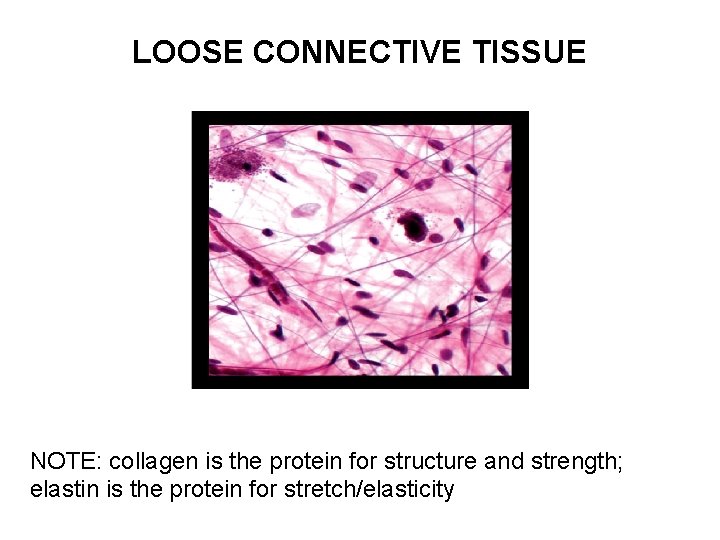
LOOSE CONNECTIVE TISSUE NOTE: collagen is the protein for structure and strength; elastin is the protein for stretch/elasticity
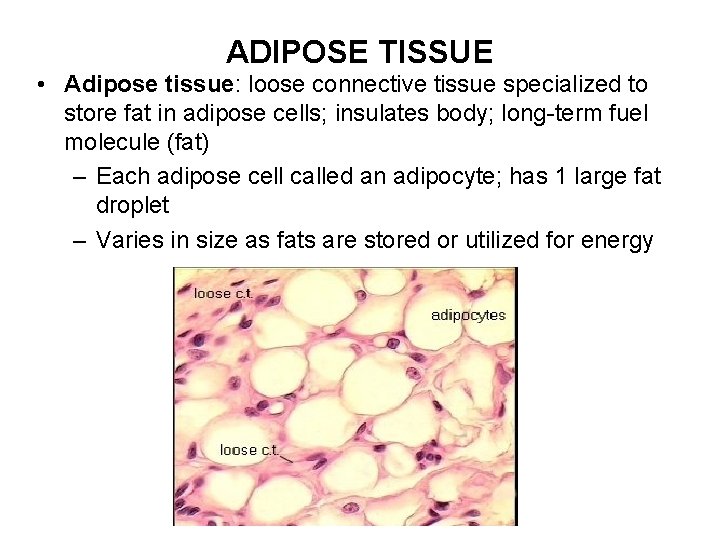
ADIPOSE TISSUE • Adipose tissue: loose connective tissue specialized to store fat in adipose cells; insulates body; long-term fuel molecule (fat) – Each adipose cell called an adipocyte; has 1 large fat droplet – Varies in size as fats are stored or utilized for energy
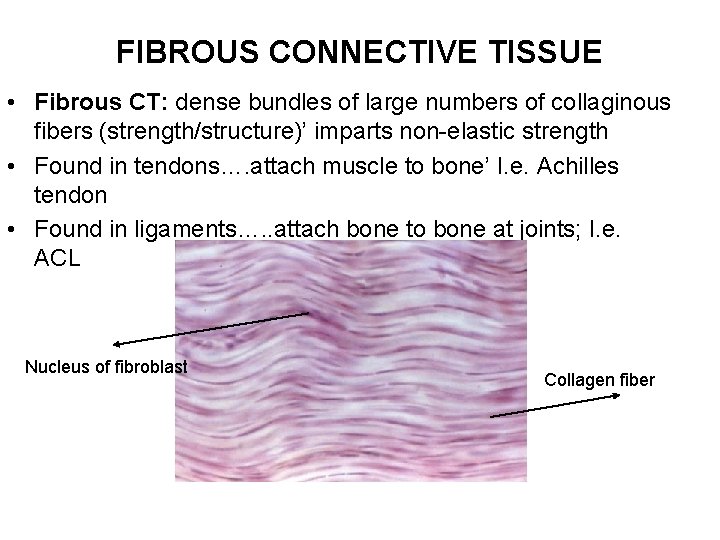
FIBROUS CONNECTIVE TISSUE • Fibrous CT: dense bundles of large numbers of collaginous fibers (strength/structure)’ imparts non-elastic strength • Found in tendons…. attach muscle to bone’ I. e. Achilles tendon • Found in ligaments…. . attach bone to bone at joints; I. e. ACL Nucleus of fibroblast Collagen fiber
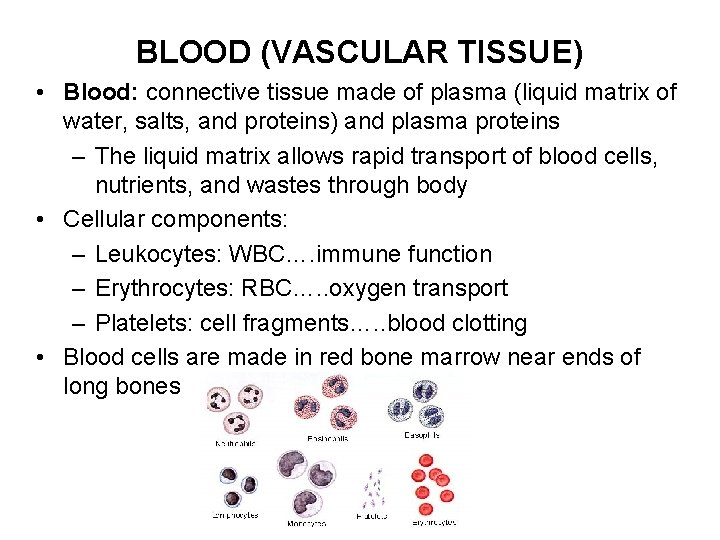
BLOOD (VASCULAR TISSUE) • Blood: connective tissue made of plasma (liquid matrix of water, salts, and proteins) and plasma proteins – The liquid matrix allows rapid transport of blood cells, nutrients, and wastes through body • Cellular components: – Leukocytes: WBC…. immune function – Erythrocytes: RBC…. . oxygen transport – Platelets: cell fragments…. . blood clotting • Blood cells are made in red bone marrow near ends of long bones
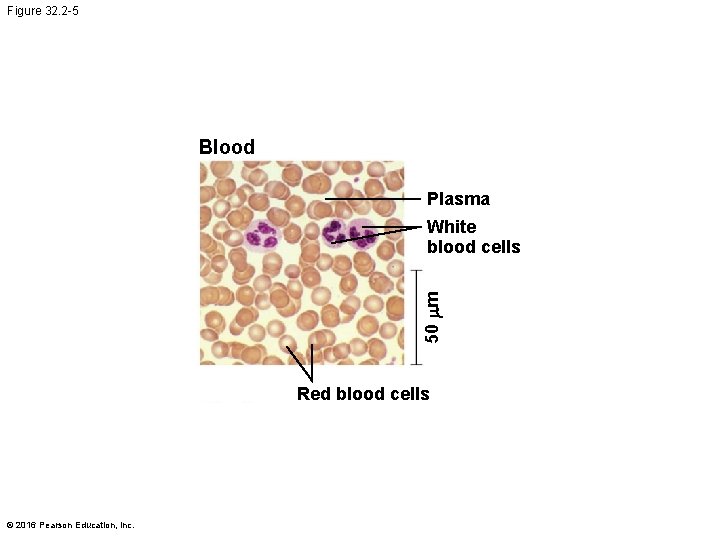
Figure 32. 2 -5 Blood Plasma 50 mm White blood cells Red blood cells © 2016 Pearson Education, Inc.
CARTILAGE • Cartilage: connective tissue that is both strong and flexible • Composed of collaginous fibers embedded in a rubbery matrix called chondroitin sulfate (a rubbery proteincarbohydrate ground substance) • Avascular and without nerves • Chondrocytes: cartilage cells; secrete both collagen and condroitin sulfate; confined to lacuna (scattered spaces in the condroitin sulfate) • Comprises skeleton of all vertebrate embryos…. retained in some vertebrates (sharks) as cartilaginous adult skeleton • Most vertebrates replace if (ossify) with bone • Cartilage still retained in vertebrate adults as nose, ears, trachea, epiglottis, ribs, intervertebral discs, ends of long bones
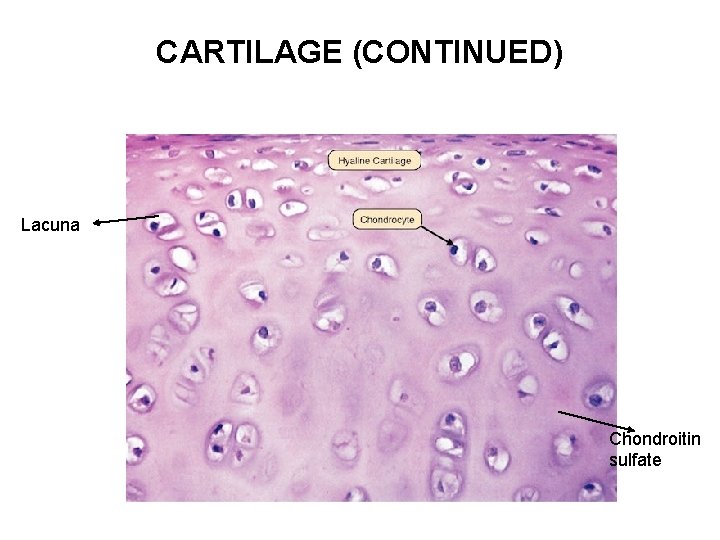
CARTILAGE (CONTINUED) Lacuna Chondroitin sulfate
BONES • Bones: mineralized connective tissue • Osteoblasts: bone-forming cells – Deposit a matrix of collagen and calcium phosphate: hardens into the mineral hydroyapatite; makes bones hard, not brittle • Bone consists of repeatiing units called Osteons or Haversian Systems – Concentric layers (lamella) of hydroxyapatite matrix around a central canal of blood vessels and nerves – Between the layers (lamella) are spaces (lacuna) which contain osteocytes • In long bones, only the outer are is hard/compact – Inner area is filled with spongy bone tissue called marrow – Red bone marrow is where blood cells are made
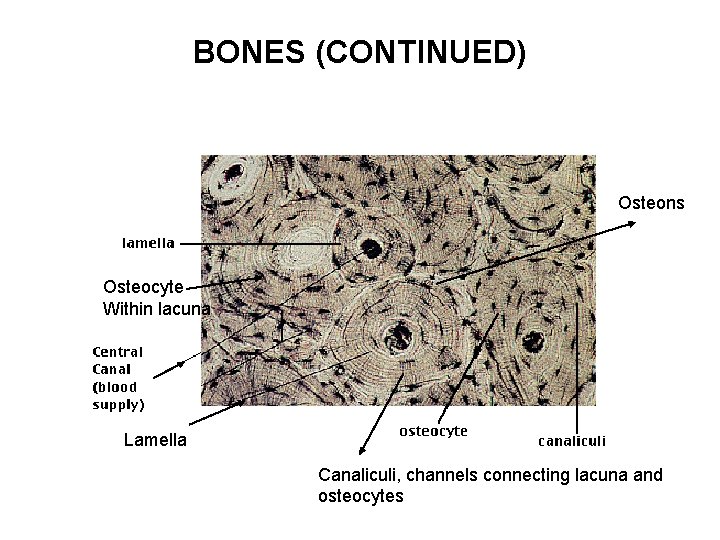
BONES (CONTINUED) Osteons Osteocyte Within lacuna Lamella Canaliculi, channels connecting lacuna and osteocytes
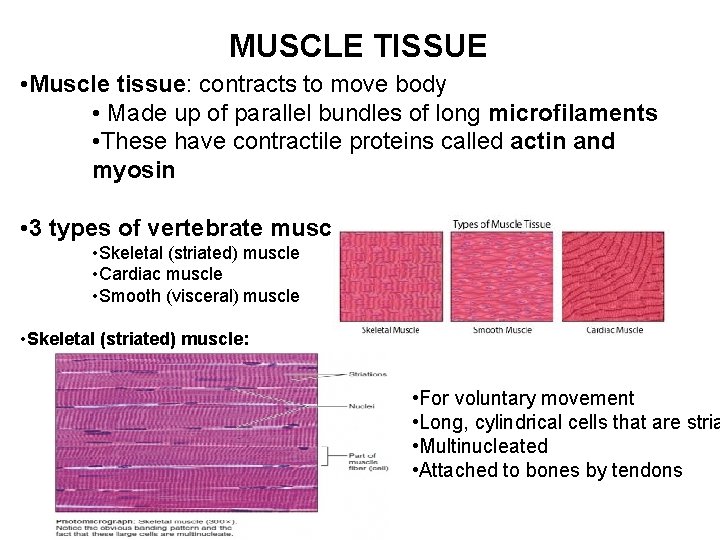
MUSCLE TISSUE • Muscle tissue: contracts to move body • Made up of parallel bundles of long microfilaments • These have contractile proteins called actin and myosin • 3 types of vertebrate muscle tissue • Skeletal (striated) muscle • Cardiac muscle • Smooth (visceral) muscle • Skeletal (striated) muscle: • For voluntary movement • Long, cylindrical cells that are stria • Multinucleated • Attached to bones by tendons
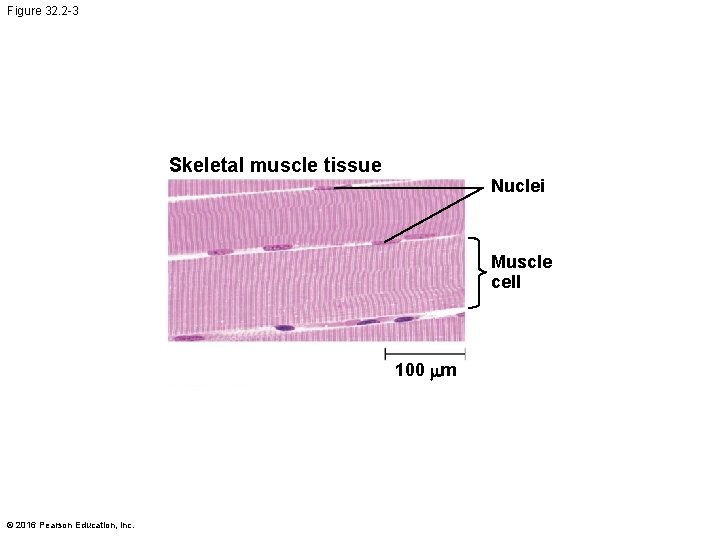
Figure 32. 2 -3 Skeletal muscle tissue Nuclei Muscle cell 100 mm © 2016 Pearson Education, Inc.
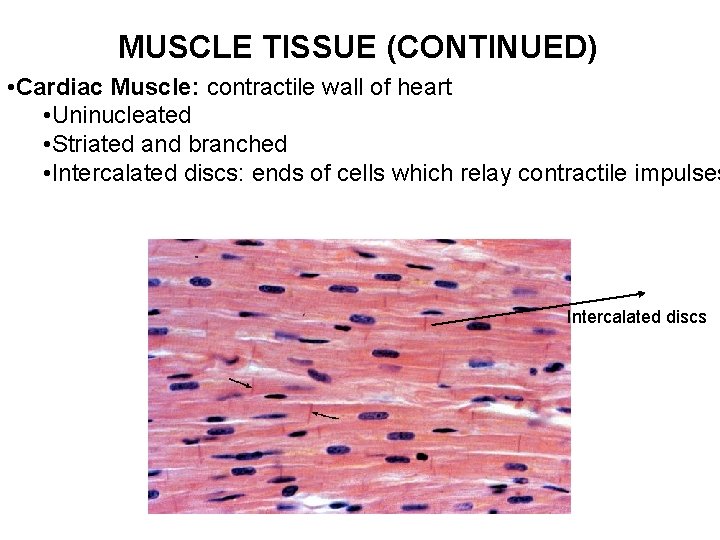
MUSCLE TISSUE (CONTINUED) • Cardiac Muscle: contractile wall of heart • Uninucleated • Striated and branched • Intercalated discs: ends of cells which relay contractile impulses Intercalated discs
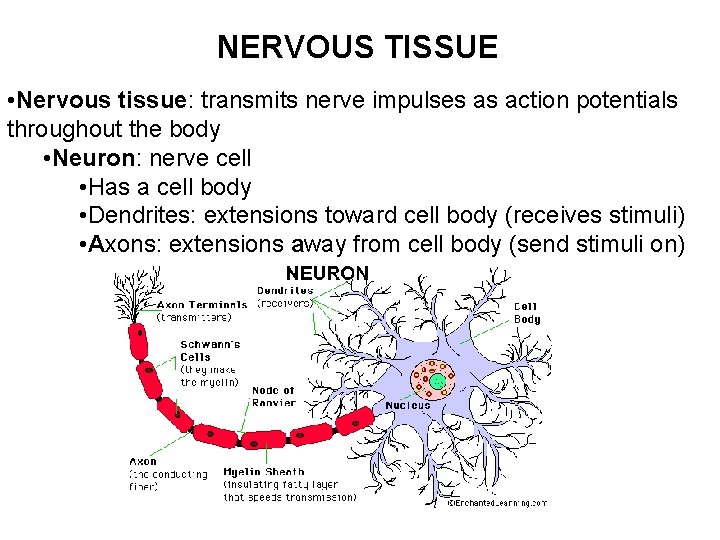
NERVOUS TISSUE • Nervous tissue: transmits nerve impulses as action potentials throughout the body • Neuron: nerve cell • Has a cell body • Dendrites: extensions toward cell body (receives stimuli) • Axons: extensions away from cell body (send stimuli on)
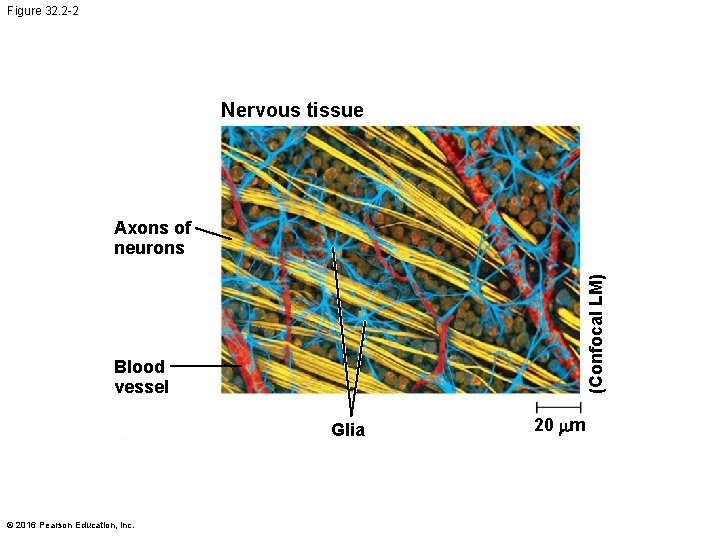
Figure 32. 2 -2 Nervous tissue (Confocal LM) Axons of neurons Blood vessel Glia © 2016 Pearson Education, Inc. 20 mm
2 COMMUNICATION SYSTEMS IN ANIMALS • 2 Communication systems in animals: • Endocrine System: acts slowly and over prolonged periods to affect broad changes in physiological and behavioral states of animal • Uses hormones…chemical compounds that are secreted and transported by the circulatory system, often to distant targets • Hormones bind to specific receptors on the surface or inside target cells that receive their signals • Helps an animal respond to its environment • Is involved in growth and development • Nervous System: responds rapidly to sensory information, providing immediate physiological responses • Both systems help maintain homeostasis…. steady state
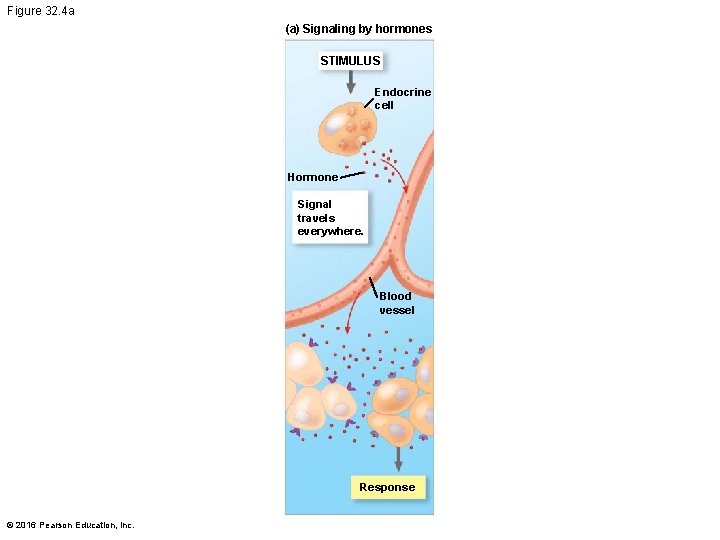
Figure 32. 4 a (a) Signaling by hormones STIMULUS Endocrine cell Hormone Signal travels everywhere. Blood vessel Response © 2016 Pearson Education, Inc.
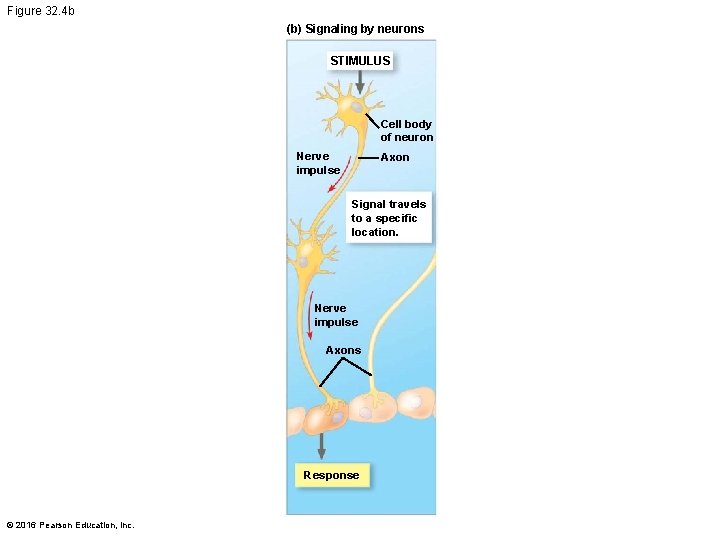
Figure 32. 4 b (b) Signaling by neurons STIMULUS Cell body of neuron Nerve impulse Axon Signal travels to a specific location. Nerve impulse Axons Response © 2016 Pearson Education, Inc.
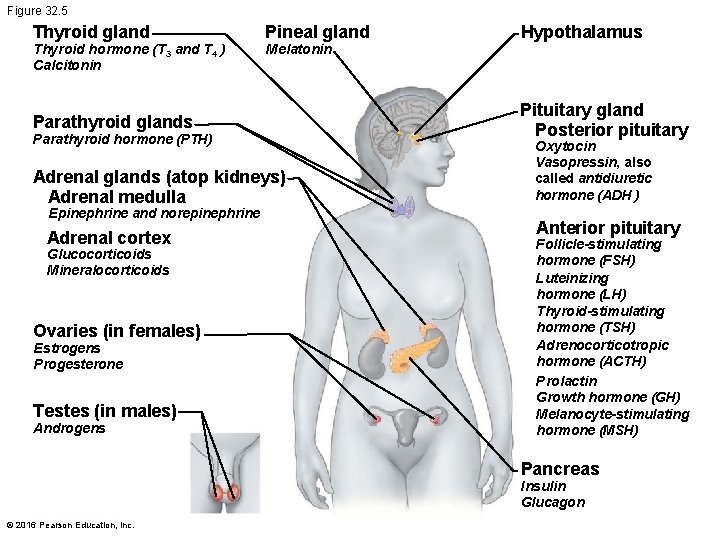
Figure 32. 5 Thyroid gland Thyroid hormone (T 3 and T 4 ) Calcitonin Pineal gland Melatonin Parathyroid glands Parathyroid hormone (PTH) Adrenal glands (atop kidneys) Adrenal medulla Epinephrine and norepinephrine Adrenal cortex Glucocorticoids Mineralocorticoids Ovaries (in females) Estrogens Progesterone Testes (in males) Androgens Hypothalamus Pituitary gland Posterior pituitary Oxytocin Vasopressin, also called antidiuretic hormone (ADH ) Anterior pituitary Follicle-stimulating hormone (FSH) Luteinizing hormone (LH) Thyroid-stimulating hormone (TSH) Adrenocorticotropic hormone (ACTH) Prolactin Growth hormone (GH) Melanocyte-stimulating hormone (MSH) Pancreas Insulin Glucagon © 2016 Pearson Education, Inc.
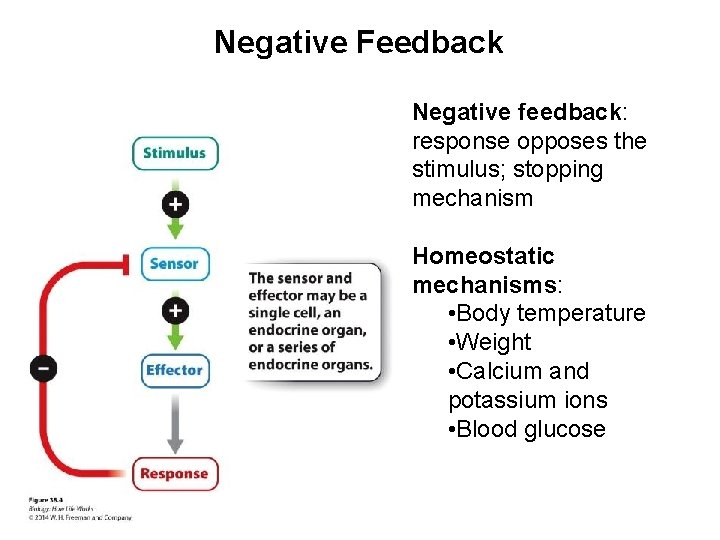
Negative Feedback Negative feedback: response opposes the stimulus; stopping mechanism Homeostatic mechanisms: • Body temperature • Weight • Calcium and potassium ions • Blood glucose
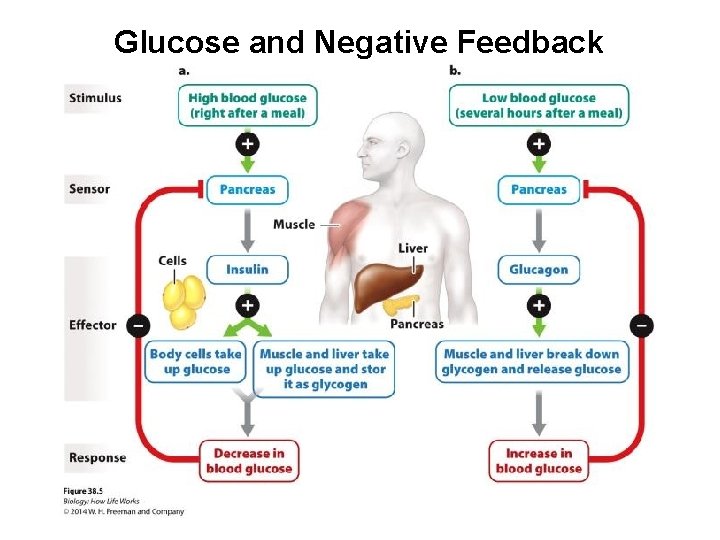
Glucose and Negative Feedback
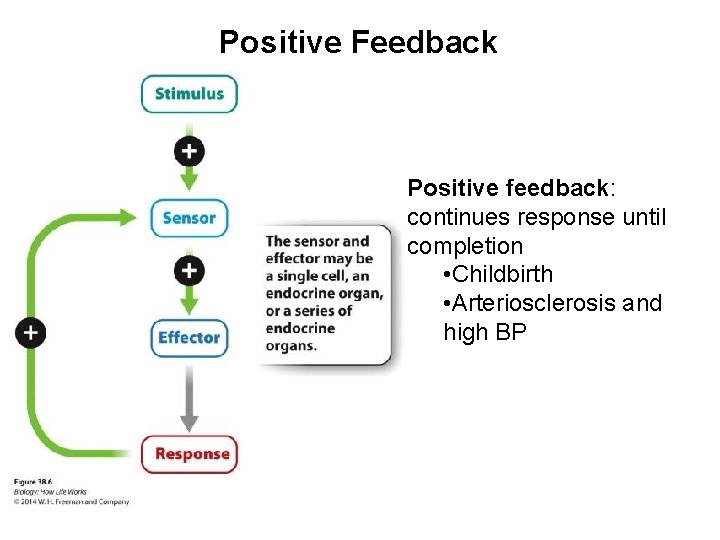
Positive Feedback Positive feedback: continues response until completion • Childbirth • Arteriosclerosis and high BP
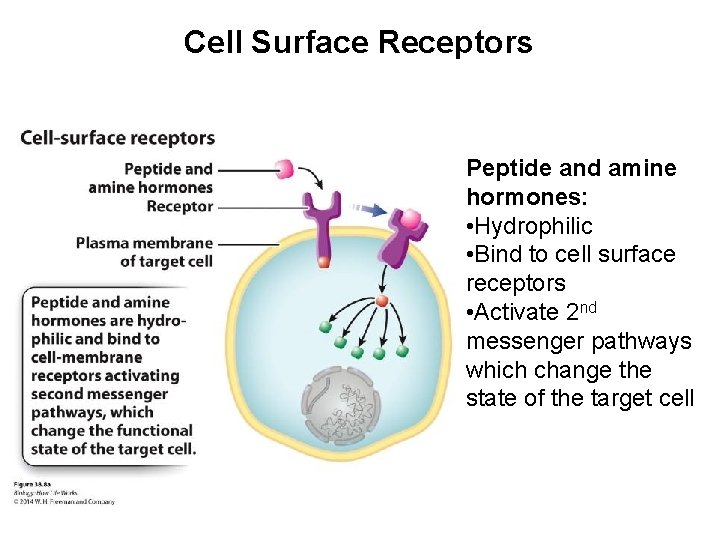
Cell Surface Receptors Peptide and amine hormones: • Hydrophilic • Bind to cell surface receptors • Activate 2 nd messenger pathways which change the state of the target cell
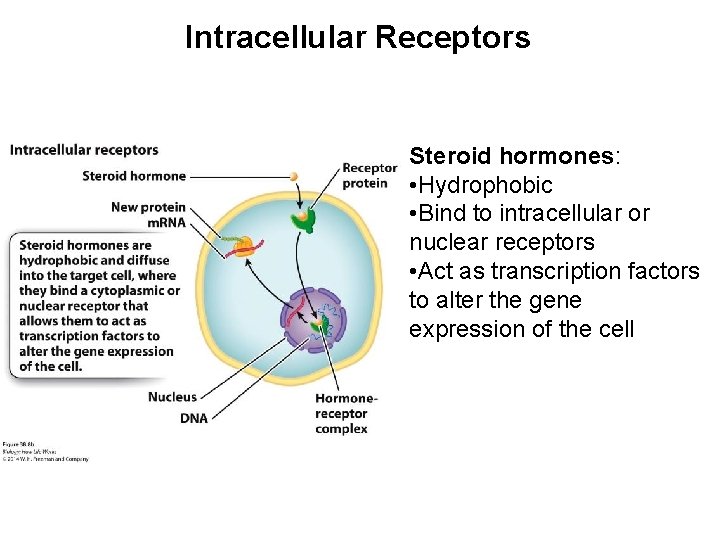
Intracellular Receptors Steroid hormones: • Hydrophobic • Bind to intracellular or nuclear receptors • Act as transcription factors to alter the gene expression of the cell
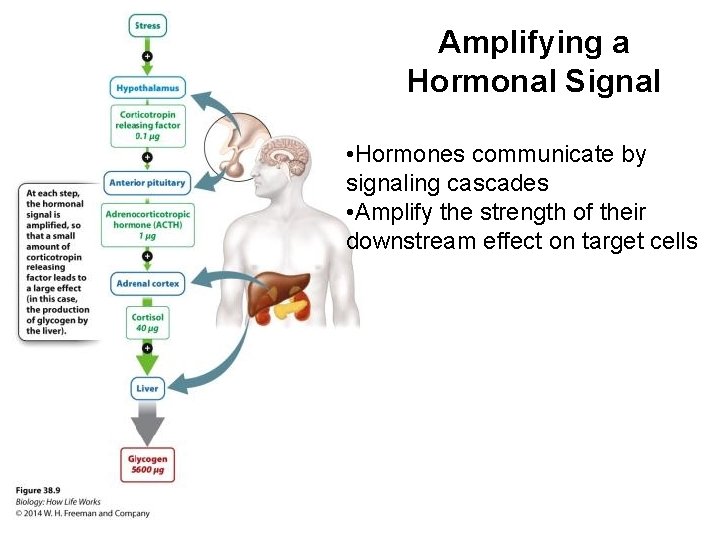
Amplifying a Hormonal Signal • Hormones communicate by signaling cascades • Amplify the strength of their downstream effect on target cells
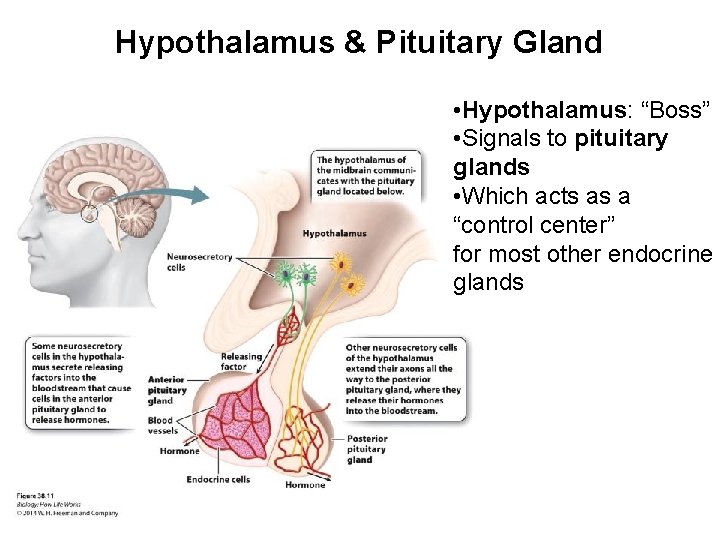
Hypothalamus & Pituitary Gland • Hypothalamus: “Boss” • Signals to pituitary glands • Which acts as a “control center” for most other endocrine glands
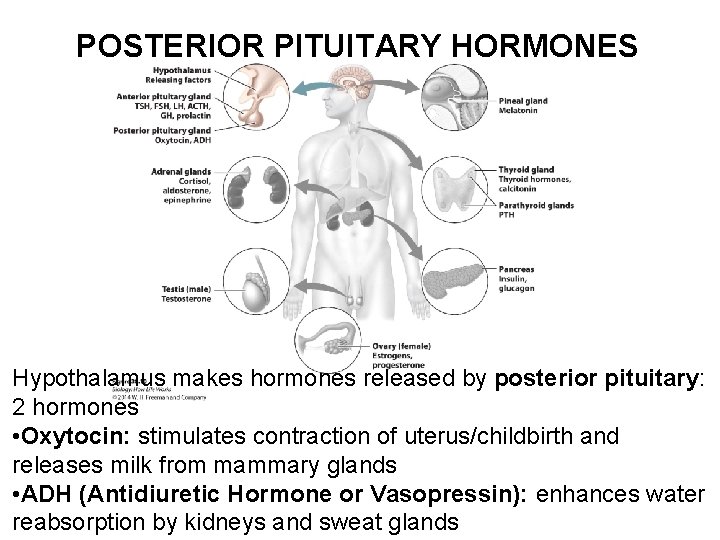
POSTERIOR PITUITARY HORMONES Hypothalamus makes hormones released by posterior pituitary: 2 hormones • Oxytocin: stimulates contraction of uterus/childbirth and releases milk from mammary glands • ADH (Antidiuretic Hormone or Vasopressin): enhances water reabsorption by kidneys and sweat glands
ANTERIOR PITUITARY HORMONES • Anterior Pituitary Gland: controlled by the hypothalamus • Tropic Hormones: when anterior pituitary acts on other endocrine glands to cause release of other hormones • TSH: acts on thyroid gland • Gonadotropic hormones – FSH and LH, which act on male & female gonads (ovaries and testes) • ACTH: acts on the adrenal glands • Growth Hormone (GH): stimulates growth of bones, muscles, other body tissues • Prolactin: stimulates milk production and secretion
Tropic Hormone - TSH (Thyroid Stimulating Hormone) • Acts on thyroid gland • Thyroid releases thyroxine (T 4) and triiodothyorine (T 3) • Help regulate cellular metabolism throughout body • Needs iodine (I)…. . iodized salt, kelp, seaweed • Deficiency…goiter…. causes thyroid enlargement • Hyperthyroidism: overly active metabolism…. weight loss, increased apetite • Hypothyroidism: slow metabolic rate…I. e. fatigue
Tropic Hormones – FSH and LH Follicle Stimulating Hormone (FSH) • Stimulates production of ova by ovaries in females • And sperm production by testes in males Leutenizing Hormone (LH) • Causes ovulation by ovaries, and changes follicle into corpus luteum • Stimulates secretion of sex hormones: estrogen from ovaries & progesterone from corpus luteum • And stimulates testes to secrete testosterone from testes
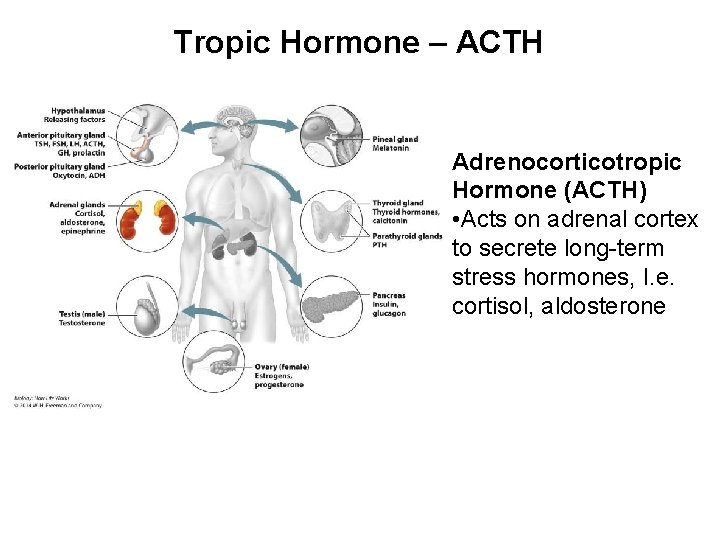
Tropic Hormone – ACTH Adrenocorticotropic Hormone (ACTH) • Acts on adrenal cortex to secrete long-term stress hormones, I. e. cortisol, aldosterone
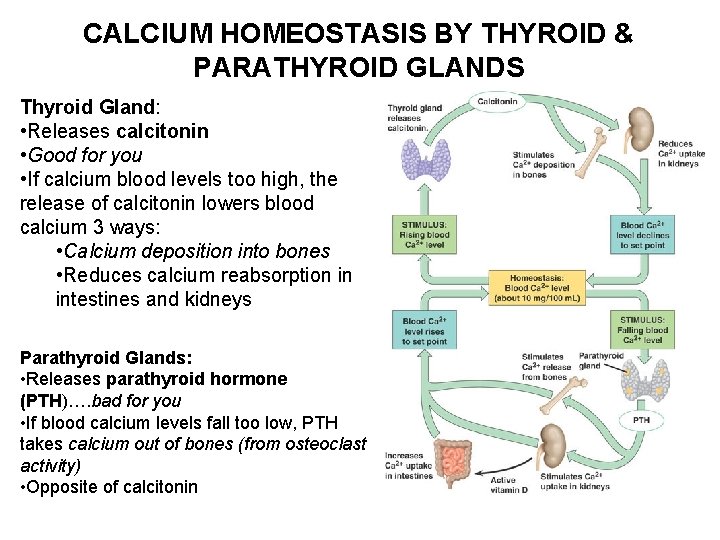
CALCIUM HOMEOSTASIS BY THYROID & PARATHYROID GLANDS Thyroid Gland: • Releases calcitonin • Good for you • If calcium blood levels too high, the release of calcitonin lowers blood calcium 3 ways: • Calcium deposition into bones • Reduces calcium reabsorption in intestines and kidneys Parathyroid Glands: • Releases parathyroid hormone (PTH)…. bad for you • If blood calcium levels fall too low, PTH takes calcium out of bones (from osteoclast activity) • Opposite of calcitonin
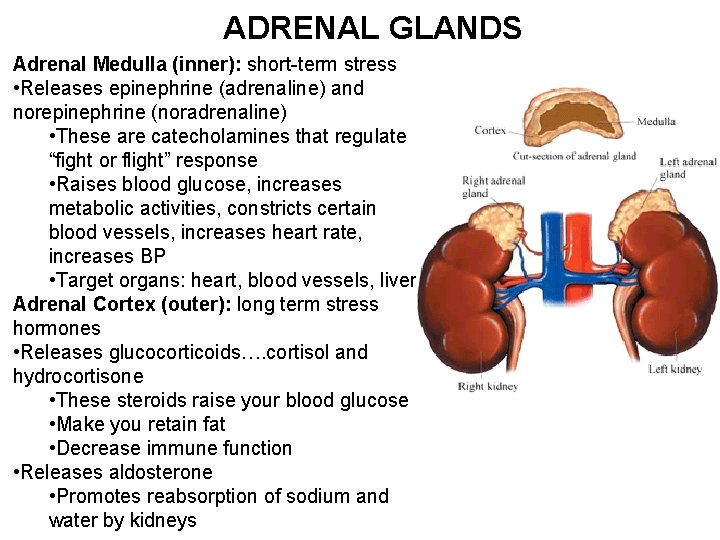
ADRENAL GLANDS Adrenal Medulla (inner): short-term stress • Releases epinephrine (adrenaline) and norepinephrine (noradrenaline) • These are catecholamines that regulate “fight or flight” response • Raises blood glucose, increases metabolic activities, constricts certain blood vessels, increases heart rate, increases BP • Target organs: heart, blood vessels, liver Adrenal Cortex (outer): long term stress hormones • Releases glucocorticoids…. cortisol and hydrocortisone • These steroids raise your blood glucose • Make you retain fat • Decrease immune function • Releases aldosterone • Promotes reabsorption of sodium and water by kidneys
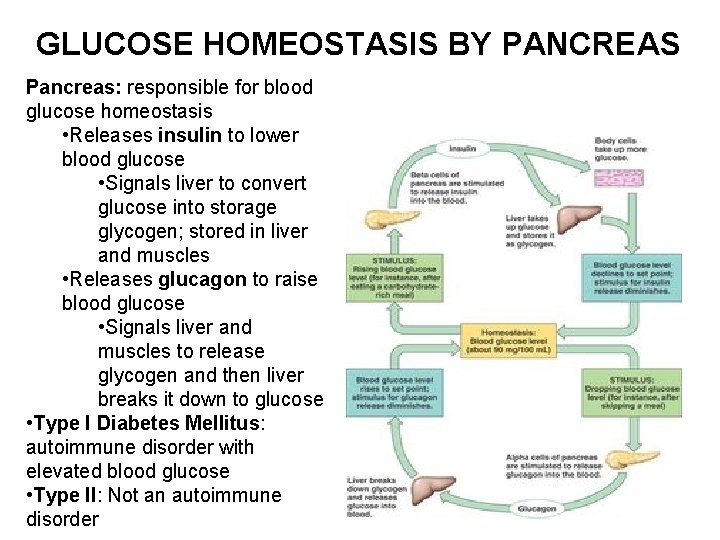
GLUCOSE HOMEOSTASIS BY PANCREAS Pancreas: responsible for blood glucose homeostasis • Releases insulin to lower blood glucose • Signals liver to convert glucose into storage glycogen; stored in liver and muscles • Releases glucagon to raise blood glucose • Signals liver and muscles to release glycogen and then liver breaks it down to glucose • Type I Diabetes Mellitus: autoimmune disorder with elevated blood glucose • Type II: Not an autoimmune disorder
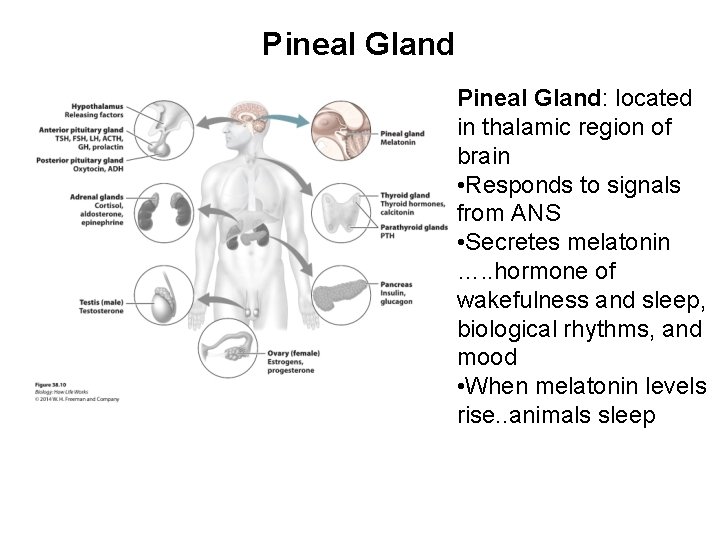
Pineal Gland: located in thalamic region of brain • Responds to signals from ANS • Secretes melatonin …. . hormone of wakefulness and sleep, biological rhythms, and mood • When melatonin levels rise. . animals sleep
Regulating and Conforming § An animal that is a regulator uses internal mechanisms to control internal change despite external fluctuation § An animal that is a conformer allows its internal condition to change in accordance with external changes § An animal may regulate some internal conditions and not others § For example, a fish may conform to surrounding temperature in the water, but it regulates solute concentrations in its blood and interstitial fluid (the fluid surrounding body cells) © 2016 Pearson Education, Inc.
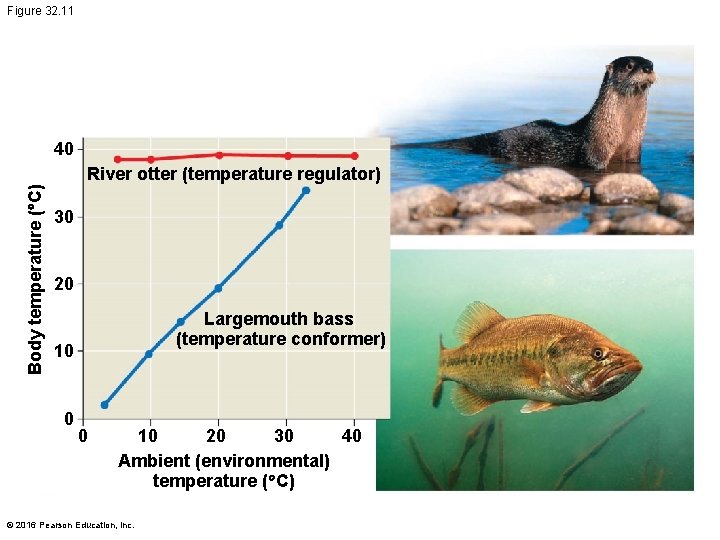
Figure 32. 11 40 Body temperature ( C) River otter (temperature regulator) 30 20 Largemouth bass (temperature conformer) 10 0 0 10 20 30 40 Ambient (environmental) temperature ( C) © 2016 Pearson Education, Inc.
Homeostasis § Organisms use homeostasis to maintain a “steady state” or internal balance regardless of external environment § In humans, body temperature, blood p. H, and glucose concentration are each maintained at a constant level © 2016 Pearson Education, Inc.
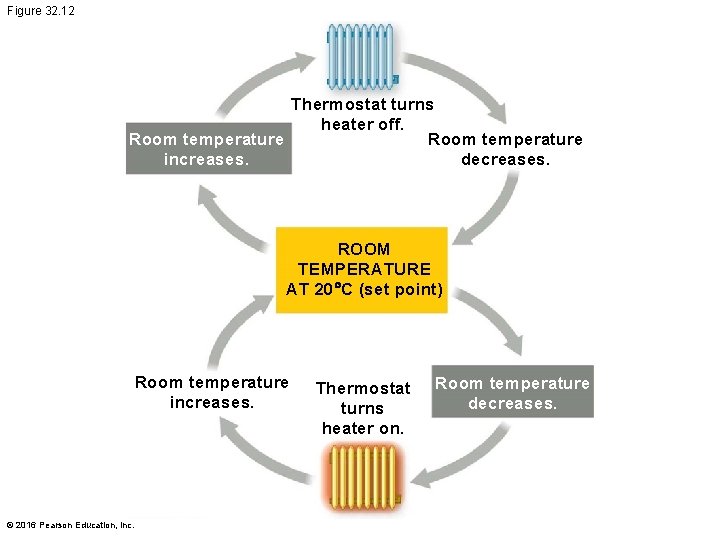
Figure 32. 12 Thermostat turns heater off. Room temperature increases. decreases. ROOM TEMPERATURE AT 20 C (set point) Room temperature increases. © 2016 Pearson Education, Inc. Thermostat turns heater on. Room temperature decreases.
Endothermy and Ectothermy Thermoregulation is the process by which animals maintain an internal temperature within a normal range § Endothermic animals generate heat by metabolism; birds and mammals are endotherms; maintain stable body temp in fluctuations of external temps § Ectothermic animals gain heat from external sources; may use behavioral methods; consume less food; e. g. most invertebrates, fishes, amphibians, and nonavian reptiles © 2016 Pearson Education, Inc.
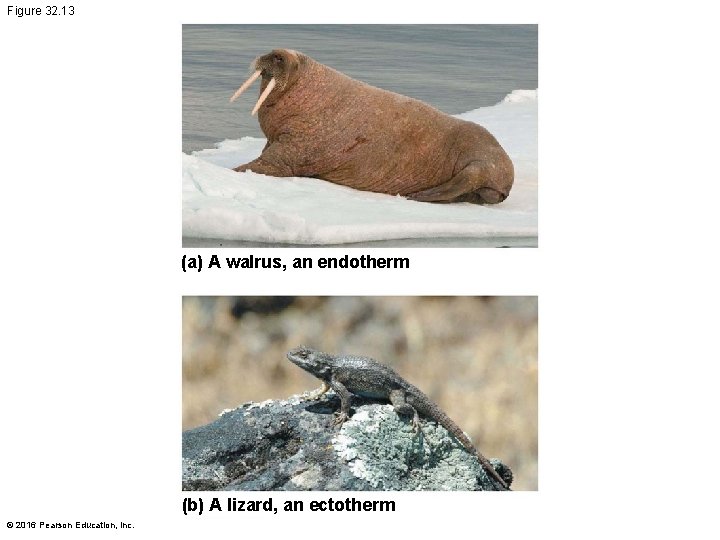
Figure 32. 13 (a) A walrus, an endotherm (b) A lizard, an ectotherm © 2016 Pearson Education, Inc.
Balancing Heat Loss and Gain § Organisms exchange heat by 4 physical processes § § Radiation Evaporation Convection Conduction § Heat is always transferred from an object of higher temperature to one of lower temperature © 2016 Pearson Education, Inc.
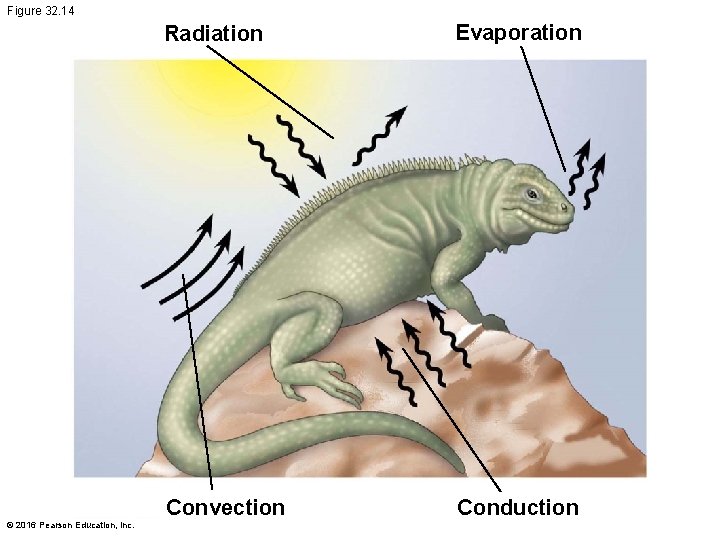
Figure 32. 14 © 2016 Pearson Education, Inc. Radiation Evaporation Convection Conduction
Circulatory Adaptations for Thermoregulation § In response to changes in environmental temperature, animals can alter blood (hence heat) flow between their body core and surface § Vasodilation, the widening of the diameter of superficial blood vessels, promotes heat loss § Vasoconstriction, the narrowing of the diameter of superficial blood vessels, reduces heat loss © 2016 Pearson Education, Inc.
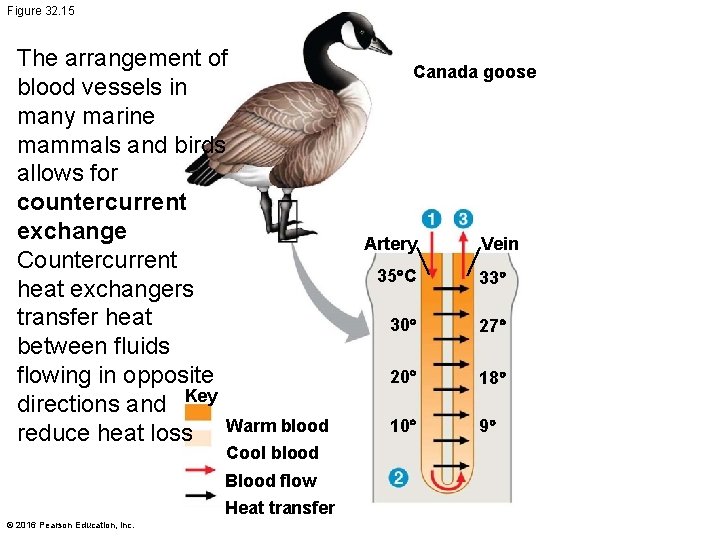
Figure 32. 15 The arrangement of blood vessels in many marine mammals and birds allows for countercurrent exchange Countercurrent heat exchangers transfer heat between fluids flowing in opposite directions and Key reduce heat loss Warm blood Cool blood Blood flow Heat transfer © 2016 Pearson Education, Inc. Canada goose Artery Vein 35 C 33 30 27 20 18 10 9
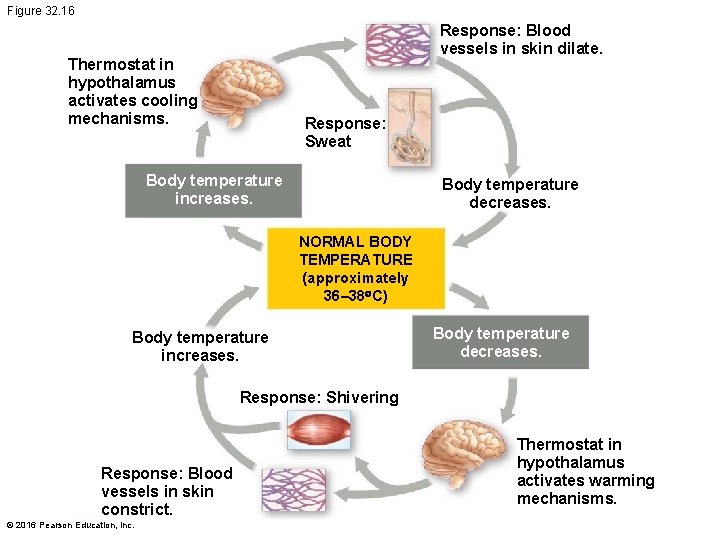
Figure 32. 16 Response: Blood vessels in skin dilate. Thermostat in hypothalamus activates cooling mechanisms. Response: Sweat Body temperature increases. Body temperature decreases. NORMAL BODY TEMPERATURE (approximately 36– 38 C) Body temperature increases. Body temperature decreases. Response: Shivering Response: Blood vessels in skin constrict. © 2016 Pearson Education, Inc. Thermostat in hypothalamus activates warming mechanisms.
PLASMA MEMBRANES All animals regulate their water and electrolyte levels within their cells. All animals must balance their water intake/output as well as solutes (also called ions or electrolytes) for homeostasis Cell membranes and sheets of cells are selectively permeable membranes • Allow the passage of water, but restrict or control the movement of many solutes • Cell membranes are lipid bilayers with embedded proteins
Plasma Membranes Cont’d Cross the membrane easily: • Nonpolar/hydrophobic molecules…. . such as HC and O 2 • Small polar molecules…. such as H 2 O and CO 2 • Cross by diffusion…. the spontaneous, net movement of a substance DOWN its concentration gradient (from higher concentration to lower concentration) © 2016 Pearson Education, Inc.
Osmosis Special type of diffusion: the diffusion of water through a semipermeable membrane • Spontaneous and passive; water moves from an area of [greater H 2 O] (or low solute concentration) to its area of [lower H 2 O] (or higher solute concentration) • Expressed as osmolarity: moles of solute/liter of H 2 O; • Higher osmolarity: more solutes (more concentrated) • I. e. osmolarity of human blood is 300 mosms/L while seawater is 1, 000 mosm/L • Osmotic pressure: pressure by water as it moves from one solution to another • Osmoregulation: regulation of water and solute levels to control osmotic pressure inside cells or organisms; a type of homeostasis; humans balance the gain and loss of water and solutes (ions, electrolytes), because blood can’t be too thick
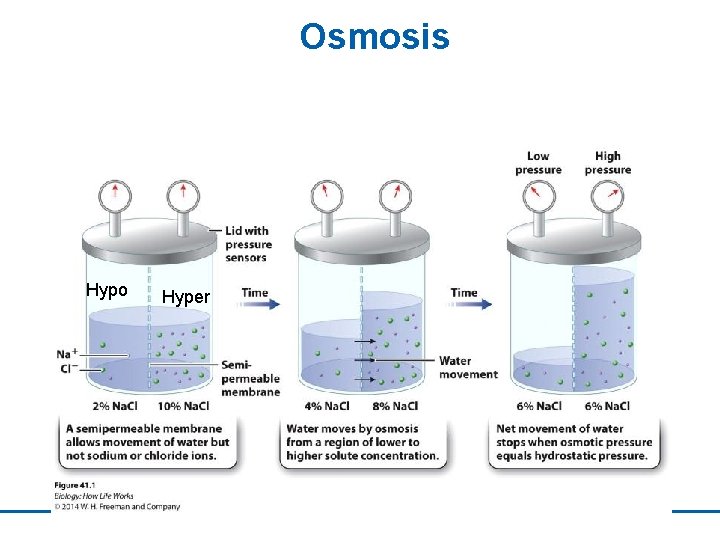
Osmosis Hypo Hyper
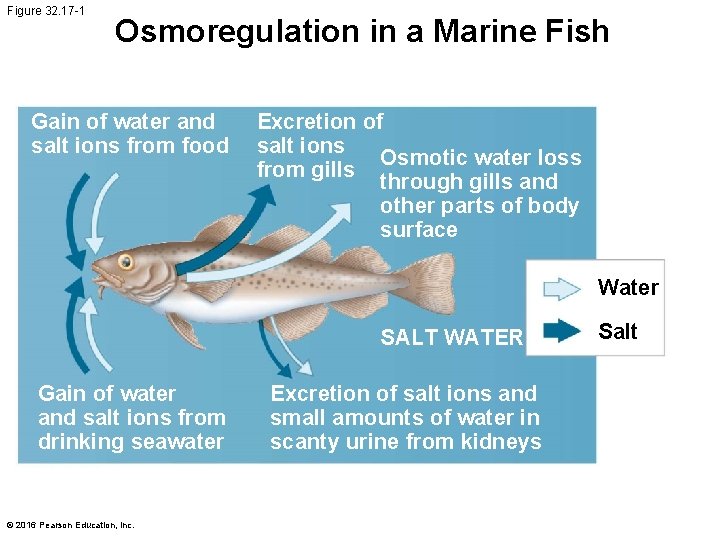
Figure 32. 17 -1 Osmoregulation in a Marine Fish Gain of water and salt ions from food Excretion of salt ions Osmotic water loss from gills through gills and other parts of body surface Water SALT WATER Gain of water and salt ions from drinking seawater © 2016 Pearson Education, Inc. Excretion of salt ions and small amounts of water in scanty urine from kidneys Salt
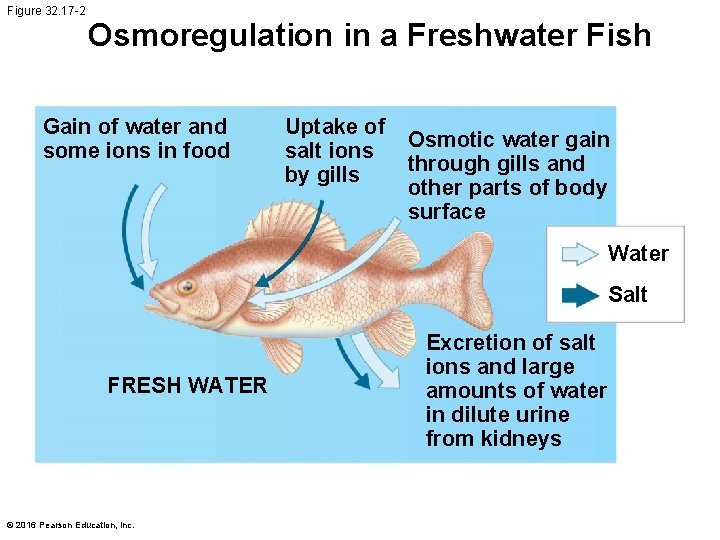
Figure 32. 17 -2 Osmoregulation in a Freshwater Fish Gain of water and some ions in food Uptake of salt ions by gills Osmotic water gain through gills and other parts of body surface Water Salt FRESH WATER © 2016 Pearson Education, Inc. Excretion of salt ions and large amounts of water in dilute urine from kidneys
Osmoregulators § Marine and freshwater organisms have opposite challenges § Marine fish drink large amounts of seawater to balance water loss and excrete salt through their gills and kidneys § Freshwater fish drink almost no water and replenish salts through eating; some also replenish salts by uptake across the gills © 2016 Pearson Education, Inc.
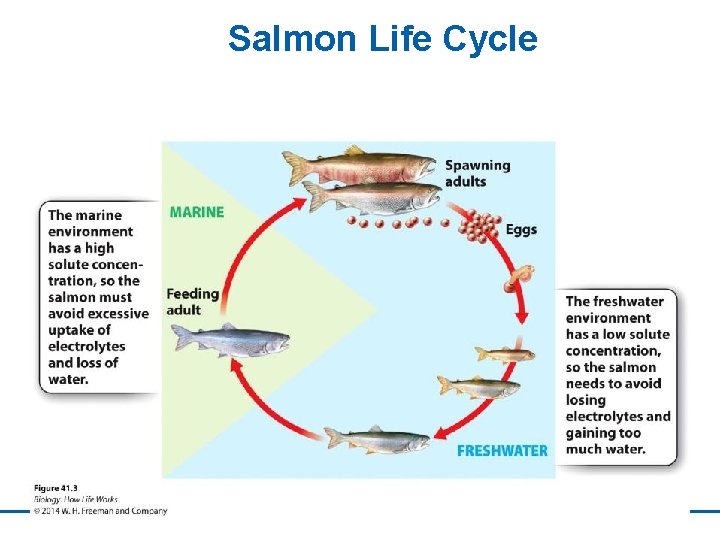
Salmon Life Cycle
Osmoconformers § Match internal osmotic pressure to that of their external environment § Reduces the movement of water and solutes into or out of their bodies § Don’t spend a lot of energy regulating osmotic pressure § However, they do need to adapt their [solute] to seawater § Examples: § Most marine invertebrates (match intracellular [solute] to seawater) § Some marine vertebrates, such as lampreys and hagfish (match intracellular [solute] to seawater) § Sharks, rays, skates (match intracellular [urea] to seawater)
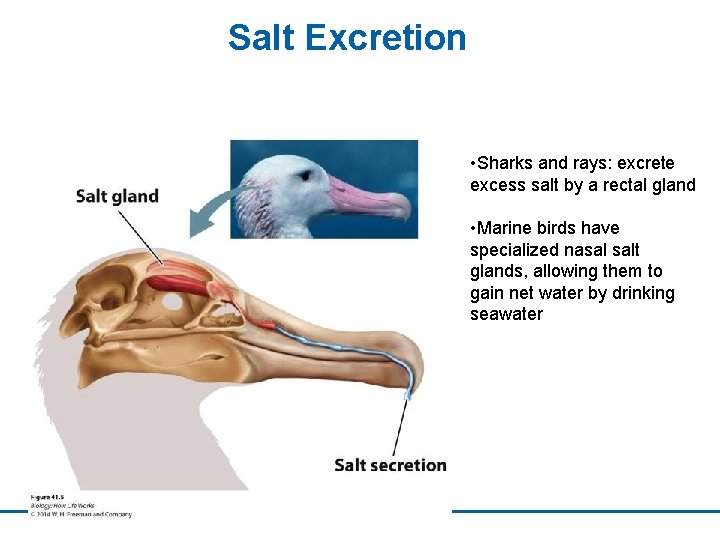
Salt Excretion • Sharks and rays: excrete excess salt by a rectal gland • Marine birds have specialized nasal salt glands, allowing them to gain net water by drinking seawater
Nitrogenous Waste Excretory organs eliminate nitrogenous wastes and regulate water and electrolyte levels. • Excretion: the elimination of waste products and toxic compounds from body • Animals have excess nitrogenous wastes from N-containing foods they metabolize for energy; specifically proteins and nucleic acids • Depending on the animal, these wastes are either excreted as: • Ammonia • Urea • Uric acid
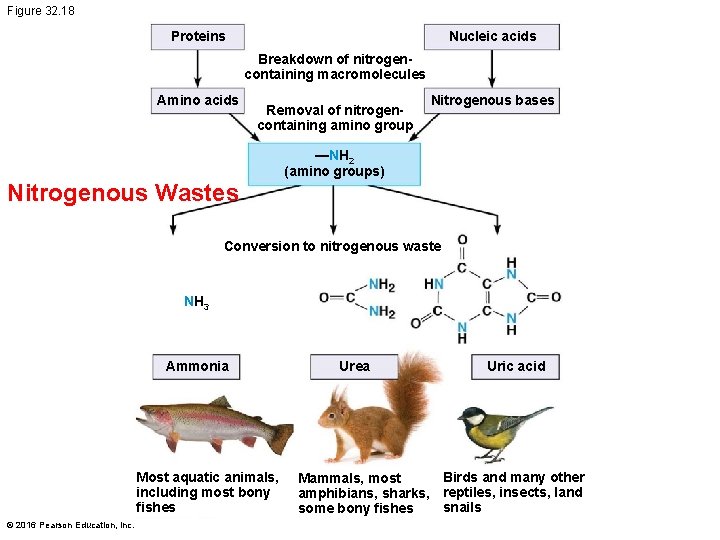
Figure 32. 18 Nucleic acids Proteins Breakdown of nitrogencontaining macromolecules Amino acids Removal of nitrogencontaining amino group Nitrogenous bases —NH 2 (amino groups) Nitrogenous Wastes Conversion to nitrogenous waste NH 3 Ammonia Most aquatic animals, including most bony fishes © 2016 Pearson Education, Inc. Urea Uric acid Birds and many other Mammals, most amphibians, sharks, reptiles, insects, land snails some bony fishes
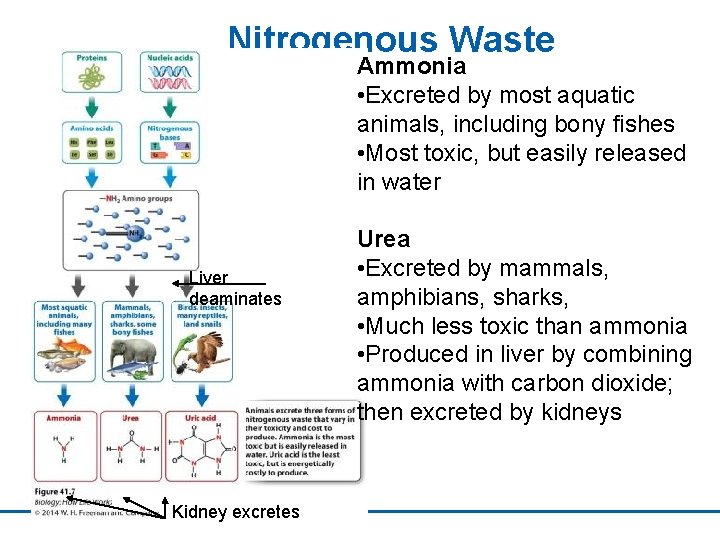
Nitrogenous Waste Ammonia • Excreted by most aquatic animals, including bony fishes • Most toxic, but easily released in water Liver deaminates Kidney excretes Urea • Excreted by mammals, amphibians, sharks, • Much less toxic than ammonia • Produced in liver by combining ammonia with carbon dioxide; then excreted by kidneys
Nitrogenous Wastes Cont’d Uric Acid • Excreted by birds, insects, reptiles • Least toxic but most energetically costly • Insoluble in water; excreted as semi-solid paste called guano; allows animal to conserve water • Humans excrete urea, but also a little bit of uric acid. Gout: excess uric acid in joints © 2016 Pearson Education, Inc.
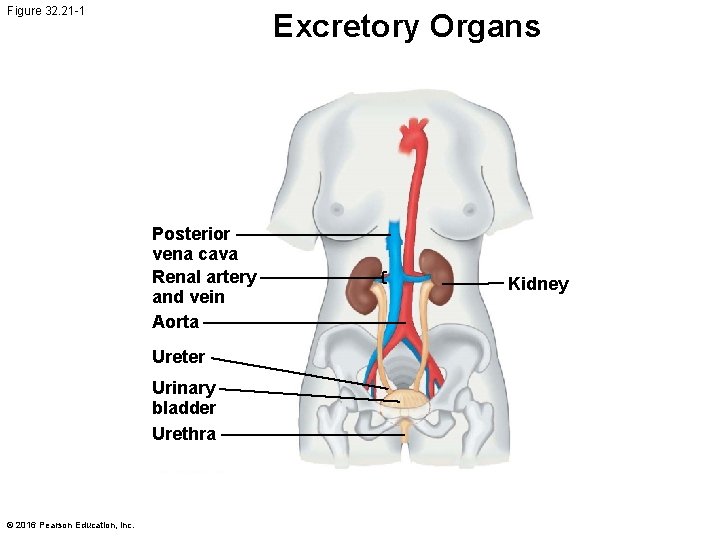
Figure 32. 21 -1 Excretory Organs Posterior vena cava Renal artery and vein Aorta Ureter Urinary bladder Urethra © 2016 Pearson Education, Inc. Kidney
ANIMAL EXCRETORY ORGANS § All animal excretory organs work by: § Filtration § Reabsorption § Secretion § Elimination; urine produced by kidneys/other excretory organs is stored in bladder or cloaca until being eliminated § Examples of excretory organs: § Protonephridia in flatworms § Metanephridia of segmented annelid worms § Malpighian tubules of insects § Kidneys of vertebrates
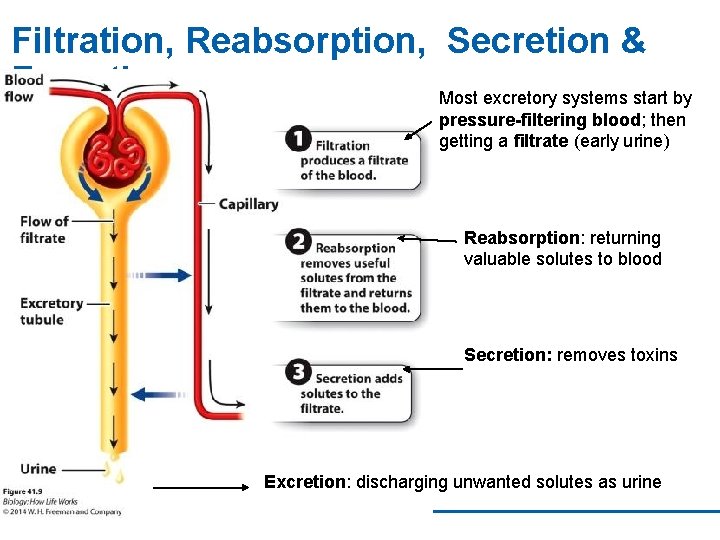
Filtration, Reabsorption, Secretion & Excretion Most excretory systems start by pressure-filtering blood; then getting a filtrate (early urine) Reabsorption: returning valuable solutes to blood Secretion: removes toxins Excretion: discharging unwanted solutes as urine
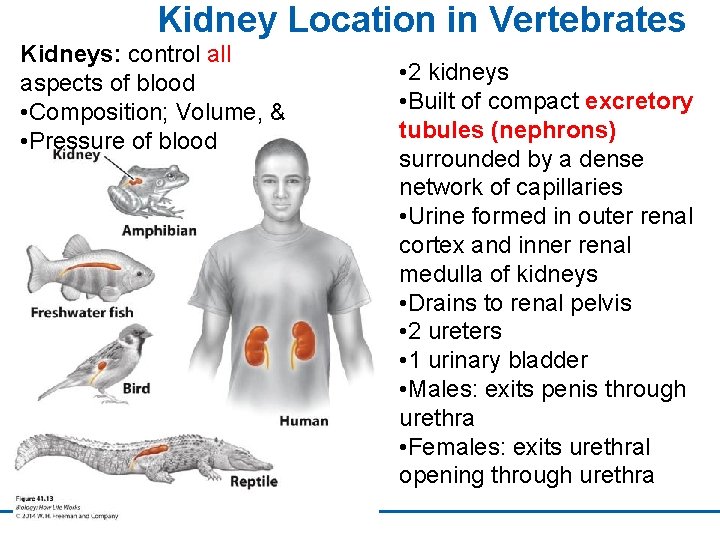
Kidney Location in Vertebrates Kidneys: control all aspects of blood • Composition; Volume, & • Pressure of blood • 2 kidneys • Built of compact excretory tubules (nephrons) surrounded by a dense network of capillaries • Urine formed in outer renal cortex and inner renal medulla of kidneys • Drains to renal pelvis • 2 ureters • 1 urinary bladder • Males: exits penis through urethra • Females: exits urethral opening through urethra
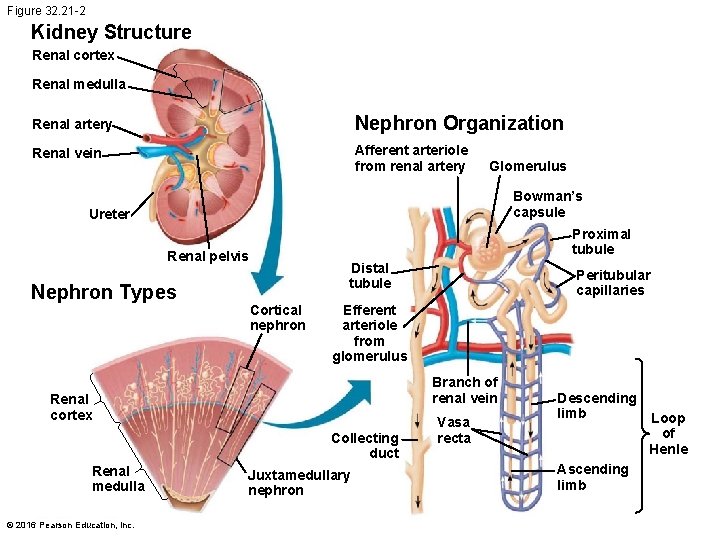
Figure 32. 21 -2 Kidney Structure Renal cortex Renal medulla Renal artery Nephron Organization Renal vein Afferent arteriole from renal artery Glomerulus Bowman’s capsule Ureter Proximal tubule Renal pelvis Nephron Types Distal tubule Cortical nephron Efferent arteriole from glomerulus Branch of renal vein Renal cortex Collecting duct Renal medulla © 2016 Pearson Education, Inc. Peritubular capillaries Juxtamedullary nephron Vasa recta Descending limb Ascending limb Loop of Henle
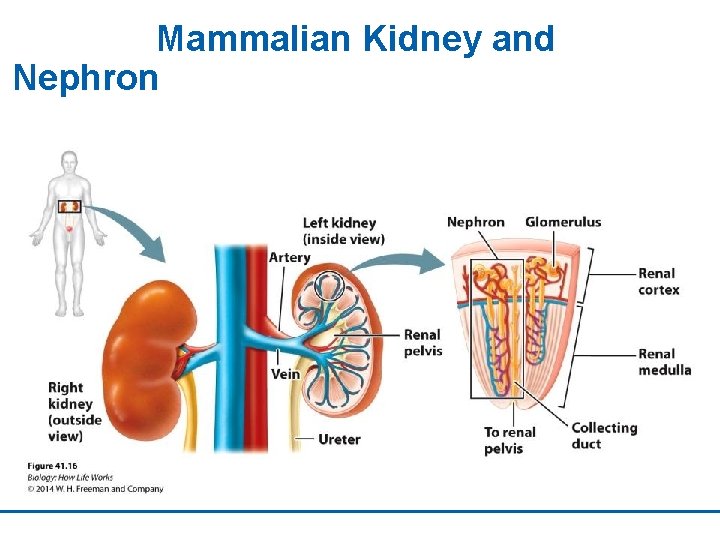
Mammalian Kidney and Nephron
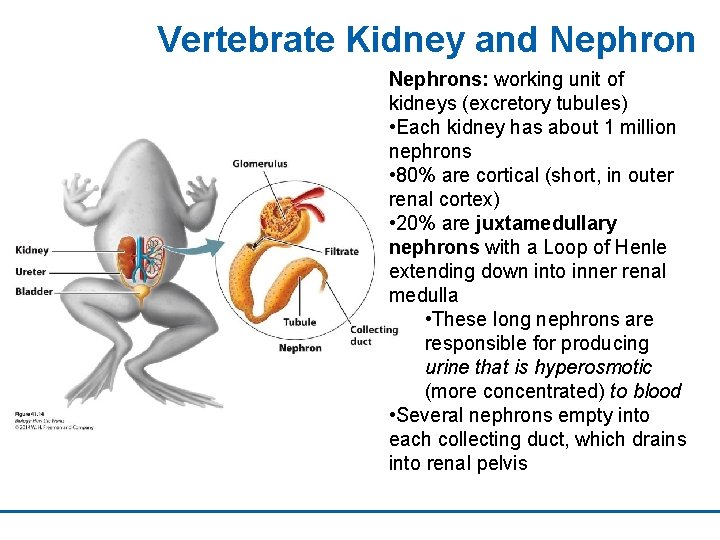
Vertebrate Kidney and Nephrons: working unit of kidneys (excretory tubules) • Each kidney has about 1 million nephrons • 80% are cortical (short, in outer renal cortex) • 20% are juxtamedullary nephrons with a Loop of Henle extending down into inner renal medulla • These long nephrons are responsible for producing urine that is hyperosmotic (more concentrated) to blood • Several nephrons empty into each collecting duct, which drains into renal pelvis
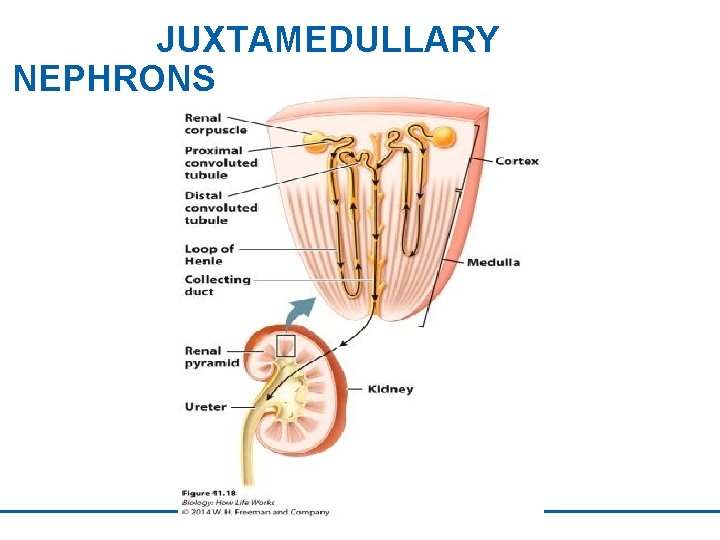
JUXTAMEDULLARY NEPHRONS
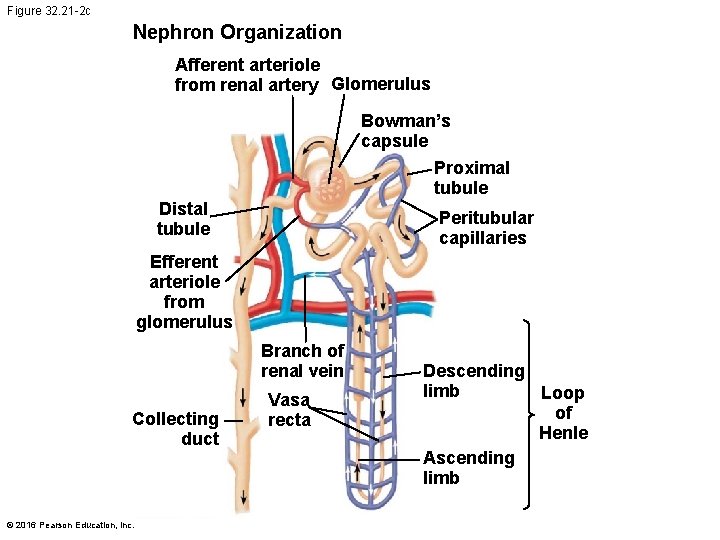
Figure 32. 21 -2 c Nephron Organization Afferent arteriole from renal artery Glomerulus Bowman’s capsule Proximal tubule Distal tubule Peritubular capillaries Efferent arteriole from glomerulus Branch of renal vein Collecting duct © 2016 Pearson Education, Inc. Vasa recta Descending limb Loop of Henle Ascending limb
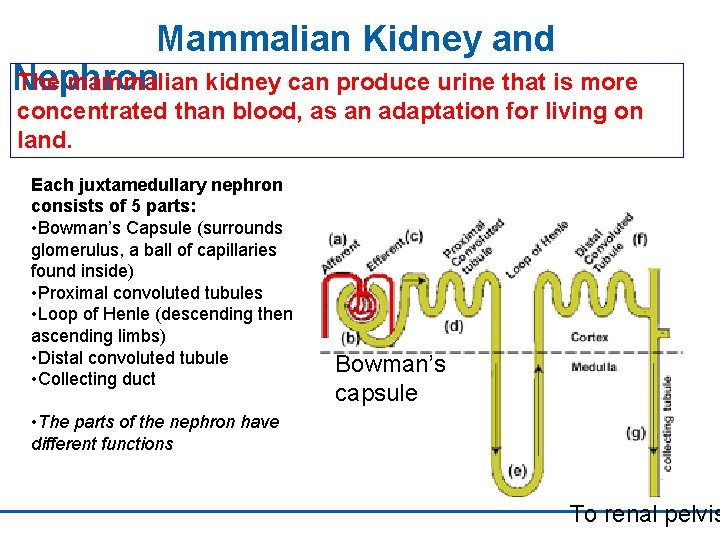
Mammalian Kidney and Nephron The mammalian kidney can produce urine that is more concentrated than blood, as an adaptation for living on land. Each juxtamedullary nephron consists of 5 parts: • Bowman’s Capsule (surrounds glomerulus, a ball of capillaries found inside) • Proximal convoluted tubules • Loop of Henle (descending then ascending limbs) • Distal convoluted tubule • Collecting duct Bowman’s capsule • The parts of the nephron have different functions To renal pelvis
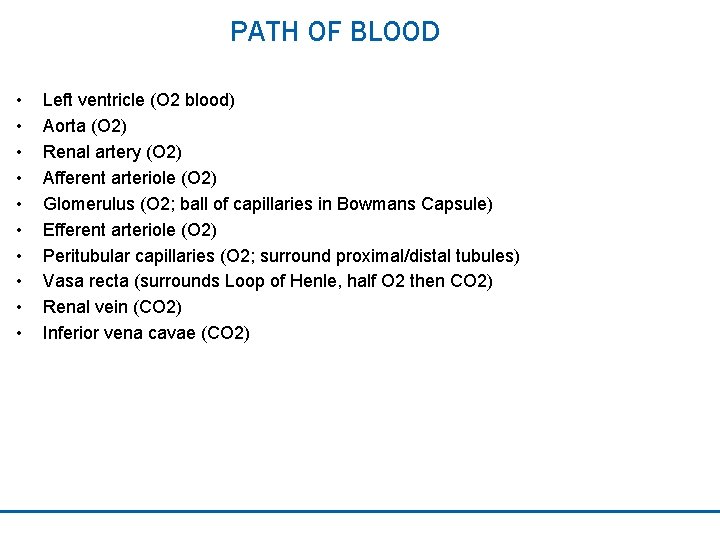
PATH OF BLOOD • • • Left ventricle (O 2 blood) Aorta (O 2) Renal artery (O 2) Afferent arteriole (O 2) Glomerulus (O 2; ball of capillaries in Bowmans Capsule) Efferent arteriole (O 2) Peritubular capillaries (O 2; surround proximal/distal tubules) Vasa recta (surrounds Loop of Henle, half O 2 then CO 2) Renal vein (CO 2) Inferior vena cavae (CO 2)

Path of Blood and Vasa Recta
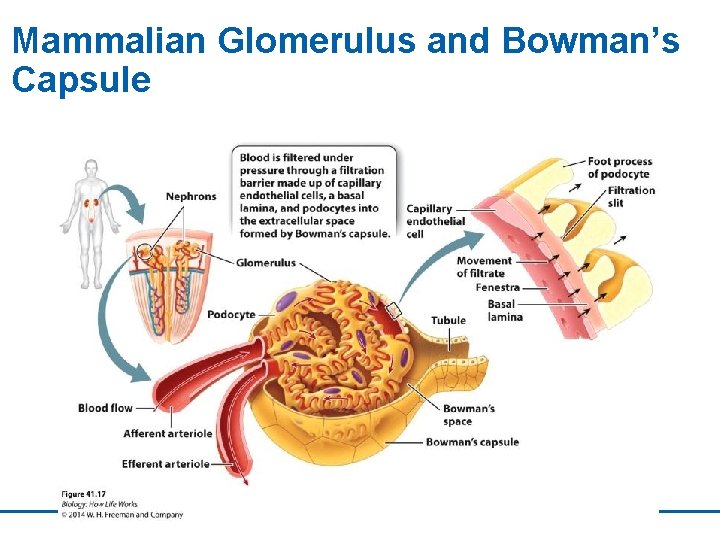
Mammalian Glomerulus and Bowman’s Capsule
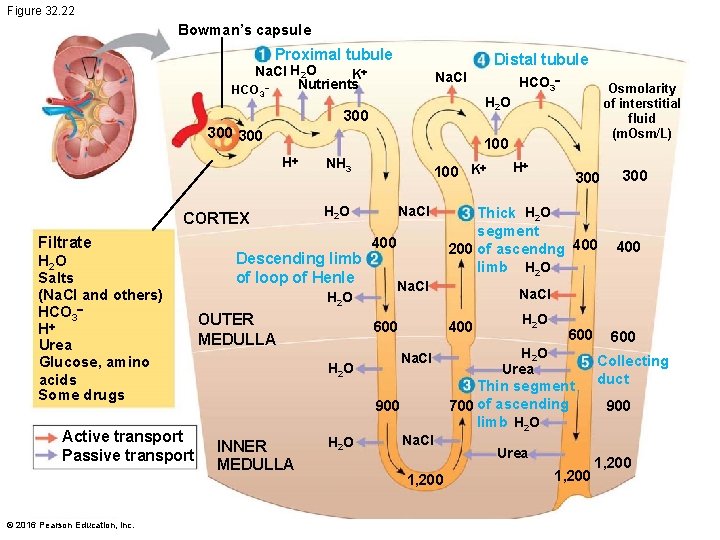
Figure 32. 22 Bowman’s capsule Proximal tubule Distal tubule Na. Cl H 2 O K+ Nutrients HCO Na. Cl 3 100 H+ CORTEX Filtrate H 2 O Salts (Na. Cl and others) HCO 3 H+ Urea Glucose, amino acids Some drugs Active transport Passive transport © 2016 Pearson Education, Inc. Osmolarity of interstitial fluid (m. Osm/L) H 2 O 300 300 HCO 3 NH 3 100 K+ H 2 O Descending limb of loop of Henle H 2 O OUTER MEDULLA Na. Cl 400 H 2 O 900 INNER MEDULLA H 2 O Na. Cl 1, 200 300 400 Na. Cl 300 Thick H 2 O segment 200 of ascendng 400 limb H 2 O Na. Cl 600 H+ H 2 O 600 H 2 O Urea Thin segment 700 of ascending limb H 2 O Urea 1, 200 600 Collecting duct 900 1, 200
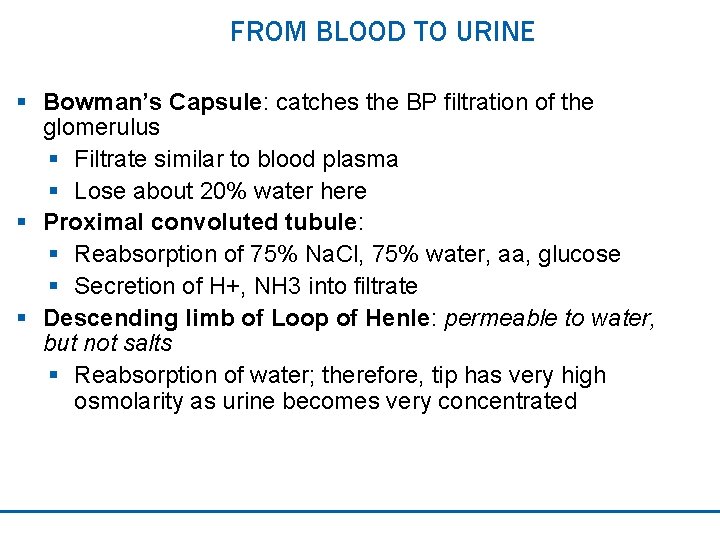
FROM BLOOD TO URINE § Bowman’s Capsule: catches the BP filtration of the glomerulus § Filtrate similar to blood plasma § Lose about 20% water here § Proximal convoluted tubule: § Reabsorption of 75% Na. Cl, 75% water, aa, glucose § Secretion of H+, NH 3 into filtrate § Descending limb of Loop of Henle: permeable to water, but not salts § Reabsorption of water; therefore, tip has very high osmolarity as urine becomes very concentrated
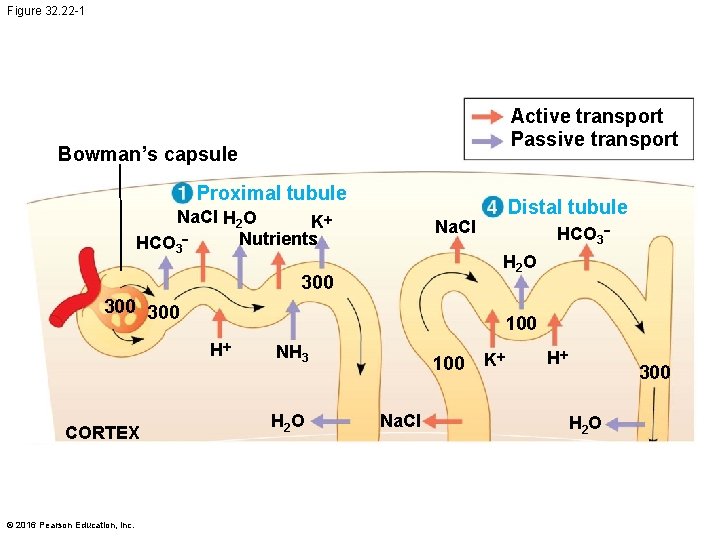
Figure 32. 22 -1 Active transport Passive transport Bowman’s capsule Proximal tubule Na. Cl H 2 O K+ Nutrients HCO 3 Distal tubule Na. Cl HCO 3 H 2 O 300 300 100 H+ CORTEX © 2016 Pearson Education, Inc. NH 3 H 2 O + 100 K Na. Cl H+ 300 H 2 O
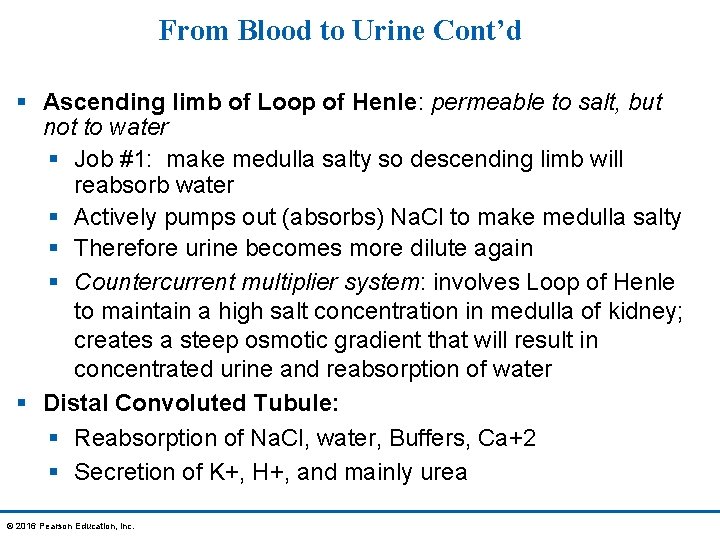
From Blood to Urine Cont’d § Ascending limb of Loop of Henle: permeable to salt, but not to water § Job #1: make medulla salty so descending limb will reabsorb water § Actively pumps out (absorbs) Na. Cl to make medulla salty § Therefore urine becomes more dilute again § Countercurrent multiplier system: involves Loop of Henle to maintain a high salt concentration in medulla of kidney; creates a steep osmotic gradient that will result in concentrated urine and reabsorption of water § Distal Convoluted Tubule: § Reabsorption of Na. Cl, water, Buffers, Ca+2 § Secretion of K+, H+, and mainly urea © 2016 Pearson Education, Inc.
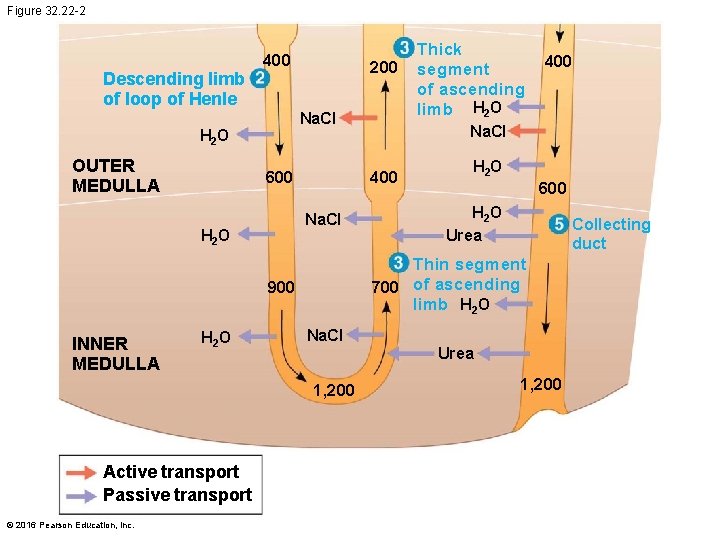
Figure 32. 22 -2 Descending limb of loop of Henle 400 Na. Cl H 2 O OUTER MEDULLA 200 600 H 2 O © 2016 Pearson Education, Inc. 600 H 2 O Urea Collecting duct Na. Cl Urea 1, 200 Active transport Passive transport H 2 O Thin segment 700 of ascending limb H 2 O 900 INNER MEDULLA 400 Na. Cl Thick segment of ascending limb H 2 O 1, 200
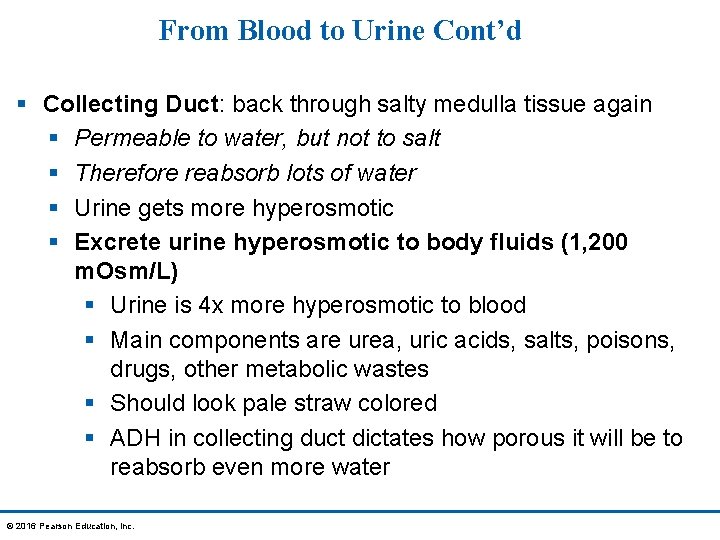
From Blood to Urine Cont’d § Collecting Duct: back through salty medulla tissue again § Permeable to water, but not to salt § Therefore reabsorb lots of water § Urine gets more hyperosmotic § Excrete urine hyperosmotic to body fluids (1, 200 m. Osm/L) § Urine is 4 x more hyperosmotic to blood § Main components are urea, uric acids, salts, poisons, drugs, other metabolic wastes § Should look pale straw colored § ADH in collecting duct dictates how porous it will be to reabsorb even more water © 2016 Pearson Education, Inc.
QUICK CHECK § The filtrate is dilute at the start and end of the loop of Henle. What, then, is the function of the loop of Henle?
Answer § The loop creates a concentration gradient from the cortex to the medulla, which is important for water reabsorption from the descending limb and the collecting ducts. § The loops also leave urea as the main solute.
Concentrating Urine in the Mammalian Kidney § The mammalian kidney’s ability to conserve water is a key terrestrial adaptation § The loop of Henle and surrounding capillaries act as a type of countercurrent system § This system involves active transport and thus an expenditure of energy § Such a system is called a countercurrent multiplier system © 2016 Pearson Education, Inc.
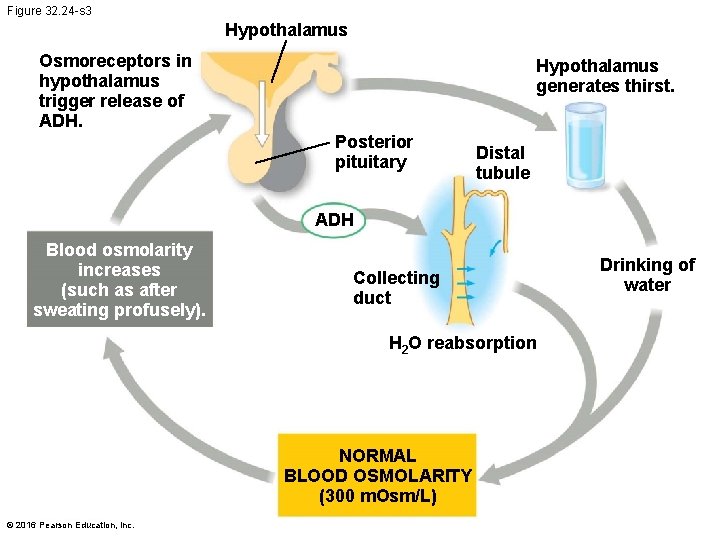
Figure 32. 24 -s 3 Hypothalamus Osmoreceptors in hypothalamus trigger release of ADH. Hypothalamus generates thirst. Posterior pituitary Distal tubule ADH Blood osmolarity increases (such as after sweating profusely). Collecting duct H 2 O reabsorption NORMAL BLOOD OSMOLARITY (300 m. Osm/L) © 2016 Pearson Education, Inc. Drinking of water
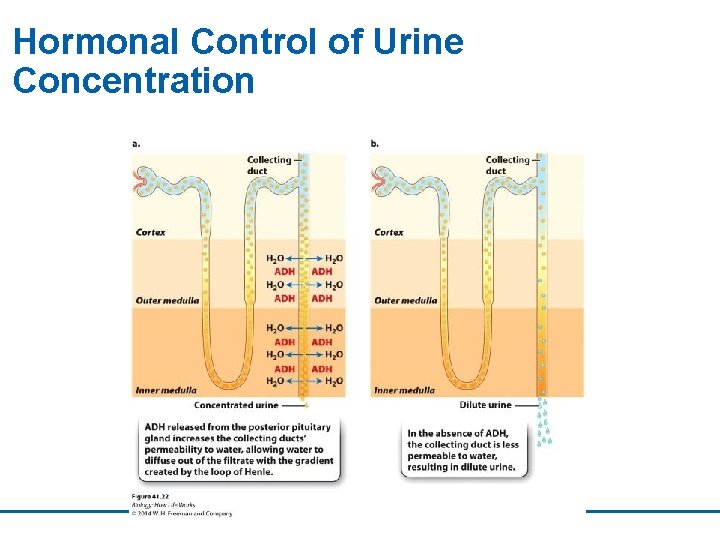
Hormonal Control of Urine Concentration
HORMONAL CONTROL OF KIDNEYS § Antidiuretic Hormone (ADH or Vasopressin) § Stimulus: high blood osmolarity; triggers osmoreceptors in hypothalamus to have posterior pituitary gland secrete ADH § ADH acts on collecting duct to increase its reaborption of water § End result: helps fluid retention by making kidneys keep more water § Hypothalamus also causes thirst…. drinking reduces blood osmolarity § NOTE: Beer lowers ADH, can’t hold water, lots of dilute urine, get dehydrated § NOTE: Diabetes symptom: thirst Why? Diabetes lowers ADH.
Hormonal Control of Kidneys Cont’d § Renin-Angiotensin-Aldosterone System (RAAS) § Stimulus: low BP or blood volume triggers JGA in kidneys to release renin § JGA releases renin, converts angiotensinogen into angiotensin II, which constricts arterioles and increases reabsorption of water and salt § Angiotensin II also stimulates adrenal cortex to release aldosterone: hormone which increases reabsorption of water and salt in distal tubules § End result: increase in BP and blood volume © 2016 Pearson Education, Inc.
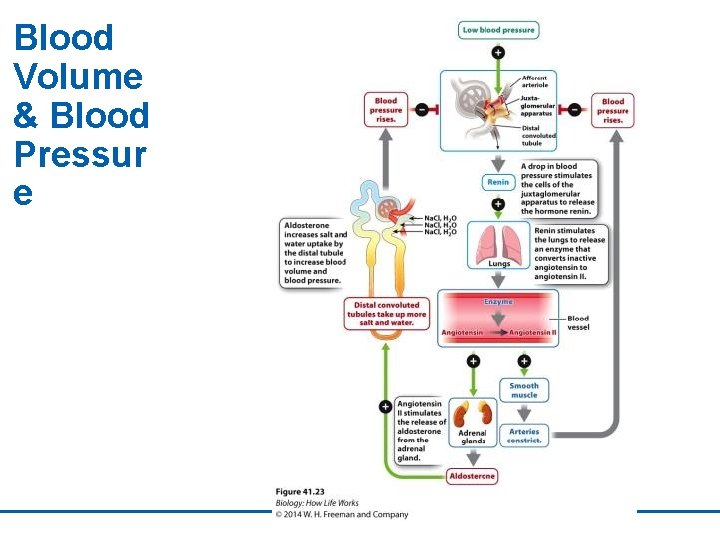
Blood Volume & Blood Pressur e
- Slides: 98