
Campaigns and Elections Representative democracy by the numbers
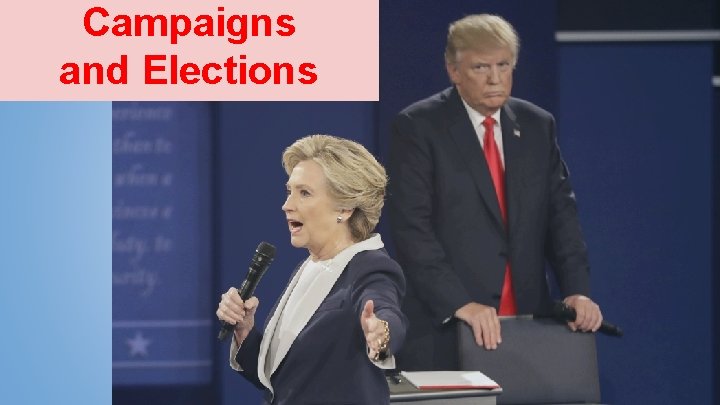
Campaigns and Elections
Representative democracy by the numbers ● ● ● ● 325. 7 million people 510, 000 elected officials 89, 000 governments! 3, 031 counties 35, 888 towns/munis 37, 203 special districts 12, 884 indie school districts Special districts - govern just one particular thing in an area. Examples include Colorado ambulance districts which are set up as special districts that only governing purpose is to manage an area’s EMT.
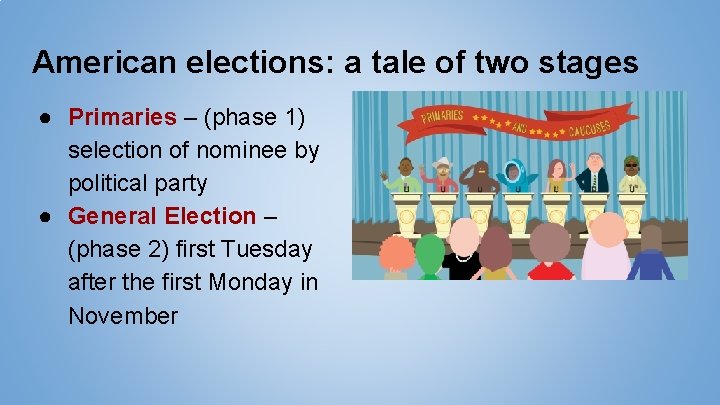
American elections: a tale of two stages ● Primaries – (phase 1) selection of nominee by political party ● General Election – (phase 2) first Tuesday after the first Monday in November
When do we vote for what? ● Presidential Election Years: Years divisible by 4; House, ⅓ Senate, some local ● Midterm Elections: Years divisible by 2; House, ⅓ Senate, some local ● Off-Year Elections: oddnumbered years; local What races are going to be decided in. . . 2019 2020 2021?
Who do Congress members represent? ● Single-member districts: House members are the only representatives for their districts, which have approximately 711, 000 people in them. ● Senators represent entire states: California senators represent 39 million people, whereas Wyoming senators only represent 573, 000 people. ● How many representatives do Wyoming, Vermont, Alaska, North and South Dakota, and Delaware have?
Plurality vs. majority voting ● Plurality - the candidate who gets the most votes wins. ● Majority - the candidate must get more than 50%. This is mostly reserved for primaries in about 10 states. ○ So what happens if there are three or more candidates and no one has a majority? ○ Run-off Election - second election that takes place between top two vote-getters.
Steps to running a political campaign ● ● ● ● ● Start a Political Action Committee Raise $$$ Hire staff, recruit volunteers Get media attention Canvass, phone bank, collect data Debate? Send mailings, make public appearances Win the primary! Repeat for the general election, GOTV
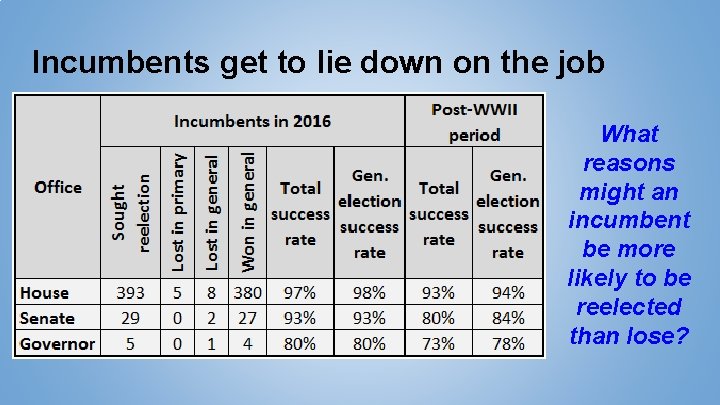
Incumbents get to lie down on the job What reasons might an incumbent be more likely to be reelected than lose?
Some advantages of incumbency ● ● ● ● Name recognition Constituent service Seniority and experience Franking privilege Pork barrel spending Gerrymandering Ease of fundraising Typically, House incumbents fare better than presidential and Senate incumbents. What about the nature of the terms of offices might make that the case?
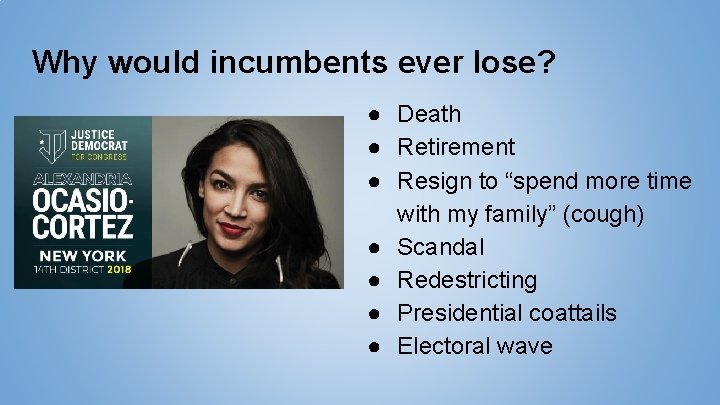
Why would incumbents ever lose? ● Death ● Retirement ● Resign to “spend more time with my family” (cough) ● Scandal ● Redestricting ● Presidential coattails ● Electoral wave
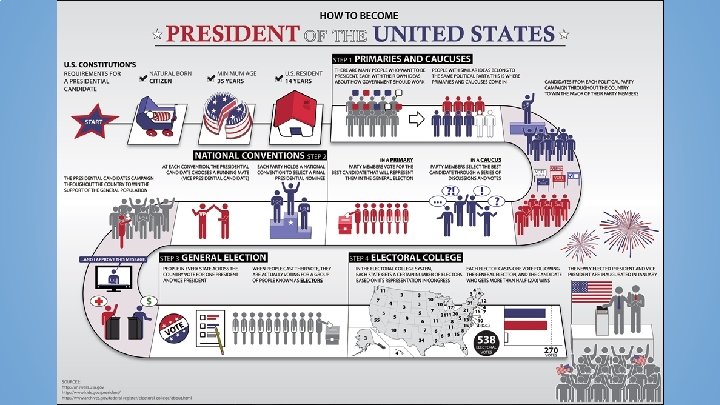
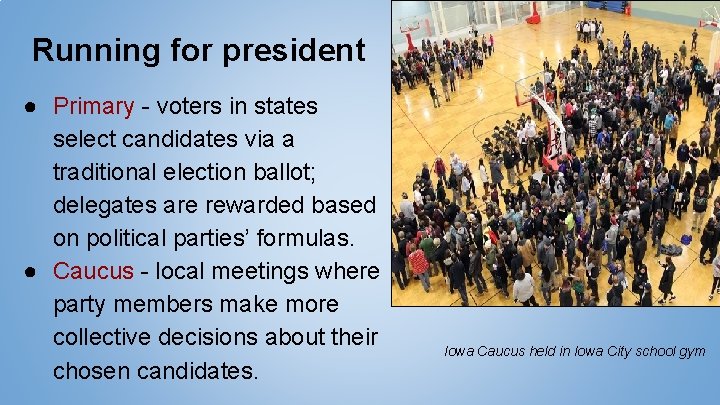
Running for president ● Primary - voters in states select candidates via a traditional election ballot; delegates are rewarded based on political parties’ formulas. ● Caucus - local meetings where party members make more collective decisions about their chosen candidates. Iowa Caucus held in Iowa City school gym
Still running for president. . . ● Proportional allocation vs. winnertake-all ● Open vs. closed primaries ● Primacy of Iowa and New Hampshire ● Super Tuesday ● Superdelegates ● National convention
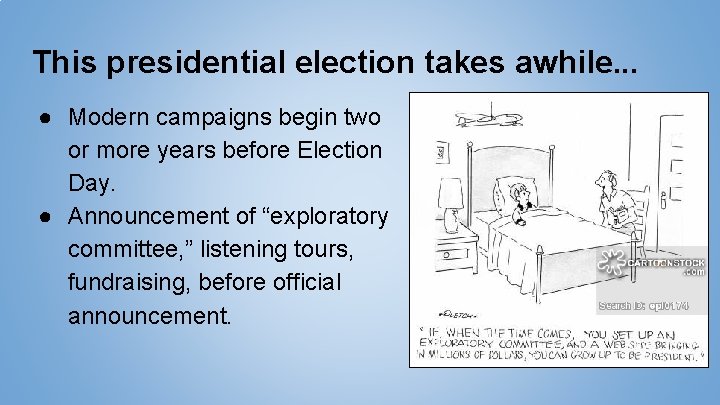
This presidential election takes awhile. . . ● Modern campaigns begin two or more years before Election Day. ● Announcement of “exploratory committee, ” listening tours, fundraising, before official announcement.
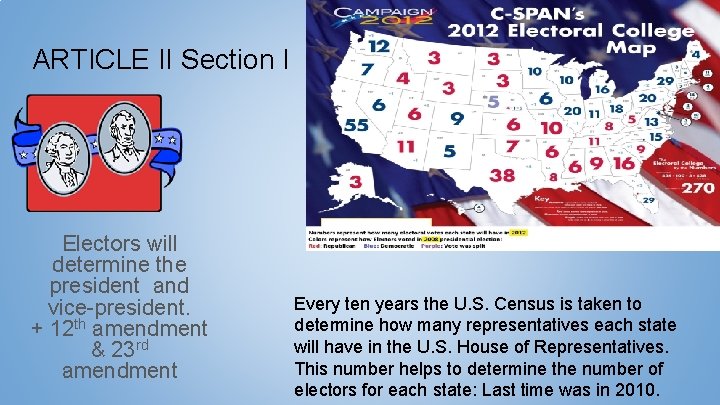
ARTICLE II Section I Electors will determine the president and vice-president. + 12 th amendment & 23 rd amendment Every ten years the U. S. Census is taken to determine how many representatives each state will have in the U. S. House of Representatives. This number helps to determine the number of electors for each state: Last time was in 2010.
The Electoral college ● Each state will have electors = to the number of senators + representatives given to that state ● There are 538 electors. Electors will be appointed by state legislature; any eligible voter could potentially become an elector. Electors must be loyal party members
Becoming an Elector & Voting as an Elector ● ● ● Electors may not hold any other office Electors do not get paid, they have other jobs Electors names appear on the ballot under the candidate they will vote for. ● Electors meet at the state capital in Nov. after the general election and cast their ballots. Electors can vote for whoever they want A joint session of Congress convenes the January after the election to count the electoral votes and announce the winner. ● ●
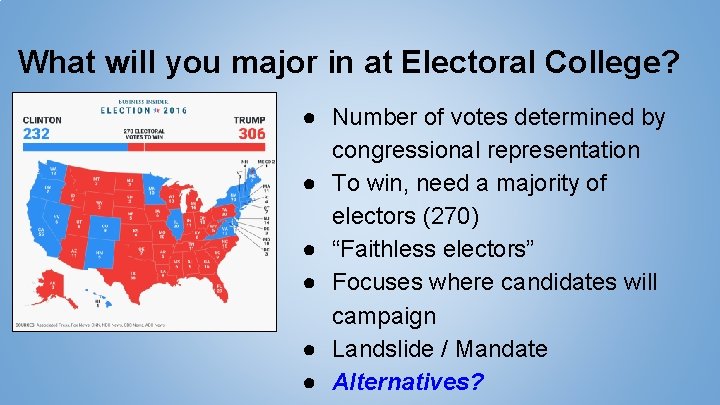
What will you major in at Electoral College? ● Number of votes determined by congressional representation ● To win, need a majority of electors (270) ● “Faithless electors” ● Focuses where candidates will campaign ● Landslide / Mandate ● Alternatives?
Electoral College Arguments against: Candidate can win the popular vote but lose the election. If there is a tie, the election is decided unfairly, because populous states have the same vote as small states. It favors republicans, who predominate in less populous states. • • •
Alternatives: § Direct Vote with Plurality Rule: Abolish the EC and require every person to cast a vote. Whomever wins the most votes nationally wins. § Direct Election with Instant Runoff Election: IRV: Instant Runoff Voting could be used for elections with or without the EC. § Proportional Allocation of Electoral Votes § Preferential Popular Vote § National Bonus Plan: winner of largest popular vote gets 100 bonus electoral votes § Congressional District Method
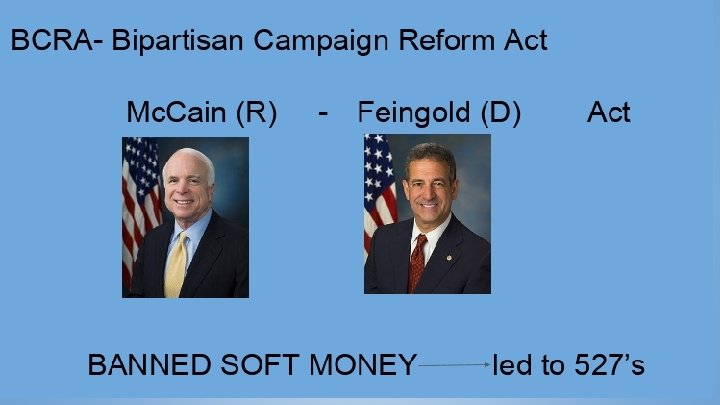
Take a Deep Breath: campaign finance ● Overseen by the Federal Election Commission. ● Hard money - donations typically given to a particular candidate for office; amount limited by law (BCRA). ● Soft money - $ to groups to spend on voter mobilization and promoting issues, but not (overtly) for the election or defeat of a given candidate. ● Buckley v. Valeo - candidates can spend as much as they want on their own campaigns. ● Matching funds - candidates can get money from government if they abide by spending limits.
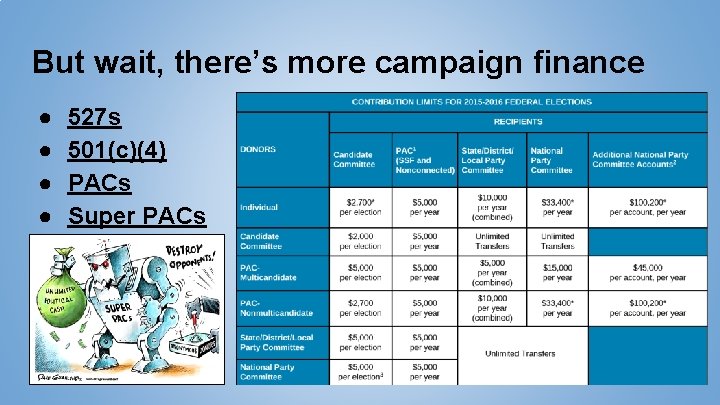
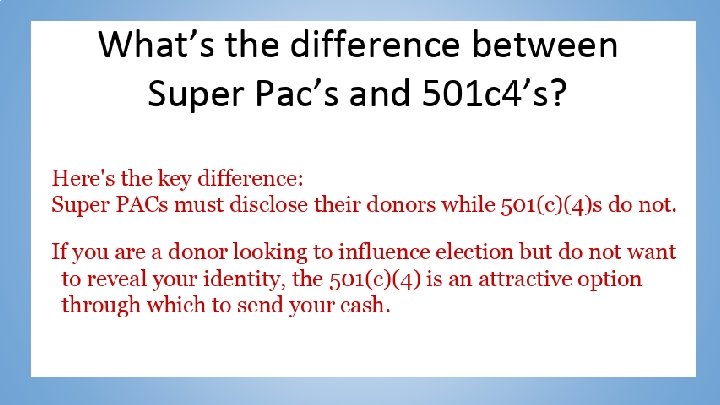
But wait, there’s more campaign finance ● ● 527 s 501(c)(4) PACs Super PACs
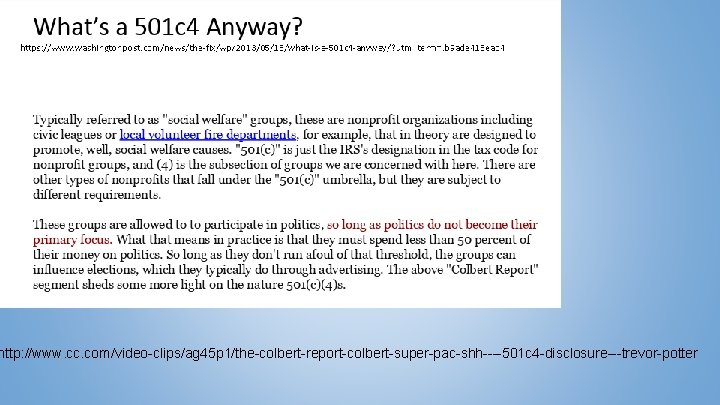
http: //www. cc. com/video-clips/ag 45 p 1/the-colbert-report-colbert-super-pac-shh----501 c 4 -disclosure---trevor-potter
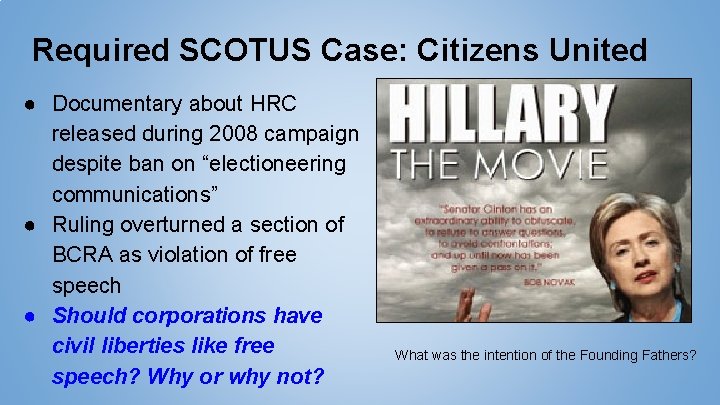
Required SCOTUS Case: Citizens United ● Documentary about HRC released during 2008 campaign despite ban on “electioneering communications” ● Ruling overturned a section of BCRA as violation of free speech ● Should corporations have civil liberties like free speech? Why or why not? What was the intention of the Founding Fathers?
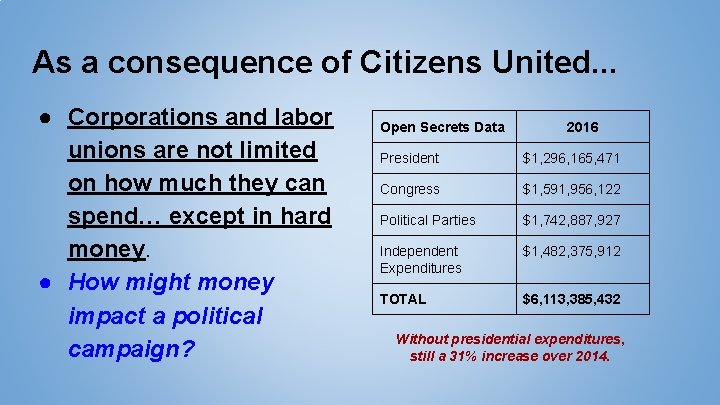
As a consequence of Citizens United. . . ● Corporations and labor unions are not limited on how much they can spend… except in hard money. ● How might money impact a political campaign? Open Secrets Data 2016 President $1, 296, 165, 471 Congress $1, 591, 956, 122 Political Parties $1, 742, 887, 927 Independent Expenditures $1, 482, 375, 912 TOTAL $6, 113, 385, 432 Without presidential expenditures, still a 31% increase over 2014.
Arguments in favor of spending limits ● Constant negative advertisements have a corrosive impact on political discourse and turn off voters. ● Only 12% of the population contributed to a campaign in 2016. ● Candidates may feel beholden to “special interests. ” ● Money could be better spent elsewhere. What counter-arguments can you think of (whether or not your agree)?
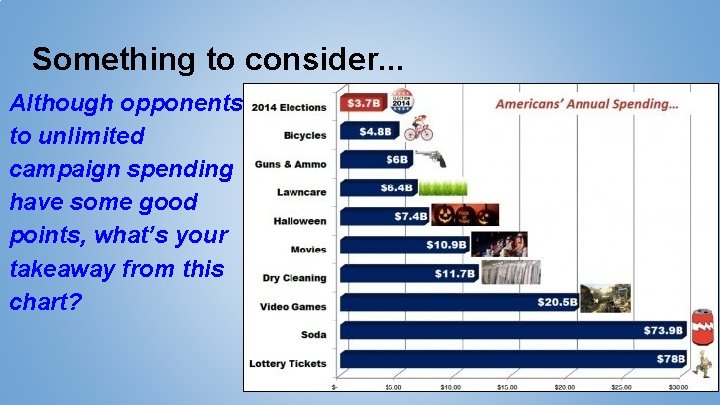
Something to consider. . . Although opponents to unlimited campaign spending have some good points, what’s your takeaway from this chart?
- Slides: 30