
CAMHScampfire No 3 Developmental Language Disorder and reoffending

- Slides: 9
#CAMHScampfire No. 3 Developmental Language Disorder and reoffending Evidence from a prospective cohort study of first-time offenders
Hello! Andre Tomlin (Chair, The Mental Elf) Richard Church (Professor and clinical psychologist) Maxine Winstanley (Lead researcher) Douglas Badenoch (Information specialist, Minervation) Celine Ryckaert (Psychiatrist and researcher, ACAMH) Please use the poll to tell us about yourselves!
Agenda 1. 2. 3. 4. 5. 6. Introductions What is the research question? Is this evidence valid? What are the findings? Is this valid, important evidence helpful? Closing remarks Please use the chat window to post any questions you have.
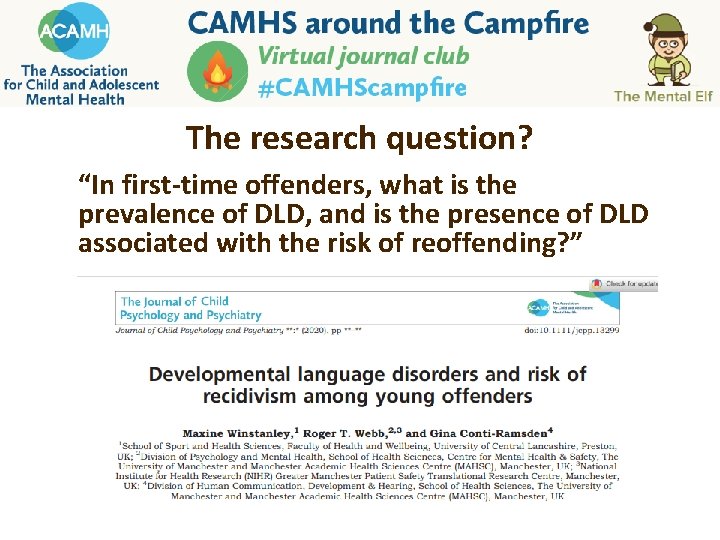
The research question? “In first-time offenders, what is the prevalence of DLD, and is the presence of DLD associated with the risk of reoffending? ”
Study methods Participants were recruited from youth offending services in NW England. – Aimed for first offenders Language ability was evaluated using subtests of the CELF-4 assessment. The cut-off for DLD was >1. 5 SDs below the normative mean. – Also measured nonverbal IQ, adversity, prior offending, deprivation and CU traits Followed for 1 year
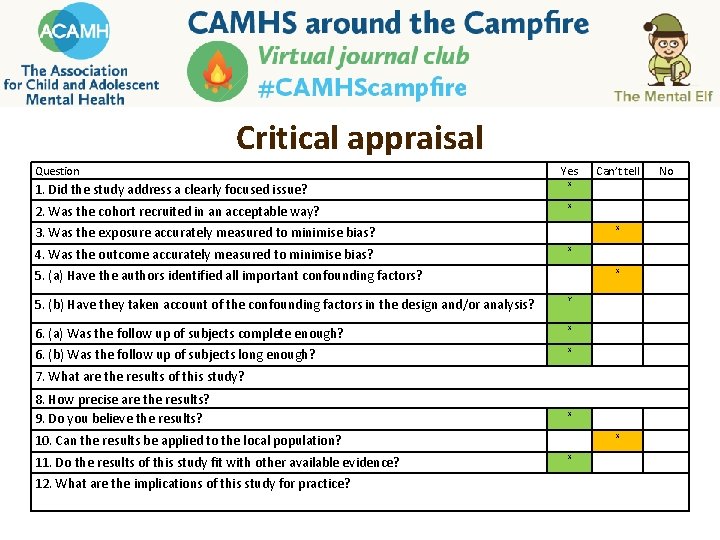
Critical appraisal Question Yes 1. Did the study address a clearly focused issue? X 2. Was the cohort recruited in an acceptable way? X X 3. Was the exposure accurately measured to minimise bias? 4. Was the outcome accurately measured to minimise bias? Can’t tell X X 5. (a) Have the authors identified all important confounding factors? 5. (b) Have they taken account of the confounding factors in the design and/or analysis? Y 6. (a) Was the follow up of subjects complete enough? X 6. (b) Was the follow up of subjects long enough? X 7. What are the results of this study? 8. How precise are the results? 9. Do you believe the results? X X 10. Can the results be applied to the local population? 11. Do the results of this study fit with other available evidence? 12. What are the implications of this study for practice? X No
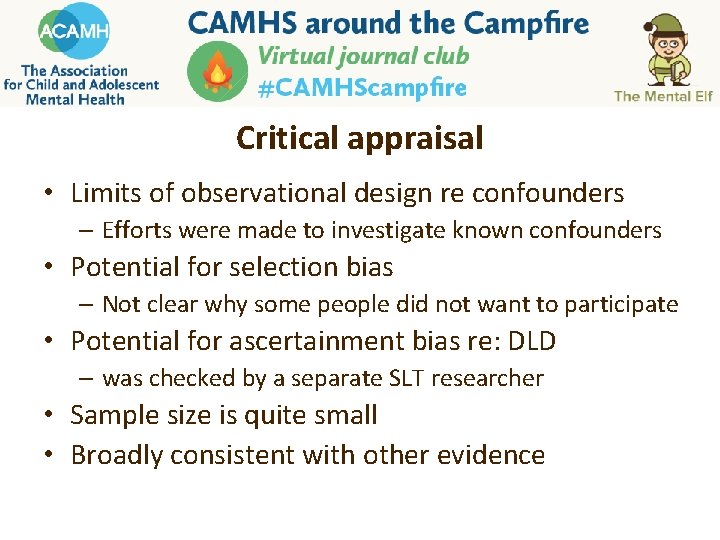
Critical appraisal • Limits of observational design re confounders – Efforts were made to investigate known confounders • Potential for selection bias – Not clear why some people did not want to participate • Potential for ascertainment bias re: DLD – was checked by a separate SLT researcher • Sample size is quite small • Broadly consistent with other evidence
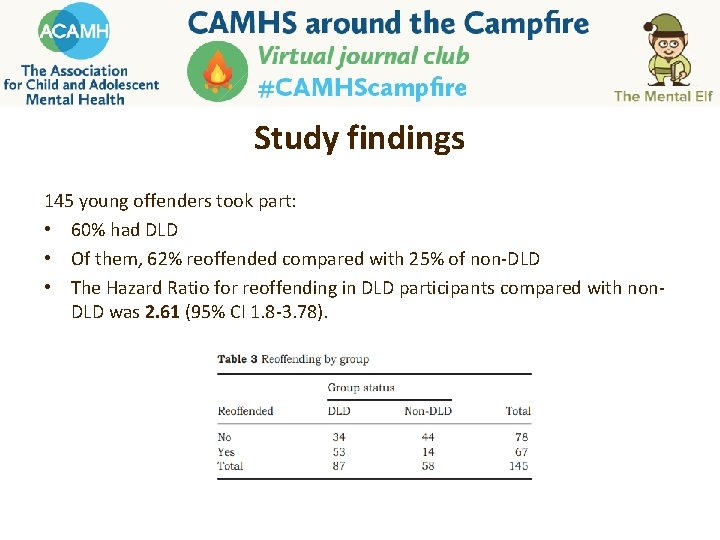
Study findings 145 young offenders took part: • 60% had DLD • Of them, 62% reoffended compared with 25% of non-DLD • The Hazard Ratio for reoffending in DLD participants compared with non. DLD was 2. 61 (95% CI 1. 8 -3. 78).
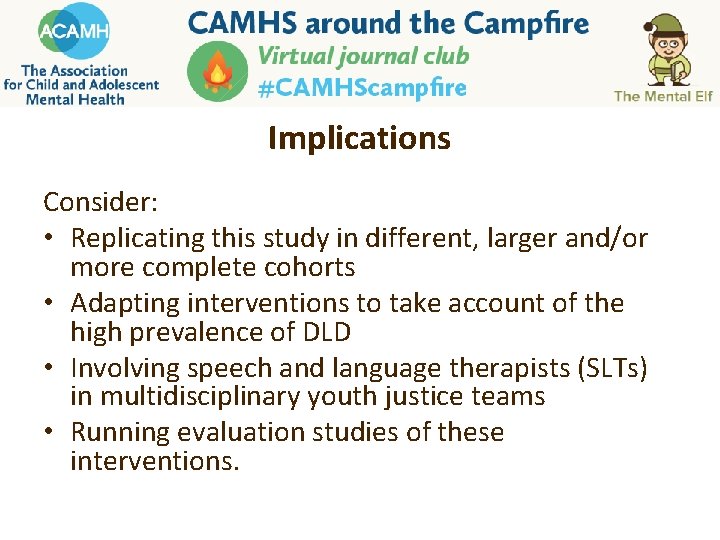
Implications Consider: • Replicating this study in different, larger and/or more complete cohorts • Adapting interventions to take account of the high prevalence of DLD • Involving speech and language therapists (SLTs) in multidisciplinary youth justice teams • Running evaluation studies of these interventions.