
CAMFAS A Compiler Approach to Mitigate Fault Attacks


- Slides: 22
CAMFAS: A Compiler Approach to Mitigate Fault Attacks via Enhanced SIMDization Zhi Chen 1, Junjie Shen 1, Alex Nicolau 1, Alex Veidenbaum 1 Nahid Farhady Ghalaty 2 and Rosario Cammarota 3 1 University of California, Irvine 2 Accenture Cyber Security Technology Labs, Virginia, USA 3 Qualcomm Research, San Diego, USA
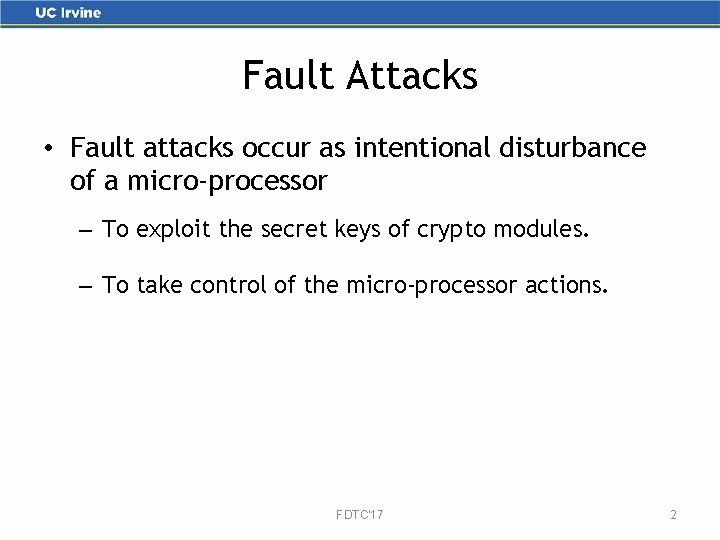
Fault Attacks • Fault attacks occur as intentional disturbance of a micro-processor – To exploit the secret keys of crypto modules. – To take control of the micro-processor actions. FDTC'17 2
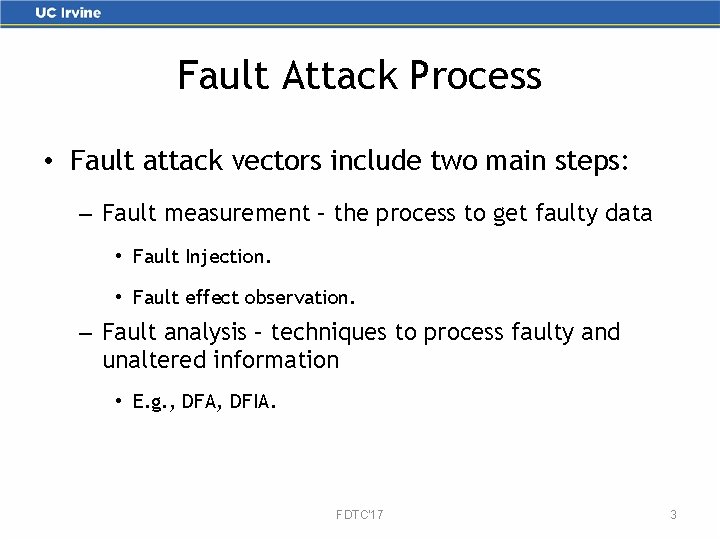
Fault Attack Process • Fault attack vectors include two main steps: – Fault measurement – the process to get faulty data • Fault Injection. • Fault effect observation. – Fault analysis – techniques to process faulty and unaltered information • E. g. , DFA, DFIA. FDTC'17 3
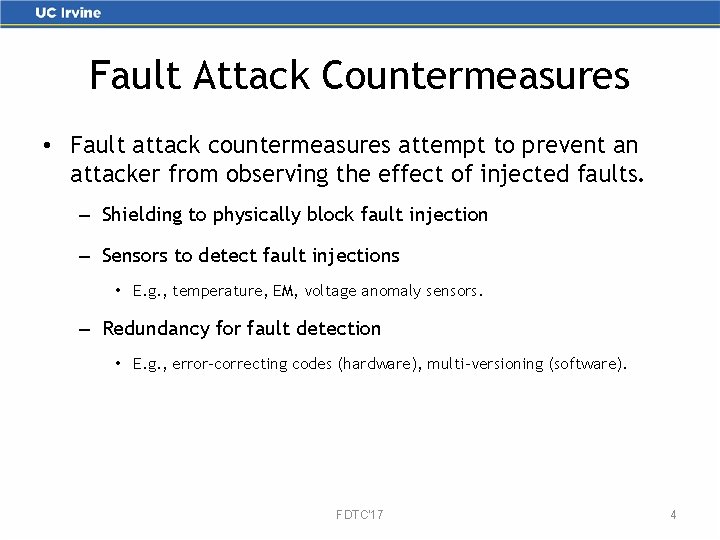
Fault Attack Countermeasures • Fault attack countermeasures attempt to prevent an attacker from observing the effect of injected faults. – Shielding to physically block fault injection – Sensors to detect fault injections • E. g. , temperature, EM, voltage anomaly sensors. – Redundancy for fault detection • E. g. , error-correcting codes (hardware), multi-versioning (software). FDTC'17 4
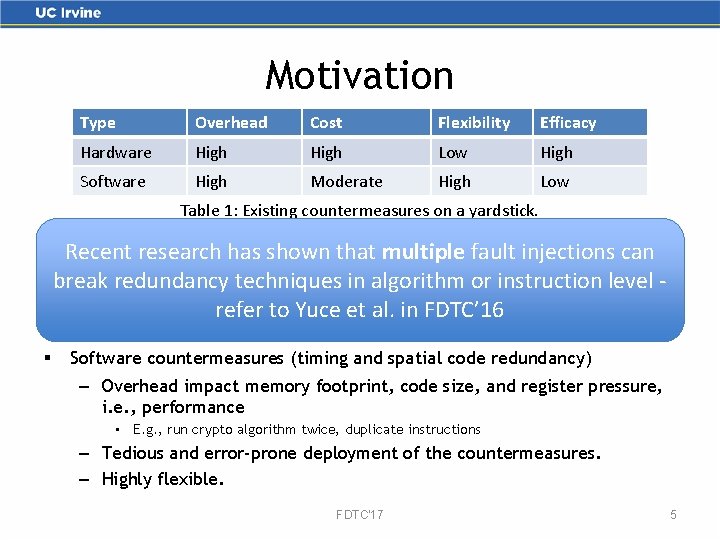
Motivation Type Overhead Cost Flexibility Efficacy Hardware High Low High Software High Moderate High Low Table 1: Existing countermeasures on a yardstick. § § Hardware countermeasures Recent research has shown that multiple fault injections can – Overhead impact silicon area and performance. break redundancy techniques in algorithm or instruction level – Increase the hardware design life cycle. refer to Yuce et al. in FDTC’ 16 – Limited flexibility. Software countermeasures (timing and spatial code redundancy) – Overhead impact memory footprint, code size, and register pressure, i. e. , performance • E. g. , run crypto algorithm twice, duplicate instructions – Tedious and error-prone deployment of the countermeasures. – Highly flexible. FDTC'17 5
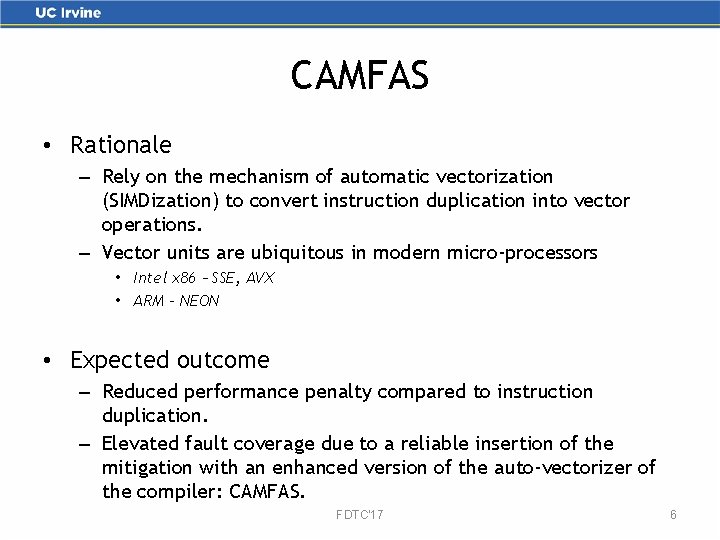
CAMFAS • Rationale – Rely on the mechanism of automatic vectorization (SIMDization) to convert instruction duplication into vector operations. – Vector units are ubiquitous in modern micro-processors • Intel x 86 – SSE, AVX • ARM - NEON • Expected outcome – Reduced performance penalty compared to instruction duplication. – Elevated fault coverage due to a reliable insertion of the mitigation with an enhanced version of the auto-vectorizer of the compiler: CAMFAS. FDTC'17 6
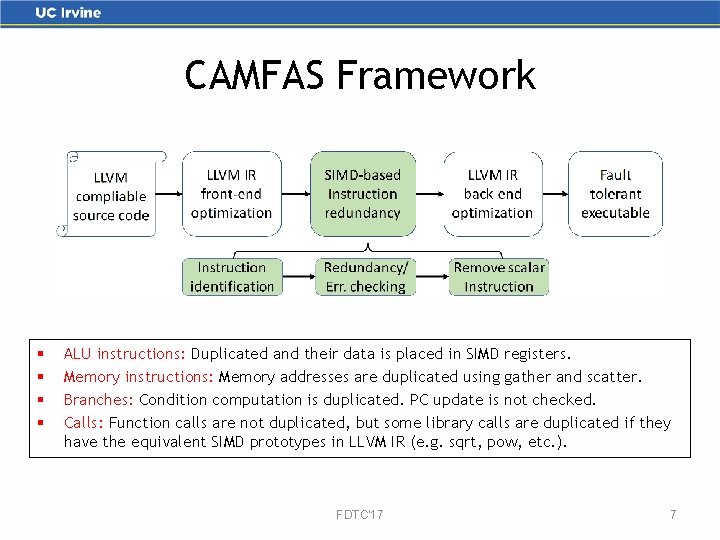
CAMFAS Framework § § ALU instructions: Duplicated and their data is placed in SIMD registers. Memory instructions: Memory addresses are duplicated using gather and scatter. Branches: Condition computation is duplicated. PC update is not checked. Calls: Function calls are not duplicated, but some library calls are duplicated if they have the equivalent SIMD prototypes in LLVM IR (e. g. sqrt, pow, etc. ). FDTC'17 7
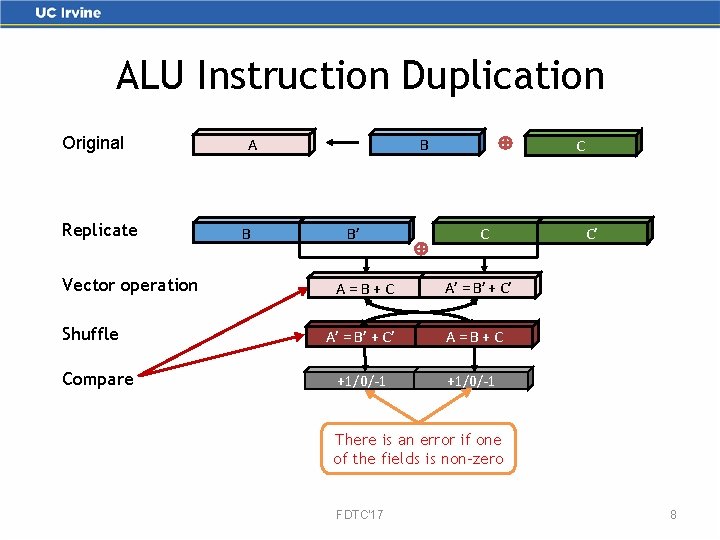
ALU Instruction Duplication Original Replicate Vector operation Shuffle Compare B A B B’ C C A=B+C A’ = B’ + C’ A=B+C +1/0/-1 C’ There is an error if one of the fields is non-zero FDTC'17 8
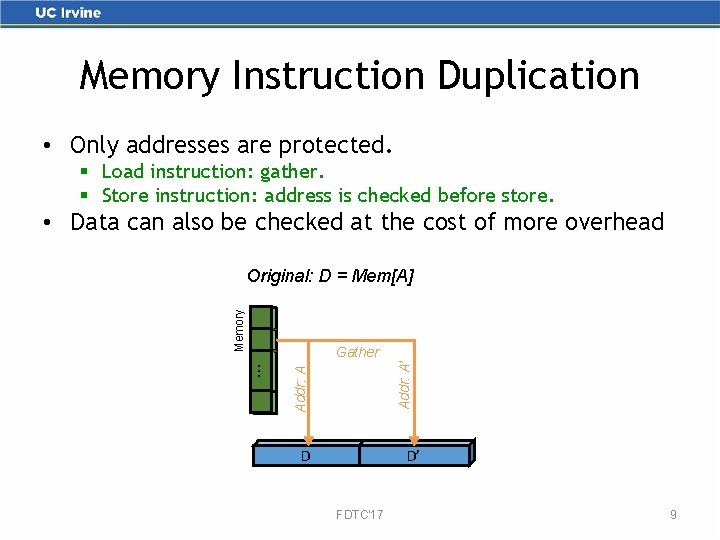
Memory Instruction Duplication • Only addresses are protected. § Load instruction: gather. § Store instruction: address is checked before store. • Data can also be checked at the cost of more overhead Memory Original: D = Mem[A] Addr: A . . . Addr: A’ Gather D D’ FDTC'17 9
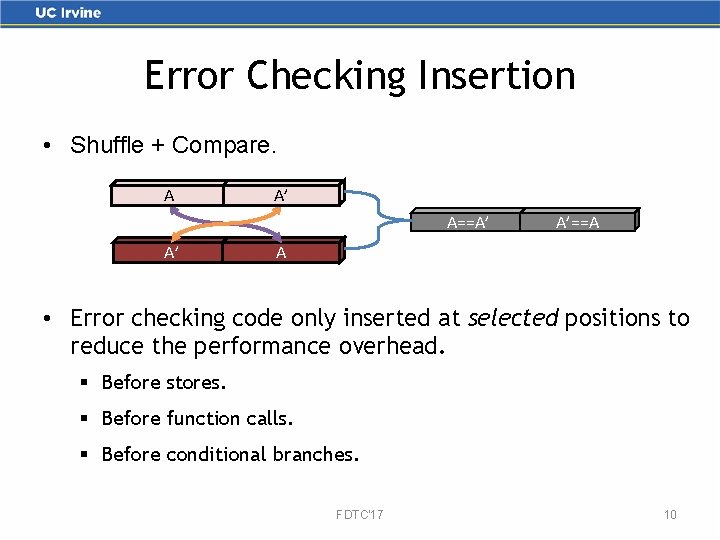
Error Checking Insertion • Shuffle + Compare. A A’ A==A’ A’ A’==A A • Error checking code only inserted at selected positions to reduce the performance overhead. § Before stores. § Before function calls. § Before conditional branches. FDTC'17 10
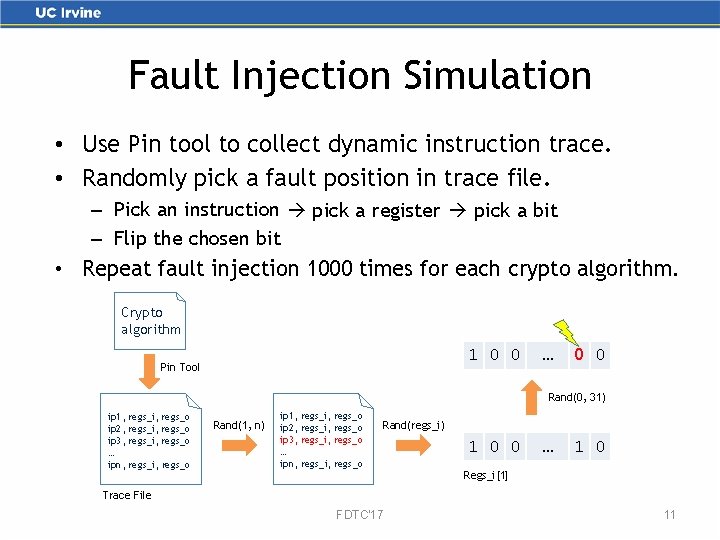
Fault Injection Simulation • Use Pin tool to collect dynamic instruction trace. • Randomly pick a fault position in trace file. – Pick an instruction pick a register pick a bit – Flip the chosen bit • Repeat fault injection 1000 times for each crypto algorithm. Crypto algorithm 1 0 0 Pin Tool … 1 0 0 Rand(0, 31) ip 1, regs_i, regs_o ip 2, regs_i, regs_o ip 3, regs_i, regs_o … ipn, regs_i, regs_o Rand(1, n) ip 1, regs_i, regs_o ip 2, regs_i, regs_o ip 3, regs_i, regs_o … ipn, regs_i, regs_o Rand(regs_i) 1 0 0 … 1 0 Regs_i[1] Trace File FDTC'17 11
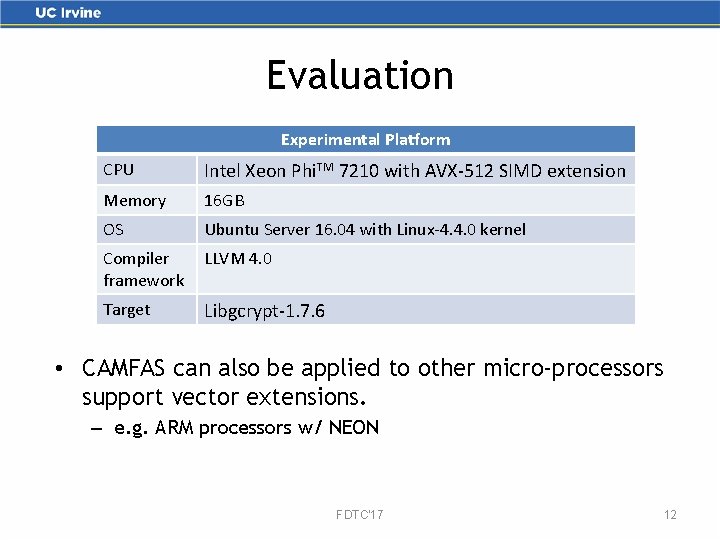
Evaluation Experimental Platform CPU Intel Xeon Phi. TM 7210 with AVX-512 SIMD extension Memory 16 GB OS Ubuntu Server 16. 04 with Linux-4. 4. 0 kernel Compiler framework LLVM 4. 0 Target Libgcrypt-1. 7. 6 • CAMFAS can also be applied to other micro-processors support vector extensions. – e. g. ARM processors w/ NEON FDTC'17 12
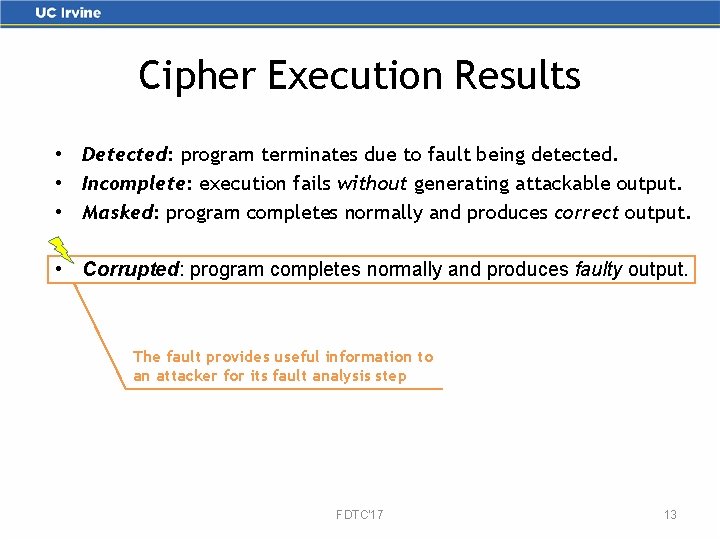
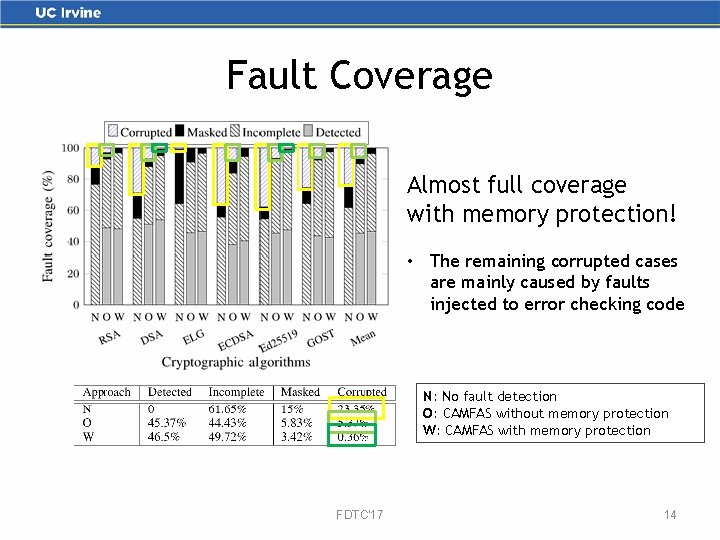
Cipher Execution Results • Detected: program terminates due to fault being detected. • Incomplete: execution fails without generating attackable output. • Masked: program completes normally and produces correct output. • Corrupted: program completes normally and produces faulty output. The fault provides useful information to an attacker for its fault analysis step FDTC'17 13
Fault Coverage Almost full coverage with memory protection! • The remaining corrupted cases are mainly caused by faults injected to error checking code N: No fault detection O: CAMFAS without memory protection W: CAMFAS with memory protection FDTC'17 14
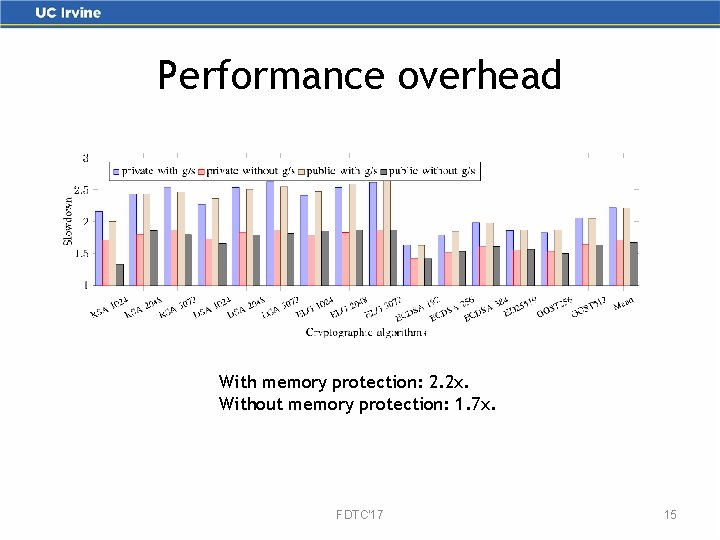
Performance overhead With memory protection: 2. 2 x. Without memory protection: 1. 7 x. FDTC'17 15
Discussion • Differential Fault Analysis (DFA) – Requires both correct and faulty cipher texts. – CAMFAS detects incorrect result and prevents the generation of faulty cipher text. • Differential Fault Intensity Analysis (DFIA) – Relies on the bias of fault behavior. – CAMFAS effectively prevents faulty output from being propagated. • Single-Glitch Attack – Injects clock glitches at precisely controlled timing and pipeline stages to thwart redundancy-based countermeasures – CAMFAS makes the attack more difficult as duplication and error checking are inserted at the IR level FDTC'17 16
Conclusions • CAMFAS is a redundancy-based countermeasure implemented in LLVM infrastructure. • CAMFAS exploits SIMD units in modern micro-processors to mitigate fault attacks. • CAMFAS provides high fault coverage while keeps a moderate performance penalty. Future directions • Extend CAMFAS to thwart side-channel attacks. • New micro-architectural features to mitigate fault attacks. FDTC'17 17
Thank you! FDTC'17 18
Backup Slides FDTC'17
Fault injections can be detrimental • Methods: Laser, EM, heat, etc. • Common approach: Differential Fault Analysis (DFA) • A single fault is enough to break the cryptosystem – Public key cipher: “Bellcore attack” on RSA-CRT [1] – Block cipher: DFA on AES [2] [1] Boneh, Dan, Richard A. De. Millo, and Richard J. Lipton. "On the importance of eliminating errors in cryptographic computations. " Journal of cryptology 14, no. 2 (2001): 101 -119. [2] Tunstall, Michael, Debdeep Mukhopadhyay, and Subidh Ali. "Differential fault analysis of the advanced encryption standard using a single fault. " IFIP International Workshop on Information Security Theory and Practices. Springer, Berlin, Heidelberg, 2011. FDTC'17 20
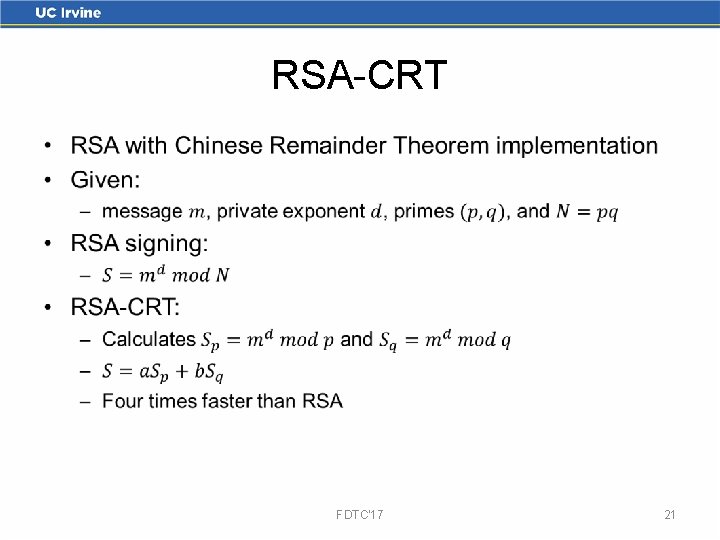
RSA-CRT • FDTC'17 21
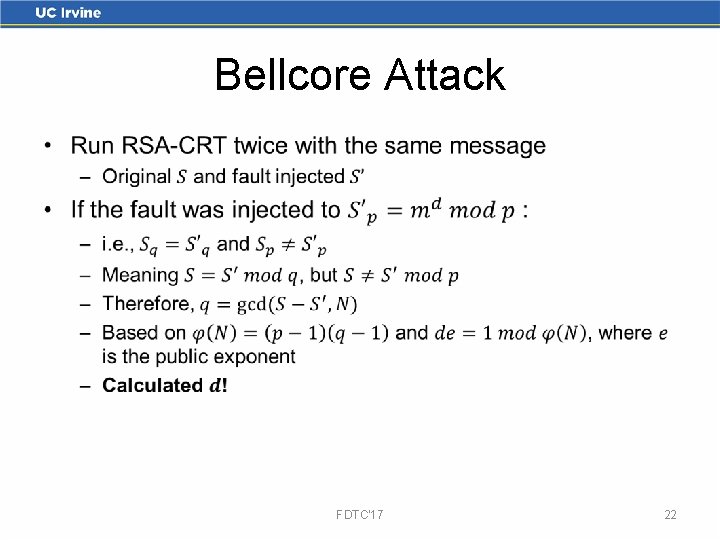
Bellcore Attack • FDTC'17 22