
Camera Traps for Terrestrial Biodiversity Monitoring in Northern
Camera Traps for Terrestrial Biodiversity Monitoring in Northern Australia Graeme Gillespie, Department of Land Resource Management, NT
Typical applications of camera traps Simple or targeted surveillance General biodiversity surveys Targeted species surveys Population density estimation Monitoring species and communities through time Management evaluation
How do camera traps work? ‘Passive Infra-red (PIR) Sensor’ PIR sensors detect ‘heat in motion’; moving objects within the sensor’s detection zone that are a different temperature to the background environment. Wedge-shaped zone of detection radiating outwards in front of the camera Easy to use, wide variety of models ‘Active Infra-red’ cameras
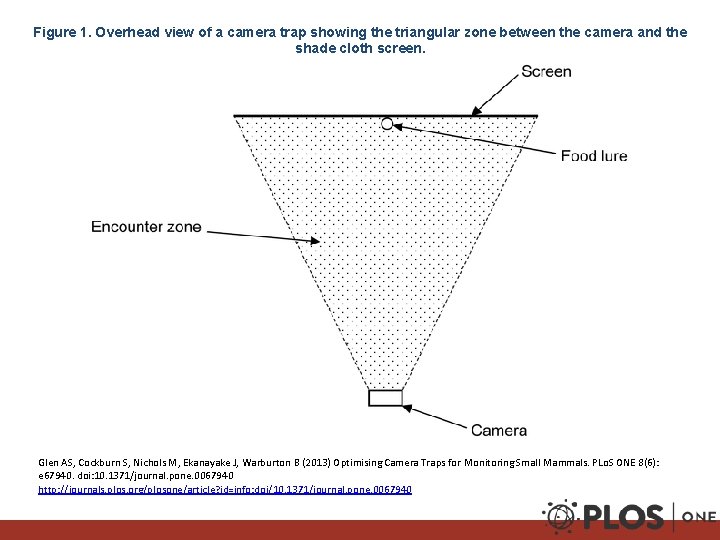
Figure 1. Overhead view of a camera trap showing the triangular zone between the camera and the shade cloth screen. Glen AS, Cockburn S, Nichols M, Ekanayake J, Warburton B (2013) Optimising Camera Traps for Monitoring Small Mammals. PLo. S ONE 8(6): e 67940. doi: 10. 1371/journal. pone. 0067940 http: //journals. plos. org/plosone/article? id=info: doi/10. 1371/journal. pone. 0067940
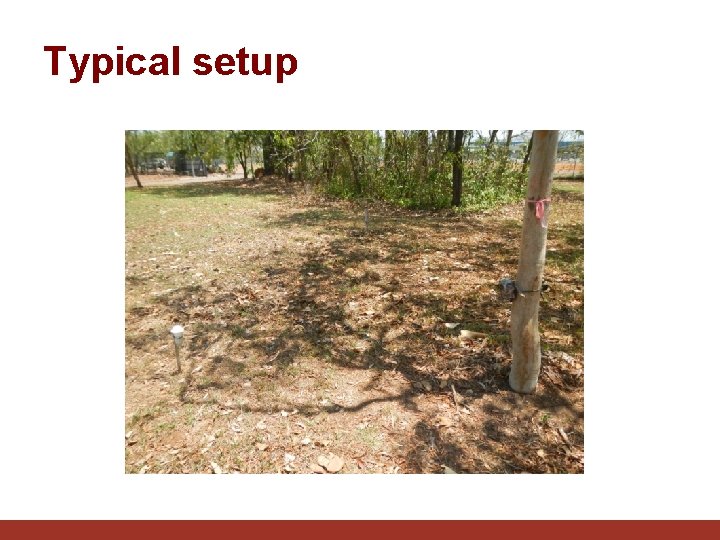
Typical setup
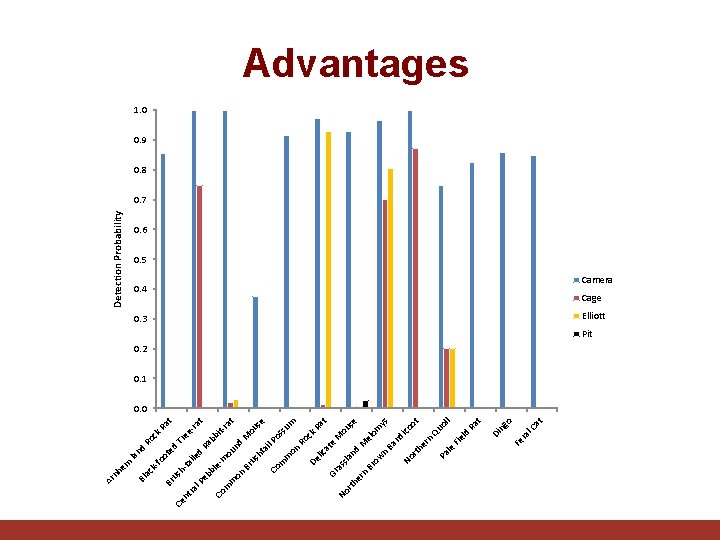
n er rth No n le Pa al Fe r t Ca o ng Di t Ra l ot ys ol Qu ld Fie n er ico nd om se t Ra M ou M el e Ba rth No ow nd as sla Br Gr ck m os su se t t ra ou M Ro lic at on m De m nd ai l. P ht us Br Co on it- bb t Ra -ra ee Tr ck Ro Ra ou d d te ile hta bl em eb m m Co l. P ra nt Ce us Br nd la fo o ac k- Bl em nh Ar Detection Probability Advantages 1. 0 0. 9 0. 8 0. 7 0. 6 0. 5 0. 4 Camera Cage 0. 3 Elliott Pit 0. 2 0. 1 0. 0
Other advantages • Low interference/disturbance to animals/populations • One method samples wider species range concurrently • Cost effective for remote locations • Cost-effective for long sampling periods • Cost effective for multiple concurrent sampling sites • Highly accessible technology requiring limited training
Monitoring applications • Occupancy modelling of species through space and time • Changes in species richness and composition • Spatially explicit population modelling
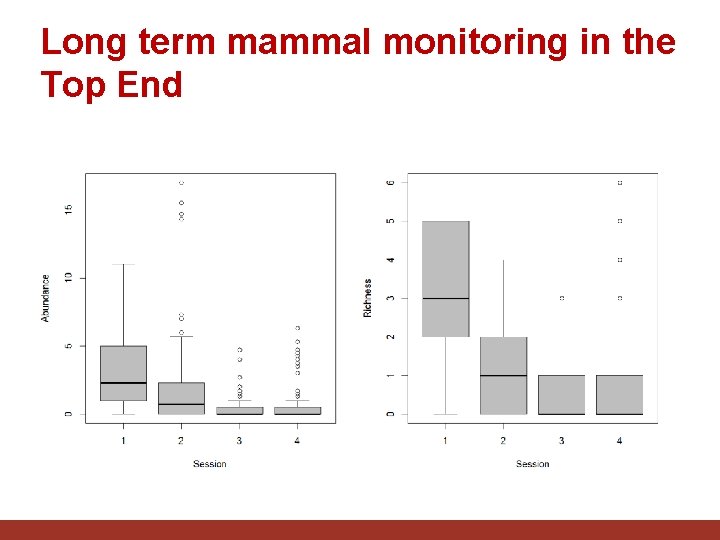
Long term mammal monitoring in the Top End
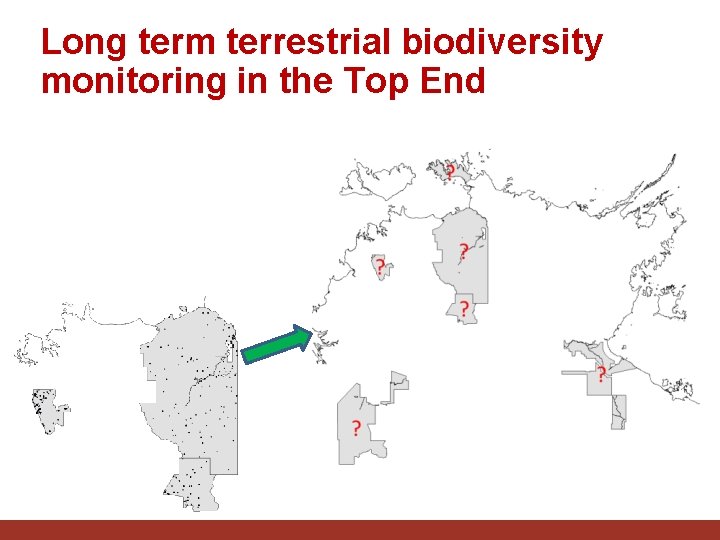
Long term terrestrial biodiversity monitoring in the Top End
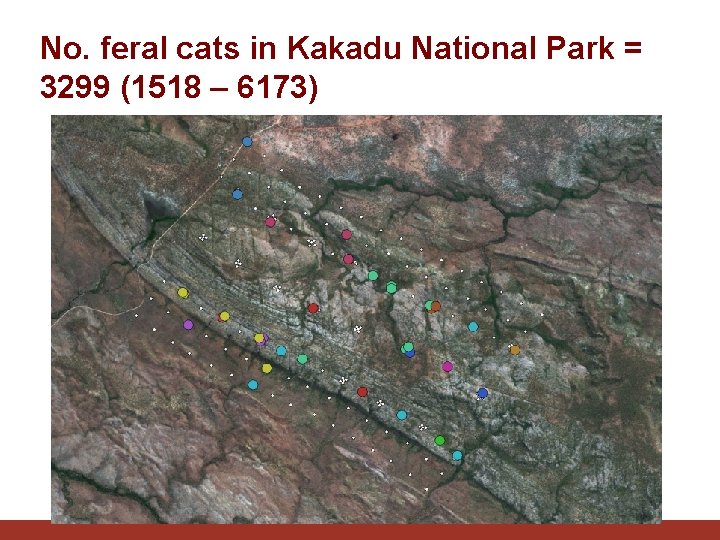
No. feral cats in Kakadu National Park = 3299 (1518 – 6173)
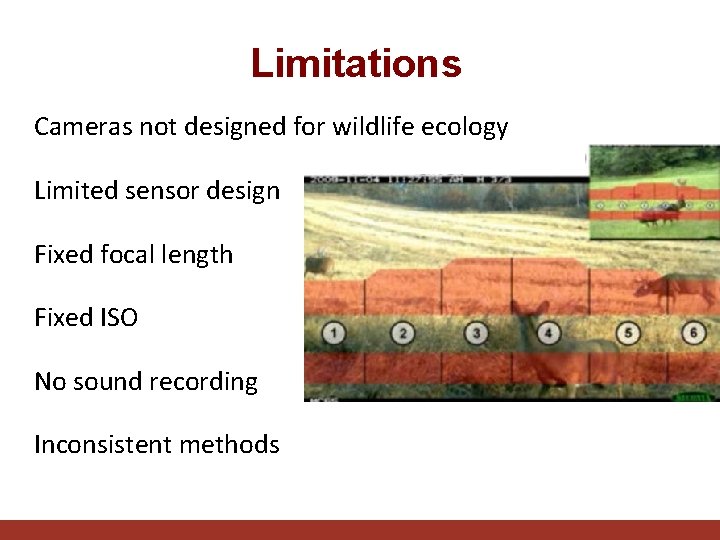
Limitations Cameras not designed for wildlife ecology Limited sensor design Fixed focal length Fixed ISO No sound recording Inconsistent methods
Other limitations • Difficult to reliably identified closely related species • Limited application for reptiles and amphibians • High temperature constraints • Durability • Cost ? • Time-consuming manual photo-checking • Rudimentary data management systems
In the pipeline • Trialling methods for increasing detection of small mammals and reptiles. • Species/individual recognition software • Better database systems • Large user base
Development needs • Primitive • Improved sensor designs for wildlife ecology • Motion-only camera traps • Automatic data-logging • Remote download/programming capability • Methodology consistency
- Slides: 15