
Camera Shots Angles and Movement Review Ways of
- Slides: 31
Camera Shots, Angles and Movement
Review: Ways of Reading a Film • Literary • Dramatic • Cinematic THIS is where we are headed! • https: //www. youtube. com/watch? v=Irv. Mrf. Pjhw
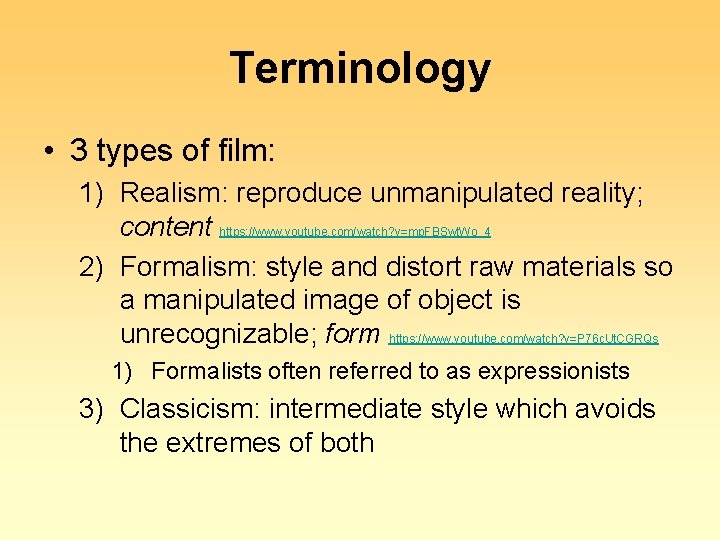
Terminology • 3 types of film: 1) Realism: reproduce unmanipulated reality; content https: //www. youtube. com/watch? v=mp. FBSwt. Wo_4 2) Formalism: style and distort raw materials so a manipulated image of object is unrecognizable; form https: //www. youtube. com/watch? v=P 76 c. Ut. CGRQs 1) Formalists often referred to as expressionists 3) Classicism: intermediate style which avoids the extremes of both
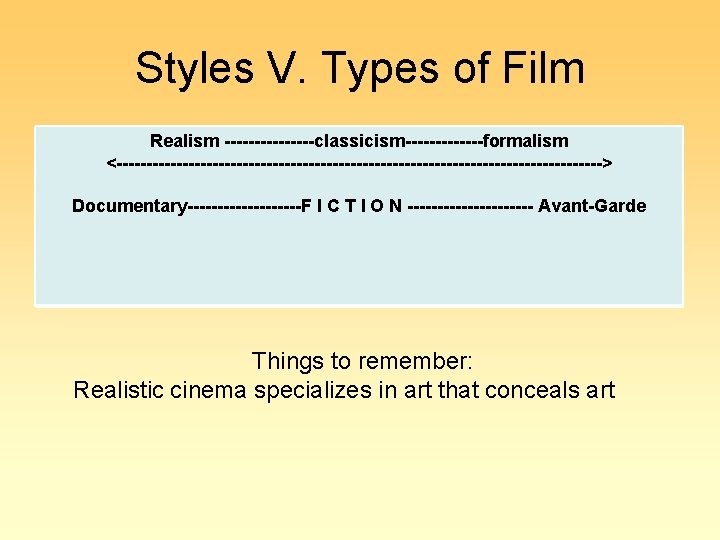
Styles V. Types of Film Realism --------classicism-------formalism <-----------------------------------------> Documentary----------F I C T I O N ----------- Avant-Garde Things to remember: Realistic cinema specializes in art that conceals art
Camera Shots https: //www. youtube. com/watch? v=Infc. Mwc. SG 3 g
Types of Shots Cinematic shots are defined by the amount of subject matter within the frame/an unedited strip of film Shots can also vary in duration – from subliminal (a few frames) – to quick (less than a second) – to “average” (more than a second but less than a minute) – to lengthy (more than a minute) – Goodfellas Copacabana Bird Man
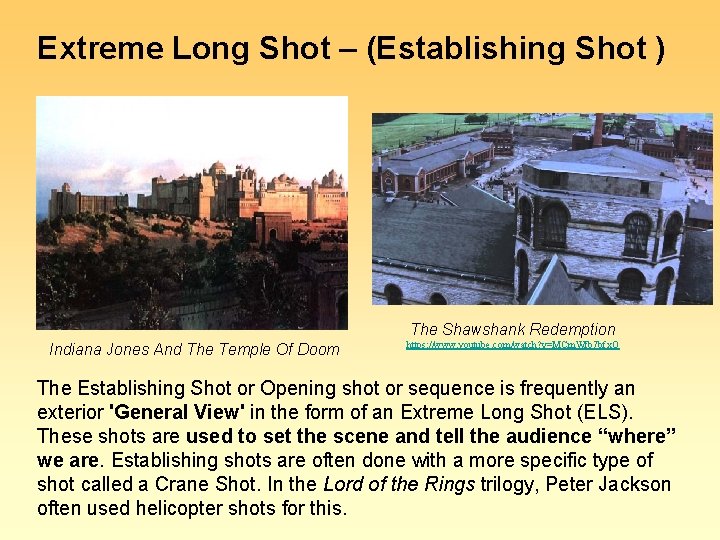
Extreme Long Shot – (Establishing Shot ) The Shawshank Redemption Indiana Jones And The Temple Of Doom https: //www. youtube. com/watch? v=MCm. Wfb 7 bfx. Q The Establishing Shot or Opening shot or sequence is frequently an exterior 'General View' in the form of an Extreme Long Shot (ELS). These shots are used to set the scene and tell the audience “where” we are. Establishing shots are often done with a more specific type of shot called a Crane Shot. In the Lord of the Rings trilogy, Peter Jackson often used helicopter shots for this.
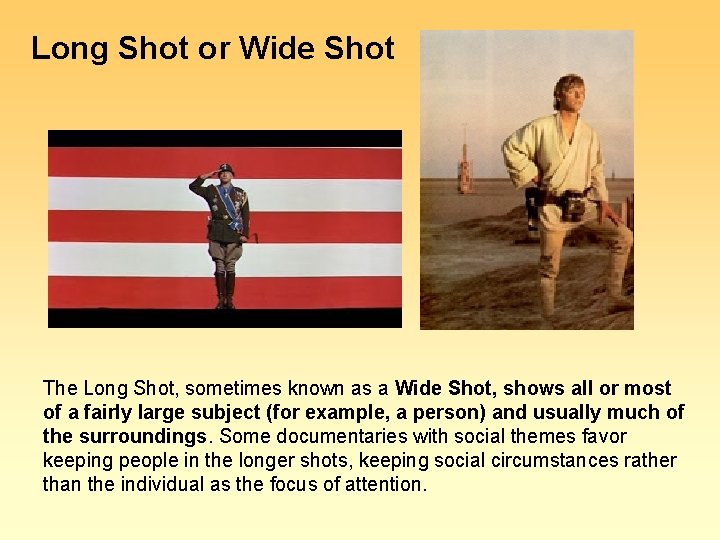
Long Shot or Wide Shot The Long Shot, sometimes known as a Wide Shot, shows all or most of a fairly large subject (for example, a person) and usually much of the surroundings. Some documentaries with social themes favor keeping people in the longer shots, keeping social circumstances rather than the individual as the focus of attention.
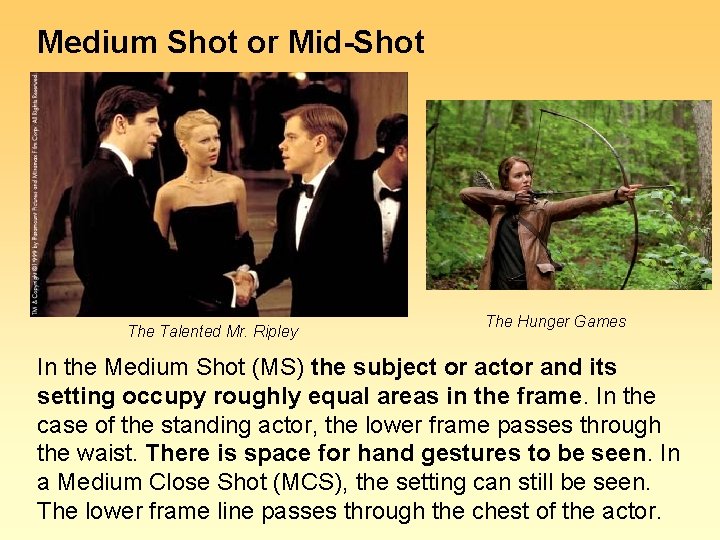
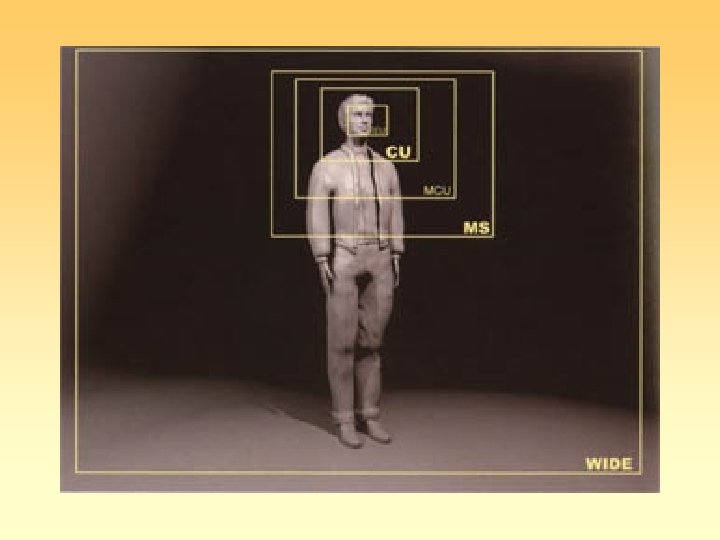
Medium Shot or Mid-Shot The Talented Mr. Ripley The Hunger Games In the Medium Shot (MS) the subject or actor and its setting occupy roughly equal areas in the frame. In the case of the standing actor, the lower frame passes through the waist. There is space for hand gestures to be seen. In a Medium Close Shot (MCS), the setting can still be seen. The lower frame line passes through the chest of the actor.
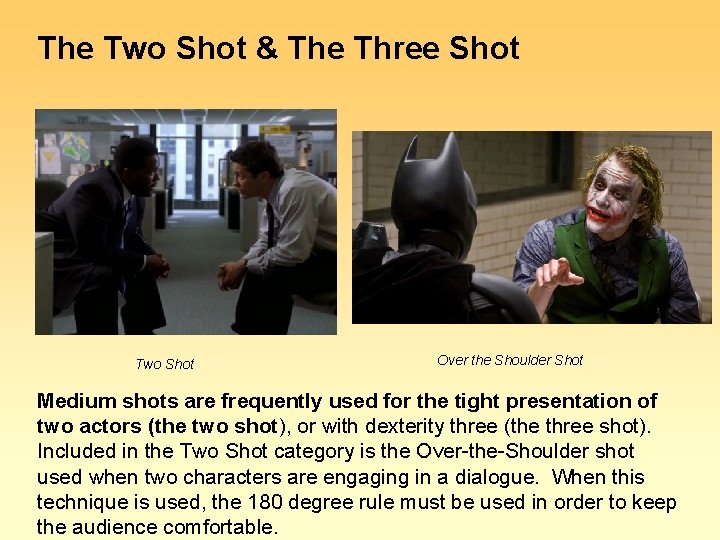
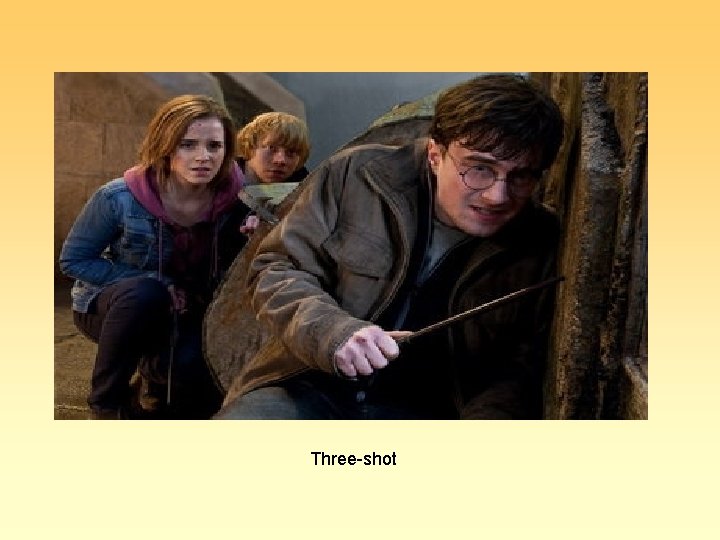
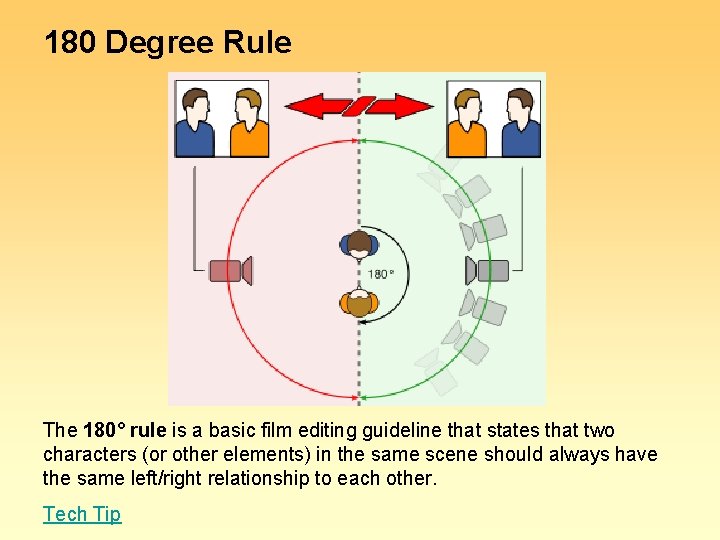
The Two Shot & The Three Shot Two Shot Over the Shoulder Shot Medium shots are frequently used for the tight presentation of two actors (the two shot), or with dexterity three (the three shot). Included in the Two Shot category is the Over-the-Shoulder shot used when two characters are engaging in a dialogue. When this technique is used, the 180 degree rule must be used in order to keep the audience comfortable.
Three-shot
180 Degree Rule The 180° rule is a basic film editing guideline that states that two characters (or other elements) in the same scene should always have the same left/right relationship to each other. Tech Tip
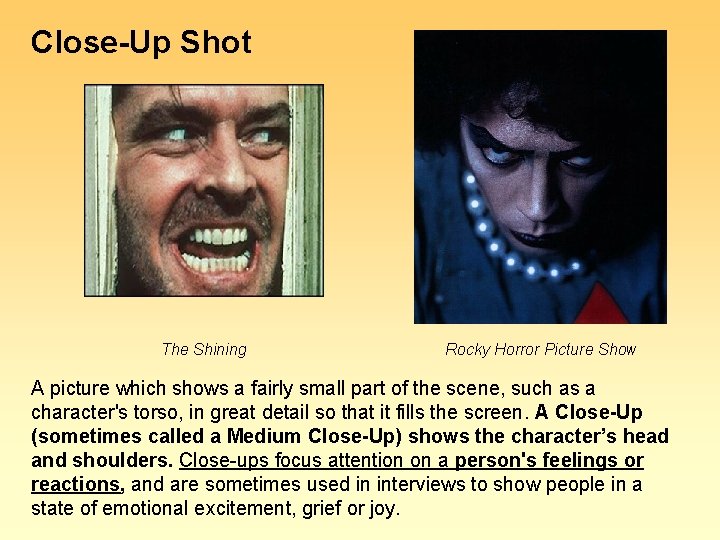
Close-Up Shot The Shining Rocky Horror Picture Show A picture which shows a fairly small part of the scene, such as a character's torso, in great detail so that it fills the screen. A Close-Up (sometimes called a Medium Close-Up) shows the character’s head and shoulders. Close-ups focus attention on a person's feelings or reactions, and are sometimes used in interviews to show people in a state of emotional excitement, grief or joy.
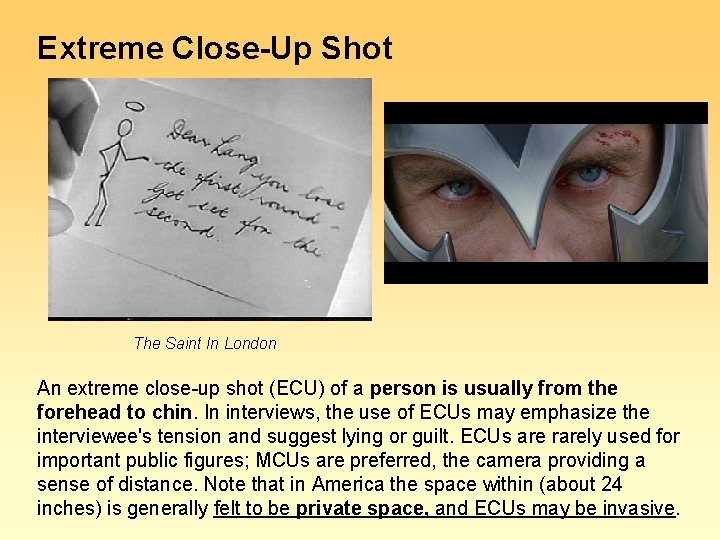
Extreme Close-Up Shot The Saint In London An extreme close-up shot (ECU) of a person is usually from the forehead to chin. In interviews, the use of ECUs may emphasize the interviewee's tension and suggest lying or guilt. ECUs are rarely used for important public figures; MCUs are preferred, the camera providing a sense of distance. Note that in America the space within (about 24 inches) is generally felt to be private space, and ECUs may be invasive.
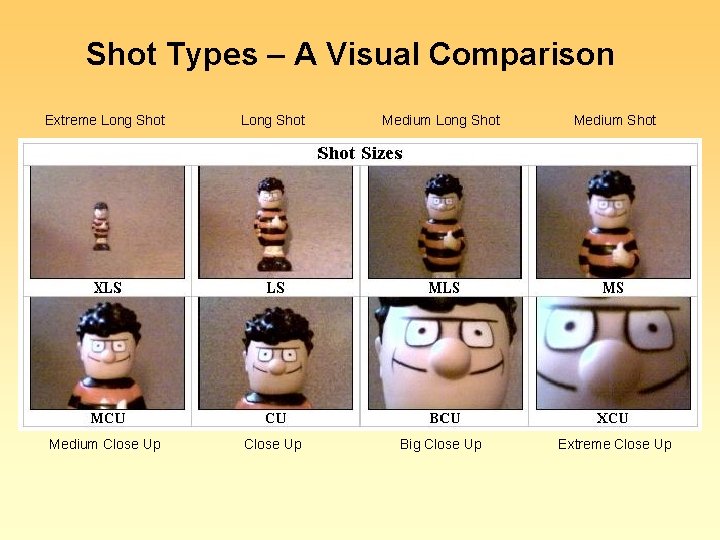
Shot Types – A Visual Comparison Extreme Long Shot Medium Close Up Big Close Up Extreme Close Up
Focus
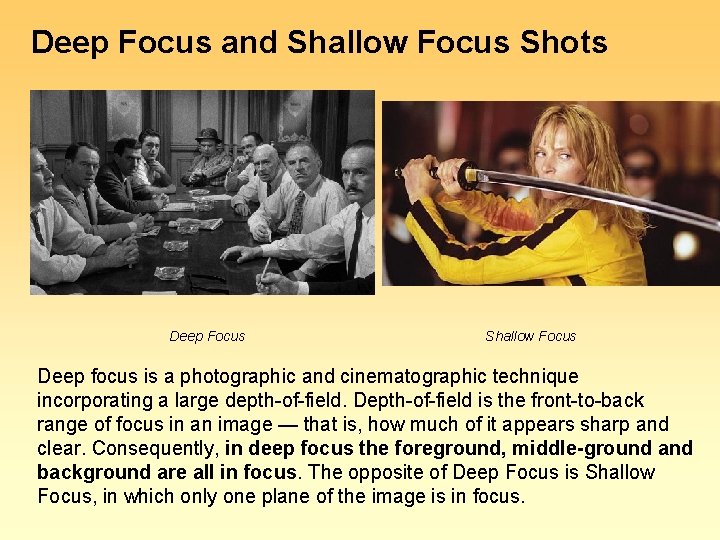
Deep Focus and Shallow Focus Shots Deep Focus Shallow Focus Deep focus is a photographic and cinematographic technique incorporating a large depth-of-field. Depth-of-field is the front-to-back range of focus in an image — that is, how much of it appears sharp and clear. Consequently, in deep focus the foreground, middle-ground and background are all in focus. The opposite of Deep Focus is Shallow Focus, in which only one plane of the image is in focus.
Camera Angles
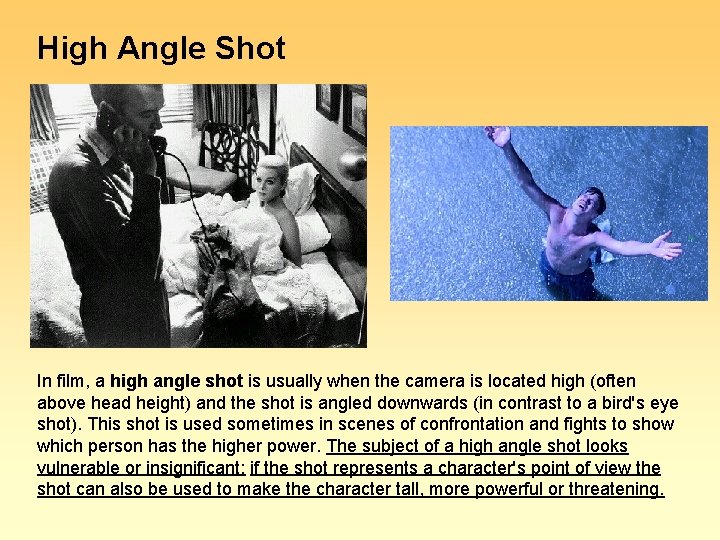
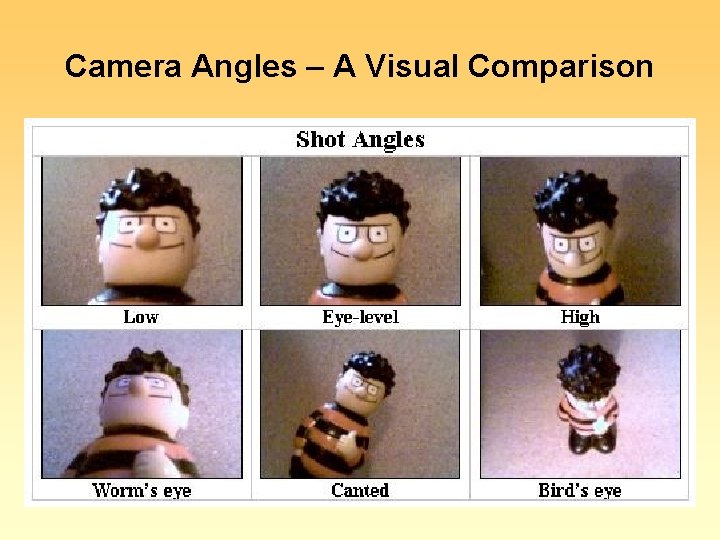
High Angle Shot In film, a high angle shot is usually when the camera is located high (often above head height) and the shot is angled downwards (in contrast to a bird's eye shot). This shot is used sometimes in scenes of confrontation and fights to show which person has the higher power. The subject of a high angle shot looks vulnerable or insignificant; if the shot represents a character's point of view the shot can also be used to make the character tall, more powerful or threatening.
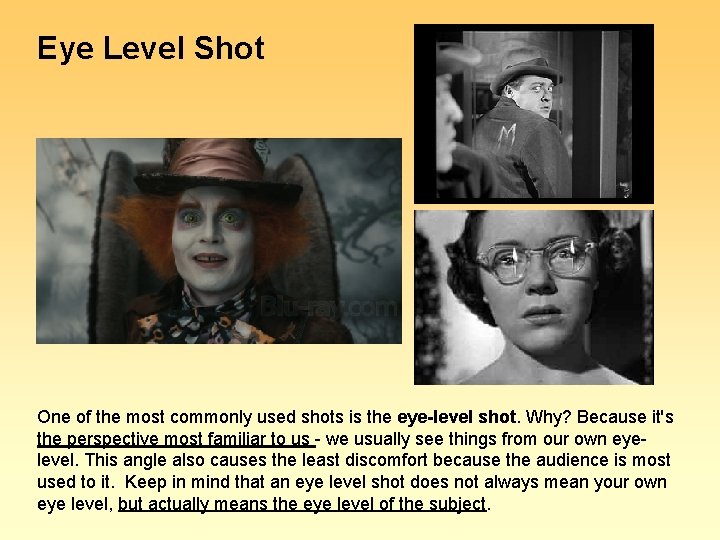
Eye Level Shot One of the most commonly used shots is the eye-level shot. Why? Because it's the perspective most familiar to us - we usually see things from our own eyelevel. This angle also causes the least discomfort because the audience is most used to it. Keep in mind that an eye level shot does not always mean your own eye level, but actually means the eye level of the subject.
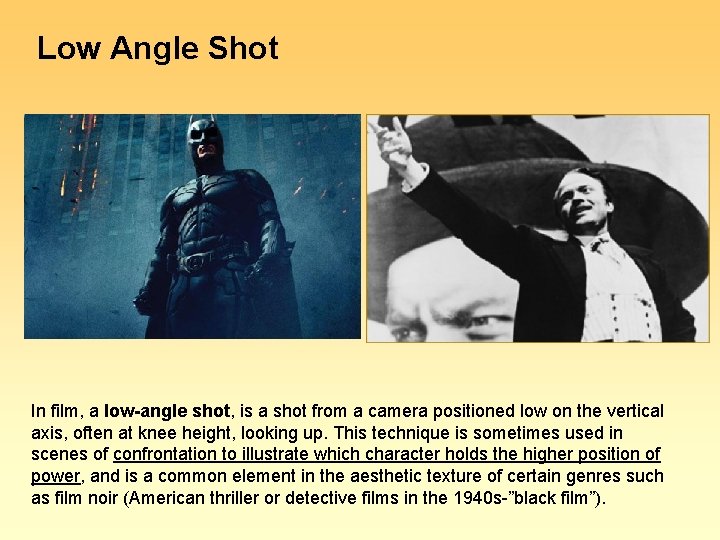
Low Angle Shot In film, a low-angle shot, is a shot from a camera positioned low on the vertical axis, often at knee height, looking up. This technique is sometimes used in scenes of confrontation to illustrate which character holds the higher position of power, and is a common element in the aesthetic texture of certain genres such as film noir (American thriller or detective films in the 1940 s-”black film”).
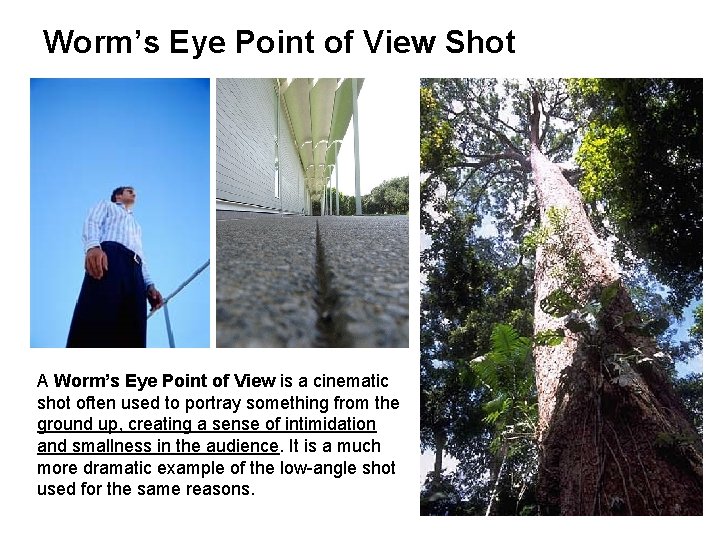
Worm’s Eye Point of View Shot A Worm’s Eye Point of View is a cinematic shot often used to portray something from the ground up, creating a sense of intimidation and smallness in the audience. It is a much more dramatic example of the low-angle shot used for the same reasons.
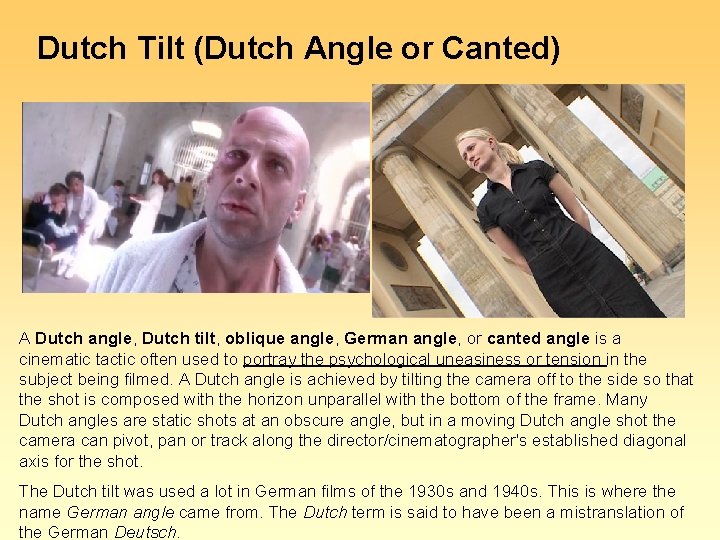
Dutch Tilt (Dutch Angle or Canted) A Dutch angle, Dutch tilt, oblique angle, German angle, or canted angle is a cinematic tactic often used to portray the psychological uneasiness or tension in the subject being filmed. A Dutch angle is achieved by tilting the camera off to the side so that the shot is composed with the horizon unparallel with the bottom of the frame. Many Dutch angles are static shots at an obscure angle, but in a moving Dutch angle shot the camera can pivot, pan or track along the director/cinematographer's established diagonal axis for the shot. The Dutch tilt was used a lot in German films of the 1930 s and 1940 s. This is where the name German angle came from. The Dutch term is said to have been a mistranslation of the German Deutsch.
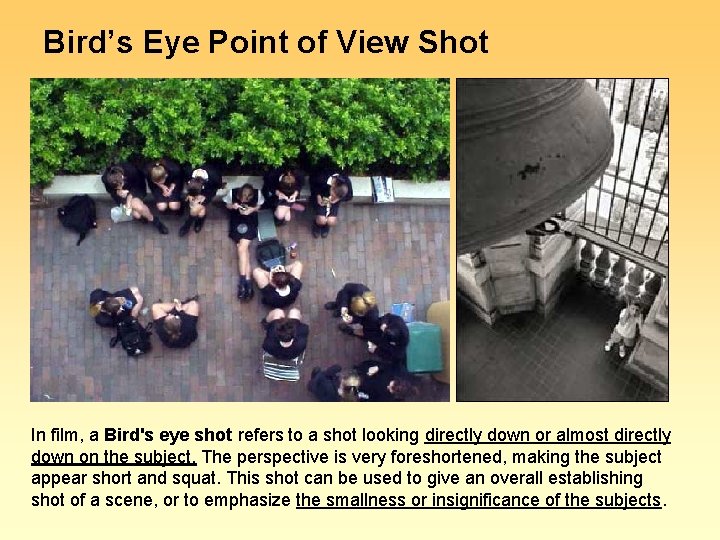
Bird’s Eye Point of View Shot In film, a Bird's eye shot refers to a shot looking directly down or almost directly down on the subject. The perspective is very foreshortened, making the subject appear short and squat. This shot can be used to give an overall establishing shot of a scene, or to emphasize the smallness or insignificance of the subjects.
Camera Angles – A Visual Comparison
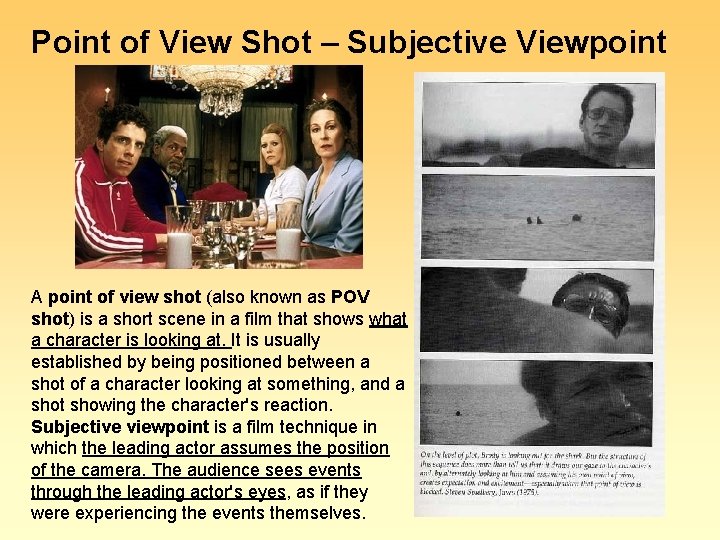
Point of View Shot – Subjective Viewpoint A point of view shot (also known as POV shot) is a short scene in a film that shows what a character is looking at. It is usually established by being positioned between a shot of a character looking at something, and a shot showing the character's reaction. Subjective viewpoint is a film technique in which the leading actor assumes the position of the camera. The audience sees events through the leading actor's eyes, as if they were experiencing the events themselves.
Camera Movement
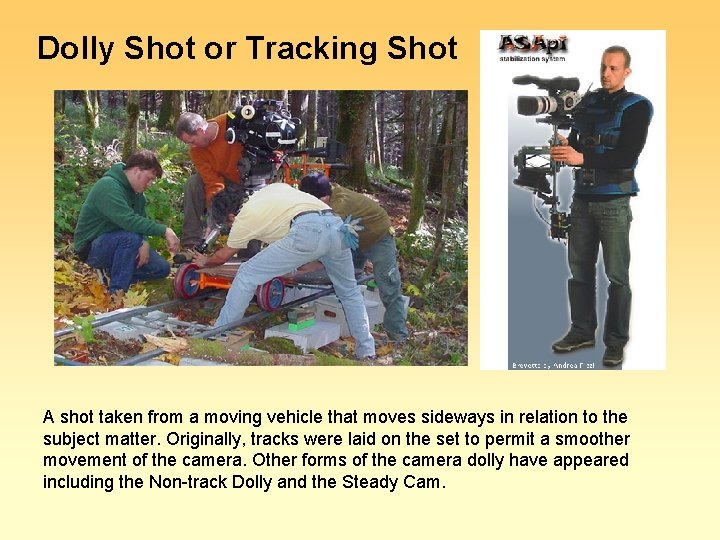
Dolly Shot or Tracking Shot A shot taken from a moving vehicle that moves sideways in relation to the subject matter. Originally, tracks were laid on the set to permit a smoother movement of the camera. Other forms of the camera dolly have appeared including the Non-track Dolly and the Steady Cam.
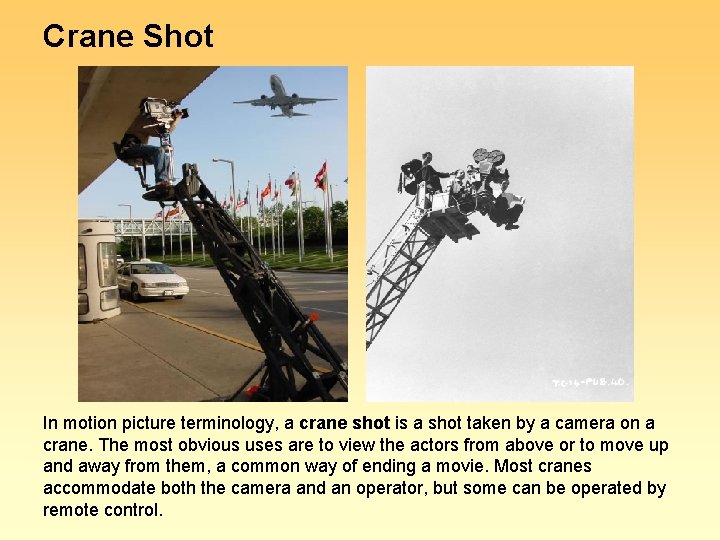
Crane Shot In motion picture terminology, a crane shot is a shot taken by a camera on a crane. The most obvious uses are to view the actors from above or to move up and away from them, a common way of ending a movie. Most cranes accommodate both the camera and an operator, but some can be operated by remote control.
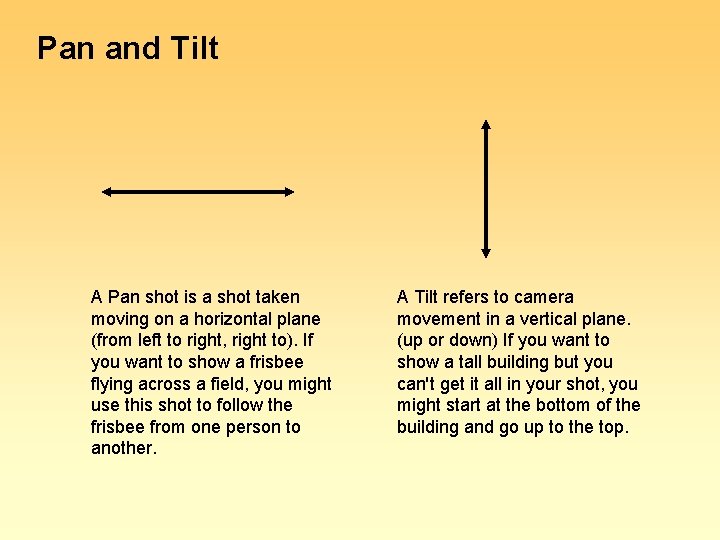
Pan and Tilt A Pan shot is a shot taken moving on a horizontal plane (from left to right, right to). If you want to show a frisbee flying across a field, you might use this shot to follow the frisbee from one person to another. A Tilt refers to camera movement in a vertical plane. (up or down) If you want to show a tall building but you can't get it all in your shot, you might start at the bottom of the building and go up to the top.