
Camera Model c optical center R retinal plane



- Slides: 9
Camera Model c – optical center R – retinal plane F – focal plane f – focal length
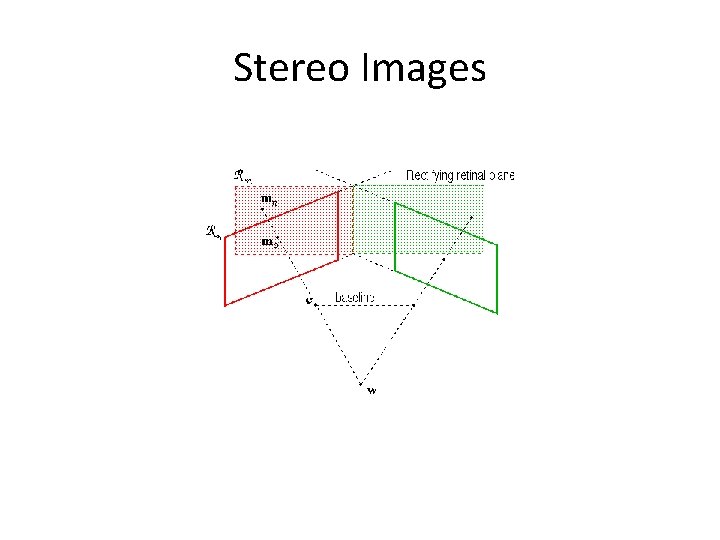
Stereo Images
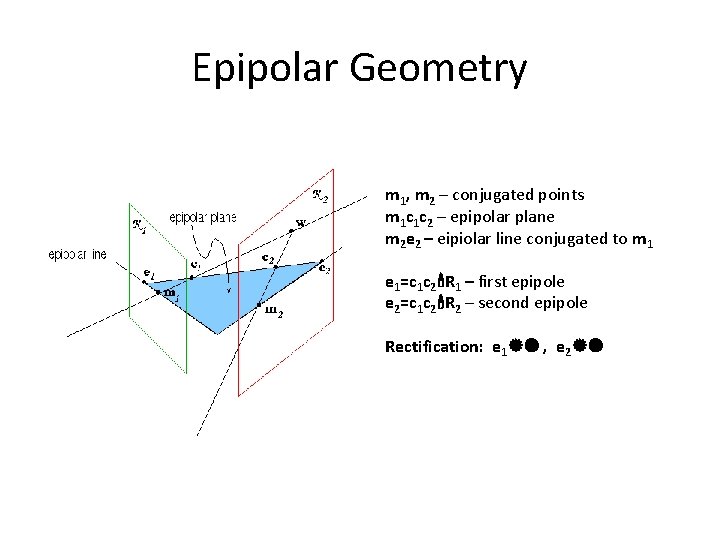
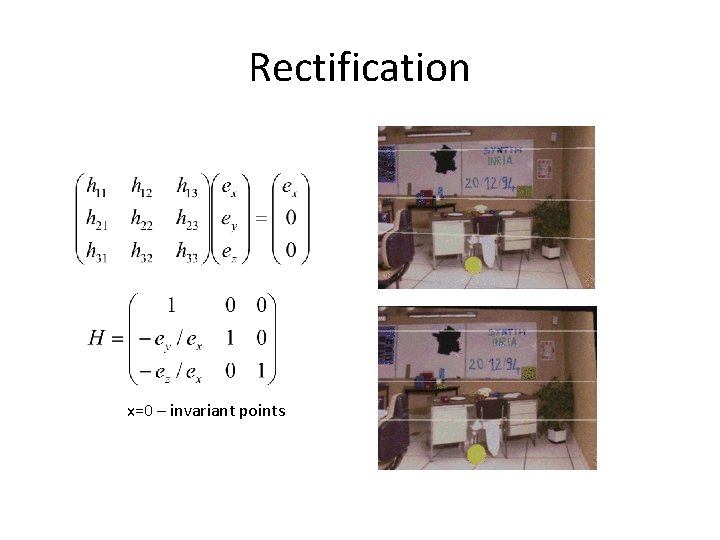
Epipolar Geometry m 1, m 2 – conjugated points m 1 c 1 c 2 – epipolar plane m 2 e 2 – eipiolar line conjugated to m 1 e 1=c 1 c 2 R 1 – first epipole e 2=c 1 c 2 R 2 – second epipole Rectification: e 1 , e 2
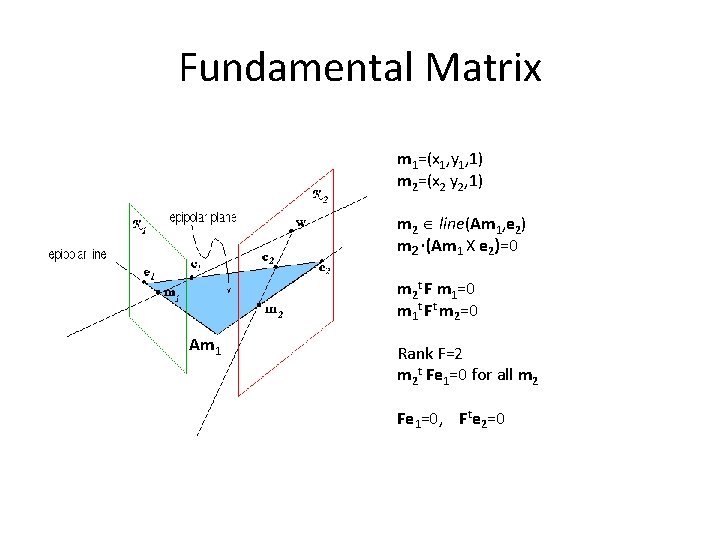
Fundamental Matrix m 1=(x 1, y 1, 1) m 2=(x 2 y 2, 1) m 2 line(Am 1, e 2) m 2 ∙(Am 1 X e 2)=0 m 2 t F m 1=0 m 1 t Ft m 2=0 Am 1 Rank F=2 m 2 t Fe 1=0 for all m 2 Fe 1=0, Fte 2=0
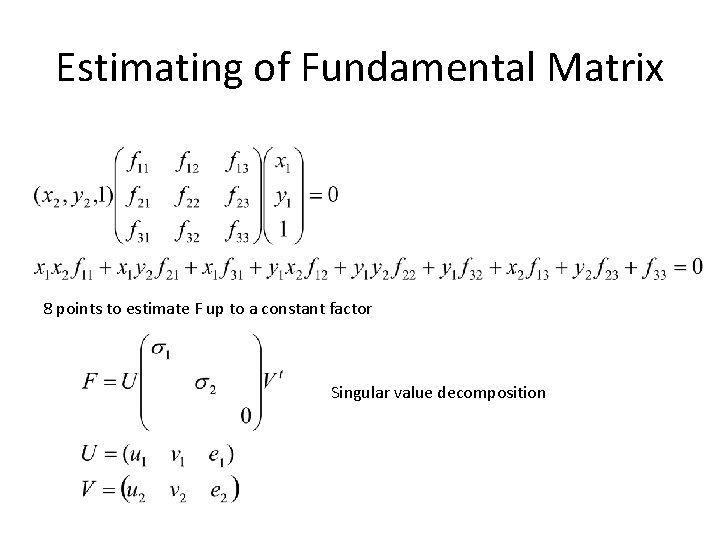
Estimating of Fundamental Matrix 8 points to estimate F up to a constant factor Singular value decomposition
Rectification x=0 – invariant points
Better solution H=GRT T – translation central point to the origin R – rotation epipole to be on X-axis G – projective transform
• R. I. Hartley, Theory and practice of projective rectification, International Journal of Computer Vision 35 (2) (1999) 115– 127. • • C. Loop, Z. Zhang, Computing rectifying homographies for stereo vision, in: Proceedings of the IEEE Conference on Computer Vision and Pattern Recognition, Vol. 1, 1999, pp. 125– 131. J. Mallon, P. F. Whelan: Projective rectification from the fundamental matrix. Image Vision Comput. 23(7): 643 -650 (2005)