
CAMELS Concept Materials A phase change memory PCM
- Slides: 2
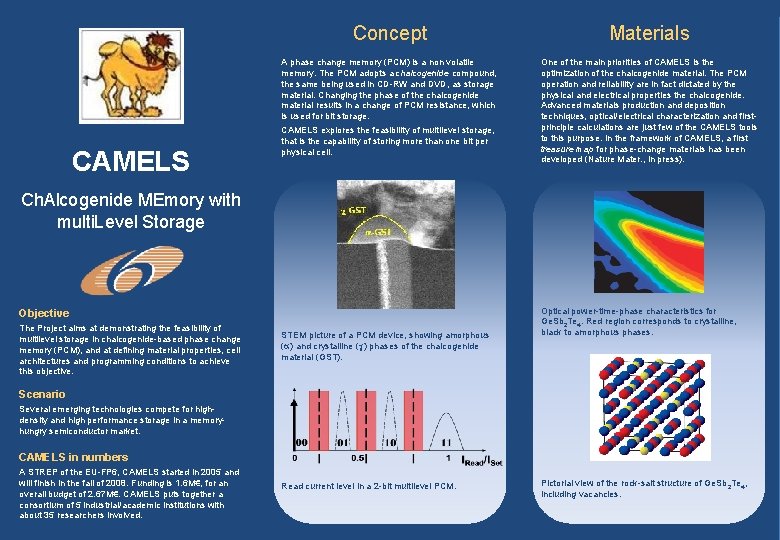
CAMELS Concept Materials A phase change memory (PCM) is a non volatile memory. The PCM adopts a chalcogenide compound, the same being used in CD-RW and DVD, as storage material. Changing the phase of the chalcogenide material results in a change of PCM resistance, which is used for bit storage. One of the main priorities of CAMELS is the optimization of the chalcogenide material. The PCM operation and reliability are in fact dictated by the physical and electrical properties the chalcogenide. Advanced materials production and deposition techniques, optical/electrical characterization and firstprinciple calculations are just few of the CAMELS tools to this purpose. In the framework of CAMELS, a first treasure map for phase-change materials has been developed (Nature Mater. , in press). CAMELS explores the feasibility of multilevel storage, that is the capability of storing more than one bit per physical cell. Ch. Alcogenide MEmory with multi. Level Storage Objective The Project aims at demonstrating the feasibility of multilevel storage in chalcogenide-based phase change memory (PCM), and at defining material properties, cell architectures and programming conditions to achieve this objective. STEM picture of a PCM device, showing amorphous (a) and crystalline (c) phases of the chalcogenide material (GST). Optical power-time-phase characteristics for Ge. Sb 2 Te 4. Red region corresponds to crystalline, black to amorphous phases. Scenario Several emerging technologies compete for highdensity and high performance storage in a memoryhungry semiconductor market. CAMELS in numbers A STREP of the EU-FP 6, CAMELS started in 2005 and will finish in the fall of 2008. Funding is 1. 6 M€, for an overall budget of 2. 67 M€. CAMELS puts together a consortium of 5 industrial/academic institutions with about 35 researchers involved. Read current level in a 2 -bit multilevel PCM. Pictorial view of the rock-salt structure of Ge. Sb 2 Te 4, including vacancies.
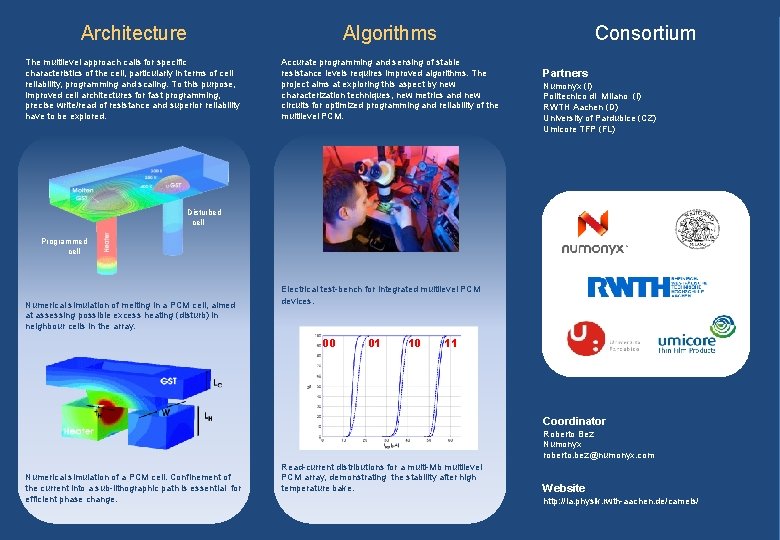
Architecture Algorithms The multilevel approach calls for specific characteristics of the cell, particularly in terms of cell reliability, programming and scaling. To this purpose, improved cell architectures for fast programming, precise write/read of resistance and superior reliability have to be explored. Accurate programming and sensing of stable resistance levels requires improved algorithms. The project aims at exploring this aspect by new characterization techniques, new metrics and new circuits for optimized programming and reliability of the multilevel PCM. Consortium Partners Numonyx (I) Politecnico di Milano (I) RWTH Aachen (D) University of Pardubice (CZ) Umicore TFP (FL) Disturbed cell Programmed cell Numerical simulation of melting in a PCM cell, aimed at assessing possible excess heating (disturb) in neighbour cells in the array. Electrical test-bench for integrated multilevel PCM devices. 00 01 10 11 Coordinator Roberto Bez Numonyx roberto. bez@numonyx. com Numerical simulation of a PCM cell. Confinement of the current into a sub-lithographic path is essential for efficient phase change. Read-current distributions for a multi-Mb multilevel PCM array, demonstrating the stability after high temperature bake. Website http: //ia. physik. rwth-aachen. de/camels/