
Cambyses 2 Consequences and Apis Bull STARTER CHALLENGE
Cambyses 2. Consequences and Apis Bull
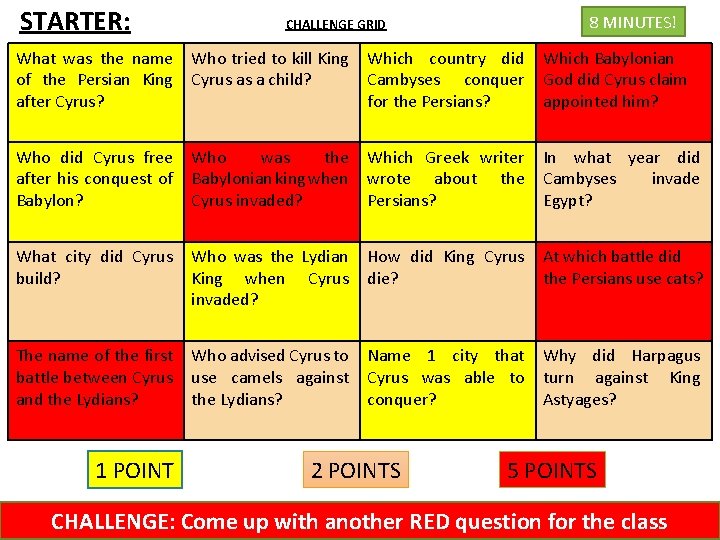
STARTER: CHALLENGE GRID 8 MINUTES! What was the name Who tried to kill King Which country did Which Babylonian of the Persian King Cyrus as a child? Cambyses conquer God did Cyrus claim after Cyrus? for the Persians? appointed him? Who did Cyrus free Who was the Which Greek writer In what year did after his conquest of Babylonian king when wrote about the Cambyses invade Babylon? Cyrus invaded? Persians? Egypt? What city did Cyrus Who was the Lydian How did King Cyrus At which battle did build? King when Cyrus die? the Persians use cats? invaded? The name of the first Who advised Cyrus to Name 1 city that Why did Harpagus battle between Cyrus use camels against Cyrus was able to turn against King and the Lydians? conquer? Astyages? 1 POINT 2 POINTS 5 POINTS CHALLENGE: Come up with another RED question for the class
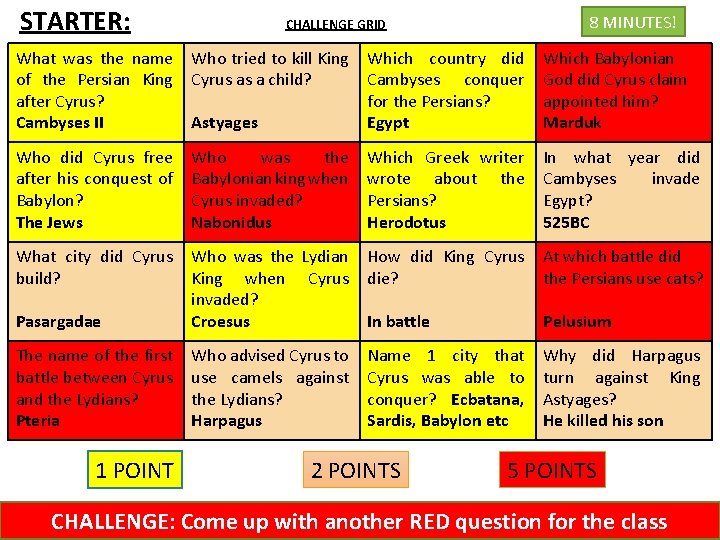
STARTER: 8 MINUTES! CHALLENGE GRID What was the name Who tried to kill King Which country did of the Persian King Cyrus as a child? Cambyses conquer after Cyrus? for the Persians? Cambyses II Astyages Egypt Which Babylonian God did Cyrus claim appointed him? Marduk Who did Cyrus free after his conquest of Babylon? The Jews In what year did Cambyses invade Egypt? 525 BC Who was the Babylonian king when Cyrus invaded? Nabonidus Which Greek writer wrote about the Persians? Herodotus What city did Cyrus Who was the Lydian How did King Cyrus At which battle did build? King when Cyrus die? the Persians use cats? invaded? Pasargadae Croesus In battle Pelusium The name of the first battle between Cyrus and the Lydians? Pteria 1 POINT Who advised Cyrus to use camels against the Lydians? Harpagus Name 1 city that Cyrus was able to conquer? Ecbatana, Sardis, Babylon etc 2 POINTS Why did Harpagus turn against King Astyages? He killed his son 5 POINTS CHALLENGE: Come up with another RED question for the class
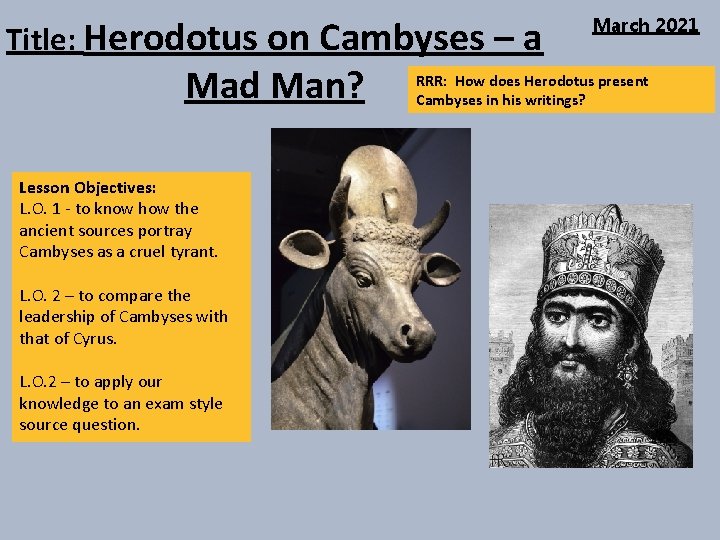
Title: Herodotus on Cambyses – a Mad Man? Lesson Objectives: L. O. 1 - to know how the ancient sources portray Cambyses as a cruel tyrant. L. O. 2 – to compare the leadership of Cambyses with that of Cyrus. L. O. 2 – to apply our knowledge to an exam style source question. March 2021 RRR: How does Herodotus present Cambyses in his writings?
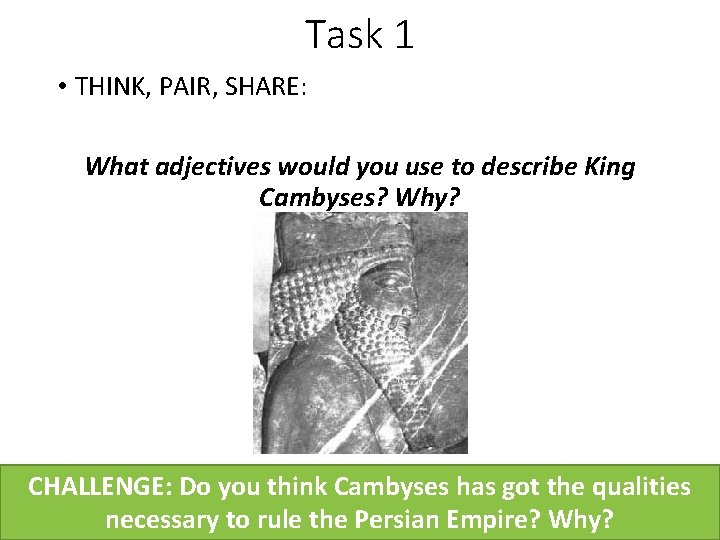
Task 1 • THINK, PAIR, SHARE: What adjectives would you use to describe King Cambyses? Why? CHALLENGE: Do you think Cambyses has got the qualities necessary to rule the Persian Empire? Why?
Task 2 – Herodotus on Cambyses – it’s not good… • In pairs read the extract from Herodotus. • Fill in your relevant section of the table. TASK 1: Fill in the columns explaining what Cambyses did and what this showed about him as king. TASK 2: Fill in the column comparing Cambyses style of leadership to that of Cyrus. CHALLENGE: read Herodotus 3. 26. Using the passage and your own knowledge, what can we learn about the character of Cambyses? (10)
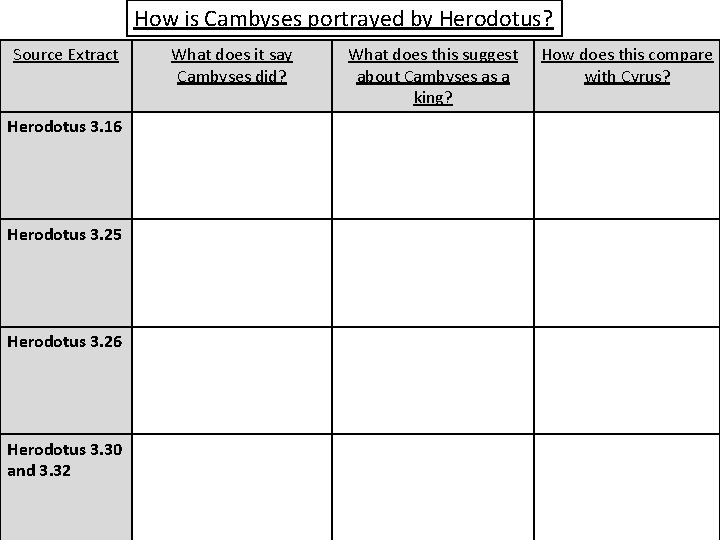
How is Cambyses portrayed by Herodotus? Source Extract Herodotus 3. 16 Herodotus 3. 25 Herodotus 3. 26 Herodotus 3. 30 and 3. 32 What does it say Cambyses did? What does this suggest about Cambyses as a king? How does this compare with Cyrus?
Cambyses went to the city Sais, anxious to do exactly what he did do. Entering the house of Amasis (a previous king of Egypt), he had the body of Amasis carried outside from its place of burial; and when this had been done, he gave orders to whip it and pull out the hair and pierce it with knives, and to desecrate it in every way. [2] When they were tired of doing this (for the body, being embalmed, remained whole and did not fall to pieces), Cambyses gave orders to burn it, a sacrilegious command; for the Persians hold fire to be a god and never burn their dead. Herodotus 3. 16: Desecrate = showing disrespect Sacrilegious = an action against God
Cambyses at once began his march against Ethiopia, without any order for the provision of supplies, and without for a moment considering the fact that he was to take his men to the ends of the earth… They had not, however, covered a fifth of the distance, when everything in the nature of provisions gave out, and the men were forced to eat the pack-animals until they, too, were all gone. If Cambyses, when he saw what the situation was, had change his mind and returned to his base, he would have shown some sense; but as it was, he paid not the least attention to what was happening and continued his advance. The troops kept themselves alive by eating grass… some were reduced to cannibalism. Herodotus 3. 25 Provisions = food and water. Pack-animals = horses and donkeys used to carry equipment
As for those who were sent to march against the Ammonians, they set out and journeyed across the desert with guides; after this nobody heard or saw the army except for the Ammonians themselves and those who heard from them, no man can say anything of them; for they neither reached the Ammonians nor returned back. But this is what the Ammonians themselves say: when the Persians were crossing the sandy desert to attack them, and were about midway between their country and Ammon, while they were breakfasting a great and violent south wind arose, which buried them in the masses of sand which it bore; and so they disappeared from sight. 50, 000 Persian soldiers died in this way. Such is the Ammonian tale about this army. Herodotus 3. 26 Ammonians – a people who lived in the Sahara desert in modern day Libya.
His next evil act was to destroy his full brother Smerdis, whom he had sent away from Egypt to Persia out of jealousy, because Smerdis alone could draw the bow brought from the Ethiopians as far as two fingerbreadths, but no other Persian could draw it. Smerdis having gone to Persia, Cambyses saw in a dream a vision, in which it seemed to him that a messenger came from Persia and told him that Smerdis sitting on the royal throne touched heaven with his head. Fearing therefore for himself, lest his brother might slay him and so be king, he sent Prexaspes, the most trusted of his Persians, to Persia to kill him. Prexaspes went up to Susa and killed Smerdis. Next, he destroyed his sister, who had come with him to Egypt, and whom he had taken to wife. He married her as he was infatuated with her. So Cambyses married the object of his desire; yet not long afterwards he took another sister as well. It was the younger of these who had come with him to Egypt, and whom he now killed. The Egyptian tale is that as the two sat at table the woman took a lettuce and plucked off the leaves, then asked her husband whether he preferred the look of it with or without leaves. “With the leaves, ” he said; whereupon she answered “Yet you have stripped Cyrus' kingdom as bare as this lettuce. ” Angered at this, they say, he sprang upon her and beat her to death. HERODOTUS 3. 30 and 3. 32
Cambyses and the Apis Bull When Cambyses returned from his failed expedition to Ethiopia, he returned to Memphis in celebration. Cambyses assumed they were celebrating his failure, when in fact they were celebrating the appearance of their god, Ptah, who would come in the form of a sacred animal, that they called the Apis Bull. Herodotus presents Cambyses as a mad man, who did not believe that the people were celebrating the appearance of the new Apis Bull, and had the advisors who tried to explain this to him executed! Cambyses then demanded that the bull be brought before him… Herodotus says that; “the priests brought the animal and Cambyses, half mad as he was, drew his dagger, aimed a blow at Apis’ belly, but missed and struck its thigh. ” Apparently Cambyses then laughed at the god for bleeding, and the bull wasted away and died of its injuries. TASK: How is Cambyses’ treatment of the Apis Bull/ Egyptian religion, different to Cyrus’ approach to the religions of the people he conquered after Babylon? Apis Bull: a scared bull of Egyptian religion which Cambyses fatally wounded. Ptah was an important creator god for the Egyptians, and particularly associated with Memphis. People rejoiced when a new Apis bull was identified
Task 4 • How does the reign of Cambyses II compare to that of Cyrus? • Some criteria to use; Expansion of the Persian Empire Respect for the Gods Treatment of conquered people Military abilities Treatment of individuals CHALLENGE: Can you think of any other criteria to use to compare the two kings?
What can we learn about Cambyses’ style of leadership from the source (10 marks)? TASK: exam practise. Question 3. Using passage A, and your own knowledge, what can we learn about Cambyses as a ruler? (10 marks) - Make 2/3 points about what he learn about Cambyses as a ruler? – think about what qualities/ habits he displays. - Make sure you have quotes to support your answer. - Explain HOW these quotes prove he had these qualities, but using your own knowledge. - POINT - EVIDENCE FROM SOURCE - EVIDENCE FROM OWN KNOWLEDGE
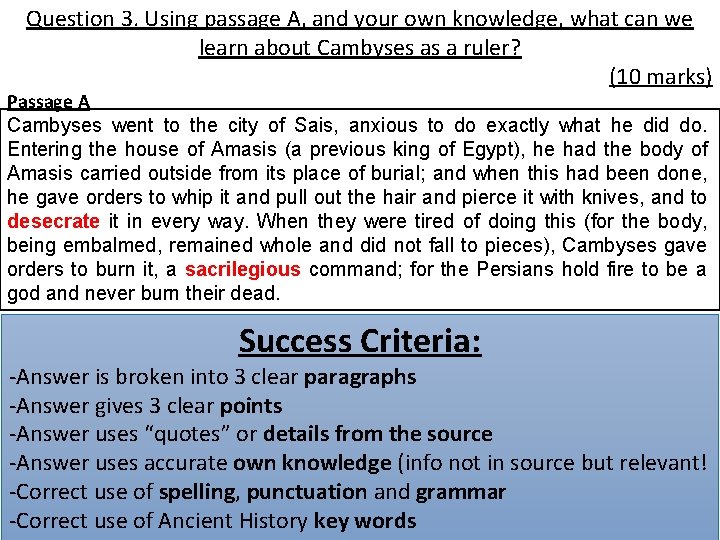
Question 3. Using passage A, and your own knowledge, what can we learn about Cambyses as a ruler? (10 marks) Passage A Cambyses went to the city of Sais, anxious to do exactly what he did do. Entering the house of Amasis (a previous king of Egypt), he had the body of Amasis carried outside from its place of burial; and when this had been done, he gave orders to whip it and pull out the hair and pierce it with knives, and to desecrate it in every way. When they were tired of doing this (for the body, being embalmed, remained whole and did not fall to pieces), Cambyses gave orders to burn it, a sacrilegious command; for the Persians hold fire to be a god and never burn their dead. Success Criteria: -Answer is broken into 3 clear paragraphs -Answer gives 3 clear points -Answer uses “quotes” or details from the source -Answer uses accurate own knowledge (info not in source but relevant! -Correct use of spelling, punctuation and grammar -Correct use of Ancient History key words
Task 5 • Using a green pen, peer assess your partners’ Q 3 answer. • Use the Success Criteria and give 1 x WWW and 1 x EBI. Success Criteria: -Answer is broken into 3 clear paragraphs -Answer gives 3 clear points -Answer uses “quotes” or details from the source -Answer uses accurate own knowledge (info not in source but relevant! -Correct use of spelling, punctuation and grammar -Correct use of Ancient History key words
Plenary 3 stories that Herodotus tells us about Cambyses “madness”. 2 key exam techniques for the source question 3. 1 key similarity between Cyrus and Cambyses.
- Slides: 17