
Cambridgeshire Autonomous Metro CAM Key Stakeholder Briefing March
Cambridgeshire Autonomous Metro CAM Key Stakeholder Briefing March 2020
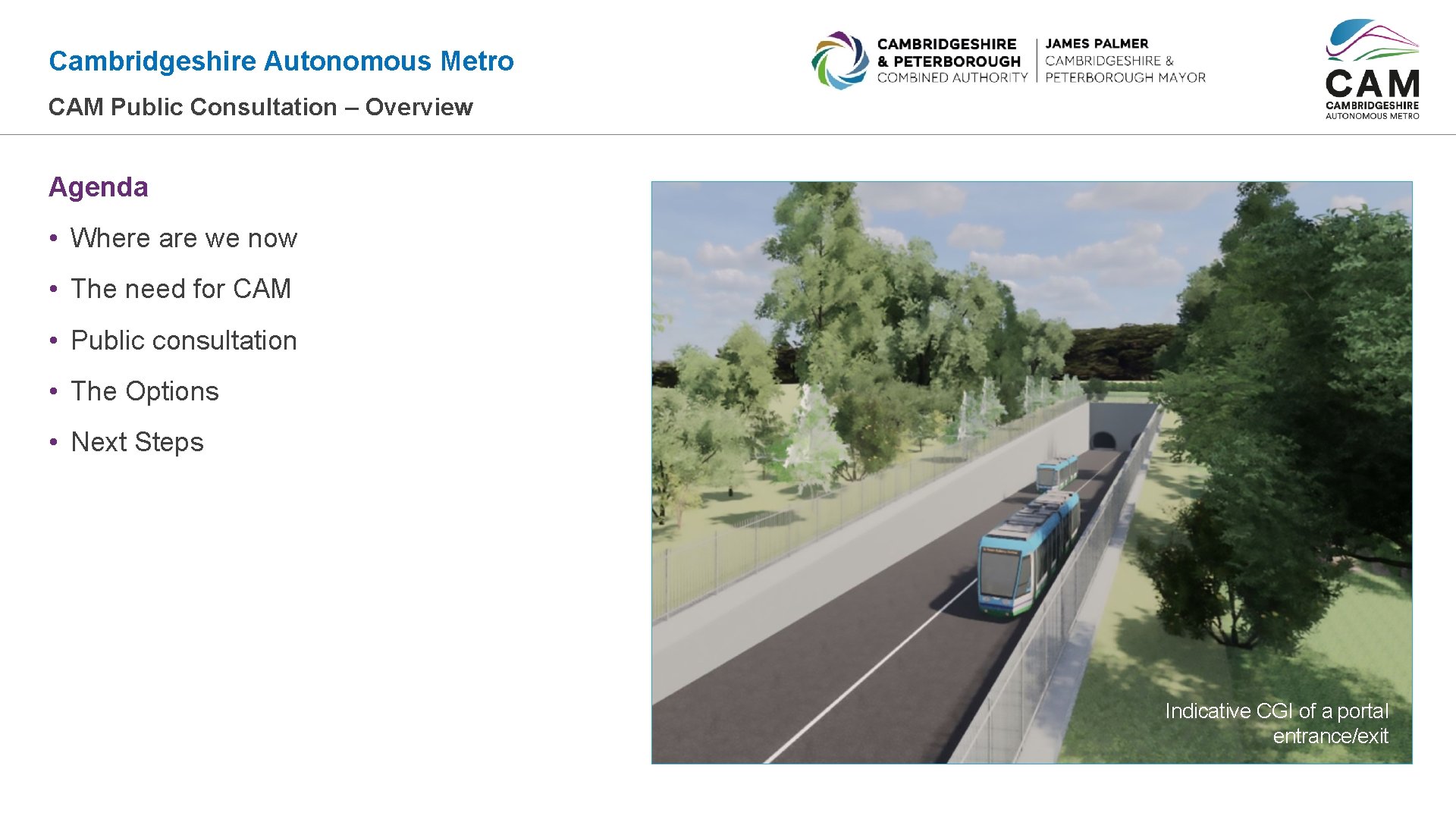
Cambridgeshire Autonomous Metro CAM Public Consultation – Overview Agenda • Where are we now • The need for CAM • Public consultation • The Options • Next Steps Indicative CGI of a portal entrance/exit
Cambridgeshire Autonomous Metro Where are we now? • The CPCA is developing the Outline Business Case (OBC) for CAM • The OBC will be compliant with the HM Treasury Green Book and Df. T Guidance for Transport Projects • At OBC stage, the guidance requires a non-statutory public consultation to be carried out on options under consideration. • The findings of the consultation will influence the development of the scheme, and support the preparation of the application for a Transport and Works Act Order (TWAO) for the project. • Engagement with colleagues from the City and South Cambridgeshire’s Joint Planning Service, and from the Greater Cambridge Partnership are well underway The scope of the consultation will focus on the level of public support for (a) the overall CAM network and (b) elements of the route alignment, especially the tunnelled section.
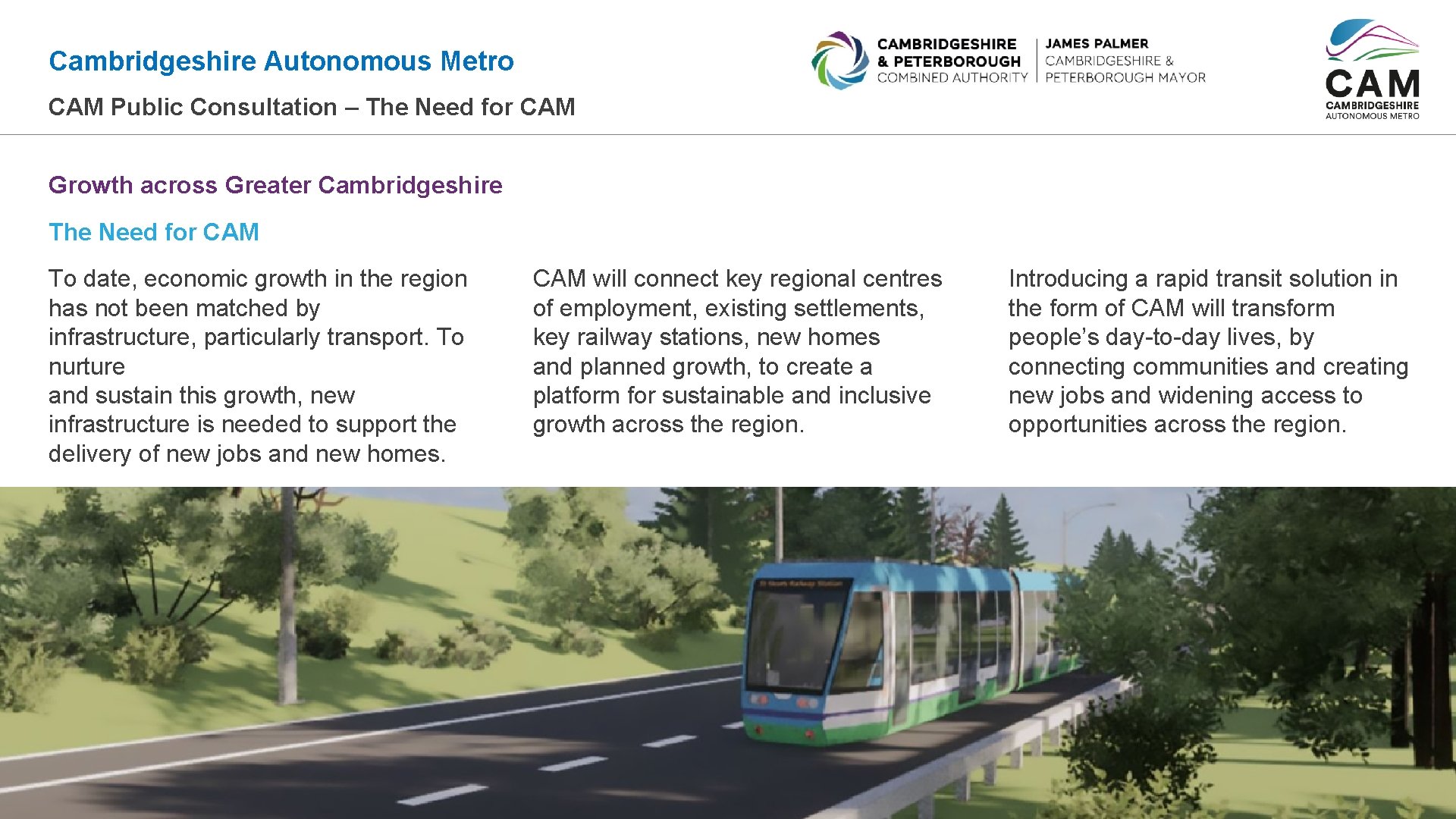
Cambridgeshire Autonomous Metro CAM Public Consultation – The Need for CAM Growth across Greater Cambridgeshire The Need for CAM To date, economic growth in the region has not been matched by infrastructure, particularly transport. To nurture and sustain this growth, new infrastructure is needed to support the delivery of new jobs and new homes. CAM will connect key regional centres of employment, existing settlements, key railway stations, new homes and planned growth, to create a platform for sustainable and inclusive growth across the region. Introducing a rapid transit solution in the form of CAM will transform people’s day-to-day lives, by connecting communities and creating new jobs and widening access to opportunities across the region.
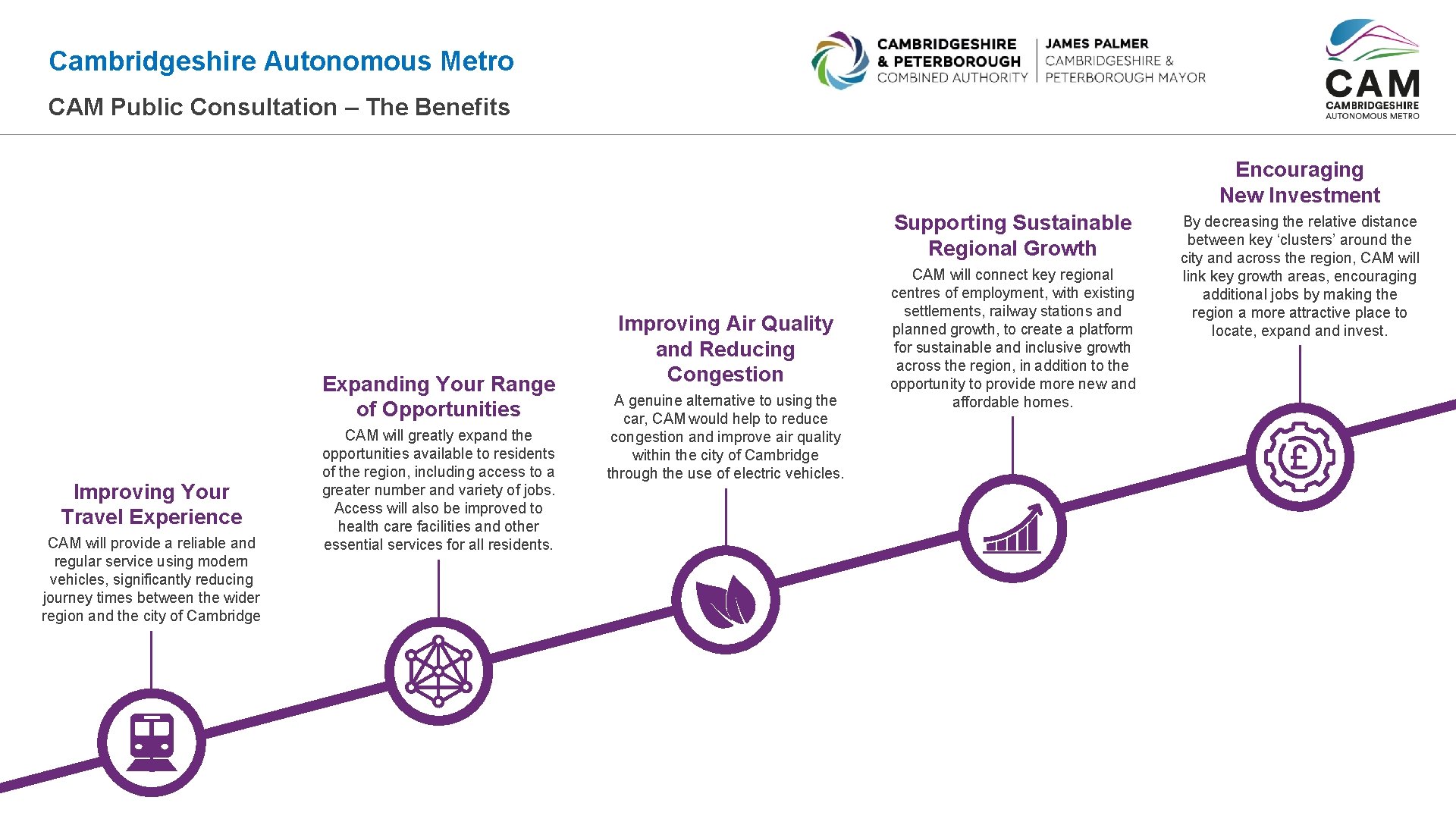
Cambridgeshire Autonomous Metro CAM Public Consultation – The Benefits Encouraging New Investment Supporting Sustainable Regional Growth Expanding Your Range of Opportunities Improving Your Travel Experience CAM will provide a reliable and regular service using modern vehicles, significantly reducing journey times between the wider region and the city of Cambridge CAM will greatly expand the opportunities available to residents of the region, including access to a greater number and variety of jobs. Access will also be improved to health care facilities and other essential services for all residents. Improving Air Quality and Reducing Congestion A genuine alternative to using the car, CAM would help to reduce congestion and improve air quality within the city of Cambridge through the use of electric vehicles. CAM will connect key regional centres of employment, with existing settlements, railway stations and planned growth, to create a platform for sustainable and inclusive growth across the region, in addition to the opportunity to provide more new and affordable homes. By decreasing the relative distance between key ‘clusters’ around the city and across the region, CAM will link key growth areas, encouraging additional jobs by making the region a more attractive place to locate, expand invest.
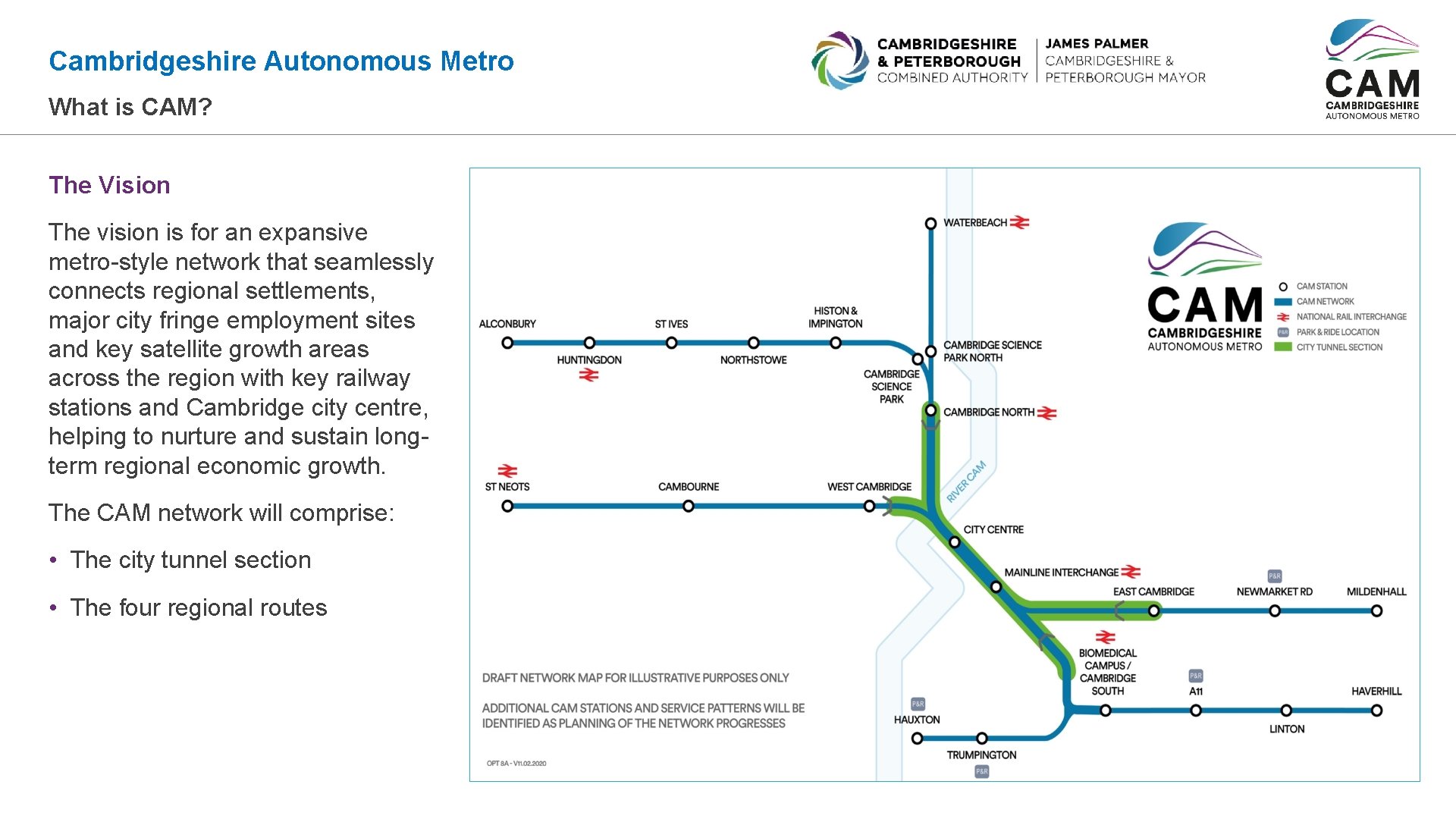
Cambridgeshire Autonomous Metro What is CAM? The Vision The vision is for an expansive metro-style network that seamlessly connects regional settlements, major city fringe employment sites and key satellite growth areas across the region with key railway stations and Cambridge city centre, helping to nurture and sustain longterm regional economic growth. The CAM network will comprise: • The city tunnel section • The four regional routes
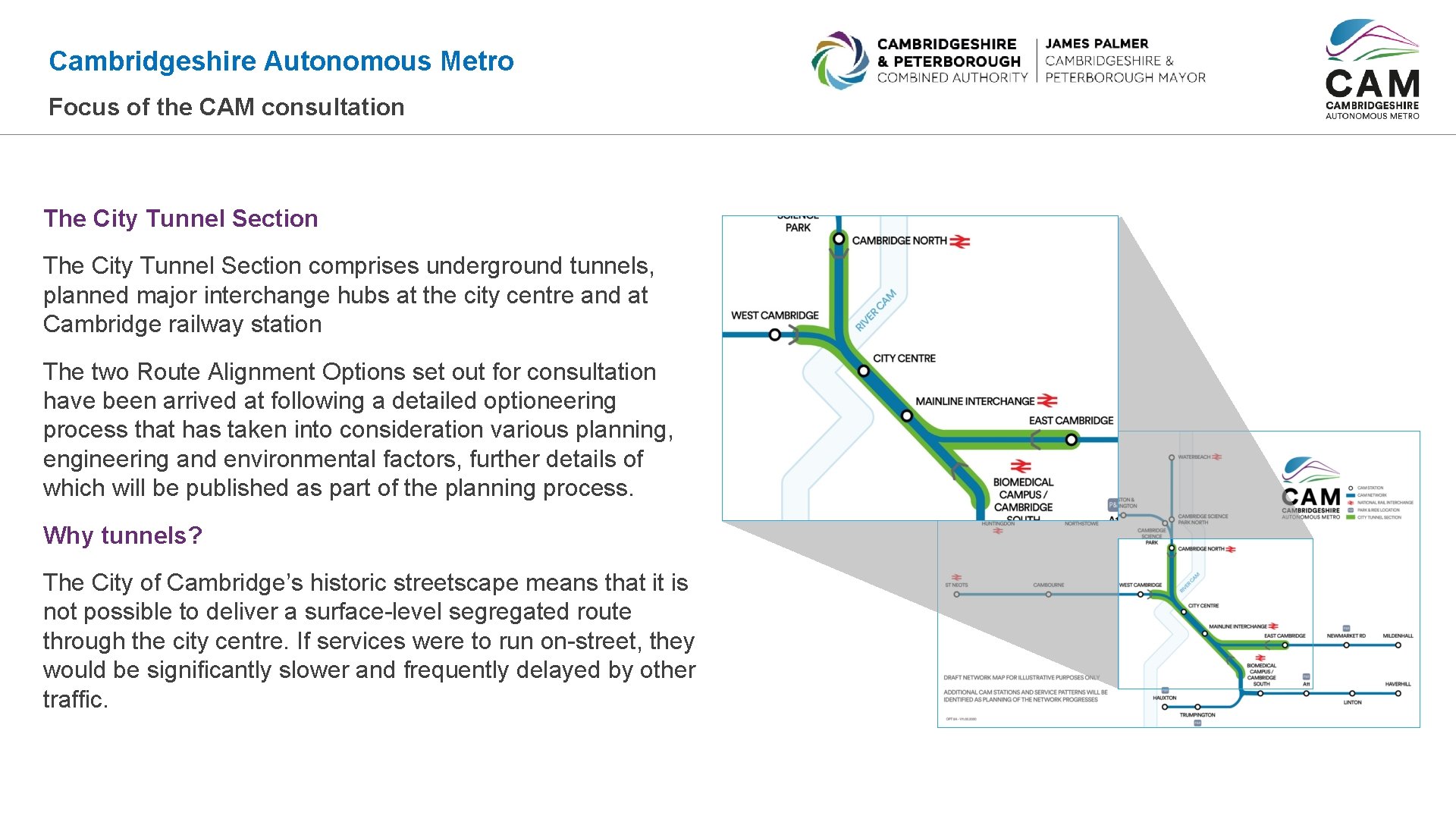
Cambridgeshire Autonomous Metro Focus of the CAM consultation The City Tunnel Section comprises underground tunnels, planned major interchange hubs at the city centre and at Cambridge railway station The two Route Alignment Options set out for consultation have been arrived at following a detailed optioneering process that has taken into consideration various planning, engineering and environmental factors, further details of which will be published as part of the planning process. Why tunnels? The City of Cambridge’s historic streetscape means that it is not possible to deliver a surface-level segregated route through the city centre. If services were to run on-street, they would be significantly slower and frequently delayed by other traffic.
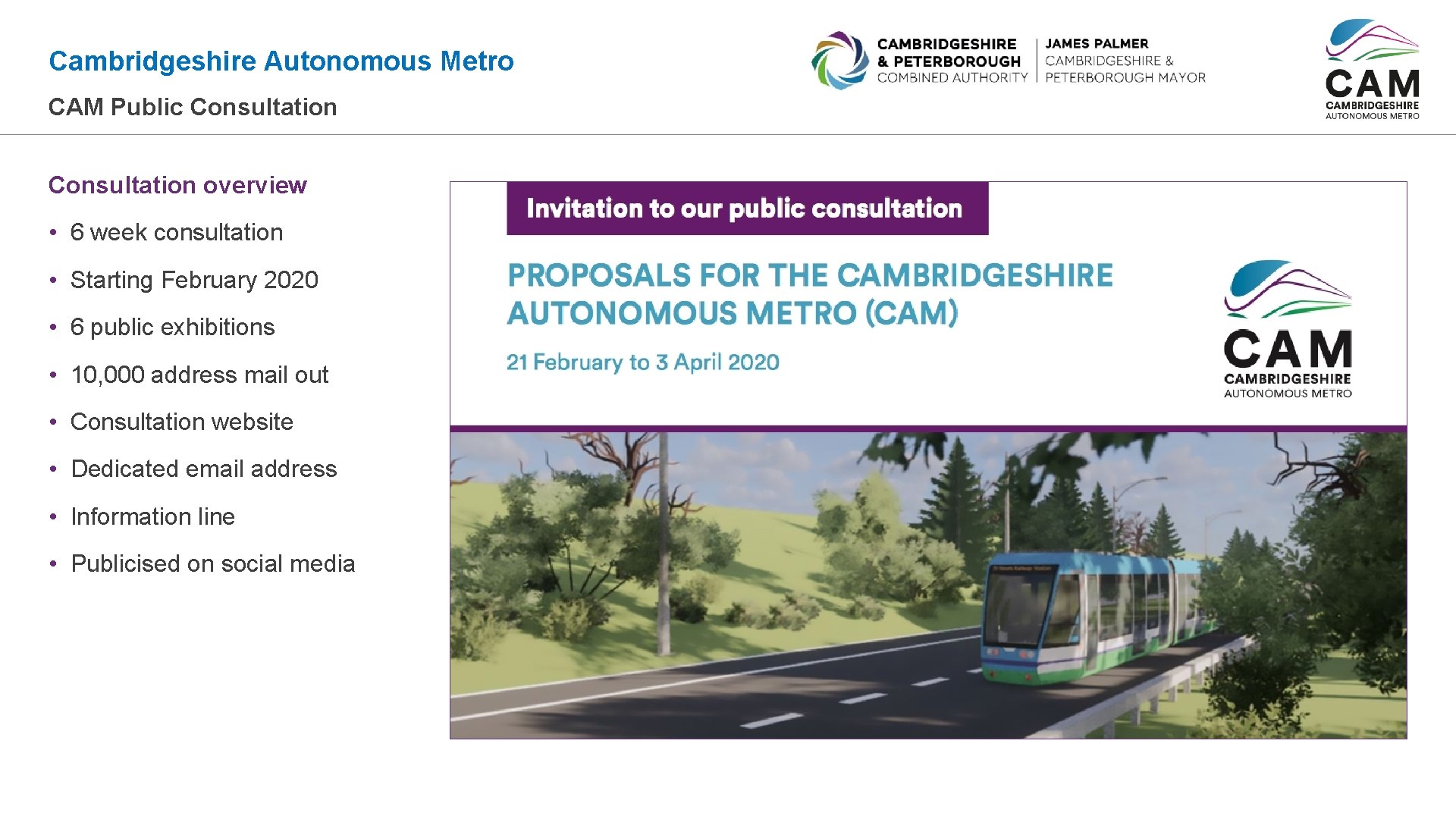
Cambridgeshire Autonomous Metro CAM Public Consultation overview • 6 week consultation • Starting February 2020 • 6 public exhibitions • 10, 000 address mail out • Consultation website • Dedicated email address • Information line • Publicised on social media
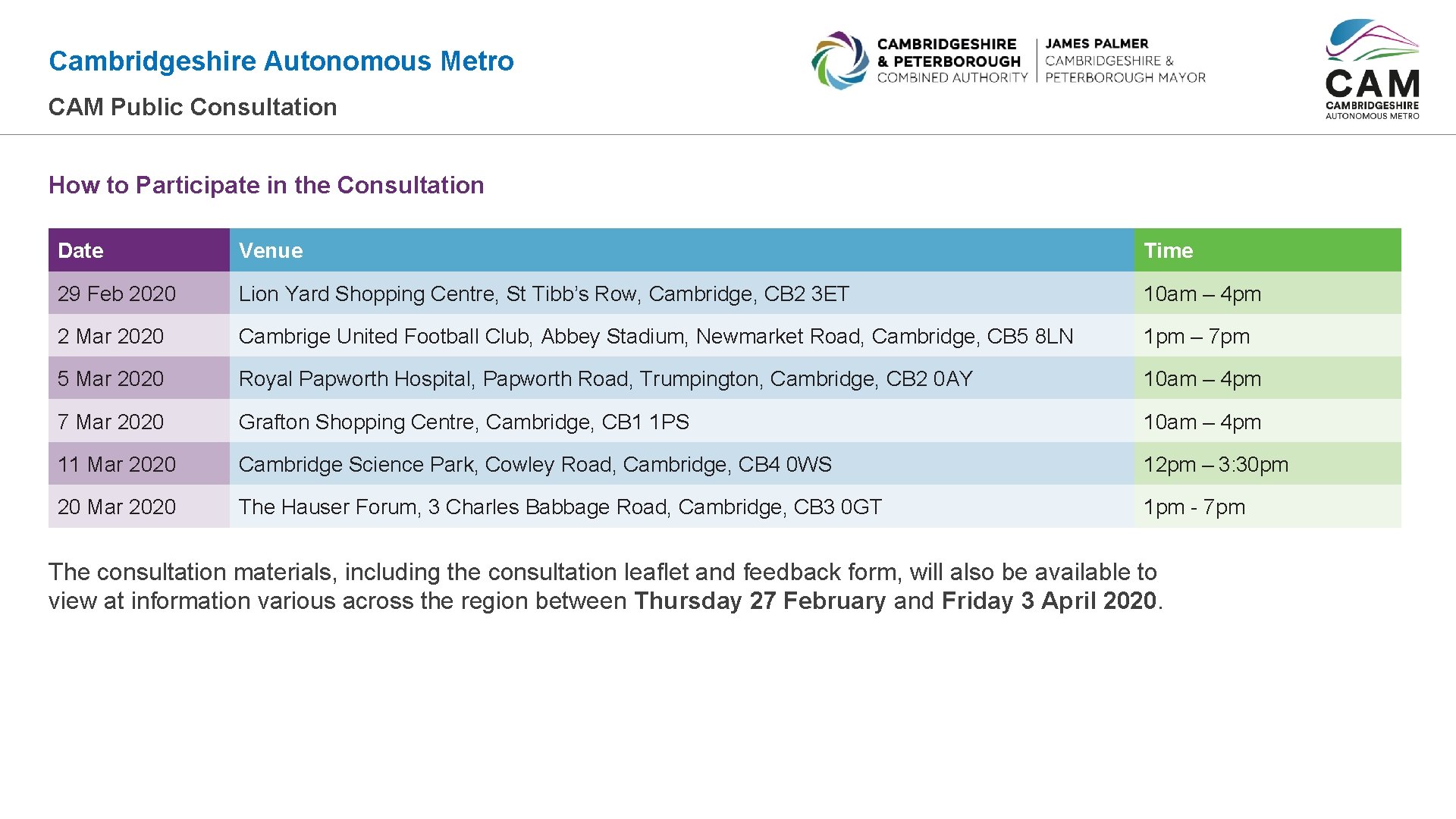
Cambridgeshire Autonomous Metro CAM Public Consultation How to Participate in the Consultation Date Venue Time 29 Feb 2020 Lion Yard Shopping Centre, St Tibb’s Row, Cambridge, CB 2 3 ET 10 am – 4 pm 2 Mar 2020 Cambrige United Football Club, Abbey Stadium, Newmarket Road, Cambridge, CB 5 8 LN 1 pm – 7 pm 5 Mar 2020 Royal Papworth Hospital, Papworth Road, Trumpington, Cambridge, CB 2 0 AY 10 am – 4 pm 7 Mar 2020 Grafton Shopping Centre, Cambridge, CB 1 1 PS 10 am – 4 pm 11 Mar 2020 Cambridge Science Park, Cowley Road, Cambridge, CB 4 0 WS 12 pm – 3: 30 pm 20 Mar 2020 The Hauser Forum, 3 Charles Babbage Road, Cambridge, CB 3 0 GT 1 pm - 7 pm The consultation materials, including the consultation leaflet and feedback form, will also be available to view at information various across the region between Thursday 27 February and Friday 3 April 2020.
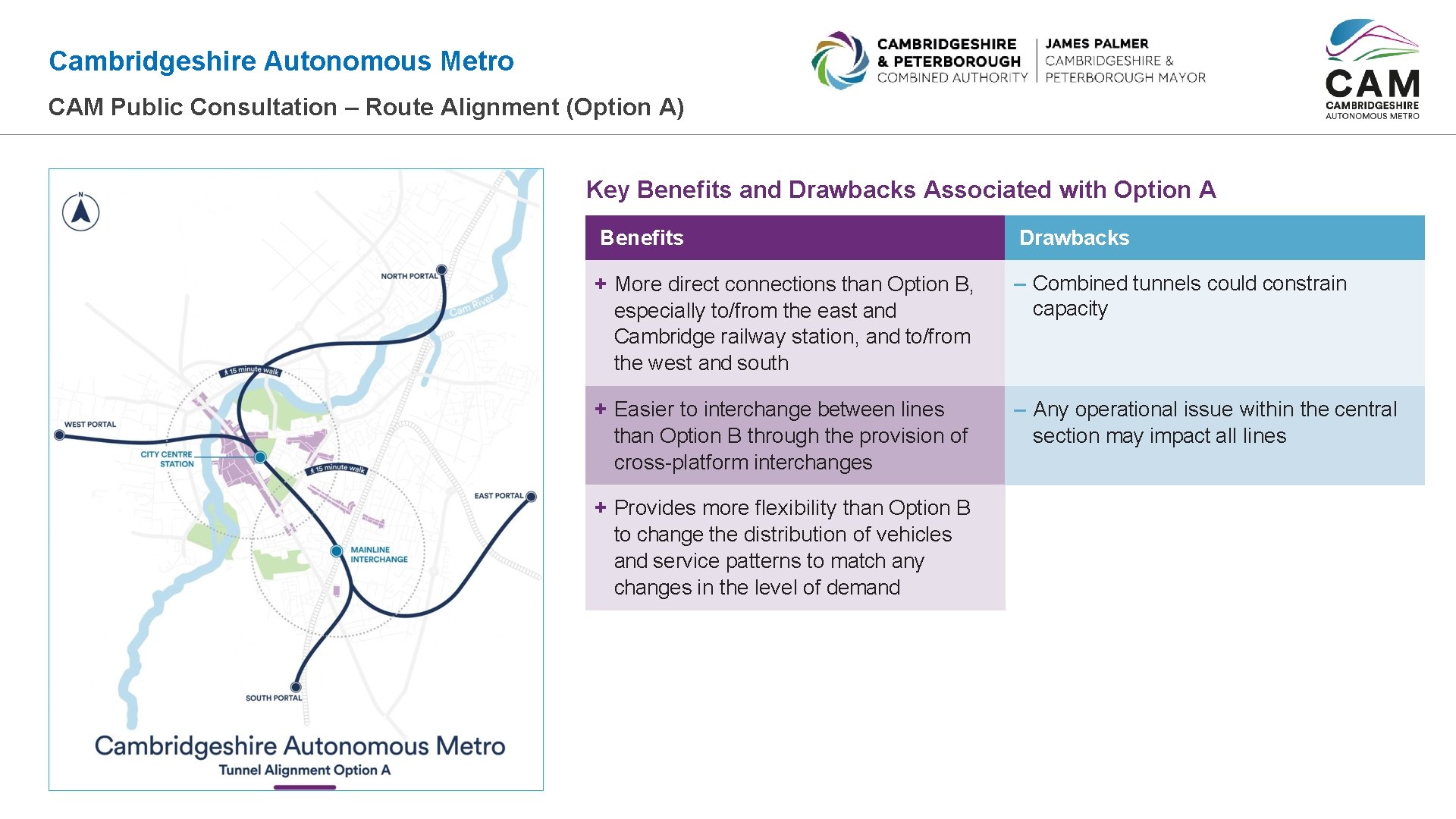
Cambridgeshire Autonomous Metro CAM Public Consultation – Route Alignment (Option A) Key Benefits and Drawbacks Associated with Option A Benefits Drawbacks + More direct connections than Option B, especially to/from the east and Cambridge railway station, and to/from the west and south – Combined tunnels could constrain capacity + Easier to interchange between lines than Option B through the provision of cross-platform interchanges – Any operational issue within the central section may impact all lines + Provides more flexibility than Option B to change the distribution of vehicles and service patterns to match any changes in the level of demand
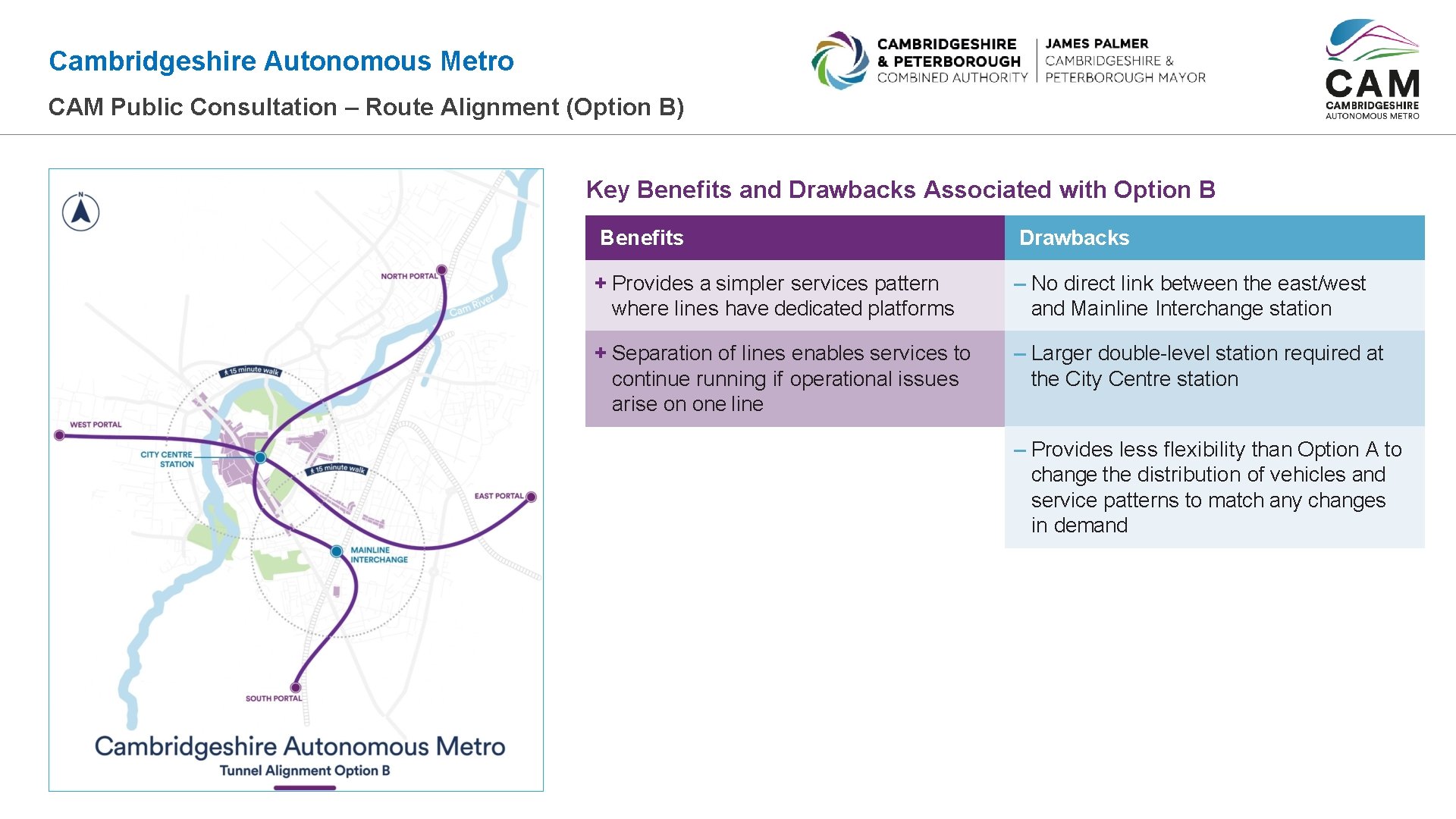
Cambridgeshire Autonomous Metro CAM Public Consultation – Route Alignment (Option B) Key Benefits and Drawbacks Associated with Option B Benefits Drawbacks + Provides a simpler services pattern where lines have dedicated platforms – No direct link between the east/west and Mainline Interchange station + Separation of lines enables services to continue running if operational issues arise on one line – Larger double-level station required at the City Centre station – Provides less flexibility than Option A to change the distribution of vehicles and service patterns to match any changes in demand
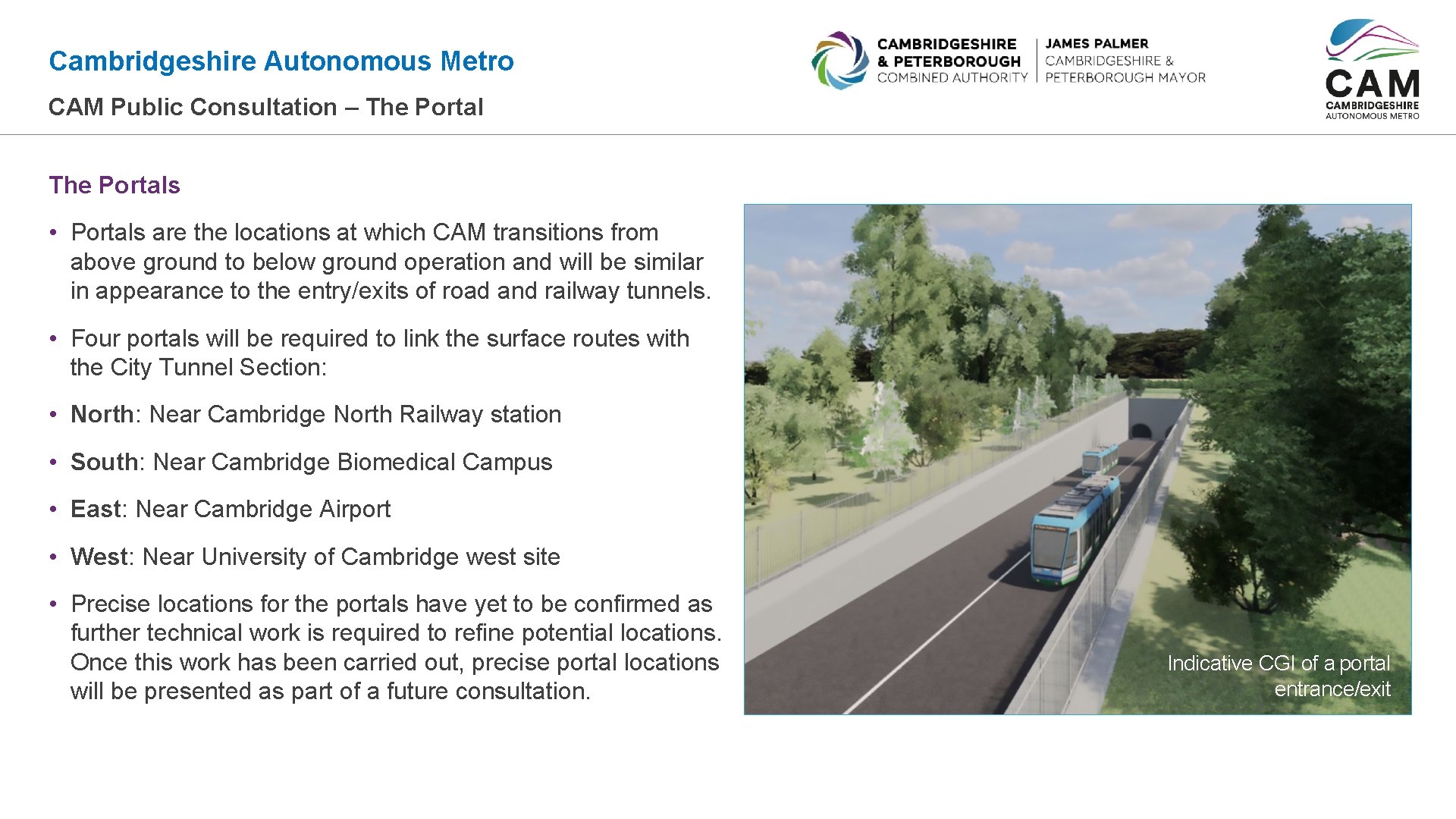
Cambridgeshire Autonomous Metro CAM Public Consultation – The Portals • Portals are the locations at which CAM transitions from above ground to below ground operation and will be similar in appearance to the entry/exits of road and railway tunnels. • Four portals will be required to link the surface routes with the City Tunnel Section: • North: Near Cambridge North Railway station • South: Near Cambridge Biomedical Campus • East: Near Cambridge Airport • West: Near University of Cambridge west site • Precise locations for the portals have yet to be confirmed as further technical work is required to refine potential locations. Once this work has been carried out, precise portal locations will be presented as part of a future consultation. Indicative CGI of a portal entrance/exit
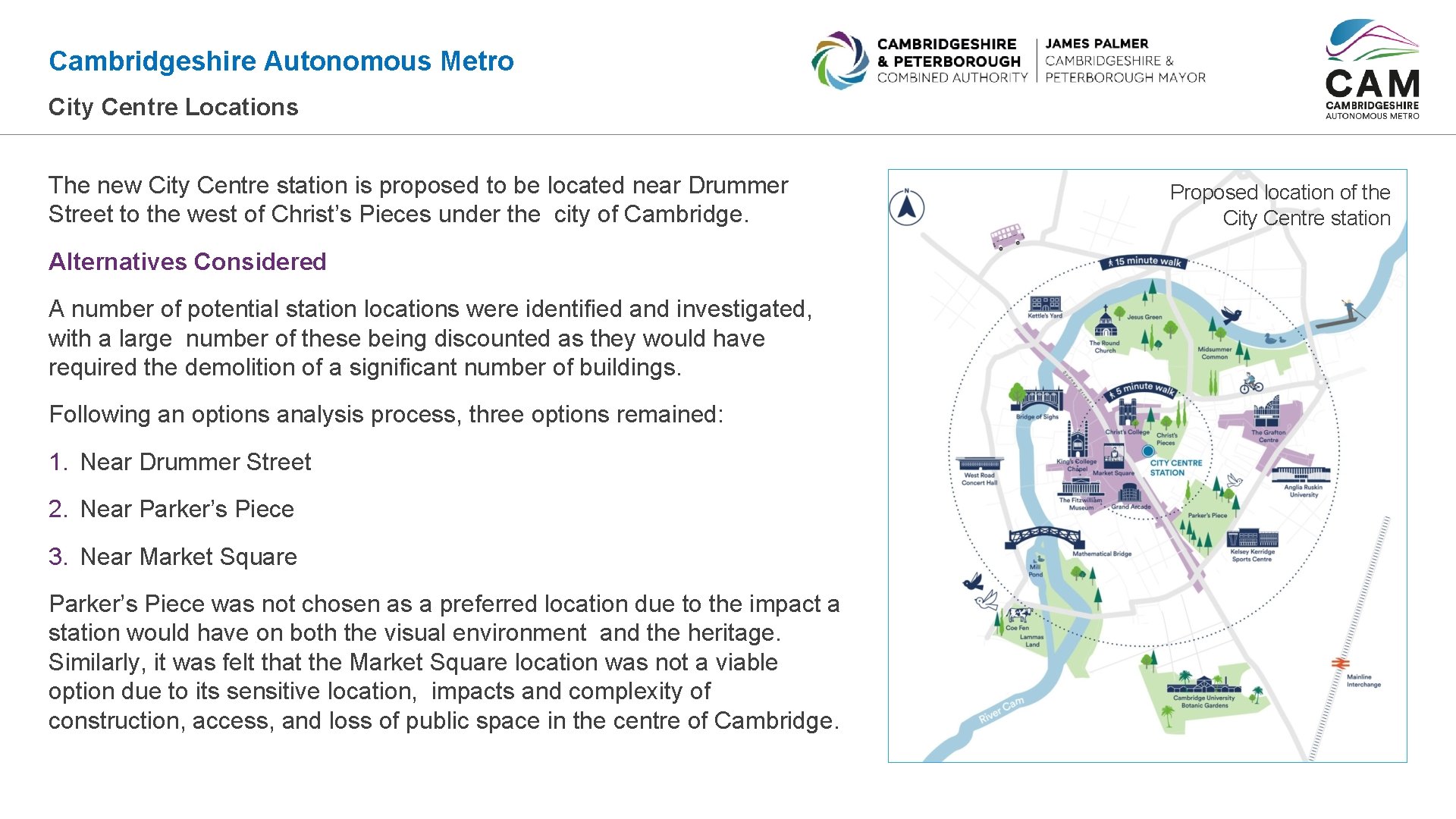
Cambridgeshire Autonomous Metro City Centre Locations The new City Centre station is proposed to be located near Drummer Street to the west of Christ’s Pieces under the city of Cambridge. Alternatives Considered A number of potential station locations were identified and investigated, with a large number of these being discounted as they would have required the demolition of a significant number of buildings. Following an options analysis process, three options remained: 1. Near Drummer Street 2. Near Parker’s Piece 3. Near Market Square Parker’s Piece was not chosen as a preferred location due to the impact a station would have on both the visual environment and the heritage. Similarly, it was felt that the Market Square location was not a viable option due to its sensitive location, impacts and complexity of construction, access, and loss of public space in the centre of Cambridge. Proposed location of the City Centre station
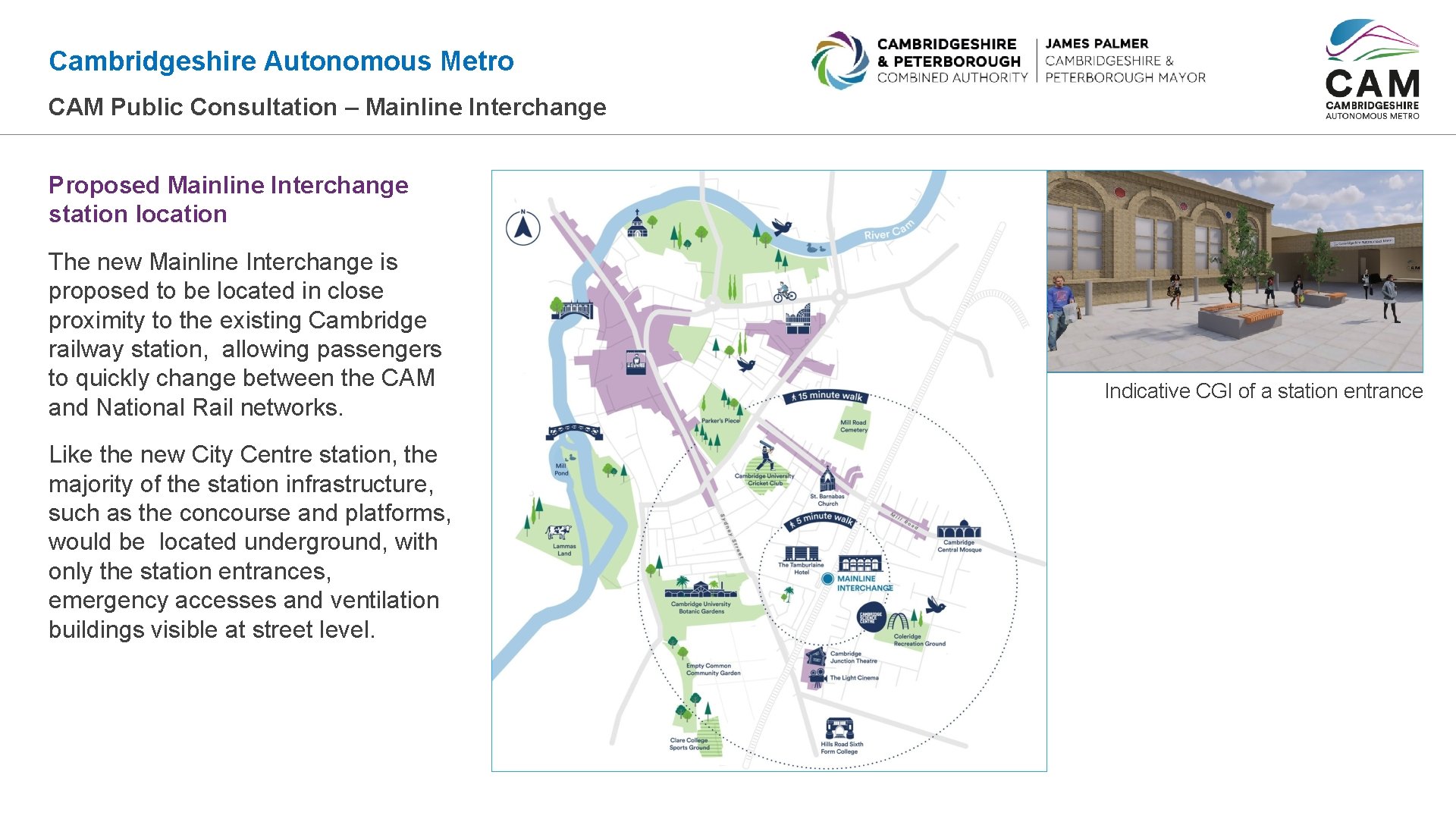
Cambridgeshire Autonomous Metro CAM Public Consultation – Mainline Interchange Proposed Mainline Interchange station location The new Mainline Interchange is proposed to be located in close proximity to the existing Cambridge railway station, allowing passengers to quickly change between the CAM and National Rail networks. Like the new City Centre station, the majority of the station infrastructure, such as the concourse and platforms, would be located underground, with only the station entrances, emergency accesses and ventilation buildings visible at street level. Indicative CGI of a station entrance
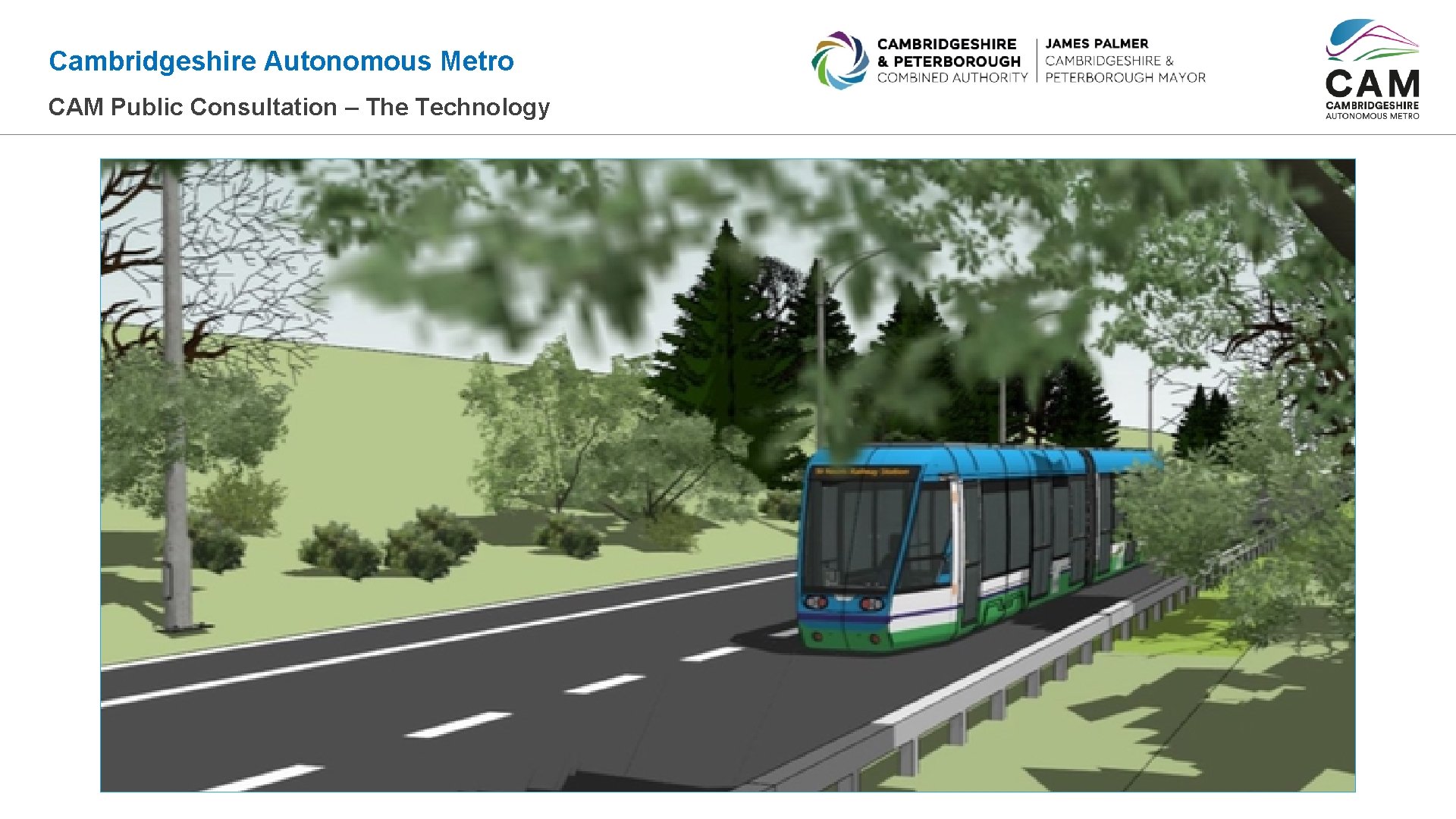
Cambridgeshire Autonomous Metro CAM Public Consultation – The Technology
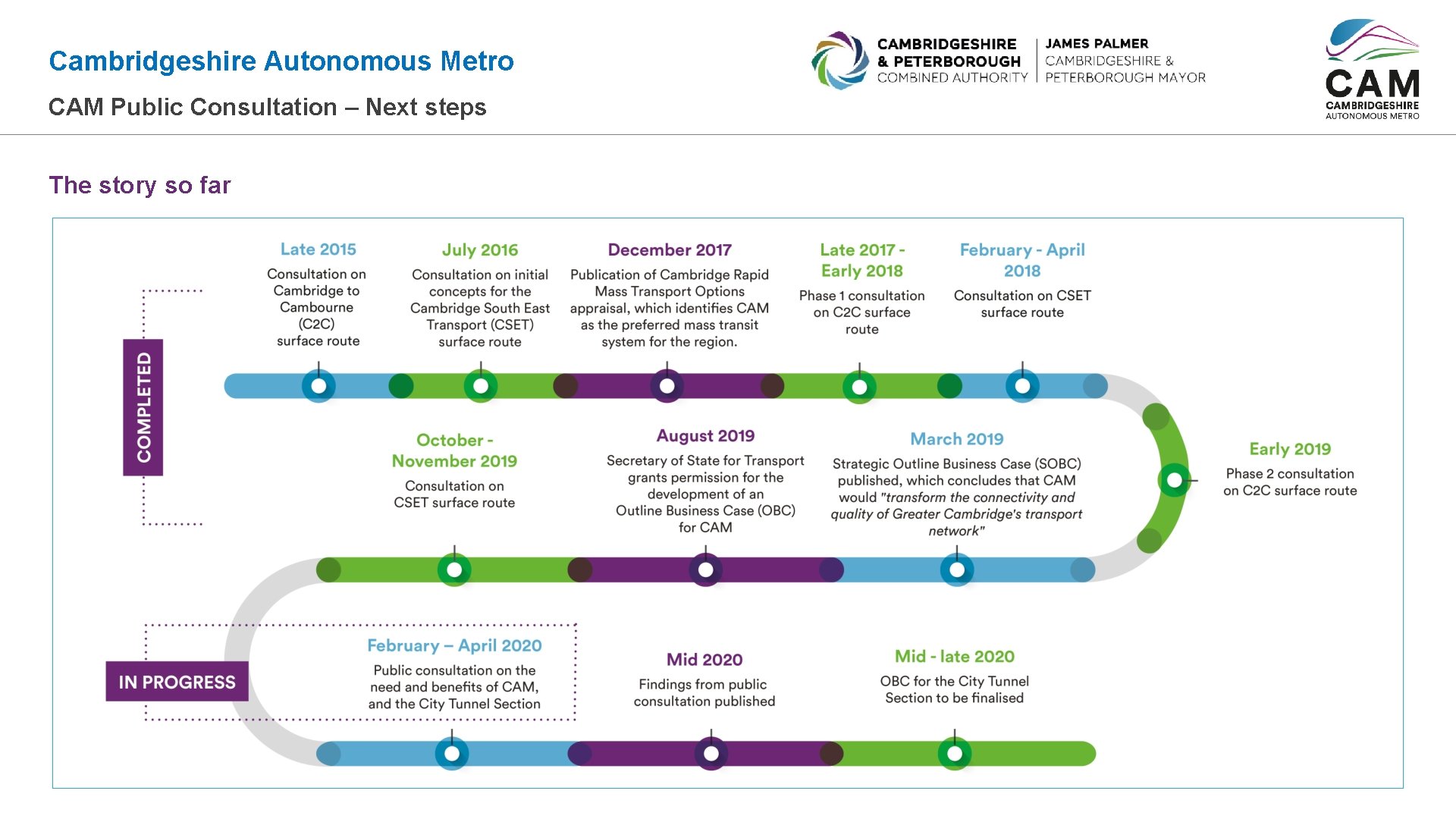
Cambridgeshire Autonomous Metro CAM Public Consultation – Next steps The story so far
Cambridgeshire Autonomous Metro Thank you.
- Slides: 17