
Cambridge TECHNICALS LEVEL 3 Unit 16 Principles of

Cambridge TECHNICALS- LEVEL 3 Unit 16 – Principles of Project Management 2016 Specification - M/507/8163 LO 3 - Understand How and Why Projects are Monitored and Factors That Influence a Project
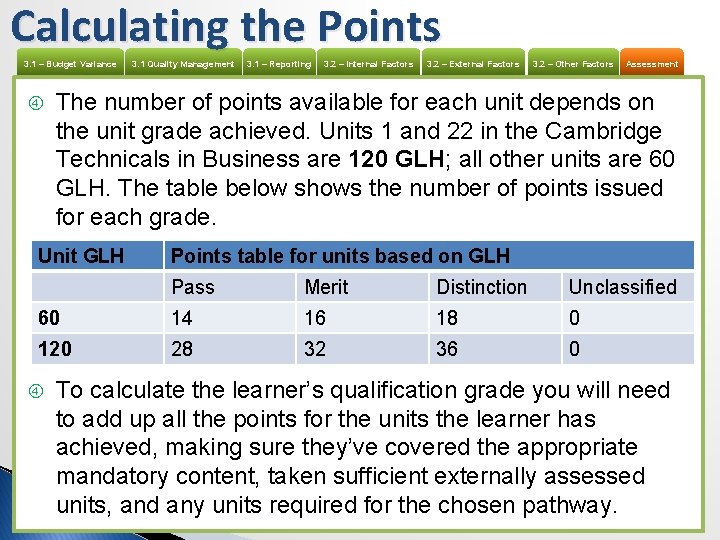
Calculating the Points 3. 1 – Budget Variance 3. 1 Quality Management 3. 1 – Reporting 3. 2 – Internal Factors 3. 2 – External Factors 3. 2 – Other Factors Assessment The number of points available for each unit depends on the unit grade achieved. Units 1 and 22 in the Cambridge Technicals in Business are 120 GLH; all other units are 60 GLH. The table below shows the number of points issued for each grade. Unit GLH Points table for units based on GLH Pass Merit Distinction Unclassified 60 14 16 18 0 120 28 32 36 0 To calculate the learner’s qualification grade you will need to add up all the points for the units the learner has achieved, making sure they’ve covered the appropriate mandatory content, taken sufficient externally assessed units, and any units required for the chosen pathway.
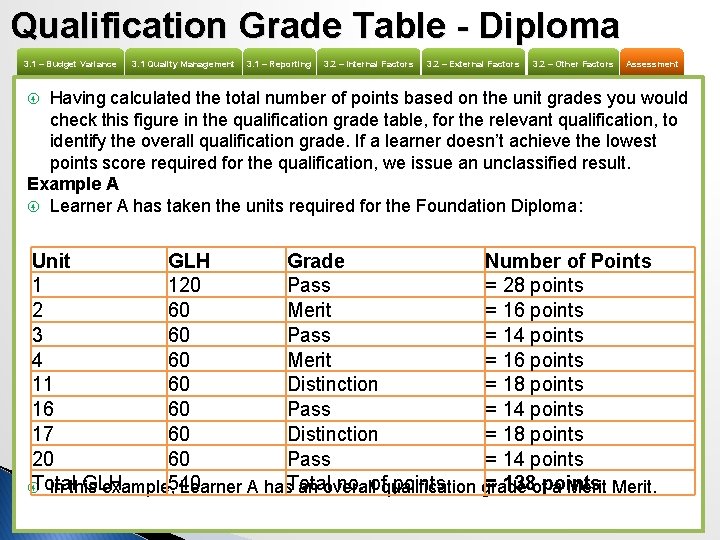
Qualification Grade Table - Diploma 3. 1 – Budget Variance 3. 1 Quality Management 3. 1 – Reporting 3. 2 – Internal Factors 3. 2 – External Factors 3. 2 – Other Factors Assessment Having calculated the total number of points based on the unit grades you would check this figure in the qualification grade table, for the relevant qualification, to identify the overall qualification grade. If a learner doesn’t achieve the lowest points score required for the qualification, we issue an unclassified result. Example A Learner A has taken the units required for the Foundation Diploma: Unit GLH Grade Number of Points 1 120 Pass = 28 points 2 60 Merit = 16 points 3 60 Pass = 14 points 4 60 Merit = 16 points 11 60 Distinction = 18 points 16 60 Pass = 14 points 17 60 Distinction = 18 points 20 60 Pass = 14 points Total GLH no. ofqualification points = 138 ofpoints In this example, 540 Learner A has. Total an overall grade a Merit.
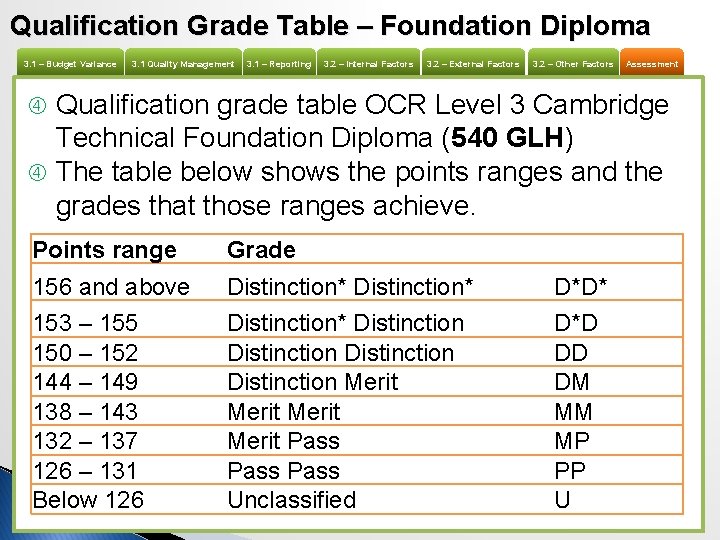
Qualification Grade Table – Foundation Diploma 3. 1 – Budget Variance 3. 1 Quality Management 3. 1 – Reporting 3. 2 – Internal Factors 3. 2 – External Factors 3. 2 – Other Factors Assessment Qualification grade table OCR Level 3 Cambridge Technical Foundation Diploma (540 GLH) The table below shows the points ranges and the grades that those ranges achieve. Points range Grade 156 and above Distinction* D*D* 153 – 155 150 – 152 144 – 149 138 – 143 132 – 137 126 – 131 Below 126 Distinction* Distinction Merit Pass Unclassified D*D DD DM MM MP PP U

Qualification Grade Table – Technical Diploma 3. 1 – Budget Variance 3. 1 Quality Management 3. 1 – Reporting 3. 2 – Internal Factors 3. 2 – External Factors 3. 2 – Other Factors Assessment Qualification grade table OCR Level 3 Cambridge Technical Diploma (720 GLH) The table below shows the points ranges and the grades that those ranges achieve. Points range Grade 208 and above Distinction* D*D* 204 - 207 200 – 203 192 – 199 184 – 191 176 – 183 168 - 175 Below 168 Distinction* Distinction Merit Pass Unclassified D*D DD DM MM MP PP U
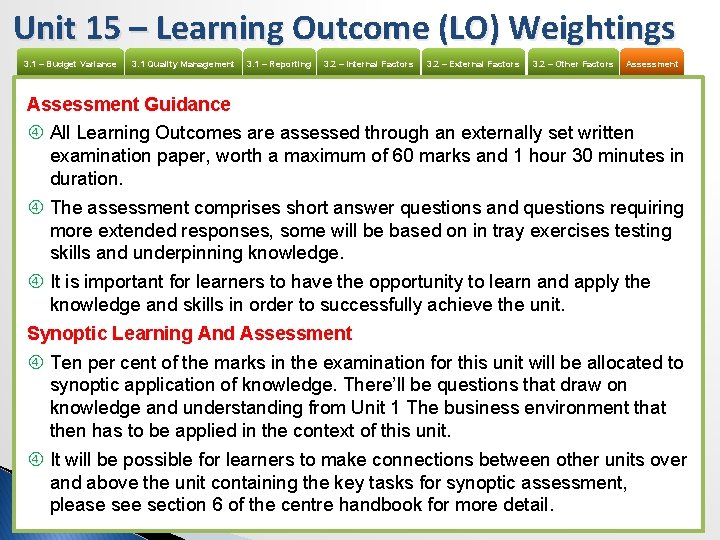
Unit 15 – Learning Outcome (LO) Weightings 3. 1 – Budget Variance 3. 1 Quality Management 3. 1 – Reporting 3. 2 – Internal Factors 3. 2 – External Factors 3. 2 – Other Factors Assessment Guidance All Learning Outcomes are assessed through an externally set written examination paper, worth a maximum of 60 marks and 1 hour 30 minutes in duration. The assessment comprises short answer questions and questions requiring more extended responses, some will be based on in tray exercises testing skills and underpinning knowledge. It is important for learners to have the opportunity to learn and apply the knowledge and skills in order to successfully achieve the unit. Synoptic Learning And Assessment Ten per cent of the marks in the examination for this unit will be allocated to synoptic application of knowledge. There’ll be questions that draw on knowledge and understanding from Unit 1 The business environment that then has to be applied in the context of this unit. It will be possible for learners to make connections between other units over and above the unit containing the key tasks for synoptic assessment, please section 6 of the centre handbook for more detail.

Assessment Criteria 3. 1 – Budget Variance 3. 1 Quality Management 3. 1 – Reporting 3. 2 – Internal Factors 3. 2 – External Factors Assessment LO Pass 1. Understand the stages of project management P 1*: Explain the stages of project management used in a specific business project 2. Understand the skills project managers need to have P 2*: Explain the skillset a project manager needs to have and why 3. Understand how and why projects are monitored and factors that influence a project P 3*: Explain how the factors that influence or present a risk to a specific project are monitored M 1: Analyse the factors that influence, and the factors that present a risk to, a specific project and explain the potential impact(s) on the project D 1: Evaluate the effectiveness of the methods used for monitoring a specific project 4. Be able to prepare project plans P 4*: Prepare a project plan for a specific project M 2: Explain how the risks to a specific project could be mitigated D 2: Evaluate the impact on a specific project if contingencies have to be implemented P 5: Justify the choice of the project plan tool(s) used Merit 3. 2 – Other Factors Distinction

16 – Principles of Project Management – Unit Aim 3. 1 – Budget Variance 3. 1 Quality Management 3. 1 – Reporting 3. 2 – Internal Factors 3. 2 – External Factors 3. 2 – Other Factors Assessment UNIT AIM Businesses undertake projects of all kinds that vary in terms of purpose and scope. Some examples of business projects are running an event, launching a marketing campaign, carrying out market research and setting up book keeping for local clubs or charities. A project comprises a set of tasks and activities to be carried out in order to reach an intended purpose. Being able to prepare and manage a project is an important skill needed by many different people working in business. In this unit you will learn about the stages of project management, and the type of skills a project manager should have. You will also learn why you need to monitor the progress of projects as it is vital to their successful completion and implementation. You will plan a project, and prepare a project plan. You will learn about the different planning tools available for project planning. Whilst preparing the project plan, you need to be aware of internal and external factors which might have an impact on the planning process, as well as the successful completion and implementation of a project. This unit will help you to develop the skills required to plan projects and be aware of possible obstacles that can impact on the outcome of a project.
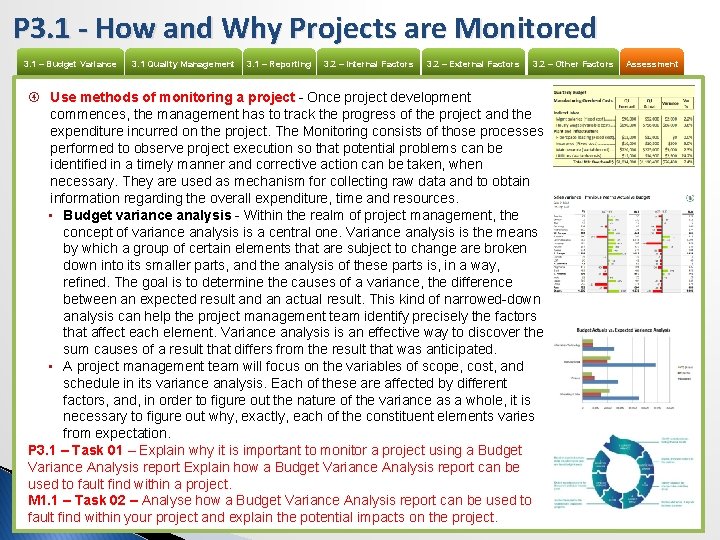
P 3. 1 - How and Why Projects are Monitored 3. 1 – Budget Variance 3. 1 Quality Management 3. 1 – Reporting 3. 2 – Internal Factors 3. 2 – External Factors 3. 2 – Other Factors Use methods of monitoring a project - Once project development commences, the management has to track the progress of the project and the expenditure incurred on the project. The Monitoring consists of those processes performed to observe project execution so that potential problems can be identified in a timely manner and corrective action can be taken, when necessary. They are used as mechanism for collecting raw data and to obtain information regarding the overall expenditure, time and resources. • Budget variance analysis - Within the realm of project management, the concept of variance analysis is a central one. Variance analysis is the means by which a group of certain elements that are subject to change are broken down into its smaller parts, and the analysis of these parts is, in a way, refined. The goal is to determine the causes of a variance, the difference between an expected result and an actual result. This kind of narrowed-down analysis can help the project management team identify precisely the factors that affect each element. Variance analysis is an effective way to discover the sum causes of a result that differs from the result that was anticipated. • A project management team will focus on the variables of scope, cost, and schedule in its variance analysis. Each of these are affected by different factors, and, in order to figure out the nature of the variance as a whole, it is necessary to figure out why, exactly, each of the constituent elements varies from expectation. P 3. 1 – Task 01 – Explain why it is important to monitor a project using a Budget Variance Analysis report Explain how a Budget Variance Analysis report can be used to fault find within a project. M 1. 1 – Task 02 – Analyse how a Budget Variance Analysis report can be used to fault find within your project and explain the potential impacts on the project. Assessment
P 3. 1 - How and Why Projects are Monitored 3. 1 – Budget Variance 3. 1 Quality Management 3. 1 – Reporting 3. 2 – Internal Factors • 3. 2 – External Factors 3. 2 – Other Factors Assessment Quality management - Quality management is a discipline for ensuring that outputs, benefits, and the processes by which they are delivered, meet stakeholder requirements and are fit for purpose. • Quality management has 4 components: quality planning, quality assurance, quality control and continual improvement. These include procedures, tools and techniques that are used to ensure that the outputs and benefits meet customer requirements. • The first component, quality planning, involves the preparation of a quality management plan that describes the processes and metrics that will be used. The quality management plan needs to be agreed with relevant stakeholders to ensure that their expectations for quality are correctly identified. The processes described in the quality management plan should conform to the processes, culture and values of the host organisation. • Risks and decisions logs – Risks and Decision Logs or RAID stands for Risks, Assumptions, Issues, and Dependencies. • Risks - A risk is any specific event which might occur and thus have a negative impact on your project or program. Each risk will have an associated probability of occurrence along with an impact on your project if it does materialize such as a change in legislation to tax law. • Assumptions - An assumption is something we set as true to enable us to proceed with our project or program. Typically this happens during the planning and estimation phase of the project such as we might assume that we have access to 10 skilled specialists throughout the entire duration of the project. • Issues - An issue is anything which arises on your project which you have to deal with in order to ensure your project runs smoothly. Issues differ from risks in that they exist as a problem today, unlike risks which might turn into issues in the future. • Dependencies - A dependency exists when an output from one piece of work or project is needed as mandatory input for another project or piece of work such as the architectural diagrams need to be complete before the foundations can be laid in a building project. P 3. 1 – Task 03 – Explain what Quality Management and Risks and Decision Logs are and how these reports can be used to manage progression within a project. M 1. 2 – Task 04 – Analyse how Quality Management techniques can influence a specific project and explain the potential impact(s) on the project of using this technique.
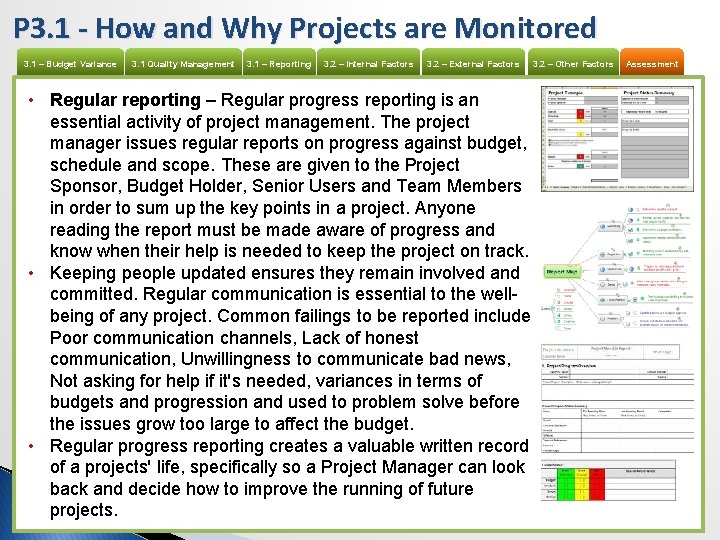
P 3. 1 - How and Why Projects are Monitored 3. 1 – Budget Variance 3. 1 Quality Management 3. 1 – Reporting 3. 2 – Internal Factors 3. 2 – External Factors • Regular reporting – Regular progress reporting is an essential activity of project management. The project manager issues regular reports on progress against budget, schedule and scope. These are given to the Project Sponsor, Budget Holder, Senior Users and Team Members in order to sum up the key points in a project. Anyone reading the report must be made aware of progress and know when their help is needed to keep the project on track. • Keeping people updated ensures they remain involved and committed. Regular communication is essential to the wellbeing of any project. Common failings to be reported include Poor communication channels, Lack of honest communication, Unwillingness to communicate bad news, Not asking for help if it's needed, variances in terms of budgets and progression and used to problem solve before the issues grow too large to affect the budget. • Regular progress reporting creates a valuable written record of a projects' life, specifically so a Project Manager can look back and decide how to improve the running of future projects. 3. 2 – Other Factors Assessment
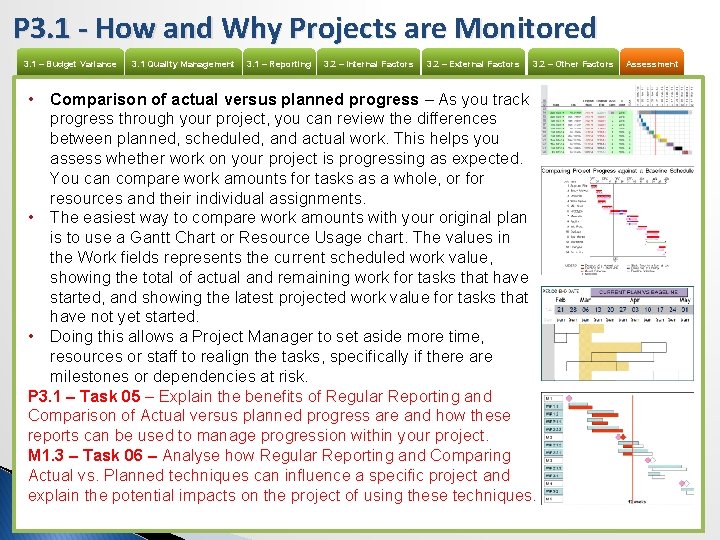
P 3. 1 - How and Why Projects are Monitored 3. 1 – Budget Variance 3. 1 Quality Management 3. 1 – Reporting 3. 2 – Internal Factors 3. 2 – External Factors 3. 2 – Other Factors • Comparison of actual versus planned progress – As you track progress through your project, you can review the differences between planned, scheduled, and actual work. This helps you assess whether work on your project is progressing as expected. You can compare work amounts for tasks as a whole, or for resources and their individual assignments. • The easiest way to compare work amounts with your original plan is to use a Gantt Chart or Resource Usage chart. The values in the Work fields represents the current scheduled work value, showing the total of actual and remaining work for tasks that have started, and showing the latest projected work value for tasks that have not yet started. • Doing this allows a Project Manager to set aside more time, resources or staff to realign the tasks, specifically if there are milestones or dependencies at risk. P 3. 1 – Task 05 – Explain the benefits of Regular Reporting and Comparison of Actual versus planned progress are and how these reports can be used to manage progression within your project. M 1. 3 – Task 06 – Analyse how Regular Reporting and Comparing Actual vs. Planned techniques can influence a specific project and explain the potential impacts on the project of using these techniques. Assessment
P 3. 1 – Reasons For Monitoring 3. 1 – Budget Variance 3. 1 Quality Management 3. 1 – Reporting 3. 2 – Internal Factors 3. 2 – External Factors 3. 2 – Other Factors Reasons for monitoring • Reporting progress against the plan – It is the Project Managers job to maintain a cohesion within the project and that means constantly updating status against the Project Plan. Reporting progress against this plan is a key element to keeping the project on track, a constant juggling of tasks t allow deliverables and dependencies to happen. This may mean giving contingency times to tasks which is part of the managers duty as long as the rest of the plan still continues on track. • To ensure the project remains viable - The key here is consistent delivery. The project status report is such a key component of the project in maintaining viability. It helps ensure proper understanding of status among project stakeholders and meeting participants. Even if not much is going on with the project, this should still continue to happen. Update it accurately and in detail and send it out to everyone otherwise the customer will start to be concerned about the gaps in delivery and start to lose confidence in the project team’s ability to deliver. A Project Manager will not want the project customer to start questioning their progress and ability – it can go downhill fast. • To identify potential slippage – Slippages cause delays even with contingencies set on tasks. Some slippages are bound to happen, a delay in stock delivery, materials not arriving on time, staff taking days off etc. and these are set on the project plan as contingency time. It is the managers job to deal with these potential slippages, anticipate some and deal with others in order to keep everything on track. Assessment
P 3. 1 – Reasons For Monitoring 3. 1 – Budget Variance • 3. 1 Quality Management 3. 1 – Reporting 3. 2 – Internal Factors 3. 2 – External Factors 3. 2 – Other Factors Assessment Identify issues and problems – A Project Manager should have a regular project management reporting schedule and stick to it. Periodically team members can be lazy or issues and problems can occur without being dealt with, leading to escalation. • This might be particularly useful when a Project Manager needs more information on risks and issues. And if the Project team aren’t meeting regularly, they should set up some kind of reminder system so that you can follow up with issues to make sure they have been dealt with. A Project Manager will likely have periodic meetings where they discuss progress, risks, money, issues, lessons learned, and next actions. • Identify possible solutions – It is the Project Manager’s duty to deal with the problems and provide the solutions to the issues, when possible, for the good of the overall plan. For example, missing staff could simply mean slowing a task or the need to replace temporarily staff in order to maintain the progress needed. It is the Project Manager’s job to track this, provide a viable solution based on their knowledge of budgets, times, schedules and stakeholders expectations. • Escalate/delegate to managers and colleagues – It is also the Project Manager’s job to increase the workload or decrease the tasks set upon staff and adapt the job importance in terms of priorities. Projects change through time, something new is added or staff change or do not prove good enough, this constant flow of changes can alter the timeline on task completion, escalating and deescalating timescales, risks, delays, issues and activities can allow the continued flow of the project with little implication on the overall quality and timescale of the project. P 3. 1 – Task 07 – Explain the reasons and benefits for monitoring a project including identifying issues and providing solutions and explain how this can be used to manage progression within your project. M 1. 4 – Task 08 – Analyse how monitoring a project processes can influence a specific project and explain the potential impacts on the project of using this technique. D 1. 1 – Task 09 – In terms of Reporting, Quality Management and Comparison of Values, evaluate the effectiveness of the methods used for monitoring for your specific project.
P 3. 2 - Factors that Influence a Project and which need Monitoring 3. 1 – Budget Variance 3. 1 Quality Management 3. 1 – Reporting 3. 2 – Internal Factors 3. 2 – External Factors 3. 2 – Other Factors Assessment The methods and tactics applied for managing projects depend on the kind of project that has to be dealt with. The project structure, processes involved varies based on the kind of products or services on offer, and the market it is concerned with. For example, the project management tactics applied in a product manufacturing firm will be different from that of a construction firm. The factors that influence the scope of the project can be internal, external or other. Internal – Factors inside the company, the internal need for the business to control and influence the project deliverables that they have more control over. These include: • Organisation’s aims/objectives – What a company wants to achieve from the project defined in the scope document and if this is good, well written and clearly defined then the project should have a clear focus. But what can hinder it can include: • How aligned is the project – Is the project in line with the larger company aims and objectives, is there something that has not been taken into consideration such as the 3 year or 5 year plan of the company so when the project gets up and running, it can be scrapped, delayed or act against a corporate need to go in a different direction. A project manager with the help of stakeholders should be able to define this for the scope document. • How clear are the objectives – Objectives from companies can be vague, we need to make more profit, but defined enough to state how, when, where and by what time. When objectives are not clear, the drive and purpose of the Project Manager can be dampened with indecision. Company objectives should have a good degree of clarity and the scope objectives should be clearly defined in the initial meetings with the more senior managers or the stakeholders to align the project objectives with those of the company so that clarity can ensure success.
P 3. 2 - Factors that present a Risk to a Project and which need Monitoring 3. 1 – Budget Variance 3. 1 Quality Management 3. 1 – Reporting 3. 2 – Internal Factors 3. 2 – External Factors 3. 2 – Other Factors Assessment • Resource – Set within the resources plan document at the beginning of the project in order to define the breadth of the project scope. But things can change, and the longer the project goes on for, the more likely resources cannot be managed as well. • Constraints on budget – Resources can become more expensive over time and the allocated and negotiated materials and tools needed for the project can put a bigger strain on the budget as time goes by. For example, building a house, prices are set for now and contingencies are set into the schedule but a house can take a year to make and in that time prices can change, shortages of materials can occur, budgets can change and restrict the use of pre-chosen materials. • Human resources – Staff change with time, some get better at the jobs and so the project gets better, faster more streamlined, and some staff leave. The staffing resource is an ever changing process, issues with conflicts can upset the balance, departures, illnesses etc. and the use of these as a dependable resource can limit a project completion. For example, meeting rely on staff attendance, without the key staff the meeting can be pointless, causing a delay. • Procedures and policies – Project managers should be aware of all the necessary procedures and policies within a company for a project to take place and this should be run through with the stakeholders like managers and SMT using the scope document but sometimes these change or are enforced more rigorously, delaying a project or forcing an alternative solution which may not be as cost effective or hindering the project quality. For example, school child protection can hinder an IT project upgrade of the management system forcing a different approach to the installation than anticipated. • Corporate social responsibility – When the scope document is presented the corporate strategy should be defined and taken into consideration but as a project progresses, months, a corporate social responsibility can change due to internal pressures. This can be environmental, staffing, working conditions or community related. For instance, emission percentages change with new agreements, this can influence the success of a smelting conversion plant for the better or worse in terms of funding, subsidies and finances. P 3. 2 – Task 10 – Explain with examples how internal factors within a company can influence a project and how these influences can and need to be monitored as the project progresses. M 1. 5 – Task 11 - Analyse the Internal factors that present a risk to a specific project and explain the potential impacts on the project
P 3. 2 - Factors that present a Risk to a Project and which need Monitoring 3. 1 – Budget Variance 3. 1 Quality Management 3. 1 – Reporting 3. 2 – Internal Factors 3. 2 – External Factors 3. 2 – Other Factors External – Factors beyond the control of the company can influence how a project is managed, before and during the process. These cannot be managed as easily as internal issues so a Project Manager needs to work around them more than through them. These include: • Suppliers/contractors – Every company needs these to get their raw materials in and their goods out but they cannot always be relied upon to keep their word or contract. Some quit, some close, some charge more etc. , they are a business on to their own and subject to their own managerial decisions. • Availability – Just because the supplier has said that they can get the goods for the project, 1 month, 3 months or further those goods may no longer be available, other jobs come up, higher priorities. If the goods are not available, a good project manager will have an alternative but this may take time, breach contracts or add costs to the project. • Specialisms - Some companies sell specialist goods or services that may either no longer be suited to the project or be out of range in terms of price, or delivery times. The longer a project goes on, the more likely this will happen. Again a Project Manager may factor this in but costs may spiral. For example, if a project requires specific windows for a building and that specialist company has increased the price or those specific windows will have a delay in being produced, this will affect deadlines and push milestones. These can be factored in to a degree but not every specialist materials or product can be predicted. Assessment
P 3. 2 - Factors that present a Risk to a Project and which need Monitoring 3. 1 – Budget Variance 3. 1 Quality Management 3. 1 – Reporting 3. 2 – Internal Factors 3. 2 – External Factors 3. 2 – Other Factors • Finance – Money is always a big influencing factor in funding a project, and a lot of large projects rely on external funding to subsidise them. Control over these external budgets is not their job but can be monitored so predictive measures can be in place to compensate. • Sources of funding – Where the money comes from depends on the type of company. If this is shareholder funds then shareholders may not be keen to sell in the current market, government funding comes with conditions that need to be met and private funding including the owners money may be restricted or even withdrawn in circumstances. Preparing for this is a matter of constant vigilance and backup planning. • Inflation – This can be seen and predicted but cannot be controlled. Inflation pushes up the price of goods, suppliers for the project, and can even push up the staffing budget but can be seen and planned for. Contingencies can be put in place. If it is inflated goods prices from suppliers this can have a different influence of the management of the project. The longer the project goes on, the more likely this will have an impact. Monitoring the rates and news will give a company advance warning to prepare. • Exchange rates – Like inflation but exchange rates are less predictable and happen more often. The rise and fall of the pound against foreign currencies can impact a project if the materials are being purchased from outside the country but it can also have an impact on the pricing of the suppliers products if the goods were made abroad or used foreign building materials. Assessment
P 3. 2 - Factors that present a Risk to a Project and which need Monitoring 3. 1 – Budget Variance 3. 1 Quality Management 3. 1 – Reporting 3. 2 – Internal Factors 3. 2 – External Factors 3. 2 – Other Factors • Laws and regulations – The Project Manager will be aware of the basic needed legal regulations at the beginning of the project but Laws change and events that are subject to law can have an impact on the progress of a project. All it takes in one incident: • Planning permission – Companies need these to buildings, the council grants them based on conditions and plans, companies are restricted to these plans, no matter how much it might benefit them to go beyond. Failure to stick to the agreed plan cause a restart of the project. Councils inspect the building to see that it conforms to agreed standards. Decisions made by the Project Manager that are against the drawn agreed plans risk the project. • Employment law – Who to hire, how to hire, who you did not hire, this can have an impact on the workers you have on a Project. Current staffing is less of an issue as long as there has not been bias in the job selection but outside contractors and workers are subject to conditions such as equal opportunities. Hiring someone not as capable can cause delays, there may be more need for training and internal conflict but failure to do so, to hire based on equal opportunities, may slow down or hinder the quality success of a project. • Health and Safety at Work Act – All it takes is for one injury for a Project to stop and new measures put in place to protect the staff. The Health and Safety at Work Act is a broad stroke when it comes to staff welfare measures have to be put in place for all staff to safeguard their safety at all times from Hard hats to High Visibility gear on building sites to length of breaks and noise and air conditions. Failing to abide by these can lead to prosecution and site closure, inspections and fines, adding to the time, cost and progress of the chosen project. P 3. 2 – Task 12 – Explain with examples how external factors within a company can influence a project and how these influences can and need to be monitored as the project progresses. M 1. 5 – Task 13 - Analyse the External factors that present a risk to a specific project and explain the potential impacts on the project. Assessment
P 3. 2 - Factors that present a Risk to a Project and which need Monitoring 3. 1 – Budget Variance 3. 1 Quality Management 3. 1 – Reporting 3. 2 – Internal Factors 3. 2 – External Factors 3. 2 – Other Factors Other factors that present a risk to the success of the project – Not everything can be predicted at the beginning of a project, some things crop up as they happen and need to be dealt with in order to risk reduce. These can be fixed with time and experience but when a project is up and running, only that project is important. These include: • Poor leadership – Leadership within project management is critical on all projects. Whether it comes just from the project manager – where it must be prevalent – or from others on the project team, leadership is very important. The problem is, it is often lacking on some of the projects that need it the most. • Failing to communicate - Poor communications could just be a symptom of underlying leadership problems specifically in terms of a lack of executive support. Poor communication within the leadership leads to Poor project management, insufficient involvement of users/stakeholders, a denial of risk, difficulties in defining work in detail and setting unreasonable timeframes. • Overlooking stakeholders who should be involved Stakeholders are the people who need to provide key input to the critical decisions made in the project and with leadership failing to get the stakeholders involved means cutting off the judgers of the project success. E. g. a school build that does not engage parents is OK but not to get input from the builders on what can be done can lead to structural mistakes. Assessment
P 3. 2 - Factors that present a Risk to a Project and which need Monitoring 3. 1 – Budget Variance 3. 1 Quality Management 3. 1 – Reporting 3. 2 – Internal Factors 3. 2 – External Factors 3. 2 – Other Factors Assessment • Poor planning – The work needed to successfully transition a project from the project team to the operational environment or market place once the project is complete is an area that often gets overlooked. Failure to properly think through and plan that transition can quickly turn what might have been a project success into chaos. For example: • Not updating schedules regularly – This leaves it open to overlapping tasks, tasks that have dependencies not starting on time, timings of parts of the projects rushed due to not starting earlier when it could and even to staff waiting around for tasks to begin without realising, under using the resources available. It is a project managers job to track all these tasks along a schedule line to make as much effective use of resources and budgets. • Lack of coordination of activities - Projects frequently fail, not because of a lack of technical skills on the part of those executing the project, but because of inadequate coordination of activities, integration, and the control of project activities, people, stakeholders and contractors. This is due mainly to the inability of many project managers to successfully apply the tools and techniques of modern project coordination and control to their projects. • In addition to the financial losses suffered by the business, many such projects also fail to deliver the required quality of outcomes intended for the project, as a direct consequence of the inadequate identification, definition, planning and control of staff involves activities. This can include motivation, use of resources, planning these activities and enthusing the project. • No contingencies – Having no plan to be prepared for any events (such as the loss of data, employee dismissal, lack of finance, various disasters, unsatisfied customers, dishonest suppliers, late procurement deliveries etc. ) can cause a situation when the project is no more manageable, out of control and does not meet requirements and expectations stated in the project management plan and subsidiary plans. It is very important to successful project management. That’s why the right understanding of project contingency planning definition significantly influences the likelihood of project delivery.
P 3. 2 - Factors that present a Risk to a Project and which need Monitoring 3. 1 – Budget Variance 3. 1 Quality Management 3. 1 – Reporting 3. 2 – Internal Factors 3. 2 – External Factors 3. 2 – Other Factors • Failing to manage change - Managing and preparing for change tends to be placed on the back burner for many businesses leading to a rush when the project is complete to take advantage of the change. Data repeatedly shows that implementing change management strategies can enable businesses to successfully complete more projects and benefit more from the change. Initiatives with excellent change management are six times more likely to meet objectives than those with poor change management. • Changes occurring within the project and/or as a result of the project which are not controlled – The period of time between the project completion and instigation of the new phase should be taken advantage of through training, preparation and advance planning. E. g. a school develops a new building, on the first weeks the building has one class running, and 10 empty rooms, by the second month this is reversed but this was a month of lost business, additional revenue and value added. • Objective(s) of project not clearly defined - Starting a project without clear objectives, specific directions and a prepared plan of action is like starting out on a road trip with no idea where you're going or how to get there. You will waste fuel, time and effort. Likewise, a business suffers when it tries to implement a plan without clarity and forethought. While a business may not be able to predict the final outcome of the project, the Project Manager can define the scope of the technical and organisational components of the project, how many resources you're willing to allocate to the entire project, establish clear deadlines and the expected results. Simply put, the failure to define the objectives, the success criteria, leads to poorly met criteria. Assessment
P 3. 2 - Factors that present a Risk to a Project and which need Monitoring 3. 1 – Budget Variance 3. 1 Quality Management 3. 1 – Reporting 3. 2 – Internal Factors 3. 2 – External Factors 3. 2 – Other Factors Assessment • Lack of resources – When running a project, possibly even deep into development or other critical activities and the project loses a key resource or can’t get access to the right resource at the planned portion of your project. When a business lacks the right amount of skilled resources to fully stock all the projects that are active at any given time then 100% effectiveness is not being used. As the Project Manager, there a few things that can be done to combat it, but there’s no guarantee of success with any of them. • Resources not ordered in time – This causes delays, delays affect dependencies and sets targets back or leads to overruns. Poor management causes it but all areas of a project can be affected. It can lead to slowing of work while the resources arrive, delays in work completion and can be demotivating. • Resources not available – Worst than delays is the simple lack of resources to use through not properly managed resource booking or a poor management of resources. Without resources, projects stop, temporarily or permanently. E. g. a new course in your school has no books for September, contingencies can be written in but a lack of books means poor delivery, tracking, course guidance and structure. • Poor project reporting – This is the responsibility of the project manager. Tracking milestones is how you are going to know whether you are meeting expectations. Proper reporting and monitoring lets the Project Manager identify where more resources are needed to complete a project on time. Whether it’s between upper management, middle or with the team, it’s disastrous to have poor reporting and tracking. Everyone should be able to refer to these reports to see where things are, what is done and what needs to be done to avowing misunderstandings. When everyone is on the same page and there’s transparency, workflow is at an optimum level. P 3. 2 – Task 14 – Using the website examples, explain how other factors can present a risk to the success of a project. P 3. 2 – Task 15 – Discuss in terms of your project the need to monitor other activities in order for a project to be more of a success. M 1. 5 – Task 16 - Analyse the Other factors that present a risk to a specific project and explain the potential impacts on the project. D 1. 2 – Task 17 – In terms of Internal, External and Other risks, evaluate the effectiveness of the methods against the potential risks when monitoring your specific project.
P 3, M 1 and D 1 – Assessment Criteria 3. 1 – Budget Variance 3. 1 Quality Management 3. 1 – Reporting 3. 2 – Internal Factors 3. 2 – External Factors 3. 2 – Other Factors Assessment P 3. 1 – Task 01 – Explain why it is important to monitor a project using a Budget Variance Analysis report Explain how a Budget Variance Analysis report can be used to fault find within a project. M 1. 1 – Task 02 – Analyse how a Budget Variance Analysis report can be used to fault find within your project and explain the potential impacts on the project. P 3. 1 – Task 03 – Explain what Quality Management and Risks and Decision Logs are and how these reports can be used to manage progression within a project. M 1. 2 – Task 04 – Analyse how Quality Management techniques can influence a specific project and explain the potential impact(s) on the project of using this technique. P 3. 1 – Task 05 – Explain the benefits of Regular Reporting and Comparison of Actual versus planned progress are and how these reports can be used to manage progression within your project. M 1. 3 – Task 06 – Analyse how Regular Reporting and Comparing Actual vs. Planned techniques can influence a specific project and explain the potential impacts on the project of using these techniques. P 3. 1 – Task 07 – Explain the reasons and benefits for monitoring a project including identifying issues and providing solutions and explain how this can be used to manage progression within your project. M 1. 4 – Task 08 – Analyse how monitoring a project processes can influence a specific project and explain the potential impacts on the project of using this technique. D 1. 1 – Task 09 – In terms of Reporting, Quality Management and Comparison of Values, evaluate the effectiveness of the methods used for monitoring for your specific project. P 3. 2 – Task 10 – Explain with examples how internal factors within a company can influence a project and how these influences can and need to be monitored as the project progresses. M 1. 5 – Task 11 - Analyse the Internal factors that present a risk to a specific project and explain the potential impacts on the project P 3. 2 – Task 12 – Explain with examples how external factors within a company can influence a project and how these influences can and need to be monitored as the project progresses. M 1. 5 – Task 13 - Analyse the External factors that present a risk to a specific project and explain the potential impacts on the project. P 3. 2 – Task 14 – Using the website examples, explain how other factors can present a risk to the success of a project. P 3. 2 – Task 15 – Discuss in terms of your project the need to monitor other activities in order for a project to be more of a success. M 1. 5 – Task 16 - Analyse the Other factors that present a risk to a specific project and explain the potential impacts on the project. D 1. 2 – Task 17 – In terms of Internal, External and Other risks, evaluate the effectiveness of the methods against the potential risks when monitoring your specific project.
- Slides: 24