
Cambridge Maths Hub New GCSE 1 st March
Cambridge Maths Hub New GCSE 1 st March 2017 02/11/2016 1
Work Group Outcomes – The New GCSE Please complete your evaluation forms. For the teacher: • To build on their knowledge of the new GCSE and become more familiar with new topics. • To have a better knowledge of the way the new GCSEs is assessed. • To create and develop resources for use in the classroom to address some of the new topics. • To have access to a bank of resources prepared collaboratively. For the students: • To have access to resources planned by teachers collaboratively. • To be exposed to resources that support solving multi-step problems. For the department: • To access a bank of resources that can be embedded into Schemes of Work/Learning. • To have a teacher who has had an opportunity to reflect on and discuss some of the changes. • To have a sense of collaboration in an area where we are all in unknown territory.
What is a work group? • A ‘Work Group’ is a group of subject-matter experts working together collectively to achieve a specific goal. In this case we are working together to better understand the teach new topics on the GCSE curriculum. • The ultimate aims of each work group is to have an impact on you the teacher, your department and most importantly your students. • During the life of the work group we will need to collect evidence that the work group is achieving its aims or otherwise. • We are flexible and will act on your feedback so please be honest and give as much detail as is necessary.
Another Workgroup Mastery at KS 3 • There are three mastery specialists based at: • Soham • Saffron Walden • Swavesey • Maximum two participants per school • 3 sessions with gap tasks • £ 500 person towards cover • Contact Geetha@cambridgemathshub. org 4
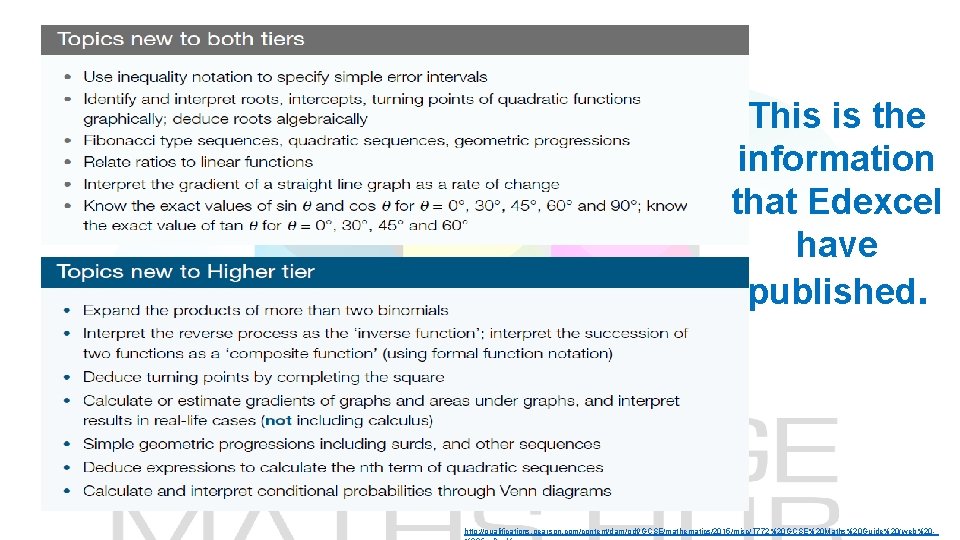
This is the information that Edexcel have published. http: //qualifications. pearson. com/content/dam/pdf/GCSE/mathematics/2015/misc/T 772%20 GCSE%20 Maths%20 Guide%20(web%20 -
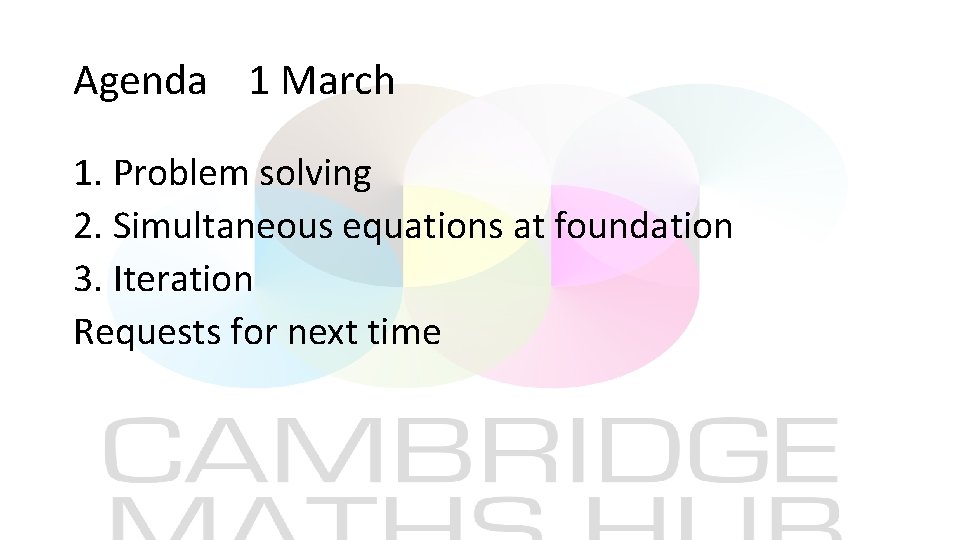
Agenda 1 March 1. Problem solving 2. Simultaneous equations at foundation 3. Iteration Requests for next time
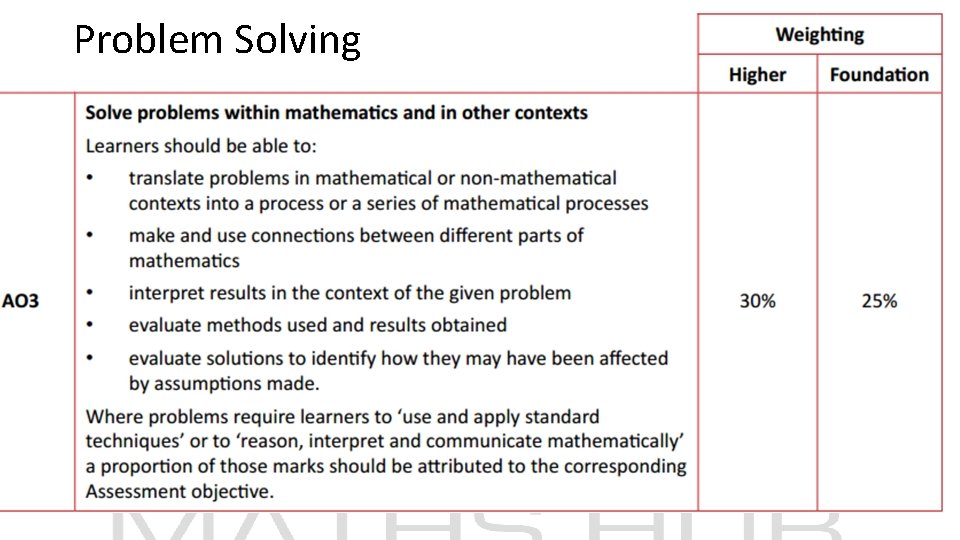
Problem Solving
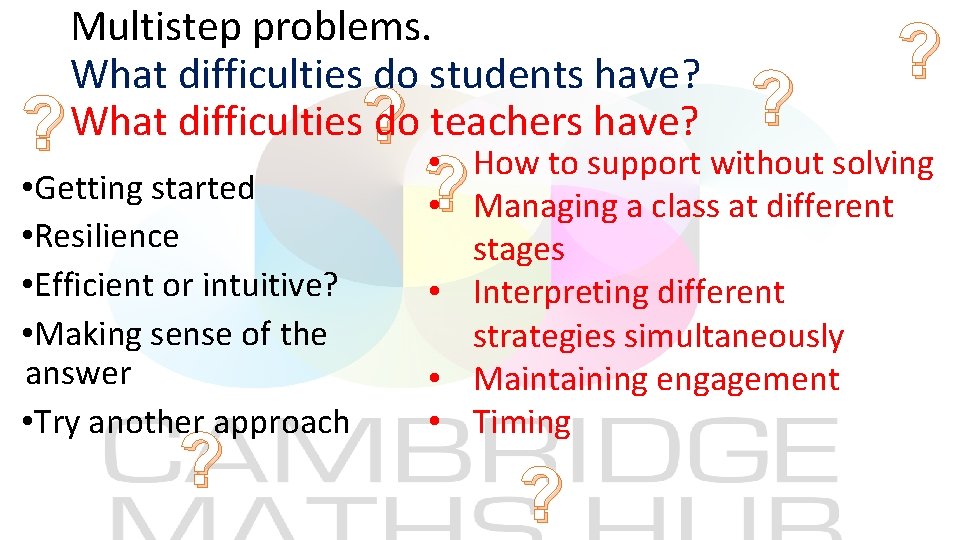
? Multistep problems. What difficulties do students have? What difficulties do teachers have? • Getting started • Resilience • Efficient or intuitive? • Making sense of the answer • Try another approach ? ? • How to support without solving ? • Managing a class at different stages • Interpreting different strategies simultaneously • Maintaining engagement • Timing ?
Possible approaches • Try something. Anything. • Change the numbers • Focus on the process, not the answer • Pictures • Algebra • Tables • Number lines/graphs
AQA problem classification 1 Set out cases 2 Work back familiar; work back unfamiliar 3 Find an example to fit 4 Find key relationships 5 Find mathematical features
Try some of the AQA problems in the pack. How could you support pupils? Which of these approaches could be used to get into the questions? • Change the numbers • Pictures/representations • Tables • Number lines/graphs Which strategies would be useful? Can you classify the problems? 1 Set out cases 2 Work back familiar; work back unfamiliar 3 Find an example to fit 4 Find key relationships 5 Find mathematical features

White Rose problems How will you use problems from today?
Problem solving Resources • https: //integralmaths. org/course/view. php? id=198 integral free resources • https: //www. ncetm. org. uk/public/files/18986365/Problem+Solving. pdf FMSP “how to” • https: //www. google. co. uk/search? q=fmsp+problem+solving+Power. Point&ie=u tf-8&oe=utf-8&client=firefox-b&gfe_rd=cr&ei=HMG 2 WM 65 Icq. N 8 Qezxp. OABQ FMSP Assessment • http: //allaboutmaths. aqa. org. uk/attachments/5592. pdf AQA • http: //furthermaths. org. uk/docs/GCSE-Problem-Solving-Booklet. pdf FMSP problems and strategies • https: //www. tes. com/teaching-resource/gcse-problem-solving-questions-ofthe-day-compilation-11283604 White Rose • http: //qualifications. pearson. com/content/dam/pdf/GCSE/mathematics/2015/ teaching-and-learning-materials/gcse-maths-9 -1 -Problem-Solving-Questions. zip Edexcel

Simultaneous Equations - AQA
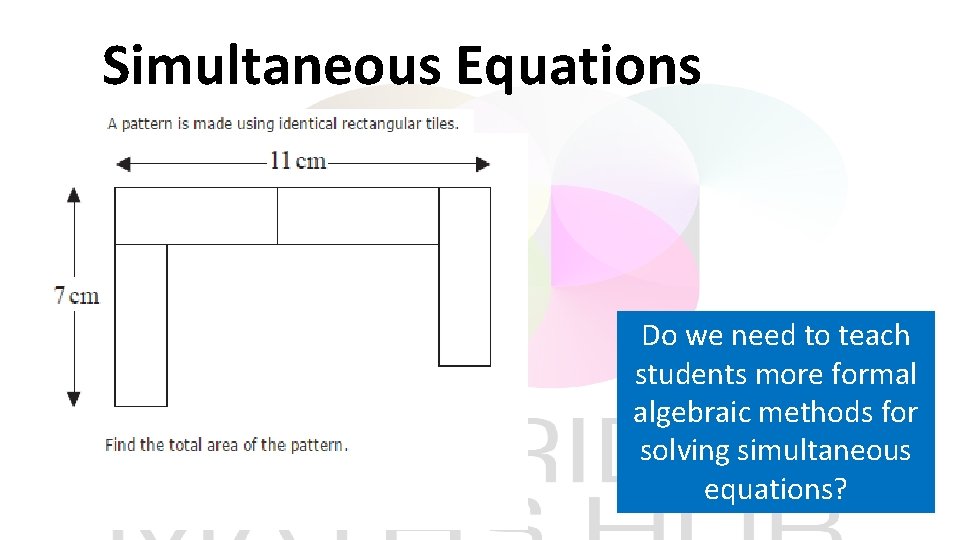
Simultaneous Equations Do we need to teach students more formal algebraic methods for solving simultaneous equations?
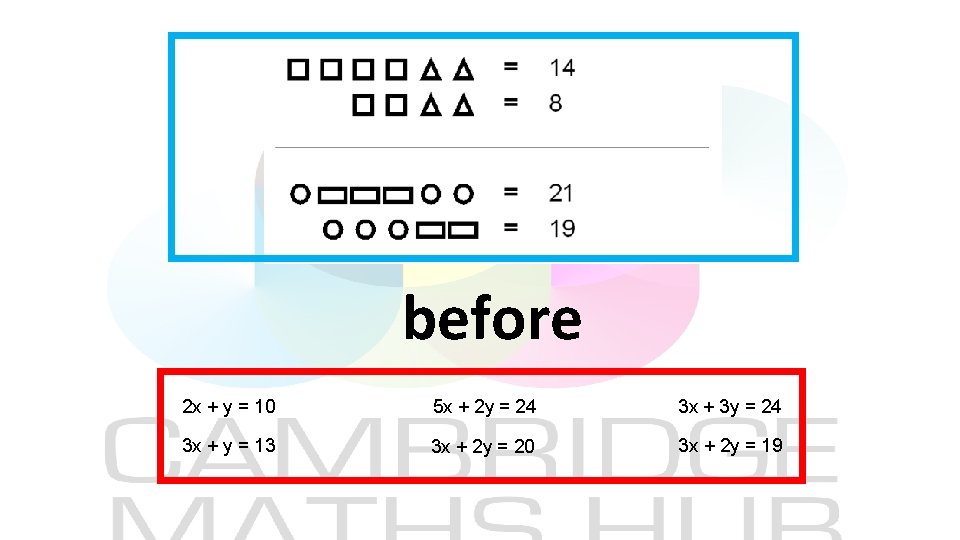
before 2 x + y = 10 5 x + 2 y = 24 3 x + 3 y = 24 3 x + y = 13 3 x + 2 y = 20 3 x + 2 y = 19
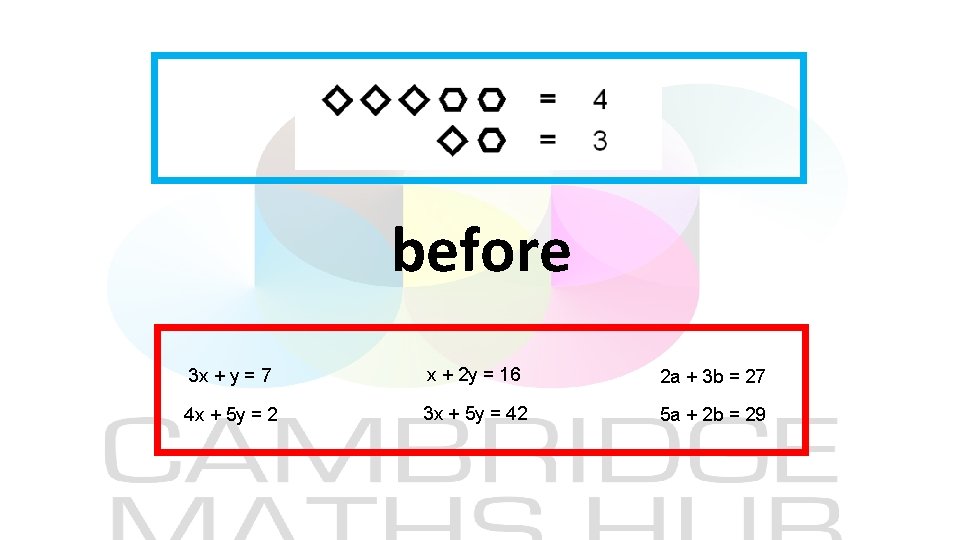
before 3 x + y = 7 x + 2 y = 16 2 a + 3 b = 27 4 x + 5 y = 2 3 x + 5 y = 42 5 a + 2 b = 29
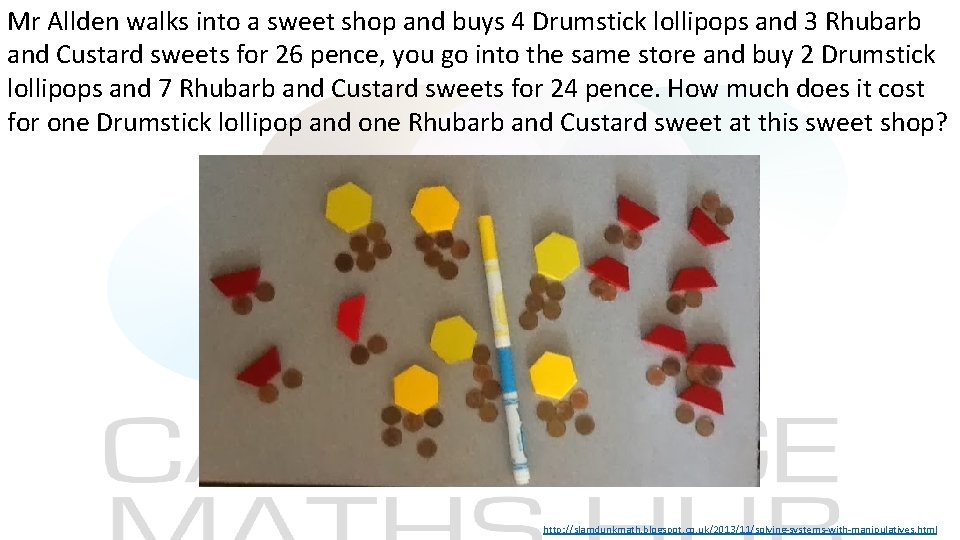
Mr Allden walks into a sweet shop and buys 4 Drumstick lollipops and 3 Rhubarb and Custard sweets for 26 pence, you go into the same store and buy 2 Drumstick lollipops and 7 Rhubarb and Custard sweets for 24 pence. How much does it cost for one Drumstick lollipop and one Rhubarb and Custard sweet at this sweet shop? http: //slamdunkmath. blogspot. co. uk/2013/11/solving-systems-with-manipulatives. html
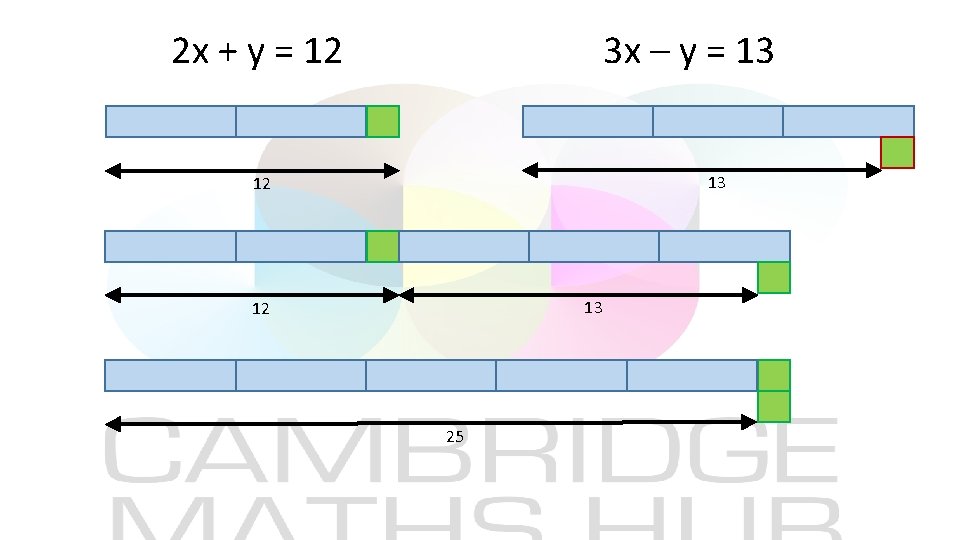
2 x + y = 12 3 x – y = 13 13 12 25
Exam questions – Just. Maths • Attempt the questions in your group. Work together and agree solutions before moving on. • Compare the style of questions. How similar are they? Would you use an OCR question if your are doing AQA? • Do you know where to get additional questions for the exam board you are using? http: //justmaths. co. uk/2015/12/21/9 -1 -exam-questions-by-topic-higher-tier
How would you teach simultaneous equations to a foundation set? In your groups could you plan the outline of a unit of work teaching simultaneous equations. What would you do, when would you do it and why would you do it that way? Using the sugar paper include examples, key questions, learning leaps, etc.
Some thoughts … for the moment! Should there be less examples where equations are given? Can we create more opportunities for setting up equations before solving? Do we need to work at a slower pace to allow time for deeper thinking? Should we find more time for pupils to share answers and discuss the efficiency of methods?
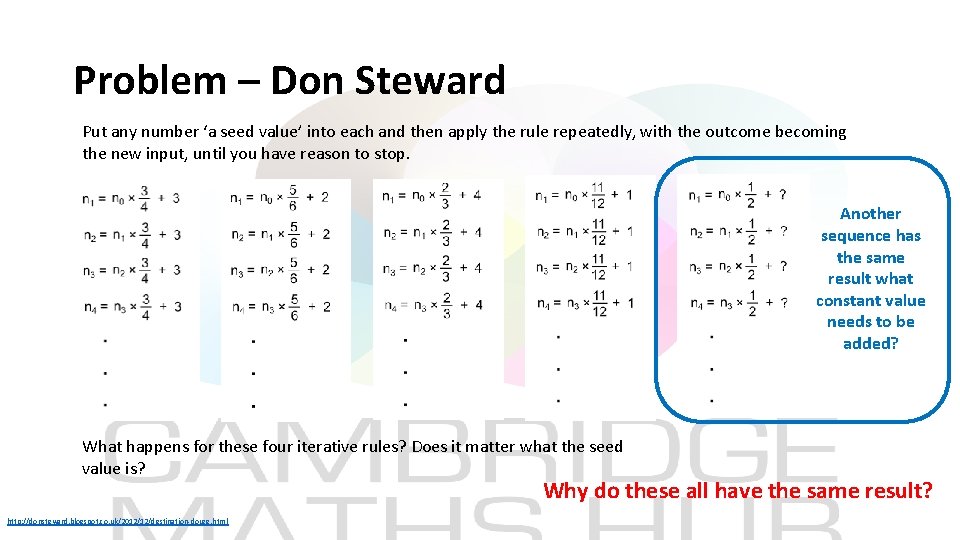
Problem – Don Steward Put any number ‘a seed value’ into each and then apply the rule repeatedly, with the outcome becoming the new input, until you have reason to stop. Another sequence has the same result what constant value needs to be added? What happens for these four iterative rules? Does it matter what the seed value is? Why do these all have the same result? http: //donsteward. blogspot. co. uk/2012/12/destination-douze. html
Gap task • Try some of the ideas from today • Discuss them in your department • Be ready to feed back next time • Please complete the evaluation 2 nd page 25
- Slides: 25