
Cambridge International Schools presents Teachers Training Workshop Preparation
Cambridge International Schools presents: Teachers Training Workshop Preparation and Implementation of Lesson Plan Using CIE/QCA Framework & Scheme of Work Preparation and Implementation of Lesson Plan
Workshop Objectives In this workshop you will: Become familiar with the issues, challenges, and skills needed to prepare and implement your daily lesson plan using the CIE/QCA/EYFS British National Curriculum Frame work and Scheme of Work. Be able to make connections between Frame work Codes , ELG Codes and the Scheme of Work and use it in your lesson plan as well as in the classroom. Be able to apply your teaching skills to well develop your school , your class and your pupils by preparing the weekly assessment / evaluation sheet according to CIE , QCA , EYFS standards. Be able to link your teaching methodology to the learning objectives of CIE , National Curriculum and the CIEs requirements as well as to the QCA , EYFS and Cambridge Schools Teachers Website. Preparation and Implementation of Lesson Plan
Workshop contents 1 - Introduction - Understand The British National Curriculum. 2 - The Framework Codes / ELGs Codes Structure 3 - The Steps of preparing your lesson plan using Framework / Objectives and Scheme of Work ( CIE , QCA EYFS). 4 - How to link between Framework / Objectives and Scheme of Work ( CIE , QCA EYFS). 5 - Examples. Preparation and Implementation of Lesson Plan
Introduction - Glossary For the purposes of this workshop some abbreviation will be used as follows : CIE Cambridge International Examination QCA KS QCA – Qualification & Curriculum Authority (Now QCDA) Key Stage EYFS Early Years Foundation Stage DCSF Department for Children , Schools and Families ( UK ) Strand Content area, further divided into ‘sub-strands’ Stage Year of education in Cambridge Primary and Secondary 1 National Curriculum The National Curriculum for England CIPP Cambridge International Primary Program Preparation and Implementation of Lesson Plan
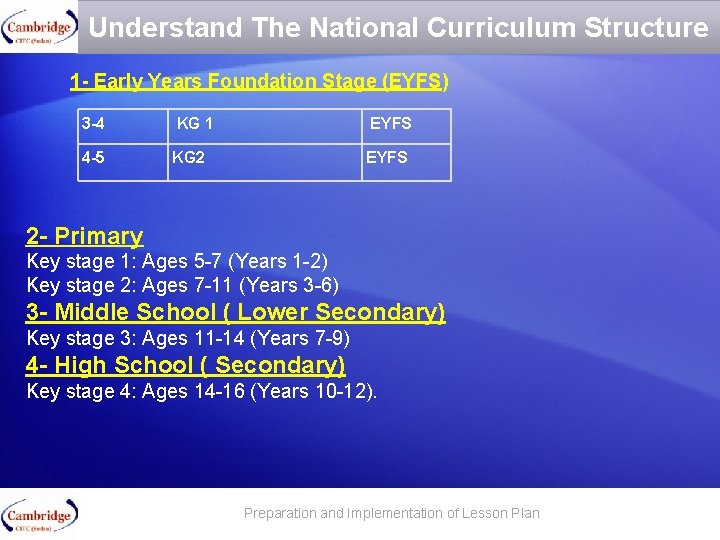
Understand The National Curriculum Structure 1 - Early Years Foundation Stage (EYFS) 3 -4 KG 1 EYFS 4 -5 KG 2 EYFS 2 - Primary Key stage 1: Ages 5 -7 (Years 1 -2) Key stage 2: Ages 7 -11 (Years 3 -6) 3 - Middle School ( Lower Secondary) Key stage 3: Ages 11 -14 (Years 7 -9) 4 - High School ( Secondary) Key stage 4: Ages 14 -16 (Years 10 -12). Preparation and Implementation of Lesson Plan

Understand The National Curriculum Structure Preparation and Implementation of Lesson Plan
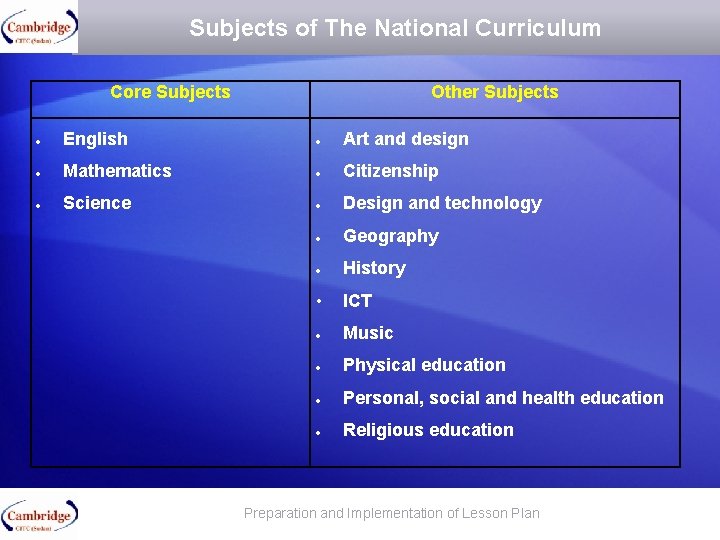
Subjects of The National Curriculum Core Subjects Other Subjects English Art and design Mathematics Citizenship Science Design and technology Geography History • ICT Music Physical education Personal, social and health education Religious education Preparation and Implementation of Lesson Plan
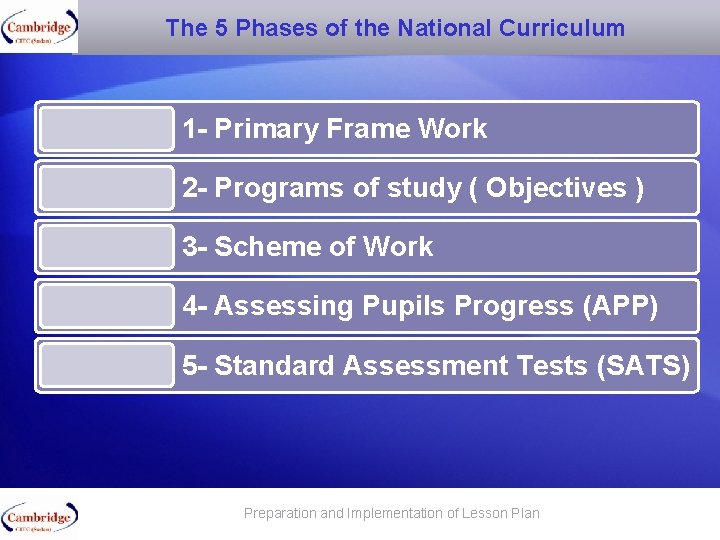
The 5 Phases of the National Curriculum 1 - Primary Frame Work 2 - Programs of study ( Objectives ) 3 - Scheme of Work 4 - Assessing Pupils Progress (APP) 5 - Standard Assessment Tests (SATS) Preparation and Implementation of Lesson Plan
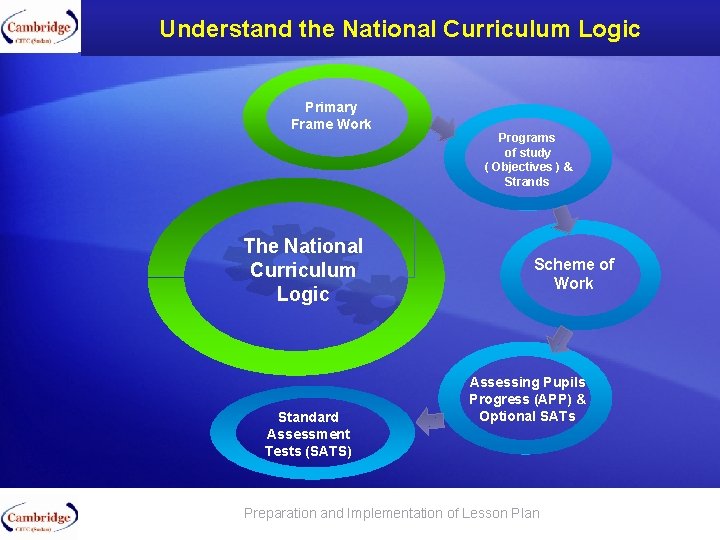
Understand the National Curriculum Logic Primary Frame Work The National Curriculum Logic Standard Assessment Tests (SATS) Programs of study ( Objectives ) & Strands Scheme of Work Assessing Pupils Progress (APP) & Optional SATs Preparation and Implementation of Lesson Plan
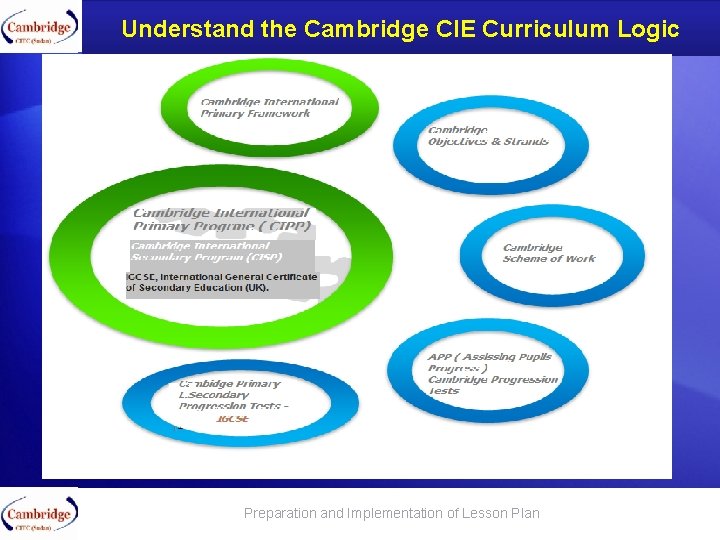
Understand the Cambridge CIE Curriculum Logic Preparation and Implementation of Lesson Plan

Cambridge CIE vs QCA Curriculum Logic Preparation and Implementation of Lesson Plan
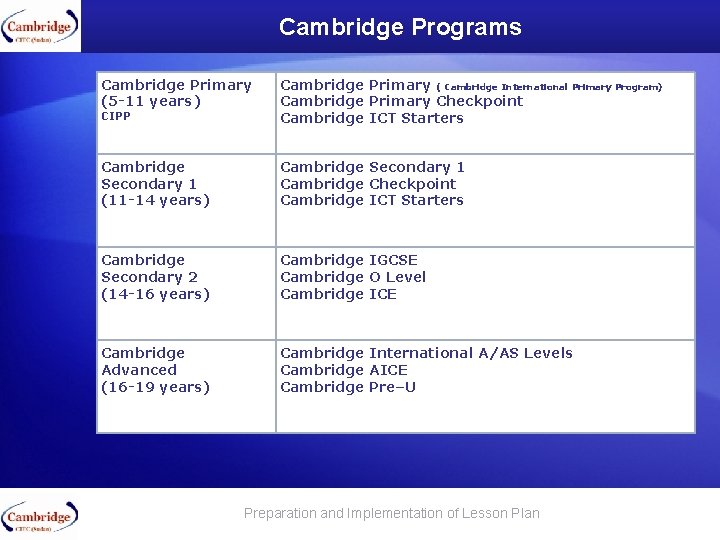
Cambridge Programs Cambridge Primary (5 -11 years) CIPP Cambridge Primary ( Cambridge International Primary Program) Cambridge Primary Checkpoint Cambridge ICT Starters Cambridge Secondary 1 (11 -14 years) Cambridge Secondary 1 Cambridge Checkpoint Cambridge ICT Starters Cambridge Secondary 2 (14 -16 years) Cambridge IGCSE Cambridge O Level Cambridge ICE Cambridge Advanced (16 -19 years) Cambridge International A/AS Levels Cambridge AICE Cambridge Pre–U Preparation and Implementation of Lesson Plan
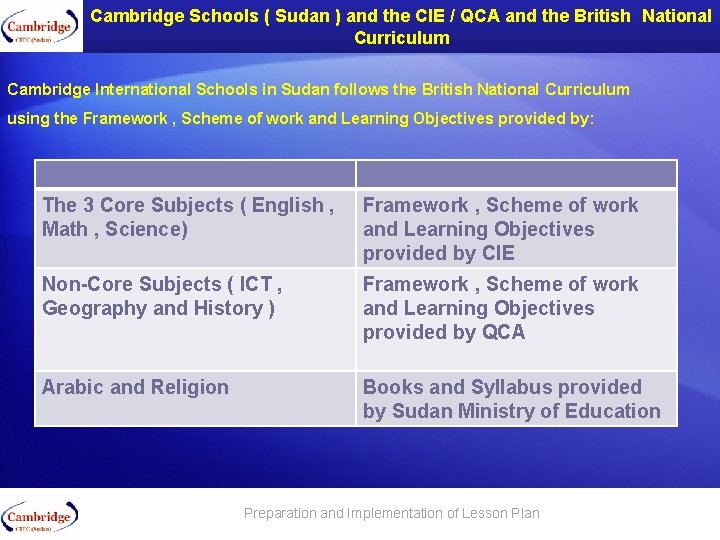
Cambridge Schools ( Sudan ) and the CIE / QCA and the British National Curriculum Cambridge International Schools in Sudan follows the British National Curriculum using the Framework , Scheme of work and Learning Objectives provided by: The 3 Core Subjects ( English , Math , Science) Framework , Scheme of work and Learning Objectives provided by CIE Non-Core Subjects ( ICT , Geography and History ) Framework , Scheme of work and Learning Objectives provided by QCA Arabic and Religion Books and Syllabus provided by Sudan Ministry of Education Preparation and Implementation of Lesson Plan
Connection between Learning Objectives , the Scheme of Work and the Framework: For Cambridge Primary Framework, the curriculum is presented in number of content areas or ‘strands’. These are further subdivided into ‘substrands’. The framework promotes an enquiry-based approach to learning to develop thinking skills and encourage intellectual engagement by applying these strands. Preparation and Implementation of Lesson Plan
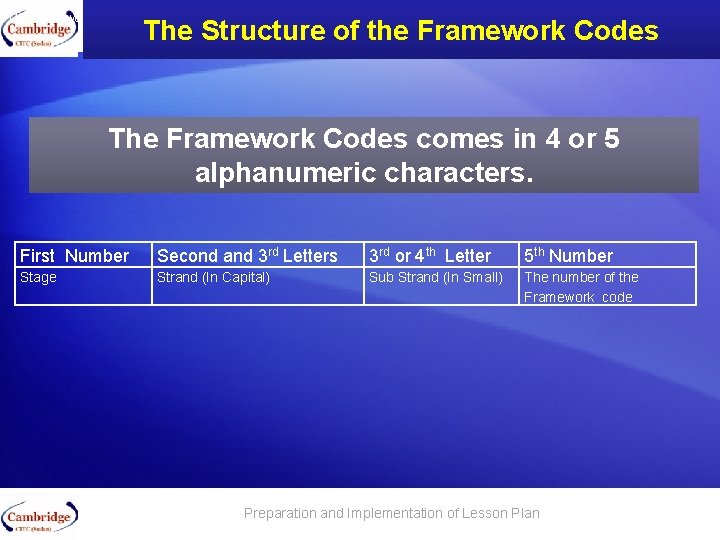
The Framework Codes comes in 4 or 5. The Structure of the Framework Codes The Framework Codes comes in 4 or 5 alphanumeric characters. First Number Second and 3 rd Letters 3 rd or 4 th Letter 5 th Number Stage Strand (In Capital) Sub Strand (In Small) The number of the Framework code Preparation and Implementation of Lesson Plan
Connection between Learning Objectives , the Scheme of Work and the Framework: How to identify and connect the Learning Objectives , the Scheme of Work and the Framework: Example 1 – Science Stage 3 Preparation and Implementation of Lesson Plan
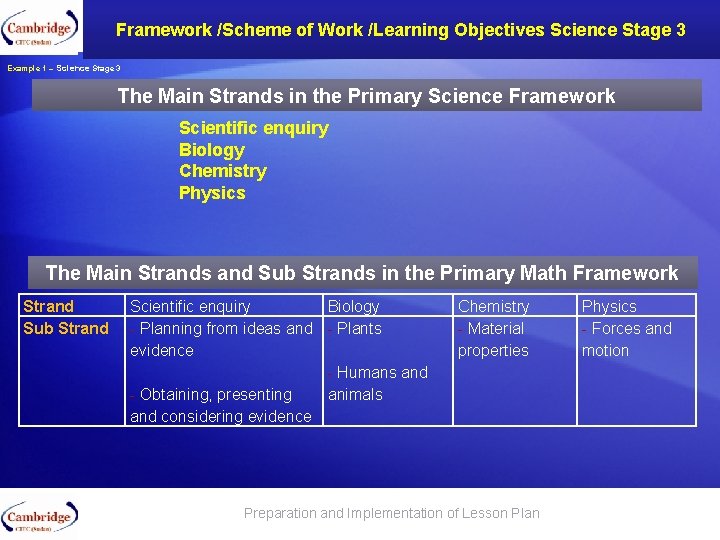
The Framework Codes comes in 4 or 5. Framework /Scheme of Work /Learning Objectives Science Stage 3 Example 1 – Science Stage 3 The Main Strands in the Primary Science Framework Scientific enquiry Biology Chemistry Physics The Main Strands and Sub Strands in the Primary Math Framework Strand Sub Strand Scientific enquiry Biology - Planning from ideas and - Plants evidence - Humans and - Obtaining, presenting animals and considering evidence Chemistry - Material properties Preparation and Implementation of Lesson Plan Physics - Forces and motion
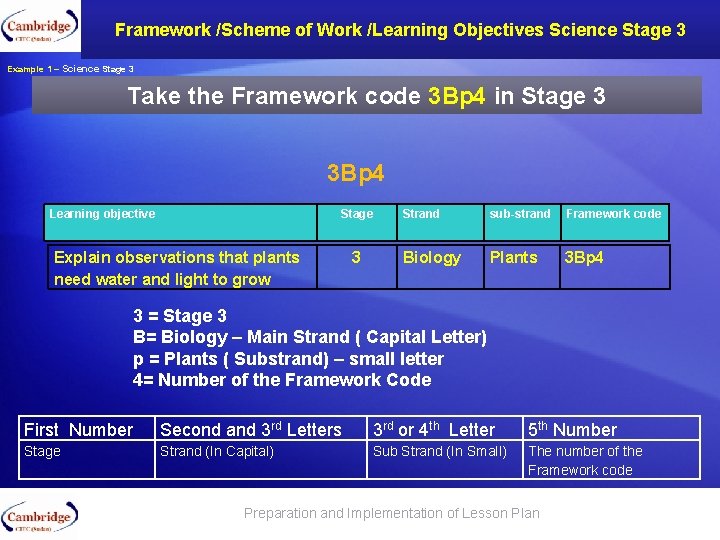
The Framework Codes comes in 4 or 5. Framework /Scheme of Work /Learning Objectives Science Stage 3 Example 1 – Science Stage 3 Take the Framework code 3 Bp 4 in Stage 3 3 Bp 4 Learning objective Stage Explain observations that plants need water and light to grow 3 Strand sub-strand Framework code Biology Plants 3 Bp 4 3 = Stage 3 B= Biology – Main Strand ( Capital Letter) p = Plants ( Substrand) – small letter 4= Number of the Framework Code First Number Second and 3 rd Letters 3 rd or 4 th Letter 5 th Number Stage Strand (In Capital) Sub Strand (In Small) The number of the Framework code Preparation and Implementation of Lesson Plan
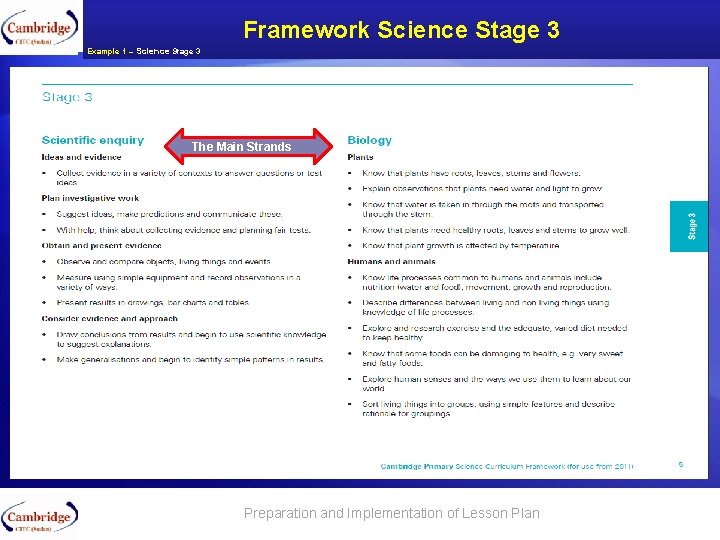
App SATs Framework Science Stage 3 Example 1 – Science Stage 3 Medium Term Planning To be prepared by the Academic Manager of schools The Main Strands Preparation and Implementation of Lesson Plan
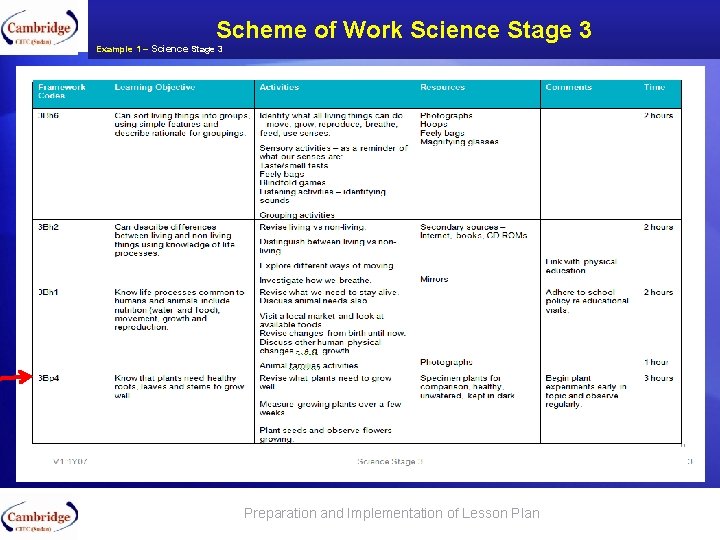
What to tell the parents about Check Point and Progression Tests Scheme of Work Science Stage 3 Example 1 – Science Stage 3 Preparation and Implementation of Lesson Plan
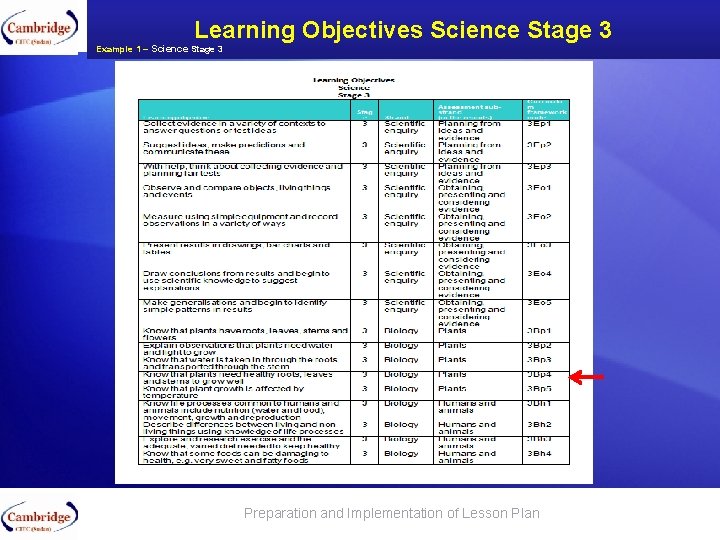
App SATs Learning Objectives Science Stage 3 Example 1 – Science Stage 3 Short Term Planning To be prepared by the Teachers on weekly basis Preparation and Implementation of Lesson Plan
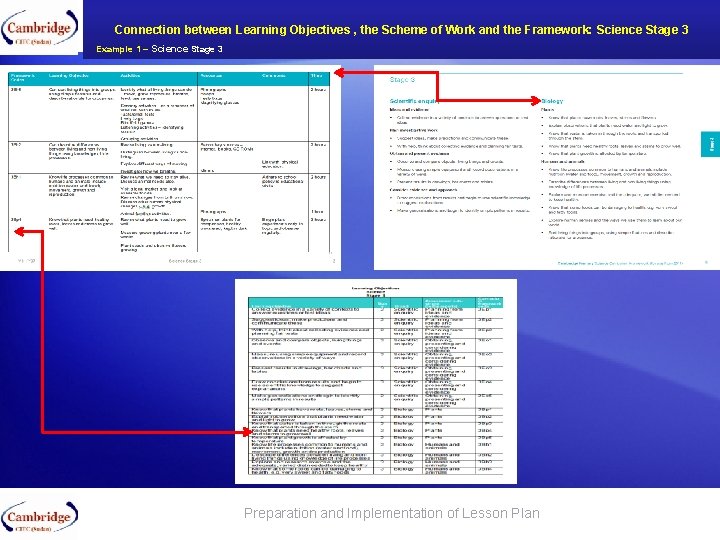
App SATs Connection between Learning Objectives , the Scheme of Work and the Framework: Science Stage 3 Example 1 – Science Stage 3 Preparation and Implementation of Lesson Plan
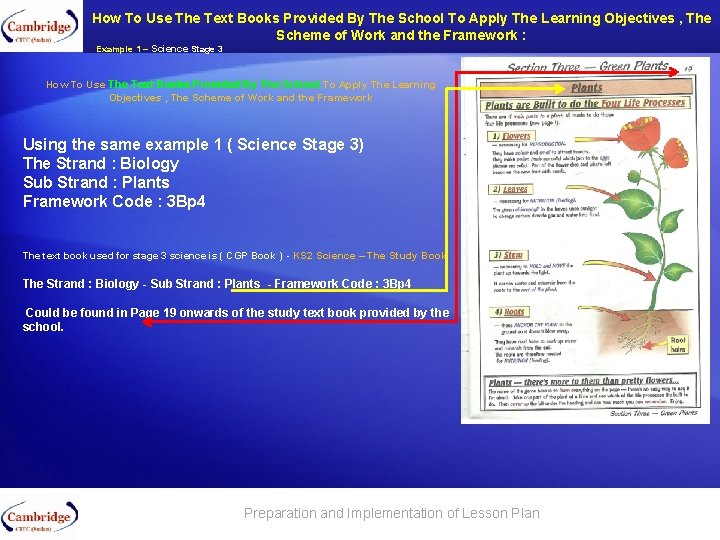
How To Use The Text Books Provided By The School To Apply The Learning Objectives , The Scheme of Work and the Framework : Example 1 – Science Stage 3 How To Use The Text Books Provided By The School To Apply The Learning Objectives , The Scheme of Work and the Framework Using the same example 1 ( Science Stage 3) The Strand : Biology Sub Strand : Plants Framework Code : 3 Bp 4 The text book used for stage 3 science is ( CGP Book ) - KS 2 Science – The Study Book The Strand : Biology - Sub Strand : Plants - Framework Code : 3 Bp 4 Could be found in Page 19 onwards of the study text book provided by the school. Preparation and Implementation of Lesson Plan
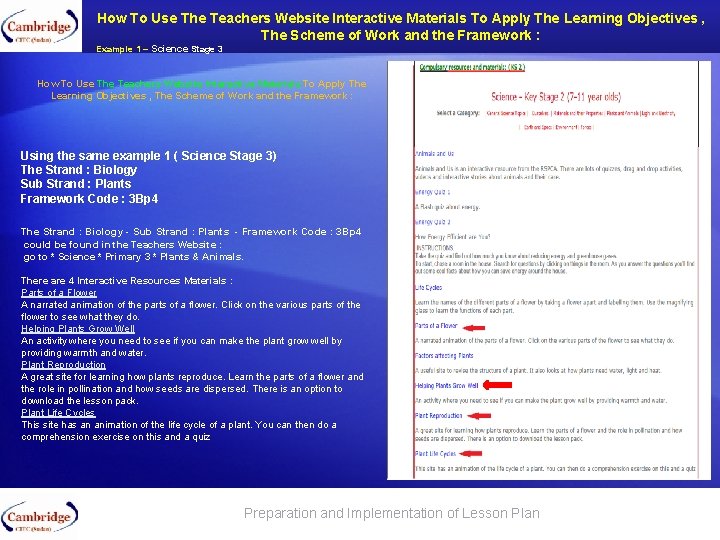
How To Use The Teachers Website Interactive Materials To Apply The Learning Objectives , The Scheme of Work and the Framework : Example 1 – Science Stage 3 How To Use The Teachers Website Interactive Materials To Apply The Learning Objectives , The Scheme of Work and the Framework : Using the same example 1 ( Science Stage 3) The Strand : Biology Sub Strand : Plants Framework Code : 3 Bp 4 The Strand : Biology - Sub Strand : Plants - Framework Code : 3 Bp 4 could be found in the Teachers Website : go to * Science * Primary 3 * Plants & Animals. There are 4 Interactive Resources Materials : Parts of a Flower A narrated animation of the parts of a flower. Click on the various parts of the flower to see what they do. Helping Plants Grow Well An activity where you need to see if you can make the plant grow well by providing warmth and water. Plant Reproduction A great site for learning how plants reproduce. Learn the parts of a flower and the role in pollination and how seeds are dispersed. There is an option to download the lesson pack. Plant Life Cycles This site has an animation of the life cycle of a plant. You can then do a comprehension exercise on this and a quiz Preparation and Implementation of Lesson Plan
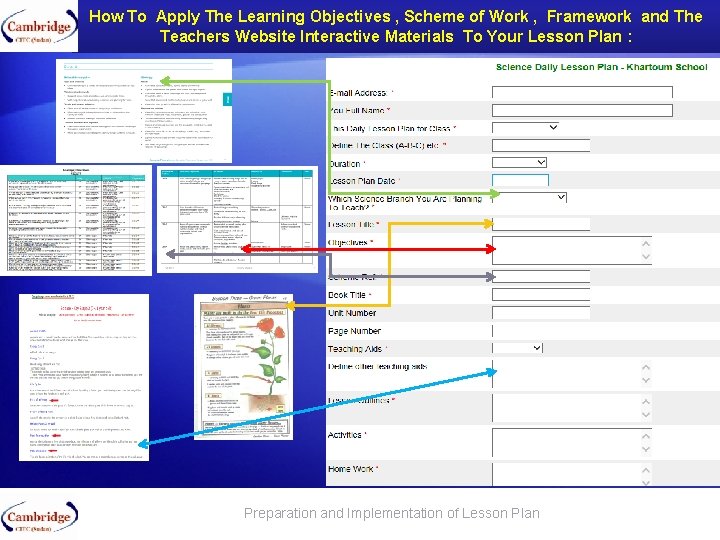
How To Apply The Learning Objectives , Scheme of Work , Framework and The Teachers Website Interactive Materials To Your Lesson Plan : Preparation and Implementation of Lesson Plan
Connection between Learning Objectives , the Scheme of Work and the Framework: How to identify and connect the Learning Objectives , the Scheme of Work and the Framework: Example 2 – Math Stage 5 Preparation and Implementation of Lesson Plan
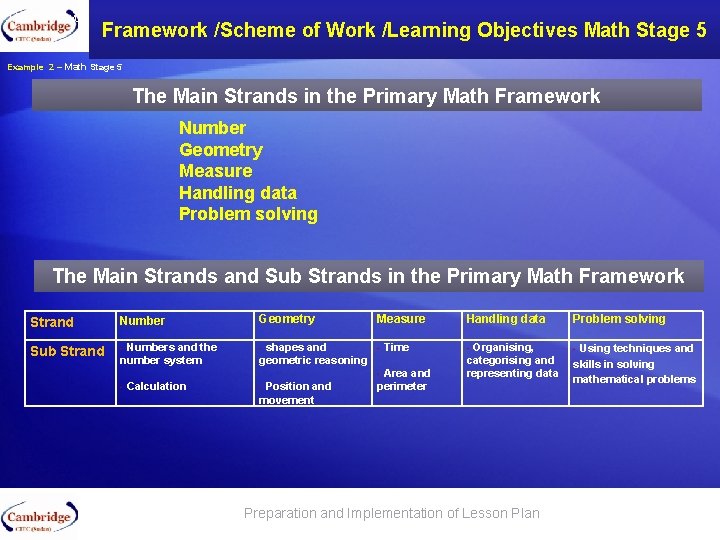
The Framework Codes comes in 4 or 5. Framework /Scheme of Work /Learning Objectives Math Stage 5 Example 2 – Math Stage 5 The Main Strands in the Primary Math Framework Number Geometry Measure Handling data Problem solving The Main Strands and Sub Strands in the Primary Math Framework Strand Number Geometry Sub Strand - Numbers and the number system - shapes and - Time geometric reasoning - Area and - Position and perimeter movement - Calculation Measure Handling data Problem solving - Organising, categorising and representing data - Using techniques and skills in solving mathematical problems Preparation and Implementation of Lesson Plan
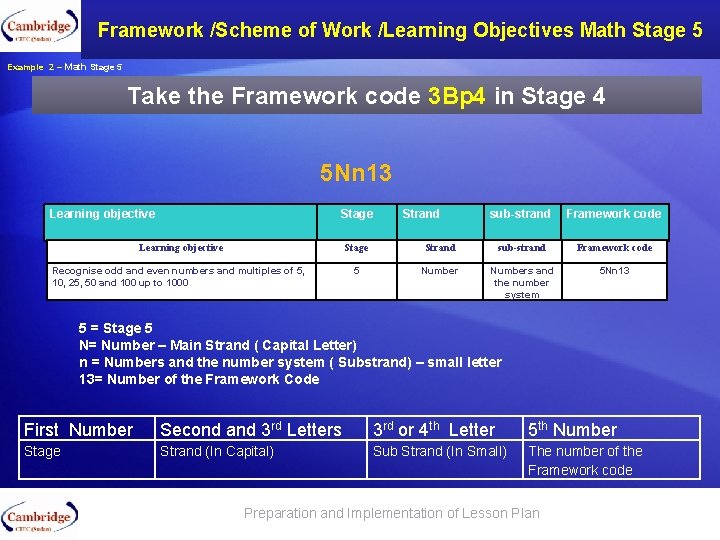
The Framework Codes comes in 4 or 5. Framework /Scheme of Work /Learning Objectives Math Stage 5 Example 2 – Math Stage 5 Take the Framework code 3 Bp 4 in Stage 4 5 Nn 13 Learning objective Stage Strand sub-strand Framework code Recognise odd and even numbers and multiples of 5, 10, 25, 50 and 100 up to 1000 5 Numbers and the number system 5 Nn 13 5 = Stage 5 N= Number – Main Strand ( Capital Letter) n = Numbers and the number system ( Substrand) – small letter 13= Number of the Framework Code First Number Second and 3 rd Letters 3 rd or 4 th Letter 5 th Number Stage Strand (In Capital) Sub Strand (In Small) The number of the Framework code Preparation and Implementation of Lesson Plan
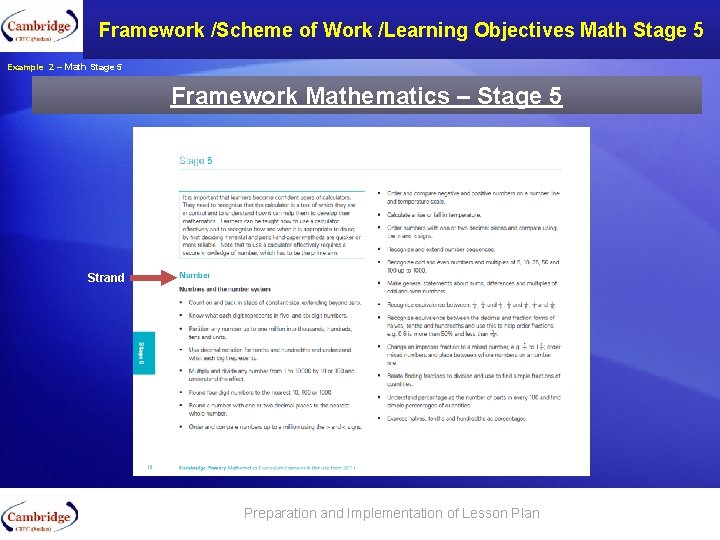
The Framework Codes comes in 4 or 5. Framework /Scheme of Work /Learning Objectives Math Stage 5 Example 2 – Math Stage 5 Framework Mathematics – Stage 5 Strand Preparation and Implementation of Lesson Plan
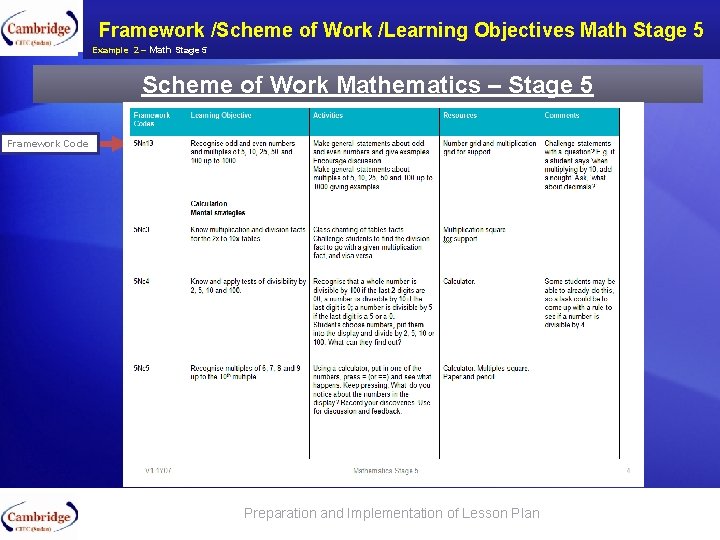
Framework /Scheme of Work /Learning Objectives Math Stage 5 Example 2 – Math Stage 5 Scheme of Work Mathematics – Stage 5 Framework Code Preparation and Implementation of Lesson Plan
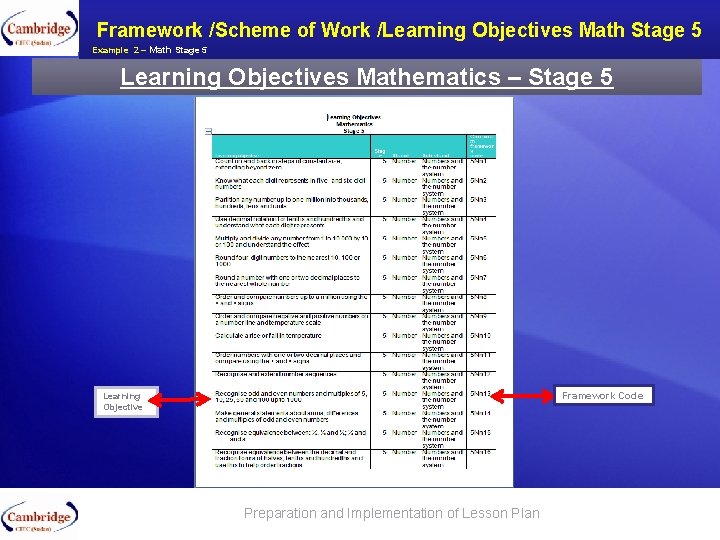
Framework /Scheme of Work /Learning Objectives Math Stage 5 Example 2 – Math Stage 5 Learning Objectives Mathematics – Stage 5 Framework Code Learning Objective Preparation and Implementation of Lesson Plan
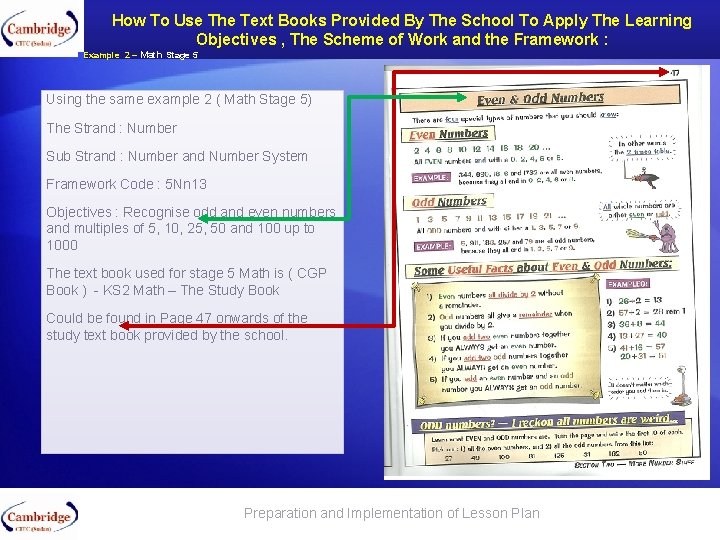
How To Use The Text Books Provided By The School To Apply The Learning Objectives , The Scheme of Work and the Framework : Example 2 – Math Stage 5 Using the same example 2 ( Math Stage 5) The Strand : Number Sub Strand : Number and Number System Framework Code : 5 Nn 13 Objectives : Recognise odd and even numbers and multiples of 5, 10, 25, 50 and 100 up to 1000 The text book used for stage 5 Math is ( CGP Book ) - KS 2 Math – The Study Book Could be found in Page 47 onwards of the study text book provided by the school. Preparation and Implementation of Lesson Plan
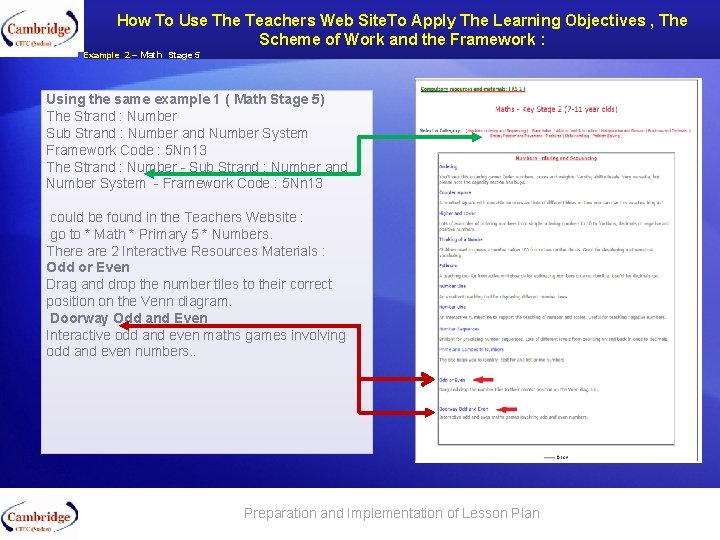
How To Use The Teachers Web Site. To Apply The Learning Objectives , The Scheme of Work and the Framework : Example 2 – Math Stage 5 Using the same example 1 ( Math Stage 5) The Strand : Number Sub Strand : Number and Number System Framework Code : 5 Nn 13 The Strand : Number - Sub Strand : Number and Number System - Framework Code : 5 Nn 13 could be found in the Teachers Website : go to * Math * Primary 5 * Numbers. There are 2 Interactive Resources Materials : Odd or Even Drag and drop the number tiles to their correct position on the Venn diagram. Doorway Odd and Even Interactive odd and even maths games involving odd and even numbers. . Preparation and Implementation of Lesson Plan
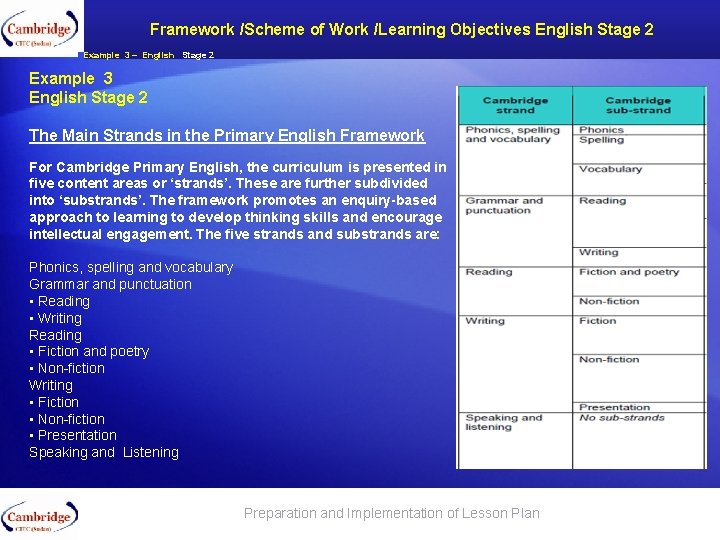
Framework /Scheme of Work /Learning Objectives English Stage 2 Example 3 – English Stage 2 Example 3 English Stage 2 The Main Strands in the Primary English Framework For Cambridge Primary English, the curriculum is presented in five content areas or ‘strands’. These are further subdivided into ‘substrands’. The framework promotes an enquiry-based approach to learning to develop thinking skills and encourage intellectual engagement. The five strands and substrands are: Phonics, spelling and vocabulary Grammar and punctuation • Reading • Writing Reading • Fiction and poetry • Non-fiction Writing • Fiction • Non-fiction • Presentation Speaking and Listening Preparation and Implementation of Lesson Plan
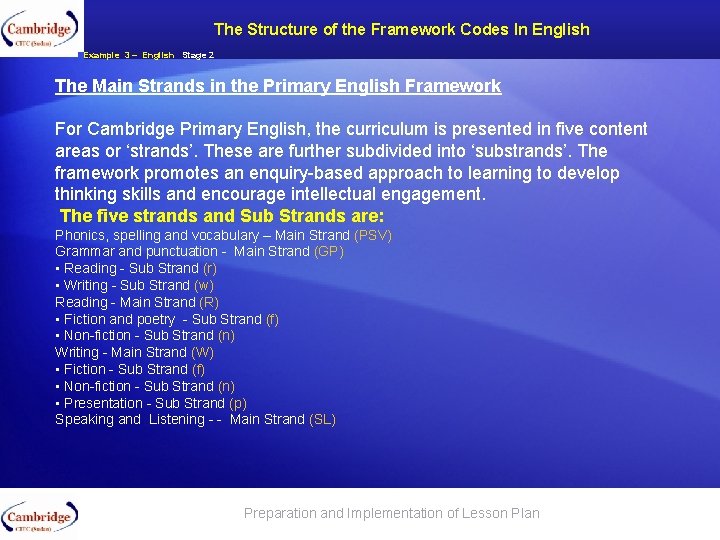
The Structure of the Framework Codes In English Example 3 – English Stage 2 The Main Strands in the Primary English Framework For Cambridge Primary English, the curriculum is presented in five content areas or ‘strands’. These are further subdivided into ‘substrands’. The framework promotes an enquiry-based approach to learning to develop thinking skills and encourage intellectual engagement. The five strands and Sub Strands are: Phonics, spelling and vocabulary – Main Strand (PSV) Grammar and punctuation - Main Strand (GP) • Reading - Sub Strand (r) • Writing - Sub Strand (w) Reading - Main Strand (R) • Fiction and poetry - Sub Strand (f) • Non-fiction - Sub Strand (n) Writing - Main Strand (W) • Fiction - Sub Strand (f) • Non-fiction - Sub Strand (n) • Presentation - Sub Strand (p) Speaking and Listening - - Main Strand (SL) Preparation and Implementation of Lesson Plan
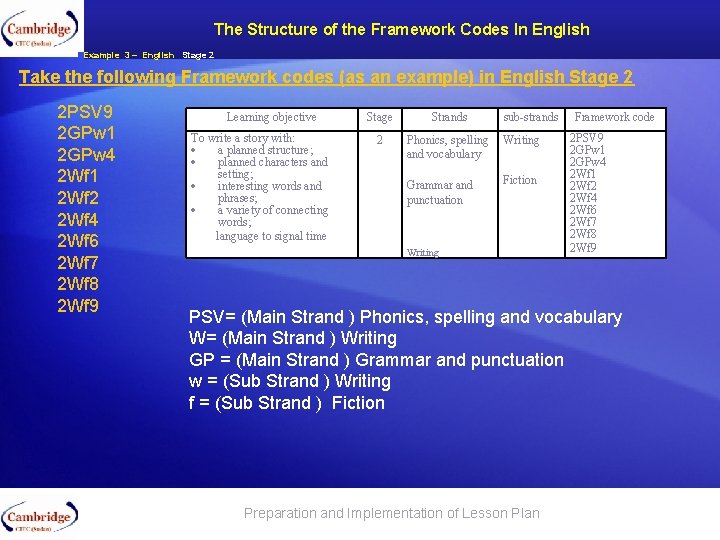
The Structure of the Framework Codes In English Example 3 – English Stage 2 Take the following Framework codes (as an example) in English Stage 2 2 PSV 9 2 GPw 1 2 GPw 4 2 Wf 1 2 Wf 2 2 Wf 4 2 Wf 6 2 Wf 7 2 Wf 8 2 Wf 9 Learning objective To write a story with: a planned structure; planned characters and setting; interesting words and phrases; a variety of connecting words; language to signal time Stage Strands sub-strands 2 Phonics, spelling and vocabulary Writing Grammar and punctuation Fiction Writing Framework code 2 PSV 9 2 GPw 1 2 GPw 4 2 Wf 1 2 Wf 2 2 Wf 4 2 Wf 6 2 Wf 7 2 Wf 8 2 Wf 9 PSV= (Main Strand ) Phonics, spelling and vocabulary W= (Main Strand ) Writing GP = (Main Strand ) Grammar and punctuation w = (Sub Strand ) Writing f = (Sub Strand ) Fiction Preparation and Implementation of Lesson Plan
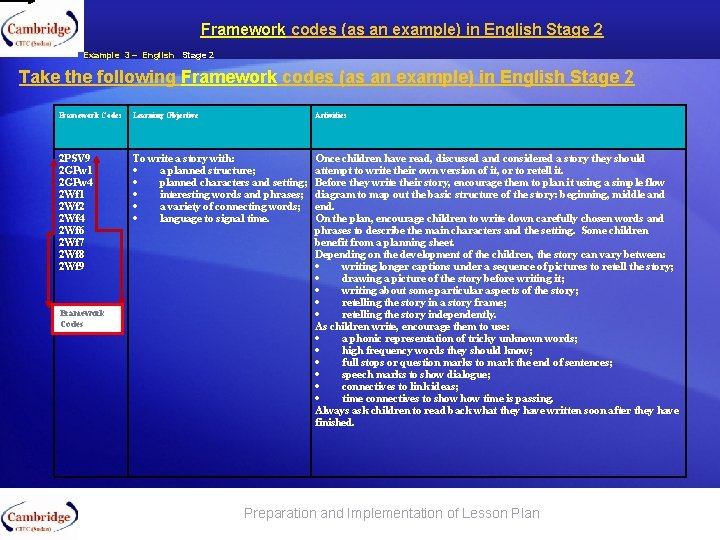
Framework codes (as an example) in English Stage 2 Example 3 – English Stage 2 Take the following Framework codes (as an example) in English Stage 2 Framework Codes Learning Objective Activities 2 PSV 9 2 GPw 1 2 GPw 4 2 Wf 1 2 Wf 2 2 Wf 4 2 Wf 6 2 Wf 7 2 Wf 8 2 Wf 9 To write a story with: a planned structure; planned characters and setting; interesting words and phrases; a variety of connecting words; language to signal time. Once children have read, discussed and considered a story they should attempt to write their own version of it, or to retell it. Before they write their story, encourage them to plan it using a simple flow diagram to map out the basic structure of the story: beginning, middle and end. On the plan, encourage children to write down carefully chosen words and phrases to describe the main characters and the setting. Some children benefit from a planning sheet. Depending on the development of the children, the story can vary between: writing longer captions under a sequence of pictures to retell the story; drawing a picture of the story before writing it; writing about some particular aspects of the story; retelling the story in a story frame; retelling the story independently. As children write, encourage them to use: a phonic representation of tricky unknown words; high frequency words they should know; full stops or question marks to mark the end of sentences; speech marks to show dialogue; connectives to link ideas; time connectives to show time is passing. Always ask children to read back what they have written soon after they have finished. Framework Codes Preparation and Implementation of Lesson Plan
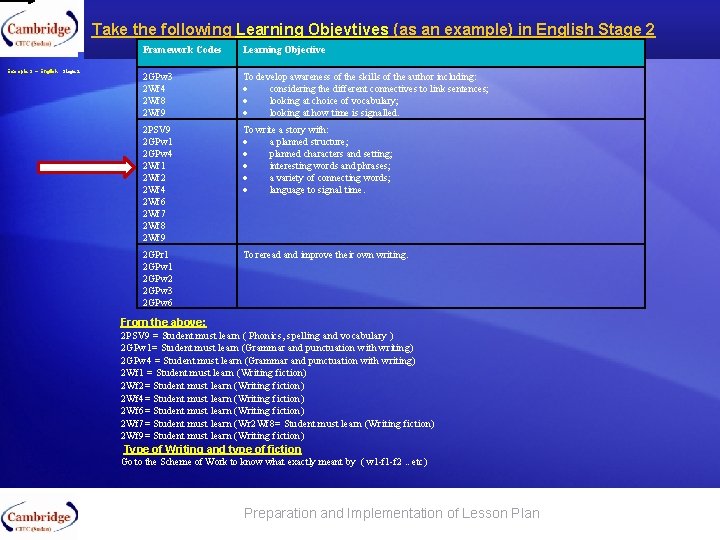
Take the following Learning Objevtives (as an example) in English Stage 2 Example 3 – English Stage 2 Framework Codes Learning Objective 2 GPw 3 2 Wf 4 2 Wf 8 2 Wf 9 To develop awareness of the skills of the author including: considering the different connectives to link sentences; looking at choice of vocabulary; looking at how time is signalled. 2 PSV 9 2 GPw 1 2 GPw 4 2 Wf 1 2 Wf 2 2 Wf 4 2 Wf 6 2 Wf 7 2 Wf 8 2 Wf 9 To write a story with: a planned structure; planned characters and setting; interesting words and phrases; a variety of connecting words; language to signal time. 2 GPr 1 2 GPw 2 2 GPw 3 2 GPw 6 To reread and improve their own writing. From the above: 2 PSV 9 = Student must learn ( Phonics, spelling and vocabulary ) 2 GPw 1= Student must learn (Grammar and punctuation with writing) 2 GPw 4 = Student must learn (Grammar and punctuation with writing) 2 Wf 1 = Student must learn (Writing fiction) 2 Wf 2= Student must learn (Writing fiction) 2 Wf 4= Student must learn (Writing fiction) 2 Wf 6= Student must learn (Writing fiction) 2 Wf 7= Student must learn (Wr 2 Wf 8= Student must learn (Writing fiction) 2 Wf 9= Student must learn (Writing fiction) Type of Writing and type of fiction Go to the Scheme of Work to know what exactly meant by ( w 1 -f 2. . etc) Preparation and Implementation of Lesson Plan
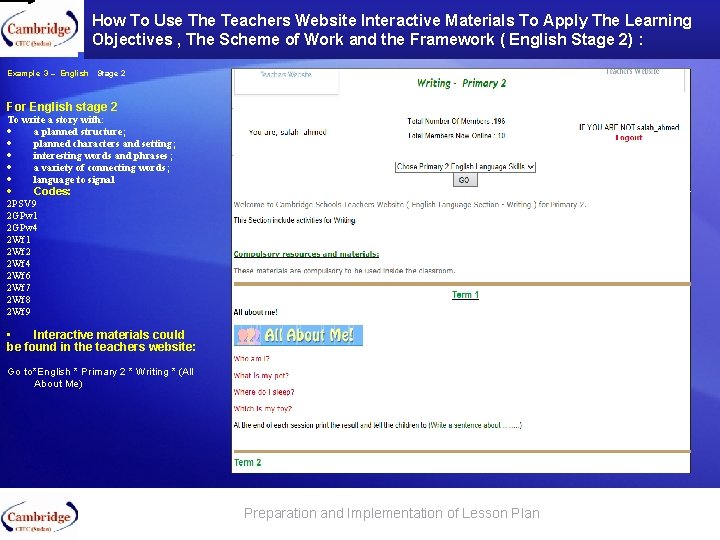
How To Use The Teachers Website Interactive Materials To Apply The Learning Objectives , The Scheme of Work and the Framework ( English Stage 2) : Example 3 – English Stage 2 For English stage 2 To write a story with: a planned structure; planned characters and setting; interesting words and phrases; a variety of connecting words; language to signal Codes: 2 PSV 9 2 GPw 1 2 GPw 4 2 Wf 1 2 Wf 2 2 Wf 4 2 Wf 6 2 Wf 7 2 Wf 8 2 Wf 9 • Interactive materials could be found in the teachers website: Go to*English * Primary 2 * Writing * (All About Me) Preparation and Implementation of Lesson Plan
Early Years Foundation Stage (EYFS) EYFS All providers of education and care to children from birth to the age of five must follow the standards set in the early years foundation stage (EYFS) framework. Early Years Foundation Stage Framework The areas of learning of EYFS are associated to ELGs (Early Learning Goals). In the EYFS Framework there are 7 areas of learning ( Main Strands ) 1 - Communication and language 2 - Physical development 3 - Personal, social and emotional development 4 - Literacy 5 - Mathematics 6 - Understanding the world 7 - Expressive arts and design The 7 Areas of Learning are Divided into 17 ELGs ( Sub Strands) Preparation and Implementation of Lesson Plan
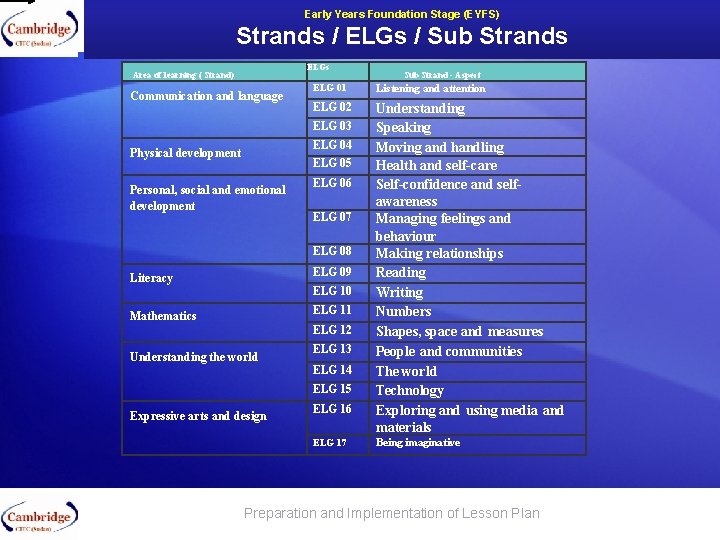
Early Years Foundation Stage (EYFS) Strands / ELGs / Sub Strands ELGs Area of learning ( Strand) Communication and language Listening and attention ELG 02 Understanding Speaking Moving and handling Health and self-care Self-confidence and selfawareness Managing feelings and behaviour Making relationships Reading Writing Numbers Shapes, space and measures People and communities The world Technology Exploring and using media and materials ELG 03 ELG 04 ELG 05 Physical development Personal, social and emotional development ELG 06 ELG 07 ELG 08 ELG 09 Literacy ELG 10 ELG 11 Mathematics ELG 12 Understanding the world ELG 13 ELG 14 ELG 15 Expressive arts and design Sub Strand - Aspect ELG 01 ELG 16 ELG 17 Being imaginative Preparation and Implementation of Lesson Plan
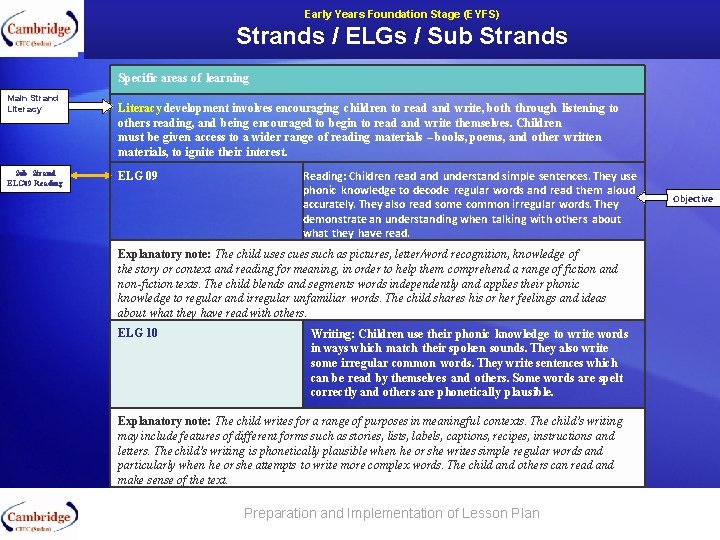
Early Years Foundation Stage (EYFS) Strands / ELGs / Sub Strands Specific areas of learning Main Strand Literacy Sub Strand ELG 09 Reading Literacy development involves encouraging children to read and write, both through listening to others reading, and being encouraged to begin to read and write themselves. Children must be given access to a wider range of reading materials – books, poems, and other written materials, to ignite their interest. ELG 09 Reading: Children read and understand simple sentences. They use phonic knowledge to decode regular words and read them aloud accurately. They also read some common irregular words. They demonstrate an understanding when talking with others about what they have read. Explanatory note: The child uses cues such as pictures, letter/word recognition, knowledge of the story or context and reading for meaning, in order to help them comprehend a range of fiction and non-fiction texts. The child blends and segments words independently and applies their phonic knowledge to regular and irregular unfamiliar words. The child shares his or her feelings and ideas about what they have read with others. ELG 10 Writing: Children use their phonic knowledge to write words in ways which match their spoken sounds. They also write some irregular common words. They write sentences which can be read by themselves and others. Some words are spelt correctly and others are phonetically plausible. Explanatory note: The child writes for a range of purposes in meaningful contexts. The child’s writing may include features of different forms such as stories, lists, labels, captions, recipes, instructions and letters. The child’s writing is phonetically plausible when he or she writes simple regular words and particularly when he or she attempts to write more complex words. The child and others can read and make sense of the text. Preparation and Implementation of Lesson Plan Objective
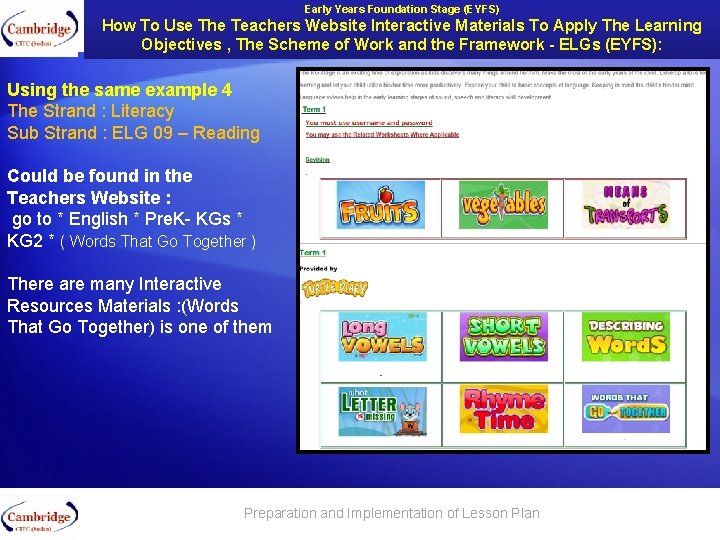
Early Years Foundation Stage (EYFS) How To Use The Teachers Website Interactive Materials To Apply The Learning Objectives , The Scheme of Work and the Framework - ELGs (EYFS): Using the same example 4 The Strand : Literacy Sub Strand : ELG 09 – Reading Could be found in the Teachers Website : go to * English * Pre. K- KGs * KG 2 * ( Words That Go Together ) There are many Interactive Resources Materials : (Words That Go Together) is one of them Preparation and Implementation of Lesson Plan
The End of Workshop All Kindergarten , Primary and Lower Secondary teachers ( of the core subject , Geography , History and ICT )are required to attend this training session ( Compulsory). All teacher assistants are required to take this training online. After taking the course workshop (Attend or Online ) you are required to submit (The End of Training Test ) online. This test will be marked by the Academic Managers in each school and will be send to HR Department to be a reference for any future evaluation or assessment of the teacher or teacher's assistant. Any Teacher/ Teacher Assistant who get 85% and above will be awarded (PILP) certification from Cambridge Schools. Those who fail to complete the training course either by attend or online the school will hold any promotions , privileges and requests for them until the completion of the training course and the submission of the final test. The Test Online Test Preparation and Implementation of Lesson Plan
The End of Workshop Preparation and Implementation of Lesson Plan Using CIE/QCA/EYFS Framework & Scheme of Work The End of Workshop Thank You Presented By Dr. Salah Abelaziz Ahmed 2013 Cambridge International Sudan. All Rights Reserved Preparation and Implementation of Lesson Plan
- Slides: 45