
Cambridge Incentive Zoning Nexus Study PRESENTATION TO CAMBRIDGE
Cambridge Incentive Zoning Nexus Study PRESENTATION TO CAMBRIDGE CITY COUNCIL ORDINANCE COMMITTEE KARL F. SEIDMAN FEBRUARY 12, 2020

Incentive Zoning Ordinance 2 �Established in 1988; amended in 2015 �Applies to non-residential development over 30, 000 gross square feet New construction, substantial renovation, change in use �Requires housing contributions of $17. 10 per sq. foot �Annual CPI adjustments �Periodic studies (every 3 years) to update contribution rate Note: Summary presentation. See Nexus Study for complete analysis.
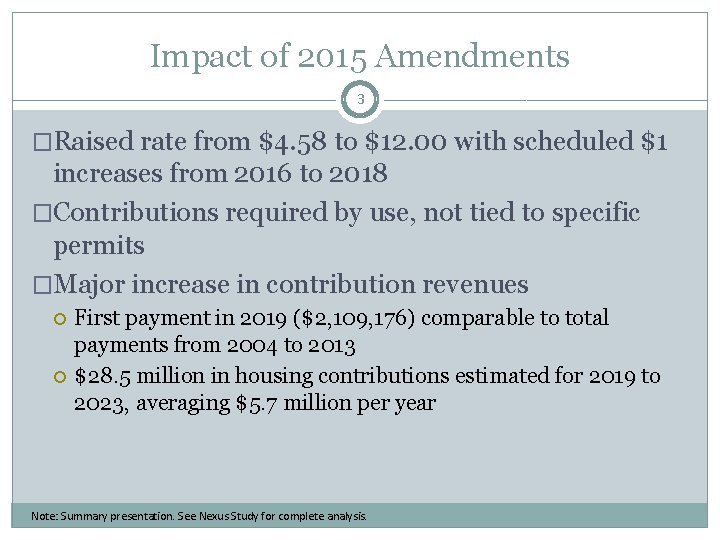
Impact of 2015 Amendments 3 �Raised rate from $4. 58 to $12. 00 with scheduled $1 increases from 2016 to 2018 �Contributions required by use, not tied to specific permits �Major increase in contribution revenues First payment in 2019 ($2, 109, 176) comparable to total payments from 2004 to 2013 $28. 5 million in housing contributions estimated for 2019 to 2023, averaging $5. 7 million per year Note: Summary presentation. See Nexus Study for complete analysis.
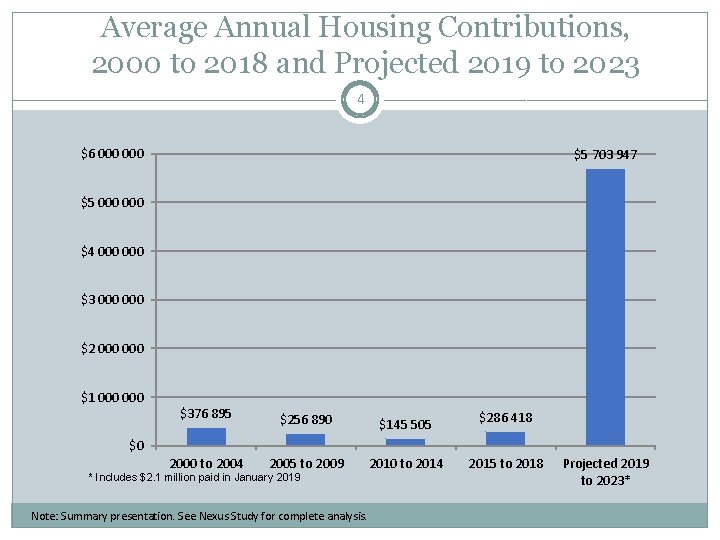
Average Annual Housing Contributions, 2000 to 2018 and Projected 2019 to 2023 4 $6 000 $5 703 947 $5 000 $4 000 $3 000 $2 000 $1 000 $376 895 $256 890 $145 505 $286 418 2000 to 2004 2005 to 2009 2010 to 2014 2015 to 2018 $0 * Includes $2. 1 million paid in January 2019 Note: Summary presentation. See Nexus Study for complete analysis. Projected 2019 to 2023*
Study Purpose and Scope 5 �Analyze development and employment trends and impacts �Review existing policies and options �Analyze job contribution option �Recommend new contribution rates and policy changes Note: Summary presentation. See Nexus Study for complete analysis.
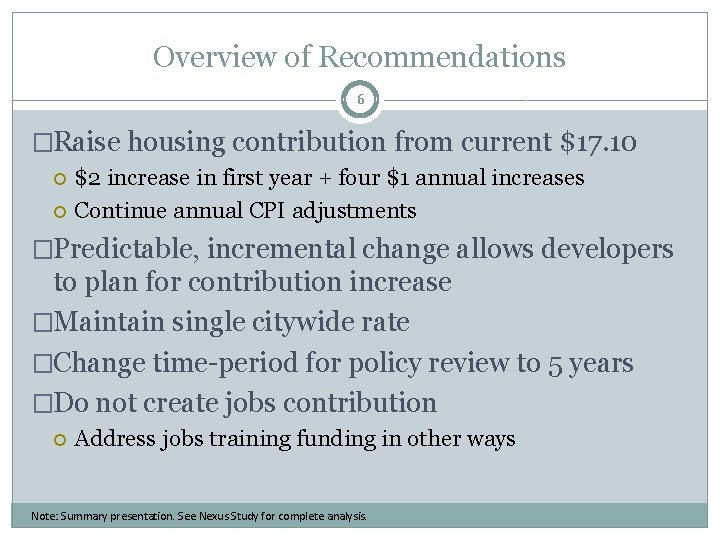
Overview of Recommendations 6 �Raise housing contribution from current $17. 10 $2 increase in first year + four $1 annual increases Continue annual CPI adjustments �Predictable, incremental change allows developers to plan for contribution increase �Maintain single citywide rate �Change time-period for policy review to 5 years �Do not create jobs contribution Address jobs training funding in other ways Note: Summary presentation. See Nexus Study for complete analysis.
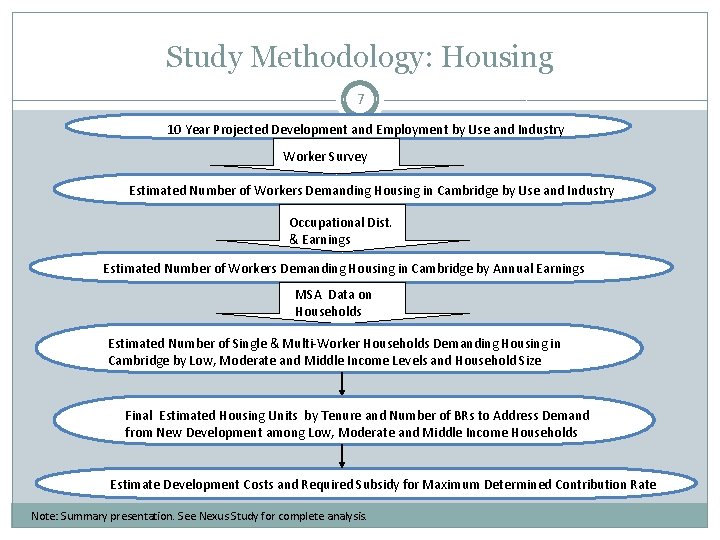
Study Methodology: Housing 7 10 Year Projected Development and Employment by Use and Industry Worker Survey Estimated Number of Workers Demanding Housing in Cambridge by Use and Industry Occupational Dist. & Earnings Estimated Number of Workers Demanding Housing in Cambridge by Annual Earnings MSA Data on Households Estimated Number of Single & Multi-Worker Households Demanding Housing in Cambridge by Low, Moderate and Middle Income Levels and Household Size Final Estimated Housing Units by Tenure and Number of BRs to Address Demand from New Development among Low, Moderate and Middle Income Households Estimate Development Costs and Required Subsidy for Maximum Determined Contribution Rate Note: Summary presentation. See Nexus Study for complete analysis.
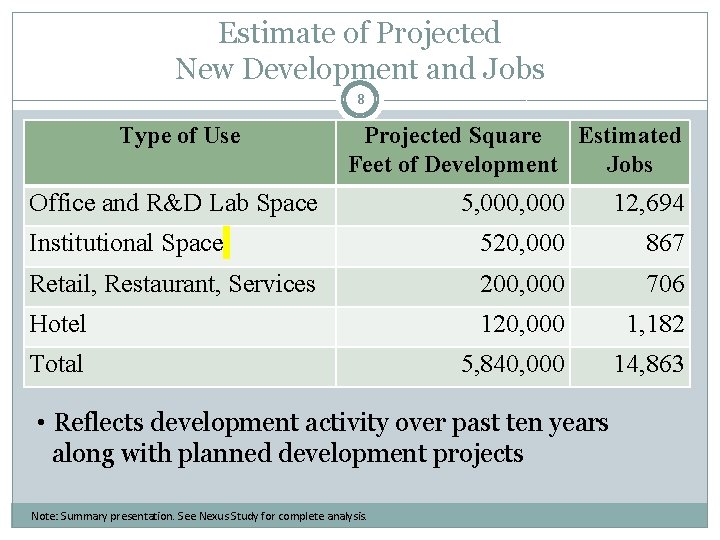
Estimate of Projected New Development and Jobs 8 Type of Use Projected Square Estimated Feet of Development Jobs Office and R&D Lab Space 5, 000 12, 694 Institutional Space 520, 000 867 Retail, Restaurant, Services 200, 000 706 Hotel 120, 000 1, 182 Total 5, 840, 000 14, 863 • Reflects development activity over past ten years along with planned development projects Note: Summary presentation. See Nexus Study for complete analysis.
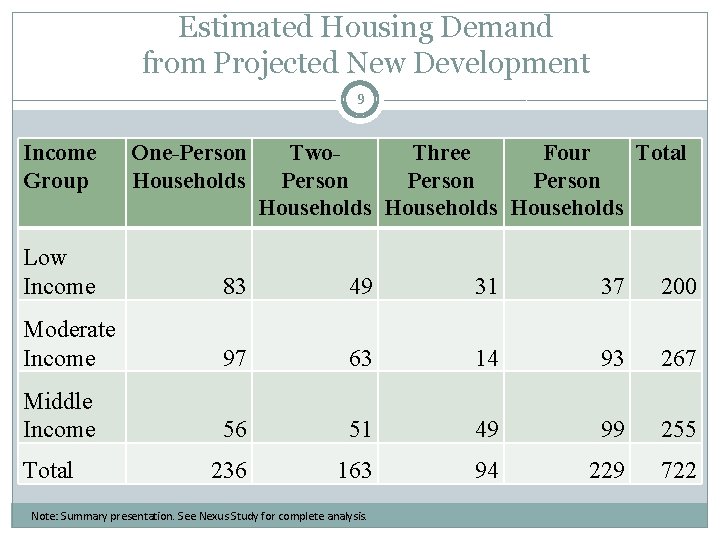
Estimated Housing Demand from Projected New Development 9 Income Group One-Person Households Low Income 83 49 31 37 200 Moderate Income 97 63 14 93 267 Middle Income 56 51 49 99 255 236 163 94 229 722 Total Two. Three Four Total Person Households Note: Summary presentation. See Nexus Study for complete analysis.

Housing Mix Assumptions in Calculations 10 � Rental and Ownership Units Low-income units are all rental units Moderate income units are 30% ownership/70% rental Middle income units are 50% ownership/50% rental � Unit Size One person households are 100% one BR units Two person households are 20% one BR /80% two BR units Three person households are 80% two BR/20% three BR units Four person or larger households are 100% three BR units 1 BR Units Rental Ownership Total Units 2 BR Units 191 78 269 Note: Summary presentation. See Nexus Study for complete analysis. 134 72 206 3 BR Units 146 101 247 Total 471 251 722
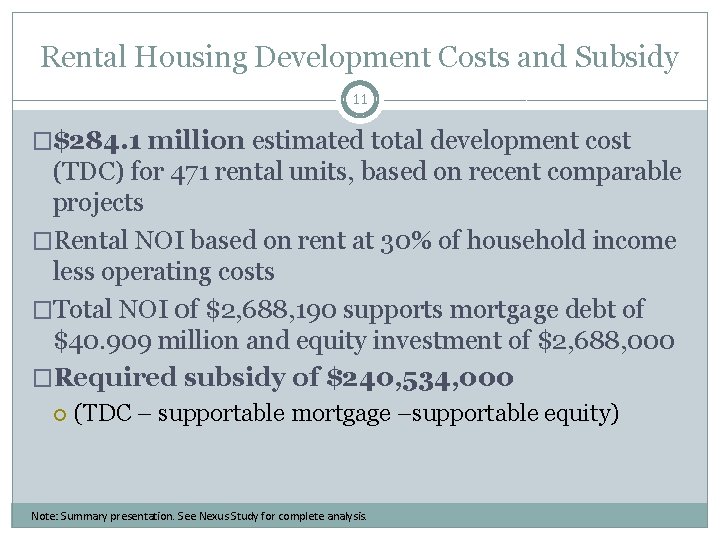
Rental Housing Development Costs and Subsidy 11 �$284. 1 million estimated total development cost (TDC) for 471 rental units, based on recent comparable projects �Rental NOI based on rent at 30% of household income less operating costs �Total NOI 0 f $2, 688, 190 supports mortgage debt of $40. 909 million and equity investment of $2, 688, 000 �Required subsidy of $240, 534, 000 (TDC – supportable mortgage –supportable equity) Note: Summary presentation. See Nexus Study for complete analysis.
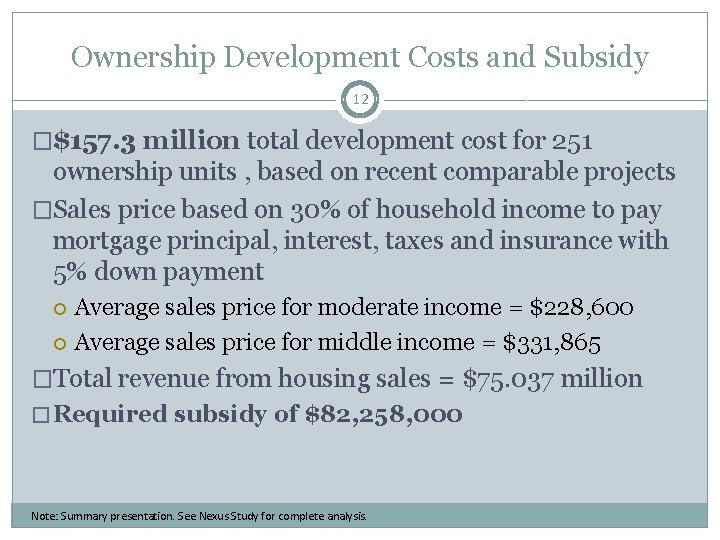
Ownership Development Costs and Subsidy 12 �$157. 3 million total development cost for 251 ownership units , based on recent comparable projects �Sales price based on 30% of household income to pay mortgage principal, interest, taxes and insurance with 5% down payment Average sales price for moderate income = $228, 600 Average sales price for middle income = $331, 865 �Total revenue from housing sales = $75. 037 million � Required subsidy of $82, 258, 000 Note: Summary presentation. See Nexus Study for complete analysis.
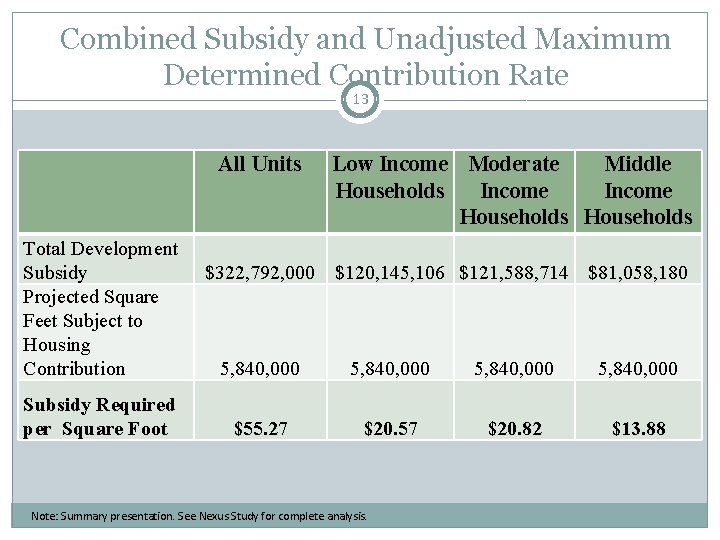
Combined Subsidy and Unadjusted Maximum Determined Contribution Rate 13 Total Development Subsidy Projected Square Feet Subject to Housing Contribution Subsidy Required per Square Foot All Units Low Income Moderate Middle Households Income Households $322, 792, 000 $120, 145, 106 $121, 588, 714 $81, 058, 180 5, 840, 000 $55. 27 $20. 57 $20. 82 $13. 88 Note: Summary presentation. See Nexus Study for complete analysis.
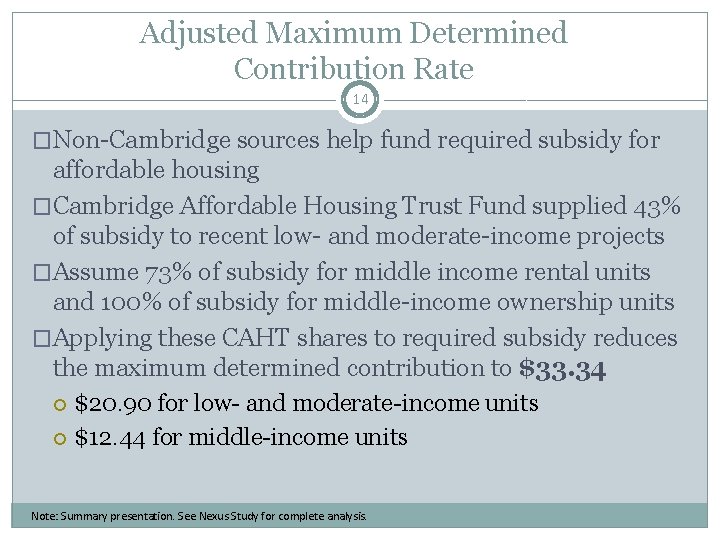
Adjusted Maximum Determined Contribution Rate 14 �Non-Cambridge sources help fund required subsidy for affordable housing �Cambridge Affordable Housing Trust Fund supplied 43% of subsidy to recent low- and moderate-income projects �Assume 73% of subsidy for middle income rental units and 100% of subsidy for middle-income ownership units �Applying these CAHT shares to required subsidy reduces the maximum determined contribution to $33. 34 $20. 90 for low- and moderate-income units $12. 44 for middle-income units Note: Summary presentation. See Nexus Study for complete analysis.
Job Contribution Nexus 15 �New development creates employment opportunities for Cambridge residents Focus on occupations for lower skilled workers �Education and training services will be needed to address labor supply gap and prepare Cambridge residents to access to these jobs Occupational training English language, math skills and ESOL �If existing services are insufficient to meet needs, contributions are warranted to fund this service gap Note: Summary presentation. See Nexus Study for complete analysis.
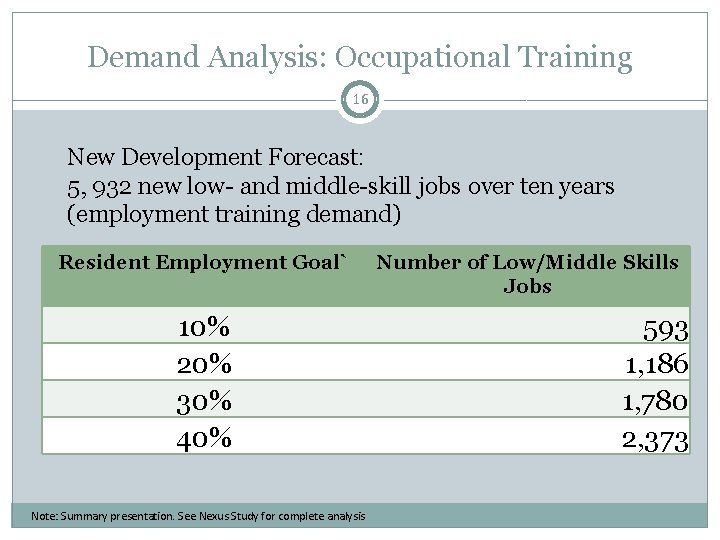
Demand Analysis: Occupational Training 16 New Development Forecast: 5, 932 new low- and middle-skill jobs over ten years (employment training demand) Resident Employment Goal` 10% 20% 30% 40% Note: Summary presentation. See Nexus Study for complete analysis Number of Low/Middle Skills Jobs 593 1, 186 1, 780 2, 373
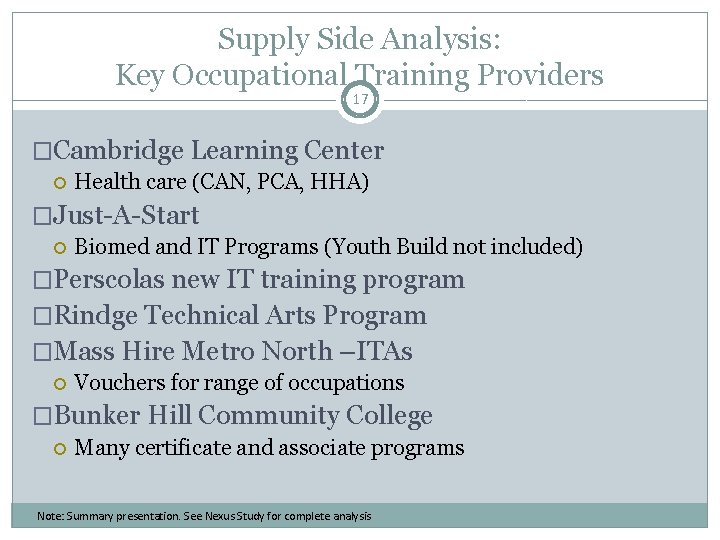
Supply Side Analysis: Key Occupational Training Providers 17 �Cambridge Learning Center Health care (CAN, PCA, HHA) �Just-A-Start Biomed and IT Programs (Youth Build not included) �Perscolas new IT training program �Rindge Technical Arts Program �Mass Hire Metro North –ITAs Vouchers for range of occupations �Bunker Hill Community College Many certificate and associate programs Note: Summary presentation. See Nexus Study for complete analysis
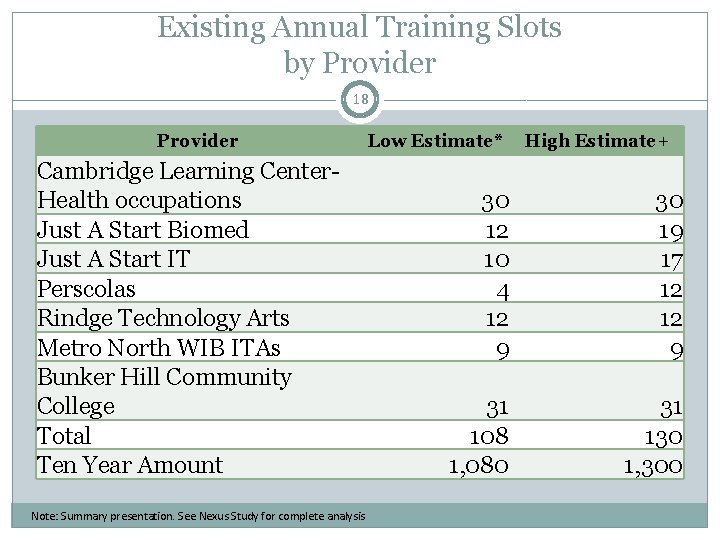
Existing Annual Training Slots by Provider 18 Provider Cambridge Learning Center. Health occupations Just A Start Biomed Just A Start IT Perscolas Rindge Technology Arts Metro North WIB ITAs Bunker Hill Community College Total Ten Year Amount Note: Summary presentation. See Nexus Study for complete analysis Low Estimate* High Estimate+ 30 12 10 4 12 9 30 19 17 12 12 9 31 108 1, 080 31 130 1, 300
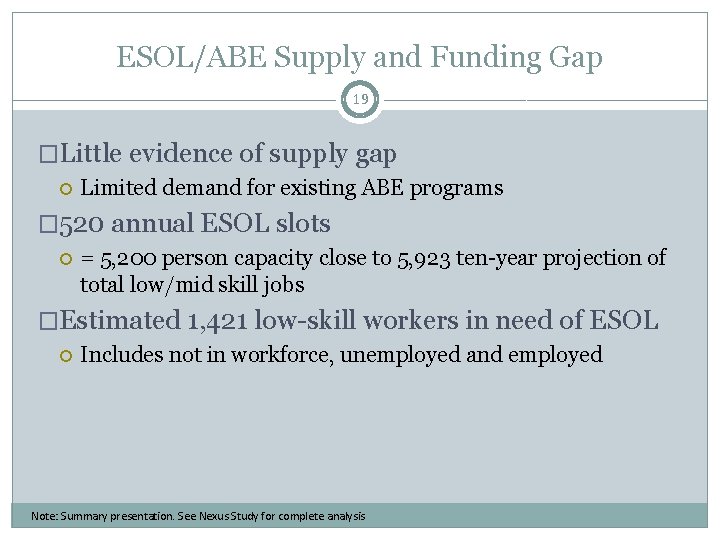
ESOL/ABE Supply and Funding Gap 19 �Little evidence of supply gap Limited demand for existing ABE programs � 520 annual ESOL slots = 5, 200 person capacity close to 5, 923 ten-year projection of total low/mid skill jobs �Estimated 1, 421 low-skill workers in need of ESOL Includes not in workforce, unemployed and employed Note: Summary presentation. See Nexus Study for complete analysis
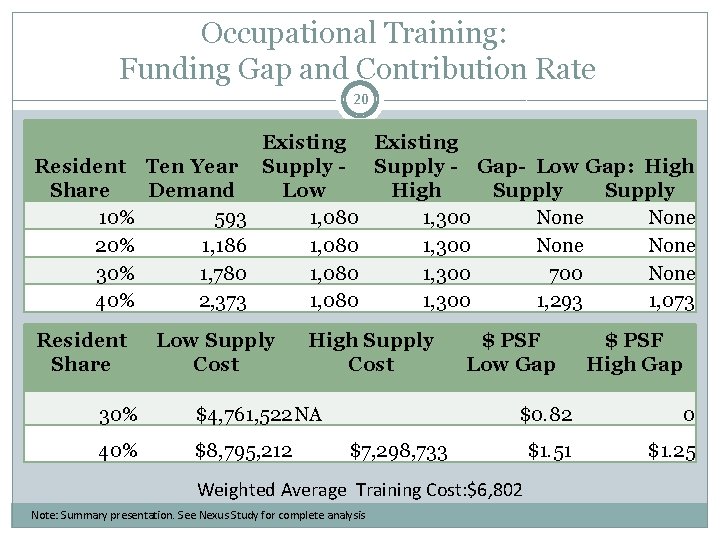
Occupational Training: Funding Gap and Contribution Rate 20 Resident Ten Year Share Demand 10% 593 20% 1, 186 30% 1, 780 40% 2, 373 Resident Share Existing Supply - Gap- Low Gap: High Low High Supply 1, 080 1, 300 None 1, 080 1, 300 700 None 1, 080 1, 300 1, 293 1, 073 Low Supply Cost High Supply Cost 30% $4, 761, 522 NA 40% $8, 795, 212 $ PSF Low Gap $0. 82 0 $1. 51 $1. 25 $7, 298, 733 Weighted Average Training Cost: $6, 802 Note: Summary presentation. See Nexus Study for complete analysis $ PSF High Gap
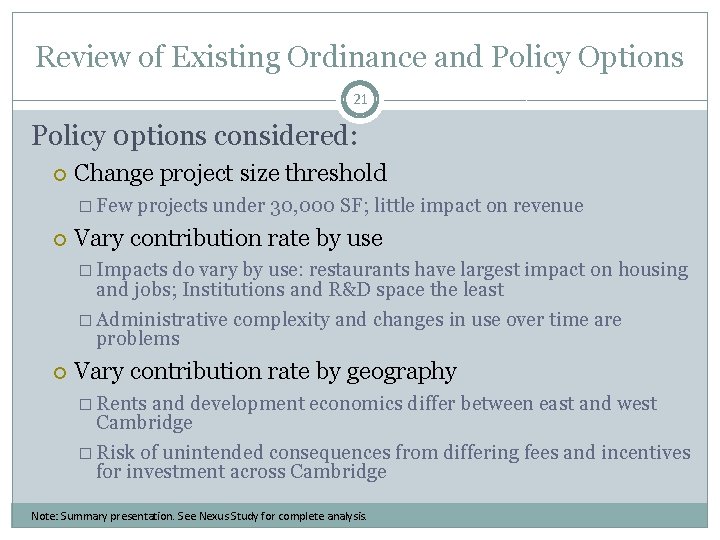
Review of Existing Ordinance and Policy Options 21 Policy 0 ptions considered: Change project size threshold � Few projects under 30, 000 SF; little impact on revenue Vary contribution rate by use � Impacts do vary by use: restaurants have largest impact on housing and jobs; Institutions and R&D space the least � Administrative complexity and changes in use over time are problems Vary contribution rate by geography � Rents and development economics differ between east and west Cambridge � Risk of unintended consequences from differing fees and incentives for investment across Cambridge Note: Summary presentation. See Nexus Study for complete analysis.
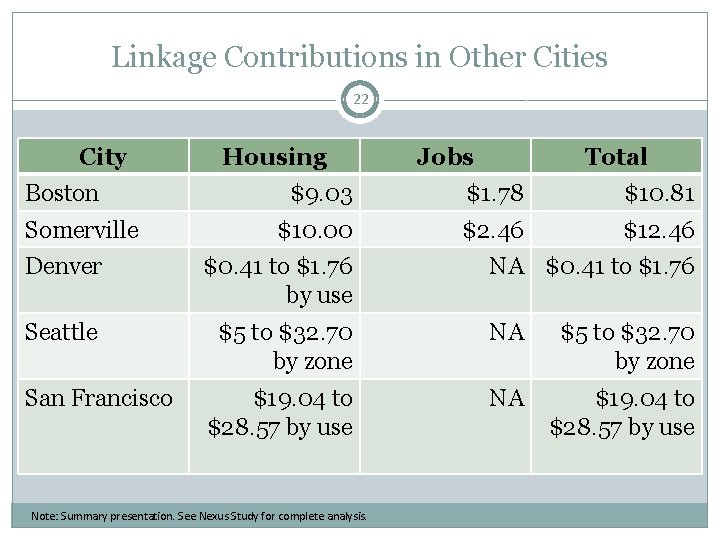
Linkage Contributions in Other Cities 22 City Boston Somerville Housing Jobs Total $9. 03 $1. 78 $10. 81 $10. 00 $2. 46 $12. 46 Denver $0. 41 to $1. 76 by use Seattle $5 to $32. 70 by zone NA $5 to $32. 70 by zone $19. 04 to $28. 57 by use NA $19. 04 to $28. 57 by use San Francisco Note: Summary presentation. See Nexus Study for complete analysis. NA $0. 41 to $1. 76
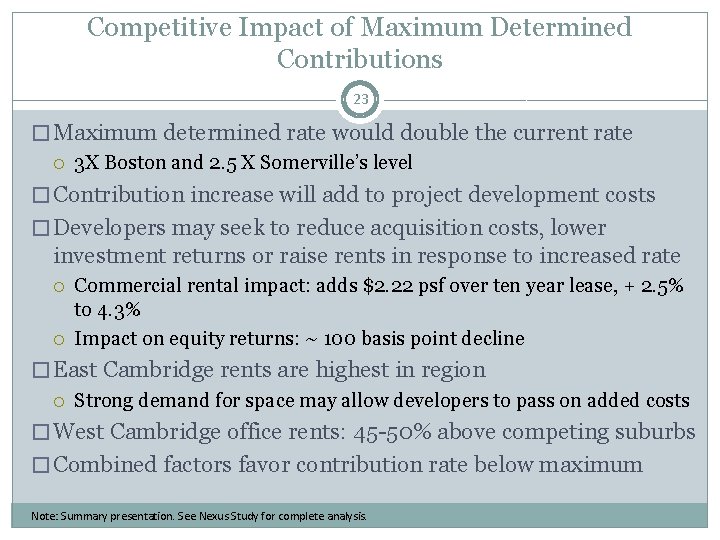
Competitive Impact of Maximum Determined Contributions 23 � Maximum determined rate would double the current rate 3 X Boston and 2. 5 X Somerville’s level � Contribution increase will add to project development costs � Developers may seek to reduce acquisition costs, lower investment returns or raise rents in response to increased rate Commercial rental impact: adds $2. 22 psf over ten year lease, + 2. 5% to 4. 3% Impact on equity returns: ~ 100 basis point decline � East Cambridge rents are highest in region Strong demand for space may allow developers to pass on added costs � West Cambridge office rents: 45 -50% above competing suburbs � Combined factors favor contribution rate below maximum Note: Summary presentation. See Nexus Study for complete analysis.
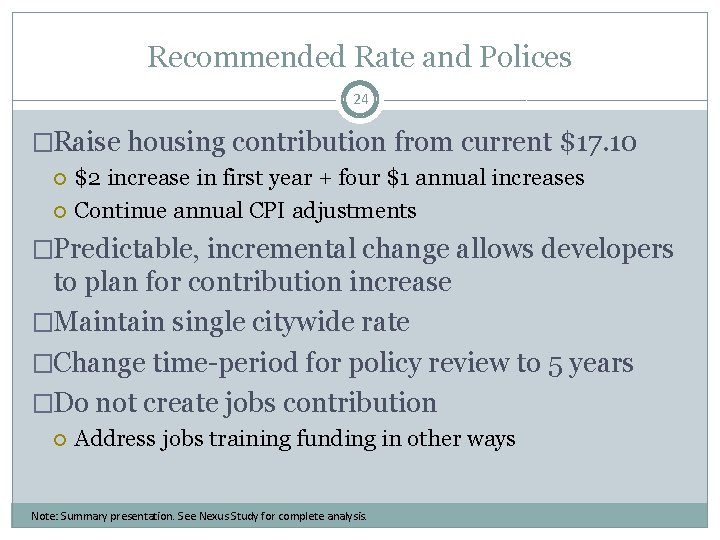
Recommended Rate and Polices 24 �Raise housing contribution from current $17. 10 $2 increase in first year + four $1 annual increases Continue annual CPI adjustments �Predictable, incremental change allows developers to plan for contribution increase �Maintain single citywide rate �Change time-period for policy review to 5 years �Do not create jobs contribution Address jobs training funding in other ways Note: Summary presentation. See Nexus Study for complete analysis.
- Slides: 24