
Cambodia Export Diversification and Expansion ITC logo Program

Cambodia Export Diversification and Expansion ITC logo Program (CEDEP I)/High Value silk project EXTRACTION AND APPLICATION OF NATURAL DAYES FOR SILK AND COTTON Chomnab HO National consultant Phnom Penh, June 2 -4, 2014
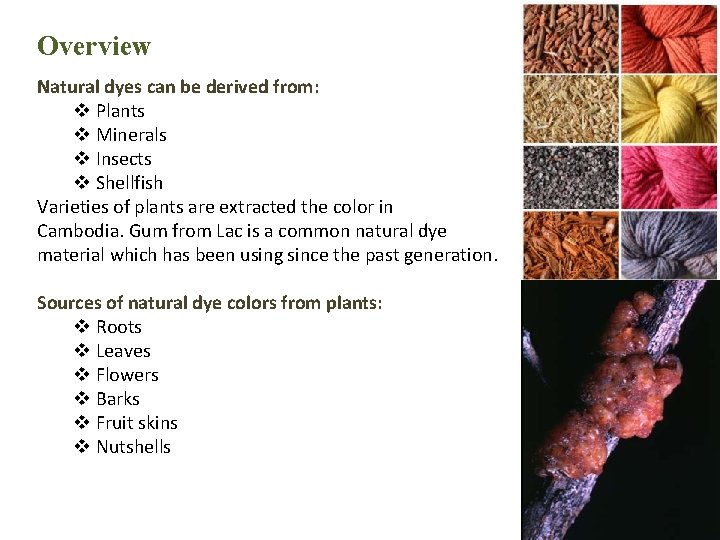
Overview Natural dyes can be derived from: v Plants v Minerals v Insects v Shellfish Varieties of plants are extracted the color in Cambodia. Gum from Lac is a common natural dye material which has been using since the past generation. Sources of natural dye colors from plants: v Roots v Leaves v Flowers v Barks v Fruit skins v Nutshells
Characteristics of natural dyes – eco-friendly – harmless – non-toxic Hue or shade of the color is dependent on: v. Soil vweather conditions v. Time of year the plants is harvested v. Age of plant
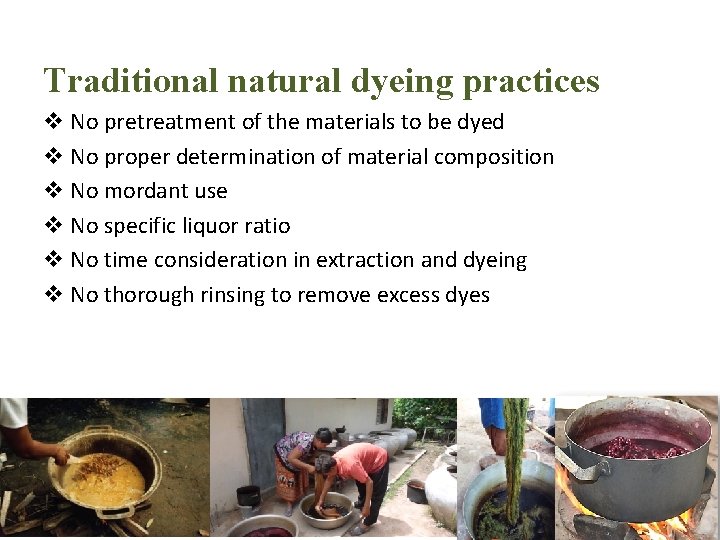
Traditional natural dyeing practices v No pretreatment of the materials to be dyed v No proper determination of material composition v No mordant use v No specific liquor ratio v No time consideration in extraction and dyeing v No thorough rinsing to remove excess dyes
Effects of poor natural dyeing practices v. Poor colorfastness v. Low breaking strength v. Differences in shades v. Uneven dyeing v. Poor quality of end products
Natural dyeing parameters v. Dyeing time v. Temperature v. Liquor ratio vp. H v. Dyeing method v. Mordant and dye concentration (lightness and darkness of the dye) v. Mordanting process Ø Materials to be dyed is completely wet and entirely submerged in the dyeing solution to attain even dying Ø All dyed materials must be rushed thoroughly prior to dyeing to prevent bleeding and staining
Good Practice on Natural Dyes Standardized and upgraded natural dye extraction and textile application processes vmore efficient and faster methods of extraction and dyeing than traditional method vincrease dye yield vimproved colorfastness vshade reproducibility vincreased productivity
Factors affecting dye yield productivity Size of dye parts The smaller the cut or size of the plants used, the better the color yield produced due to the larger surface area that is exposed which allows better solvent water penetration of the dye parts Liquor ratio (LR) LR ratio of the materials to be dyed to the volume of water to be used for the dye extraction The volume is maintained by adding hot water to the dye extract to compensate the water loss. Extraction method Time for dye extraction PH Temperature
Pretreatment Process Degumming of silk – to remove sericin to achieve better dye ability, colorfastness properties and dye affinity Time: 45 -90 mm Temperature: Boiling Liquor Ration 1: 30 15% grated dish washing soap 5% soda ash 2% sodium hydrosulfite Washed 6 times in water at gradual lowering of temperature. Soak in 2 g/L acetic acid solution for 15 min Washed thoroughly with tap water Air dried
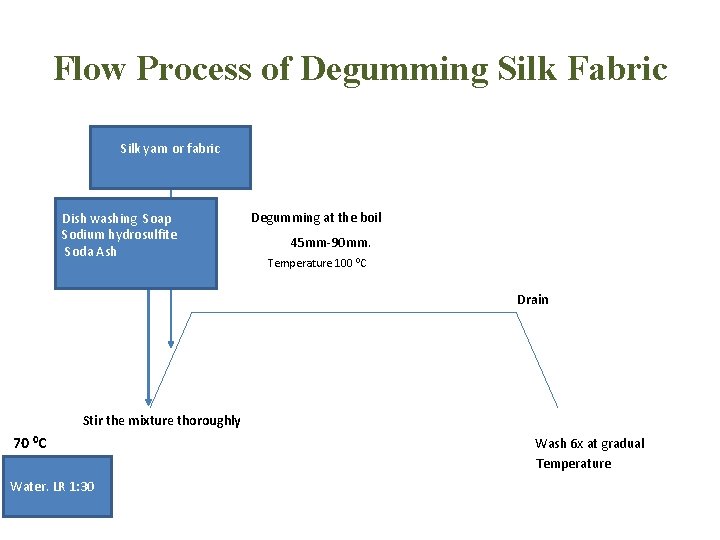
Flow Process of Degumming Silk Fabric Silk yarn or fabric Dish washing Soap Sodium hydrosulfite Soda Ash Degumming at the boil 45 mm-90 mm. Temperature 100 0 C Drain Stir the mixture thoroughly 70 0 C Water. LR 1: 30 Wash 6 x at gradual Temperature
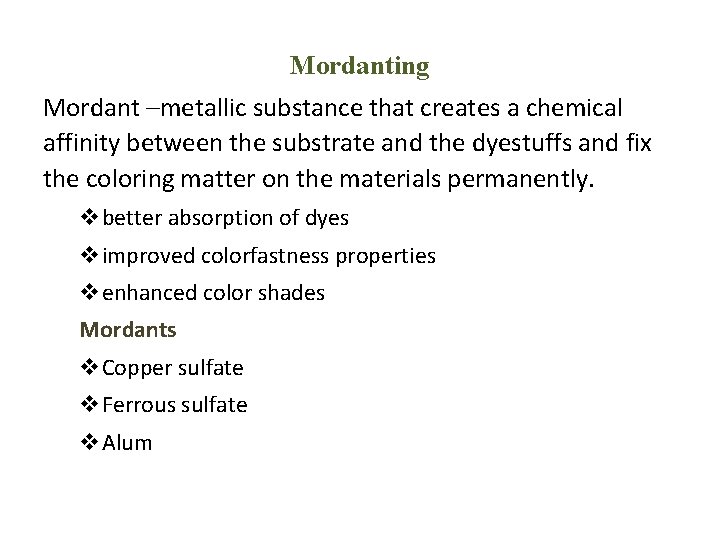
Mordanting Mordant –metallic substance that creates a chemical affinity between the substrate and the dyestuffs and fix the coloring matter on the materials permanently. vbetter absorption of dyes vimproved colorfastness properties venhanced color shades Mordants v. Copper sulfate v. Ferrous sulfate v. Alum
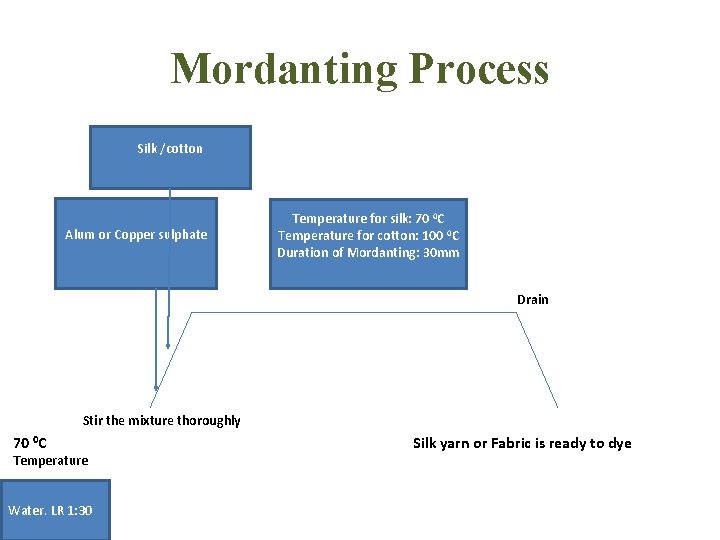
Mordanting Process Silk /cotton Alum or Copper sulphate Temperature for silk: 70 0 C Temperature for cotton: 100 0 C Duration of Mordanting: 30 mm Drain Stir the mixture thoroughly 70 0 C Temperature Water. LR 1: 30 Silk yarn or Fabric is ready to dye
INTRODUCTION OF NATURAL DYE MATERIAL
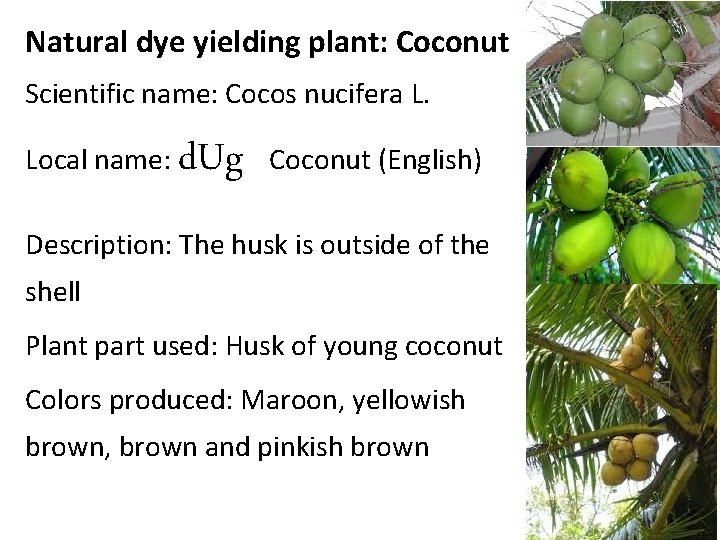
Natural dye yielding plant: Coconut Scientific name: Cocos nucifera L. Local name: d. Ug Coconut (English) Description: The husk is outside of the shell Plant part used: Husk of young coconut Colors produced: Maroon, yellowish brown, brown and pinkish brown
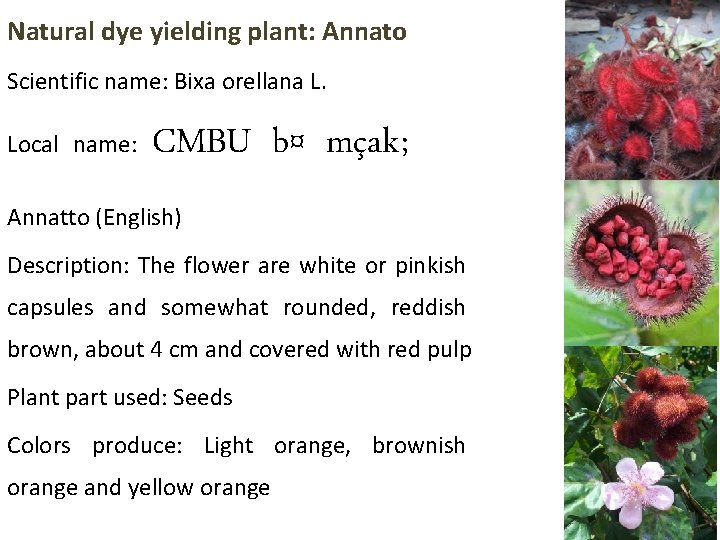
Natural dye yielding plant: Annato Scientific name: Bixa orellana L. Local name: CMBU b¤ mçak; Annatto (English) Description: The flower are white or pinkish capsules and somewhat rounded, reddish brown, about 4 cm and covered with red pulp Plant part used: Seeds Colors produce: Light orange, brownish orange and yellow orange
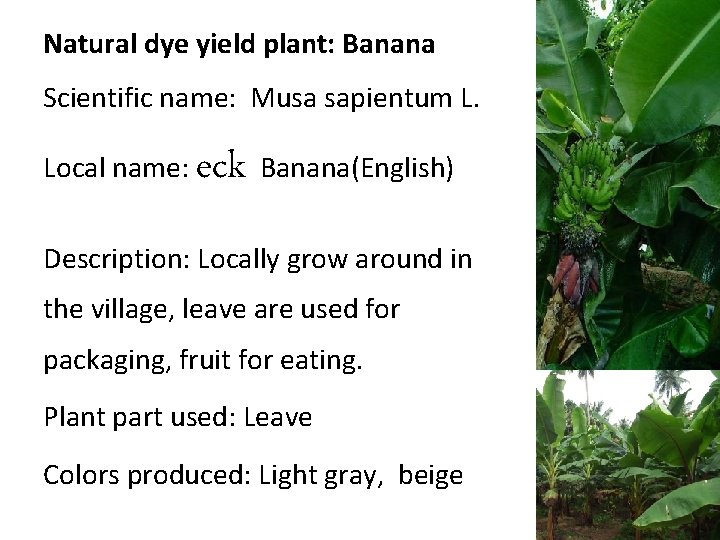
Natural dye yield plant: Banana Scientific name: Musa sapientum L. Local name: eck Banana(English) Description: Locally grow around in the village, leave are used for packaging, fruit for eating. Plant part used: Leave Colors produced: Light gray, beige
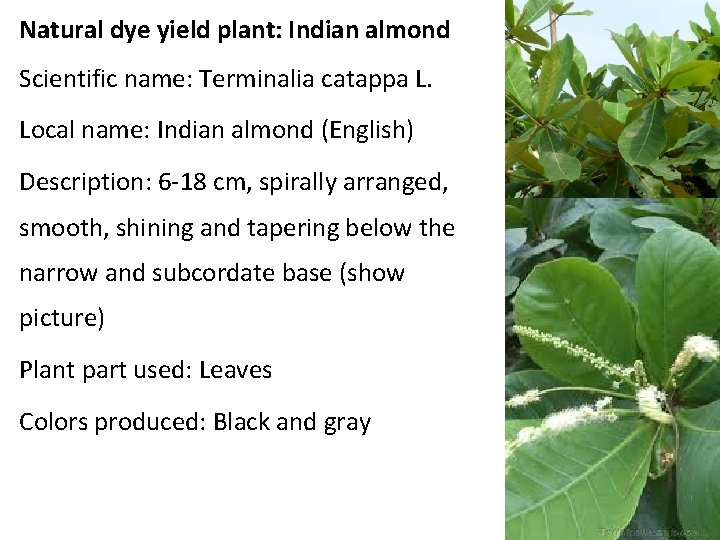
Natural dye yield plant: Indian almond Scientific name: Terminalia catappa L. Local name: Indian almond (English) Description: 6 -18 cm, spirally arranged, smooth, shining and tapering below the narrow and subcordate base (show picture) Plant part used: Leaves Colors produced: Black and gray
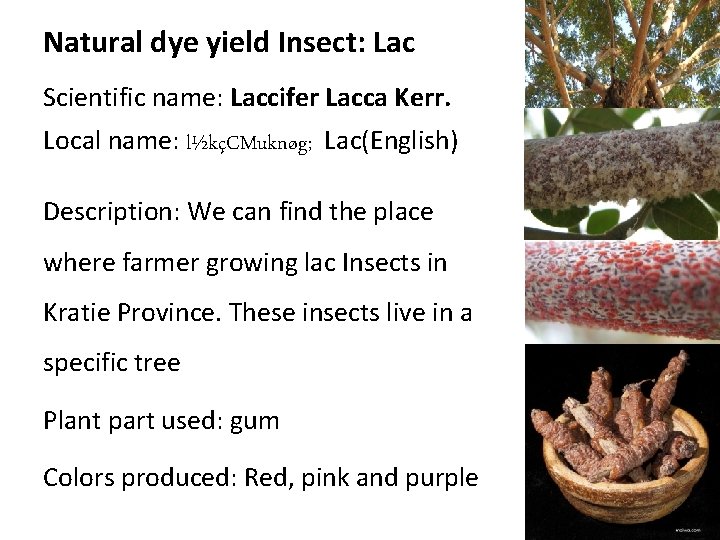
Natural dye yield Insect: Lac Scientific name: Laccifer Lacca Kerr. Local name: l½kçCMuknøg; Lac(English) Description: We can find the place where farmer growing lac Insects in Kratie Province. These insects live in a specific tree Plant part used: gum Colors produced: Red, pink and purple
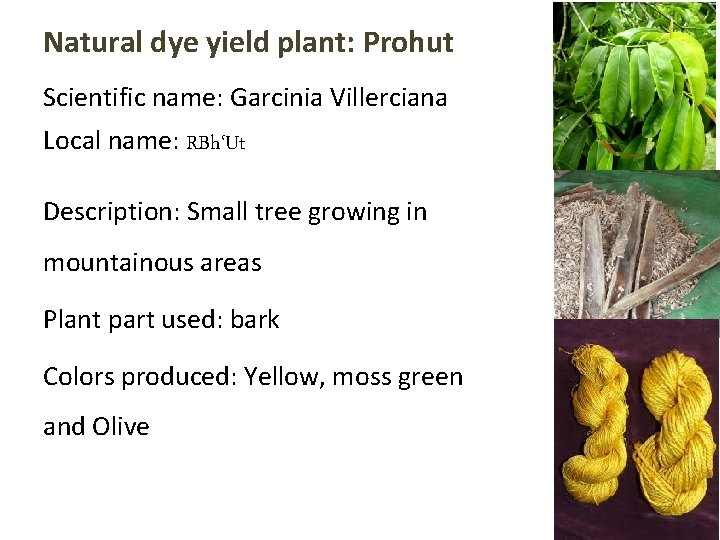
Natural dye yield plant: Prohut Scientific name: Garcinia Villerciana Local name: RBh‘Ut Description: Small tree growing in mountainous areas Plant part used: bark Colors produced: Yellow, moss green and Olive
DYE EXTRACTION PROCESS
Dye Extraction Process Extraction of natural dyes from plant parts (bark, leaves, seeds, flowers) is the process of harnessing the pigment from the dye source. This is usually done by boiling of barks, woods, seeds and/or rhizomes while, fermentation and maceration are efficient for leaves and flowers, respectively. Prior thereto, plant parts are chopped/cut into smaller sizes for more effective dye extraction as characterized by higher color intensity of the extract.
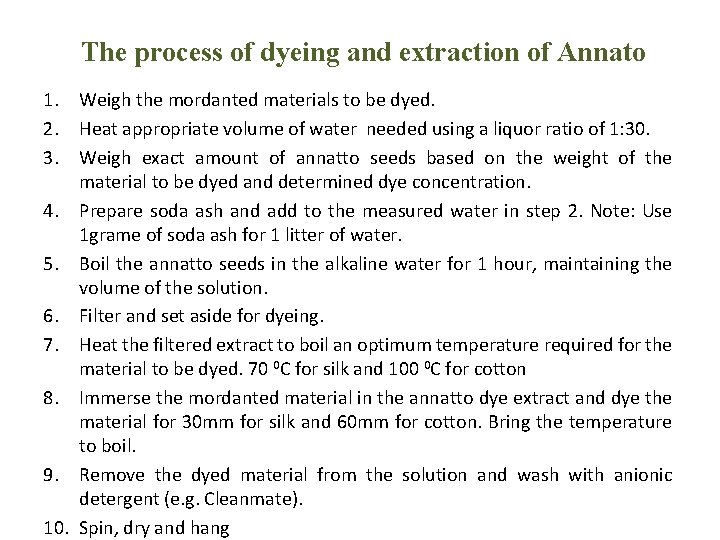
The process of dyeing and extraction of Annato 1. Weigh the mordanted materials to be dyed. 2. Heat appropriate volume of water needed using a liquor ratio of 1: 30. 3. Weigh exact amount of annatto seeds based on the weight of the material to be dyed and determined dye concentration. 4. Prepare soda ash and add to the measured water in step 2. Note: Use 1 grame of soda ash for 1 litter of water. 5. Boil the annatto seeds in the alkaline water for 1 hour, maintaining the volume of the solution. 6. Filter and set aside for dyeing. 7. Heat the filtered extract to boil an optimum temperature required for the material to be dyed. 70 0 C for silk and 100 0 C for cotton 8. Immerse the mordanted material in the annatto dye extract and dye the material for 30 mm for silk and 60 mm for cotton. Bring the temperature to boil. 9. Remove the dyed material from the solution and wash with anionic detergent (e. g. Cleanmate). 10. Spin, dry and hang
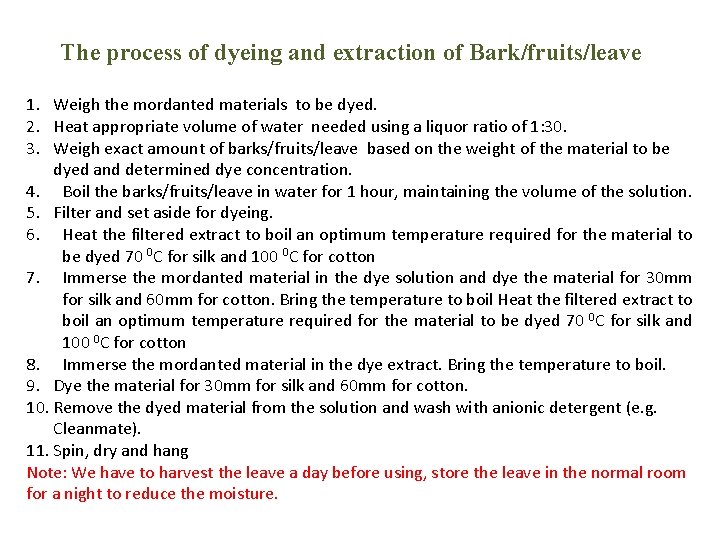
The process of dyeing and extraction of Bark/fruits/leave 1. Weigh the mordanted materials to be dyed. 2. Heat appropriate volume of water needed using a liquor ratio of 1: 30. 3. Weigh exact amount of barks/fruits/leave based on the weight of the material to be dyed and determined dye concentration. 4. Boil the barks/fruits/leave in water for 1 hour, maintaining the volume of the solution. 5. Filter and set aside for dyeing. 6. Heat the filtered extract to boil an optimum temperature required for the material to be dyed 70 0 C for silk and 100 0 C for cotton 7. Immerse the mordanted material in the dye solution and dye the material for 30 mm for silk and 60 mm for cotton. Bring the temperature to boil Heat the filtered extract to boil an optimum temperature required for the material to be dyed 70 0 C for silk and 100 0 C for cotton 8. Immerse the mordanted material in the dye extract. Bring the temperature to boil. 9. Dye the material for 30 mm for silk and 60 mm for cotton. 10. Remove the dyed material from the solution and wash with anionic detergent (e. g. Cleanmate). 11. Spin, dry and hang Note: We have to harvest the leave a day before using, store the leave in the normal room for a night to reduce the moisture.
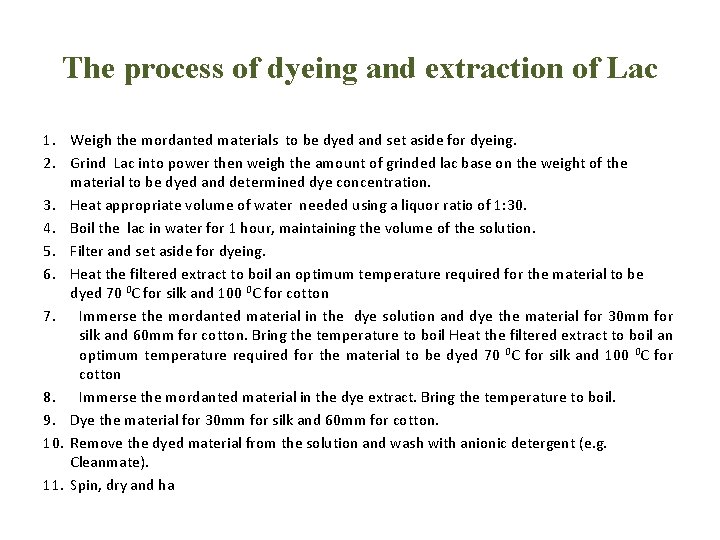
The process of dyeing and extraction of Lac 1. Weigh the mordanted materials to be dyed and set aside for dyeing. 2. Grind Lac into power then weigh the amount of grinded lac base on the weight of the material to be dyed and determined dye concentration. 3. Heat appropriate volume of water needed using a liquor ratio of 1: 30. 4. Boil the lac in water for 1 hour, maintaining the volume of the solution. 5. Filter and set aside for dyeing. 6. Heat the filtered extract to boil an optimum temperature required for the material to be dyed 70 0 C for silk and 100 0 C for cotton 7. Immerse the mordanted material in the dye solution and dye the material for 30 mm for silk and 60 mm for cotton. Bring the temperature to boil Heat the filtered extract to boil an optimum temperature required for the material to be dyed 70 0 C for silk and 100 0 C for cotton 8. Immerse the mordanted material in the dye extract. Bring the temperature to boil. 9. Dye the material for 30 mm for silk and 60 mm for cotton. 10. Remove the dyed material from the solution and wash with anionic detergent (e. g. Cleanmate). 11. Spin, dry and ha
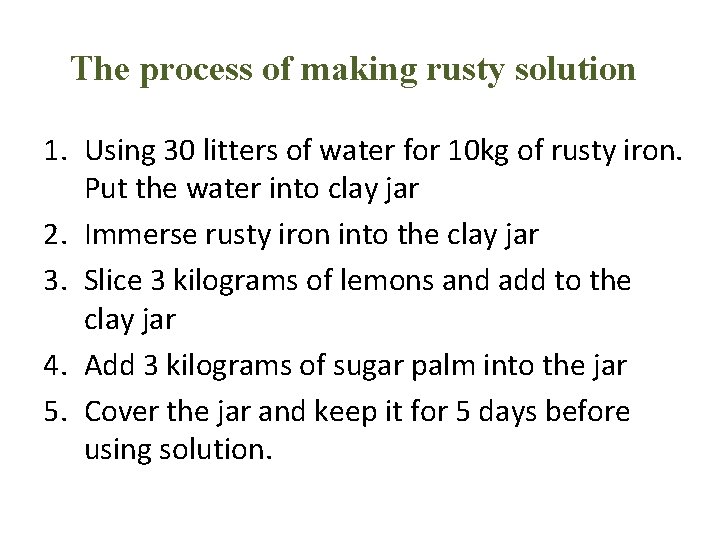
The process of making rusty solution 1. Using 30 litters of water for 10 kg of rusty iron. Put the water into clay jar 2. Immerse rusty iron into the clay jar 3. Slice 3 kilograms of lemons and add to the clay jar 4. Add 3 kilograms of sugar palm into the jar 5. Cover the jar and keep it for 5 days before using solution.
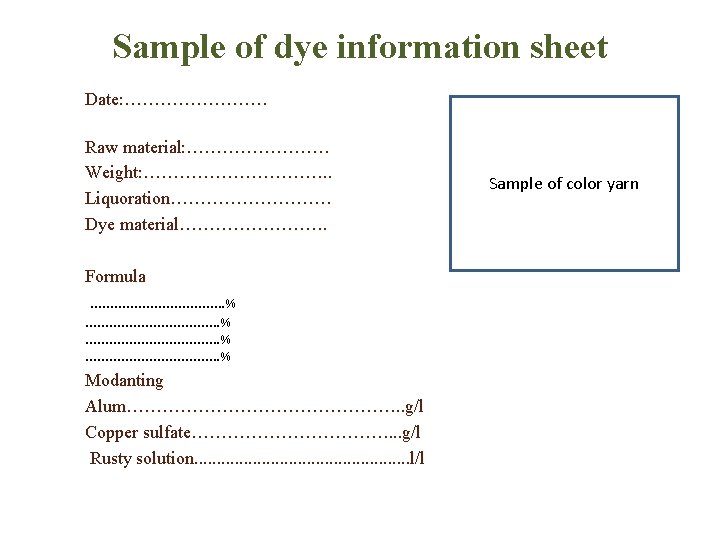
Sample of dye information sheet Date: ………… Raw material: ………… Weight: ……………. . Liquoration…………… Dye material…………. Formula ……………………………. % Modanting Alum……………………. . g/l Copper sulfate………………. . . g/l Rusty solution. . . l/l Sample of color yarn
- Slides: 26