
Calvin Cycle n Uses ATP and NADPH to
- Slides: 11
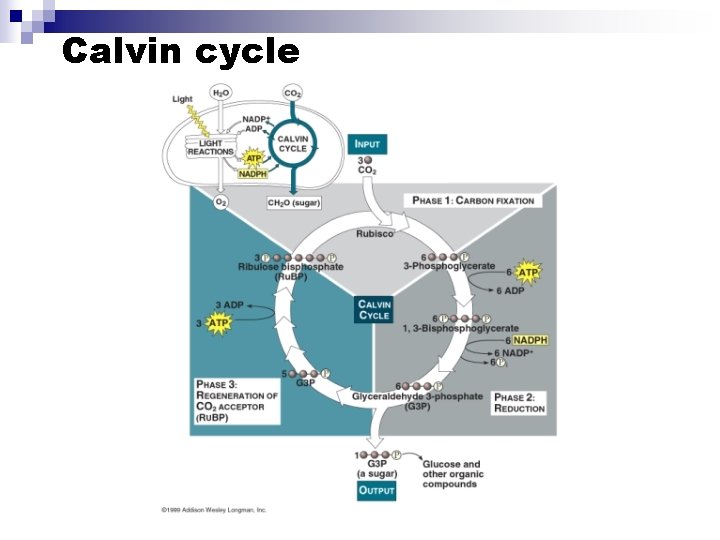
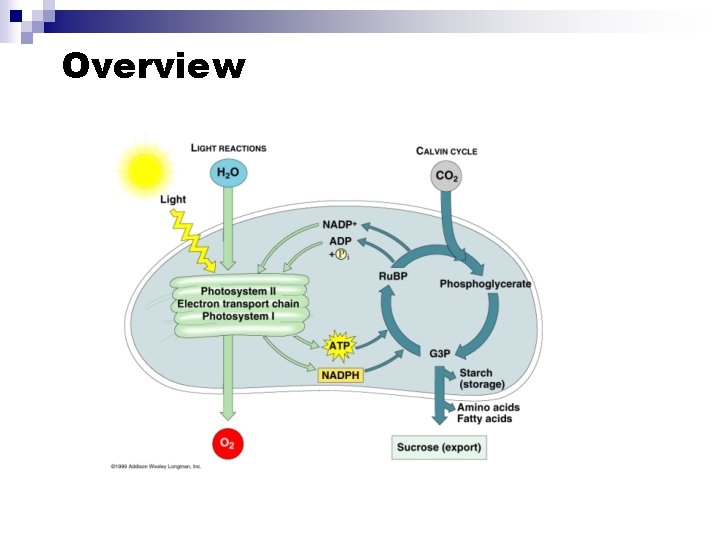
Calvin Cycle n Uses ATP and NADPH to convert CO 2 to glucose or other sugars Glyceraldehyde-3 -phosphate is final product of Calvin cycle ¨ G 3 P can easily be converted to glucose or other sugars ¨ n n Cycle because CO 2 acceptor is regenerated during the process 3 CO 2 molecules (and 3 cycles) are needed to produce on net G 3 P molecule
Calvin cycle
Calvin cycle-Carbon fixation n n Carbon from CO 2 is added to organic acceptor and can then be used for synthesis Ribulose biphosphate (Ru. BP) is the acceptor 5 carbon sugar ¨ Rubisco (Ribulose biphosphate carboxylase) is the enzyme that adds the new carbon to Ru. BP ¨ n ¨ Most common enzyme on earth Results in a 6 carbon molecule that immediately degrades into two three carbon molecules-3 phosphoglycerate s n has carboxyl group
Calvin Cycle-Reduction n ATP is used to phosphorylate 3 -Phosphoglycerate New molecule is 1, 3 -Bisphoglycerate ¨ Activated intermediate ¨ n Electrons from NADPH are used to reduce 1, 3 Bisphoglycerate Results in a carbonyl group ¨ Sugars have carbonyl group ¨ G 3 P is produced and it is a 3 carbon sugar ¨ n For every 6 G 3 P molecules produced-5 are recycled and one can be used for anabolic rxns
Calvin Cycle-Regeneration n Uses 5 molecules of G 3 P to produce 3 molecules of Ru. BP ¨ Requires ATP to perform this task n n n This is why more ATP is needed than NADPH Without regeneration of G 3 P, this would not be a cyclical reaction Ru. BP is ready to act as Carbon acceptor fixation stage
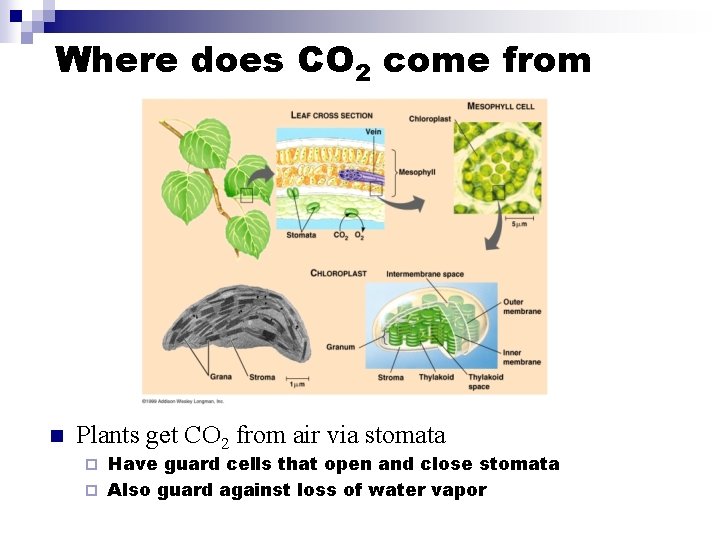
Where does CO 2 come from n Plants get CO 2 from air via stomata Have guard cells that open and close stomata ¨ Also guard against loss of water vapor ¨
Photorespiration n n Happens in many plants during hot daytime conditions-soybeanss Guard cells close stomata to prevent water loss Unable to take up new CO 2 molecules ¨ Oxygen: CO 2 ration shifts ¨ n Rubisco uses O 2 instead of CO 2 ¨ Eventually yields CO 2 for Calvin cycle but so much effort was expended it is a net loss for plant
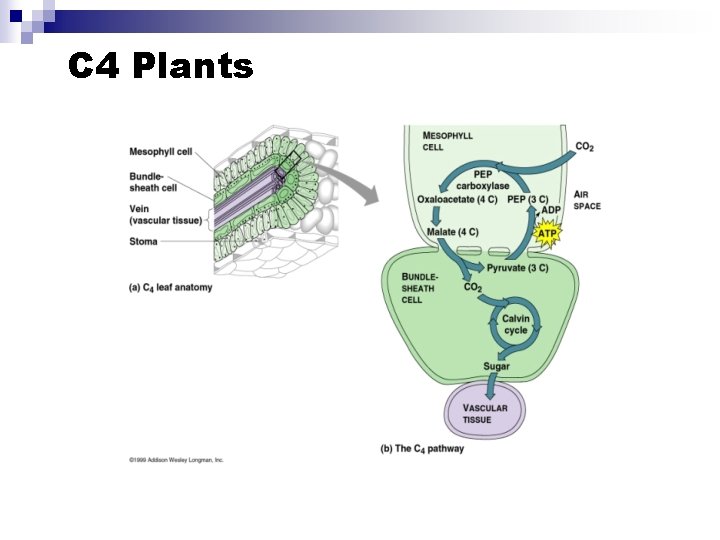
C 4 Plants n n n Way to avoid photorespiration Takes place in grasses like corn Two types of tissue for photosynthesis First acts like antechamber-Mesophyll cell ¨ PEP carboxylase has higher affinity for CO 2 than Rubisco ¨ n n Adds Carbon from CO 2 onto PEP to form Oxaloacetate Eventually CO 2 is released into adjacent Bundle Sheath cell where Calvin takes place Maintains high CO 2 to O 2 ratio in BSC ¨ Rubisco can still use CO 2 ¨
C 4 Plants
CAM Plants n n Pineapples, cacti and other succulents Similar to C 4 ¨ n Stomata open during night to take in CO 2 ¨ n Way to get around photorespiration Carbon is stored in an organic acid molecule During daylight (when light cylce produces ATP and NADPH) organic acids degrade releasing CO 2 into the Calvin Cycle
Overview