
CalOSHA and COVID19 Workplace Safety for Logistics Trucking












- Slides: 38
Cal/OSHA and COVID-19 Workplace Safety for Logistics, Trucking, and Shipping Businesses Presented by: Kevin Bland Karen Tynan
Agenda • Present CA Situation – brief update by Karen Tynan • Potentially Applicable Regulations to COVID-19 Pandemic • Section 3203 – Injury Illness Prevention Plan – Kevin Bland • Section 3380 – Personal Protective Devices - Karen Tynan and Kevin Bland • Section 5144 – Respiratory Protection – Karen Tynan • Cal/OSHA Guidance and Recommendations Kevin Bland • Including Cal/OSHA Guidance for Logistics Employers published May 2020 • Inspection Scenarios • Frequently Asked Questions (FAQs) – Karen Tynan
TODAY California OSHA offices remain open with limited capability, including: • Responding to queries and complaints • Advising employers as needed on COVID-19 • Permits via phone conference • Informal Settlement Conferences via phone • Posting advice and guidance online • Inspections / Investigations are happening
California Workplace Safety Regulations COVID-19
Section 3203 – Injury Illness Prevention Plan • Very familiar to California employers • California’s version of the general duty clause. • Requires employers to “establish, implement and maintain an effective Injury and Illness Prevention Program. ” • There are some specific provision under Section 3203 that can apply to the COVID-19 pandemic.
Section 3203 – Injury Illness Prevention Plan • Inspections shall be made to identify and evaluate work place hazards: • Whenever new substances, processes, procedures, or equipment are introduced to the workplace that represent a new occupational safety and health hazard; and • Whenever the employer is made aware of a new or previously unrecognized hazard. OUR HAZARD IS COVID-19
Section 3203 – Injury Illness Prevention Plan • When a hazard is discovered, there should be “methods and/or procedures for correcting unsafe or unhealthy conditions, work practices and work procedures in a timely manner based on the severity of the hazard. ” • “When an imminent hazard exists which cannot be immediately abated without endangering employee(s) and/or property, remove all exposed personnel from the area except those necessary to correct the existing condition. Employees necessary to correct the hazardous condition shall be provided the necessary safeguards. ”
Section 3203 Action Items Discussion 1. Identify COVID-19 in the workplace 2. Take action to minimize COVID-19 hazards 1. 2. 3. 4. 5. 6. 7. 8. Personnel and their work processes; Frequent, open, and honest communication with employees; Workplace; Cleaning; Training; Continuous monitoring of Cal/OSHA, CDC, Orders, Continuous evaluation and improvement of this work. Assessment of results.
REMEMBR HINDSIGHT WILL BE 20/20 Why didn’t you evaluate the hazard related to this class of employee? Wasn’t there a better way to minimize the risks to that employee? How did you expect the PPE to work related to COVID-19? Did you consider the risks to the workers when they had to perform this risky task? When PPE was not available, what did you do about that? Where are your documents that evidence your efforts regarding COVID 19?
PPE Today
Section 3380 – Personal Protective Devices The employer shall assess the workplace to determine if hazards are present, or are likely to be present, which necessitate the use of personal protective equipment (PPE). If such hazards are present, or likely to be present, the employer shall: • Select, and have each affected employee use, the types of PPE that will protect the affected employee from the hazards identified in the hazard assessment; • Communicate selection decisions to each affected employee; and, • Select PPE that properly fits each affected employee.
Section 3380 – Personal Protective Devices The employer shall verify that the required workplace hazard assessment has been performed through a written certification that identifies the workplace evaluated; the person certifying that the evaluation has been performed; the date(s) of the hazard assessment; and, which identifies the document as a certification of hazard assessment. Action Item: Document your hazard assessment and any actions taken with PPE including selection of PPE, communication to employees, training, and evaluation of how well the PPE is working for employees.
True or False? PPE includes face coverings provided by employees.
Section 3380 Personal Protective Devices Training REMINDER • Training. The employer shall provide training to each employee who is required by this section to use PPE. Each such employee shall be trained to know at least the following: • • • When PPE is necessary; What PPE is necessary; How to properly don, doff, adjust, and wear PPE; The limitations of the PPE; and, The proper care, maintenance, useful life and disposal of the PPE.
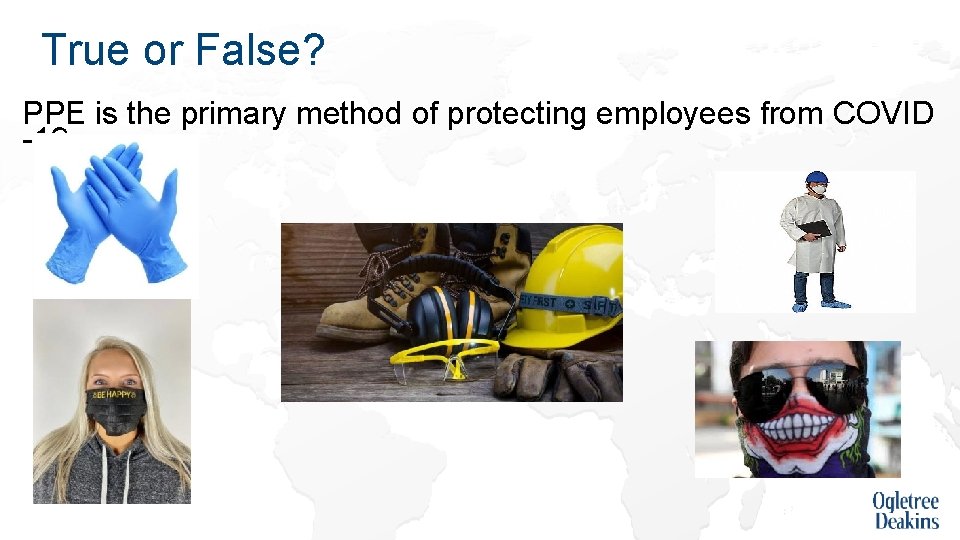
True or False? PPE is the primary method of protecting employees from COVID -19.
Section 3380 – Personal Protective Devices • Guidance for hazard assessment can be found in Appendix A. https: //www. dir. ca. gov/title 8/3380. html • A few items of guidance implicated by COVID-19 pandemic: • Do not rely on PPE alone. Consider administrative and engineering controls. • Survey. Conduct a walk-through survey of the areas in question. The purpose of the survey is to identify sources of hazards to workers and co -workers. • Sources. During the walk-through survey, the safety officer should observe potential sources of the virus. Pay attention to the layout of workplace and location of co-workers to achieve required social distancing.
SHORT SIDEBAR ON HIERARCHY OF CONTROLS
Section 5144 – Respiratory Protection • “Respirators shall be provided by the employer when such equipment is necessary to protect the health of the employee. ” • “The employer shall be responsible for the establishment and maintenance of a respiratory protection program…. ” • “ required worksite-specific procedures” • “program must be administered by a suitably trained program administrator”
Section 5144 – Respiratory Protection 1/2 The employer shall include in the program the following provisions, as applicable: (A) Procedures for selecting respirators for use in the workplace; (B) Medical evaluations of employees required to use respirators; (C) Fit testing procedures for tight-fitting respirators; (D) Procedures for proper use of respirators in routine and reasonably foreseeable emergency situations; (E) Procedures and schedules for cleaning, disinfecting, storing, inspecting, repairing, discarding, and otherwise maintaining respirators;
Section 5144 – Respiratory Protection 2/2 The employer shall include in the program the following provisions, as applicable: (A) Procedures to ensure adequate air quality, quantity, and flow of breathing air for atmosphere-supplying respirators; (B) Training of employees in the respiratory hazards to which they are potentially exposed during routine and emergency situations; (C) Training of employees in the proper use of respirators, including putting on and removing them, any limitations on their use, and their maintenance; and (D) Procedures for regularly evaluating the effectiveness of the program.
Section 5144 – Respiratory Protection Q. What are filtering facepieces (dust masks)? A. “Filtering facepieces means a negative pressure particulate respirator with a filter as an integral part of the facepiece or with the entire facepiece composed of the filtering medium. ” Q. Is an N 95 respirator a negative pressure particulate respirator? A. Yes. (see https: //www. osha. gov/lawsregs/standardinterpretations/2011 -11 -22 -0)
True or False I must allow an employee to voluntarily wear a respirator when it is not required. Answer Allowed if the employer complies with all three of the following: 1. The employer determines that such respirator use will not in itself create a hazard; 2. The employer provides respirator users with the information contained in Appendix D; and 3. The employer must establish and implement those elements of a written respiratory protection program necessary to ensure that any employee using a respirator voluntarily is medically able to use that respirator, and that the respirator is cleaned, stored, and maintained so that its use does not present a health hazard to the user. 1. Exception: Employers are not required to include in a written respiratory protection program those employees whose only use of respirators involves the voluntary use of filtering facepieces (dust masks).
SCENARIO Eugene works as a janitor at the loading dock and office area of a facility. He’s been provided with PPE whenever he works. He calls in and tells Mary in HR that he has tested positive for COVID-19 and has no other members of his household sick or positive. He thinks he must have gotten the virus at work. He’s home resting in bed and taking over the counter medications. No other workers have symptoms or tested positive for COVID-19. Should Mary record this as a workplace injury / illness? Should Mary report this as a workplace injury / illness?
Cal/OSHA Guidance COVID-19
Cal/OSHA Guidance for Logistics Employers • Training • Self-Screening before coming to work • Screening at work • Procedures to Prevent the Spread of COVID-19 • Procedures to Increase Physical Distancing • Good Hygiene / Sanitation • No sick employees at work • PPE • Signage
Cal/OSHA Guidance for General Industry • Regardless of COVID-19 risk, all employers must provide washing facilities that have an adequate supply of suitable cleansing agents, water and single-use towels or blowers (title 8 sections 1527, 3366, 3457 and 8397. 4).
Scenario – An Inspection by OSHA Deborah, an OSHA inspector comes to the warehouse entrance with her identification asking to speak to a supervisor to start an inspection. First, do you have to let her come into the premises to start the inspection? Do we have to supply her with PPE to do a “walk around? ” Can she interview employees on that day? 1/2
Scenario – An Inspection by OSHA Deborah asks for your OSHA 300 log. What do you do? Deborah tells you that their office received a complaint that there were drivers who have become infected with COVID-19 and are hospitalized. She wants to know which drivers were infected. Deborah asks to perform testing and sampling of surfaces for COVID-19. Can she do that? 2/2
Scenario – An Inspection by OSHA 1/2 Eugene, an inspector, comes to your business. Your “designated management representative, ” Michelle, is at another facility 30 minutes away, can you ask the inspector to wait for Michelle’s arrival to start the inspection. After the Opening Conference, and during the “walk around, ” Eugene sees a daisy chain of extension cords in an office and points out the hazard. How do you respond? Eugene asks to have a driver demonstrate donning and doffing of PPE. Can you refuse?
Scenario – An Inspection by OSHA Eugene asks to interview the company CEO privately. How can you handle that request? After Eugene leaves, he e-mails you a document request with a huge list of demands. What are the best practices for gathering, compiling, and organizing documents to turn over to OSHA? Eugene asks for documents related to your janitorial services vendor. Do you have to turn over contractor documents? 2/2
Frequently Asked Questions COVID-19
FAQs Q. Are there any Cal/OSHA requirements that must be followed when an employee is diagnosed with COVID-19? A. Yes. You should already have documented procedures. First, ensure that the infected employee stays away from the workplace. Second, evaluate areas where the employee worked, including with whom the employee made contact, what equipment was used, etc. Notify other workers. Testing as advised by public health or medical consultant. Sanitize the work area and take all other actions advised by public health. Consult with medical and safety professionals as needed.
FAQs Q. May an employee refuse to come to work due to a fear of becoming infected with COVID-19? A. Employees may be protected from retaliation under California Law in certain circumstances when they refuse to perform work as directed. Specifically, California Labor Code section 6311 states: “No employee shall be laid off or discharged for refusing to perform work in the performance of which this code, including Section 6400 [which generally requires a “safe and healthful” workplace], any occupational safety or health standard or any safety order of the division or standards board will be violated, where the violation would create a real and apparent hazard to the employee or his or her fellow employees…. ” BE CAREFUL - While each situation is different, a generalized fear of contracting COVID-19 is not likely to justify a work refusal in most cases. Specific facts such as a lack of required PPE, lack of sanitation, improper procedures, could tip the scales.
FAQs Q. May an employer refuse an employee’s request to wear selfprovided respiratory protection and/or gloves? A. Yes, if such PPE are not otherwise required by the CDC’s guidance or Cal/OSHA’s regulations, or if the employer determines that the employee’s use of respiratory protection or gloves in and of themselves presents a hazard to the employee (e. g. , if they interfere with the employee’s ability to work safely). The CDC and U. S. Surgeon General state that respirators are not required and are not protective for the general public working in nonhealthcare settings. Given that, employers in non-healthcare settings with no infected employees have no need to require respirators. If the employer wishes to allow its employees to voluntarily wear respirators, it should follow the guidance above.
FAQs Q. Are employers required to record an employee’s COVID-19 diagnosis? A. Maybe. Employers are required under Cal/OSHA’s recordkeeping regulation (8 CCR 14300, et seq. ) to record illnesses that are “work related” and meet one of the recording criteria, which include days away from work, job transfer, and medical treatment. A work -related illness that meets these criteria must be recorded on the employer’s Cal/OSHA Form 300, and a Form 301 must also be completed.
FAQs Q. Are employers required to report an employee’s COVID-19 diagnosis? A. Employers may be required to report an employee’s coronavirus infection to Cal/OSHA if: 1. 2. The infection is work-related (e. g. , the infection was contracted in a place of employment or in connection with any employment); and The infected employee is hospitalized as an in-patient, or dies without hospitalization. If the answer to both questions are yes, the hospitalization/death must be reported to Cal/OSHA “immediately, ” which means “as soon as practically possible but not longer than 8 hours after the employer knows or with diligent inquiry would have known of the death or [hospitalization]. ” However, “if the employer can demonstrate that exigent circumstances exist, the time frame for the report may be made no longer than 24 hours after the incident. ”
Additional Resources Ogletree Deakins COVID-19 https: //ogletree. com/solutions/coronavirus-covid-19 -resourcecenter/ https: //ogletree. com/solutions/practice-areas/workplace-safety-and -health/ COVID-19 Podcasts by Kevin and Karen https: //ogletree. com/podcasts/
Thank you! Kevin Bland Karen Tynan Ogletree, Deakins, Nash, Smoak & Stewart, P. C. Park Tower 500 Capital Mall 695 Town Center Drive Suite 2500 Suite 1500 Sacramento, CA 95814 Costa Mesa, CA 92626 Phone: 707. 508. 8476 Phone: 949. 813. 1120 Karen. tynan@ogletree. c Kevin. bland@ogletree. com om