
Calorimetry Lab Integrated Science H INTRODUCTION All foods

Calorimetry Lab Integrated Science (H)
INTRODUCTION All foods contain chemical energy stored in the bonds that hold atoms together. This energy is measured in the unit kilocalories (k. Cal); one k. Cal is the amount of energy needed to raise the temperature of 1 kilogram of water 1 degree Celsius. The caloric value of a food is determined by the organic molecules it contains: lipid molecules contain 9 kcal per gram, carbohydrates and proteins 4 kcal per gram. Scientists determine how much energy is stored in a food using a calorimeter that burns food as a fuel to heat water. Higher energy fuels raise a constant volume of water to a higher temperature.
VIRTUAL LABs https: //www. classzone. com/books/hs/ca/sc/bio_07/vir tual_labs/virtual. Labs. html works in Safari Choose & run the Calorimetry ‘lab’ Record in your lab notebook the change in mass : change in water temp per food tested Reduce the ratio by dividing each side by the change in mass. Compare the foods http: //www. wiley. com/college/trefil/0470118547/vdl/l ab_calorimeter/ if the first link is not working Which foods are highest in Calories? Why? How effective is the calorimeter at measuring?
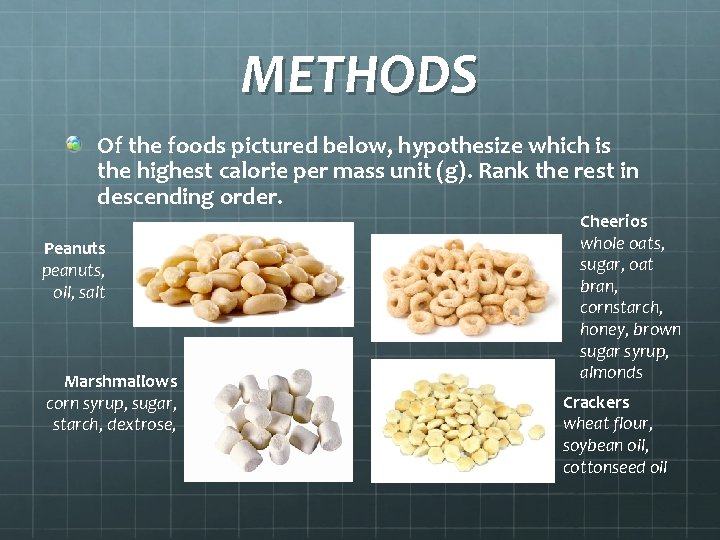
METHODS Of the foods pictured below, hypothesize which is the highest calorie per mass unit (g). Rank the rest in descending order. Peanuts peanuts, oil, salt Marshmallows corn syrup, sugar, starch, dextrose, Cheerios whole oats, sugar, oat bran, cornstarch, honey, brown sugar syrup, almonds Crackers wheat flour, soybean oil, cottonseed oil

Weigh a small sample of one food. Place it onto a straight pin and hold the pin in a clothespin as a ‘stand’. Slide the can over the food sample and adjust the test tube height so that it is 1 cm above the food. Measure 15 ml of water into the test tube. Suspend thermometer in the test tube to determine the initial water temperature. Remove thermometer. My calorimeters use a tin can to hold the test tube in place Clothespin holding a pin Test tube with 15 m. L water Food on the pin
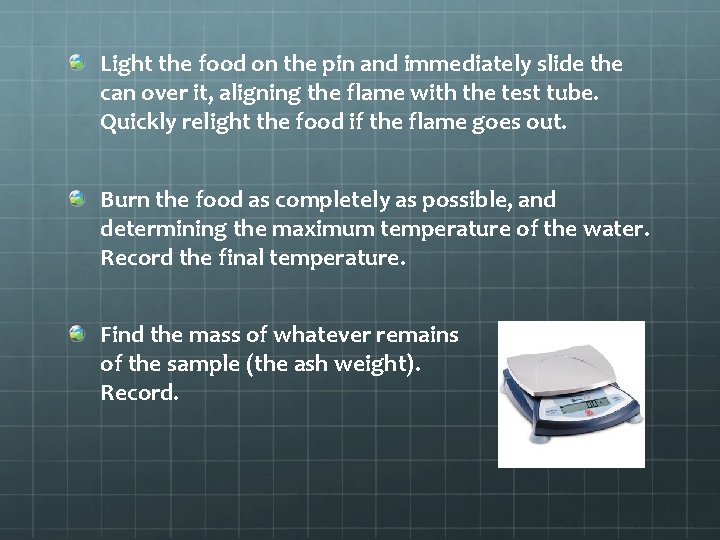
Light the food on the pin and immediately slide the can over it, aligning the flame with the test tube. Quickly relight the food if the flame goes out. Burn the food as completely as possible, and determining the maximum temperature of the water. Record the final temperature. Find the mass of whatever remains of the sample (the ash weight). Record.
Repeat steps 2 - 6 for each other food type available. Cool the test tube; use fresh water each trial. Run multiple trials of each food as time allows; average the results. DATA TO RESULTS Calculate the change in temperature and the change in mass for each trial. Record.
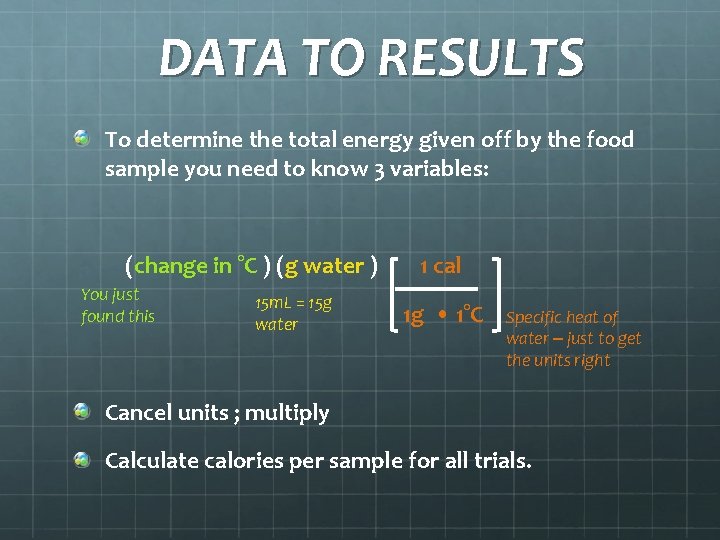
DATA TO RESULTS To determine the total energy given off by the food sample you need to know 3 variables: (change in °C ) (g water ) 1 cal You just found this 15 m. L = 15 g water 1 g • 1°C Specific heat of water – just to get the units right Cancel units ; multiply Calculate calories per sample for all trials.
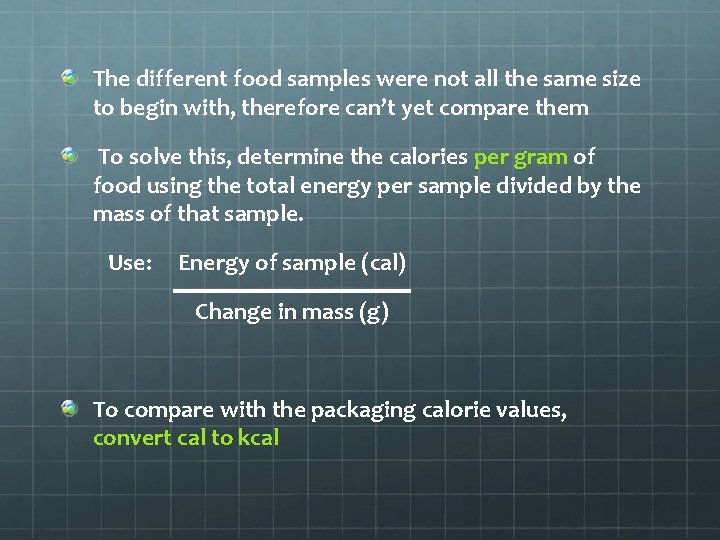
The different food samples were not all the same size to begin with, therefore can’t yet compare them To solve this, determine the calories per gram of food using the total energy per sample divided by the mass of that sample. Use: Energy of sample (cal) Change in mass (g) To compare with the packaging calorie values, convert cal to kcal
Homework: we love analysis! o 1. Are your groups results posted to the spreadsheet? Add them! o 2. Read the 3 -6 below and decide if you want to do the assignment in a spreadsheet, or by hand. o o To work by hand, simply print a copy of the spreadsheet. To work in a spreadsheet, you must first make a copy of the class sheet for yourself heres how. o 3. For any two of the foods, identify at least 2 suspect values. Highlight the cells of these values. o 4. If any are from your group, dig in your lab data and find the problem. Write and explain the correction on your copy. o 5. Ignoring the suspect values you identified, identify the high and low value for the food. Use to find the range of values (subtract!). Use to find the mean average of the kcal/gram for that food. o 6. Record everything and share it with me, either electronically or by turning in the marked up paper next class. o Note: I expect lots of variation on the assignment – any identical work will be assumed to have been copied.
- Slides: 10