
Calorimetry Calorimeter Reaction at Constant P DH qrxn
- Slides: 13
Calorimetry
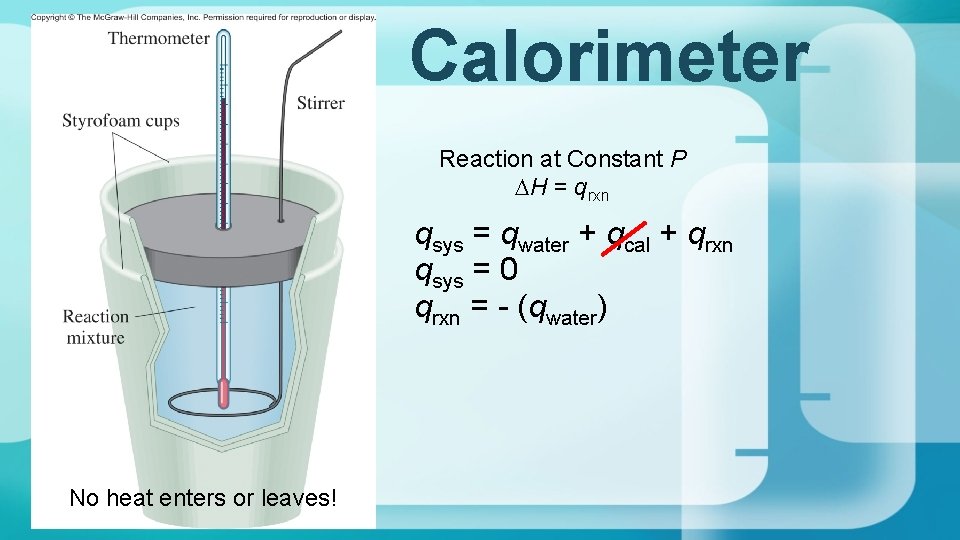
Calorimeter Reaction at Constant P DH = qrxn qsys = qwater + qcal + qrxn qsys = 0 qrxn = - (qwater) No heat enters or leaves!
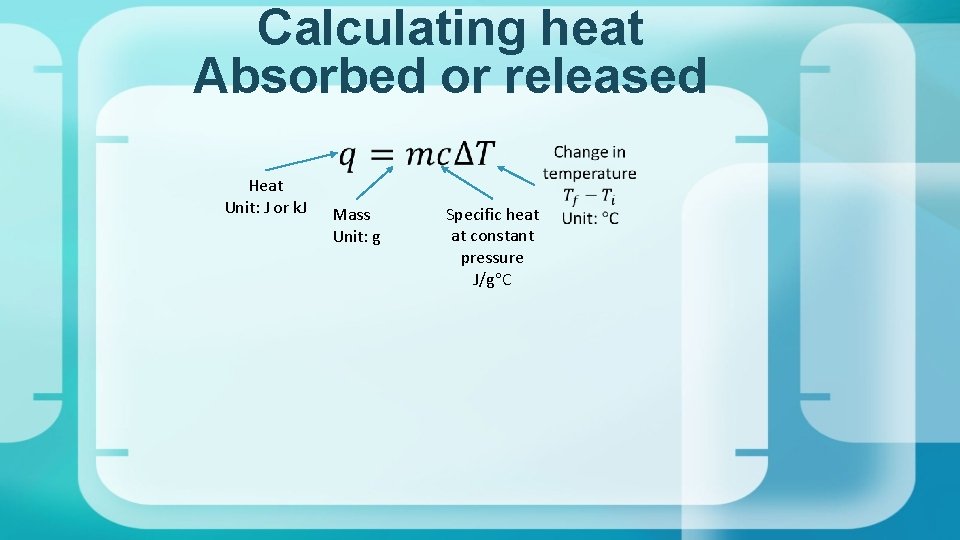
Calculating heat Absorbed or released Heat Unit: J or k. J Mass Unit: g Specific heat at constant pressure J/g C
Specific Heat = c Specific heat of a substance is the amount of heat required to raise the temperature of one gram of that substance by one degree Celsius. Unit for specific heat is J/go. C
Heat capacity The amount of heat required to raise the system’s temperature by one Celsius.
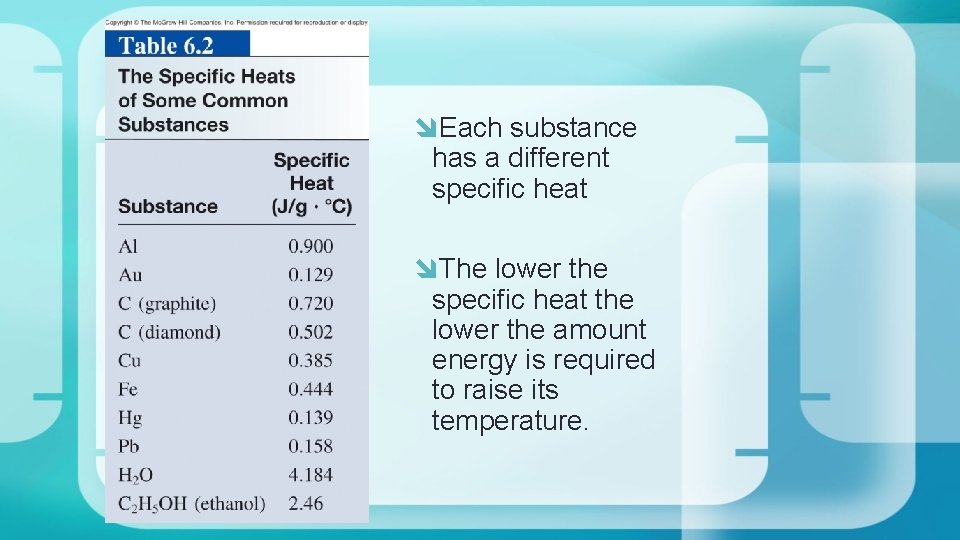
Each substance has a different specific heat The lower the specific heat the lower the amount energy is required to raise its temperature.
Example 1 If the temperature of 56. 6 g of ethanol increases from 45. 0°C to 80. 0°C, how much heat has been absorbed by the ethanol? Specific heat of ethanol =2. 44 J/g°C
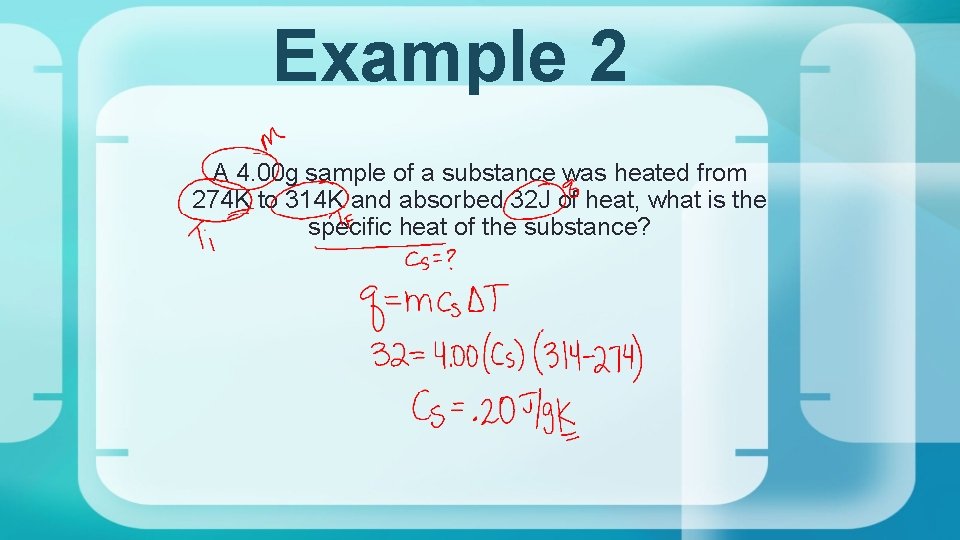
Example 2 A 4. 00 g sample of a substance was heated from 274 K to 314 K and absorbed 32 J of heat, what is the specific heat of the substance?
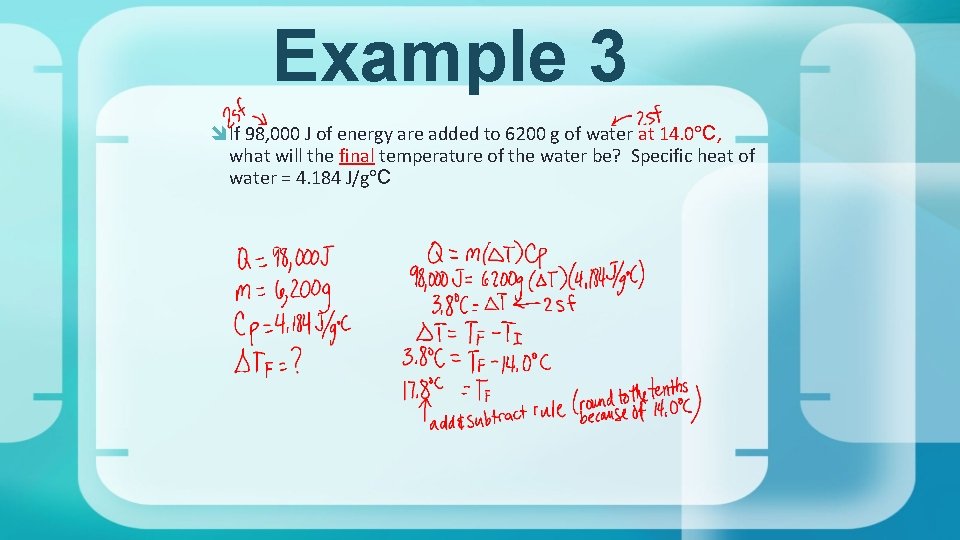
Example 3 If 98, 000 J of energy are added to 6200 g of water at 14. 0 C, what will the final temperature of the water be? Specific heat of water = 4. 184 J/g C
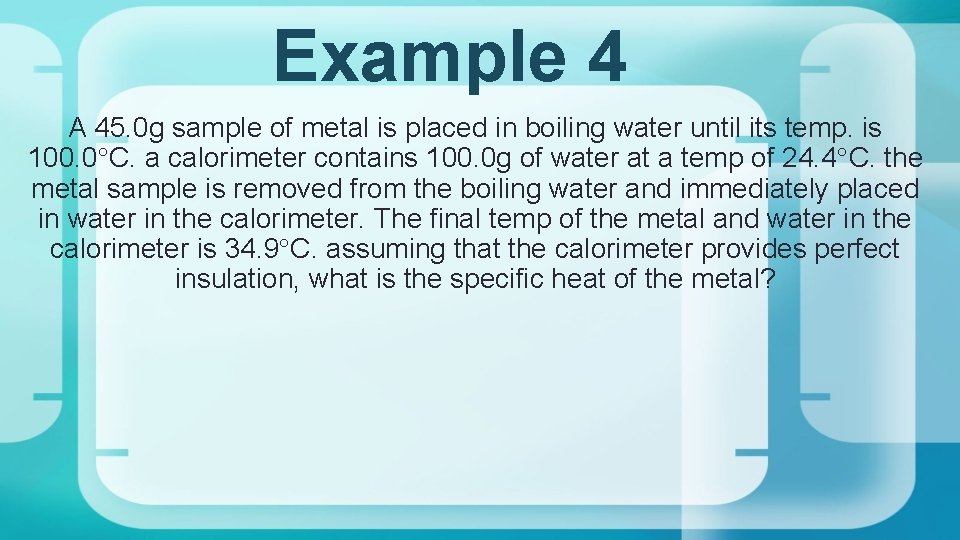
Example 4 A 45. 0 g sample of metal is placed in boiling water until its temp. is 100. 0 C. a calorimeter contains 100. 0 g of water at a temp of 24. 4 C. the metal sample is removed from the boiling water and immediately placed in water in the calorimeter. The final temp of the metal and water in the calorimeter is 34. 9 C. assuming that the calorimeter provides perfect insulation, what is the specific heat of the metal?
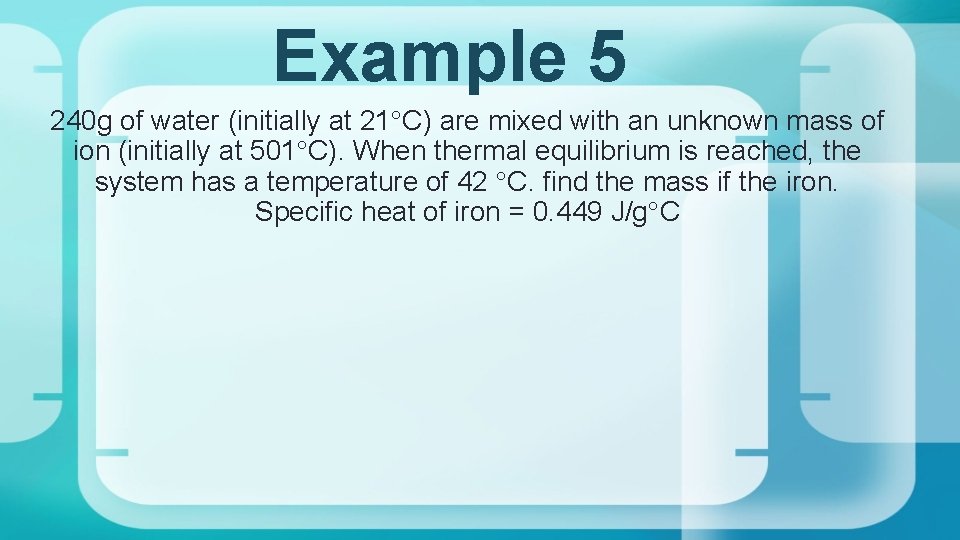
Example 5 240 g of water (initially at 21 C) are mixed with an unknown mass of ion (initially at 501 C). When thermal equilibrium is reached, the system has a temperature of 42 C. find the mass if the iron. Specific heat of iron = 0. 449 J/g C
Example 6 240 g of water (initially at 21 C) are mixed with an unknown mass of ion (initially at 501 C). When thermal equilibrium is reached, the system has a temperature of 42 C. find the mass if the iron. Specific heat of iron = 0. 449 J/g C
Example 7 Determine the final temperature when a 25. 0 g piece of iron at 85. 0 C is placed into 75. 0 grams of water at 20. 0 C.