
Calorimetry Burning of a Match Potential energy System
Calorimetry
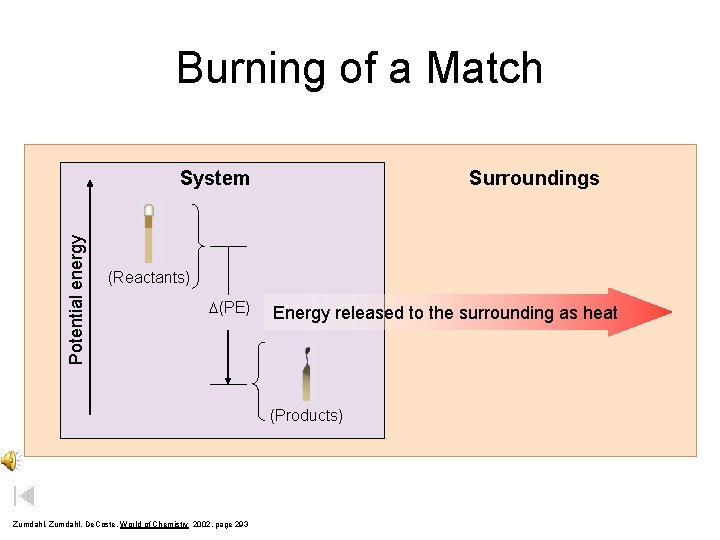
Burning of a Match Potential energy System Surroundings (Reactants) (PE) Energy released to the surrounding as heat (Products) Zumdahl, De. Coste, World of Chemistry 2002, page 293
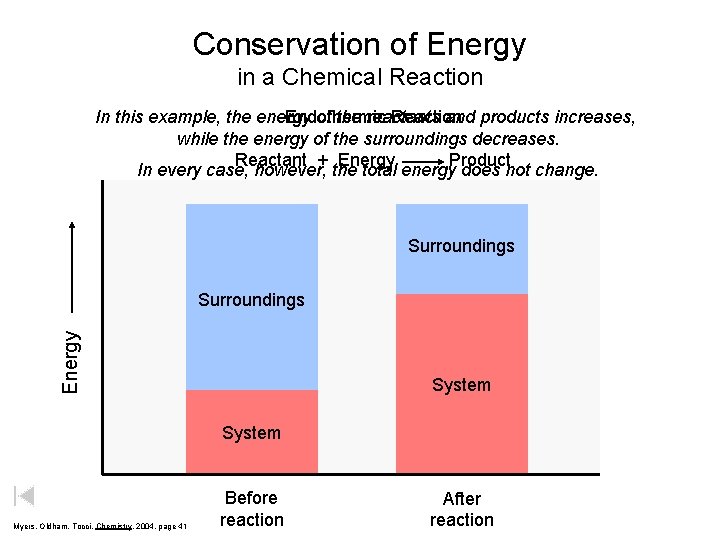
Conservation of Energy in a Chemical Reaction In this example, the energy Endothermic Reaction of the reactants and products increases, while the energy of the surroundings decreases. Reactant + Energy Product In every case, however, the total energy does not change. Surroundings Energy Surroundings System Myers, Oldham, Tocci, Chemistry, 2004, page 41 Before reaction After reaction
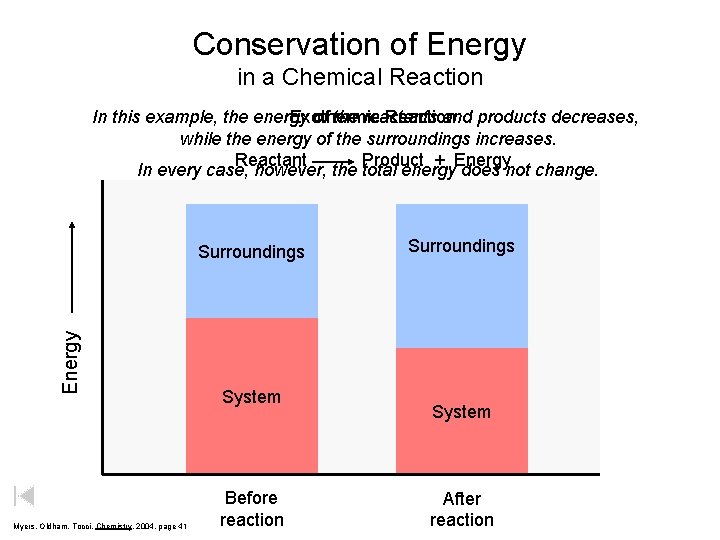
Conservation of Energy in a Chemical Reaction In this example, the energy Exothermic Reaction of the reactants and products decreases, while the energy of the surroundings increases. Reactant Product + Energy In every case, however, the total energy does not change. Energy Surroundings Myers, Oldham, Tocci, Chemistry, 2004, page 41 System Before reaction Surroundings System After reaction
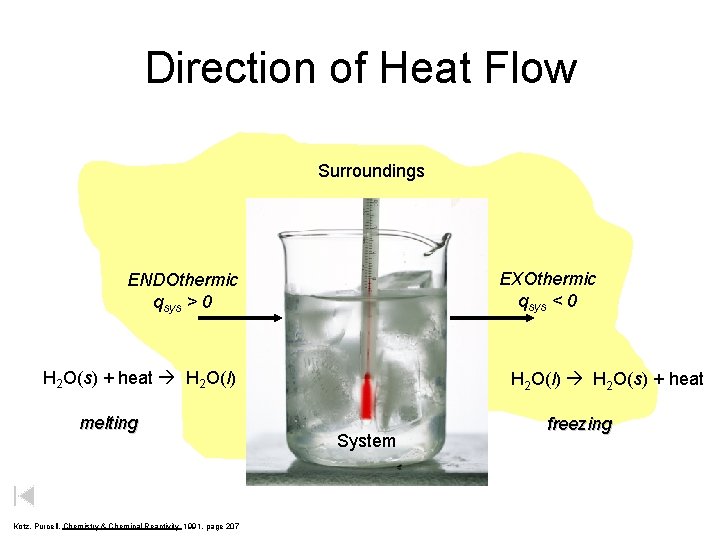
Direction of Heat Flow Surroundings ENDOthermic qsys > 0 System H 2 O(s) + heat H 2 O(l) melting Kotz, Purcell, Chemistry & Chemical Reactivity 1991, page 207 EXOthermic qsys < 0 H 2 O(l) H 2 O(s) + heat System freezing
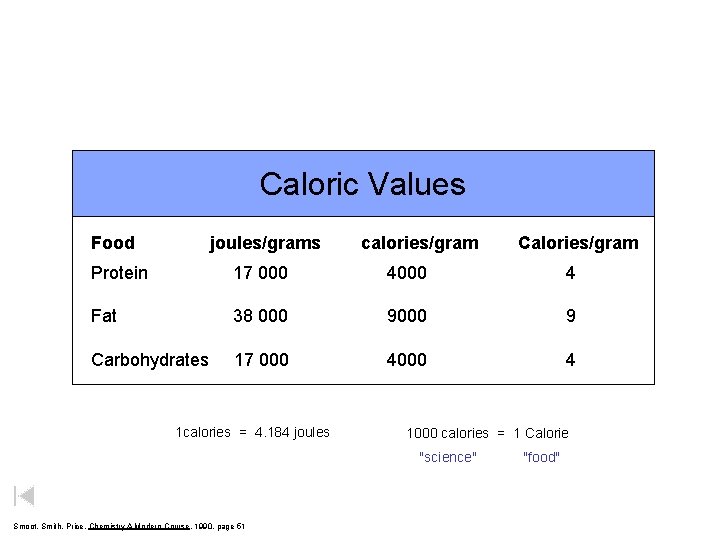
Caloric Values Food joules/grams calories/gram Calories/gram Protein 17 000 4000 Fat 9000 9 38 000 Carbohydrates 17 000 4000 1 calories = 4. 184 joules 4 1000 calories = 1 Calorie "science" "food" Smoot, Smith, Price, Chemistry A Modern Course, 1990, page 51
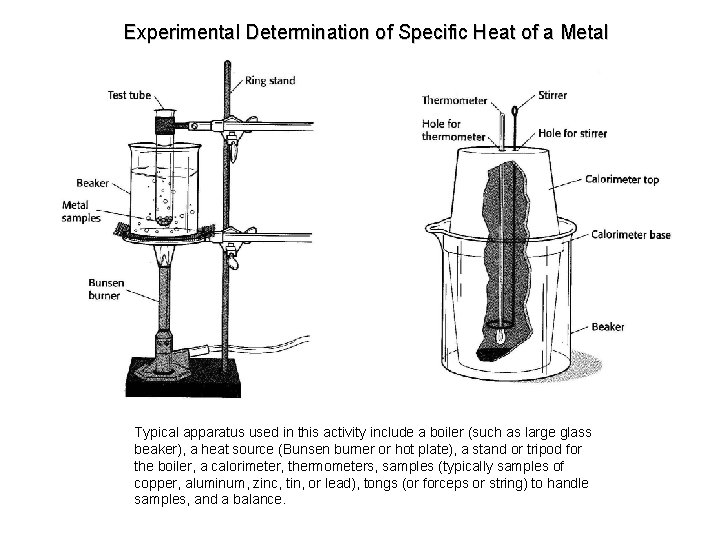
Experimental Determination of Specific Heat of a Metal Typical apparatus used in this activity include a boiler (such as large glass beaker), a heat source (Bunsen burner or hot plate), a stand or tripod for the boiler, a calorimeter, thermometers, samples (typically samples of copper, aluminum, zinc, tin, or lead), tongs (or forceps or string) to handle samples, and a balance.
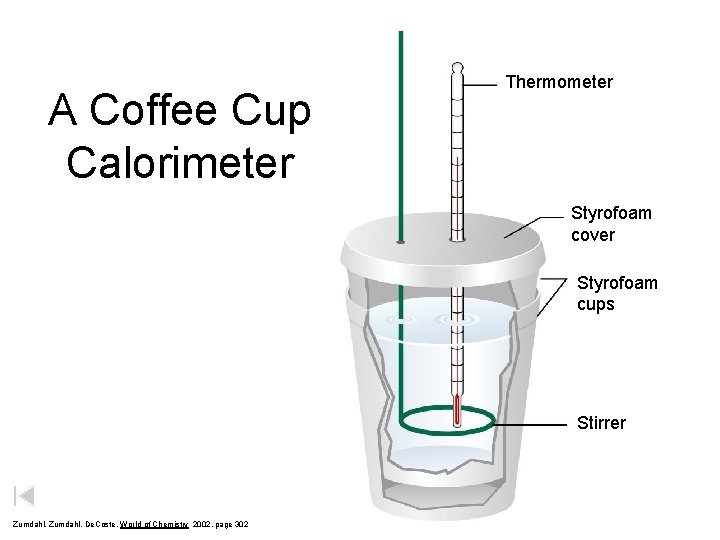
A Coffee Cup Calorimeter Thermometer Styrofoam cover Styrofoam cups Stirrer Zumdahl, De. Coste, World of Chemistry 2002, page 302
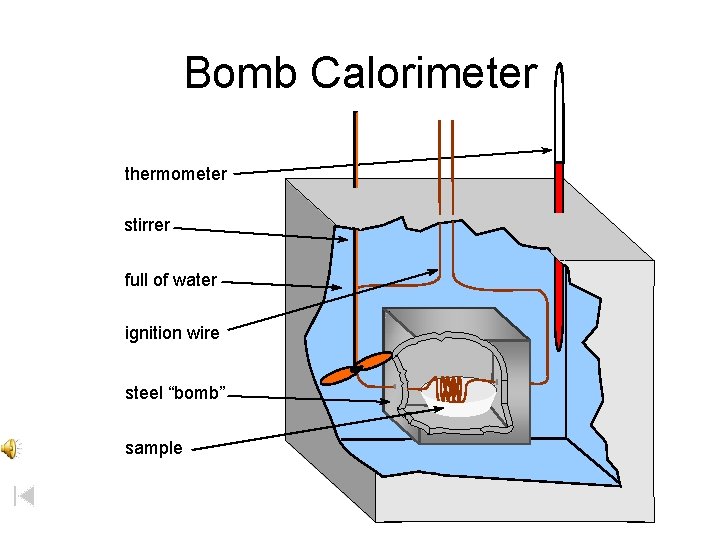
Bomb Calorimeter thermometer stirrer full of water ignition wire steel “bomb” sample
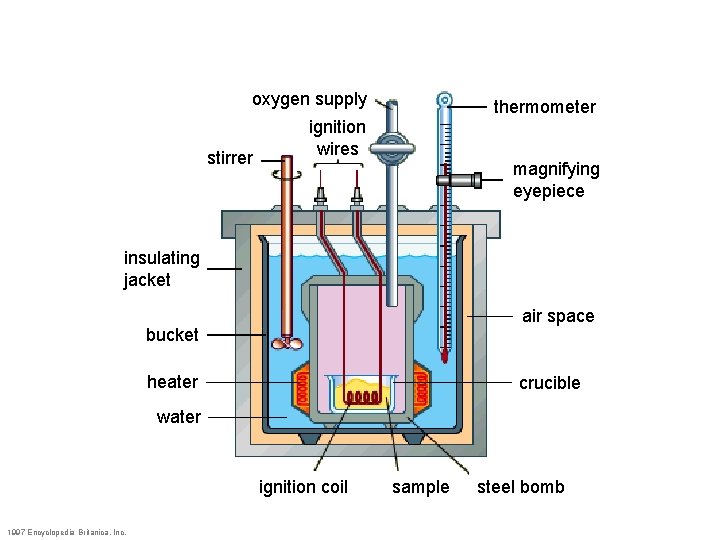
oxygen supply stirrer thermometer ignition wires magnifying eyepiece insulating jacket air space bucket heater crucible water ignition coil 1997 Encyclopedia Britanica, Inc. sample steel bomb
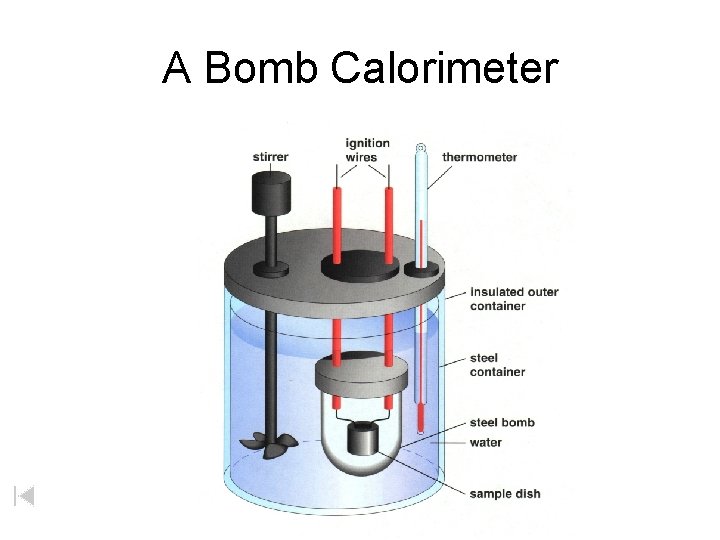
A Bomb Calorimeter
Causes of Change - Calorimetry Outline Keys http: //www. unit 5. org/chemistry/Matter. html
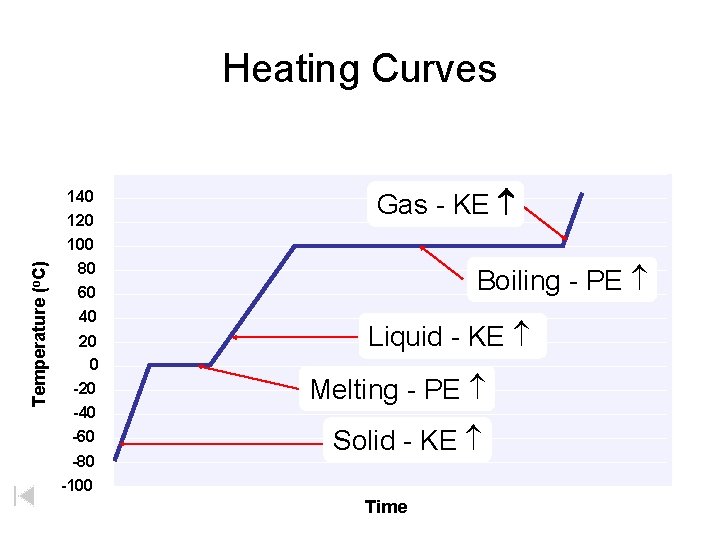
Temperature (o. C) Heating Curves 140 120 100 80 60 40 20 0 -20 -40 -60 -80 -100 Gas - KE Boiling - PE Liquid - KE Melting - PE Solid - KE Time
Heating Curves • Temperature Change – change in KE (molecular motion) – depends on heat capacity • Heat Capacity – energy required to raise the temp of 1 gram of a substance by 1°C – “Volcano” clip – water has a very high heat capacity Courtesy Christy Johannesson www. nisd. net/communicationsarts/pages/chem
Heating Curves • Phase Change – change in PE (molecular arrangement) – temp remains constant • Heat of Fusion ( Hfus) – energy required to melt 1 gram of a substance at its m. p. Courtesy Christy Johannesson www. nisd. net/communicationsarts/pages/chem
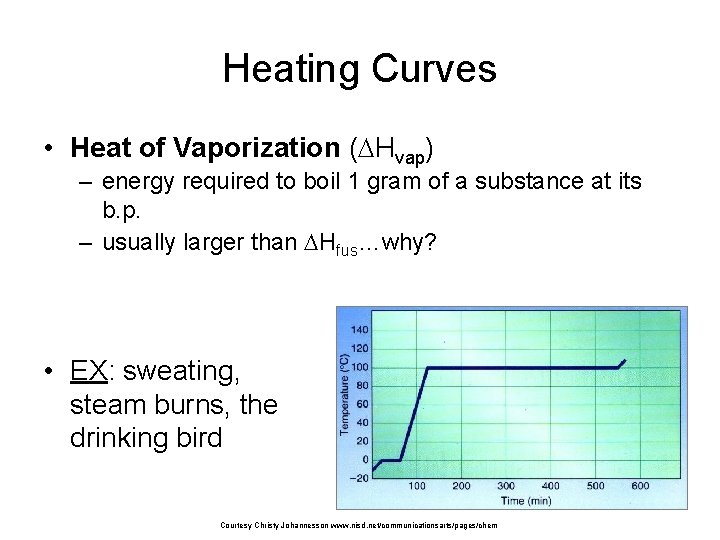
Heating Curves • Heat of Vaporization ( Hvap) – energy required to boil 1 gram of a substance at its b. p. – usually larger than Hfus…why? • EX: sweating, steam burns, the drinking bird Courtesy Christy Johannesson www. nisd. net/communicationsarts/pages/chem
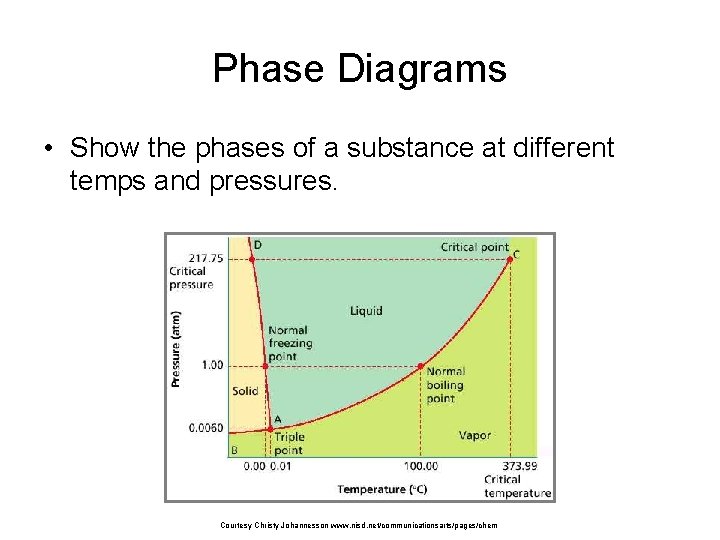
Phase Diagrams • Show the phases of a substance at different temps and pressures. Courtesy Christy Johannesson www. nisd. net/communicationsarts/pages/chem
Humor A small piece of ice which lived in a test tube fell in love with a Bunsen burner. “Bunsen! My flame! I melt whenever I see you” said the ice. The Bunsen burner replied” “It’s just a phase you’re going through”.
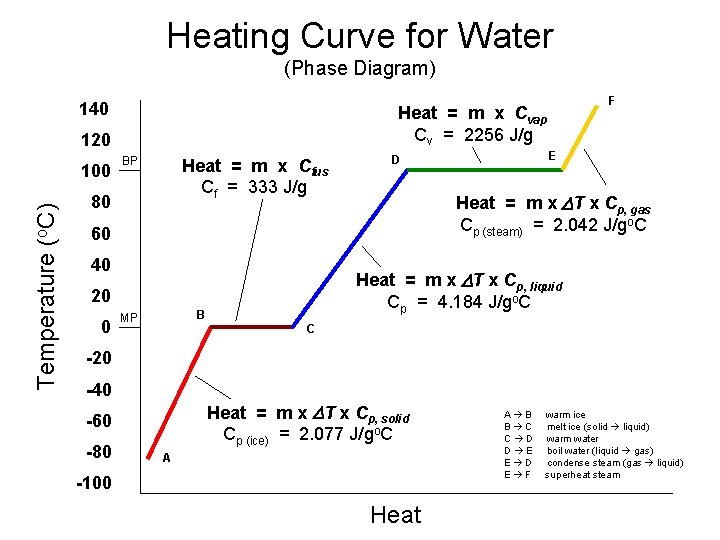
Heating Curve for Water (Phase Diagram) 140 120 Temperature (o. C) 100 BP Heat = m x Cfus Cf = 333 J/g 80 D 40 Heat = m x DT x Cp, liquid Cp = 4. 184 J/go. C 20 B MP E Heat = m x DT x Cp, gas Cp (steam) = 2. 042 J/go. C 60 0 F Heat = m x Cvap Cv = 2256 J/g C -20 -40 Heat = m x DT x Cp, solid Cp (ice) = 2. 077 J/go. C -60 -80 A -100 Heat A B warm ice B C melt ice (solid liquid) C D warm water D E boil water (liquid gas) E D condense steam (gas liquid) E F superheat steam
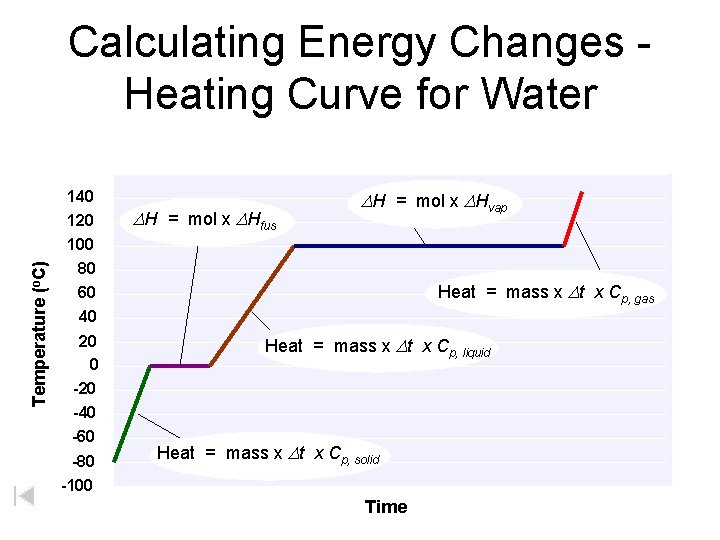
Temperature (o. C) Calculating Energy Changes - Heating Curve for Water 140 120 100 80 60 40 20 0 -20 -40 -60 -80 -100 DH = mol x DHfus DH = mol x DHvap Heat = mass x Dt x Cp, gas Heat = mass x Dt x Cp, liquid Heat = mass x Dt x Cp, solid Time
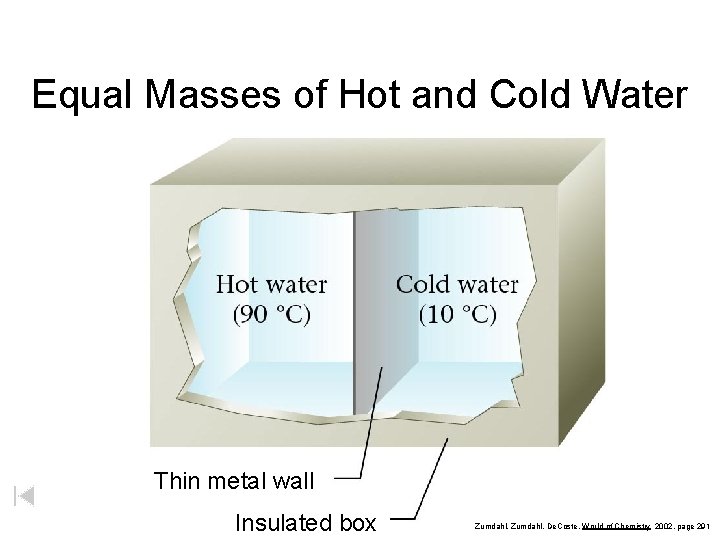
Equal Masses of Hot and Cold Water Thin metal wall Insulated box Zumdahl, De. Coste, World of Chemistry 2002, page 291
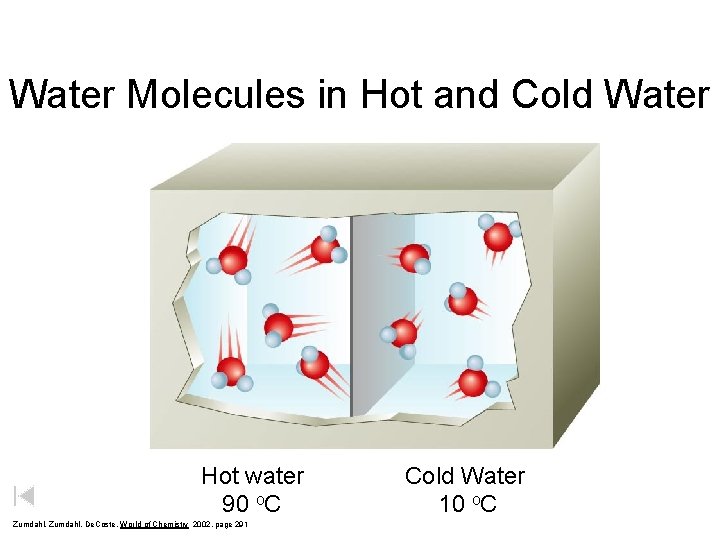
Water Molecules in Hot and Cold Water Hot water 90 o. C Zumdahl, De. Coste, World of Chemistry 2002, page 291 Cold Water 10 o. C
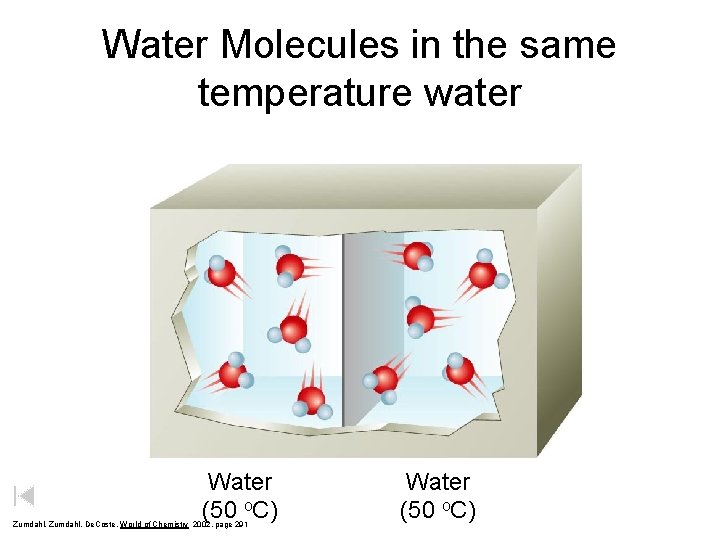
Water Molecules in the same temperature water Water (50 o. C) Zumdahl, De. Coste, World of Chemistry 2002, page 291 Water (50 o. C)

Heat Transfer Surroundings Block “A” SYSTEM Block “B” 20 g (40 o. C) 20 g (20 o. C) Al Al m = 20 g T = 40 o. C m = 20 g T = 20 o. C Final Temperature 30 o. C What will be the final temperature of the system ? a) 60 o. C b) 30 o. C c) 20 o. C d) ? Assume NO heat energy is “lost” to the surroundings from the system.
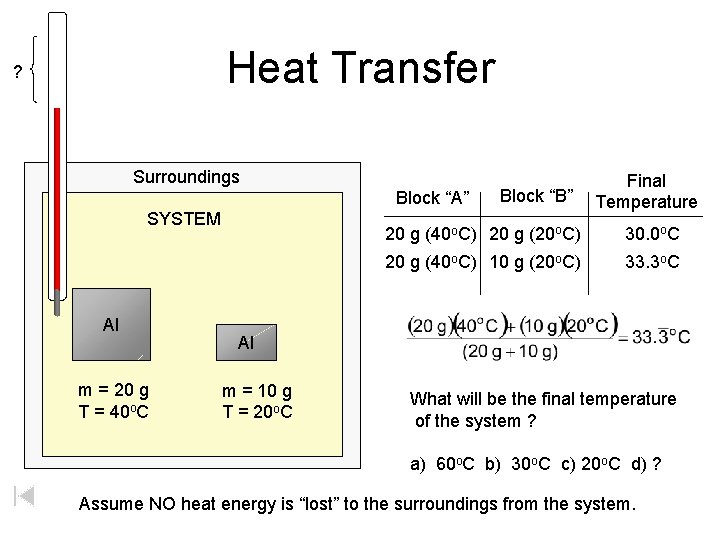
Heat Transfer ? Surroundings Block “A” SYSTEM Al m = 20 g T = 40 o. C Block “B” Final Temperature 20 g (40 o. C) 20 g (20 o. C) 30. 0 o. C 20 g (40 o. C) 10 g (20 o. C) 33. 3 o. C Al m = 10 g T = 20 o. C What will be the final temperature of the system ? a) 60 o. C b) 30 o. C c) 20 o. C d) ? Assume NO heat energy is “lost” to the surroundings from the system.
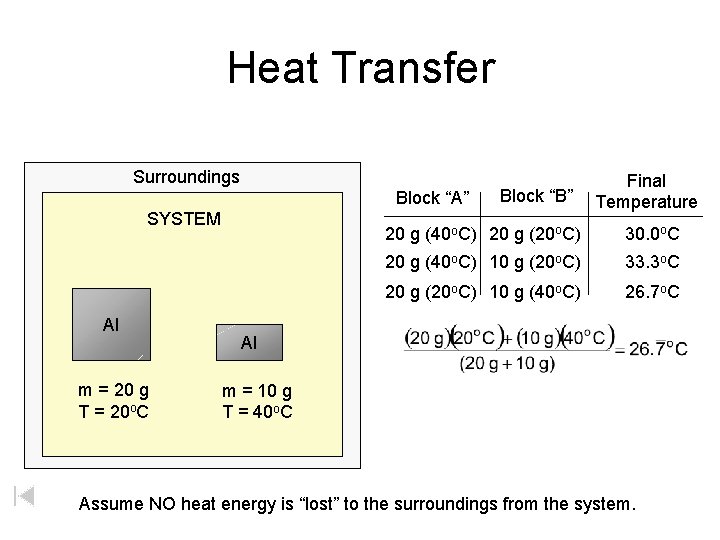
Heat Transfer Surroundings Block “A” SYSTEM Al m = 20 g T = 20 o. C Block “B” Final Temperature 20 g (40 o. C) 20 g (20 o. C) 30. 0 o. C 20 g (40 o. C) 10 g (20 o. C) 33. 3 o. C 20 g (20 o. C) 10 g (40 o. C) 26. 7 o. C Al m = 10 g T = 40 o. C Assume NO heat energy is “lost” to the surroundings from the system.
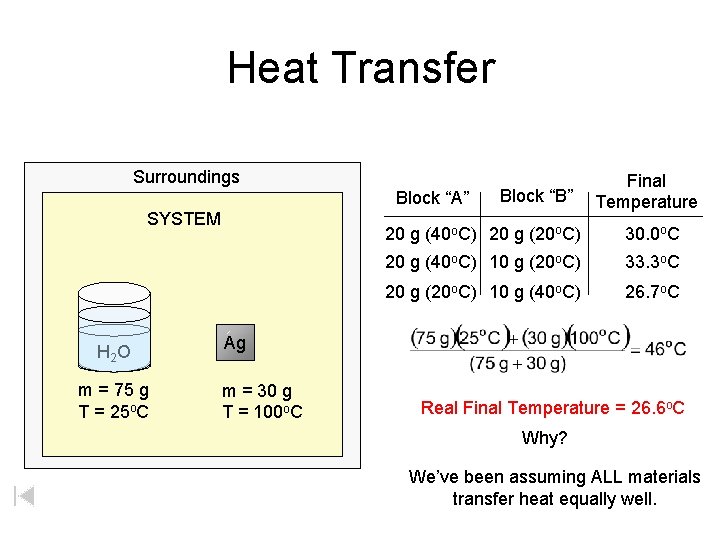
Heat Transfer Surroundings Block “A” SYSTEM H 2 O m = 75 g T = 25 o. C Block “B” Final Temperature 20 g (40 o. C) 20 g (20 o. C) 30. 0 o. C 20 g (40 o. C) 10 g (20 o. C) 33. 3 o. C 20 g (20 o. C) 10 g (40 o. C) 26. 7 o. C Ag m = 30 g T = 100 o. C Real Final Temperature = 26. 6 o. C Why? We’ve been assuming ALL materials transfer heat equally well.
Specific Heat • Water and silver do not transfer heat equally well. Water has a specific heat Cp = 4. 184 J/go. C Silver has a specific heat Cp = 0. 235 J/go. C • What does that mean? It requires 4. 184 Joules of energy to heat 1 gram of water 1 o. C and only 0. 235 Joules of energy to heat 1 gram of silver 1 o. C. • Law of Conservation of Energy… In our situation (silver is “hot” and water is “cold”)… this means water heats up slowly and requires a lot of energy whereas silver will cool off quickly and not release much energy. • Lets look at the math!
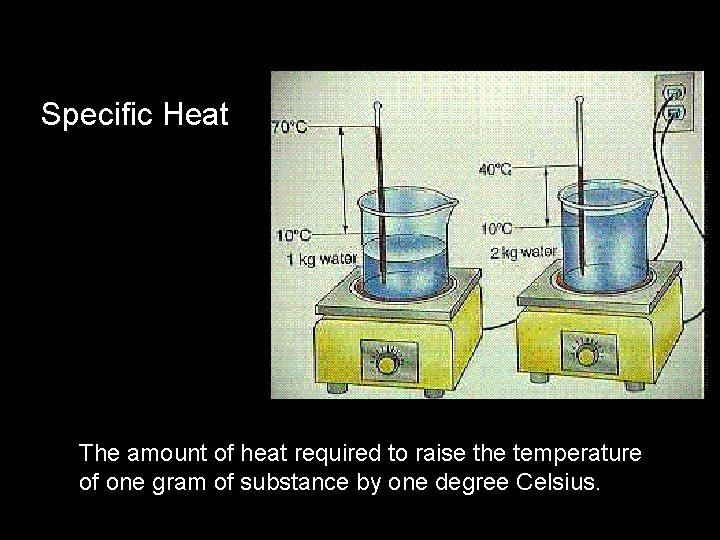
Specific Heat The amount of heat required to raise the temperature of one gram of substance by one degree Celsius.
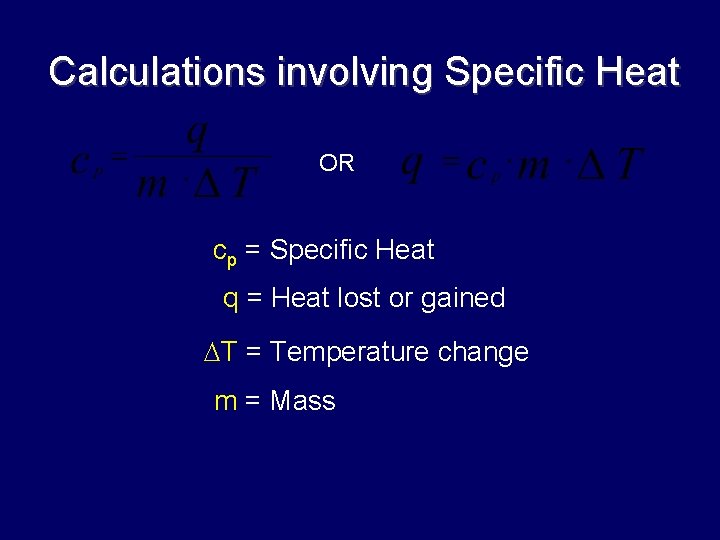
Calculations involving Specific Heat OR cp = Specific Heat q = Heat lost or gained T = Temperature change m = Mass
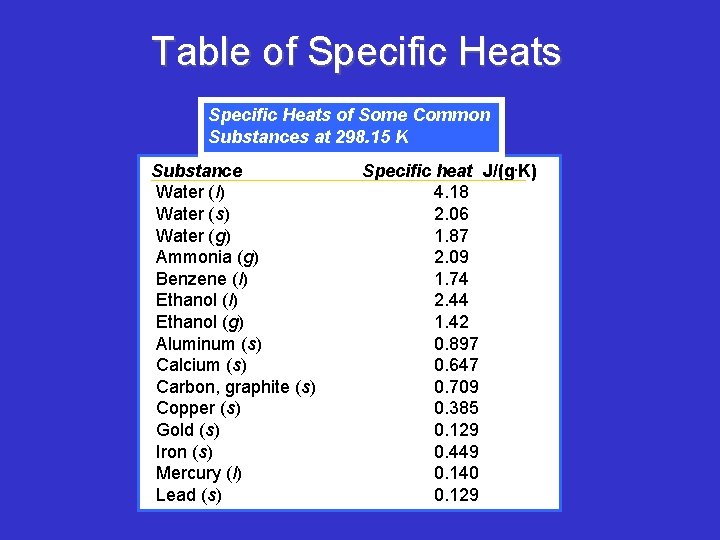
Table of Specific Heats of Some Common Substances at 298. 15 K Substance Water (l) Water (s) Water (g) Ammonia (g) Benzene (l) Ethanol (g) Aluminum (s) Calcium (s) Carbon, graphite (s) Copper (s) Gold (s) Iron (s) Mercury (l) Lead (s) Specific heat J/(g. K) 4. 18 2. 06 1. 87 2. 09 1. 74 2. 44 1. 42 0. 897 0. 647 0. 709 0. 385 0. 129 0. 449 0. 140 0. 129
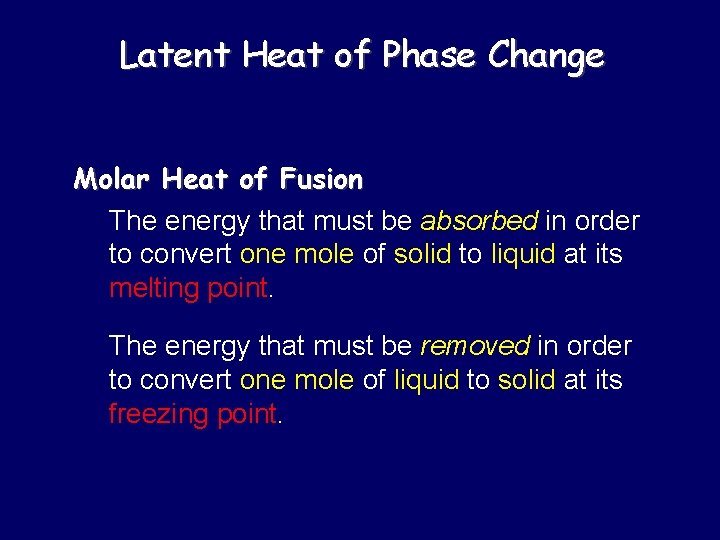
Latent Heat of Phase Change Molar Heat of Fusion The energy that must be absorbed in order to convert one mole of solid to liquid at its melting point. The energy that must be removed in order to convert one mole of liquid to solid at its freezing point.
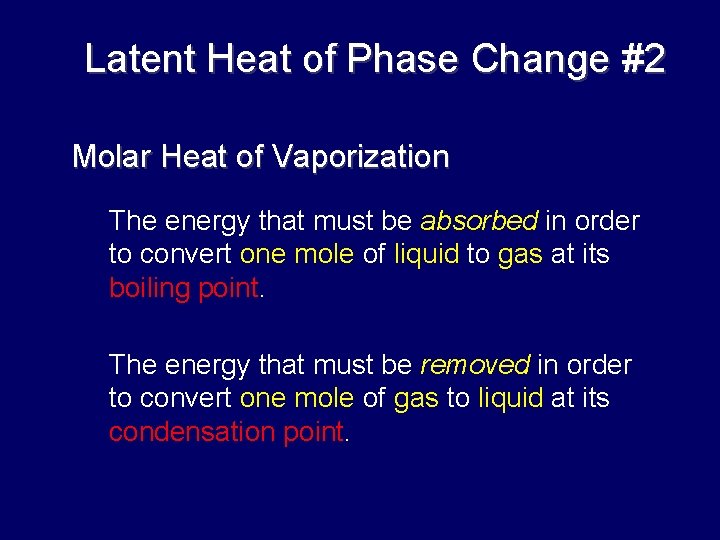
Latent Heat of Phase Change #2 Molar Heat of Vaporization The energy that must be absorbed in order to convert one mole of liquid to gas at its boiling point. The energy that must be removed in order to convert one mole of gas to liquid at its condensation point.
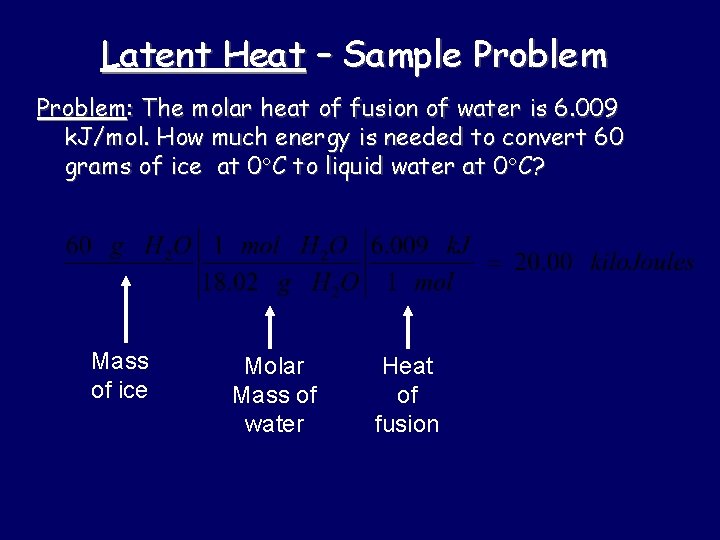
Latent Heat – Sample Problem: The molar heat of fusion of water is 6. 009 k. J/mol. How much energy is needed to convert 60 grams of ice at 0 C to liquid water at 0 C? Mass of ice Molar Mass of water Heat of fusion
Heat of Reaction The amount of heat released or absorbed during a chemical reaction. Endothermic: Reactions in which energy is absorbed as the reaction proceeds. Exothermic: Reactions in which energy is released as the reaction proceeds.
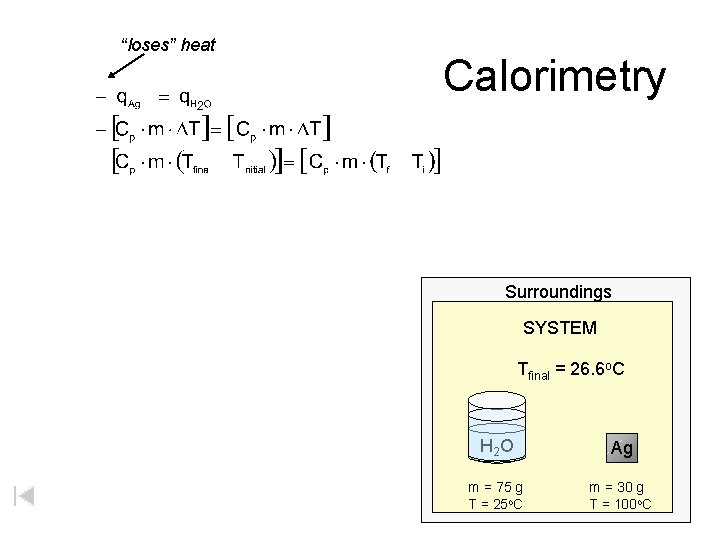
“loses” heat Calorimetry Surroundings SYSTEM Tfinal = 26. 6 o. C H 2 O Ag m = 75 g T = 25 o. C m = 30 g T = 100 o. C

Calorimetry Surroundings SYSTEM H 2 O Ag m = 75 g T = 25 o. C m = 30 g T = 100 o. C
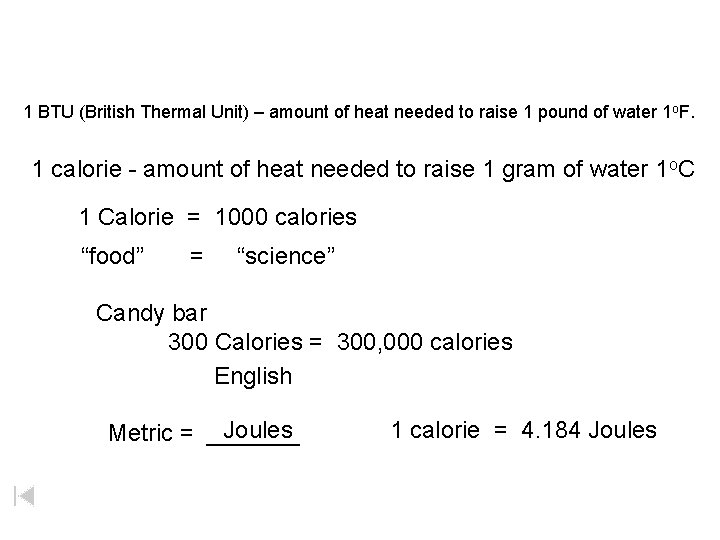
1 BTU (British Thermal Unit) – amount of heat needed to raise 1 pound of water 1 o. F. 1 calorie - amount of heat needed to raise 1 gram of water 1 o. C 1 Calorie = 1000 calories “food” = “science” Candy bar 300 Calories = 300, 000 calories English Joules Metric = _______ 1 calorie = 4. 184 Joules

Temperature (o. C) Cp(ice) = 2. 077 J/g o. C 140 120 100 80 60 40 20 0 -20 -40 -60 -80 -100 DH = mol x DHfus DH = mol x DHvap Heat = mass x Dt x Cp, gas Heat = mass x Dt x Cp, liquid Heat = mass x Dt x Cp, solid Time It takes 2. 077 Joules to raise 1 gram ice 1 o. C. X Joules to raise 10 gram ice 1 o. C. (10 g)(2. 077 J/g o. C) = 20. 77 Joules X Joules to raise 10 gram ice 10 o. C. (10 o. C)(10 g)(2. 077 J/g o. C) = 207. 7 Joules q = Cp. m. T Heat = (specific heat) (mass) (change in temperature)
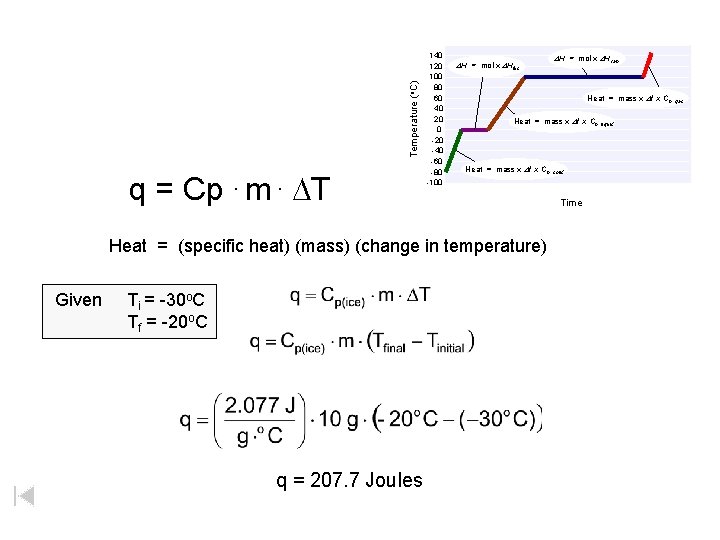
Temperature (o. C) q = Cp. m. T 140 120 100 80 60 40 20 0 -20 -40 -60 -80 -100 DH = mol x DHfus Heat = mass x Dt x Cp, gas Heat = mass x Dt x Cp, liquid Heat = mass x Dt x Cp, solid Heat = (specific heat) (mass) (change in temperature) Given Ti = -30 o. C Tf = -20 o. C q = 207. 7 Joules DH = mol x DHvap Time

240 g of water (initially at 20 o. C) are mixed with an unknown mass of iron (initially at 500 o. C). When thermal equilibrium is reached, the system has a temperature of 42 o. C. Find the mass of the iron. Fe T = 500 o. C mass = ? grams T = 20 o. C mass = 240 g - LOSE heat = GAIN heat - [(Cp, Fe) (mass) ( T)] = (Cp, H O) (mass) ( T) 2 - [(0. 4495 J/go. C) (X g) (42 o. C - 500 o. C)] = (4. 184 J/go. C) (240 g) (42 o. C - 20 o. C)] Drop Units: - [(0. 4495) (X) (-458)] = (4. 184) (240 g) (22) 205. 9 X = 22091 X = 107. 3 g Fe Calorimetry Problems 2 question #5

A 97 g sample of gold at 785 o. C is dropped into 323 g of water, which has an initial temperature of 15 o. C. If gold has a specific heat of 0. 129 J/go. C, what is the final temperature of the mixture? Assume that the gold experiences no change in state of matter. Au T = 785 o. C mass = 97 g T = 15 o. C mass = 323 g - LOSE heat = GAIN heat - [(Cp, Au) (mass) ( T)] = (Cp, H O) (mass) ( T) 2 Drop Units: - [(0. 129 J/go. C) (97 g) (Tf - 785 o. C)] = (4. 184 J/go. C) (323 g) (Tf - 15 o. C)] - [(12. 5) (Tf - 785 o. C)] = (1. 35 x 103) (Tf - 15 o. C)] -12. 5 Tf + 9. 82 x 103 = 1. 35 x 103 Tf - 2. 02 x 104 3 x 104 = 1. 36 x 103 Tf Tf = 22. 1 o. C Calorimetry Problems 2 question #8
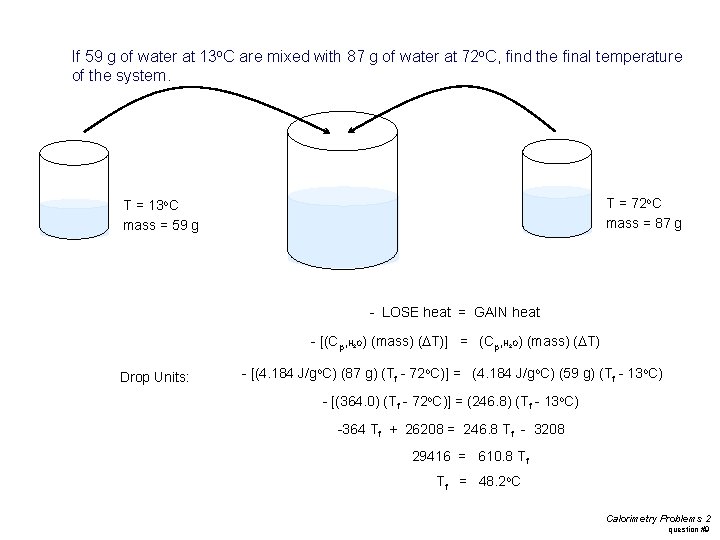
If 59 g of water at 13 o. C are mixed with 87 g of water at 72 o. C, find the final temperature of the system. T = 72 o. C mass = 87 g T = 13 o. C mass = 59 g - LOSE heat = GAIN heat - [(Cp, H O) (mass) ( T)] = (Cp, H O) (mass) ( T) 2 Drop Units: 2 - [(4. 184 J/go. C) (87 g) (Tf - 72 o. C)] = (4. 184 J/go. C) (59 g) (Tf - 13 o. C) - [(364. 0) (Tf - 72 o. C)] = (246. 8) (Tf - 13 o. C) -364 Tf + 26208 = 246. 8 Tf - 3208 29416 = 610. 8 Tf Tf = 48. 2 o. C Calorimetry Problems 2 question #9

ice Temperature (o. C) A 38 g sample of ice at -11 o. C is placed into 214 g of water at 56 o. C. Find the system's final temperature. T = -11 o. C mass = 38 g A T = 56 o. C mass = 214 g 140 120 100 80 60 40 20 0 -20 -40 -60 -80 -100 DH = mol x DHvap DH = mol x DHfus Heat = mass x Dt x Cp, gas Heat = mass x Dt x Cp, liquid D water cools B warm water C Heat = mass x Dt x Cp, solid Time melt ice warm ice - LOSE heat = GAIN heat D A C B - [(Cp, H O(l)) (mass) ( T)] = (Cp, H O(s)) (mass) ( T) + (Cf) (mass) + (Cp, H O(l)) (mass) ( T) 2 2 2 - [(4. 184 J/go. C)(214 g)(Tf - 56 o. C)] = (2. 077 J/go. C)(38 g)(11 o. C) + (333 J/g)(38 g) + (4. 184 J/go. C)(38 g)(Tf - 0 o. C) - [(895) (Tf - 56 o. C)] = 868 + 12654 + (159) (Tf)] - 895 Tf + 50141 = 868 + 12654 + 159 Tf - 895 Tf + 50141 = 13522 + 159 Tf 36619 = 1054 Tf Tf = 34. 7 o. C Calorimetry Problems 2 question #10
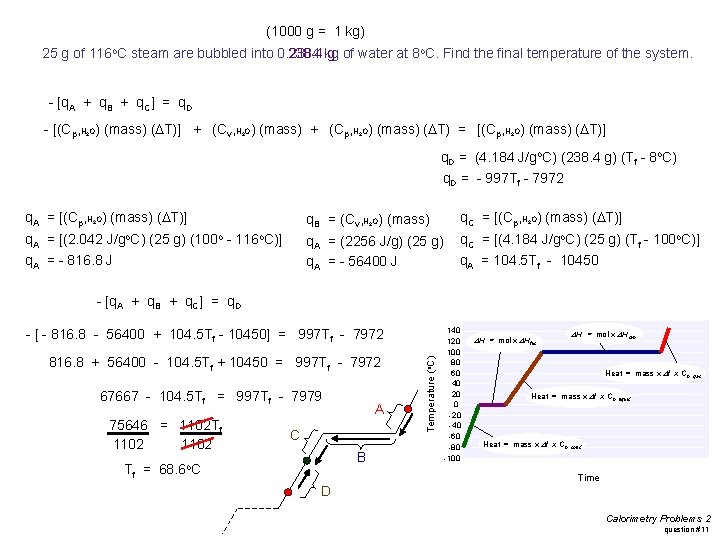
(1000 g = 1 kg) o. C. Find the final temperature of the system. 238. 4 g 25 g of 116 o. C steam are bubbled into 0. 2384 kg of water at 8 - [q. A + q. B + q. C] = q. D - [(Cp, H O) (mass) ( T)] + (Cv, H O) (mass) + (Cp, H O) (mass) ( T) = [(Cp, H O) (mass) ( T)] 2 2 q. D = (4. 184 J/go. C) (238. 4 g) (Tf - 8 o. C) q. D = - 997 Tf - 7972 q. A = [(Cp, H O) (mass) ( T)] q. B = (Cv, H O) (mass) q. A = [(2. 042 J/go. C) (25 g) (100 o - 116 o. C)] q. A = - 816. 8 J q. A = (2256 J/g) (25 g) q. C = [(4. 184 J/go. C) (25 g) (Tf - 100 o. C)] q. A = 104. 5 Tf - 10450 q. A = - 56400 J 2 2 q. C = [(Cp, H O) (mass) ( T)] 2 - [q. A + q. B + q. C] = q. D 816. 8 + 56400 - 104. 5 Tf + 10450 = 997 Tf - 7972 67667 - 104. 5 Tf = 997 Tf - 7979 75646 = 1102 Tf 1102 A C B Tf = 68. 6 o. C Temperature (o. C) - [ - 816. 8 - 56400 + 104. 5 Tf - 10450] = 997 Tf - 7972 140 120 100 80 60 40 20 0 -20 -40 -60 -80 -100 DH = mol x DHfus DH = mol x DHvap Heat = mass x Dt x Cp, gas Heat = mass x Dt x Cp, liquid Heat = mass x Dt x Cp, solid Time D Calorimetry Problems 2 question #11
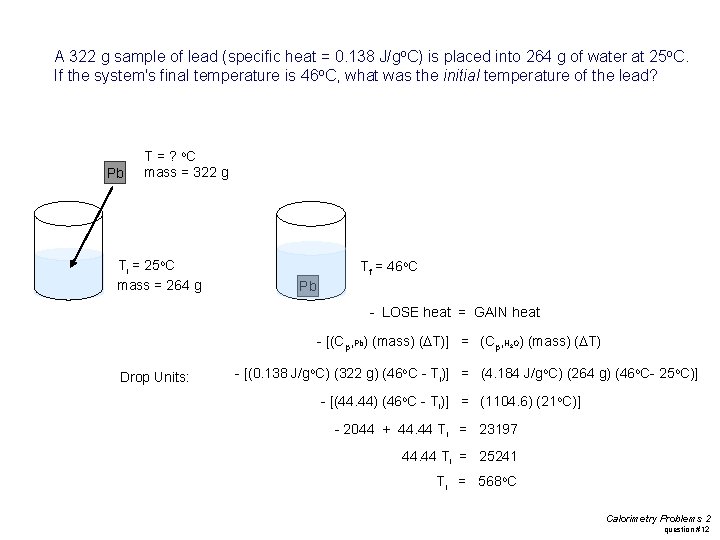
A 322 g sample of lead (specific heat = 0. 138 J/go. C) is placed into 264 g of water at 25 o. C. If the system's final temperature is 46 o. C, what was the initial temperature of the lead? Pb T = ? o. C mass = 322 g Ti = 25 o. C mass = 264 g Tf = 46 o. C Pb - LOSE heat = GAIN heat - [(Cp, Pb) (mass) ( T)] = (Cp, H O) (mass) ( T) 2 Drop Units: - [(0. 138 J/go. C) (322 g) (46 o. C - Ti)] = (4. 184 J/go. C) (264 g) (46 o. C- 25 o. C)] - [(44. 44) (46 o. C - Ti)] = (1104. 6) (21 o. C)] - 2044 + 44. 44 Ti = 23197 44. 44 Ti = 25241 Ti = 568 o. C Calorimetry Problems 2 question #12
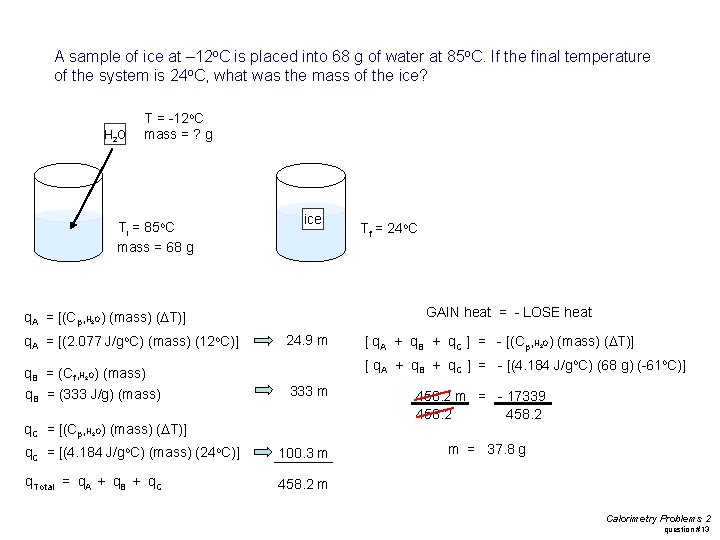
A sample of ice at – 12 o. C is placed into 68 g of water at 85 o. C. If the final temperature of the system is 24 o. C, what was the mass of the ice? H 2 O T = -12 o. C mass = ? g Ti = 85 o. C mass = 68 g ice GAIN heat = - LOSE heat q. A = [(Cp, H O) (mass) ( T)] 2 q. A = [(2. 077 J/go. C) (mass) (12 o. C)] q. B = (Cf, H O) (mass) q. B = (333 J/g) (mass) Tf = 24 o. C 24. 9 m [ q. A + q. B + q. C ] = - [(Cp, H O) (mass) ( T)] 2 [ q. A + q. B + q. C ] = - [(4. 184 J/go. C) (68 g) (-61 o. C)] 2 333 m q. C = [(Cp, H O) (mass) ( T)] 458. 2 m = - 17339 458. 2 2 q. C = [(4. 184 J/go. C) (mass) (24 o. C)] 100. 3 m q. Total = q. A + q. B + q. C 458. 2 m m = 37. 8 g Calorimetry Problems 2 question #13
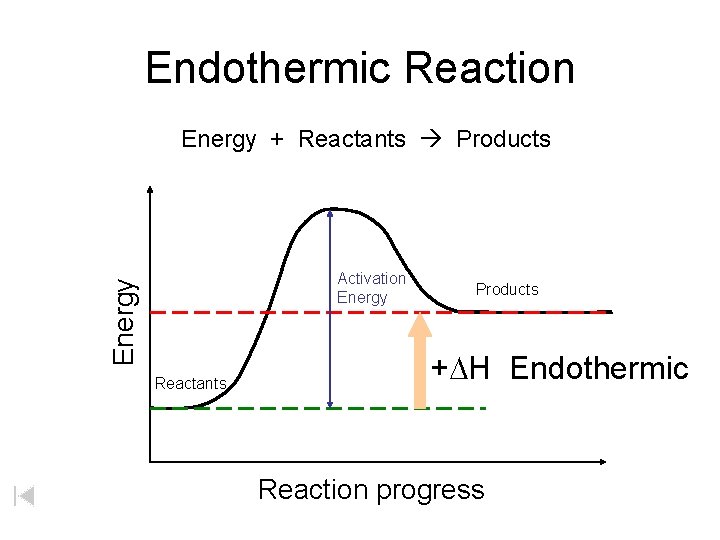
Endothermic Reaction Energy + Reactants Products Energy Activation Energy Reactants Products + H Endothermic Reaction progress
Calorimetry Problems 1 Calorimetry 1 Keys http: //www. unit 5. org/chemistry/Matter. html
Calorimetry Problems 2 Calorimetry 2 Specific Heat Values Keys http: //www. unit 5. org/chemistry/Matter. html
Heat Energy Problems Heat Problems (key) Heat Energy of Water Problems (Calorimetry) Specific Heat Problems Keys a http: //www. unit 5. org/chemistry/Matter. html b c
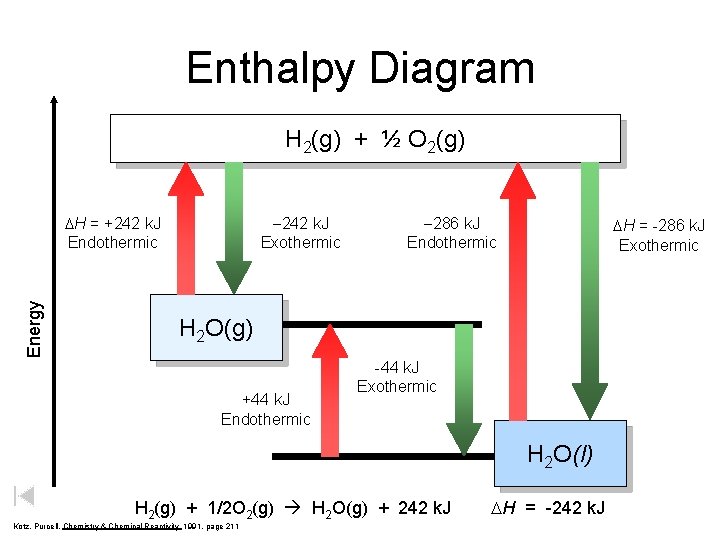
Enthalpy Diagram H 2(g) + ½ O 2(g) Energy H = +242 k. J Endothermic -242 k. J Exothermic -286 k. J Endothermic H = -286 k. J Exothermic H 2 O(g) +44 k. J Endothermic -44 k. J Exothermic H 2 O(l) H 2(g) + 1/2 O 2(g) H 2 O(g) + 242 k. J H = -242 k. J Kotz, Purcell, Chemistry & Chemical Reactivity 1991, page 211
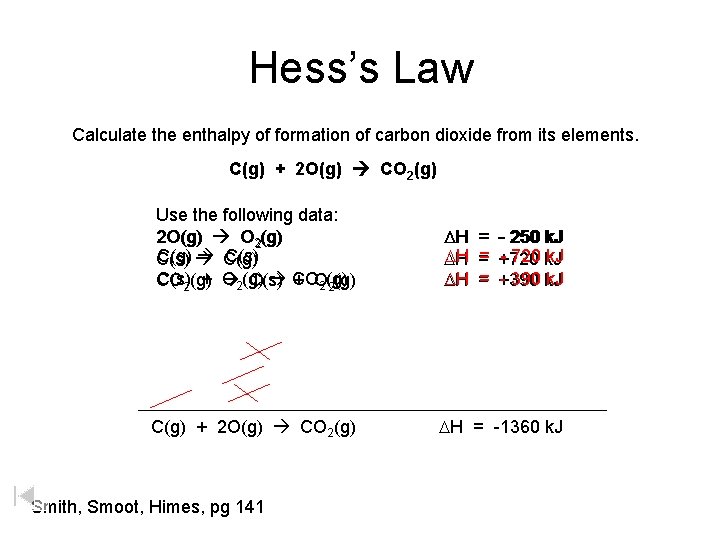
Hess’s Law Calculate the enthalpy of formation of carbon dioxide from its elements. C(g) + 2 O(g) CO 2(g) Use the following data: 2 O(g) O 22(g) C(g) C(s) C(g) C(s) + O CO 2(g) C(s) + O 2(g) H = - 250 k. J H = - 720 k. J H = +720 k. J H = - 390 k. J H = +390 k. J C(g) + 2 O(g) CO 2(g) H = -1360 k. J Smith, Smoot, Himes, pg 141
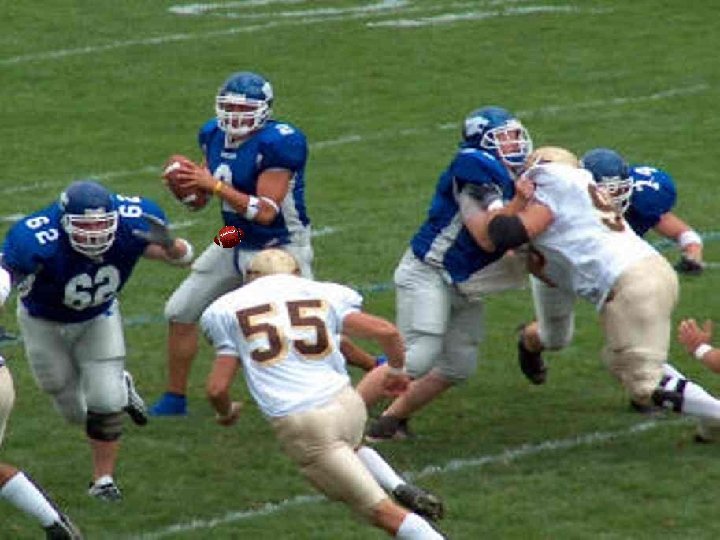
In football, as in Hess's law, only the initial and final conditions matter. A team that gains 10 yards on a pass play but has a five-yard penalty, has the same net gain as the team that gained only 5 yards. 10 yard pass 5 yard net gain net 5 yard penalty initial position of ball final position of ball
- Slides: 54