
Calorimeter Digitizer System Overview System block diagram ADC
Calorimeter Digitizer System • Overview • System block diagram • ADC choice • Digitizer Board flow • FPGA data flow • Trigger daughter card.
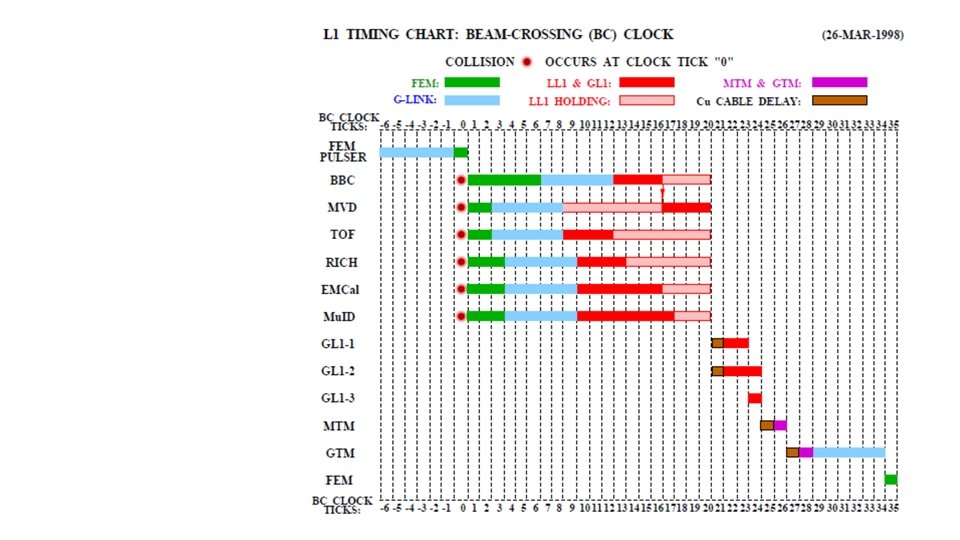
Calorimeter Digitizer system overview • • • Off detector ADC system for both EM and Hadronic calorimeter. Received the amplified signal from on-detector amplify through cables Digitize the signal at 6 x beam crossing rate, ~ 60 MHz, with 14 bits ADC Offset the baseline to use most of the ADC range. Provide at least 40 beam crossing of data buffers to cover L 1 trigger latency Provide Level 1 trigger primitives. Minimum 4 Level 1 events buffer. Maximum 31 ADC samples per channel per events, 16 samples planned. 15 KHz Level 1 trigger rate (16 Samples/channel/Event). Send Level 1 trigger events to the DAQ system. 24576 EMCAL channel, 1536 HCAL Channel. 1/4/2019 Calorimeter Electronics Digitizer System Design Review 2
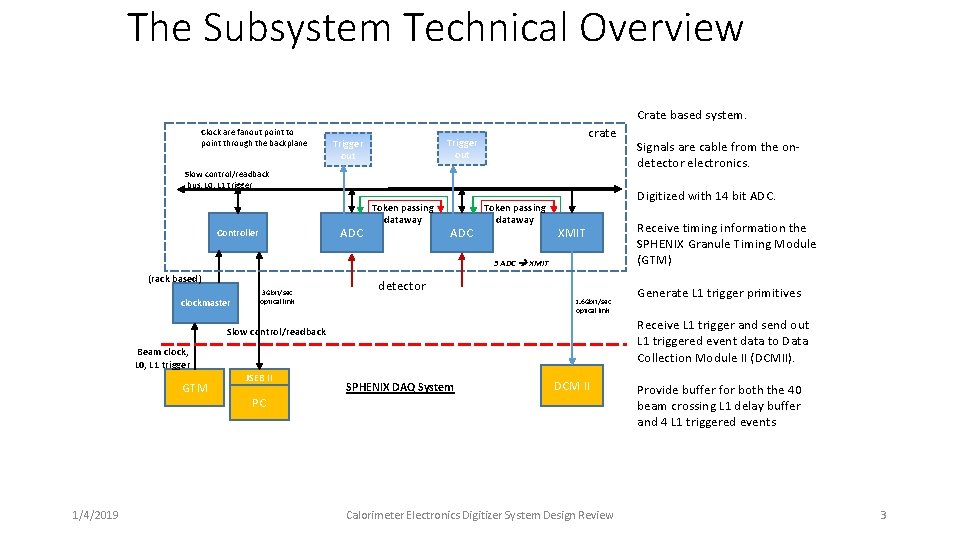
The Subsystem Technical Overview Crate based system. Clock are fanout point to point through the backplane crate Trigger out Slow control/readback bus, L 0, L 1 trigger ADC Controller Token passing dataway ADC Token passing dataway Digitized with 14 bit ADC. XMIT 3 ADC XMIT (rack based) clockmaster 3 Gbit/sec optical link detector 1. 6 Gbit/sec optical link Beam clock, L 0, L 1 trigger 1/4/2019 JSEB II PC Receive timing information the SPHENIX Granule Timing Module (GTM) Generate L 1 trigger primitives Receive L 1 trigger and send out L 1 triggered event data to Data Collection Module II (DCMII). Slow control/readback GTM Signals are cable from the ondetector electronics. SPHENIX DAQ System DCM II Calorimeter Electronics Digitizer System Design Review Provide buffer for both the 40 beam crossing L 1 delay buffer and 4 L 1 triggered events 3
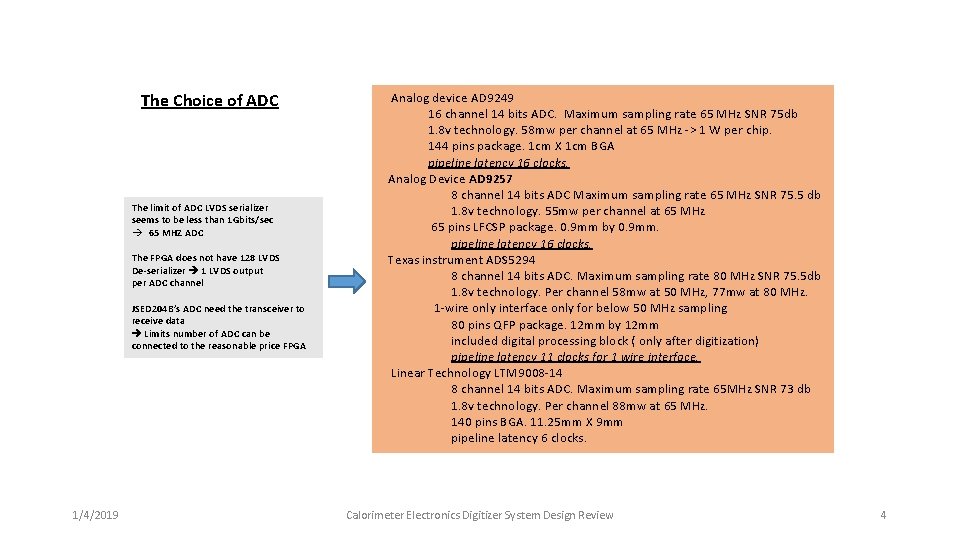
The Choice of ADC The limit of ADC LVDS serializer seems to be less than 1 Gbits/sec 65 MHZ ADC The FPGA does not have 128 LVDS De-serializer 1 LVDS output per ADC channel JSED 204 B’s ADC need the transceiver to receive data Limits number of ADC can be connected to the reasonable price FPGA 1/4/2019 Analog device AD 9249 16 channel 14 bits ADC. Maximum sampling rate 65 MHz SNR 75 db 1. 8 v technology. 58 mw per channel at 65 MHz -> 1 W per chip. 144 pins package. 1 cm X 1 cm BGA pipeline latency 16 clocks. Analog Device AD 9257 8 channel 14 bits ADC Maximum sampling rate 65 MHz SNR 75. 5 db 1. 8 v technology. 55 mw per channel at 65 MHz 65 pins LFCSP package. 0. 9 mm by 0. 9 mm. pipeline latency 16 clocks. Texas instrument ADS 5294 8 channel 14 bits ADC. Maximum sampling rate 80 MHz SNR 75. 5 db 1. 8 v technology. Per channel 58 mw at 50 MHz, 77 mw at 80 MHz. 1 -wire only interface only for below 50 MHz sampling 80 pins QFP package. 12 mm by 12 mm included digital processing block ( only after digitization) pipeline latency 11 clocks for 1 wire interface. Linear Technology LTM 9008 -14 8 channel 14 bits ADC. Maximum sampling rate 65 MHz SNR 73 db 1. 8 v technology. Per channel 88 mw at 65 MHz. 140 pins BGA. 11. 25 mm X 9 mm pipeline latency 6 clocks. Calorimeter Electronics Digitizer System Design Review 4
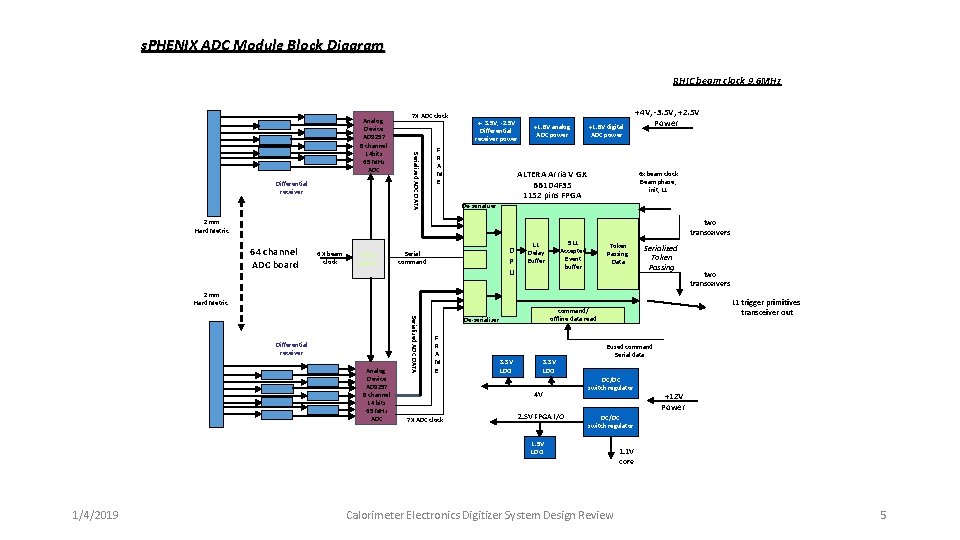
s. PHENIX ADC Module Block Diagram RHIC beam clock 9. 6 MHz Differential receiver 7 X ADC clock Serialized ADC DATA Analog Device AD 9257 8 channel 14 bits 65 MHz ADC +- 3. 5 V, -2. 5 V Differential receiver power F R A M E +1. 8 V analog ADC power +1. 8 V digital ADC power ALTERA Arria V GX BB 1 D 4 F 35 1152 pins FPGA +4 V, -3. 5 V, +2. 5 V Power 6 x beam clock Beam phase, init, L 1 De-serializer two transceivers 2 mm Hard Metric 64 channel ADC board 6 X beam clock Clock Fanout D P U Serial command 2 mm Hard Metric Analog Device AD 9257 8 channel 14 bits 65 MHz ADC Serialized ADC DATA Differential receiver 3. 3 V LDO 4 V 7 X ADC clock Token Passing Data 2. 5 V FPGA I/O two transceivers L 1 trigger primitives transceiver out Bused command Serial data DC/DC switch regulator +12 V Power DC/DC switch regulator 1. 5 V LDO 1/4/2019 Serialized Token Passing command/ offline data read De-serializer F R A M E 5 L 1 Accepted Event buffer L 1 Delay Buffer Calorimeter Electronics Digitizer System Design Review 1. 1 V core 5
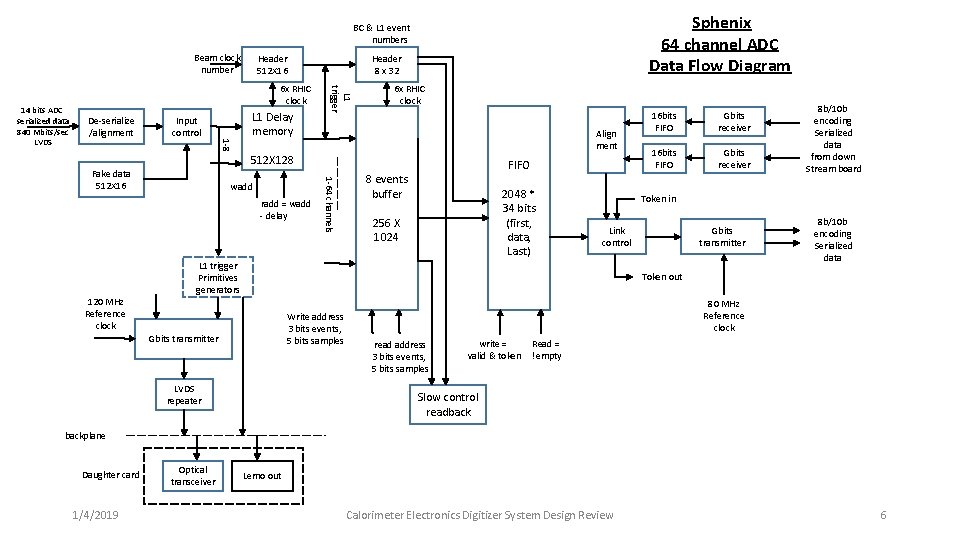
Sphenix 64 channel ADC Data Flow Diagram BC & L 1 event numbers Beam clock number De-serialize /alignment L 1 Delay memory Input control L 1 trigger 6 x RHIC clock Header 8 x 32 6 x RHIC clock Align ment 1 -8 14 bits ADC serialized data 840 Mbits/sec LVDS Header 512 X 16 512 X 128 wadd radd = wadd - delay 1 -64 channels Fake data 512 X 16 FIFO 8 events buffer 2048 * 34 bits (first, data, Last) 256 X 1024 16 bits FIFO Gbits receiver 8 b/10 b encoding Serialized data from down Stream board Token in Gbits transmitter Link control L 1 trigger Primitives generators 8 b/10 b encoding Serialized data Token out 120 MHz Reference clock Write address 3 bits events, 5 bits samples Gbits transmitter LVDS repeater 80 MHz Reference clock read address 3 bits events, 5 bits samples write = valid & token Read = !empty Slow control readbackplane Daughter card 1/4/2019 Optical transceiver Lemo out Calorimeter Electronics Digitizer System Design Review 6
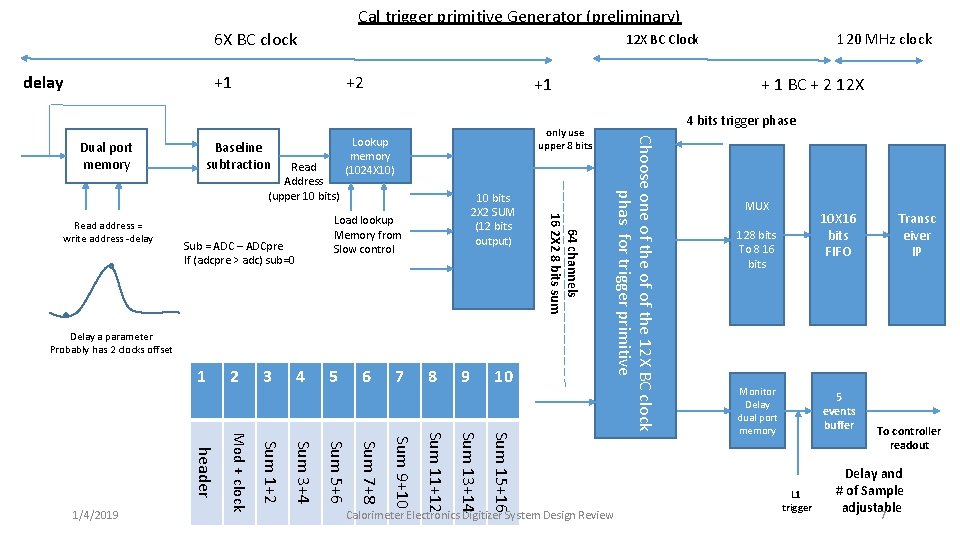
Cal trigger primitive Generator (preliminary) 6 X BC clock delay +1 Baseline subtraction Read Address (upper 10 bits) only use upper 8 bits Lookup memory (1024 X 10) 10 bits 2 X 2 SUM (12 bits output) Load lookup Memory from Slow control Sub = ADC – ADCpre If (adcpre > adc) sub=0 Delay a parameter Probably has 2 clocks offset 1 3 4 5 6 7 8 9 10 Sum 15+16 Sum 13+14 Sum 11+12 Sum 9+10 Sum 7+8 Sum 5+6 Sum 3+4 Sum 1+2 Mod + clock header 1/4/2019 2 + 1 BC + 2 12 X +1 64 channels 16 2 X 2 8 bits sum Read address = write address -delay +2 Calorimeter Electronics Digitizer System Design Review 4 bits trigger phase Choose one of the of of the 12 X BC clock phas for trigger primitive Dual port memory 120 MHz clock 12 X BC Clock MUX 10 X 16 bits FIFO 128 bits To 8 16 bits Monitor Delay dual port memory 5 events buffer L 1 trigger Transc eiver IP To controller readout Delay and # of Sample adjustable 7
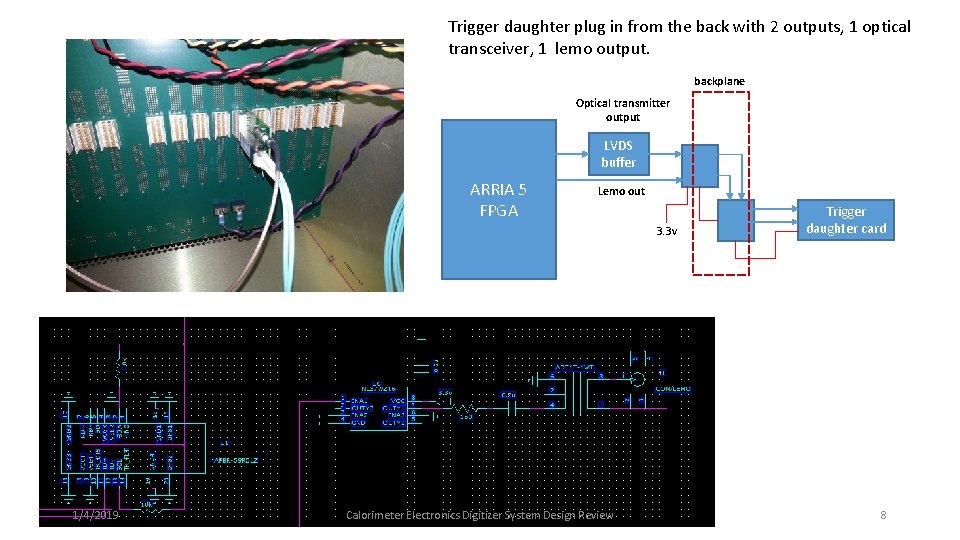
Trigger daughter plug in from the back with 2 outputs, 1 optical transceiver, 1 lemo output. backplane Optical transmitter output LVDS buffer ARRIA 5 FPGA Lemo out 3. 3 v 1/4/2019 Calorimeter Electronics Digitizer System Design Review Trigger daughter card 8
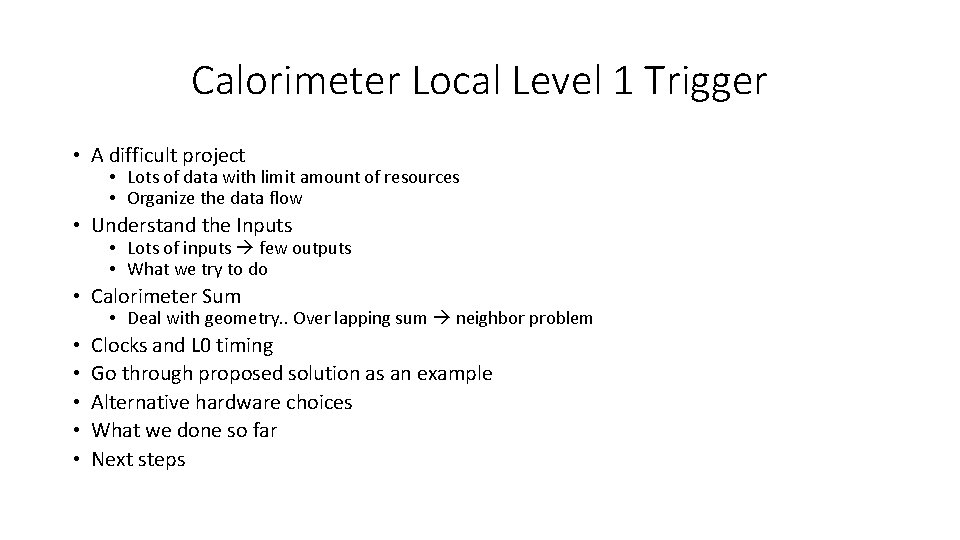
Calorimeter Local Level 1 Trigger • A difficult project • Lots of data with limit amount of resources • Organize the data flow • Understand the Inputs • Lots of inputs few outputs • What we try to do • Calorimeter Sum • Deal with geometry. . Over lapping sum neighbor problem • • • Clocks and L 0 timing Go through proposed solution as an example Alternative hardware choices What we done so far Next steps
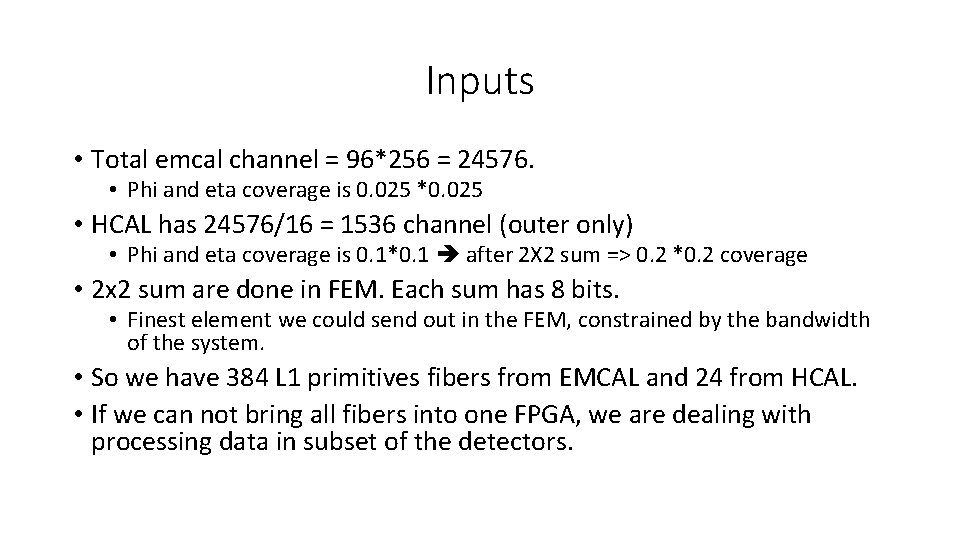
Inputs • Total emcal channel = 96*256 = 24576. • Phi and eta coverage is 0. 025 *0. 025 • HCAL has 24576/16 = 1536 channel (outer only) • Phi and eta coverage is 0. 1*0. 1 after 2 X 2 sum => 0. 2 *0. 2 coverage • 2 x 2 sum are done in FEM. Each sum has 8 bits. • Finest element we could send out in the FEM, constrained by the bandwidth of the system. • So we have 384 L 1 primitives fibers from EMCAL and 24 from HCAL. • If we can not bring all fibers into one FPGA, we are dealing with processing data in subset of the detectors.
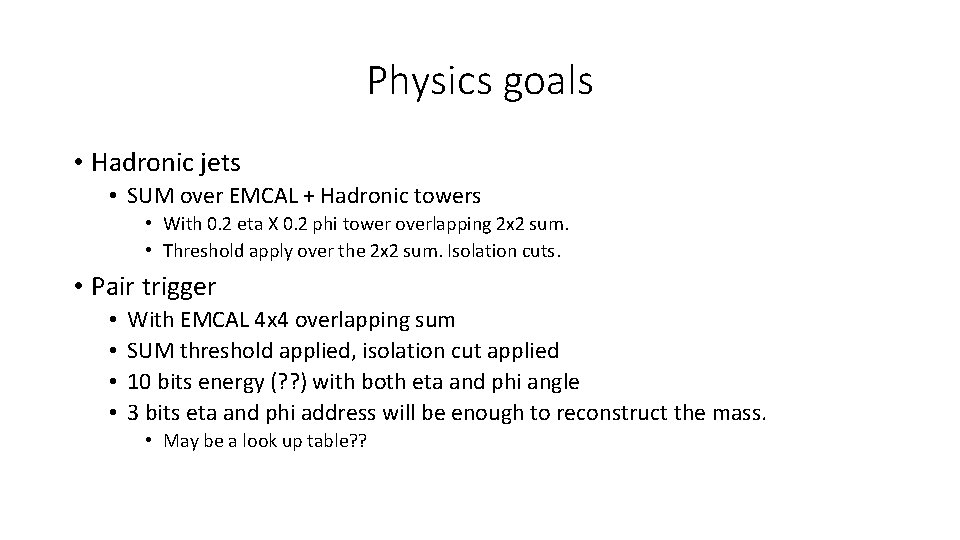
Physics goals • Hadronic jets • SUM over EMCAL + Hadronic towers • With 0. 2 eta X 0. 2 phi tower overlapping 2 x 2 sum. • Threshold apply over the 2 x 2 sum. Isolation cuts. • Pair trigger • • With EMCAL 4 x 4 overlapping sum SUM threshold applied, isolation cut applied 10 bits energy (? ? ) with both eta and phi angle 3 bits eta and phi address will be enough to reconstruct the mass. • May be a look up table? ?
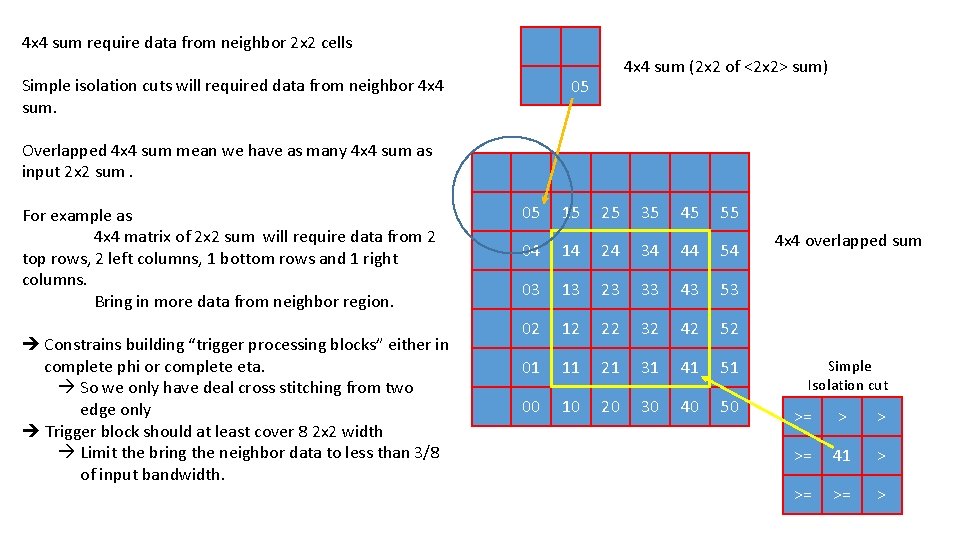
4 x 4 sum require data from neighbor 2 x 2 cells Simple isolation cuts will required data from neighbor 4 x 4 sum (2 x 2 of <2 x 2> sum) 05 Overlapped 4 x 4 sum mean we have as many 4 x 4 sum as input 2 x 2 sum. For example as 4 x 4 matrix of 2 x 2 sum will require data from 2 top rows, 2 left columns, 1 bottom rows and 1 right columns. Bring in more data from neighbor region. Constrains building “trigger processing blocks” either in complete phi or complete eta. So we only have deal cross stitching from two edge only Trigger block should at least cover 8 2 x 2 width Limit the bring the neighbor data to less than 3/8 of input bandwidth. 05 15 25 35 45 55 04 14 24 34 44 54 03 13 23 33 43 53 02 12 22 32 42 52 01 11 21 31 41 51 00 10 20 30 40 50 4 x 4 overlapped sum Simple Isolation cut >= > > >= 41 > >= >= >
Data division • The EMCAL data have 256 channel phi and 96 channels in eta. • Assume • Each fiber cover 64 channel in square form (8 x 8) for each cable mapping • 2 layers of 8 x 8 channels • If complete phi coverage 64 fibers, For complete eta coverage 24 fibers per trigger processing blocks. • Plus sending and receiving of cross stitching fibers from neighbor region. Ignore end of the detector effect.
Clock Domain • The collider beam interaction is driven by the RHIC beam clock, ~9. 6 MHz • The calorimeter digitizer is driven by 6 X beam clock. • The L 0 timing signal, like RESET, INIT, TEST, RUN etc. , carries action associate with beam clock. • The L 1 trigger primitives optical transmitter is driven by 120 MHz crystal clock • For the clock stability. Use local crystal… • The L 1 trigger block needs • 1) beam clock is needed to clock the collision data • 2) reference clock is needed to receive the data. • 3) FPGA operation could be drive by multiple of the reference clock. • Simplify the optical interface coupling… • Per reference frequency, several possible optical speed can be achieved.
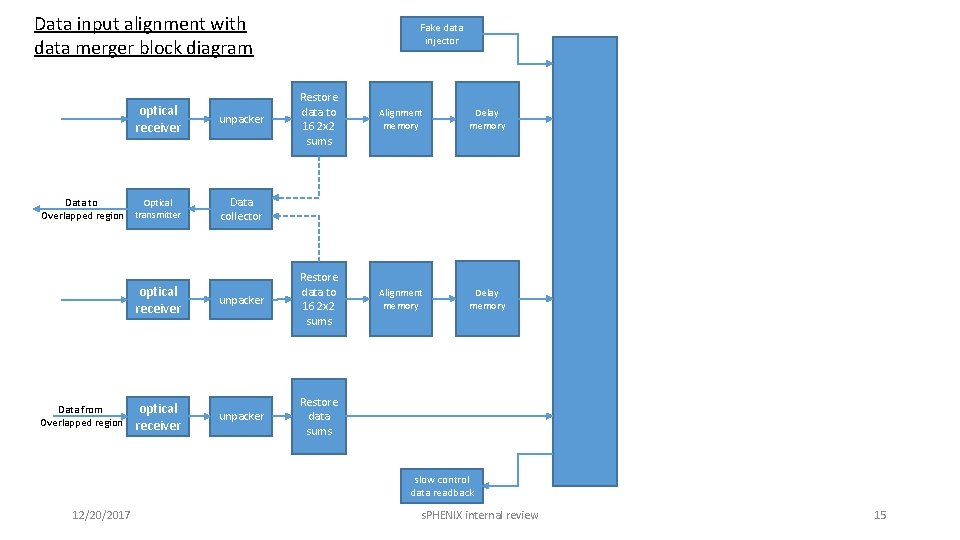
Data input alignment with data merger block diagram Restore data to 16 2 x 2 sums Alignment memory Delay memory unpacker Restore data sums optical receiver unpacker Data to Optical Overlapped region transmitter Data collector optical receiver Data from Overlapped region optical receiver Fake data injector slow control data readback 12/20/2017 s. PHENIX internal review 15
Proposed system • Using existing calorimeter digitizer system infrastructure • Beam clock distribution • Slow control/offline read back system • Power distribution • 2 sets of 2 12 V 50 A power bug ensure enough DC power distribution. • Use only every other slots • Mechanical support
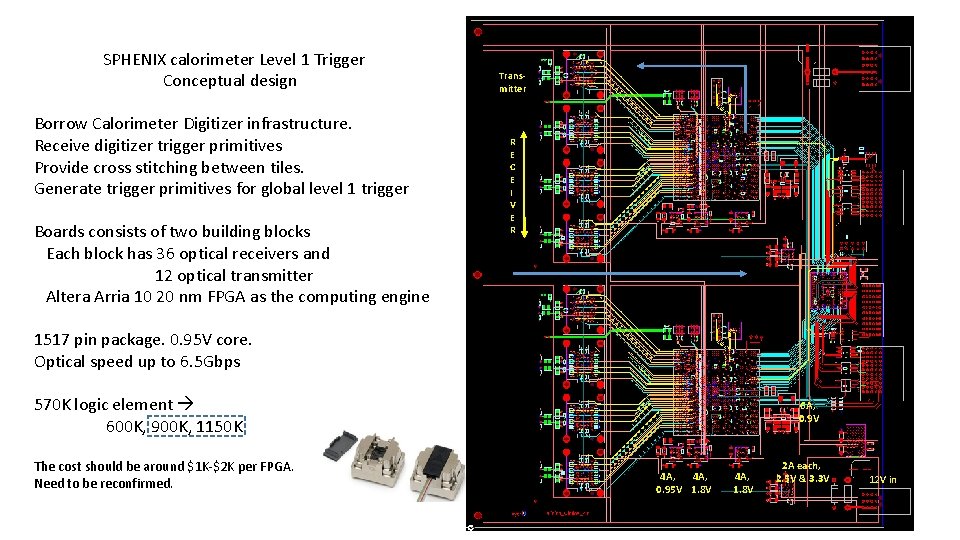
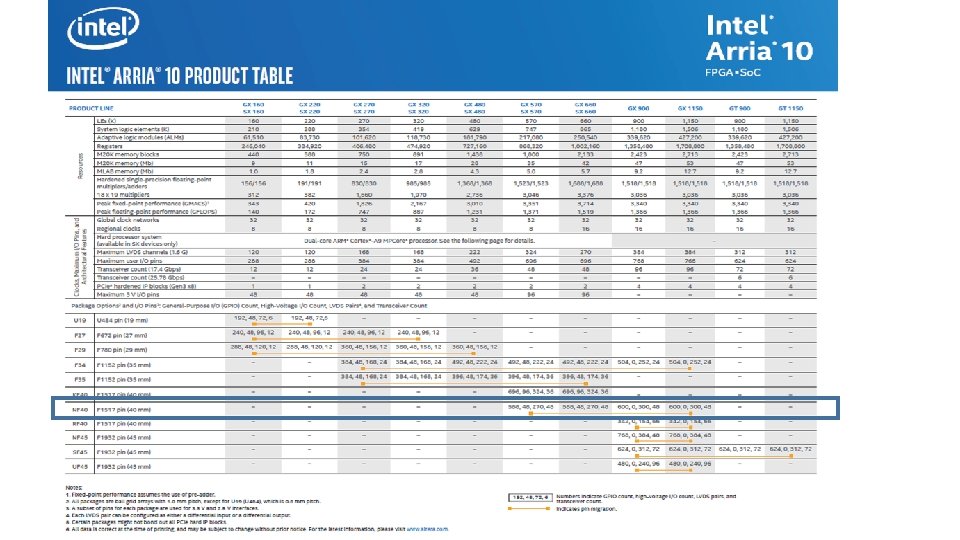
SPHENIX calorimeter Level 1 Trigger Conceptual design Borrow Calorimeter Digitizer infrastructure. Receive digitizer trigger primitives Provide cross stitching between tiles. Generate trigger primitives for global level 1 trigger Boards consists of two building blocks Each block has 36 optical receivers and 12 optical transmitter Altera Arria 10 20 nm FPGA as the computing engine Transmitter R E C E I V E R 1517 pin package. 0. 95 V core. Optical speed up to 6. 5 Gbps 570 K logic element 600 K, 900 K, 1150 K The cost should be around $1 K-$2 K per FPGA. Need to be reconfirmed. 6 A, 0. 9 V 4 A, 0. 95 V 1. 8 V 4 A, 1. 8 V 2 A each, 2. 5 V & 3. 3 V 12 V in
EMCAL Section (1) • L 1 trigger Arria 10 GX block. • Assume we will do the trigger data along the eta direction. • 24 fibers will cover 96 channel in eta and 16 channel in phi direction. • Need 48 2 x 2 sum from the bottom block and 2 set of 48 sums from the top block. • The fundamental is 48 8 bits data. 24 16 bits data + 1 header + 1 beam clock + 1 space 27 data words bandwidth need to be at least 5. 4 Gbits • The same thing hold true to copy data over to neighbors block. • This will call for 3 transmitters and 3 receivers for cross stitching • Or more lower bandwidth with more fibers.
EMCAL Section (2) • Need to do non-overlapping sum for Hadronic jets • Mapping is not uniform in eta and uniform in phi. • For bandwidth calculation use 8 x 8 non-overlapping which over 0. 2 in phi. • Trigger block holds 24*16 2 x 2 sums => 384 2 x 2 sums => 24 8 x 8 sum. • This is about the same as single cross stitching data bandwidth requirement • 1 transmitter required. • For pair trigger, • set threshold on overlapping 4 x 4 sum. • Maximum 4 peak outputs. 6 bits address (eta, phi), 10 bits energy • This will require 1 transmitter.
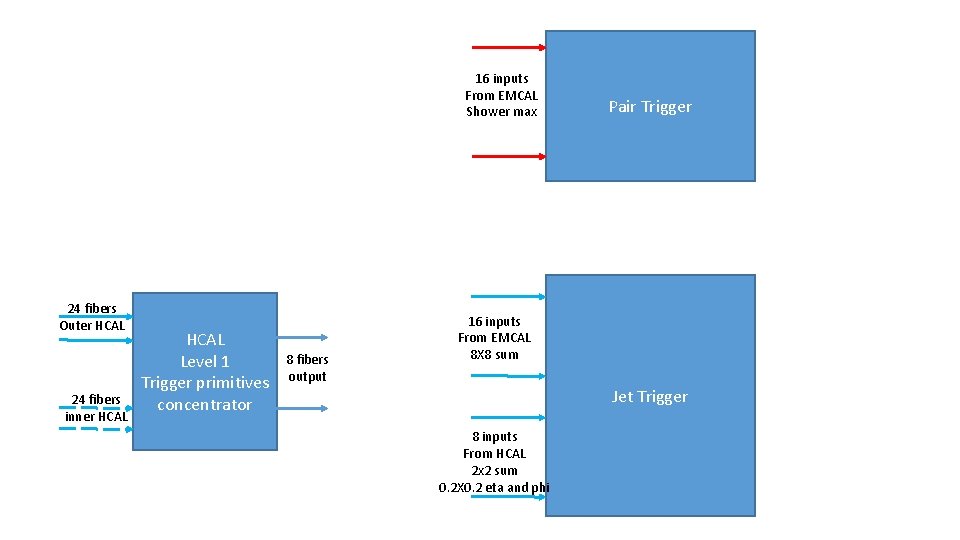
16 inputs From EMCAL Shower max 24 fibers Outer HCAL 24 fibers inner HCAL Level 1 Trigger primitives concentrator 8 fibers output Pair Trigger 16 inputs From EMCAL 8 X 8 sum Jet Trigger 8 inputs From HCAL 2 x 2 sum 0. 2 X 0. 2 eta and phi
FPGA Resource Usage • use example like proposed system • It deal with 96 channel in phi and 16 channel in phi 384 2 x 2 sum and generate equal amount 4 x 4 overlapped sum • Assume each of the sum has 10 bits. • This imply ~400 *2 *10 = 8 K registers are needed per pipeline stage. • Assume we have 20 pipeline stages 160 K. • This is not memory buffer intensive operation. • The FPGA logic cell size more or less match with number of optical transceivers • Comes with small feature, 20 nm, 16 nm, 14 nm…

Alternative choice • Possible choice • Commercial solution –Hitech • ATLAS g. FEX (Global Feature Extractor) board • ATLAS FELIX board • Questions to be asked • Does it meets the minimum choice ? ? • Is it practical ? ? ? • What are system design for? ? Can it adapted for sphenix trigger? ? • Can we handle it? ? • The complexity of the system? ? The infrastructure to operate it? ? Man power to deal with it? ?
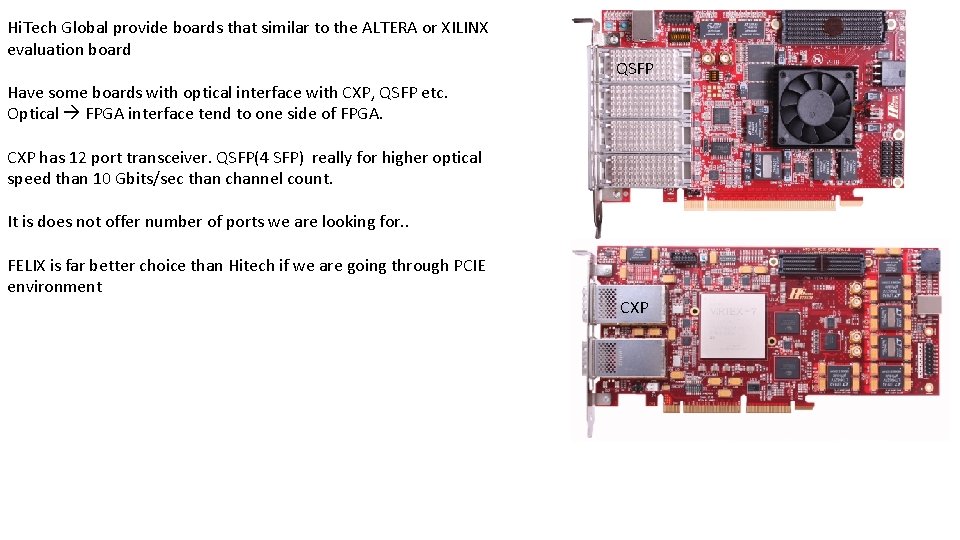
Hi. Tech Global provide boards that similar to the ALTERA or XILINX evaluation board QSFP Have some boards with optical interface with CXP, QSFP etc. Optical FPGA interface tend to one side of FPGA. CXP has 12 port transceiver. QSFP(4 SFP) really for higher optical speed than 10 Gbits/sec than channel count. It is does not offer number of ports we are looking for. . FELIX is far better choice than Hitech if we are going through PCIE environment CXP
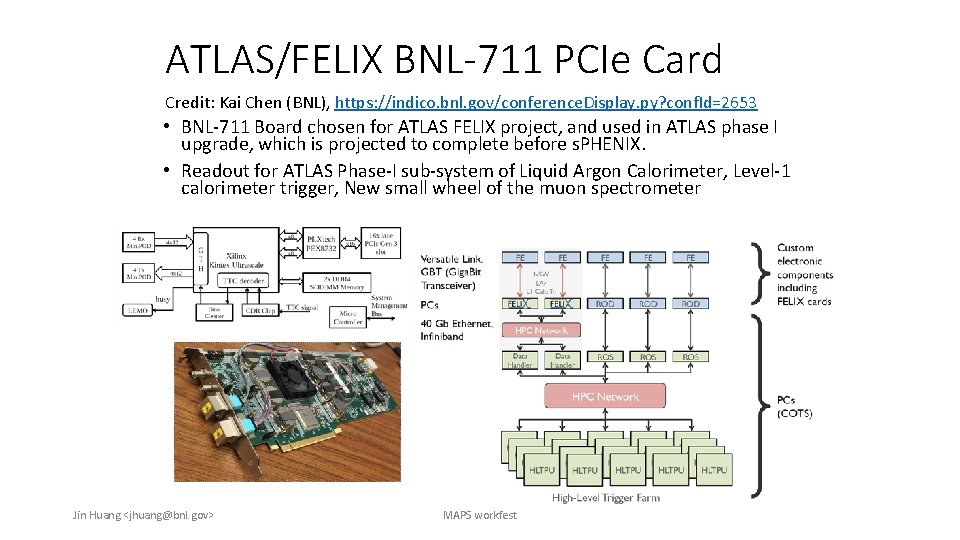
ATLAS/FELIX BNL-711 PCIe Card Credit: Kai Chen (BNL), https: //indico. bnl. gov/conference. Display. py? conf. Id=2653 • BNL-711 Board chosen for ATLAS FELIX project, and used in ATLAS phase I upgrade, which is projected to complete before s. PHENIX. • Readout for ATLAS Phase-I sub-system of Liquid Argon Calorimeter, Level-1 calorimeter trigger, New small wheel of the muon spectrometer Jin Huang <jhuang@bnl. gov> MAPS workfest
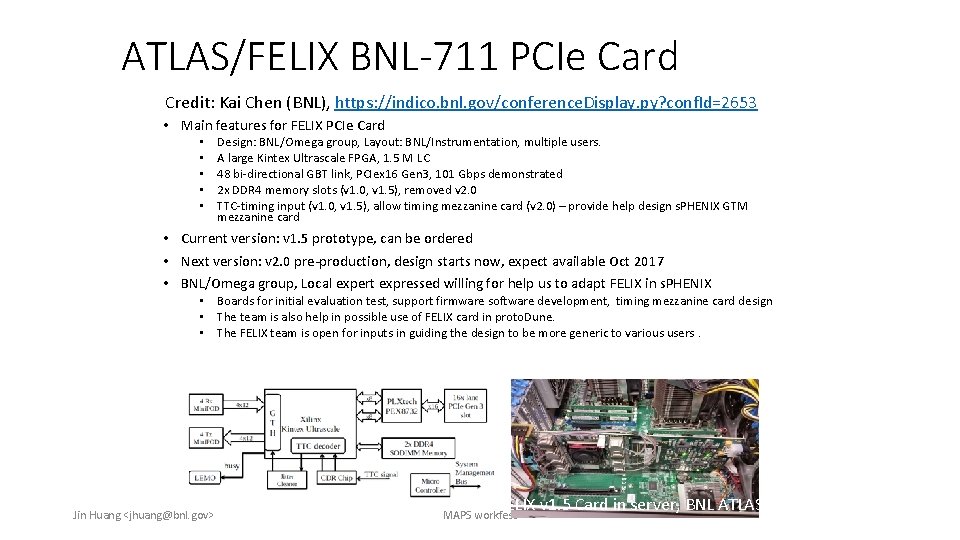
ATLAS/FELIX BNL-711 PCIe Card Credit: Kai Chen (BNL), https: //indico. bnl. gov/conference. Display. py? conf. Id=2653 • Main features for FELIX PCIe Card • • • Design: BNL/Omega group, Layout: BNL/Instrumentation, multiple users. A large Kintex Ultrascale FPGA, 1. 5 M LC 48 bi-directional GBT link, PCIex 16 Gen 3, 101 Gbps demonstrated 2 x DDR 4 memory slots (v 1. 0, v 1. 5), removed v 2. 0 TTC-timing input (v 1. 0, v 1. 5), allow timing mezzanine card (v 2. 0) – provide help design s. PHENIX GTM mezzanine card • Current version: v 1. 5 prototype, can be ordered • Next version: v 2. 0 pre-production, design starts now, expect available Oct 2017 • BNL/Omega group, Local expert expressed willing for help us to adapt FELIX in s. PHENIX • Boards for initial evaluation test, support firmware software development, timing mezzanine card design • The team is also help in possible use of FELIX card in proto. Dune. • The FELIX team is open for inputs in guiding the design to be more generic to various users. Jin Huang <jhuang@bnl. gov> FELIX v 1. 5 Card in server, BNL ATLAS Group MAPS workfest
Why not FELIX card • Good • It has 48 by directional optical/ Large FPGA. • It works as readout interface, like the old DCM, DCM II, JSEB and JSEB II • For our case • The 48 pair transceiver may be possible one to get slightly more eta space. • If multiple Level 1 board reside in the PC environment, the power distribution will be quite limited or cost effective • Add PC cost… • In ATLAS, L 0 timing is brought through TTCRX fiber. Possible adding daughter card to resolve the problem • Cost is much higher than our current solution. • FPGA, XCKU 115 XLINK Kintex Ultra. Scale, size match the optical choice. But it too large for us. • It has ~1. 5 M flip flops.
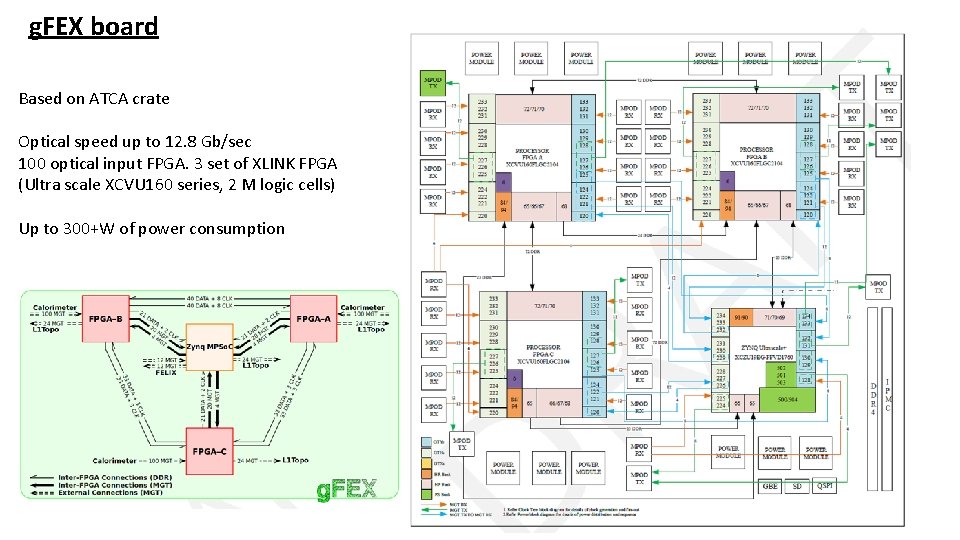
g. FEX board Based on ATCA crate Optical speed up to 12. 8 Gb/sec 100 optical input FPGA. 3 set of XLINK FPGA (Ultra scale XCVU 160 series, 2 M logic cells) Up to 300+W of power consumption
g. FEX board choice • It is designed for making L 1 trigger • With 300 fibers inputs we will need only 2 cards. • Problems • Large infrastructure just to get started. • Complexity of the board is hard to manage. • We have much simpler problems. • Does not match with our expertize or equipment's
What we done so far • Layout a possible system solutions • Coded up optical portion of receiver and transmitter. • Create code for • • • 1) overlapping 2 x 2 sums for 16 2 x 2 sums 2) isolation cuts 3) priority encoding method for output 4) sorting for highest shower energy 5) possible loop back code for testing optical transmitters and receivers.
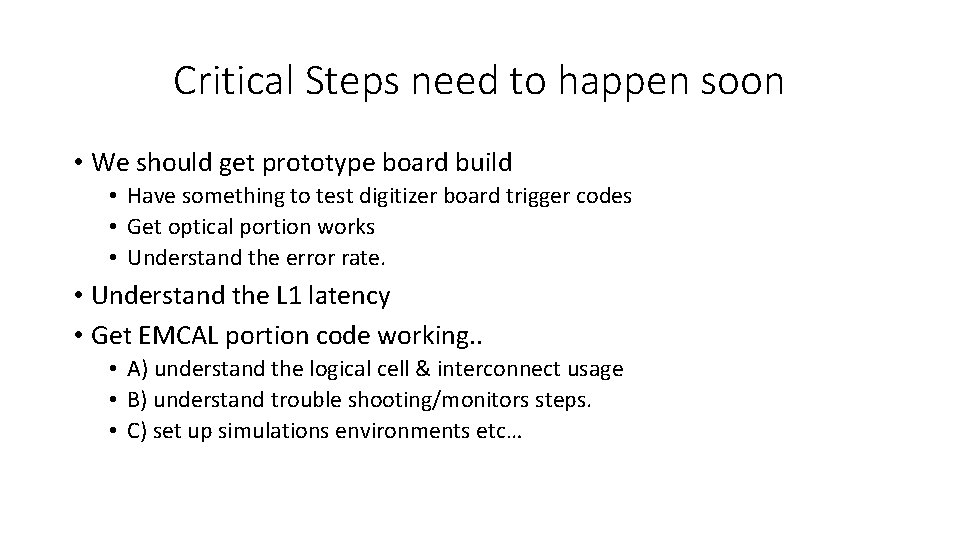
Critical Steps need to happen soon • We should get prototype board build • Have something to test digitizer board trigger codes • Get optical portion works • Understand the error rate. • Understand the L 1 latency • Get EMCAL portion code working. . • A) understand the logical cell & interconnect usage • B) understand trouble shooting/monitors steps. • C) set up simulations environments etc…
Backup slides
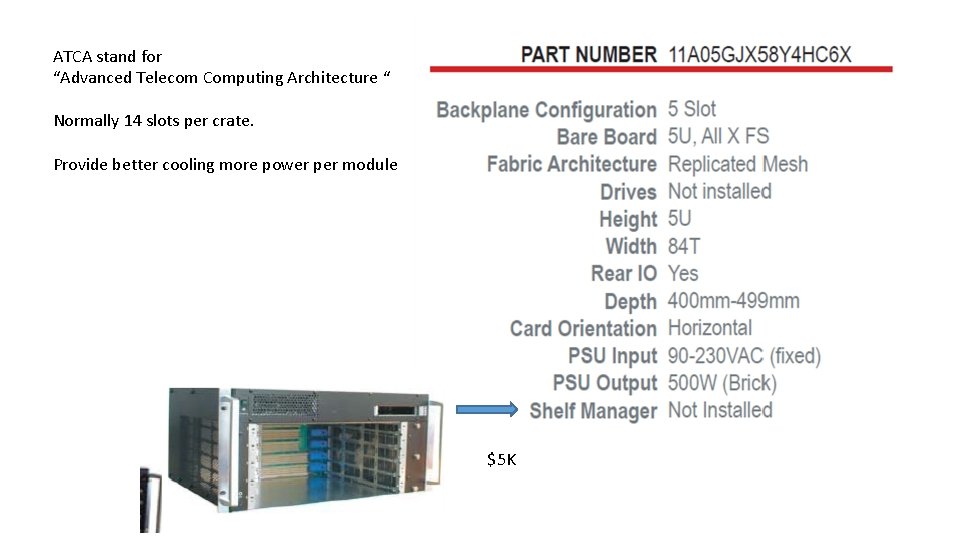
ATCA stand for “Advanced Telecom Computing Architecture “ Normally 14 slots per crate. Provide better cooling more power per module $5 K
- Slides: 34