
CalITP 1 Mobility in Flux Today residents visitors
Cal-ITP 1
Mobility in Flux Today, residents, visitors, businesses and institutions of California face a disaggregated public transportation network that is often Difficult to Use Costly to operate Suffering from declining ridership Customers experience significant difficulties planning trips, making connections, and making fare payments Agencies face a high cost to collect transit fares Between 2012 and 2016 California lost 62. 2 million annual transit rides 2
Today’s Opportunities A sense of urgency around mobility, pollution, and health Public investments in transit capacity and transit network redesigns Economic mobility and inclusion initiatives across California’s regions Diverse agencies and civic institutions addressing the same problems Local and regional transit/multimodal integration initiatives New technology platforms and new data sources To solve a problem of this magnitude, collaboration and collective problem solving is required at all levels of government, with public and private operators, academia and think tanks, and with vendors of relevant technologies and business models. 3

What is Cal-ITP? Cal-ITP is the result of cooperation between the California State Transportation Agency (Cal. STA), Caltrans, the Capitol Corridor Joint Powers Authority (CCJPA), as well as local, regional and state partners. Cal-ITP was started to research, plan and establish a statewide framework for multimodal transportation integration. 4
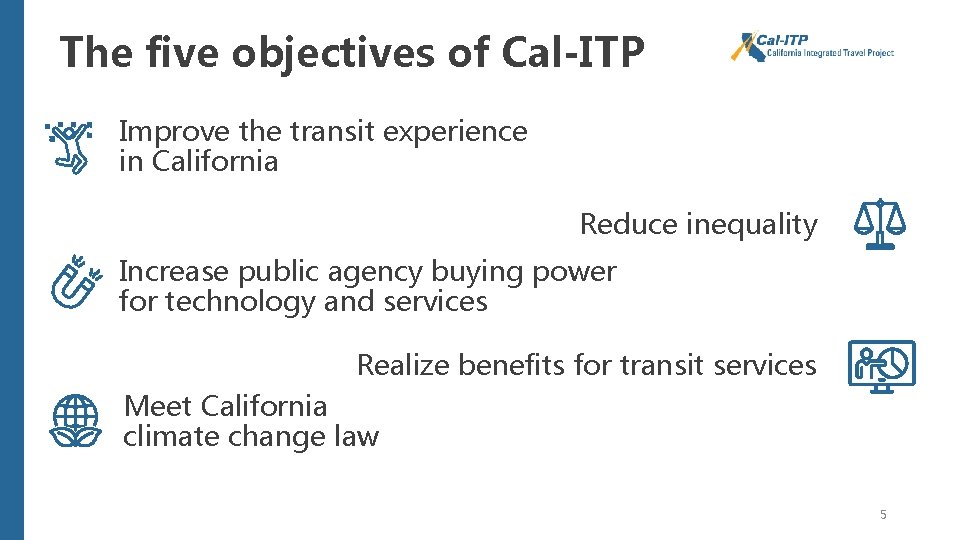
The five objectives of Cal-ITP Improve the transit experience in California Reduce inequality Increase public agency buying power for technology and services Realize benefits for transit services Meet California climate change law 5
Goals of Cal-ITP Increase ridership by offering seamless trip planning/payment across modes and across California Making transit easier for the transit rider by enabling a great user experience Meet changing consumer expectations Lower costs of fare/revenue collection/information management
What Cal-ITP aims to learn ? ? What are the latest industry innovations and best practices What is the best approach to deliver a solution that ensures seamless travel experience ? How to reduce costs for transit operators and authorities ? How to leverage global business models ? What are the most fitting business and governance models ? How can the Cal-ITP partners support the initiative In what ways can social inclusion be increased Which solutions would leverage, or create global standards, and ensure openness 7
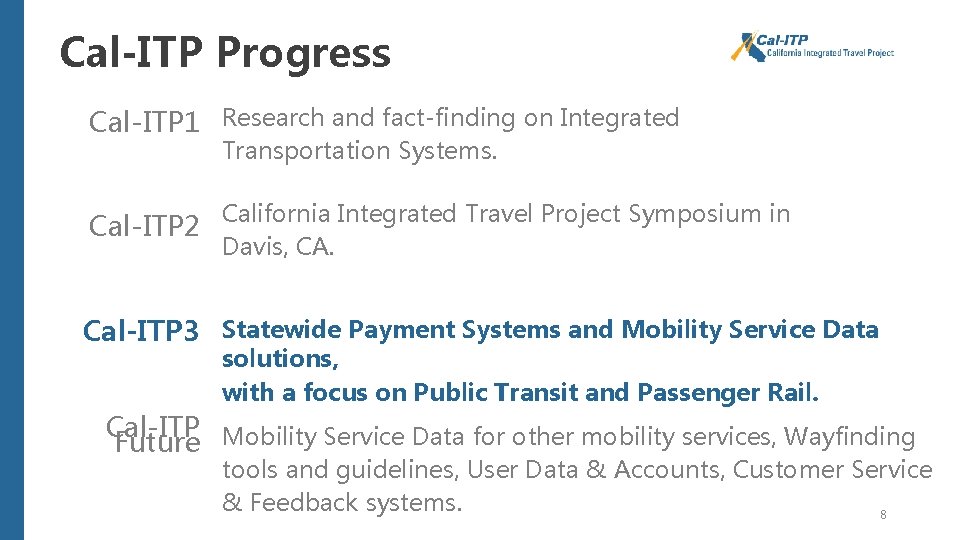
Cal-ITP Progress Cal-ITP 1 Research and fact-finding on Integrated Transportation Systems. California Integrated Travel Project Symposium in Cal-ITP 2 Davis, CA. Cal-ITP 3 Statewide Payment Systems and Mobility Service Data solutions, with a focus on Public Transit and Passenger Rail. Cal-ITP Mobility Service Data for other mobility services, Wayfinding Future tools and guidelines, User Data & Accounts, Customer Service & Feedback systems. 8
Cal-ITP Program Statewide Payment Systems and Mobility Service Data Cal-ITP 3 solutions, with a focus on Public Transit and Passenger Rail. • Sounding the Market (informal RFI) • Focusing on an opt-in state payment processing/gateway via a Master Service Agreement with a payment processor • Baselining the industry for: • Trip Planning • transit operators’ status re: payments/passenger counting/vehicle capacity • Preparing for transit operator assistance to achieve standards 9
The role the state is playing • Providing technical assistance • Identifying gaps/needs • Identifying and aligning benefits of scale and standards across: • Payments, Trip Planning, Mobility Data, and Wayfinding • Adapting to changes in the mobility ecosystem by being a partner to the market, and fostering the use of open data standards, data quality, and open payments, starting with the transit industry in California 10
Cal-ITP is not Building an “app” 11
- Slides: 11