
Calit 2 a Persistent UCSDUCI Framework for Collaboration
“Calit 2 -a Persistent UCSD/UCI Framework for Collaboration" Larry Smarr Professor, Computer Science, UCSD Director, Calit 2

“Calit 2 -a Persistent UCSD/UCI Framework for Collaboration" Invited Talk Sun Microsystems Global Education and Research Conference 2005 San Francisco, CA February 16, 2005 Dr. Larry Smarr Director, California Institute for Telecommunications and Information Technology Harry E. Gruber Professor, Dept. of Computer Science and Engineering Jacobs School of Engineering, UCSD
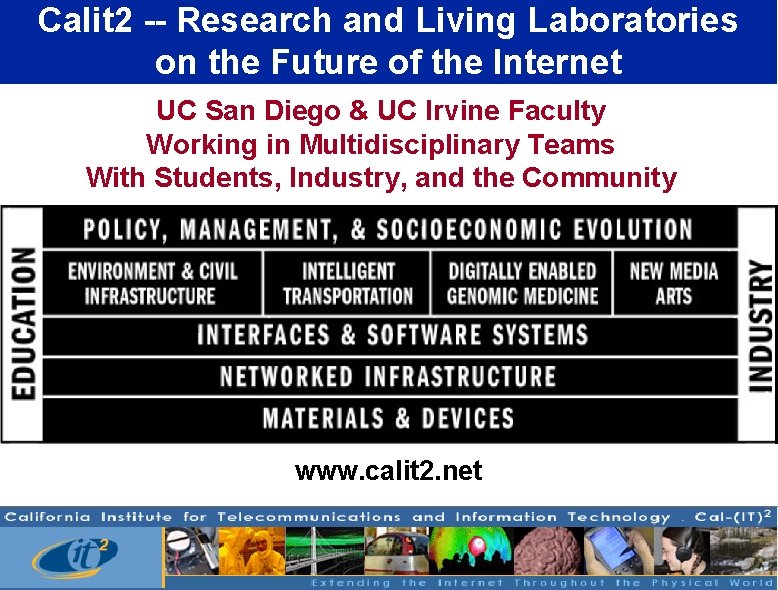
Calit 2 -- Research and Living Laboratories on the Future of the Internet UC San Diego & UC Irvine Faculty Working in Multidisciplinary Teams With Students, Industry, and the Community www. calit 2. net

Calit 2 is a UC Institutional Innovation -A Persistent Framework for Collaboration • Cuts Across Academic Stovepipes – – – Students, Faculty, Staff Disciplines Departments Schools Campuses • Links Outside of Campus – – Startups Corporations Non-Profits Community • Supports Creating Multi-Disciplinary & Multi-Institutional Teams
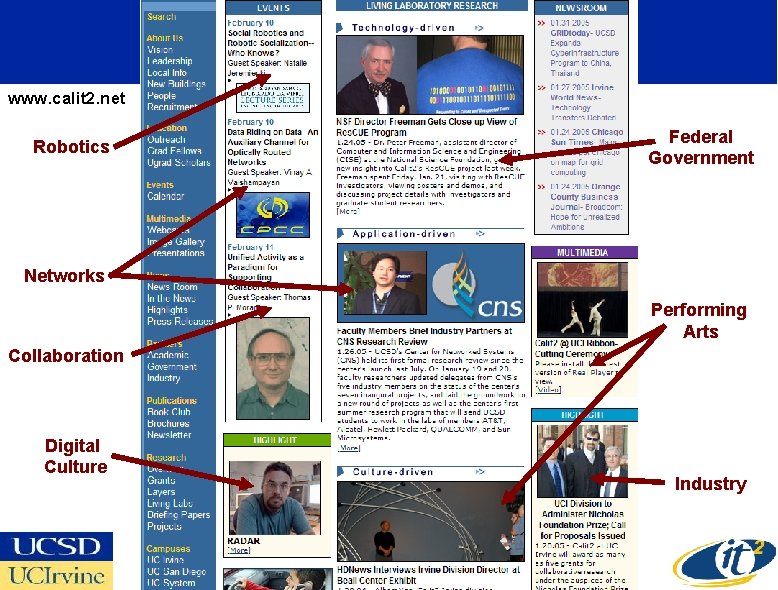
www. calit 2. net Robotics Federal Government Networks Performing Arts Collaboration Digital Culture Industry
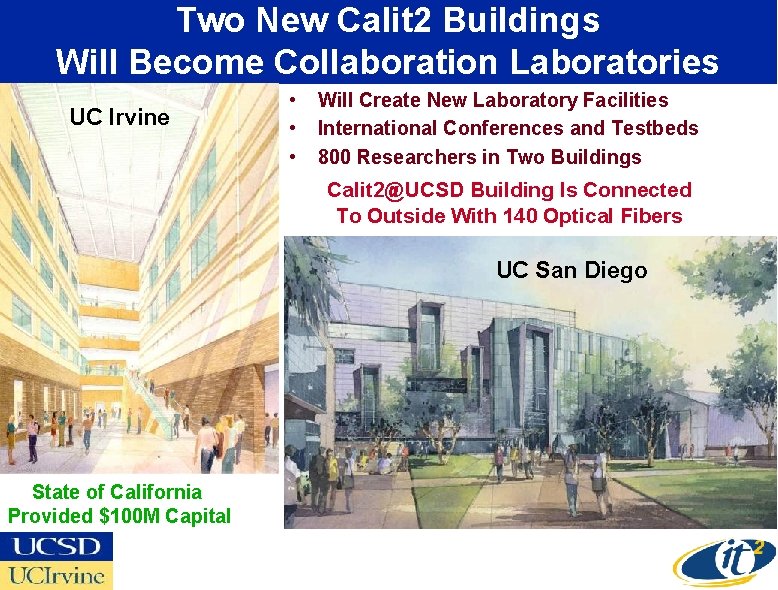
Two New Calit 2 Buildings Will Become Collaboration Laboratories Bioengineering • Will Create New Laboratory Facilities UC Irvine • International Conferences and Testbeds • 800 Researchers in Two Buildings Calit 2@UCSD Building Is Connected To Outside With 140 Optical Fibers UC San Diego State of California Provided $100 M Capital
Innovation Driven by Calit 2 Industrial Partners Teaming with Academic Research and Education • • • Funding Faculty Research Projects Supporting Graduate/Undergraduate Fellows Providing Access to Living Labs Equipment Joining on Federal Grants Co-Sponsoring Workshops/Conferences Hosting Seminars or Lectures • Endowing Chaired Professorships $85 Million from Industrial Partners in Matching Funds
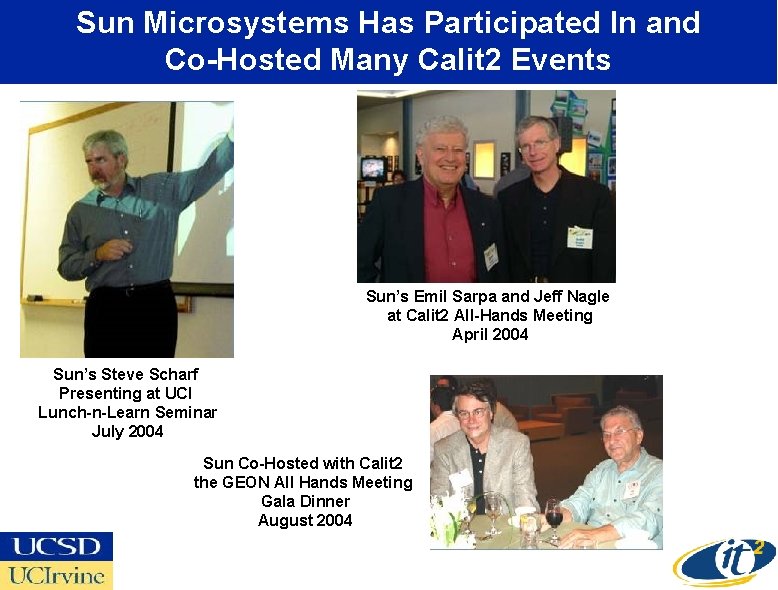
Sun Microsystems Has Participated In and Co-Hosted Many Calit 2 Events Sun’s Emil Sarpa and Jeff Nagle at Calit 2 All-Hands Meeting April 2004 Sun’s Steve Scharf Presenting at UCI Lunch-n-Learn Seminar July 2004 Sun Co-Hosted with Calit 2 the GEON All Hands Meeting Gala Dinner August 2004
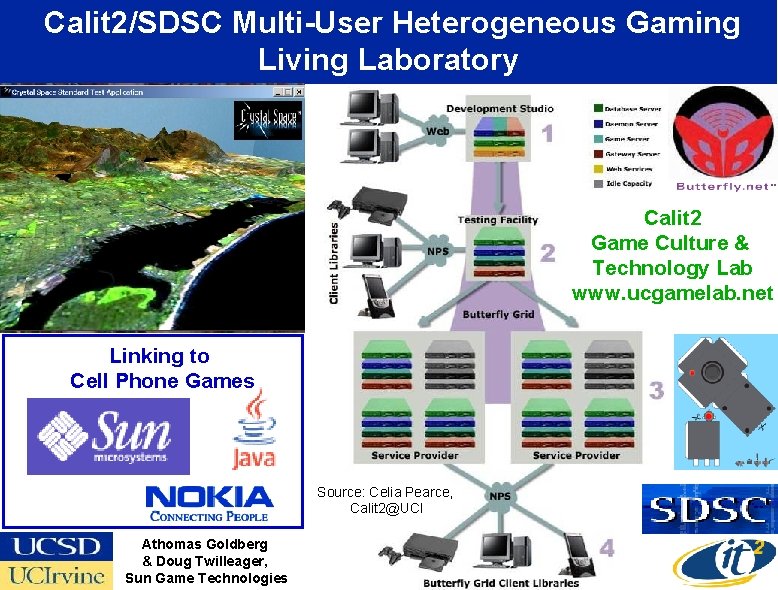
Calit 2/SDSC Multi-User Heterogeneous Gaming Living Laboratory Partners. Calit 2 Game Culture & Technology Lab www. ucgamelab. net Linking to Cell Phone Games Source: Celia Pearce, Calit 2@UCI Athomas Goldberg & Doug Twilleager, Sun Game Technologies
Calit 2@UCI Sun Sponsored Research Projects • Three Projects Driven By Sun Partnership • Demonstration Project of Playing a Game On Multiple Platforms, – e. g. , Cellular Phone, PC, PDA (Heterogeneous Gaming Initiative) • From Play Mechanics That Evolved From This Project: – Concurrently Developing Glyph Authoring System for Heterogeneous Gaming • Developing a Sun Center of Excellence for Networking Gaming & Graphics • Pending Proposal to Augment Above to Move Projects to Sun Hardware – Begin to Run Butterfly. Net Software on Sun Clusters Source: Celia Pearce, Calit 2@UCI
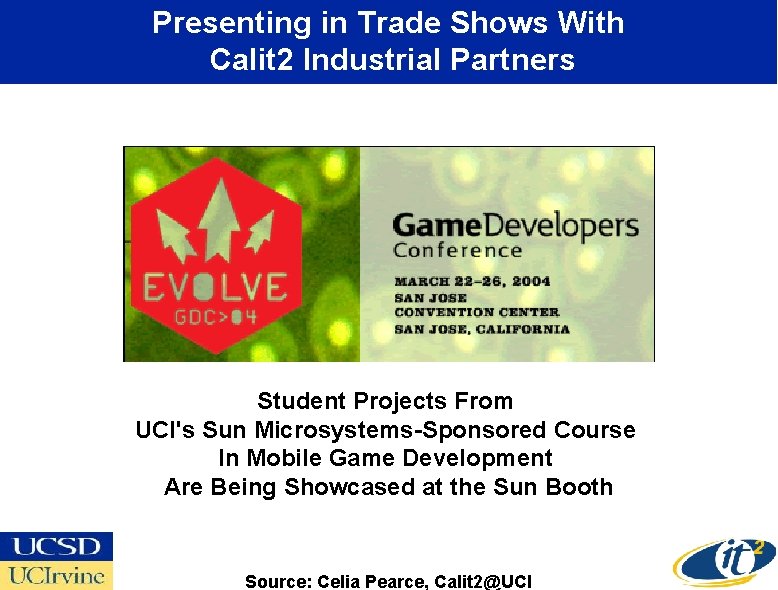
Presenting in Trade Shows With Calit 2 Industrial Partners Student Projects From UCI's Sun Microsystems-Sponsored Course In Mobile Game Development Are Being Showcased at the Sun Booth Source: Celia Pearce, Calit 2@UCI
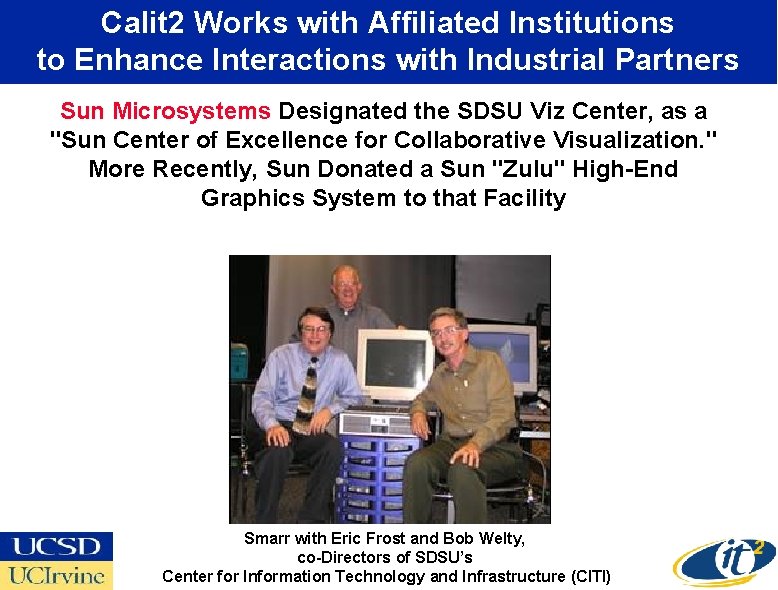
Calit 2 Works with Affiliated Institutions to Enhance Interactions with Industrial Partners Sun Microsystems Designated the SDSU Viz Center, as a "Sun Center of Excellence for Collaborative Visualization. " More Recently, Sun Donated a Sun "Zulu" High-End Graphics System to that Facility Smarr with Eric Frost and Bob Welty, co-Directors of SDSU’s Center for Information Technology and Infrastructure (CITI)
The Opt. IPuter Project Sun’s Slogan Realized… Really
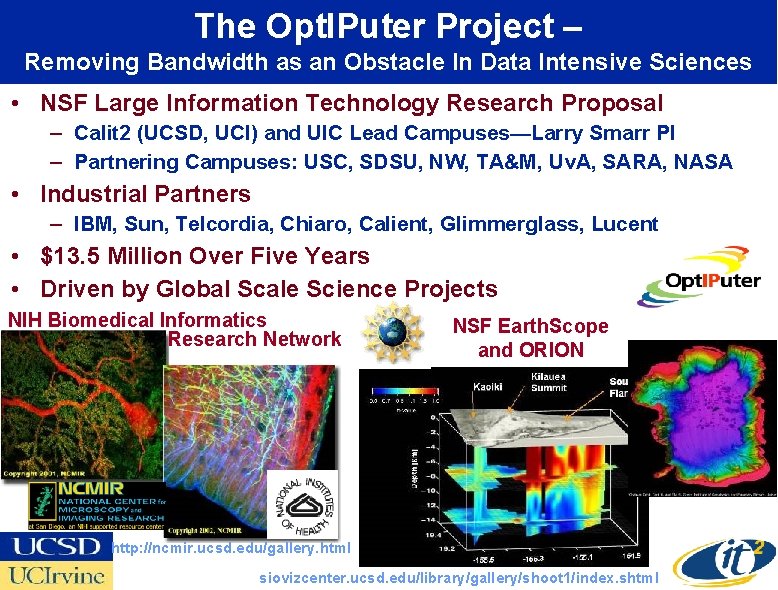
The Opt. IPuter Project – Removing Bandwidth as an Obstacle In Data Intensive Sciences • NSF Large Information Technology Research Proposal – Calit 2 (UCSD, UCI) and UIC Lead Campuses—Larry Smarr PI – Partnering Campuses: USC, SDSU, NW, TA&M, Uv. A, SARA, NASA • Industrial Partners – IBM, Sun, Telcordia, Chiaro, Calient, Glimmerglass, Lucent • $13. 5 Million Over Five Years • Driven by Global Scale Science Projects NIH Biomedical Informatics Research Network NSF Earth. Scope and ORION http: //ncmir. ucsd. edu/gallery. html siovizcenter. ucsd. edu/library/gallery/shoot 1/index. shtml
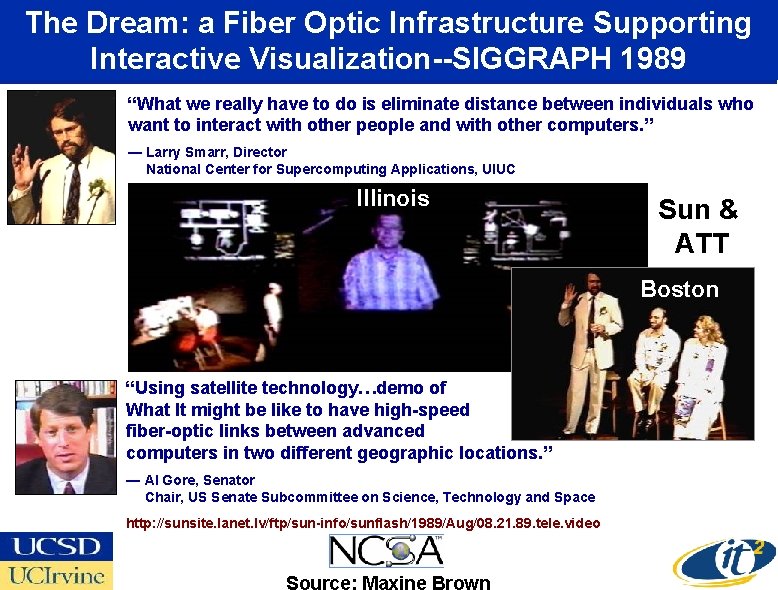
The Dream: a Fiber Optic Infrastructure Supporting Interactive Visualization--SIGGRAPH 1989 “What we really have to do is eliminate distance between individuals who want to interact with other people and with other computers. ” ― Larry Smarr, Director National Center for Supercomputing Applications, UIUC Illinois Sun & ATT Boston “Using satellite technology…demo of What It might be like to have high-speed fiber-optic links between advanced computers in two different geographic locations. ” ― Al Gore, Senator Chair, US Senate Subcommittee on Science, Technology and Space http: //sunsite. lanet. lv/ftp/sun-info/sunflash/1989/Aug/08. 21. 89. tele. video Source: Maxine Brown
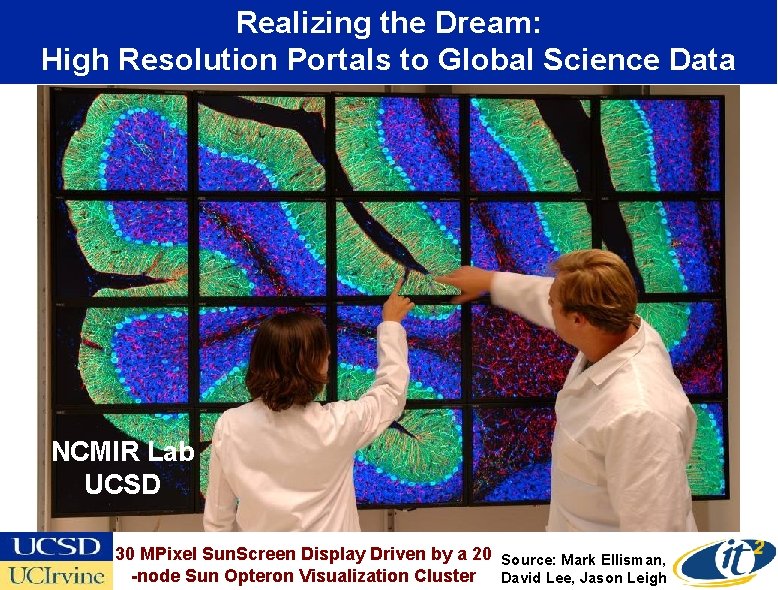
Realizing the Dream: High Resolution Portals to Global Science Data NCMIR Lab UCSD 30 MPixel Sun. Screen Display Driven by a 20 Source: Mark Ellisman, -node Sun Opteron Visualization Cluster David Lee, Jason Leigh
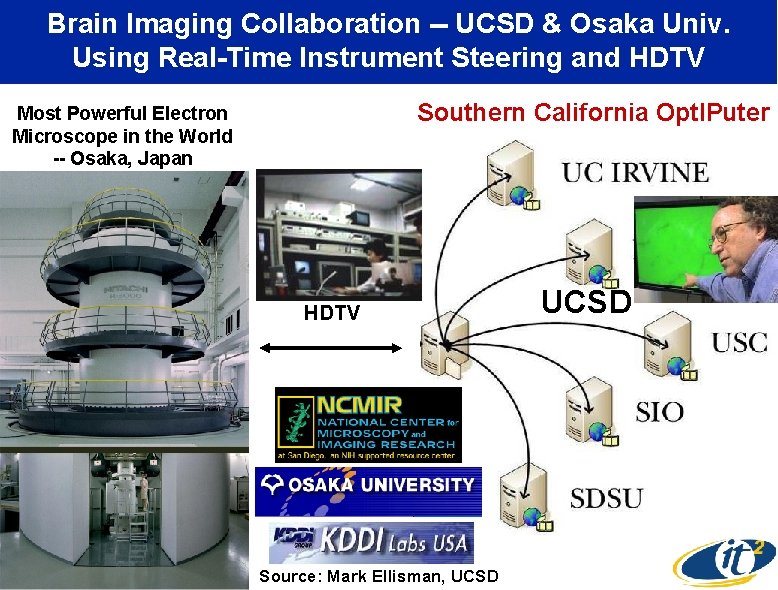
Brain Imaging Collaboration -- UCSD & Osaka Univ. Using Real-Time Instrument Steering and HDTV Southern California Opt. IPuter Most Powerful Electron Microscope in the World -- Osaka, Japan HDTV Source: Mark Ellisman, UCSD
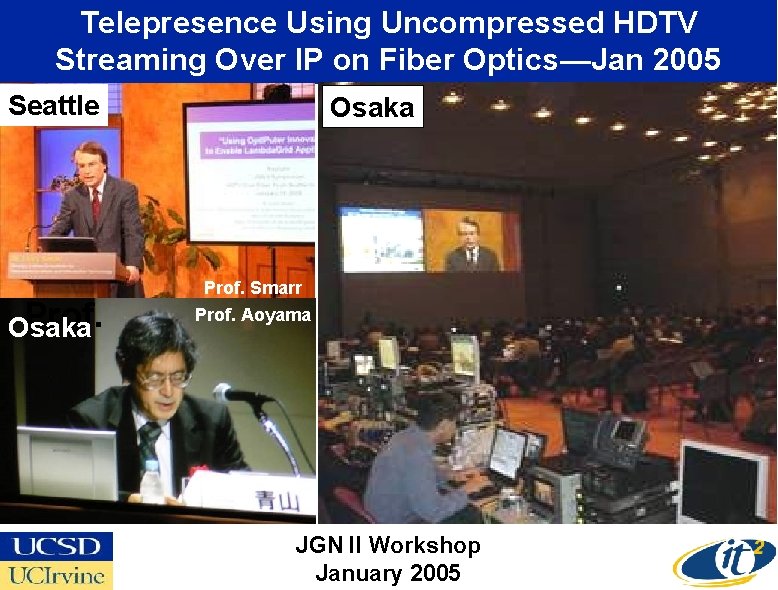
Telepresence Using Uncompressed HDTV Streaming Over IP on Fiber Optics—Jan 2005 Seattle Prof. Osaka Prof. Smarr Prof. Aoyama JGN II Workshop January 2005
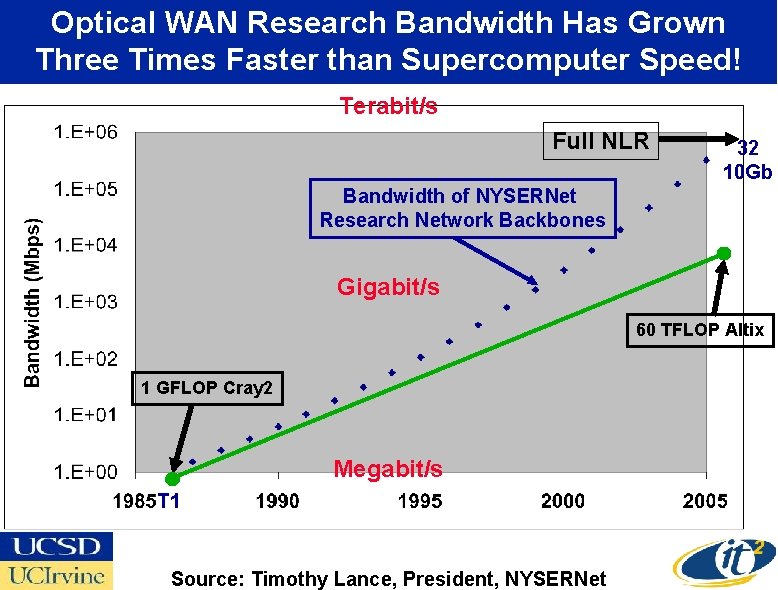
Optical WAN Research Bandwidth Has Grown Three Times Faster than Supercomputer Speed! Terabit/s Full NLR 32 10 Gb Bandwidth of NYSERNet Research Network Backbones Gigabit/s 60 TFLOP Altix 1 GFLOP Cray 2 Megabit/s T 1 Source: Timothy Lance, President, NYSERNet
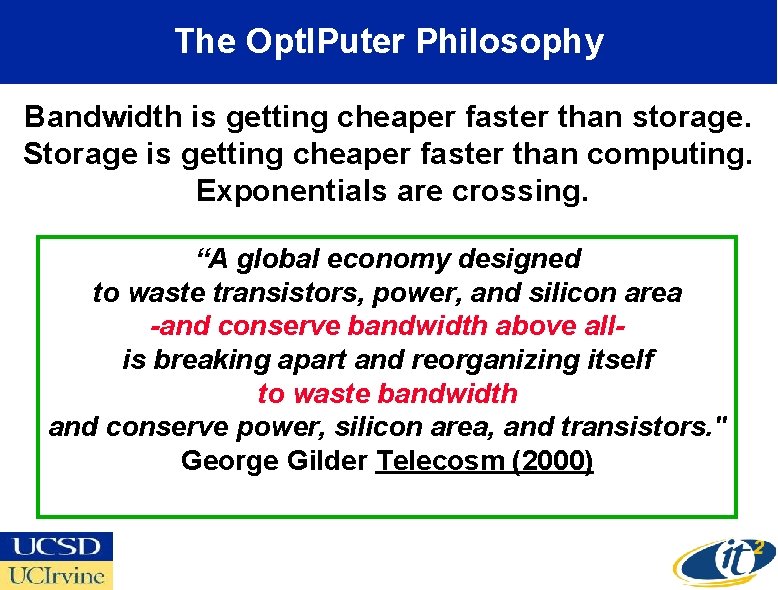
The Opt. IPuter Philosophy Bandwidth is getting cheaper faster than storage. Storage is getting cheaper faster than computing. Exponentials are crossing. “A global economy designed to waste transistors, power, and silicon area -and conserve bandwidth above allis breaking apart and reorganizing itself to waste bandwidth and conserve power, silicon area, and transistors. " George Gilder Telecosm (2000)
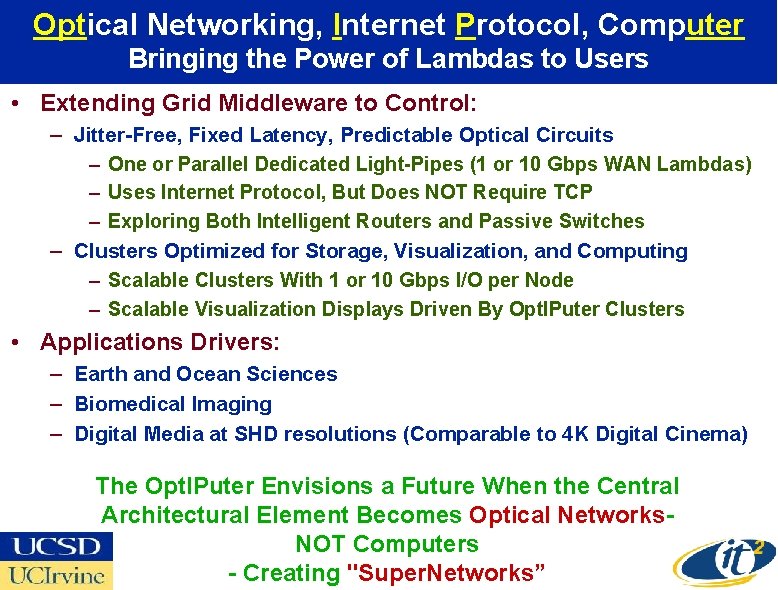
Optical Networking, Internet Protocol, Computer Bringing the Power of Lambdas to Users • Extending Grid Middleware to Control: – Jitter-Free, Fixed Latency, Predictable Optical Circuits – One or Parallel Dedicated Light-Pipes (1 or 10 Gbps WAN Lambdas) – Uses Internet Protocol, But Does NOT Require TCP – Exploring Both Intelligent Routers and Passive Switches – Clusters Optimized for Storage, Visualization, and Computing – Scalable Clusters With 1 or 10 Gbps I/O per Node – Scalable Visualization Displays Driven By Opt. IPuter Clusters • Applications Drivers: – Earth and Ocean Sciences – Biomedical Imaging – Digital Media at SHD resolutions (Comparable to 4 K Digital Cinema) The Opt. IPuter Envisions a Future When the Central Architectural Element Becomes Optical Networks. NOT Computers - Creating "Super. Networks”
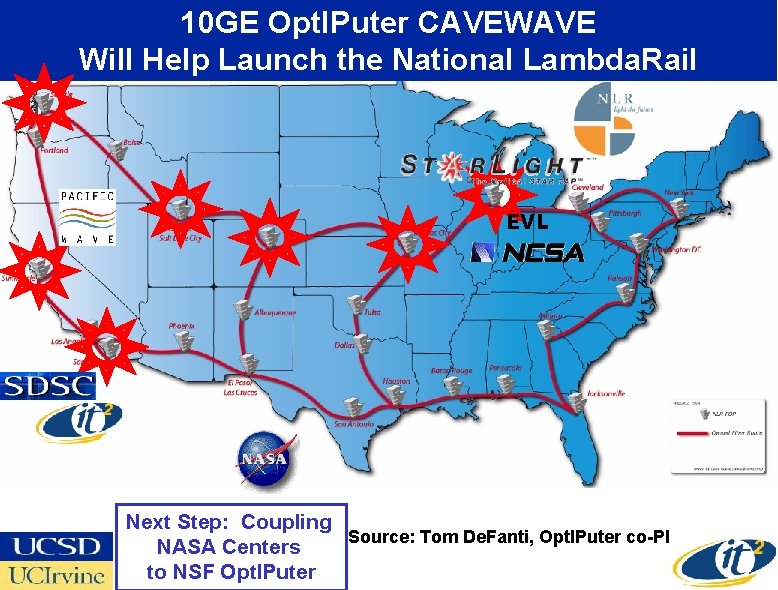
10 GE Opt. IPuter CAVEWAVE Will Help Launch the National Lambda. Rail EVL Next Step: Coupling Source: Tom De. Fanti, Opt. IPuter co-PI NASA Centers to NSF Opt. IPuter
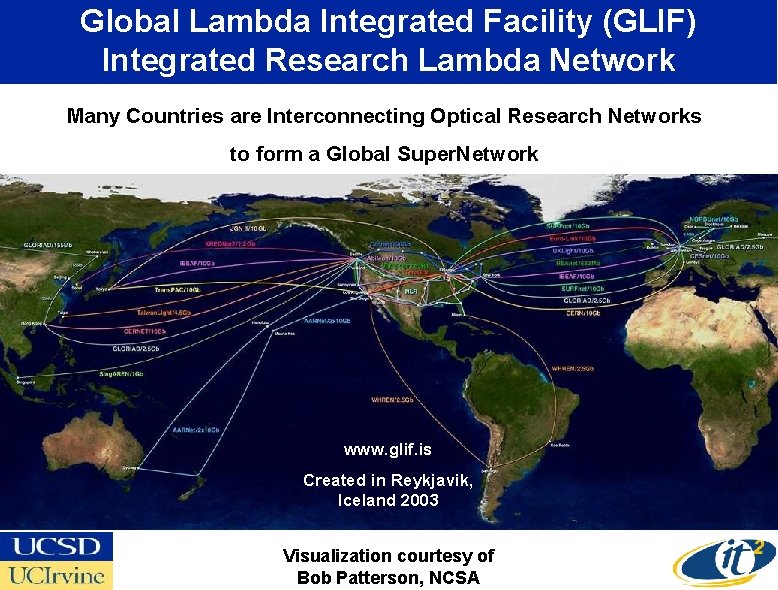
Global Lambda Integrated Facility (GLIF) Integrated Research Lambda Network Many Countries are Interconnecting Optical Research Networks to form a Global Super. Network www. glif. is Created in Reykjavik, Iceland 2003 Visualization courtesy of Bob Patterson, NCSA
Announcing… Call for Applications Using the GLIF Super. Network i Grid 2 oo 5 THE GLOBAL LAMBDA INTEGRATED FACILITY www. startap. net/igrid 2005/ September 26 -30, 2005 University of California, San Diego California Institute for Telecommunications and Information Technology Maxine Brown, Tom De. Fanti, Co-Organizers
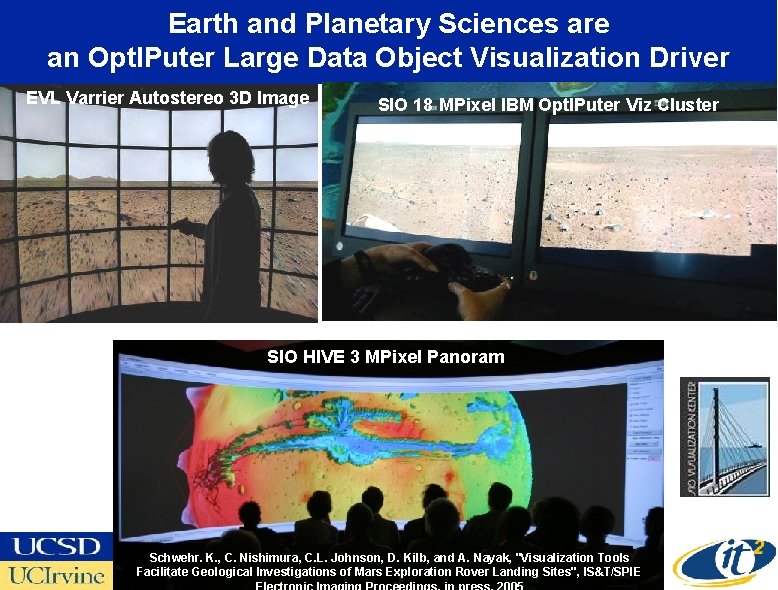
Earth and Planetary Sciences are an Opt. IPuter Large Data Object Visualization Driver EVL Varrier Autostereo 3 D Image SIO 18 MPixel IBM Opt. IPuter Viz Cluster SIO HIVE 3 MPixel Panoram Schwehr. K. , C. Nishimura, C. L. Johnson, D. Kilb, and A. Nayak, "Visualization Tools Facilitate Geological Investigations of Mars Exploration Rover Landing Sites", IS&T/SPIE
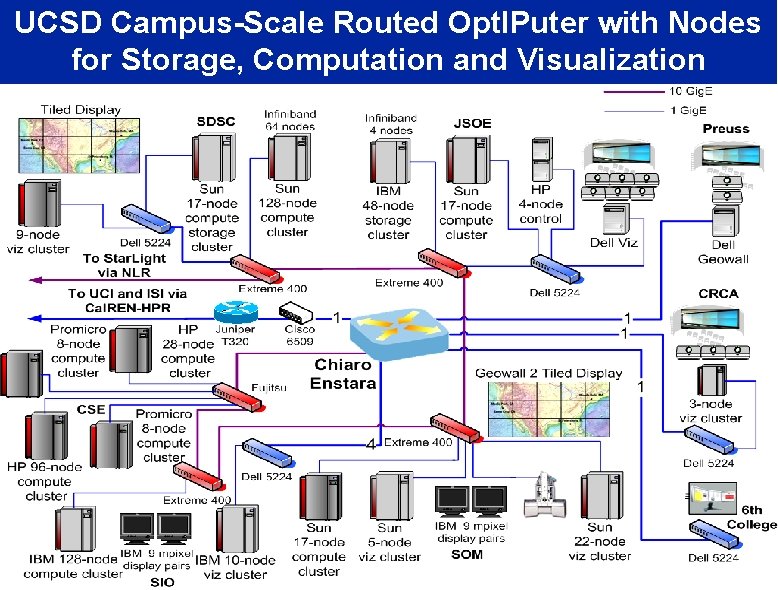
UCSD Campus-Scale Routed Opt. IPuter with Nodes for Storage, Computation and Visualization
Calit 2@UCSD Sun Sponsored Research Projects • Storage Related Projects Driven By Sun Partnership – Supports Storage Development Research Staff – Integrate Storage Cluster Functionality Into Rocks Configuration Package – Expand Research on Parallel and Distributed File System Configurations – Integrate Dynamic Storage Allocation Into Opt. IPuter Middleware • Dedicated Storage Development Position Under Recruitment • Discussions with Sun Concerning the Value of an Open-Source Solaris
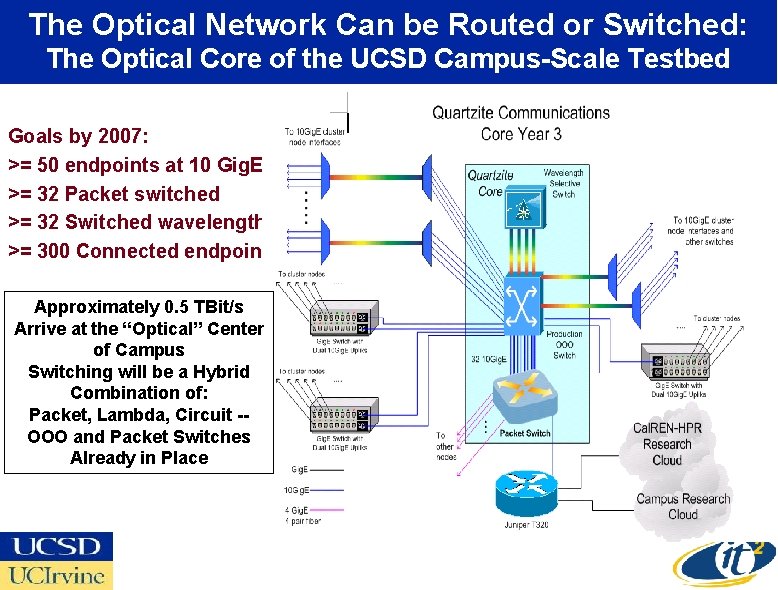
The Optical Network Can be Routed or Switched: The Optical Core of the UCSD Campus-Scale Testbed Goals by 2007: >= 50 endpoints at 10 Gig. E >= 32 Packet switched >= 32 Switched wavelengths >= 300 Connected endpoints Approximately 0. 5 TBit/s Arrive at the “Optical” Center of Campus Switching will be a Hybrid Combination of: Packet, Lambda, Circuit -OOO and Packet Switches Already in Place
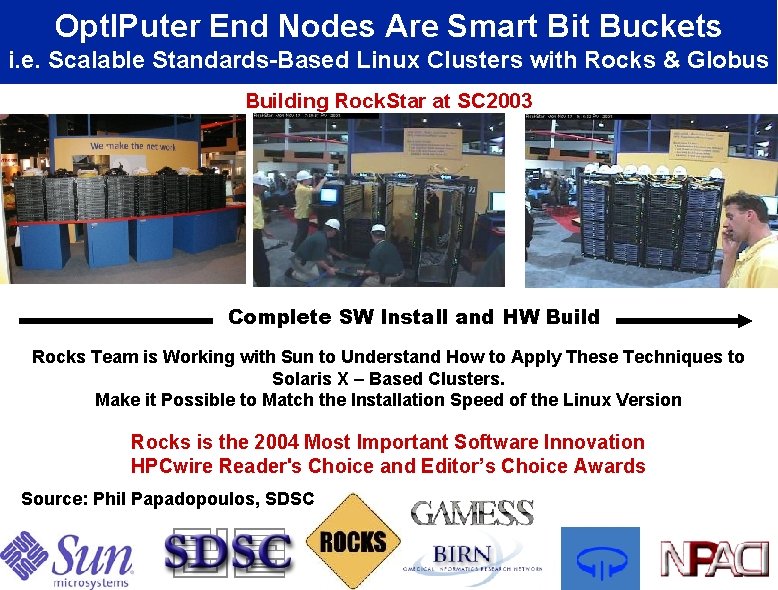
Opt. IPuter End Nodes Are Smart Bit Buckets i. e. Scalable Standards-Based Linux Clusters with Rocks & Globus Building Rock. Star at SC 2003 Complete SW Install and HW Build Rocks Team is Working with Sun to Understand How to Apply These Techniques to Solaris X – Based Clusters. Make it Possible to Match the Installation Speed of the Linux Version Rocks is the 2004 Most Important Software Innovation HPCwire Reader's Choice and Editor’s Choice Awards Source: Phil Papadopoulos, SDSC
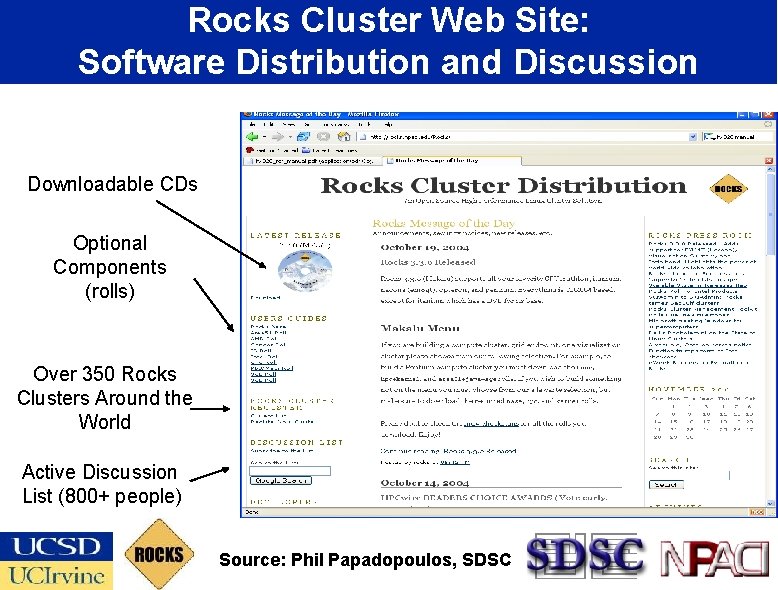
Rocks Cluster Web Site: Software Distribution and Discussion Downloadable CDs Optional Components (rolls) Over 350 Rocks Clusters Around the World Active Discussion List (800+ people) Source: Phil Papadopoulos, SDSC
Viewing UCSD as a Proving Ground for Scalable Utility Computing • Test Bed is Dedicated to Next-Generation Network Experiments • Dark Fiber Plant is Being Lit with Multiple 10 Gig. E Pipes • Hundreds of Endpoint Nodes—All with 1 or 10 Gig. E I/O • Opportunity: Utility Computing and Scalability Development = Next-Gen Optical Network + UCSD App. Scientists + Rocks Rapid Deployment + Sun HW + Solaris X + Sun/UCSD CS Grid Know-How Idea: Give Research Scientists Utility Computing Grants (“$1”/hr) to Evaluate the Capabilities Required by Using UCSD Scalable Utility Computing Testbed Source: Phil Papadopoulos, SDSC
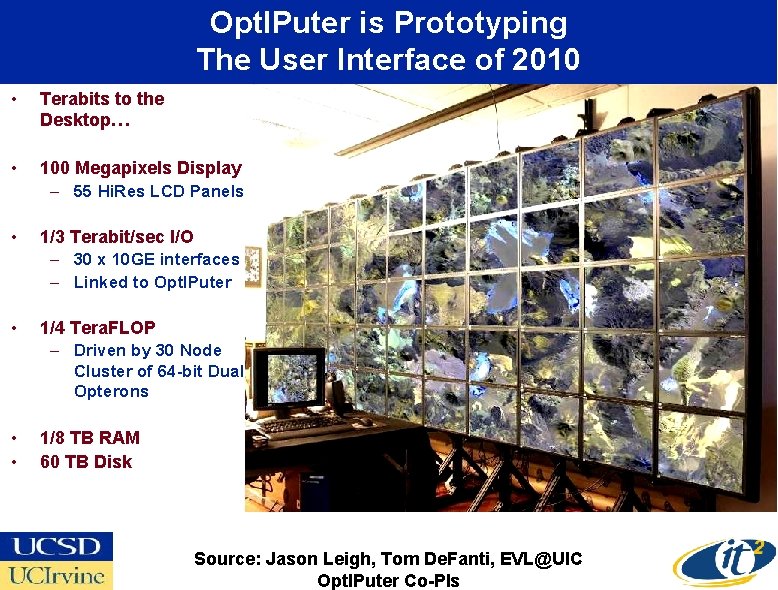
Opt. IPuter is Prototyping The User Interface of 2010 • Terabits to the Desktop… • 100 Megapixels Display – 55 Hi. Res LCD Panels • 1/3 Terabit/sec I/O – 30 x 10 GE interfaces – Linked to Opt. IPuter • 1/4 Tera. FLOP – Driven by 30 Node Cluster of 64 -bit Dual Opterons • • 1/8 TB RAM 60 TB Disk Source: Jason Leigh, Tom De. Fanti, EVL@UIC Opt. IPuter Co-PIs
- Slides: 32