
Californias Renewable Energy Transmission Initiative Anne Gillette Renewable
California’s Renewable Energy Transmission Initiative Anne Gillette Renewable Energy Policy Analyst California Public Utilities Commission August 12, 2008
Presentation Outline • California’s clean energy goals and “The Transmission Problem” • Transmission permitting at the CPUC • The Renewable Energy Transmission Initiative (RETI) • Lessons Learned from RETI
Presentation Outline • California’s clean energy goals and “The Transmission Problem” • Transmission permitting at the CPUC • The Renewable Energy Transmission Initiative (RETI) • Lessons Learned from RETI
California’s Clean Energy Future • Renewables Portfolio Standard: – Retail energy sellers must procure an additional 1% of their retail sales from renewables each year until they reach 20% by 2010 – California is considering a further renewable energy goal of 33% by 2020 • California Global Warming Solutions Act of 2006 (AB 32) – 2020: Emissions at 1990 levels – 2050: Emissions at 80% below 1990 levels – Draft Scoping Plan lists a 33% by 2020 RPS as one of 5 “key elements” needed in order to realize the 2020 emissions goal
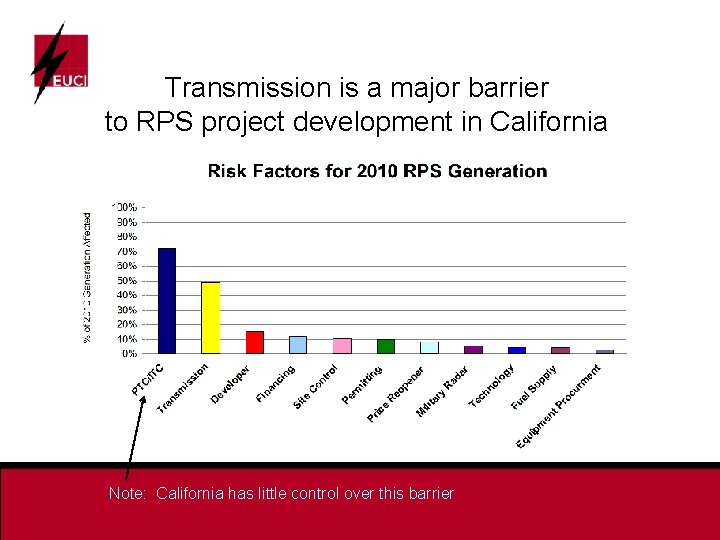
Transmission is a major barrier to RPS project development in California Note: California has little control over this barrier
Why is transmission a barrier? • Many of California’s most valuable renewable resources are far from load centers • Existing transmission lines are often congested • Significant transmission expansion is required to bring more renewable resources to market • Chicken-and-egg problem: utilities don’t want to build transmission until generation development is confirmed; developers don’t want to commit to generation projects unless transmission access is confirmed • Permitting a transmission lines is a rigorous and often contentious process
CPUC Work to Address “The Transmission Problem” • Streamlining the application process • Implementing Backstop Cost Recovery • Working with California Independent System Operator (CAISO) on interconnection queue reform • Addressing outstanding issues through CPUC RPS Transmission Investigation/ Rulemaking • Anticipating needs in the permitting process – the Renewable Energy Transmission Initiative (RETI)
Presentation Outline • California’s clean energy goals and “The Transmission Problem” • Transmission permitting at the CPUC • The Renewable Energy Transmission Initiative (RETI) • Lessons Learned from RETI

The CPCN Process • CPUC must issue a Certificate of Public Convenience and Necessity (CPCN) for major transmission projects proposed by California Investor-Owned Utilities (IOUs) – Note: municipal utilities have their own permitting processes, but joint muni-IOU lines might be cost-effective • CPCN review has two components: – Determination of need – Environmental review
CPCN: Determination of Need • A transmission project can be justified by the CPUC on the basis of: – Economics: CPUC has given the CAISO a “rebuttable presumption” on the economic analysis of a line, provided certain criteria are met – Reliability OR – Renewable energy goals
CPCN: Environmental Review • CPUC must analyze impacts of proposed line pursuant to the California Environmental Quality Act (CEQA); must consider alternatives that meet project objectives • A project crossing federal land will also require federal environmental review – CPUC prepares joint environmental documents with federal agencies to address both CEQA and the National Environmental Policy Act (NEPA) – Federal agency involvement often means delay
Permitting takes time • CPCN review takes ~18 months if all goes well • CEQA review alone generally requires over a year because of biological surveys, etc. • Public can comment on scope of environmental review, propose alternatives to the project • NIMBY issues and environmental concerns can create public opposition and result in project delay
RPS goals have dramatically changed the transmission game • Pre-2002 (prior to RPS legislation) – transmission planning and permitting focused on addressing system reliability. • Post-2002 – Devers-Palo Verde 2 approved based on economics; Tehachapi approved based on need to interconnect renewables – and more to come. • Today – Given aggressive RPS goals, CA needs to proactively identify and evaluate multiple renewable transmission projects.
Which “renewable lines” are the best? • What counts as a “renewable” line? Should some sort of economic test also be applied? • CPUC must ensure development of cost-effective renewable transmission and generation – CPUC both oversees IOU renewable procurement and permits IOU transmission lines. – Pursuant to statute, IOUs must procure the most cost-effective renewable resources, accounting for transmission and other costs. • CPUC needs to consider system reliability, economic benefits and renewables when permitting multiple transmission projects
Presentation Outline • California’s clean energy goals and “The Transmission Problem” • Transmission permitting at the CPUC • The Renewable Energy Transmission Initiative (RETI) • Lessons Learned from RETI
Renewable Energy Transmission Initiative • Statewide collaborative study effort to identify the transmission needed to access and deliver the most cost-effective renewable resources in CA and neighboring states • Participants: CPUC, California Energy Commission, CAISO, IOUs, munis, developers, environmental advocates, other interested parties • Commitment to open, inclusive, transparent process on an expedited schedule • Goals: – Answer the question, Which lines are best? – Facilitate the planning and permitting of the “best” lines
RETI Objectives • Provide a common forum for permitting agencies, utilities, and developers, and stakeholders to examine the location and timing of new generation/transmission projects; • Develop common information, tools and analytical methodologies to objectively evaluate renewable development potential; and • Support existing transmission planning institutions.
RETI is an inclusive, transparent process • CPUC needs an effective way to compare relative benefits of renewable development in various regions of CA, neighboring areas • Stakeholder participation critical to ensuring accurate representation of a project’s economic and environmental implications • RETI will provide objective, consistent, publicly-vetted resource and cost information to supplement the record in CPUC transmission proceedings • Transparency needed if used in CPCN proceeding
Three-Phased Process • Phase 1 – Identification and ranking of Competitive Renewable Energy Zones (CREZs) • Phase 2 – Refinement of CREZ analysis for priority zones and development of statewide conceptual transmission plan • Phase 3 – Detailed transmission planning for CREZs identified to be developed
Phase 1 – Scope of Work • Identify developable renewable resources in California and neighboring areas through engineering review (slope, road access, land use constraints, etc. ) • Analyze the economics of development in each area, including: – Costs: Generation and Transmission – Value: Energy and Capacity • Identify and rank high-value CREZs based on geography, development timeframe, shared transmission constraints, additive economics of specific resources • Evaluate environmental impact of development in each CREZ • Final Phase 1 Report due in October 2008
Phase 1 – Environmental Working Group • Significant and very positive development • For first time, environmental organizations and developers representing all renewable technologies working on project siting in a systematic, collaborative, proactive manner • EWG has: – Identified and mapped “black-out areas” where generation development precluded by law or policy – Identified and mapped “yellow areas” where generation development is restricted or will be environmentally difficult – Developed a methodology for rating CREZs according to their environmental impact and combining that rating with the economic CREZ ranking to develop RETI’s final CREZ “shortlist”
Phase 1 – Important Points • Not reinventing the wheel – pulling together and building on preexisting work, relevant regulatory decisions and agency priorities • Focusing on actual commercial potential • Applying consistent assumptions across the region • Stakeholders drive process by validating the work of an independent consultant (Black & Veatch) through consensus input • Goal is to rank CREZs through stakeholder consensus to reflect commercial potential, economics, and hard to quantify environmental and other concerns
Phases 2 and 3 – Scope of Work • Phase 2 – Transmission owners and other interested parties develop conceptual transmission plans for the highest ranking CREZs in collaboration with existing transmission planning organizations/institutions – Draft planned for December, 2008; may be iterative • Phase 3 – Existing transmission planning organizations collaboratively design transmission plans of service that result in applications to construct new transmission infrastructure to meet RPS goals – ~ 8 month-long process; may be iterative
RETI Organization / Roles • Coordinating Committee – Oversees the overall RETI process – Ensures development of needed information – Keeps the process on schedule • Stakeholder Steering Committee – Primary working group – Key stakeholder representatives – ~30 members • Plenary Stakeholder Group – Reviews Steering Committee work – Provides feedback, “groundtruthing” – All stakeholders and the public
Presentation Outline • California’s clean energy goals and “The Transmission Problem” • Transmission permitting at the CPUC • The Renewable Energy Transmission Initiative (RETI) • Lessons Learned from RETI
Lessons Learned… • Don’t reinvent the wheel • Make transparency a priority • Maintain a website to facilitate transparency – post all presentations, minutes of work-group meetings, etc. • Use technology to facilitate participation in meetings • Recognize that all stakeholders are very busy; make participation easy; have consultant develop straw proposals, etc. • Provide schedule, process at beginning
…and More Lessons Learned • Try for agreement from key stakeholders on guiding principles at start • Ensure that stakeholder representatives understand agree to their obligations • Active facilitation of work groups and stakeholder meetings is key • RETI has benefited from a Coordinating Committee responsible for keeping the process on track and coordinating with other processes • Decision-making agencies must be clear about what they want/need from process • Put processes and understandings in writing
More Information • RETI Mission Statement, Frequently Asked Questions, meeting minutes and presentations, etc. available at: www. energy. ca. gov/reti/ • Questions: Anne Gillette aeg@cpuc. ca. gov 415 -703 -5219
- Slides: 28