
Californias Judicial Branch Overview Largest in the US
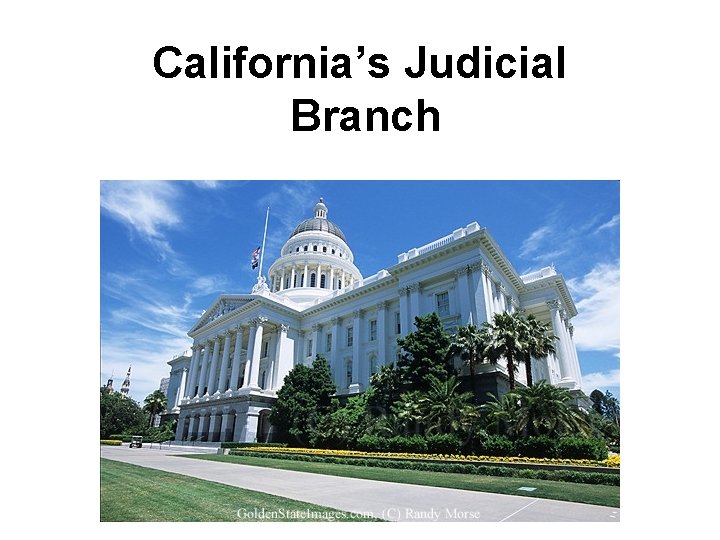
California’s Judicial Branch
Overview • Largest in the US • About 1600 judges and 400 commissioners and referees hearing over 8, 000 cases per year • Only about 840 in the federal system, by comparison • Three Levels – Supreme Court – Appellate Courts – Superior Courts
Supreme Court • Chief Justice • Six associate justices • Appointed by the governor and confirmed by the CA Commission on Judicial Appointments • Ratified by the electorate at the next general election following their appointment and at the end of each 12 -year term • Decisions are binding on all lower courts
Jurisdiction of the CA Supreme Court • Habeas corpus proceedings – prisoners requesting they be released for insufficient evidence • Review all decisions of the Courts of Appeal • Automatic appeals for all death penalty cases • Deals with about 8, 800 cases per year, but dismisses most and “rules” on about 100 -120 per year, about 20 of which are death penalty cases
Where • Headquartered in San Francisco • Branch offices in Los Angeles and Sacramento • Oral arguments hear all year long in all three locations
Courts of Appeal • Also known as Appellate Courts • Six districts: – – – San Francisco Los Angeles Sacramento San Diego Fresno San Jose • Further divided into 19 divisions • 105 justices total
Courts of Appeal • Hear about 16, 000 appeals per year if someone accused of a crime or other civil penalty would like to have a higher court hear the facts of the case • Justices selected, confirmed, and ratified just like Supreme Court justices, but only the electorate in that district get to vote for ratification
Superior Courts • • • One in each of the 58 counties of California Civil and criminal matters start here Elected by county residents for six-year terms Non-partisan Filled by appointment of the Governor Must be a member of the State Bar or a judge in CA for 10 years prior to taking office
Appeals to Superior Court Decisions • One of the unique policies in California is that different Appellate courts may rule very differently in the same type of case and if that happens, until the Supreme Court makes a decision, Superior Courts can choose which decision they like best
- Slides: 9