
CALIFORNIAS CONSTITUTIONAL PRIVACY RIGHT Moderator David A Carrillo



- Slides: 30
CALIFORNIA’S CONSTITUTIONAL PRIVACY RIGHT Moderator: David A. Carrillo J. Clark Kelso, Mc. George School of Law Jill Bronfman, UC Hastings College of Law Lothar Determann, Baker Mc. Kenzie Stephen M. Duvernay, Benbrook Law Group
BIO INFO • J. Clark Kelso: Associate Dean for Strategic Initiatives and Professor of Law, Mc. George School of Law • Jill Bronfman: Director of the Privacy and Technology Project at the Institute for Innovation Law; Adjunct Professor of Law, UC Hastings • Lothar Determann: Adjunct Professor of Law, UC Hastings, Berlin, Berkeley Law; partner, Baker & Mc. Kenzie • Stephen M. Duvernay: Benbrook Law Group in Sacramento; Senior Research Fellow, California Constitution Center
QUESTIONS • Duvernay: • Overview the current California constitutional privacy doctrine. • What’s the test? Hill or Loder? • Kelso: • What is the effect of having an express privacy provision in the state constitution? • Has privacy been a successful juridical category? • Bronfman: • What data security is necessary to protect privacy, including physical security, network security, data security? • Who is responsible for protecting privacy? • Determann: • How does the right to privacy in the California Constitution compare to privacy rights in the U. S. Federal Constitution and in Europe? • What practical impact has the right to privacy in the California Constitution had so far?
DUVERNAY
CONSTITUTIONAL RIGHT TO PRIVACY Refocusing the constitutional privacy analysis on individual privacy rights.
THE PRIVACY INITIATIVE California voters added the right to privacy to Article I in 1972 when they approved Proposition 11.
THE PRIVACY INITIATIVE Article I, section 1 of the California Constitution: “All people are by nature free and independent and have inalienable rights. Among these are enjoying and defending life and liberty, acquiring, possessing, and protecting property, and pursuing and obtaining safety, happiness, and privacy. ”
THE PRIVACY INITIATIVE “The right of privacy is an important American heritage and essential to the fundamental rights guaranteed by the. . . U. S. Constitution. This right should be abridged only when there is a compelling public need. ”
HILL v. NCAA (1994) Key opinions: • Chief Justice Lucas (majority) • Justice George • Justice Mosk
HILL v. NCAA (1994) Chief Justice George’s revenge: Loder v. City of Glendale (1997)
Compelling Public Need Sheehan v. The San Francisco 49 ers, Ltd. (2009) Hernandez v. Hillsides, Inc. (2009)
What’s the big deal? • Hill’s rejection of “compelling public need” contrary to voters’ intent. • Privacy rights at risk— “reasonableness” • Revisit Hill, adopt “compelling public need standard”
KELSO
HAS “PRIVACY” BEEN A SUCCESSFUL JURIDICAL CATEGORY? • After 100 years, still not a single, coherent concept with no sign of improvement. • Prosser’s four types of privacy are incomplete and fail to define the concept. • At the federal constitutional level, grabbag of holdings without doctrinal foundation.
HAS “PRIVACY” BEEN A SUCCESSFUL JURIDICAL CATEGORY? • Its most coherent expostulation has been in the context of informational privacy where the concept of “control” over certain personal information makes doctrinal and common sense. • Can informational privacy survive the Internet?
BRONFMAN
U. S. PRIVACY TORTS Privacy torts Why these torts? 1. Intrusion upon seclusion 2. Public disclosure of embarrassing private facts 3. Publicity placing person in false light 4. Appropriation of name and/or 1. Home is a castle, private property prerogative 2. Public vs. private citizens 3. Individual reputation (Chinese research by contrast-
U. S. v. THE STATES Federal Law California Law • First Amendment to the U. S. Constitution • CA Constitution • History: Free speech was not the default, see sedition laws, preapproval of news • Does 1 st A help or • Right to Privacy • History: privacy was not the default, see e. g. celebrities & paparazzi in LA
CAPITALISM AND FREE MARKETS • “Save the Tech!” • Congress passed Section 230 of the Communications Decency Act (CDA), immunizing ISPs and the hosts of online forums from liability for the speech of their users. The statute reads: “No provider or user of an interactive computer service shall be treated as the publisher or speaker of any information provided by another information content provider. ”
DATA BREACH STARTING LINE • Corporate proprietary information is information that belongs to a company and it is different from personal information that belongs to or • Companies are concerned about losing or leaking data that belongs to them, and also about losing the personal data with which they have been entrusted.
DATA PROTECTION EXTENDS BEYOND THE IT DEPARTMENT • C-suite responsibility • Legal • Public Relations • Executives • Security professionals • Marketing • Government relations • Customer care/HR • Risk management and Insurance
DETERMANN
OVERVIEW • How does the right to privacy in the California Constitution compare to privacy rights in the U. S. Constitution and in Europe? • 4 th & 14 th amendment jurisprudence • The EU charta, recent CJEU cases, and the European Convention for Human Rights.
COMPARISON: CONSTITUTIONAL PRIVACY RIGHTS • Express / implied right and limitations • Substantive scope: • Search & seizure • Data • Communications privacy • Autonomy privacy • Personal scope: state actors v. private actors • Remedies
CALIFORNIA CONSTITUTION ARTICLE I DECLARATION OF RIGHTS SECTION 1. All people are by nature free and independent and have inalienable rights. Among these are enjoying and defending life and liberty, acquiring, possessing, and protecting property, and pursuing and obtaining safety, happiness, and privacy. SEC. 13. The right of the people to be secure in their persons, houses, papers, and effects against unreasonable seizures and searches may not be violated; and a warrant may not issue except on probable cause, supported by oath or affirmation,
U. S. CONSTITUTION 4 th Amendment: The right of the people to be secure in their persons, houses, papers, and effects, against unreasonable searches and seizures, shall not be violated, and no Warrants shall issue, but upon probable cause, supported by Oath or affirmation, and particularly describing the place to be searched, and the persons or things to be seized.
EUROPEAN CONVENTION OF HUMAN RIGHTS (1950) ARTICLE 8 Right to respect for private and family life 1. Everyone has the right to respect for his private and family life, his home and his correspondence. 2. There shall be no interference by a public authority with the exercise of this right except such as is in accordance with the law and is necessary in a democratic society in the interests of national security, public safety or the economic wellbeing of the country, for the
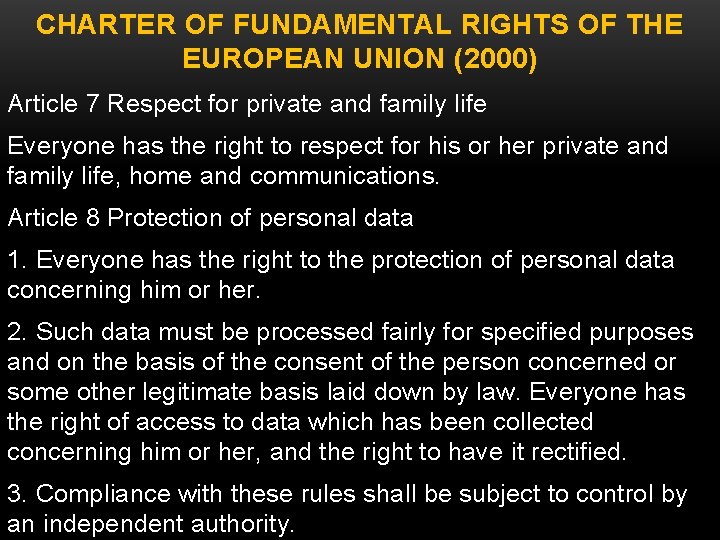
CHARTER OF FUNDAMENTAL RIGHTS OF THE EUROPEAN UNION (2000) Article 7 Respect for private and family life Everyone has the right to respect for his or her private and family life, home and communications. Article 8 Protection of personal data 1. Everyone has the right to the protection of personal data concerning him or her. 2. Such data must be processed fairly for specified purposes and on the basis of the consent of the person concerned or some other legitimate basis laid down by law. Everyone has the right of access to data which has been collected concerning him or her, and the right to have it rectified. 3. Compliance with these rules shall be subject to control by an independent authority.
PRACTICAL IMPACT • What practical impact has the right to privacy in the California Constitution had so far? • Cases in which plaintiffs have asserted the right • Note the less tangible effect of motivating the legislature to protect privacy in statutes.
• Different/more stringent test? Additional restrictions to existing law? • Empower courts to develop additional test? • Broad catch-all? • For plaintiffs, additional cause of action to throw in and perhaps survive summary judgment dismissal. • Against private actors? • Against California government? (+) • Against federal government? (-) • Hierarchy? Trumps state statute; is trumped by any federal law (constitution, statutes, regulations) • Additional remedies? • Soft impact: Mission statement to legislature, justification