
California Energy Commission The CECs Climate Change Activities
- Slides: 12
California Energy Commission The CEC’s Climate Change Activities Senate Committee on Energy, Utilities, and Communications Subcommittee on Alternative Energy August 28, 2007 Jackalyne Pfannenstiel Chairman California Energy Commission
California Energy Commission The Energy Commission’s climate change activities pre-date AB 32. • Legislation in 1988 (AB 4420, Sher) required the CEC to develop a statewide GHG inventory and to study the effects of climate change on California’s economy and environment. • The CEC’s energy efficiency, alternative fuels, and renewable energy programs have reduced greenhouse gases (GHGs). • The CEC performs scientific research on climate change pertaining to the physical, environmental and economic impacts of climate change in California and in the West. • The CEC has provided technical support to the California Climate Action Registry in formulating GHG reporting protocols.
California Energy Commission The Energy Commission’s primary responsibilities include: § Issuing energy efficiency standards for appliances and new buildings § Promoting renewable energy § Licensing thermal power plants § Gathering and analyzing energy information § Developing energy policies and strategies § Managing the Public Interest Energy Research program
California Energy Commission Most of our ongoing responsibilities achieve reductions in GHG emissions. Energy Efficiency Renewable Energy Alternative Transportation Fuels In addition, we are engaged in several activities that specifically address climate change. Climate Action Team Joint Proceeding with the CPUC on AB 32 SB 1368 Implementation
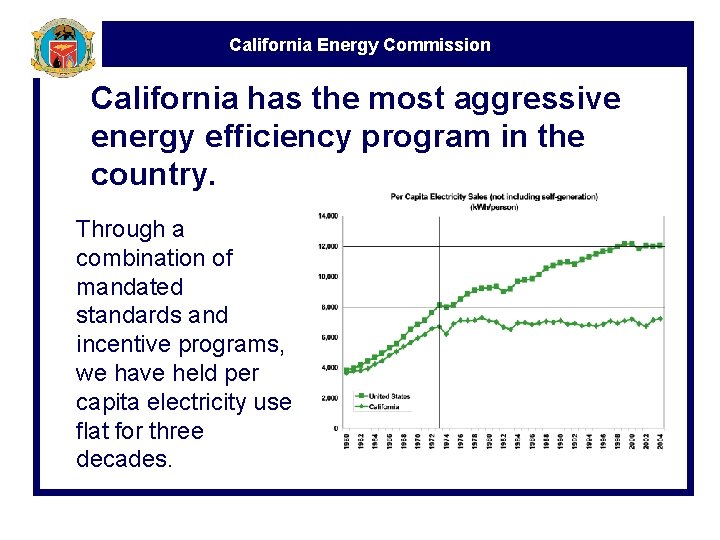
California Energy Commission California has the most aggressive energy efficiency program in the country. Through a combination of mandated standards and incentive programs, we have held per capita electricity use flat for three decades.
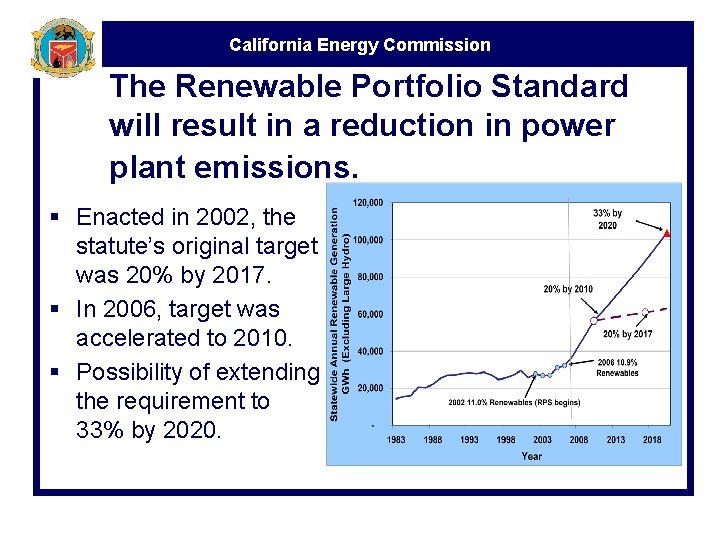
California Energy Commission The Renewable Portfolio Standard will result in a reduction in power plant emissions. § Enacted in 2002, the statute’s original target was 20% by 2017. § In 2006, target was accelerated to 2010. § Possibility of extending the requirement to 33% by 2020.
California Energy Commission The CEC has been exploring opportunities for the State to move to alternative transportation fuels. § The AB 2076 Report (2004) recommended ways to reduce petroleum use by 20% by doubling fuel economy and increasing alternative fuels. § In each IEPR cycle (2003, 2005, 2007) the Commission has recommended policies which support increased use of alternative transportation fuels. § The AB 1007 Alternative Fuels Plan (September 2007) will recommend policies and incentives to increase the use of alternative and renewable transportation fuels.
California Energy Commission The Energy Commission serves on the Climate Action Team and 8 of its subgroups. Energy Economics Science/Scenarios Smart Growth Green Buildings Water/Energy Forestry Cement
California Energy Commission The CEC chairs the Land Use/Smart Growth subgroup. § Includes representatives from all interested state agencies. § Will explore obstacles and solutions to smart growth. § Plans to hold a public symposium in October. § Building on work done for the 2007 Integrated Energy Policy Report.
California Energy Commission The CEC and the CPUC are conducting a joint proceeding on AB 32 implementation in the electric utility sector. § First issue has been accounting and reporting rules. – Decisions from the commissions anticipated in December – Joint recommendation to the ARB § Issue of a cap and trade mechanism being considered.
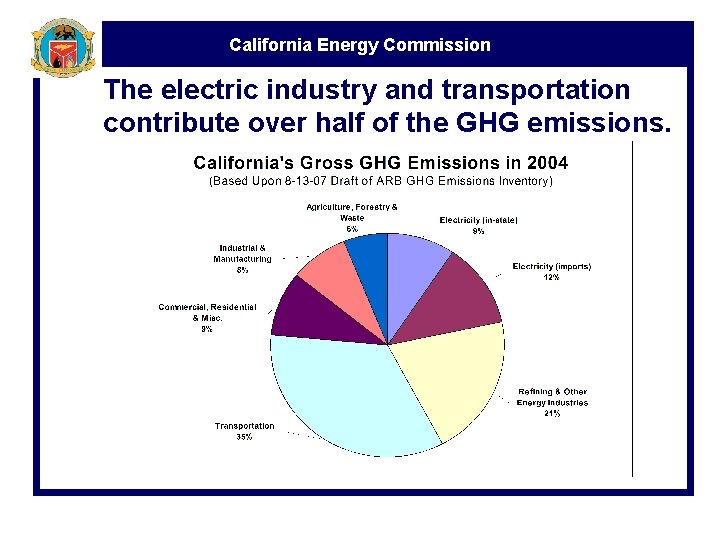
California Energy Commission The electric industry and transportation contribute over half of the GHG emissions.
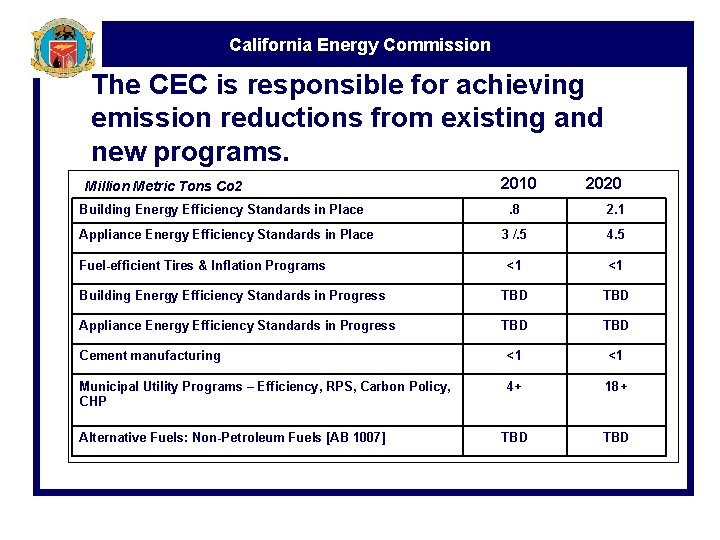
California Energy Commission The CEC is responsible for achieving emission reductions from existing and new programs. Million Metric Tons Co 2 Building Energy Efficiency Standards in Place 2010 2020 . 8 2. 1 3 /. 5 4. 5 <1 <1 Building Energy Efficiency Standards in Progress TBD Appliance Energy Efficiency Standards in Progress TBD Cement manufacturing <1 <1 Municipal Utility Programs – Efficiency, RPS, Carbon Policy, CHP 4+ 18+ TBD Appliance Energy Efficiency Standards in Place Fuel-efficient Tires & Inflation Programs Alternative Fuels: Non-Petroleum Fuels [AB 1007]