
California Energy Commission Research Development Food Production Investment
- Slides: 37
California Energy Commission Research & Development Food Production Investment Program (FPIP) TITLE OFDraft PRESENTATION Guidelines Name of Presenter Energy Research and Development Division Donald Kazama, P. E. , Virginia Lew, Cyrus Ghandi Title of conference/meeting Location presentation was given March 29, 2018 Date of meeting
Welcome and House Keeping In case of an emergency Facilities Sign-in sheet 2
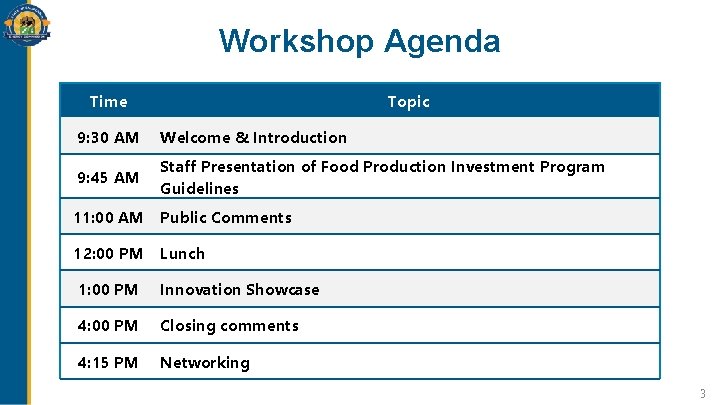
Workshop Agenda Time Topic 9: 30 AM Welcome & Introduction 9: 45 AM Staff Presentation of Food Production Investment Program Guidelines 11: 00 AM Public Comments 12: 00 PM Lunch 1: 00 PM Innovation Showcase 4: 00 PM Closing comments 4: 15 PM Networking 3
Commitment to Diversity The Energy Commission adopted a formal resolution strengthening its commitment to diversity in our funding programs. We continue to encourage disadvantaged and underrepresented businesses and communities to engage in and benefit from our many programs. To meet this commitment, Energy Commission staff conducts outreach efforts and activities to: • Engage with disadvantaged and underrepresented groups throughout the state. • Notify potential new applicants about the Energy Commission's funding opportunities. • Assist applicants in understanding how to apply for funding from the Energy Commission's programs. • Survey participants to measure progress in diversity outreach efforts.
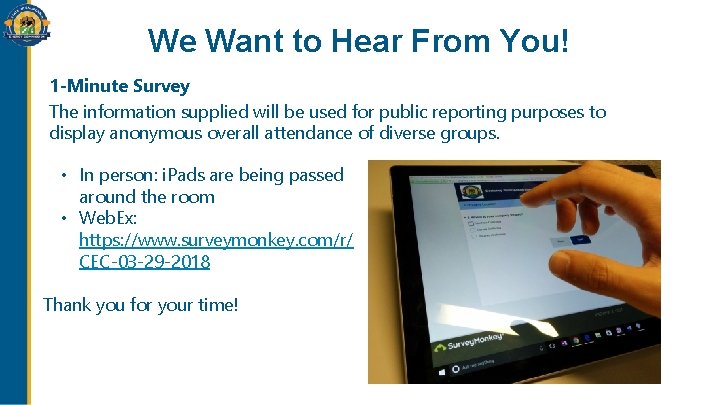
We Want to Hear From You! 1 -Minute Survey The information supplied will be used for public reporting purposes to display anonymous overall attendance of diverse groups. • In person: i. Pads are being passed around the room • Web. Ex: https: //www. surveymonkey. com/r/ CEC-03 -29 -2018 Thank you for your time!
Connect with Us
Background on the Food Production Investment Program (FPIP) $60 million in funding Established under the Budget Act of 2017, AB 109 “…shall be used to provide grants, loans, or any financial incentives to food processors to implement projects that reduce greenhouse gas emissions. ” Greenhouse Gas Reduction Fund (California Climate Investments) 7
Background on the FPIP (Continued) The FPIP was informed by the following: Food Processors’ Task Force Industry Trade organizations Government agencies Utilities Comments received from previous workshops and received in our docket: https: //efiling. energy. ca. gov/Lists/Docket. Log. aspx? docketnumber=18 -MISC-01 8
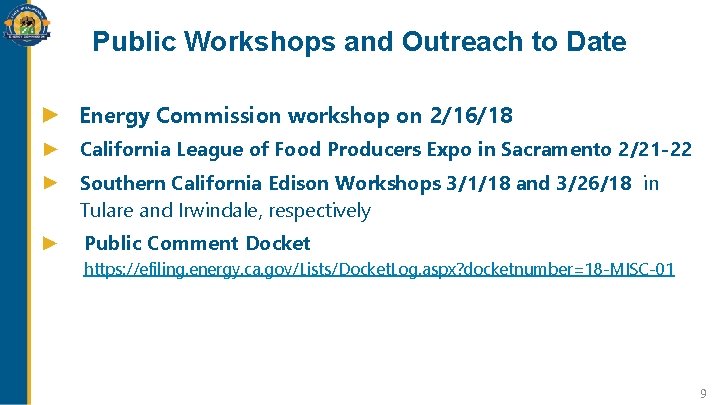
Public Workshops and Outreach to Date Energy Commission workshop on 2/16/18 California League of Food Producers Expo in Sacramento 2/21 -22 Southern California Edison Workshops 3/1/18 and 3/26/18 in Tulare and Irwindale, respectively Public Comment Docket https: //efiling. energy. ca. gov/Lists/Docket. Log. aspx? docketnumber=18 -MISC-01 9
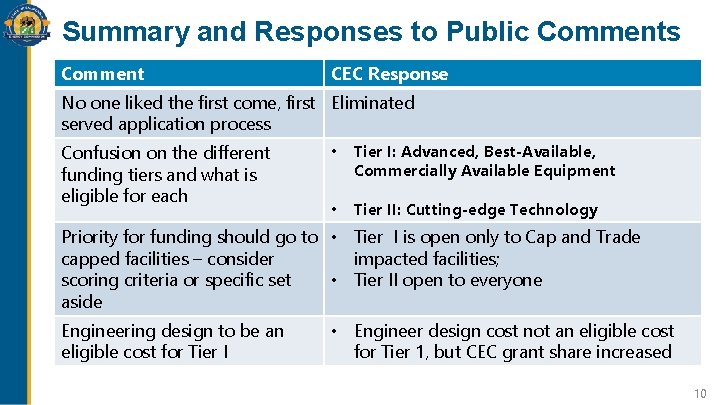
Summary and Responses to Public Comments Comment CEC Response No one liked the first come, first Eliminated served application process Confusion on the different funding tiers and what is eligible for each • Tier I: Advanced, Best-Available, Commercially Available Equipment • Tier II: Cutting-edge Technology Priority for funding should go to • Tier I is open only to Cap and Trade capped facilities – consider impacted facilities; scoring criteria or specific set • Tier II open to everyone aside Engineering design to be an eligible cost for Tier I • Engineer design cost not an eligible cost for Tier 1, but CEC grant share increased 10
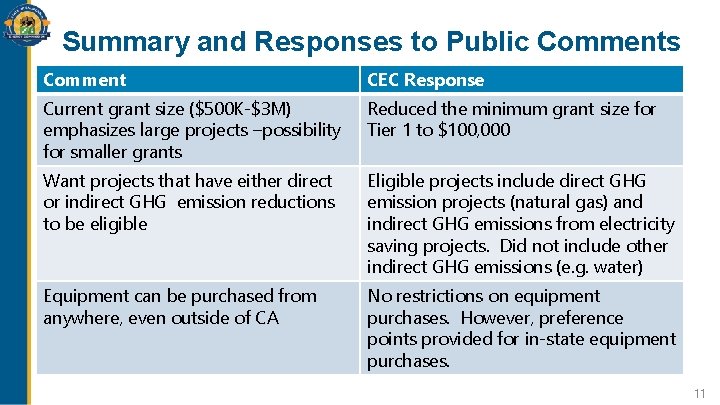
Summary and Responses to Public Comments Comment CEC Response Current grant size ($500 K-$3 M) emphasizes large projects –possibility for smaller grants Reduced the minimum grant size for Tier 1 to $100, 000 Want projects that have either direct or indirect GHG emission reductions to be eligible Eligible projects include direct GHG emission projects (natural gas) and indirect GHG emissions from electricity saving projects. Did not include other indirect GHG emissions (e. g. water) Equipment can be purchased from anywhere, even outside of CA No restrictions on equipment purchases. However, preference points provided for in-state equipment purchases. 11
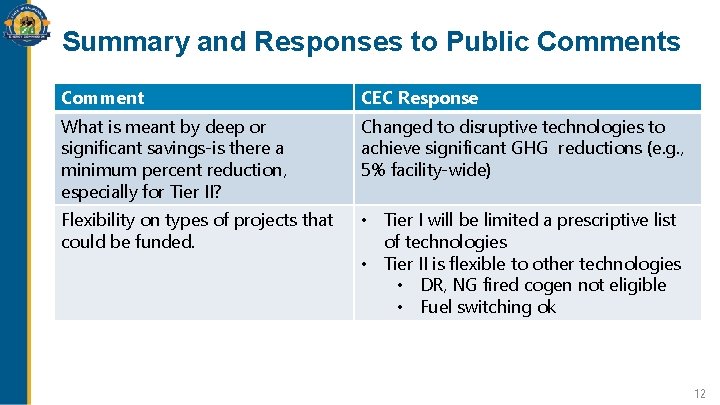
Summary and Responses to Public Comments Comment CEC Response What is meant by deep or significant savings-is there a minimum percent reduction, especially for Tier II? Changed to disruptive technologies to achieve significant GHG reductions (e. g. , 5% facility-wide) Flexibility on types of projects that could be funded. • Tier I will be limited a prescriptive list of technologies • Tier II is flexible to other technologies • DR, NG fired cogen not eligible • Fuel switching ok 12
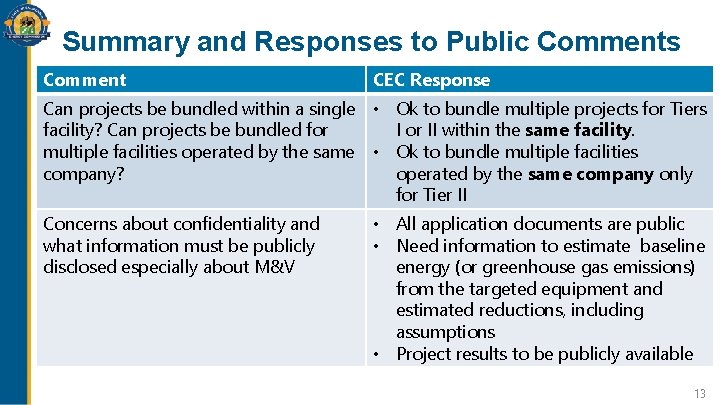
Summary and Responses to Public Comments Comment CEC Response Can projects be bundled within a single • Ok to bundle multiple projects for Tiers facility? Can projects be bundled for II within the same facility. multiple facilities operated by the same • Ok to bundle multiple facilities company? operated by the same company only for Tier II Concerns about confidentiality and what information must be publicly disclosed especially about M&V • All application documents are public • Need information to estimate baseline energy (or greenhouse gas emissions) from the targeted equipment and estimated reductions, including assumptions • Project results to be publicly available 13
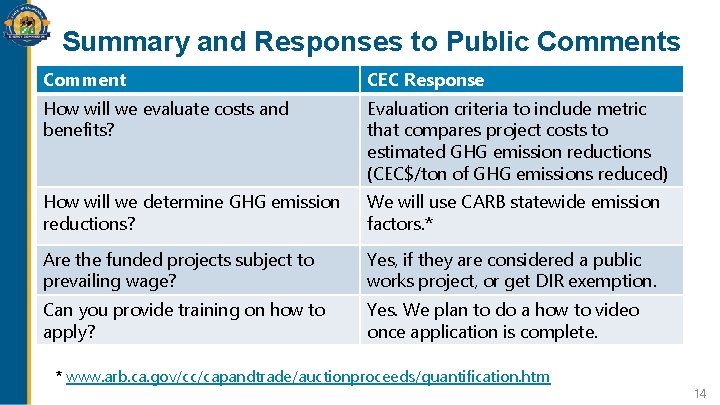
Summary and Responses to Public Comments Comment CEC Response How will we evaluate costs and benefits? Evaluation criteria to include metric that compares project costs to estimated GHG emission reductions (CEC$/ton of GHG emissions reduced) How will we determine GHG emission reductions? We will use CARB statewide emission factors. * Are the funded projects subject to prevailing wage? Yes, if they are considered a public works project, or get DIR exemption. Can you provide training on how to apply? Yes. We plan to do a how to video once application is complete. * www. arb. ca. gov/cc/capandtrade/auctionproceeds/quantification. htm 14
FPIP Draft Guidelines 15
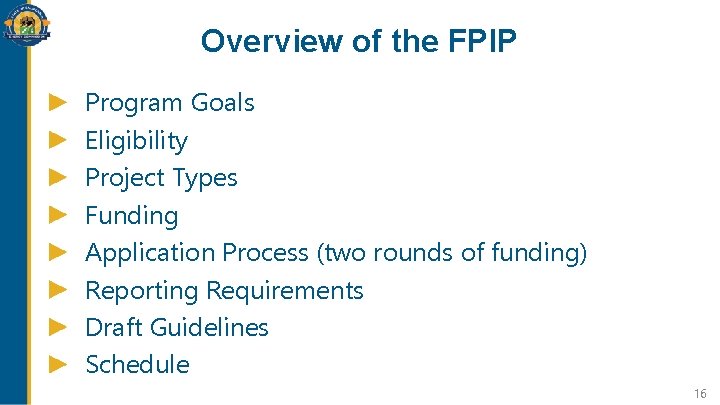
Overview of the FPIP Program Goals Eligibility Project Types Funding Application Process (two rounds of funding) Reporting Requirements Draft Guidelines Schedule 16
Program Goals Reduce GHG emissions Adopt advanced energy technologies Provide technical confidence for future adoptions Benefit AB 1550 populations 17
Eligibility for FPIP Food Processors Defined as NAICS codes 311 -312* (Food & Beverage) Manufacturers that transform livestock and agricultural products into products for intermediate or final consumption Facility must be located in California Projects must have GHG emission reductions Meet other eligibility criteria defined in the Guidelines * North American Industry Classification System: https: //www. census. gov/eos/www/naics/2017 NAICS/2017_NAICS_Manual. pdf 18
Project Funding Categories Tier I: Advanced, commercially available equipment to replace inefficient equipment to reduce GHG emissions Tier II: Disruptive, cutting edge technology that can yield substantial energy & GHG emission reductions 19
Unique Tier I Attributes Eligibility: Cap-and-Trade Impacted Facilities* Goal: Reduce GHG emissions by upgrading inefficient energyusing equipment with advanced, best available, commercially available technology from a prescriptive list Match Level Required: 40% of eligible cost Eligible Costs: Major Equipment Required M&V * Emit > 25, 000 metric tons of GHG/yr as listed in CARB’s annual summary: https: //ww 2. arb. ca. gov/our-work/programs/mandatory-greenhouse-gas-emissions-reporting 20
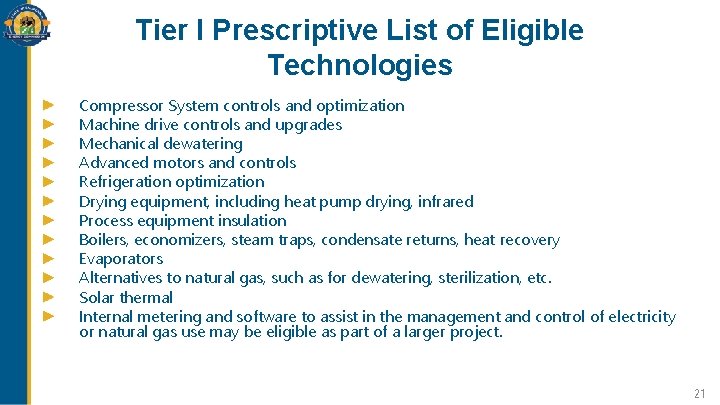
Tier I Prescriptive List of Eligible Technologies Compressor System controls and optimization Machine drive controls and upgrades Mechanical dewatering Advanced motors and controls Refrigeration optimization Drying equipment, including heat pump drying, infrared Process equipment insulation Boilers, economizers, steam traps, condensate returns, heat recovery Evaporators Alternatives to natural gas, such as for dewatering, sterilization, etc. Solar thermal Internal metering and software to assist in the management and control of electricity or natural gas use may be eligible as part of a larger project. 21
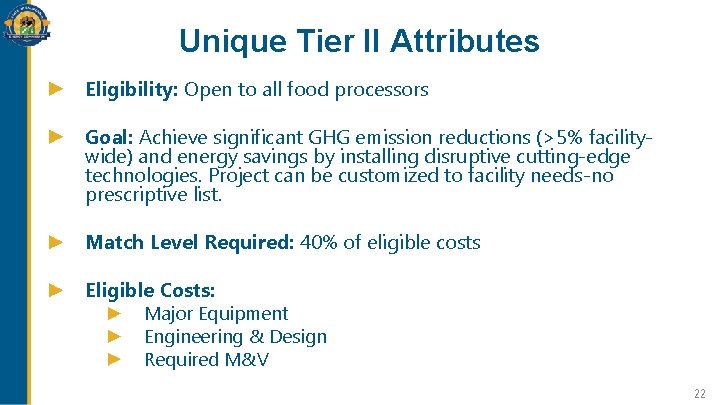
Unique Tier II Attributes Eligibility: Open to all food processors Goal: Achieve significant GHG emission reductions (>5% facilitywide) and energy savings by installing disruptive cutting-edge technologies. Project can be customized to facility needs-no prescriptive list. Match Level Required: 40% of eligible costs Eligible Costs: Major Equipment Engineering & Design Required M&V 22
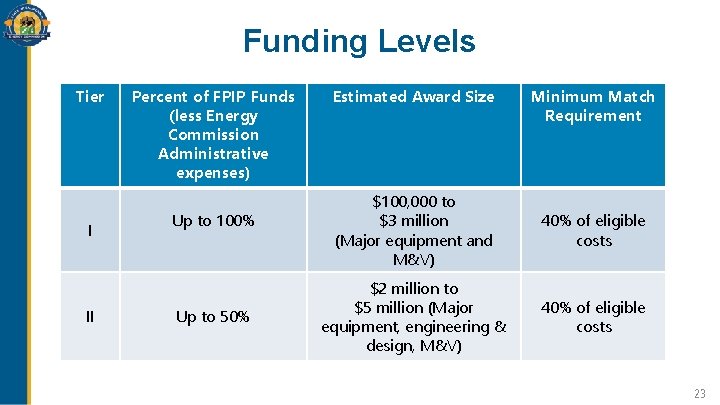
Funding Levels Tier I II Percent of FPIP Funds (less Energy Commission Administrative expenses) Up to 100% Up to 50% Estimated Award Size Minimum Match Requirement $100, 000 to $3 million (Major equipment and M&V) 40% of eligible costs $2 million to $5 million (Major equipment, engineering & design, M&V) 40% of eligible costs 23
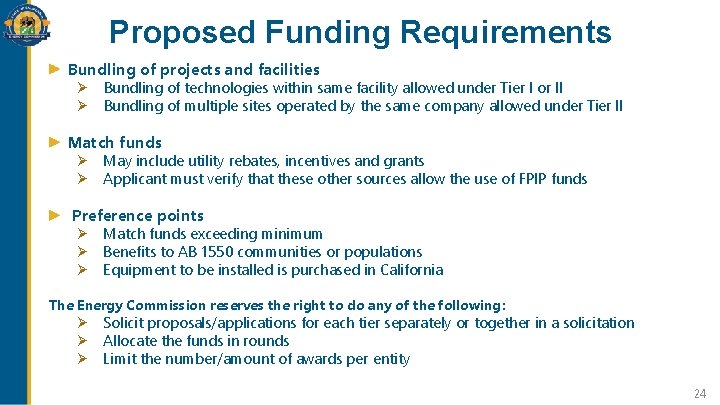
Proposed Funding Requirements Bundling of projects and facilities Ø Bundling of technologies within same facility allowed under Tier I or II Ø Bundling of multiple sites operated by the same company allowed under Tier II Match funds Ø May include utility rebates, incentives and grants Ø Applicant must verify that these other sources allow the use of FPIP funds Preference points Ø Match funds exceeding minimum Ø Benefits to AB 1550 communities or populations Ø Equipment to be installed is purchased in California The Energy Commission reserves the right to do any of the following: Ø Solicit proposals/applications for each tier separately or together in a solicitation Ø Allocate the funds in rounds Ø Limit the number/amount of awards per entity 24
Application Process Grant Funding Opportunity (GFO) – solicitation document Application form – information about you and your project Scope of work – explains how you will complete your project Schedule – timeline for completing your project (no later than 12/2022) Budget – major equipment cost, M&V cost (engineering/design for Tier 2 only) Response to evaluation criteria – narrative format CEQA evaluation form Is the project exempt from CEQA? Commitment letters for the site and match funds Support letters from the community (AB 1550) or others interested in the technology 25
Proposed Screening Criteria Application Screening is a series of pass/fail administrative requirements. Applications that do not pass all the administrative screening requirements are disqualified. Example of the screening requirements is listed below: The application is received by the due date and time specified in the solicitation The application form is signed The requested funding falls within the minimum and maximum range specified in the solicitation If the applicant has submitted more than one application, each application is for a distinct project The proposal includes one or more match funding commitment letters Proposals that pass the application screening process are then scored by an Evaluation Committee. 26
Proposed Evaluation Criteria Scoring of project proposals by Evaluation Committee Proposals evaluated and scored based on responses to evaluation criteria in the solicitation Technical Merit and Need Ø Tier I Projects: How does proposed project provide greater GHG emissions reductions than current best practices Ø Tier II Projects: How will proposed project lead to technological advancement in reducing GHG emissions Technical Approach Ø Describes approach to be used, including outstanding features Ø Identifies and discusses factors critical for success, risks, barriers, and limitations Ø Describes how knowledge gained will be shared with others 27
Proposed Evaluation Criteria (continued) Impacts and Benefits Ø Identifies how proposed project will benefit California in terms of reducing GHG Ø Ø Ø emissions Provides justifiable quantitative estimates of GHG emission reductions and other benefits from the proposed project Provides a cost benefit analysis in terms of Energy Commission $ requested per ton of GHG emissions reduced States timeframe, assumptions and calculations for the estimated benefits and explains their reasonableness Describes what other markets can use the technology Identifies impacted market segments that can use the technology proposed in the project, including size of the market, penetration and deployment rates, and provides assumptions used Identifies a clear M&V plan on how GHG emission reductions, energy savings, and other benefits will be determined Minimum Passing Score is 70 Points 28
Proposed Preference Points may be awarded for the following: Ø Match funding preference points may be awarded to proposals that provide match funding in excess of the minimum match requirements for a solicitation Ø Benefits to AB 1550 populations – Preference points will be awarded based on whether the project meets the requirements indicated in CARB Guidelines* Ø Preference points may be awarded if the equipment selected for installation is purchased from a Californiabased vendor * See the CARB Draft Funding Guidelines for more information, www. arb. ca. gov/cci-fundingguidelines 29
What Projects Benefit AB 1550 Populations? The Energy Commission anticipates 10 percent of the funds will be allocated to projects located within disadvantaged and low income communities and provide benefits to AB 1550 populations. Refer to ARB Draft Funding Guidelines*. Here are examples of benefiting criteria for AB 1550 populations: Be located in an AB 1550 community Provide environmental benefit to the community, or have community support Provides jobs to residents of AB 1550 communities Reduces criteria air pollutants or toxic air contaminants Provides direct energy cost savings or other benefits to AB 1550 communities *See the CARB Draft Funding Guidelines for more information, www. arb. ca. gov/cci-fundingguidelines 30
What to Expect if You Are Recommended for an Award Agreement Development: Scope of Work Budget Schedule CEQA Terms and Conditions 31
What to Expect if You Receive an Award Project kick-off meeting Site visits and access to project facilities to verify equipment installations and operations Periodic progress reports and other reporting required by the California Air Resources Board Invoices Bill for incurred costs, no advances Retention Prevailing wage* Publicly Disclosable information All application materials All agreement documents All deliverables, unless otherwise specified State oversight audits Records Retention – must retain records for a minimum of three years after the end of the project Critical project review meeting(s) – to assess project performance Final Project Report and other reporting requirements Knowledge Transfer Activities – to share results with others * http: //www. dir. ca. gov/Public-Works/Public. Works. html 32
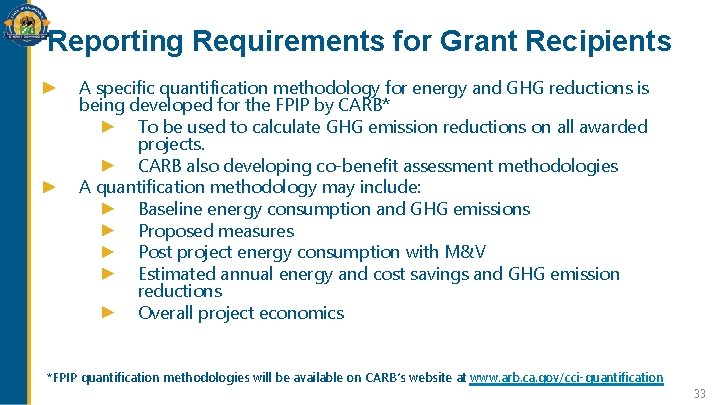
Reporting Requirements for Grant Recipients A specific quantification methodology for energy and GHG reductions is being developed for the FPIP by CARB* To be used to calculate GHG emission reductions on all awarded projects. CARB also developing co-benefit assessment methodologies A quantification methodology may include: Baseline energy consumption and GHG emissions Proposed measures Post project energy consumption with M&V Estimated annual energy and cost savings and GHG emission reductions Overall project economics *FPIP quantification methodologies will be available on CARB’s website at www. arb. ca. gov/cci-quantification 33
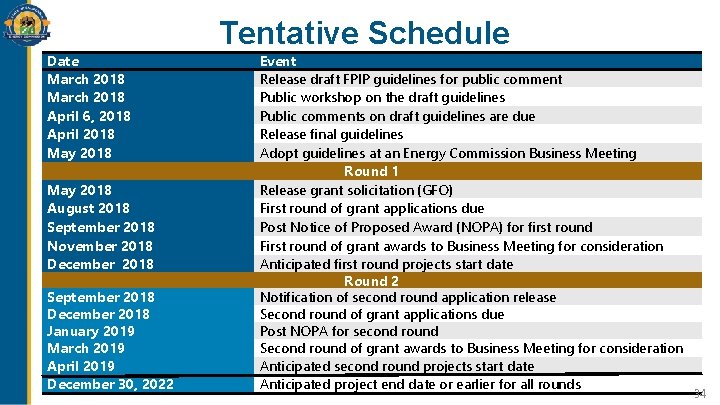
Tentative Schedule Date March 2018 April 6, 2018 April 2018 May 2018 August 2018 September 2018 November 2018 December 2018 September 2018 December 2018 January 2019 March 2019 April 2019 December 30, 2022 Event Release draft FPIP guidelines for public comment Public workshop on the draft guidelines Public comments on draft guidelines are due Release final guidelines Adopt guidelines at an Energy Commission Business Meeting Round 1 Release grant solicitation (GFO) First round of grant applications due Post Notice of Proposed Award (NOPA) for first round First round of grant awards to Business Meeting for consideration Anticipated first round projects start date Round 2 Notification of second round application release Second round of grant applications due Post NOPA for second round Second round of grant awards to Business Meeting for consideration Anticipated second round projects start date Anticipated project end date or earlier for all rounds 34
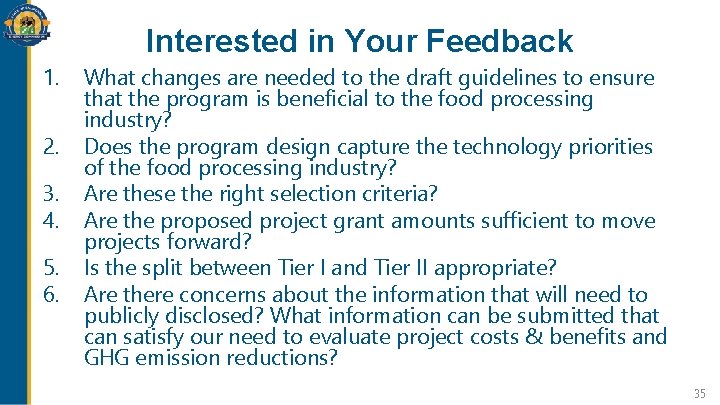
Interested in Your Feedback 1. 2. 3. 4. 5. 6. What changes are needed to the draft guidelines to ensure that the program is beneficial to the food processing industry? Does the program design capture the technology priorities of the food processing industry? Are these the right selection criteria? Are the proposed project grant amounts sufficient to move projects forward? Is the split between Tier I and Tier II appropriate? Are there concerns about the information that will need to publicly disclosed? What information can be submitted that can satisfy our need to evaluate project costs & benefits and GHG emission reductions? 35
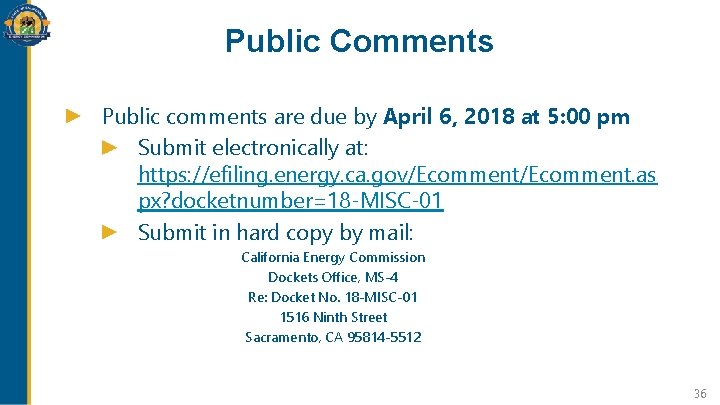
Public Comments Public comments are due by April 6, 2018 at 5: 00 pm Submit electronically at: https: //efiling. energy. ca. gov/Ecomment. as px? docketnumber=18 -MISC-01 Submit in hard copy by mail: California Energy Commission Dockets Office, MS-4 Re: Docket No. 18 -MISC-01 1516 Ninth Street Sacramento, CA 95814 -5512 36
FPIP Contact: Cyrus Ghandi Email: Cyrus. Ghandi@energy. ca. gov Phone: (916) 327 -1506 Information on the FPIP and to subscribe to the listserv: http: //www. energy. ca. gov/research/fpip/index. html Comments and questions (due by April 6, 2018) can be submitted to https: //efiling. energy. ca. gov/Ecomment. aspx? docketnumb er=18 -MISC-01 Comments can be viewed at: https: //efiling. energy. ca. gov/Lists/Docket. Log. aspx? docketnumber=18 MISC-01 37