
California Energy Commission Hourly Load Forecasts and Peak
- Slides: 12
California Energy Commission Hourly Load Forecasts and Peak Shift IEPR Workshop December 15, 2017 Chris Kavalec and Ravinderpal Vaid Energy Assessments Division Chris. Kavalec@energy. ca. gov / 916 -654 -5184 1
California Energy Commission Background • Energy Commission long-term demand forecasts currently done at annual level • Long-term projections at hourly level increasingly important for demand analysis and resource planning – In addition to peak hour, analysis of “ramp-up” period and mid-day loads important – Demand-side factors, including PV and EVs, likely to shift the peak hour 2
California Energy Commission Goals • Develop model to project 8760 hourly loads 10 years out for a specified geography • Develop “business as usual” projections that account for economic and demographic changes, changes in sector shares, and other factors • Adjust business as usual projections to account for increasing amounts of PV and EVs, along with AAEE, DR, and TOU pricing 3
California Energy Commission Model Estimation and Data • First version relies on system level hourly data (e. g. CAISO EMS data) to project hourly loads • Later versions for future forecasts would use AMI data to estimate individual models by sector as well as by more granular geography 4
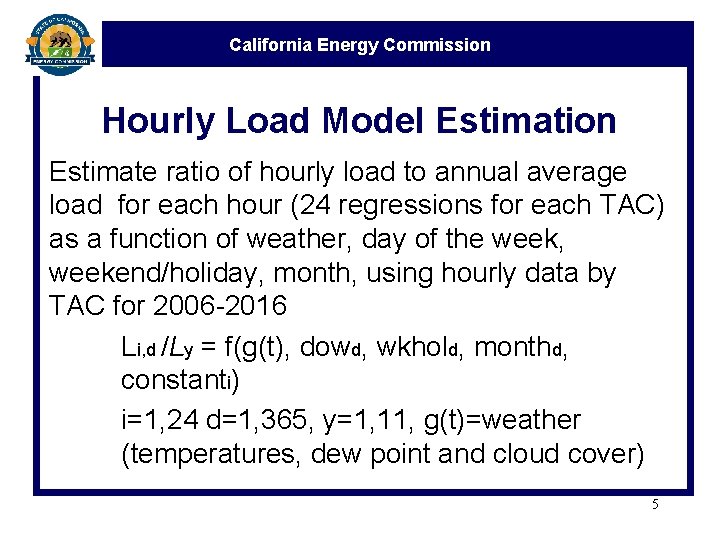
California Energy Commission Hourly Load Model Estimation Estimate ratio of hourly load to annual average load for each hour (24 regressions for each TAC) as a function of weather, day of the week, weekend/holiday, month, using hourly data by TAC for 2006 -2016 Li, d /Ly = f(g(t), dowd, wkhold, monthd, constanti) i=1, 24 d=1, 365, y=1, 11, g(t)=weather (temperatures, dew point and cloud cover) 5
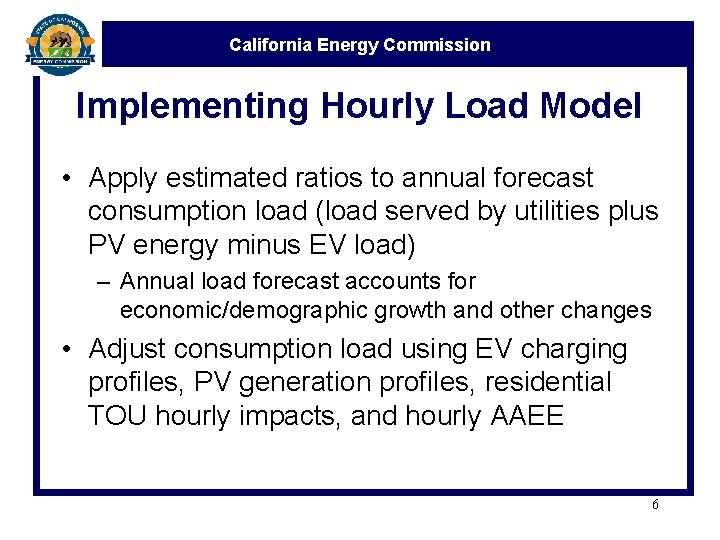
California Energy Commission Implementing Hourly Load Model • Apply estimated ratios to annual forecast consumption load (load served by utilities plus PV energy minus EV load) – Annual load forecast accounts for economic/demographic growth and other changes • Adjust consumption load using EV charging profiles, PV generation profiles, residential TOU hourly impacts, and hourly AAEE 6
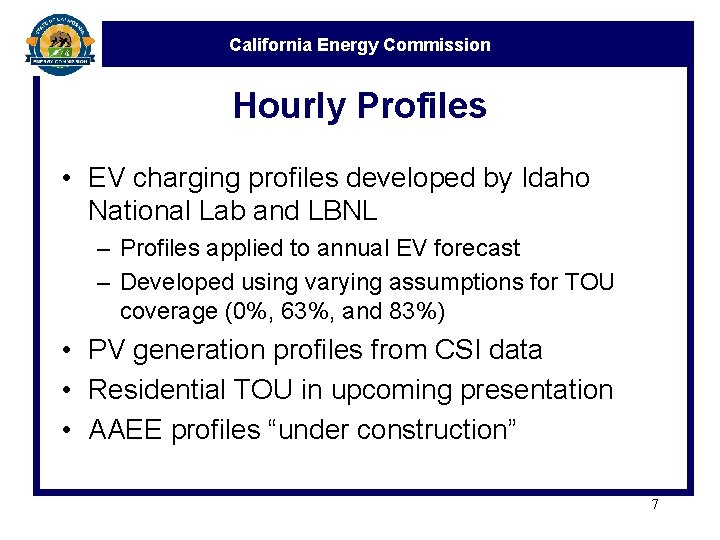
California Energy Commission Hourly Profiles • EV charging profiles developed by Idaho National Lab and LBNL – Profiles applied to annual EV forecast – Developed using varying assumptions for TOU coverage (0%, 63%, and 83%) • PV generation profiles from CSI data • Residential TOU in upcoming presentation • AAEE profiles “under construction” 7
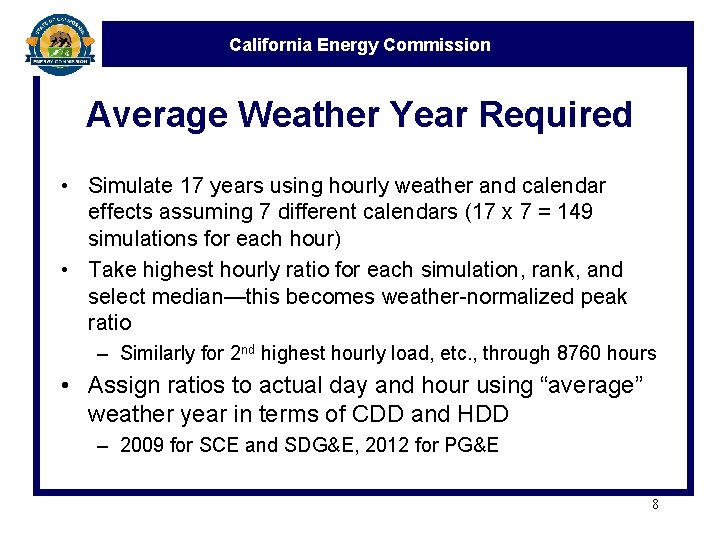
California Energy Commission Average Weather Year Required • Simulate 17 years using hourly weather and calendar effects assuming 7 different calendars (17 x 7 = 149 simulations for each hour) • Take highest hourly ratio for each simulation, rank, and select median—this becomes weather-normalized peak ratio – Similarly for 2 nd highest hourly load, etc. , through 8760 hours • Assign ratios to actual day and hour using “average” weather year in terms of CDD and HDD – 2009 for SCE and SDG&E, 2012 for PG&E 8
California Energy Commission Example of Projected Hourly Consumption Loads: PG&E in 2030 9
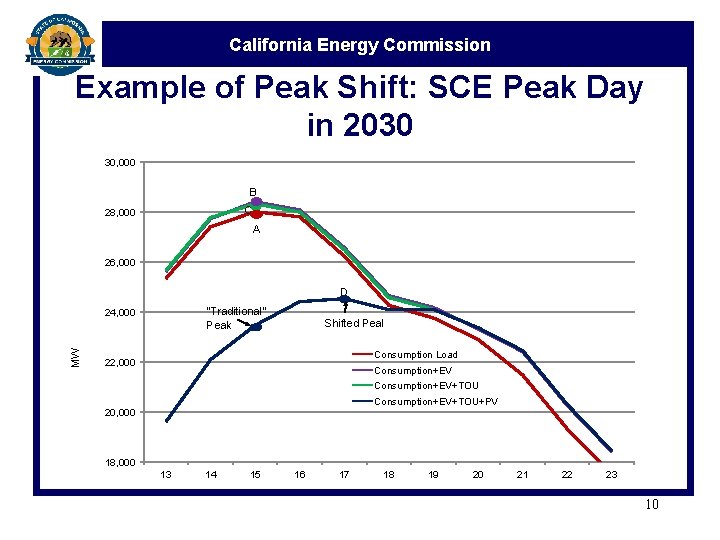
California Energy Commission Example of Peak Shift: SCE Peak Day in 2030 30, 000 B C 28, 000 A 26, 000 D "Traditional" Peak MW 24, 000 Shifted Peak Consumption Load 22, 000 Consumption+EV+TOU+PV 20, 000 18, 000 13 14 15 16 17 18 19 20 21 22 23 10
California Energy Commission Limitations • Not accounting for climate change at hourly level • Need updated PV profiles • EV shapes based on relatively small sample • System level analysis—sector and more disaggregated geographic level would improve accuracy 11
California Energy Commission Questions/Comments? 12