
California Energy Commission Hourly Load Forecasting Status Update
- Slides: 10
California Energy Commission Hourly Load Forecasting: Status Update IEPR Workshop on Inputs and Assumptions for IEPR Modeling and Forecasting Activities February 22, 2017 Chris Kavalec and Ravinderpal Vaid Energy Assessments Division Chris. Kavalec@energy. ca. gov / 916 -654 -5184 1
California Energy Commission Background • Energy Commission long-term demand forecasts currently done at annual level • Long-term projections at hourly level increasingly important for demand analysis and resource planning – In addition to peak hour, analysis of “ramp-up” period and mid-day loads important – Demand-side factors, including PV and EVs, likely to shift the peak hour 2
California Energy Commission Goals • To develop model to project 8760 hourly loads 10 years out for a specified geography • Develop “business as usual” projections that account for economic and demographic changes, changes in sector shares, and other factors • Adjust business as usual projections to account for increasing amounts of PV and EVs, along with AAEE, DR, and TOU pricing 3
California Energy Commission Model Estimation and Data • First version relies on system level hourly data (e. g. CAISO EMS data) to project hourly loads • Later versions for future forecasts would use AMI data to estimate individual models by sector as well as by more granular geography 4
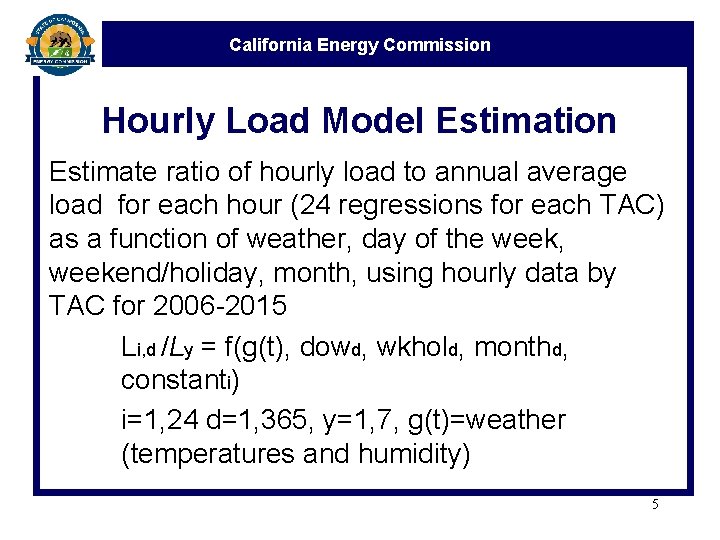
California Energy Commission Hourly Load Model Estimation Estimate ratio of hourly load to annual average load for each hour (24 regressions for each TAC) as a function of weather, day of the week, weekend/holiday, month, using hourly data by TAC for 2006 -2015 Li, d /Ly = f(g(t), dowd, wkhold, monthd, constanti) i=1, 24 d=1, 365, y=1, 7, g(t)=weather (temperatures and humidity) 5
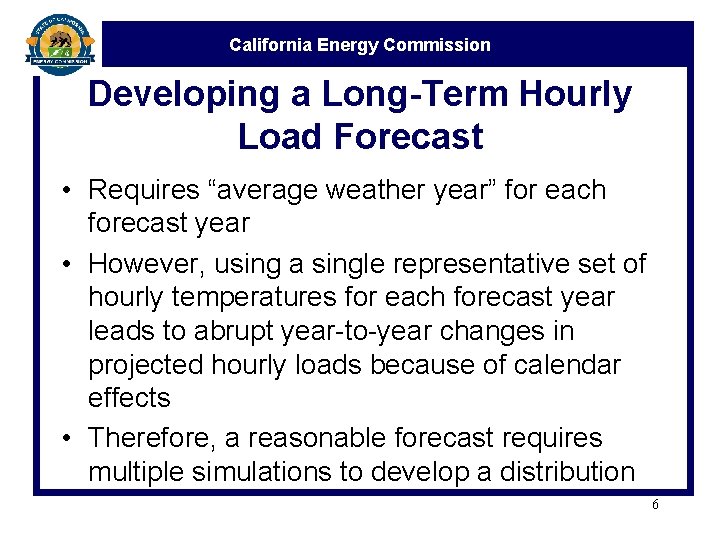
California Energy Commission Developing a Long-Term Hourly Load Forecast • Requires “average weather year” for each forecast year • However, using a single representative set of hourly temperatures for each forecast year leads to abrupt year-to-year changes in projected hourly loads because of calendar effects • Therefore, a reasonable forecast requires multiple simulations to develop a distribution 6
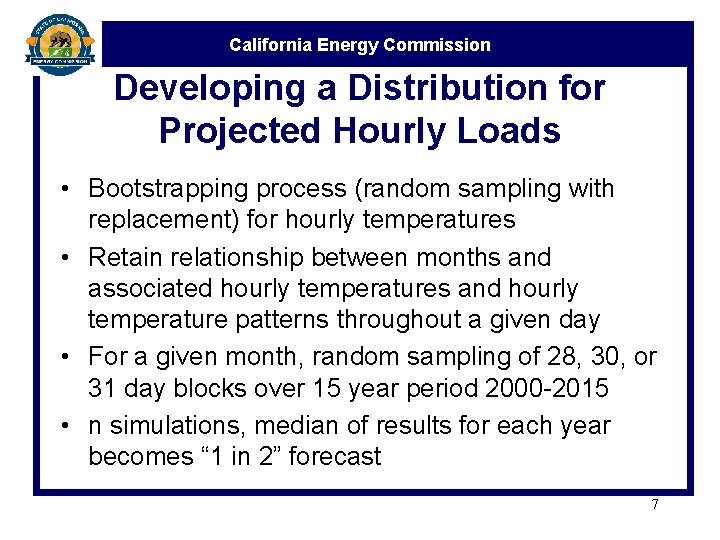
California Energy Commission Developing a Distribution for Projected Hourly Loads • Bootstrapping process (random sampling with replacement) for hourly temperatures • Retain relationship between months and associated hourly temperatures and hourly temperature patterns throughout a given day • For a given month, random sampling of 28, 30, or 31 day blocks over 15 year period 2000 -2015 • n simulations, median of results for each year becomes “ 1 in 2” forecast 7
California Energy Commission Application of Multiple Simulations: PGE Peak Demand 8
California Energy Commission Further Work/Investigation • Optimal number of simulations? • Introduce other weather variables (e. g. heat index) • Gradient boosting: form of “machine learning” using errors to “educate” model and improve performance • Load shape modifier impacts • Vet model with stakeholders at DAWG meetings 9
California Energy Commission Questions/Comments? 10