
California Collaborative on the Social Emotional Foundations for
California Collaborative on the Social. Emotional Foundations for Early Learning (CA CSEFEL) CA CSEFEL is part of the MAP to Inclusion & Belonging West. Ed Center for Child & Family Studies www. CAinclusion. org
National CSEFEL • It began at the national level with the Center on the Social Emotional Foundations for Early Learning • National Center focused on promoting the social emotional development and school readiness of young children birth to age 5 • Jointly funded by the Office of Head Start and the Office of Child Care, under the auspices of the Administration on Children, Youth and Families at the U. S. Department of Health and Human Services • Funding ended in 2012. Many of the faculty are part of Head Start National Center on Quality Teaching and Learning (NCQTL ) and are still promoting Pyramid practices and Practice-Based Coaching
Partner Project: TACSEI • TACSEI (Technical Assistance Center on Social Emotional Intervention for Young Children) is a partner National Center focused on sharing practices that improve the social-emotional outcomes for young children with, or at risk for, delays or disabilities • Recent focus on early intervention practices • Funded by the US Department of Education, Office of Special Education Programs • Funding ended in 2013. Many faculty are part of the Early Childhood Technical Assistance Center (ECTA Center) funded through OSEP
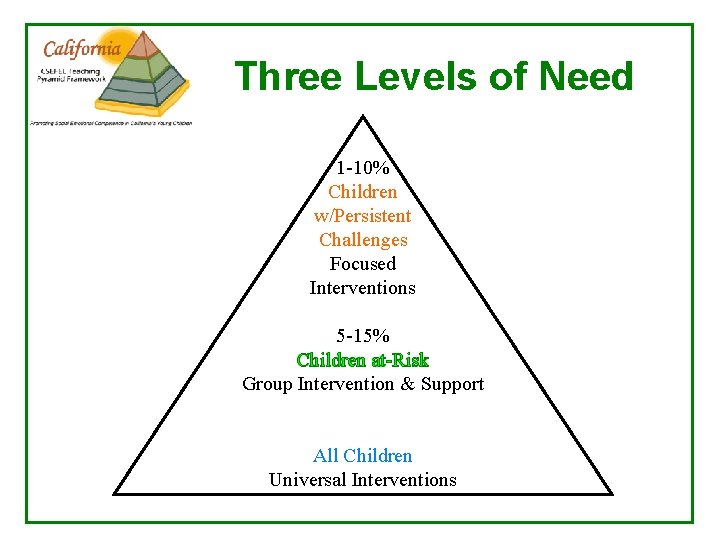
Three Levels of Need 1 -10% Children w/Persistent Challenges Focused Interventions 5 -15% Children at-Risk Group Intervention & Support All Children Universal Interventions
Teaching Pyramid • The Teaching Pyramid is the name used by CA CSEFEL to describe the training and technical assistance for the approach developed by the national Center on the Social Emotional Foundations for Early Learning (CSEFEL) • There are California adapted versions for preschool, infant/toddler, and family child care • The Teaching Pyramid Framework was built on evidence-based practices and has been shown to increase social-emotional
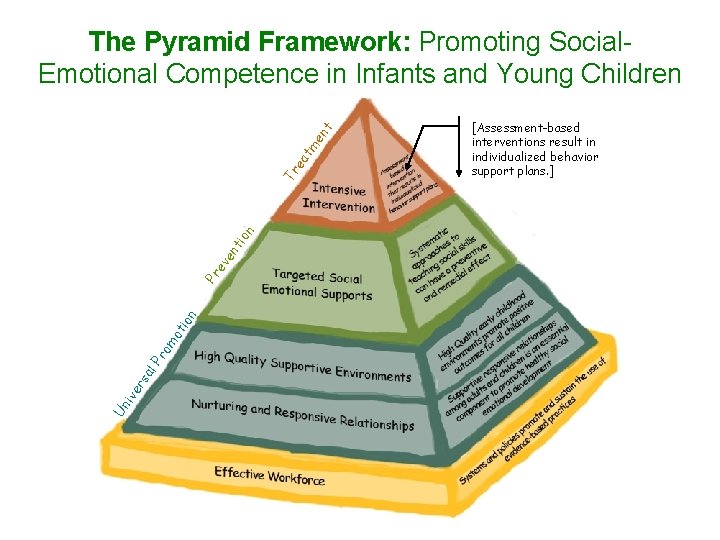
Un ive rs a l. P ro m ot ion Pr ev en tio n Tr ea tm en t The Pyramid Framework: Promoting Social. Emotional Competence in Infants and Young Children [Assessment-based interventions result in individualized behavior support plans. ]
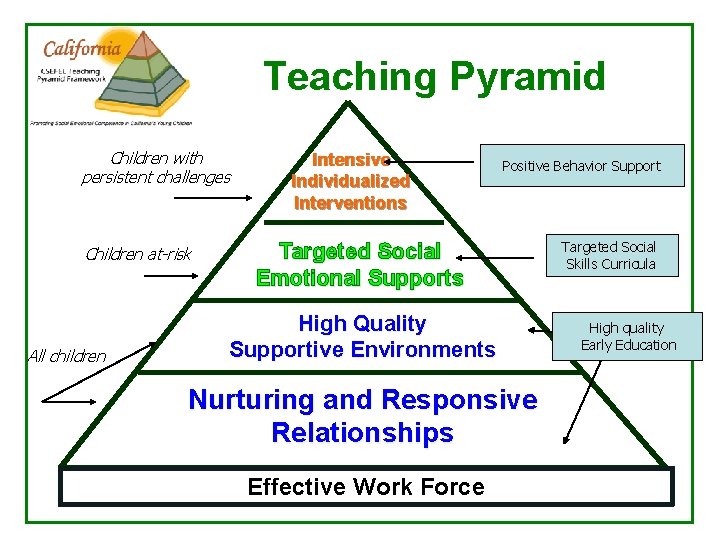
Teaching Pyramid Children with persistent challenges Children at-risk All children Intensive Individualized Interventions Positive Behavior Support Targeted Social Emotional Supports High Quality Supportive Environments Nurturing and Responsive Relationships Effective Work Force Targeted Social Skills Curricula High quality Early Education
CA CSEFEL (The California Collaborative on Social Emotional Foundations for Early Learning) is a state-wide, multi-agency group focused on spreading the Teaching Pyramid framework throughout California
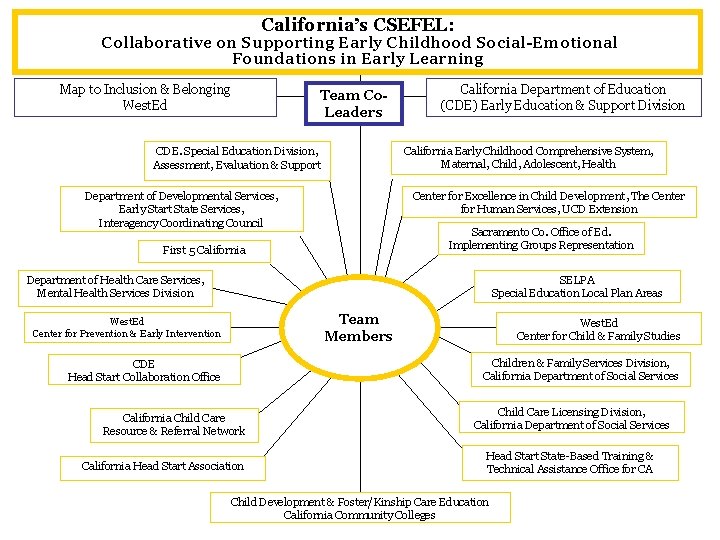
California’s CSEFEL: Collaborative on Supporting Early Childhood Social-Emotional Foundations in Early Learning Map to Inclusion & Belonging West. Ed Team Co. Leaders California Department of Education (CDE) Early Education & Support Division California Early Childhood Comprehensive System, Maternal, Child, Adolescent, Health CDE. Special Education Division, Assessment, Evaluation & Support Department of Developmental Services, Early Start State Services, Interagency Coordinating Council Center for Excellence in Child Development, The Center for Human Services, UCD Extension Sacramento Co. Office of Ed. Implementing Groups Representation First 5 California Department of Health Care Services, Mental Health Services Division SELPA Special Education Local Plan Areas Team Members West. Ed Center for Prevention & Early Intervention West. Ed Center for Child & Family Studies Children & Family Services Division, California Department of Social Services CDE Head Start Collaboration Office California Child Care Resource & Referral Network California Head Start Association Child Care Licensing Division, California Department of Social Services Head Start State-Based Training & Technical Assistance Office for CA Child Development & Foster/Kinship Care Education California Community Colleges
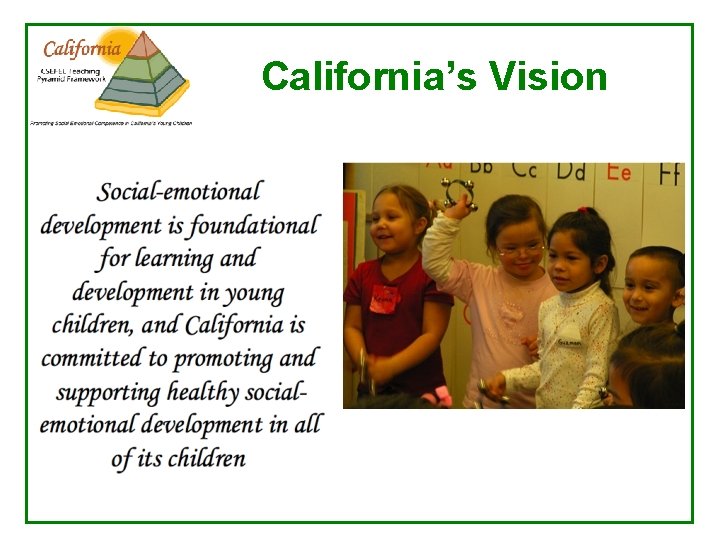
California’s Vision
CA CSEFEL Coordination • West. Ed Center for Child & Family Studies, San Marcos Office provides the coordination for the CA CSEFEL Teaching Pyramid Framework in California • The state leadership team acts as an advisory group for the CA CSEFEL Activities • West. Ed works closely with the national CSEFEL Pyramid Model to maintain
JACK O’CONNELL State Superintendent of Public Instruction

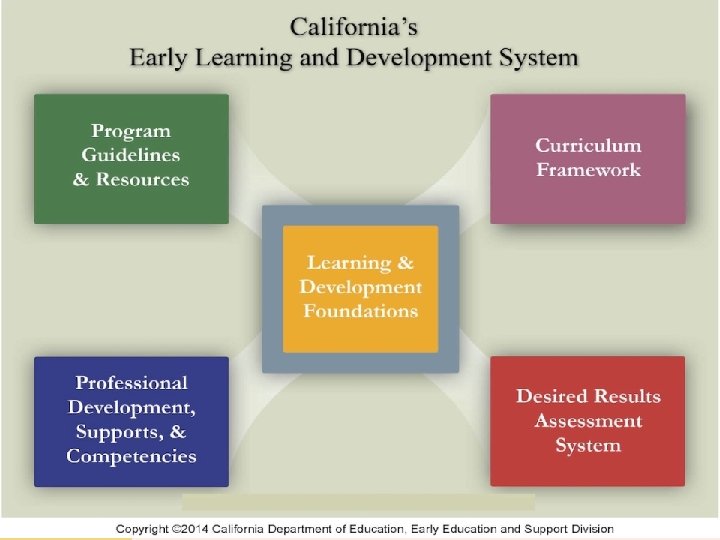
Compliments CA Documents • The CA CSEFEL Teaching Pyramid is aligned with the California Early Learning & Development System (Foundations and Frameworks) • As part of the California Department of Education’s Early Learning & Development System, there are documents being produced to guide teachers of young children • Foundations, Curriculum Frameworks, Program Guidelines, Assessment through the Desired Results measure, and Professional Development are all part of the Early Learning & Development System • The Preschool Volume 1 and the Infant Toddler Learning & Development Foundations and Curriculum Framework all begin with Social-Emotional Development • That was intentional by the CDE as that area of development is the foundation for future learning
Program-Wide is What Makes CSEFEL Unique! • The power of the Teaching Pyramid is most clearly seen when it is implemented across an entire site, district, or agency – Program. Wide! • Training is only one small part of the approach • It takes planning by a group of leaders, training in a systematic way, and coaching/technical assistance to support implementation in order to be “doing CSEFEL”
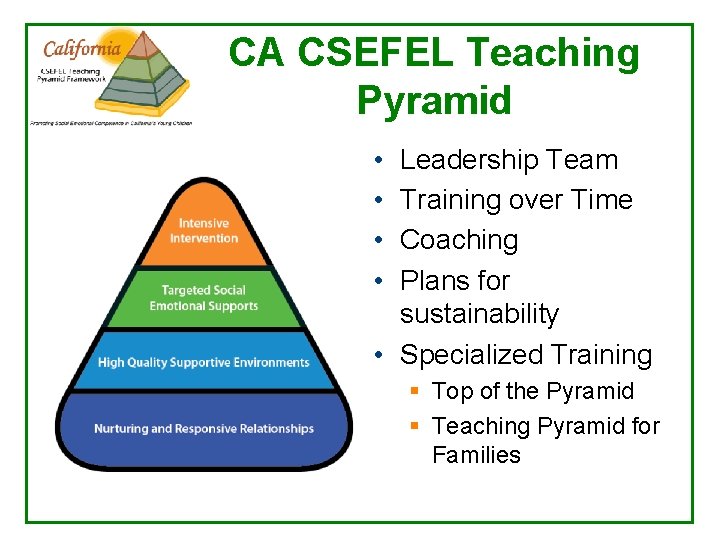
CA CSEFEL Teaching Pyramid • • Leadership Team Training over Time Coaching Plans for sustainability • Specialized Training § Top of the Pyramid § Teaching Pyramid for Families
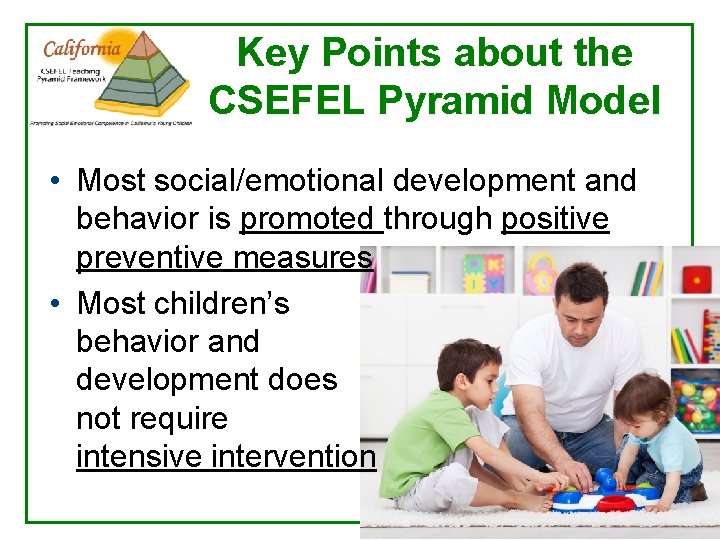
Key Points about the CSEFEL Pyramid Model • Most social/emotional development and behavior is promoted through positive preventive measures • Most children’s behavior and development does not require intensive intervention
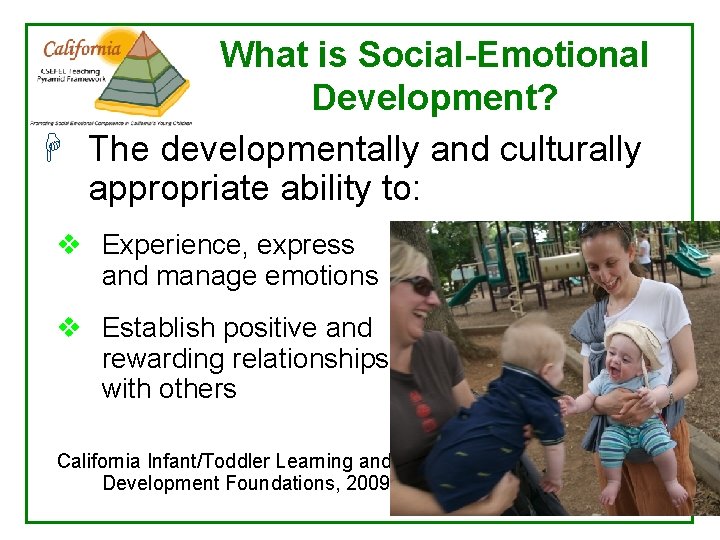
What is Social-Emotional Development? H The developmentally and culturally appropriate ability to: v Experience, express and manage emotions v Establish positive and rewarding relationships with others California Infant/Toddler Learning and Development Foundations, 2009
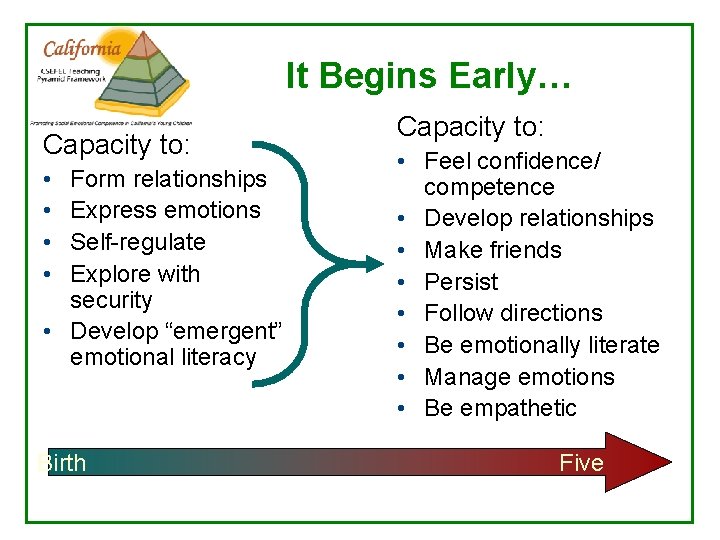
It Begins Early… Capacity to: • • Form relationships Express emotions Self-regulate Explore with security • Develop “emergent” emotional literacy Birth Capacity to: • Feel confidence/ competence • Develop relationships • Make friends • Persist • Follow directions • Be emotionally literate • Manage emotions • Be empathetic Five
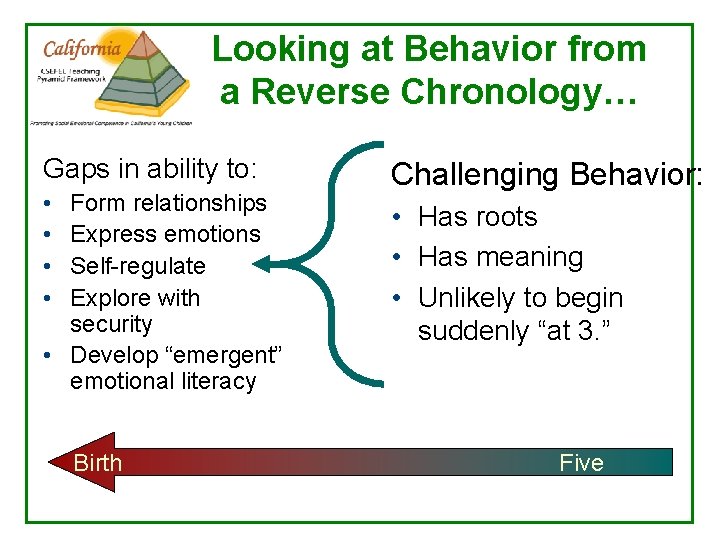
Looking at Behavior from a Reverse Chronology… Gaps in ability to: • • Form relationships Express emotions Self-regulate Explore with security • Develop “emergent” emotional literacy Birth Challenging Behavior: • Has roots • Has meaning • Unlikely to begin suddenly “at 3. ” Five
Young children who exhibit healthy social, emotional, and behavioral adjustment are more likely to have good academic performance in elementary school (Cohen and others 2005; Zero to Three 2004). This recent research strengthens the view that early childhood programs support later positive learning outcomes in all domains by maintaining a focus on the promotion of healthy social emotional development (National Scientific Council on the Developing Child 2004; Raver 2002; Shonkoff 2004).
Who Has Challenging Behavior? • For children under age three: § Behavior is how they communicate their needs § They are generally not capable of intentional misbehavior § Children will often develop coping skills that may be interpreted as challenging behavior • Adult’s can find some behaviors challenging, however it is the adult who needs to adjust and change, not the
We Need to Teach! “If a child doesn’t know how to read, we teach. If a child doesn’t know how to swim, we teach. If a child doesn’t know how to multiply, we teach. If a child doesn’t know how to drive, we teach. If a child doesn’t know how to behave, we……. . . ……. punish? ……. teach? Why can’t we finish the last sentence as automatically as we do the others? ” Tom Herner (NASDE President ) Counterpoint 1998, pg. 2
Brief Description of the Preschool Module Content Adapted by West. Ed Center for Child & Family Studies, San Marcos Office, 2012 -13 version Originally developed by the Center on the Social and Emotional Foundations for Early Learning
Module 1: Promoting Children’s Success: Building Relationship and Creating Supportive Environment Topics included in this module: § Building positive relationships with children, families and staff members § Reflecting on values, perceptions, and beliefs about young children and their behavior § Designing environments that support appropriate behavior § Using schedules, routines, and visual strategies § Examining transitions and group size § Establishing expectations § Implementing activities that promote child engagement § Providing positive descriptive acknowledgement
Module 2: Social Emotional Teaching Strategies Topics included in this module: § Identifying teachable moments § Facilitating the development of friendship skills § Teaching children to recognize and express emotions (emotional literacy) § Teaching children to understand manage strong emotions such as anger, giddiness § Teaching problem solving and conflict resolution
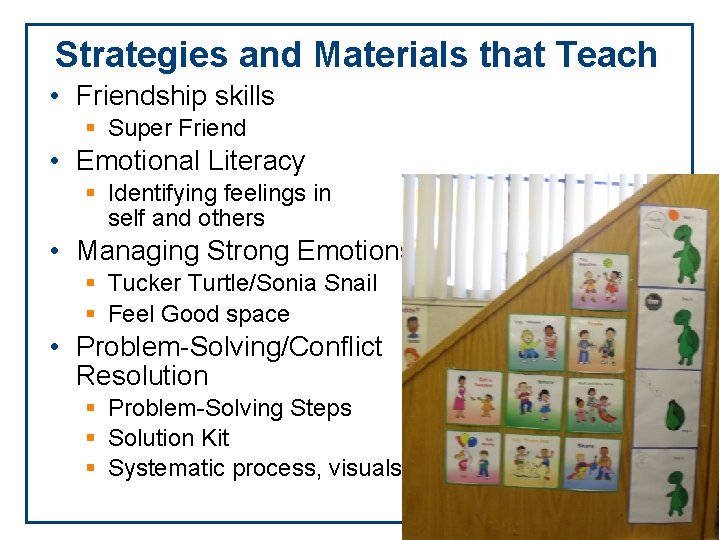
Strategies and Materials that Teach • Friendship skills § Super Friend • Emotional Literacy § Identifying feelings in self and others • Managing Strong Emotions § Tucker Turtle/Sonia Snail § Feel Good space • Problem-Solving/Conflict Resolution § Problem-Solving Steps § Solution Kit § Systematic process, visuals
Module 3 A & B: Individualized Intensive Intervention Topics included in this module: § Modifying and adapting materials and activities to meet the individual needs of all children, including those with disabilities § Identifying the function of challenging behavior § Identifying behaviors and social skills to target for intervention § Focusing on teaching new behaviors that still meet the original function § Developing a plan for supporting social-emotional development and preventing challenging behavior § Using a team approach to addressing challenging behavior and social-emotional needs
Reflection on What Works • Think about a time that you were able to work with a child who had some challenging behavior and help him or her be successful in your program • What strategies did you use to help the child to succeed? • What did you learn?
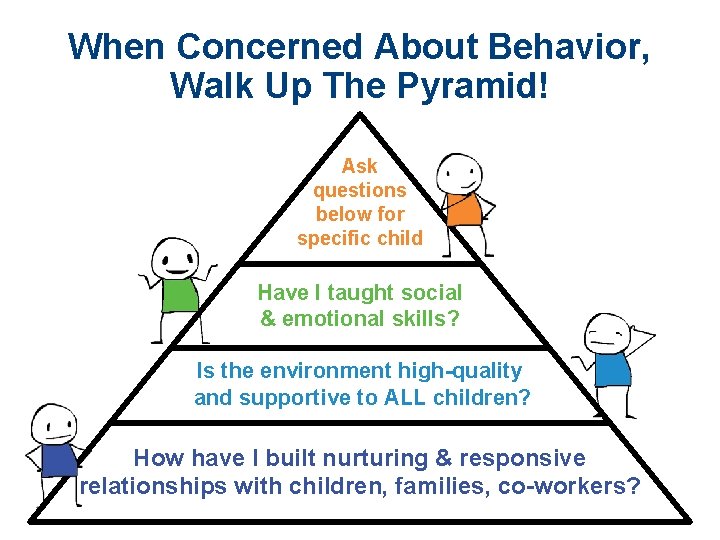
When Concerned About Behavior, Walk Up The Pyramid! Ask questions below for specific child Have I taught social & emotional skills? Is the environment high-quality and supportive to ALL children? How have I built nurturing & responsive relationships with children, families, co-workers?
Also: Leadership Strategies for an Effective Work Force Topics addressed with the Leadership Team: § Identifying challenges and barriers to implementing effective practices § Identifying strategies for addressing barriers and challenges § Developing program policies, procedures and staff development plans that promote the use of effective practices § Identifying steps to collaborative planning for programs and systems that support all young children’s social-emotional development and addressing challenging behaviors as needed
Counties With Programs Trained by West. Ed and/or Authorized Trainers ☀ ☀ ☀ ☀ ☀ Alameda County Contra Costa County El Dorado County Fresno County Los Angeles County Madera County Marin County Merced County Monterey County Orange County ☀ ☀ ☀ ☀ ☀ Sacramento County San Diego County San Francisco County San Joaquin County Santa Barbara County Santa Clara County Santa Cruz County Ventura County Yolo County
Levels of Implementation ▲ Entry CA CSEFEL Teaching Pyramid Sites Community sites who have some, but not all of the components and are interested in growing to the next level ▲ Practicing CA CSEFEL Teaching Pyramid Sites Community sites who are committed to implementing all components of the Pyramid model ▲ Partner CA CSEFEL Teaching Pyramid Sites with the goal of implementing with fidelity to the framework, sending a team to a Leadership Summit, and collaborating with CA CSEFEL on data collections ▲ Mentor CA CSEFEL Classrooms in Partner Sites Mentor classrooms are located within Partner Sites, have implemented with fidelity to the framework, and agree to reach out and mentor other programs
Online Overview • There is an overview of the CA CSEFEL Teaching Pyramid available online through the California Early Childhood Online (CECO) website: http: //www. caearlychildhoodonline. org • The three-hour overview is provided free of charge for those who register and a verification certificate will be issued upon completion
Strengthening Families • This is a national movement to provide a framework for promoting family strengths and a family environment that promotes optimal child and youth development • There are five “protective factors” that, when well established in a family, diminish the likelihood of child abuse and neglect • Information on the Protective Factors can be found at http: //www. cssp. org/reform/strengtheningfamilies/about
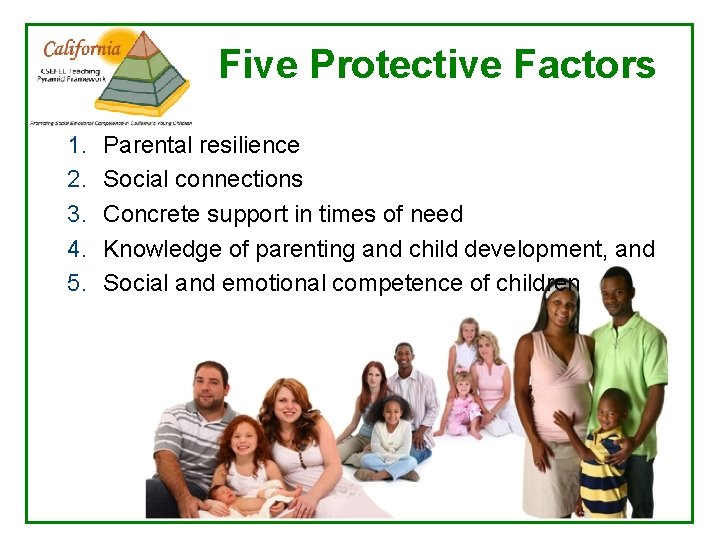
Five Protective Factors 1. 2. 3. 4. 5. Parental resilience Social connections Concrete support in times of need Knowledge of parenting and child development, and Social and emotional competence of children
CA CSEFEL Addresses the Protective Factors • The materials and the • When support is CA CSEFEL Teaching provided to families in Pyramid Framework groups it can increase support most of the parental resilience protective factors and lead to social connections • They directly address knowledge of child • And all early care and development and education providers social emotional need to learn about competence of concrete supports in children times of need available in their
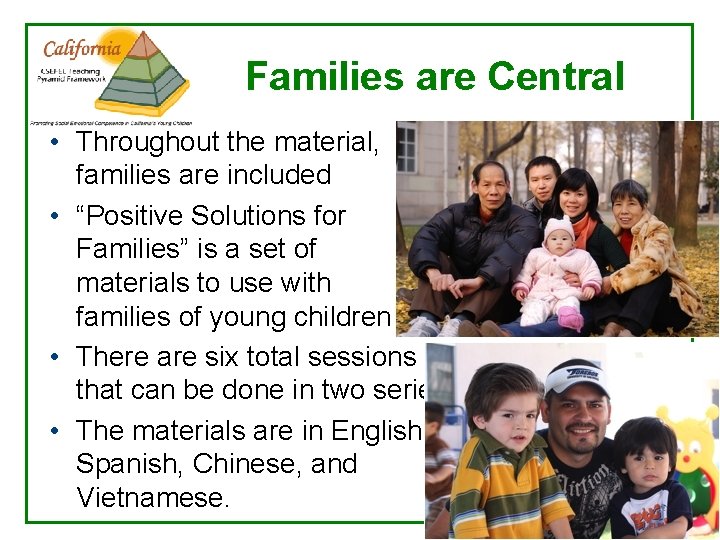
Families are Central • Throughout the material, families are included • “Positive Solutions for Families” is a set of materials to use with families of young children • There are six total sessions that can be done in two series • The materials are in English, Spanish, Chinese, and Vietnamese.
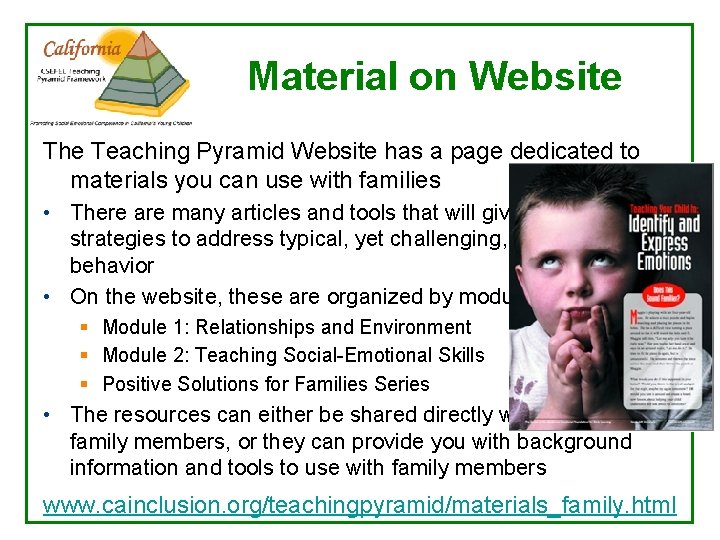
Material on Website The Teaching Pyramid Website has a page dedicated to materials you can use with families • There are many articles and tools that will give strategies to address typical, yet challenging, behavior • On the website, these are organized by module § Module 1: Relationships and Environment § Module 2: Teaching Social-Emotional Skills § Positive Solutions for Families Series • The resources can either be shared directly with family members, or they can provide you with background information and tools to use with family members www. cainclusion. org/teachingpyramid/materials_family. html
To Summarize • CA CSEFEL Teaching Pyramid is a tiered approach to promote health social -emotional development, prevent problem behavior, and address challenging behavior in young children • The Teaching Pyramid is designed to work in partnership with families, specialists, administrators, teachers, and more
Thank You! For more information: teachingpyramid@wested. org CA Map to Inclusion & Belonging http: //www. CAinclusion. org
- Slides: 40