
CALIFORNIA CODE OF JUDICIAL ETHICS Hon Tom Hollenhorst
- Slides: 37
CALIFORNIA CODE OF JUDICIAL ETHICS Hon. Tom Hollenhorst Hon. Julie Conger Hon. Dodie Harman
AMERICAN BAR ASSOCIATION MODEL CODE OF JUDICIAL CONDUCT
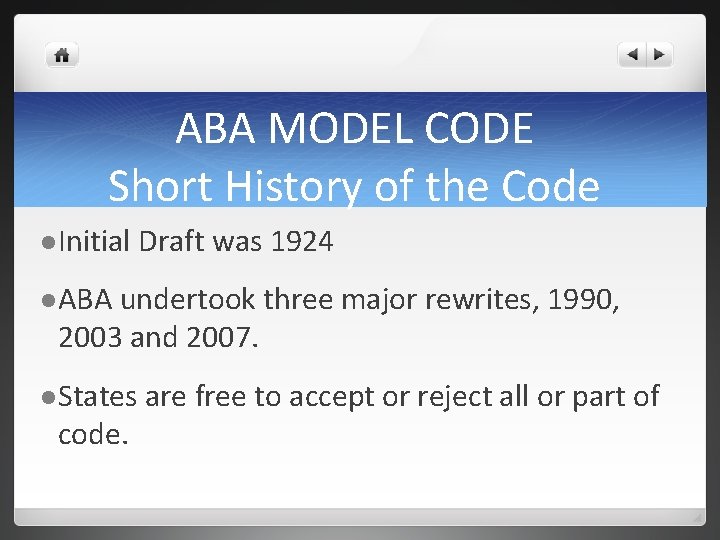
ABA MODEL CODE Short History of the Code l Initial Draft was 1924 l ABA undertook three major rewrites, 1990, 2003 and 2007. l States code. are free to accept or reject all or part of
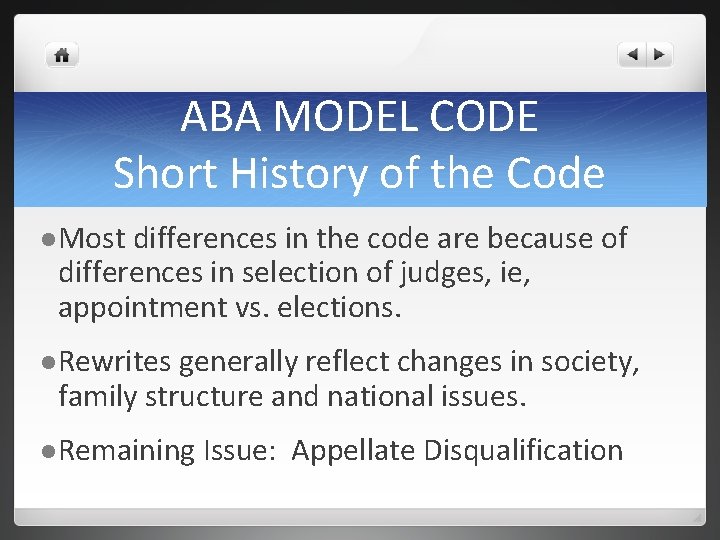
ABA MODEL CODE Short History of the Code l Most differences in the code are because of differences in selection of judges, ie, appointment vs. elections. l Rewrites generally reflect changes in society, family structure and national issues. l Remaining Issue: Appellate Disqualification
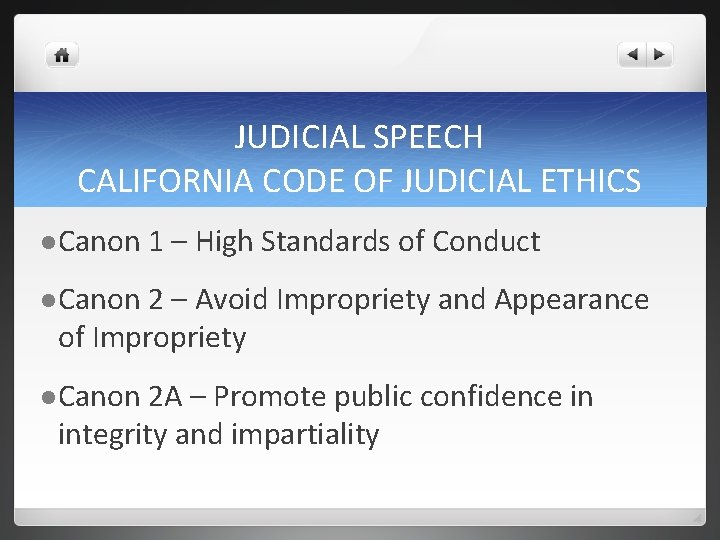
JUDICIAL SPEECH CALIFORNIA CODE OF JUDICIAL ETHICS l Canon 1 – High Standards of Conduct l Canon 2 – Avoid Impropriety and Appearance of Impropriety l Canon 2 A – Promote public confidence in integrity and impartiality
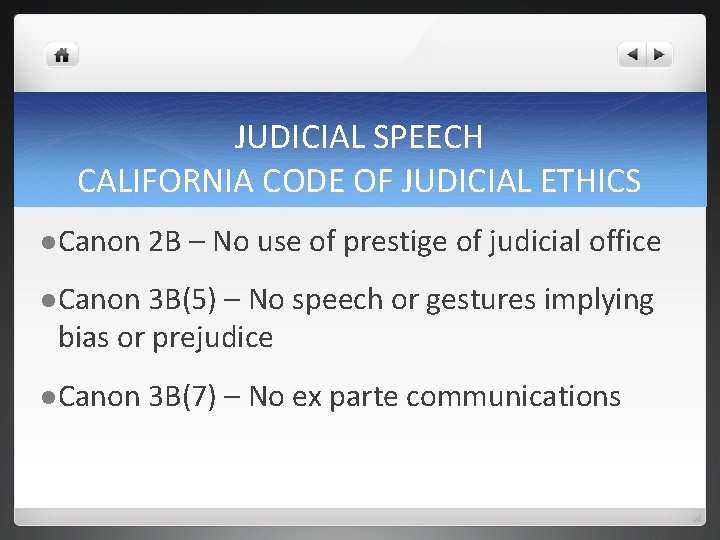
JUDICIAL SPEECH CALIFORNIA CODE OF JUDICIAL ETHICS l Canon 2 B – No use of prestige of judicial office l Canon 3 B(5) – No speech or gestures implying bias or prejudice l Canon 3 B(7) – No ex parte communications
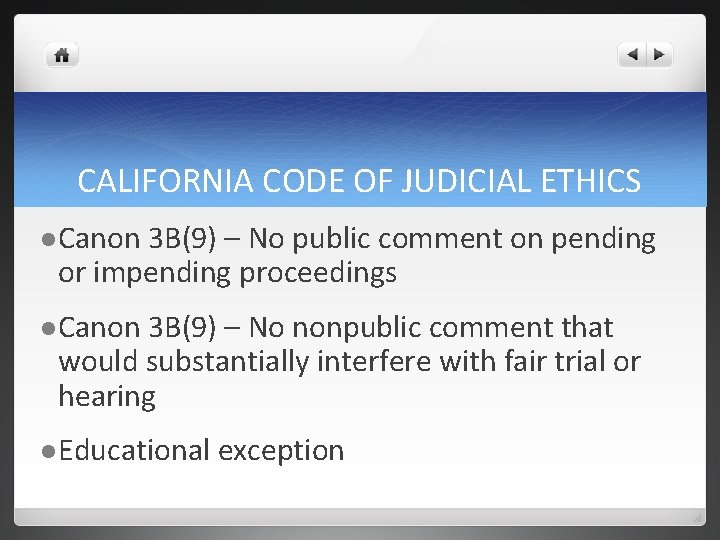
CALIFORNIA CODE OF JUDICIAL ETHICS l Canon 3 B(9) – No public comment on pending or impending proceedings l Canon 3 B(9) – No nonpublic comment that would substantially interfere with fair trial or hearing l Educational exception
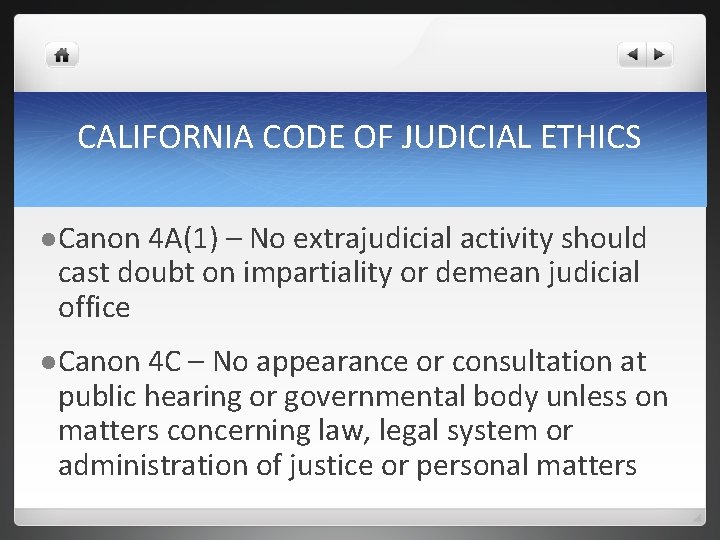
CALIFORNIA CODE OF JUDICIAL ETHICS l Canon 4 A(1) – No extrajudicial activity should cast doubt on impartiality or demean judicial office l Canon 4 C – No appearance or consultation at public hearing or governmental body unless on matters concerning law, legal system or administration of justice or personal matters
JUDICIAL SPEECH CALIFORNIA CODE OF JUDICIAL ETHICS l Canon 5 A – No inappropriate political activity – no speeches for political organizations or endorsements of nonjudicial candidates l Canon 5 B – Judicial candidate shall not make statements to electorate or appointing authority that commit with respect to cases, controversies or issues that could come before courts
NEW CANON 2 A – JUDICIAL SPEECH l. A judge shall not make statements, whether public or nonpublic, that commit the judge with respect to cases, controversies, or issues that are likely to come before the courts or that are inconsistent with the impartial performance of the adjudicative duties of judicial office.
NEW CANON 2 A – JUDICIAL SPEECH l Covers public AND nonpublic statements l No commitment on issues likely to be subject of litigation OR l No statements inconsistent with impartiality
SOURCE OF CANON 2 A ? CANON 5 B l Applies only to conduct during election campaign l Audience: Electorate or Appointing Authority
SOURCE OF CANON 2 A? ABA MODEL CODE OF JUDICIAL CONDUCT l Rule 2. 10(A) A judge shall not make any public statement that might reasonably be expected to affect the outcome or impair the fairness of a matter pending or impending in any court, or make any nonpublic statement that might substantially interfere with a fair trial or hearing
SOURCE OF CANON 2 A ? ABA MODEL CODE OF JUDICIAL CONDUCT l Rule 2. 10 (B) A judge shall not, in connection with cases, controversies, or issues that are likely to come before the court, make pledges, promises or commitments that are inconsistent with the impartial performance of the adjudicative duties of judicial office.
ABA MODEL CODE RULE 2. 10(B) l Prohibited statements only “in connection with cases, controversies, or issues likely to come before the court” l “Inconsistent with impartiality” modifies the term “commitments” and does not apply to ALL statements
NEW COMMENTARY ON CANON 3 B(9) l Cautionary l “Judges reminder of Canon 2 A should be cautious when making (nonpublic comments about pending or impending cases) that such a comment can be misheard, misinterpreted or repeated…. (When making such a nonpublic comment) the judge must keep an open mind and not form an opinion prematurely or create the appearance of having formed an opinion prematurely. ”
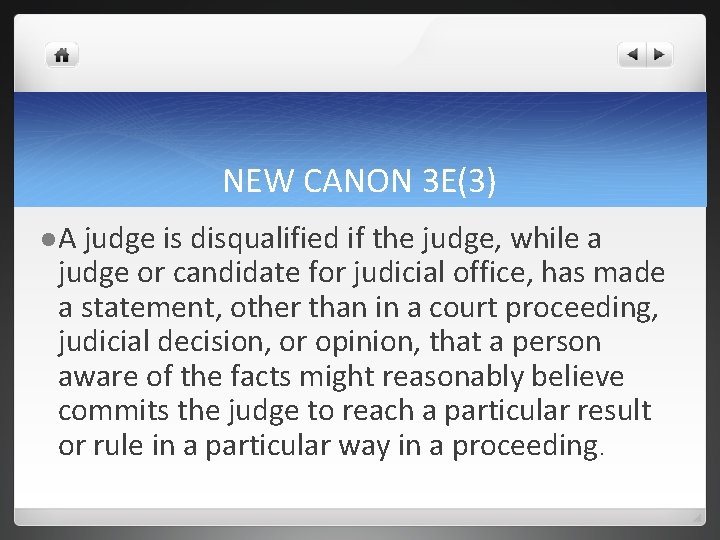
NEW CANON 3 E(3) l. A judge is disqualified if the judge, while a judge or candidate for judicial office, has made a statement, other than in a court proceeding, judicial decision, or opinion, that a person aware of the facts might reasonably believe commits the judge to reach a particular result or rule in a particular way in a proceeding.
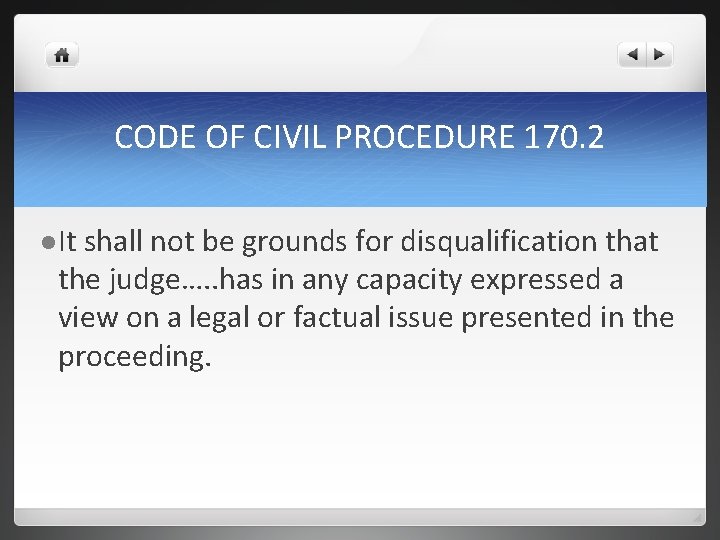
CODE OF CIVIL PROCEDURE 170. 2 l It shall not be grounds for disqualification that the judge…. . has in any capacity expressed a view on a legal or factual issue presented in the proceeding.
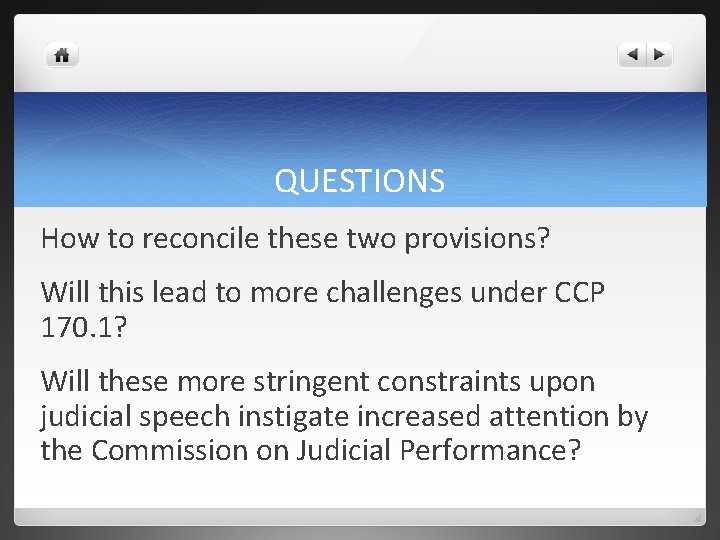
QUESTIONS How to reconcile these two provisions? Will this lead to more challenges under CCP 170. 1? Will these more stringent constraints upon judicial speech instigate increased attention by the Commission on Judicial Performance?
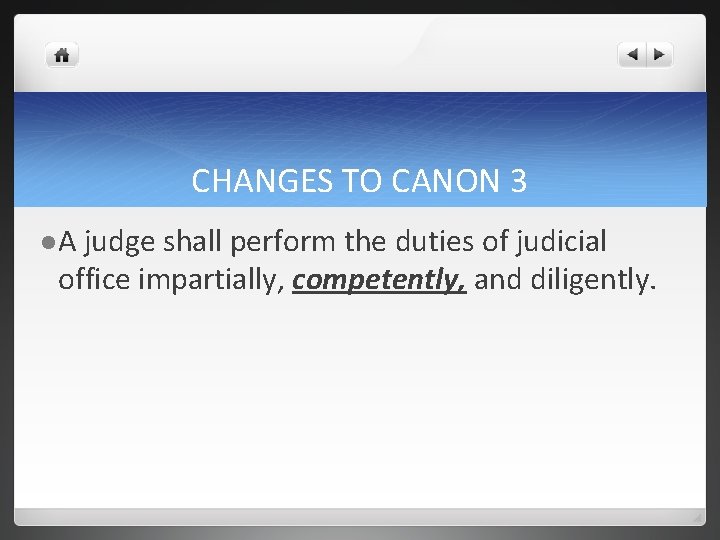
CHANGES TO CANON 3 l. A judge shall perform the duties of judicial office impartially, competently, and diligently.
CHANGES TO CANON 3 l What l AOC is “competence”? staff memo: “supports the principle that judges should engage in continuing education. ”
CHANGES TO CANON 3 l Competence: requires the legal knowledge, skill, thoroughness, and preparation reasonably necessary to perform judge’ responsibilities of judicial office l Canon 1: incorrect legal ruling is not itself a violation of this code
CHANGES TO CANON 3 l Proposed new CJP Rule 1. 14: l Discipline shall not be imposed for mere legal error without more. l Exception added: clearly and convincingly reflects bad faith…or any purpose other than the faithful discharge of judicial duty is subject to investigation and discipline.
CHANGES TO CANON 3 l Oberholzer l “critical v. CJP (1999) 20 Cal. 4 th 371: inquiry is whether petitioner’s action clearly and convincingly reflected bad faith, bias, abuse of authority, disregard for fundamental rights, intentional disregard of the law, or any purpose other than the faithful discharge of judicial duty. ”
CHANGES TO CANON 3 l “Competent” requirement – directly relates to continuing education standards. l Will this be “underlying misconduct” to justify investigation and discipline by the Commission?
CANON 3 B(7) EX PARTE COMMUNICATIONS l No independent investigation of the facts l Consider noticed l All only evidence presented or judicially media, including electronic l Must make reasonable efforts to avoid ex parte communications
CANON 3 B(7) EX PARTE COMMUNICATIONS l Adds language prohibiting communication with disqualified judge or one with appellate jurisdiction
CANON 3 B(7) EX PARTE COMMUNICATIONS l Consultation with court personnel or others authorized by law: l Allowed “so long as the communication relates to that person’s duty to aid the judge in carrying out the judge’s adjudicative responsibilities. ”
CANON 3 B(7) EX PARTE COMMUNICATIONS l Court Personnel includes: l Bailiffs, court reporters, court externs l Research l Other attorneys, courtroom clerks employees of the court
CANON 3 B(7) EX PARTE COMMUNICATIONS l Court personnel does not include: l Lawyers in a proceeding l Persons appointed by the court l Employees of government agencies, such as lawyers, social workers or representatives of probation department
CANON 3 B(7)(b) and (c) l Standardizes use of “initiate, permit or consider” l Authorizes ex parte communication when authorized to do so by stipulation of the parties l Eliminates “disinterested expert on the law” exception but Evidence Code 730 expert appointment permitted
NEW CANON 3 B(7)(d) l If judge receives ex parte communication: l Must promptly notify parties of substance l Provide opportunity to respond
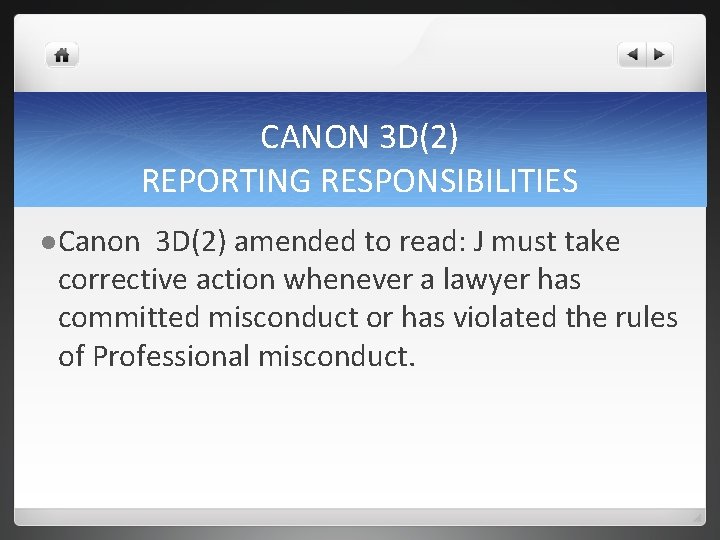
CANON 3 D(2) REPORTING RESPONSIBILITIES l Canon 3 D(2) amended to read: J must take corrective action whenever a lawyer has committed misconduct or has violated the rules of Professional misconduct.
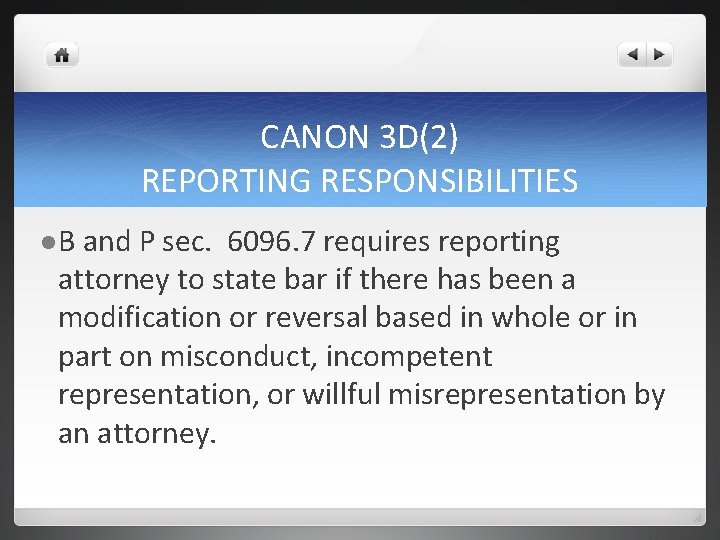
CANON 3 D(2) REPORTING RESPONSIBILITIES l. B and P sec. 6096. 7 requires reporting attorney to state bar if there has been a modification or reversal based in whole or in part on misconduct, incompetent representation, or willful misrepresentation by an attorney.
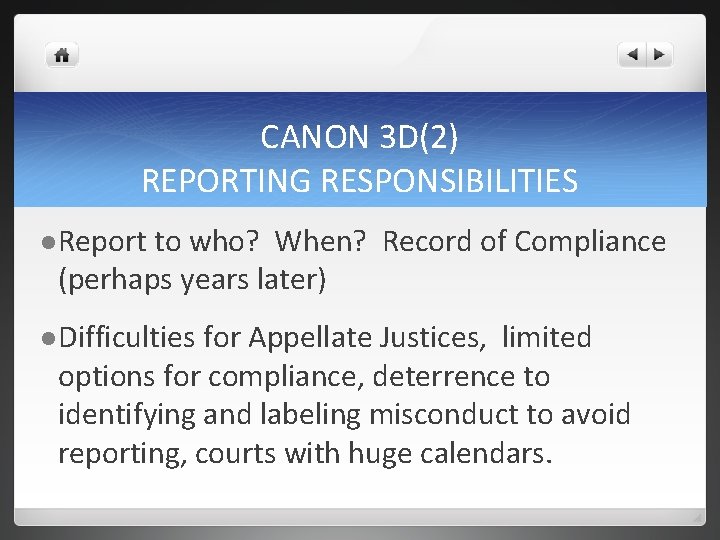
CANON 3 D(2) REPORTING RESPONSIBILITIES l Report to who? When? Record of Compliance (perhaps years later) l Difficulties for Appellate Justices, limited options for compliance, deterrence to identifying and labeling misconduct to avoid reporting, courts with huge calendars.
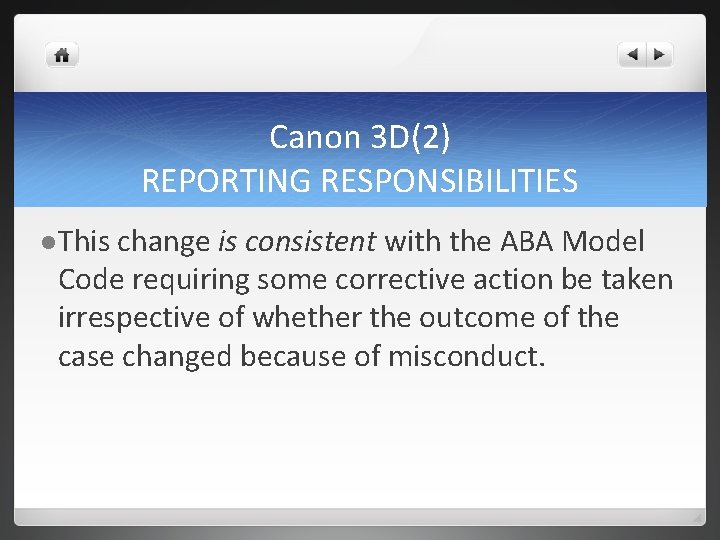
Canon 3 D(2) REPORTING RESPONSIBILITIES l This change is consistent with the ABA Model Code requiring some corrective action be taken irrespective of whether the outcome of the case changed because of misconduct.
CANON 3 D(2) REPORTING RESPONSIBILITIES l Commentary has changed : Now requires corrective action when there has been misconduct or violation of rules irrespective of change in disposition of case l Issues: Redundancy, chilling effect on making the initial determination, lapse of time since the incident occurred.