
Calibration strategy for the Corot photometry JeanTristan Buey
Calibration strategy for the Corot photometry. Jean-Tristan Buey 1, Michel Auvergne 1, Vincent Lapeyrere 1, Patrick Boumier 2 1 LESIA : Laboratoire d’Etudes Spatiales et d’Instrumentation en Astrophysique, Meudon, France. 2 IAS : Institut d’Astrophysique Spatiale, Orsay, France. Special thanks to the team of the CCD test bench. Thanks to the team of the Corot Camera Funding by CNES. 2 nd Eddington Workshop Palermo, 9 -11 April 2003
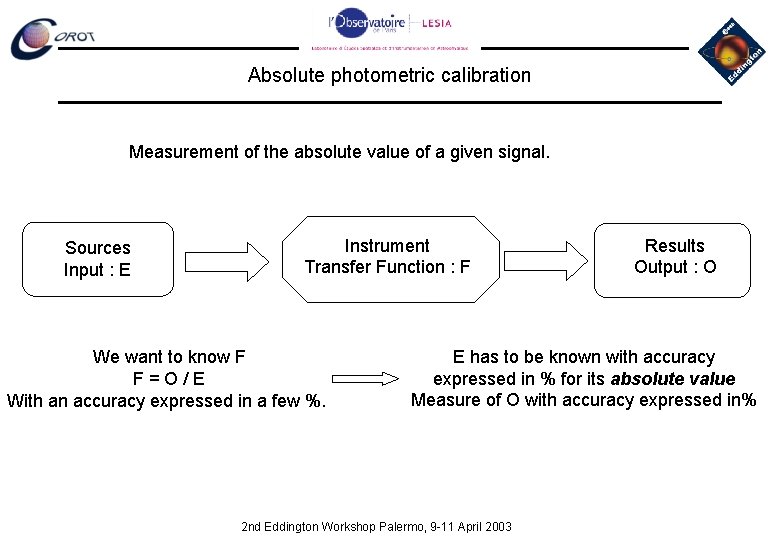
Absolute photometric calibration Measurement of the absolute value of a given signal. Sources Input : E Instrument Transfer Function : F We want to know F F=O/E With an accuracy expressed in a few %. Results Output : O E has to be known with accuracy expressed in % for its absolute value Measure of O with accuracy expressed in% 2 nd Eddington Workshop Palermo, 9 -11 April 2003
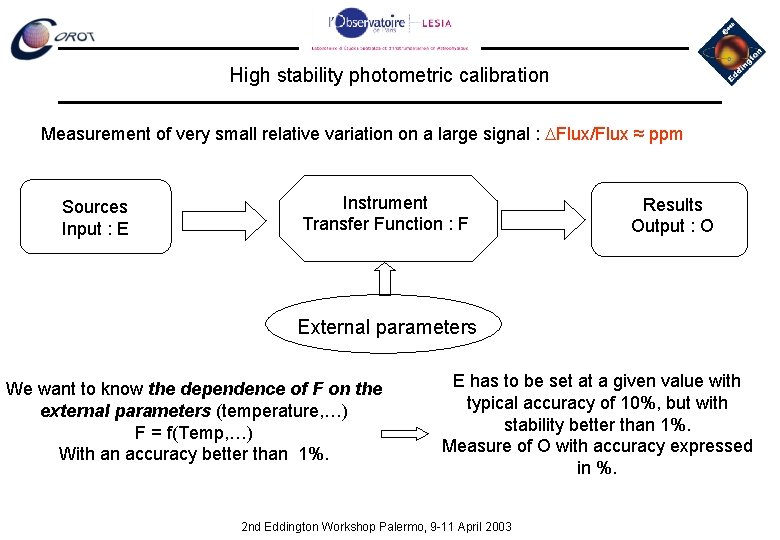
High stability photometric calibration Measurement of very small relative variation on a large signal : DFlux/Flux ≈ ppm Sources Input : E Instrument Transfer Function : F Results Output : O External parameters We want to know the dependence of F on the external parameters (temperature, …) F = f(Temp, …) With an accuracy better than 1%. E has to be set at a given value with typical accuracy of 10%, but with stability better than 1%. Measure of O with accuracy expressed in %. 2 nd Eddington Workshop Palermo, 9 -11 April 2003
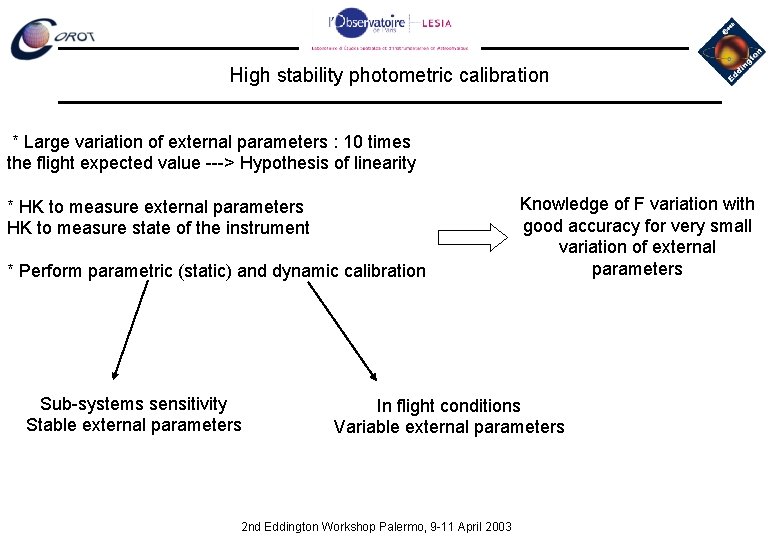
High stability photometric calibration * Large variation of external parameters : 10 times the flight expected value ---> Hypothesis of linearity * HK to measure external parameters HK to measure state of the instrument * Perform parametric (static) and dynamic calibration Sub-systems sensitivity Stable external parameters Knowledge of F variation with good accuracy for very small variation of external parameters In flight conditions Variable external parameters 2 nd Eddington Workshop Palermo, 9 -11 April 2003
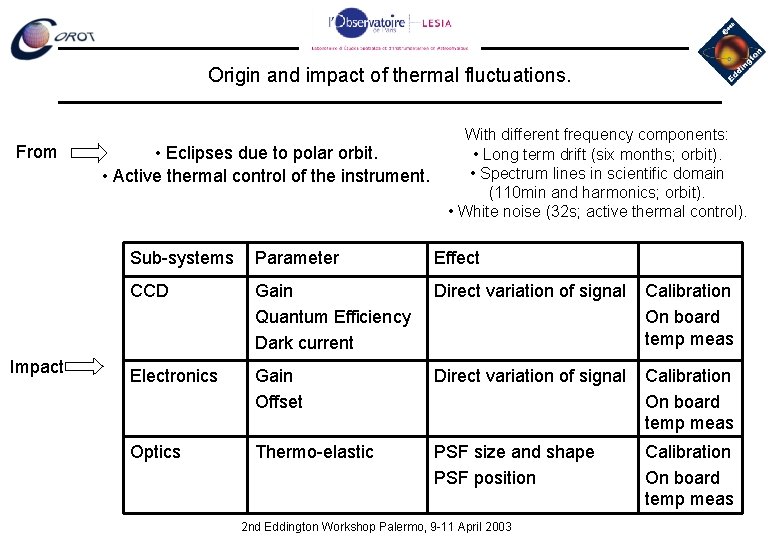
Origin and impact of thermal fluctuations. From Impact • Eclipses due to polar orbit. • Active thermal control of the instrument. With different frequency components: • Long term drift (six months; orbit). • Spectrum lines in scientific domain (110 min and harmonics; orbit). • White noise (32 s; active thermal control). Sub-systems Parameter Effect CCD Gain Quantum Efficiency Dark current Direct variation of signal Calibration On board temp meas Electronics Gain Offset Direct variation of signal Calibration On board temp meas Optics Thermo-elastic PSF size and shape PSF position Calibration On board temp meas 2 nd Eddington Workshop Palermo, 9 -11 April 2003
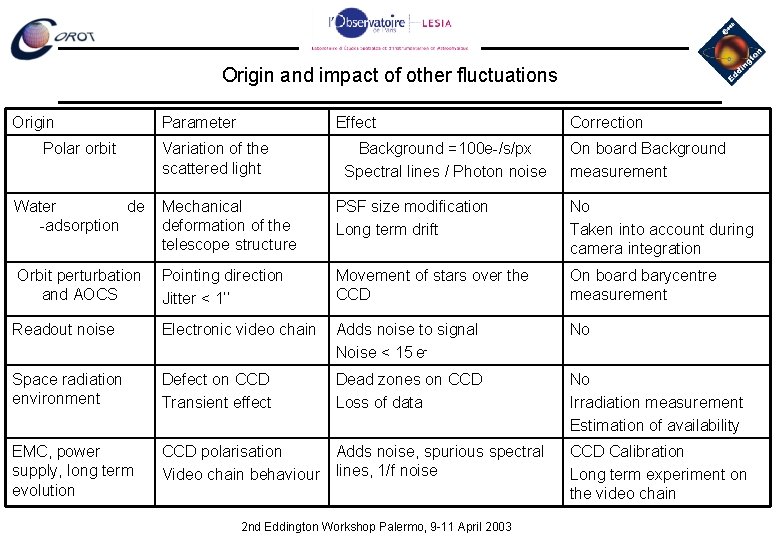
Origin and impact of other fluctuations Origin Polar orbit Parameter Effect Variation of the scattered light Background =100 e-/s/px Spectral lines / Photon noise Correction On board Background measurement Water de -adsorption Mechanical deformation of the telescope structure PSF size modification Long term drift No Taken into account during camera integration Orbit perturbation and AOCS Pointing direction Jitter < 1’’ Movement of stars over the CCD On board barycentre measurement Readout noise Electronic video chain Adds noise to signal Noise < 15 e- No Space radiation environment Defect on CCD Transient effect Dead zones on CCD Loss of data No Irradiation measurement Estimation of availability EMC, power supply, long term evolution CCD polarisation Adds noise, spurious spectral Video chain behaviour lines, 1/f noise 2 nd Eddington Workshop Palermo, 9 -11 April 2003 CCD Calibration Long term experiment on the video chain
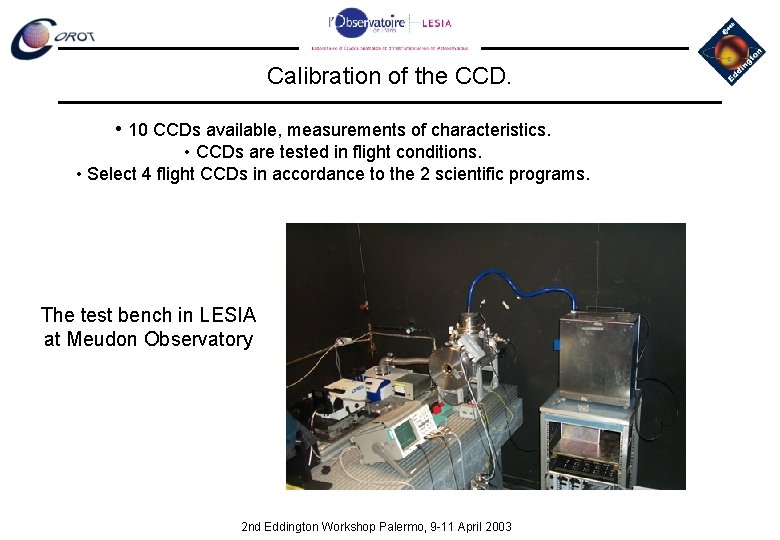
Calibration of the CCD. • 10 CCDs available, measurements of characteristics. • CCDs are tested in flight conditions. • Select 4 flight CCDs in accordance to the 2 scientific programs. The test bench in LESIA at Meudon Observatory 2 nd Eddington Workshop Palermo, 9 -11 April 2003
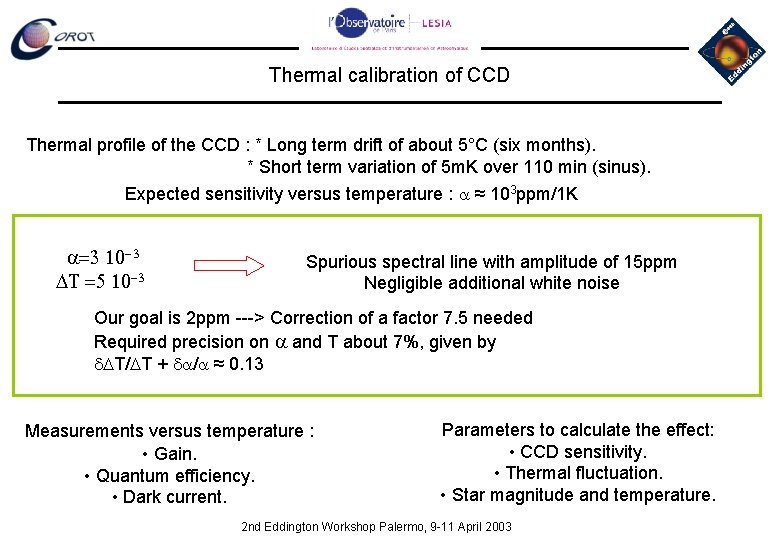
Thermal calibration of CCD Thermal profile of the CCD : * Long term drift of about 5°C (six months). * Short term variation of 5 m. K over 110 min (sinus). Expected sensitivity versus temperature : a ≈ 103 ppm/1 K a=3 10 -3 DT =5 10 -3 Spurious spectral line with amplitude of 15 ppm Negligible additional white noise Our goal is 2 ppm ---> Correction of a factor 7. 5 needed Required precision on a and T about 7%, given by d. DT/DT + da/a ≈ 0. 13 Measurements versus temperature : • Gain. • Quantum efficiency. • Dark current. Parameters to calculate the effect: • CCD sensitivity. • Thermal fluctuation. • Star magnitude and temperature. 2 nd Eddington Workshop Palermo, 9 -11 April 2003
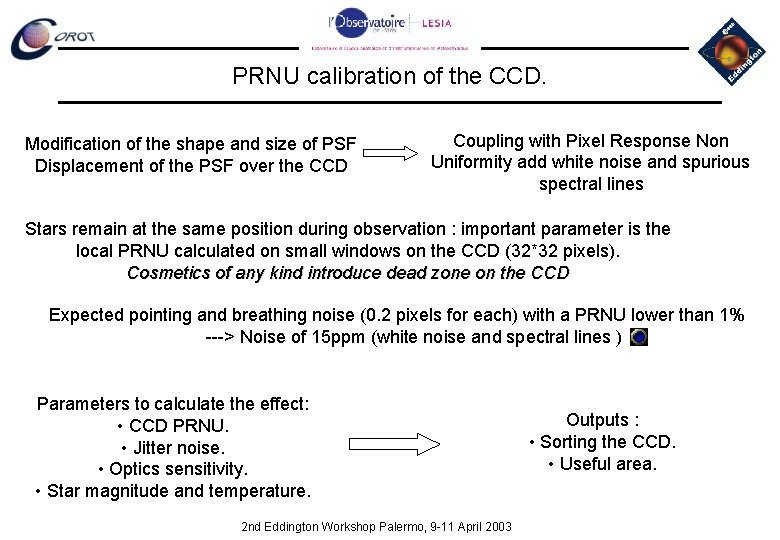
PRNU calibration of the CCD. Modification of the shape and size of PSF Displacement of the PSF over the CCD Coupling with Pixel Response Non Uniformity add white noise and spurious spectral lines Stars remain at the same position during observation : important parameter is the local PRNU calculated on small windows on the CCD (32*32 pixels). Cosmetics of any kind introduce dead zone on the CCD Expected pointing and breathing noise (0. 2 pixels for each) with a PRNU lower than 1% ---> Noise of 15 ppm (white noise and spectral lines ) Parameters to calculate the effect: • CCD PRNU. • Jitter noise. • Optics sensitivity. • Star magnitude and temperature. 2 nd Eddington Workshop Palermo, 9 -11 April 2003 Outputs : • Sorting the CCD. • Useful area.
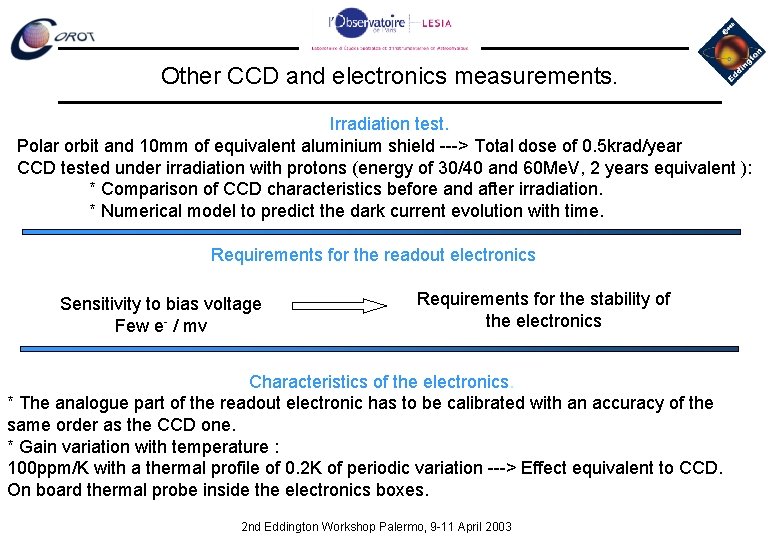
Other CCD and electronics measurements. Irradiation test. Polar orbit and 10 mm of equivalent aluminium shield ---> Total dose of 0. 5 krad/year CCD tested under irradiation with protons (energy of 30/40 and 60 Me. V, 2 years equivalent ): * Comparison of CCD characteristics before and after irradiation. * Numerical model to predict the dark current evolution with time. Requirements for the readout electronics Sensitivity to bias voltage Few e- / mv Requirements for the stability of the electronics Characteristics of the electronics. * The analogue part of the readout electronic has to be calibrated with an accuracy of the same order as the CCD one. * Gain variation with temperature : 100 ppm/K with a thermal profile of 0. 2 K of periodic variation ---> Effect equivalent to CCD. On board thermal probe inside the electronics boxes. 2 nd Eddington Workshop Palermo, 9 -11 April 2003
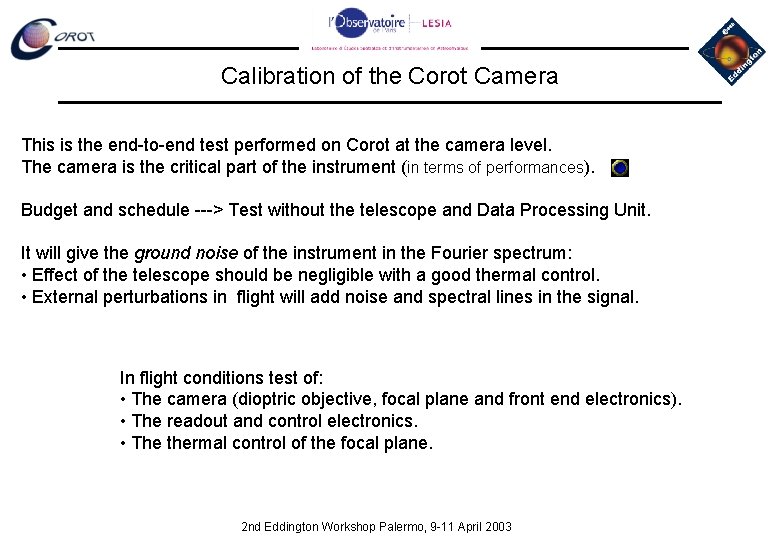
Calibration of the Corot Camera This is the end-to-end test performed on Corot at the camera level. The camera is the critical part of the instrument (in terms of performances). Budget and schedule ---> Test without the telescope and Data Processing Unit. It will give the ground noise of the instrument in the Fourier spectrum: • Effect of the telescope should be negligible with a good thermal control. • External perturbations in flight will add noise and spectral lines in the signal. In flight conditions test of: • The camera (dioptric objective, focal plane and front end electronics). • The readout and control electronics. • The thermal control of the focal plane. 2 nd Eddington Workshop Palermo, 9 -11 April 2003
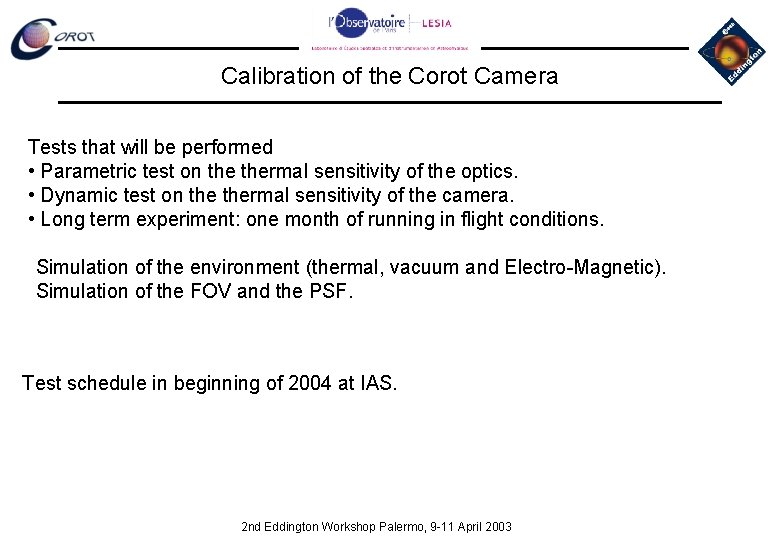
Calibration of the Corot Camera Tests that will be performed • Parametric test on thermal sensitivity of the optics. • Dynamic test on thermal sensitivity of the camera. • Long term experiment: one month of running in flight conditions. Simulation of the environment (thermal, vacuum and Electro-Magnetic). Simulation of the FOV and the PSF. Test schedule in beginning of 2004 at IAS. 2 nd Eddington Workshop Palermo, 9 -11 April 2003
- Slides: 12