
Calibration of the OSL sensors and feasibility study
Calibration of the OSL sensors and feasibility study of a new generation dosimeter C. Deneau 1, J. R. Vaillé 1, 2, F. Bezerra 3, E. Lorfèvre 3, R. Ecoffet 3 and L. Dusseau 1 1 Université Montpellier 2 – IES 2 Université de Nîmes 3 Centre National d’Etudes Spatiales ESA-CNES Final Presentation Days, ESTEC, June 5 th 2013
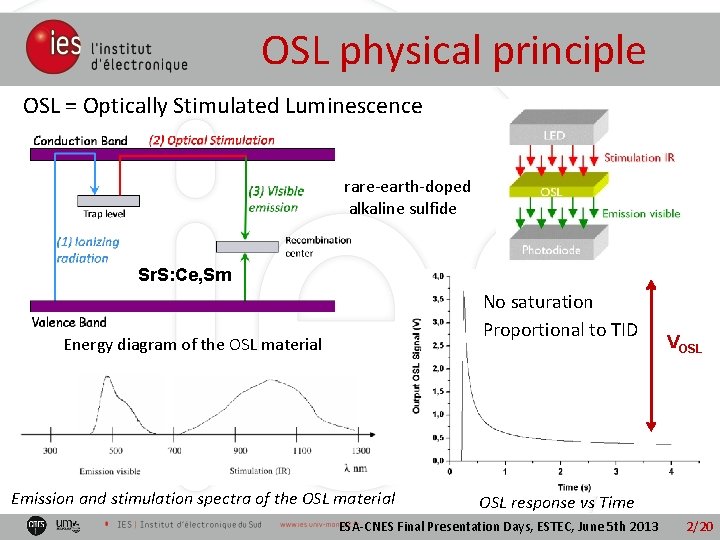
OSL physical principle OSL = Optically Stimulated Luminescence rare-earth-doped alkaline sulfide Sr. S: Ce, Sm No saturation Proportional to TID Energy diagram of the OSL material Emission and stimulation spectra of the OSL material VOSL response vs Time ESA-CNES Final Presentation Days, ESTEC, June 5 th 2013 2/20
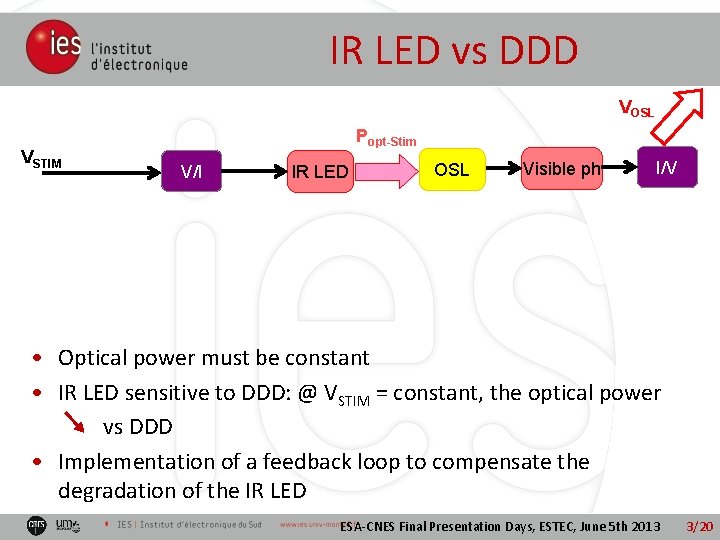
IR LED vs DDD VOSL VSTIM Popt-Stim V/I IR LED OSL Visible ph I/V • Optical power must be constant • IR LED sensitive to DDD: @ VSTIM = constant, the optical power vs DDD • Implementation of a feedback loop to compensate the degradation of the IR LED ESA-CNES Final Presentation Days, ESTEC, June 5 th 2013 3/20
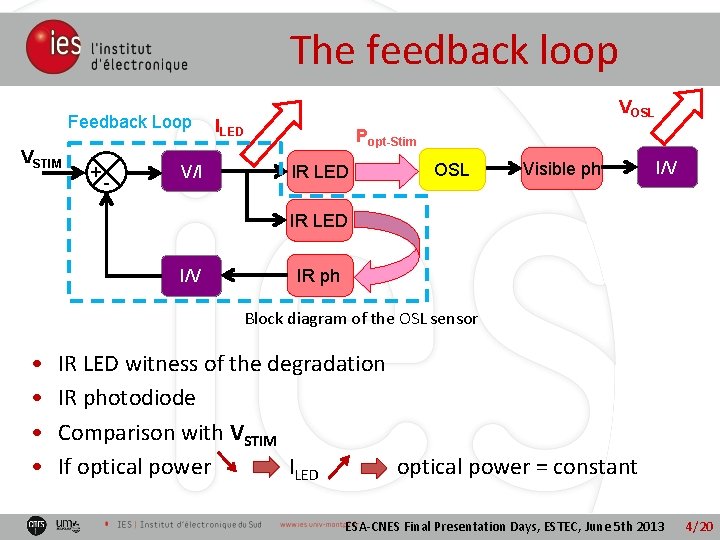
The feedback loop Feedback Loop VSTIM + - V/I VOSL ILED Popt-Stim IR LED OSL Visible ph I/V IR LED I/V IR ph Block diagram of the OSL sensor • • IR LED witness of the degradation IR photodiode Comparison with VSTIM If optical power ILED optical power = constant ESA-CNES Final Presentation Days, ESTEC, June 5 th 2013 4/20
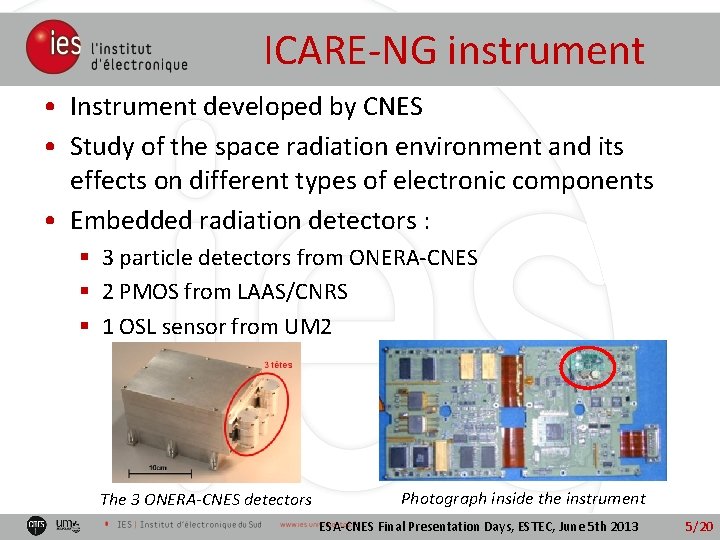
ICARE-NG instrument • Instrument developed by CNES • Study of the space radiation environment and its effects on different types of electronic components • Embedded radiation detectors : § 3 particle detectors from ONERA-CNES § 2 PMOS from LAAS/CNRS § 1 OSL sensor from UM 2 The 3 ONERA-CNES detectors Photograph inside the instrument ESA-CNES Final Presentation Days, ESTEC, June 5 th 2013 5/20
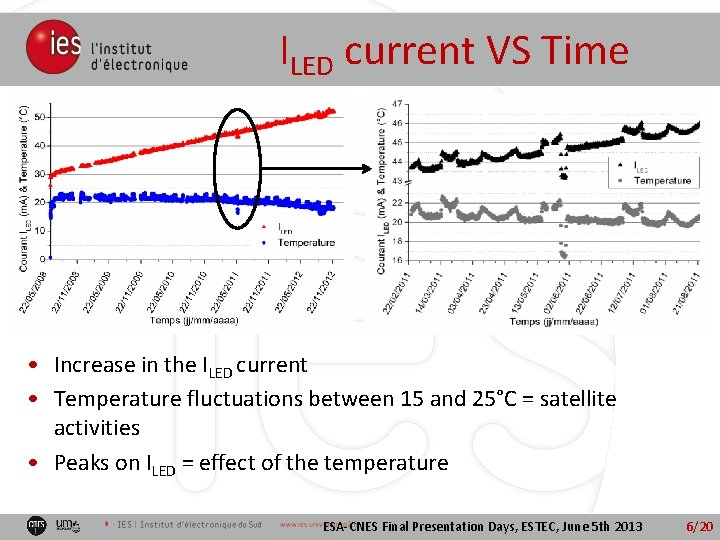
ILED current VS Time ILED & Température VS Temps • Increase in the ILED current • Temperature fluctuations between 15 and 25°C = satellite activities • Peaks on ILED = effect of the temperature ESA-CNES Final Presentation Days, ESTEC, June 5 th 2013 6/20
Temperature correction • Post-correction from a first-order model • • Objective 1 : Integrate a real-time correction ESA-CNES Final Presentation Days, ESTEC, June 5 th 2013 7/20
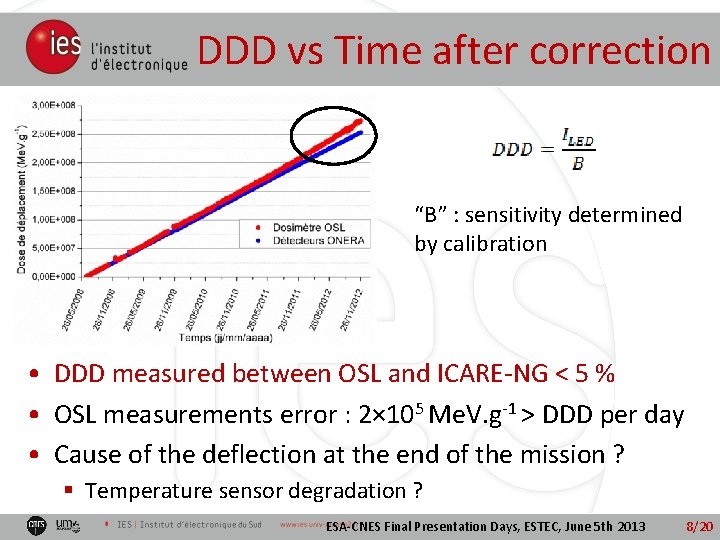
DDD vs Time after correction “B” : sensitivity determined by calibration • DDD measured between OSL and ICARE-NG < 5 % • OSL measurements error : 2× 10⁵ Me. V. g-1 > DDD per day • Cause of the deflection at the end of the mission ? § Temperature sensor degradation ? ESA-CNES Final Presentation Days, ESTEC, June 5 th 2013 8/20
TID measurements • Problem : in-flight results inconsistent with calibration and prediction • Does the OSL sensor work properly ? § Has it been damaged during the launch ? § Calibration problem ? § Integration problem ? • Objective 2 : Implement a self-test to check the operation after integration of the sensor • Objective 3 : Make reliable the mechanical assembling • Objective 4 : Simplify the integration ESA-CNES Final Presentation Days, ESTEC, June 5 th 2013 9/20
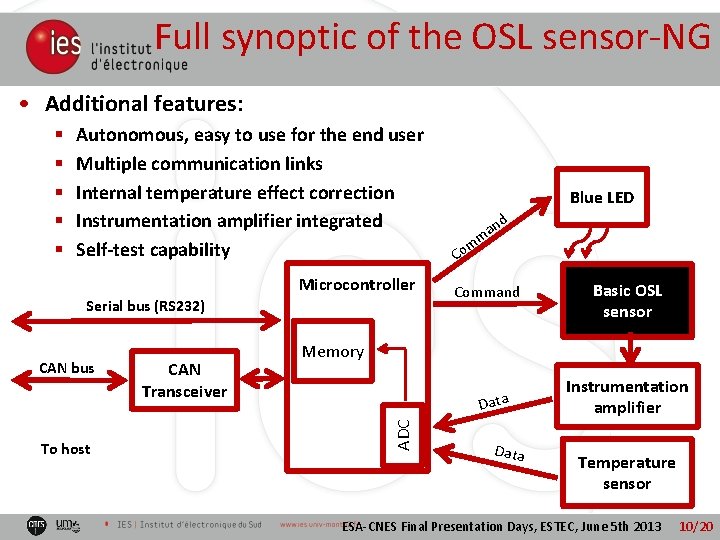
Full synoptic of the OSL sensor-NG • Additional features: § § § Autonomous, easy to use for the end user Multiple communication links Internal temperature effect correction Instrumentation amplifier integrated Self-test capability Microcontroller Serial bus (RS 232) To host CAN Transceiver d n ma m Co Command Basic OSL sensor Memory Data ADC CAN bus Blue LED Data Instrumentation amplifier Temperature sensor ESA-CNES Final Presentation Days, ESTEC, June 5 th 2013 10/20
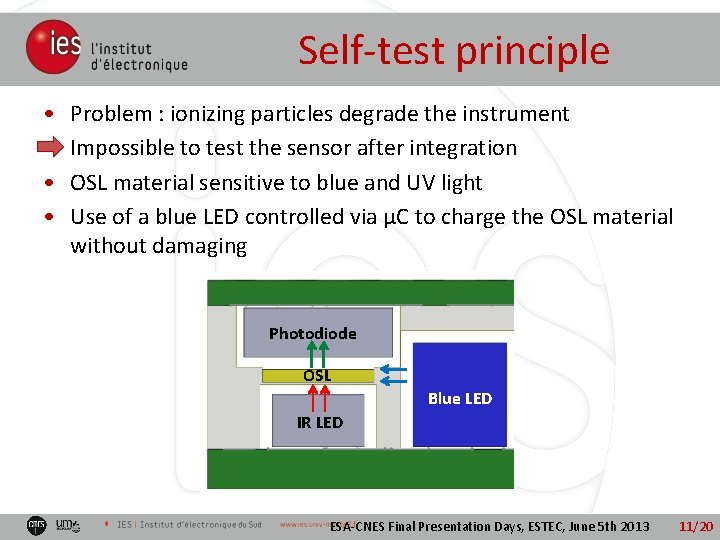
Self-test principle • • Problem : ionizing particles degrade the instrument Impossible to test the sensor after integration OSL material sensitive to blue and UV light Use of a blue LED controlled via µC to charge the OSL material without damaging Photodiode OSL Blue LED IR LED ESA-CNES Final Presentation Days, ESTEC, June 5 th 2013 11/20
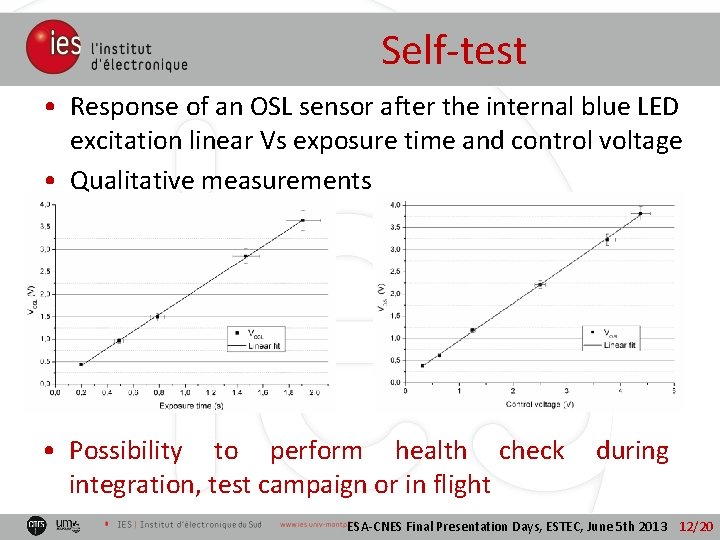
Self-test • Response of an OSL sensor after the internal blue LED excitation linear Vs exposure time and control voltage • Qualitative measurements • Possibility to perform health check during integration, test campaign or in flight ESA-CNES Final Presentation Days, ESTEC, June 5 th 2013 12/20
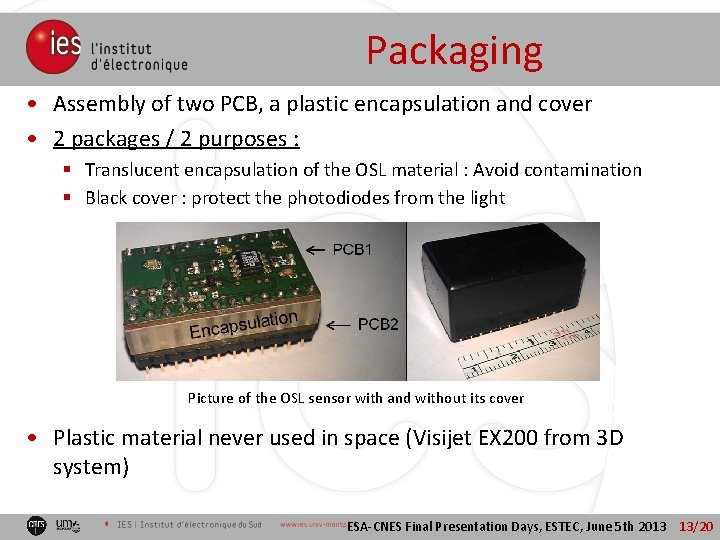
Packaging • Assembly of two PCB, a plastic encapsulation and cover • 2 packages / 2 purposes : § Translucent encapsulation of the OSL material : Avoid contamination § Black cover : protect the photodiodes from the light Picture of the OSL sensor with and without its cover • Plastic material never used in space (Visijet EX 200 from 3 D system) ESA-CNES Final Presentation Days, ESTEC, June 5 th 2013 13/20
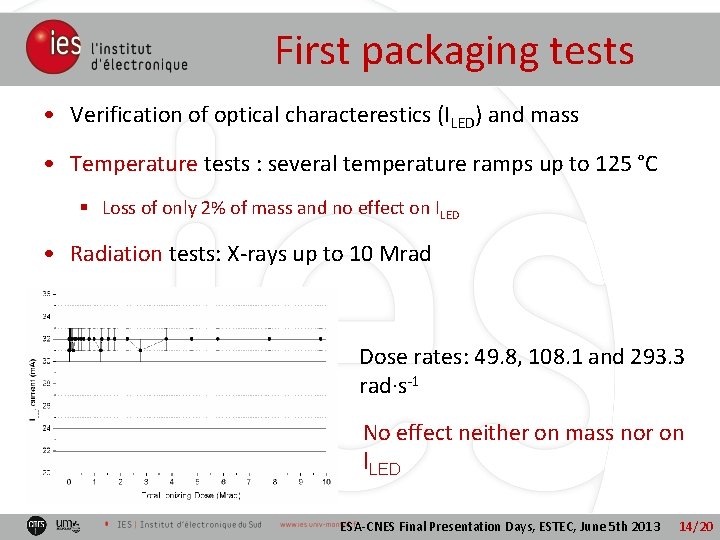
First packaging tests • Verification of optical characterestics (ILED) and mass • Temperature tests : several temperature ramps up to 125 °C § Loss of only 2% of mass and no effect on ILED • Radiation tests: X-rays up to 10 Mrad Dose rates: 49. 8, 108. 1 and 293. 3 rad·s-1 No effect neither on mass nor on ILED ESA-CNES Final Presentation Days, ESTEC, June 5 th 2013 14/20
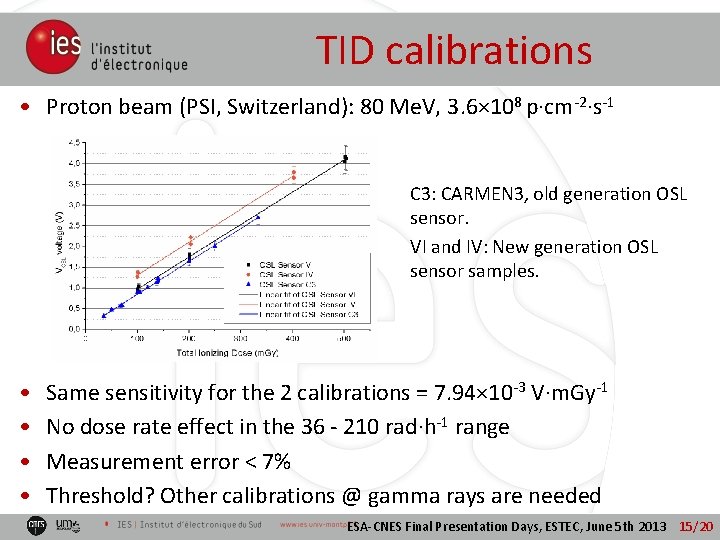
TID calibrations • Proton beam (PSI, Switzerland): 80 Me. V, 3. 6× 10⁸ p·cm-2·s-1 C 3: CARMEN 3, old generation OSL sensor. VI and IV: New generation OSL sensor samples. • • Same sensitivity for the 2 calibrations = 7. 94× 10 -3 V·m. Gy-1 No dose rate effect in the 36 - 210 rad·h-1 range Measurement error < 7% Threshold? Other calibrations @ gamma rays are needed ESA-CNES Final Presentation Days, ESTEC, June 5 th 2013 15/20
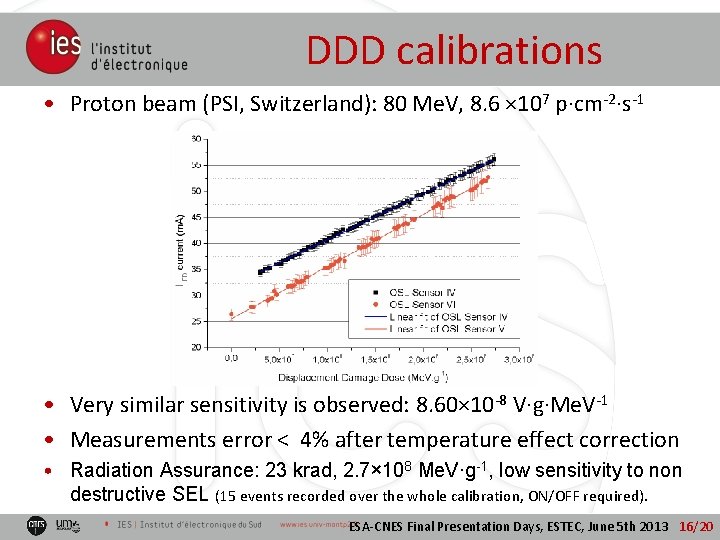
DDD calibrations • Proton beam (PSI, Switzerland): 80 Me. V, 8. 6 × 10⁷ p·cm-2·s-1 • Very similar sensitivity is observed: 8. 60× 10 -8 V·g·Me. V-1 • Measurements error < 4% after temperature effect correction • Radiation Assurance: 23 krad, 2. 7× 10⁸ Me. V·g-1, low sensitivity to non destructive SEL (15 events recorded over the whole calibration, ON/OFF required). ESA-CNES Final Presentation Days, ESTEC, June 5 th 2013 16/20
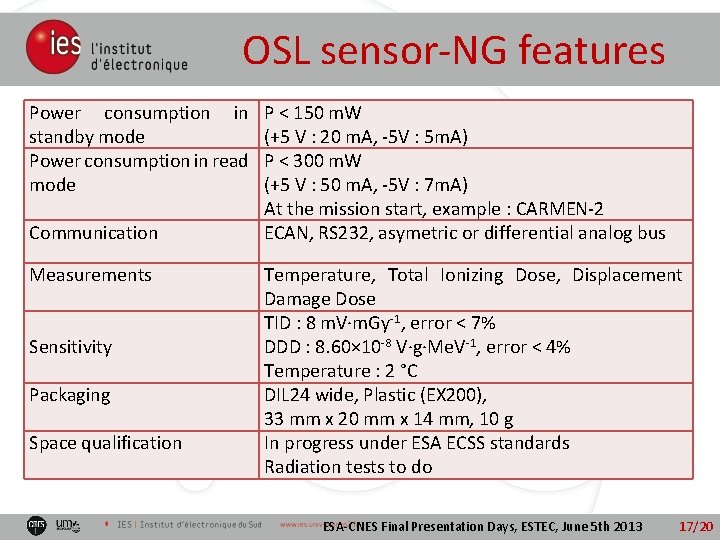
OSL sensor-NG features Power consumption in standby mode Power consumption in read mode Communication Measurements Sensitivity Packaging Space qualification P < 150 m. W (+5 V : 20 m. A, -5 V : 5 m. A) P < 300 m. W (+5 V : 50 m. A, -5 V : 7 m. A) At the mission start, example : CARMEN-2 ECAN, RS 232, asymetric or differential analog bus Temperature, Total Ionizing Dose, Displacement Damage Dose TID : 8 m. V·m. Gy-1, error < 7% DDD : 8. 60× 10 -8 V·g·Me. V-1, error < 4% Temperature : 2 °C DIL 24 wide, Plastic (EX 200), 33 mm x 20 mm x 14 mm, 10 g In progress under ESA ECSS standards Radiation tests to do ESA-CNES Final Presentation Days, ESTEC, June 5 th 2013 17/20
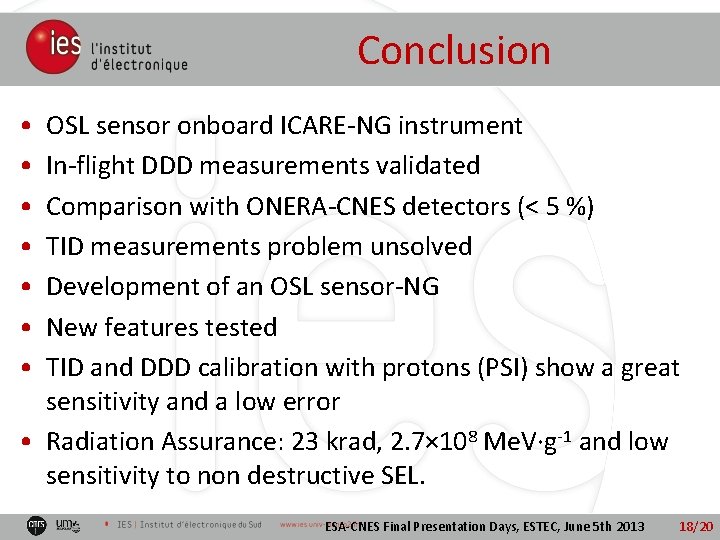
Conclusion • • OSL sensor onboard ICARE-NG instrument In-flight DDD measurements validated Comparison with ONERA-CNES detectors (< 5 %) TID measurements problem unsolved Development of an OSL sensor-NG New features tested TID and DDD calibration with protons (PSI) show a great sensitivity and a low error • Radiation Assurance: 23 krad, 2. 7× 10⁸ Me. V·g-1 and low sensitivity to non destructive SEL. ESA-CNES Final Presentation Days, ESTEC, June 5 th 2013 18/20
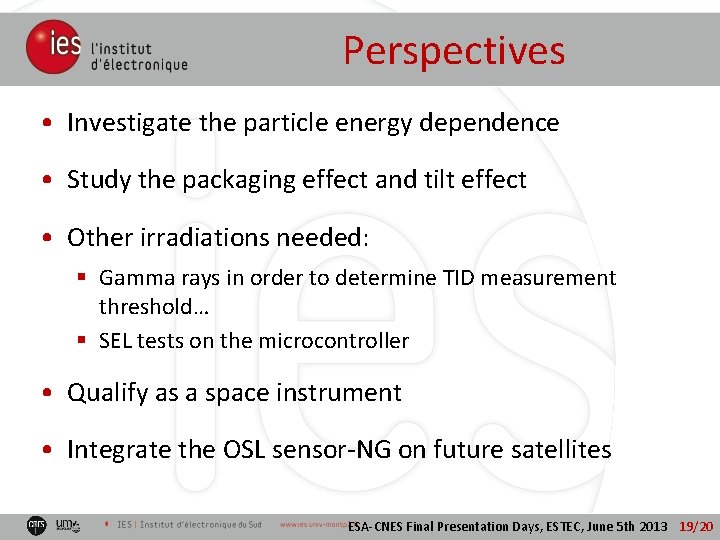
Perspectives • Investigate the particle energy dependence • Study the packaging effect and tilt effect • Other irradiations needed: § Gamma rays in order to determine TID measurement threshold… § SEL tests on the microcontroller • Qualify as a space instrument • Integrate the OSL sensor-NG on future satellites ESA-CNES Final Presentation Days, ESTEC, June 5 th 2013 19/20
Thank you for your attention Contact : christelle. deneau@ies. univ-montp 2. fr ESA-CNES Final Presentation Days, ESTEC, June 5 th 2013 20/20
- Slides: 20